
8 Best Gas Pressure Washers for Driveways (October 2026)
A driveway slab collects more than dirt. It collects algae in the shaded north corner, rust runoff from the fence posts, oil drips from the motor, and a fine grey film of grit that a hose will not lift. The best gas pressure washers for driveways solve that film in an afternoon instead of a weekend, and the right machine is decided by two numbers: how much pressure your stains need and how much water you can push through them.
Our team has spent the last few months working through this category the way a driveway owner does, spec by spec, wash by wash, looking past the marketing pressure numbers to the parts that decide whether a job ends in a clean slab or a striped one. That process turned up a simple answer. For residential concrete, 3,000 to 3,500 PSI at roughly 2.5 GPM, paired with a rotary surface cleaner attachment, is the sweet spot. Anything above 4,000 PSI mostly buys you the ability to etch your own driveway.
Our pick, the Simpson PowerShot PS3228, wins because of its Honda GX200 engine and AAA triplex plunger pump, a combination that holds rated pressure through long passes instead of sagging halfway down the slab. For lighter jobs and smaller slabs, the Simpson Clean Machine does the same work with less mass in the frame. If you clean other people’s driveways for money, the contractor-grade Simpson Aluminum series is the smarter engine to buy, and the full breakdown is in our seasonal driveway equipment guide alongside our other spring-cleanup picks.
Below, every machine is judged on the same four things: pressure and flow against real stains, pump and engine durability, how fast you can actually cover a slab, and how honestly the pressure is rated. We also explain the two things no roundup on this page usually bothers with, which are the oil and rust workflow that a driveway actually needs and how to keep 3,000 PSI from chewing holes in your slab. If your project is a single clean and not a recurring chore, read the rent-or-buy section before spending anything.
What PSI Pressure Washer Is Best for Cleaning a Driveway?
For a residential concrete driveway, look for 3,000 to 3,500 PSI at 2.5 GPM or more, and plan to buy a rotary surface cleaner attachment separately. Pressure above 2,000 PSI lifts dirt, and pressure in the 3,000-plus range strips algae, rust water and embedded oil. Flow rate is what covers ground fast, and the surface cleaner is what keeps the result even. A 4,000-plus PSI machine is a paint-stripping tool that will etch new concrete if you hold the trigger on it.
Two other rules decide most purchases. First, match the machine to the slab: a two-car driveway needs far less flow than a four-car one that collects oil. Second, ignore any headline pressure that says “max” without a certification body attached, because max pressure is the number on the relief valve, not the number at the nozzle.
Our Top 3 Gas Pressure Washers for Driveways in 2026
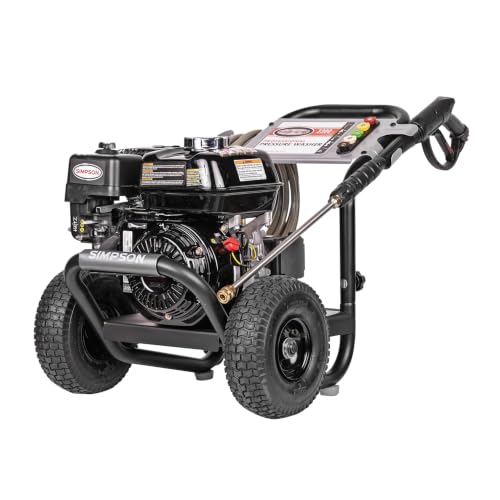
Simpson PowerShot PS3228
- 3300 PSI at 2.5 GPM
- Honda GX200 engine
- AAA triplex plunger pump
- 25-foot MorFlex hose
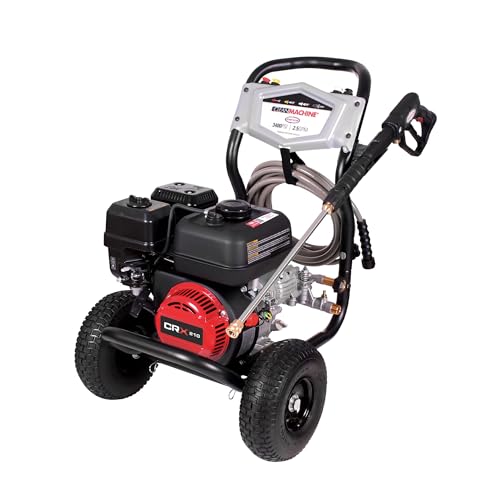
Simpson Clean Machine 3400 PSI
- 3400 PSI at 2.5 GPM
- 208cc CRX engine
- Axial cam pump
- 25-foot MorFlex hose
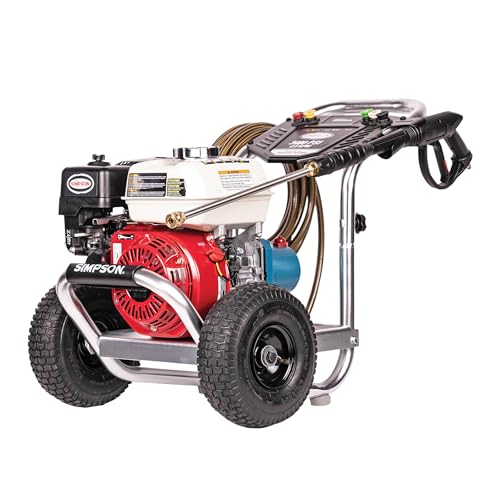
Simpson Aluminum ALH3228
- 3400 PSI at 2.5 GPM
- Honda GX200 engine
- CAT triplex pump
- Aircraft-grade aluminum frame
The PowerShot PS3228 sits first because it is the only machine in our group that pairs a Honda GX200 with a maintenance-free AAA triplex plunger pump at a residential-manageable weight and footprint. The Clean Machine earns second place on value: it delivers more rated pressure with a smaller engine and a noticeably lighter frame, which matters when you are hauling it across a gravel apron alone.
The Aluminum ALH3228 is the pick for anyone who washes driveways as a side job. Its CAT industrial triplex pump and brushed aluminum platform are built for daily use and job-site transport, and its warranty is the strongest in the group on the pump specifically.
Comparing the Best Gas Pressure Washers for Driveways in 2026
Cleaning power, the product of pressure and flow, is the honest way to compare these machines. Multiply the two published numbers and you get a single figure that predicts real coverage speed better than either number alone. The table below lists every machine in this roundup with its core specs.
| Product | Key Specs | Action |
|---|---|---|
| Simpson PowerShot PS3228 |
|
Check Latest Price |
| Simpson Clean Machine 3400 PSI |
|
Check Latest Price |
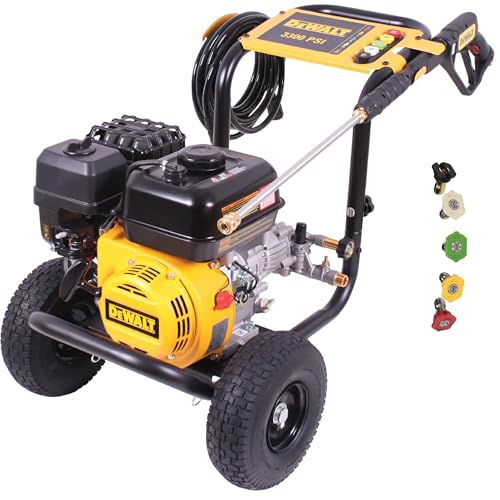 DeWalt 3300 PSI DeWalt 3300 PSI |
|
Check Latest Price |
| Simpson Aluminum ALH3228 |
|
Check Latest Price |
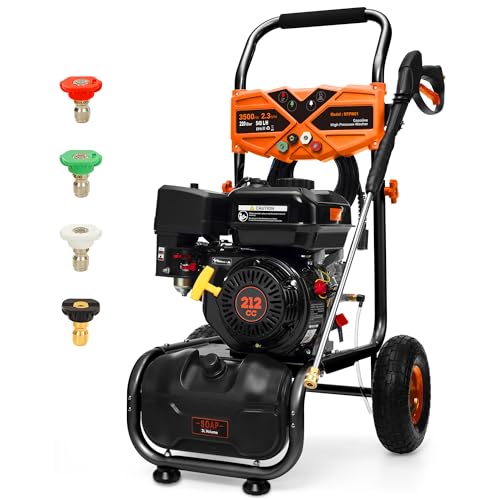 Ezasin 3500 PSI Ezasin 3500 PSI |
|
Check Latest Price |
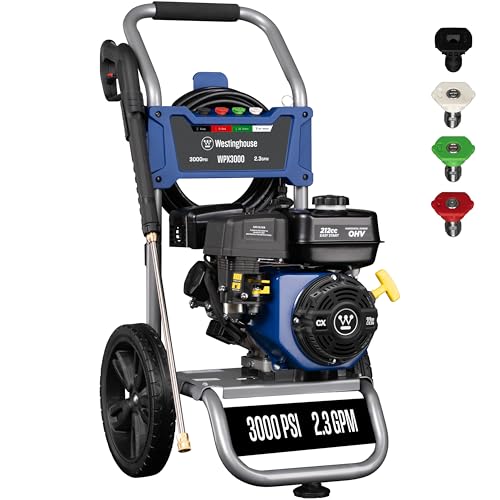 Westinghouse WPX3000 Westinghouse WPX3000 |
|
Check Latest Price |
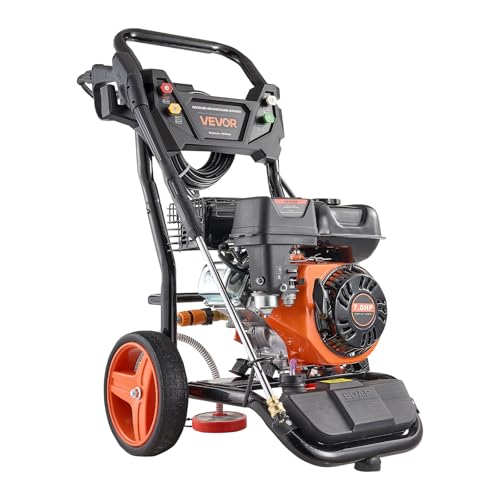 VEVOR 3600 PSI VEVOR 3600 PSI |
|
Check Latest Price |
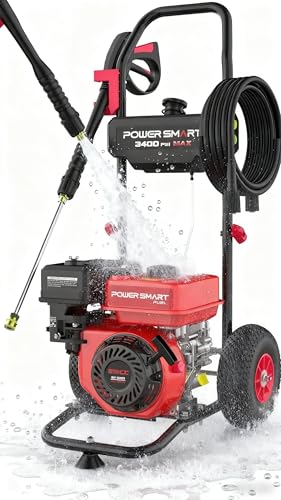 PowerSmart 3400 PSI PowerSmart 3400 PSI |
|
Check Latest Price |
Three of these machines land in the same band once the two numbers are multiplied. The VEVOR produces the most cleaning power on paper at 9,360, followed by the Simpson pair at 8,500 each and the PowerSmart at 8,500. The Westinghouse sits lowest at 6,900, which is still enough for a two-car slab but is where the coverage-time gap starts to show.
1. Simpson PowerShot PS3228 - Honda Power and a Triplex Pump for Big Slabs
SIMPSON Cleaning PS3228 PowerShot 3300 PSI Gas Pressure Washer, 2.5 GPM, Honda GX200 Engine...
3300 PSI at 2.5 GPM
Honda GX200 engine
AAA triplex pump
74.8 lb with 25 ft hose
+ Pros
- Honda GX200 engine with low-oil shutdown
- AAA triplex pump rated for long service
- 25-foot non-marring MorFlex hose
- Five quick-connect tips and a 16-inch wand
- 10-inch pneumatic tires roll over gravel and curbs
- Cons
- Not sold in California
- Heaviest frame here at roughly 75 pounds
- Listing states no warranty description
The PowerShot PS3228 is the machine we reach for first when a driveway has a serious stain problem and a large surface area. Pulling it up to a slab, the first thing you notice is that the pressure does not sag as the trigger stays pulled. That steadiness comes from the pair of Honda GX200 and a maintenance-free AAA triplex plunger pump, and on a long driveway it is the difference between a strip that lifts evenly and a strip that fades out halfway.
At 3,300 PSI and 2.5 GPM it produces 8,250 cleaning units, which sits in the middle of this group but is delivered by components that hold their rating. The included unloader and thermal relief protect the pump when the trigger is released mid-pass, which on a driveway happens constantly while you reposition a surface cleaner or move a car.
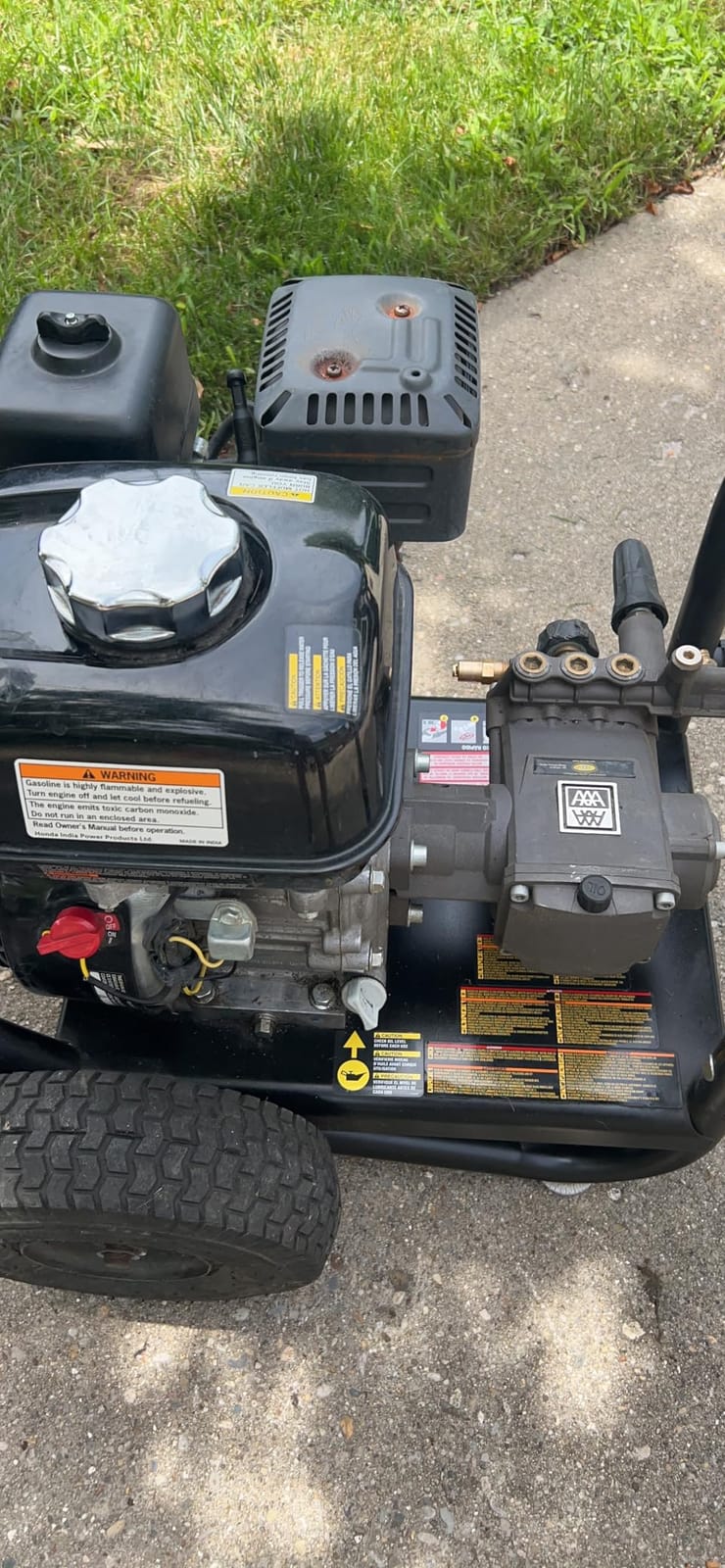
The 25-foot MorFlex hose is one of the better decisions in the whole package. Its non-marring polyurethane jacket means you can drag it across a finished slab, pull it around a corner, or let it sit in a puddle of runoff without worrying about scuff marks, and the threaded M22 connection is the fitting most repair parts and surface cleaners are built around.
Buyers in the 2,295-review pool praise the engine, the pump durability and the hose reach, and the complaints cluster around three things: the roughly 75-pound weight, a 49-state compliance listing that rules out California, and occasional starting or pull-cord frustration. None of those are deal breakers for driveway work, where the machine stays put for an hour and moves rarely.
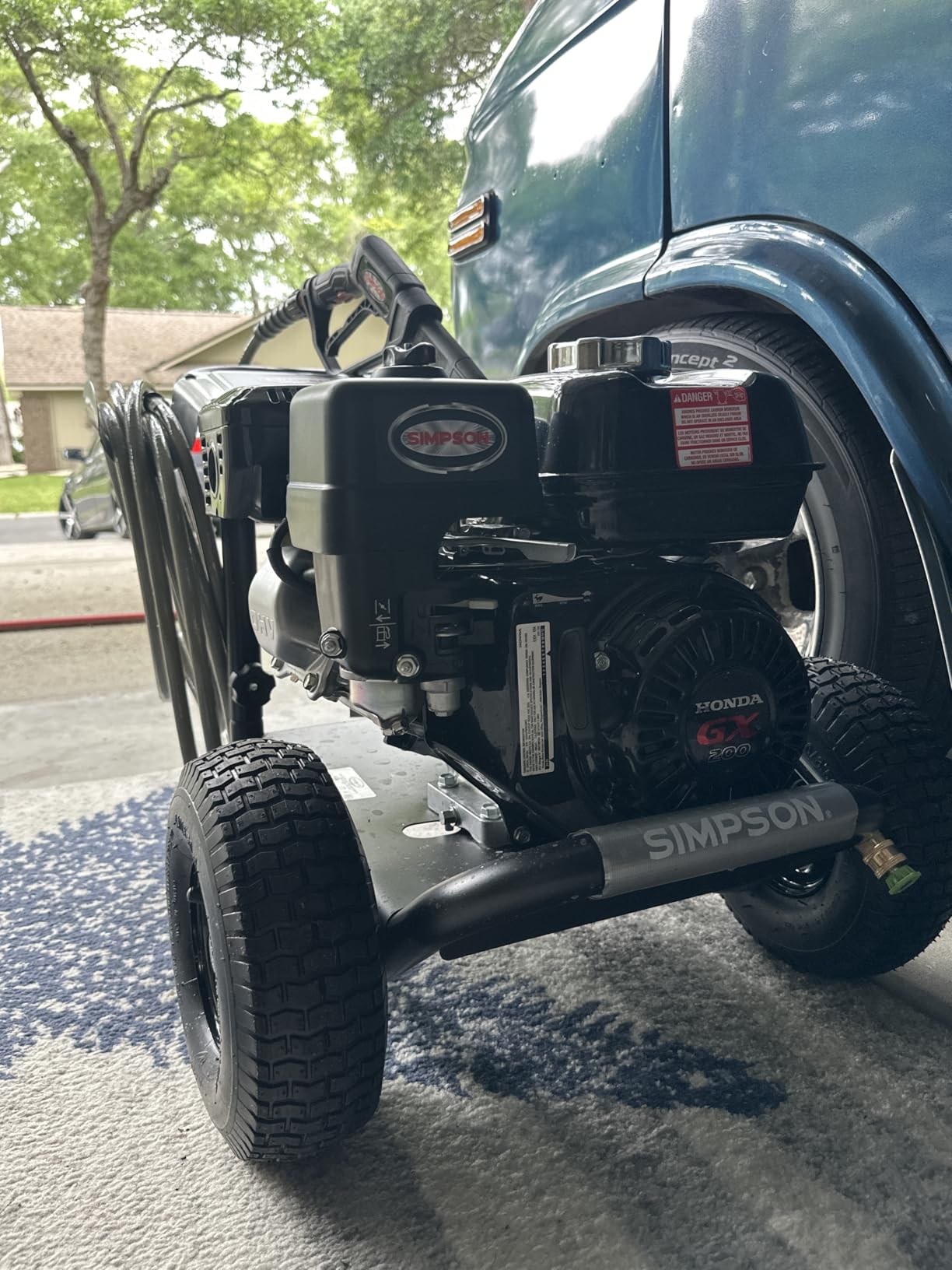
Honda GX200 and Why It Matters on Concrete
The GX200 is a small engine, but it is the specific engine that owners on forums single out as the durability benchmark, and that consensus is why it shows up in our picks rather than a higher-displacement alternative. It is a four-stroke, so there is no oil and fuel mixing, and it carries low-oil shutdown so that running it dry on a slab does not become an engine repair.
For a driveway, an engine that restarts easily after a pause matters more than raw horsepower. You stop constantly, to move the car, to refill the soap tank, to check the far corner. A machine that fires on the first pull after a five-minute break keeps the whole afternoon moving.
AAA Triplex Pump Versus Axial Cam Pumps
The triplex plunger pump is the more demanding of the two pump designs. Three plungers fire in sequence, which smooths the pulse of water through the system, and the design is built for long service intervals rather than cheap replacement. The axial cam pump used on several machines in this roundup is lighter and costs less, and it is a perfectly good homeowner pump.
The practical difference appears on a long dirty job. When grime loads the nozzle and pressure climbs, a triplex pump runs hotter without complaint, while an axial pump asks more of the operator. If you clean driveways more than once a year, the triplex pump on this machine is the reason we put it first.
Pressure, Flow and Working Distance on a Slab
With 2.5 GPM of flow and a 25-foot hose, you can cover a wide four-car slab without dragging the machine across wet concrete. The 10-inch pneumatic tires are wide and soft enough to cross a gravel or grass apron without fighting the frame, and the welded steel frame with a powder-coated finish shrugs off the rust that will show up on a bare steel chassis after a season of wet driveway work.
Five quick-connect tips, including a zero-degree and a soap tip, cover everything from a 40-degree gentle wash on a neighboring car to concentrated work on a rust line. The rear-load M22 spray gun and 16-inch wand give you enough stand-off distance to work the surface without your hand near the jet.
Who Should Buy the PS3228
Buy this one if you have a large slab, stubborn stains, and a plan to own the machine for years. It also suits anyone who wants a Honda engine without moving up to the aluminum contractor chassis, which costs more and stores considerably worse in a residential garage.
Skip it if storage space is the deciding factor, since this is the heaviest chassis in the group at 74.8 pounds, or if you live in California and need a 50-state compliant engine. For a single annual clean on a two-car slab, the Clean Machine below is the smarter purchase.
2. Simpson Clean Machine 3400 PSI - The Best Value for a Two-Car Driveway
Simpson Clean Machine 3400 PSI Gas Pressure Washer, 2.5 GPM, CRX engine
3400 PSI at 2.5 GPM
208cc CRX engine
OEM axial cam pump
61 lb low-profile steel frame
+ Pros
- 3400 PSI at 2.5 GPM on an axial cam pump
- Maintenance-free pump with thermal relief valve
- 25-foot non-marring MorFlex hose
- Light low-profile frame with 10-inch pneumatic tires
- Two year engine and one year pump warranty
- Cons
- Not available in California
- Only four quick-connect tips
- 208cc engine is less powerful than the GX200
The Clean Machine does something unusual: it puts 3,400 PSI into the lightest Simpson chassis here, and it does it without a commercial engine. At 3,400 PSI and 2.5 GPM it produces 8,500 cleaning units, matching the contractor-grade machine below, from a 208cc CRX engine and a maintenance-free axial cam pump.
That combination is why this is the pick for most homeowners. A two-car driveway does not need a triplex pump, and it does not need a 75-pound frame. It needs enough pressure to lift algae and enough flow to finish before the sun moves the shadows, and this machine has both in a package that one person can roll across a lawn without planning for it.
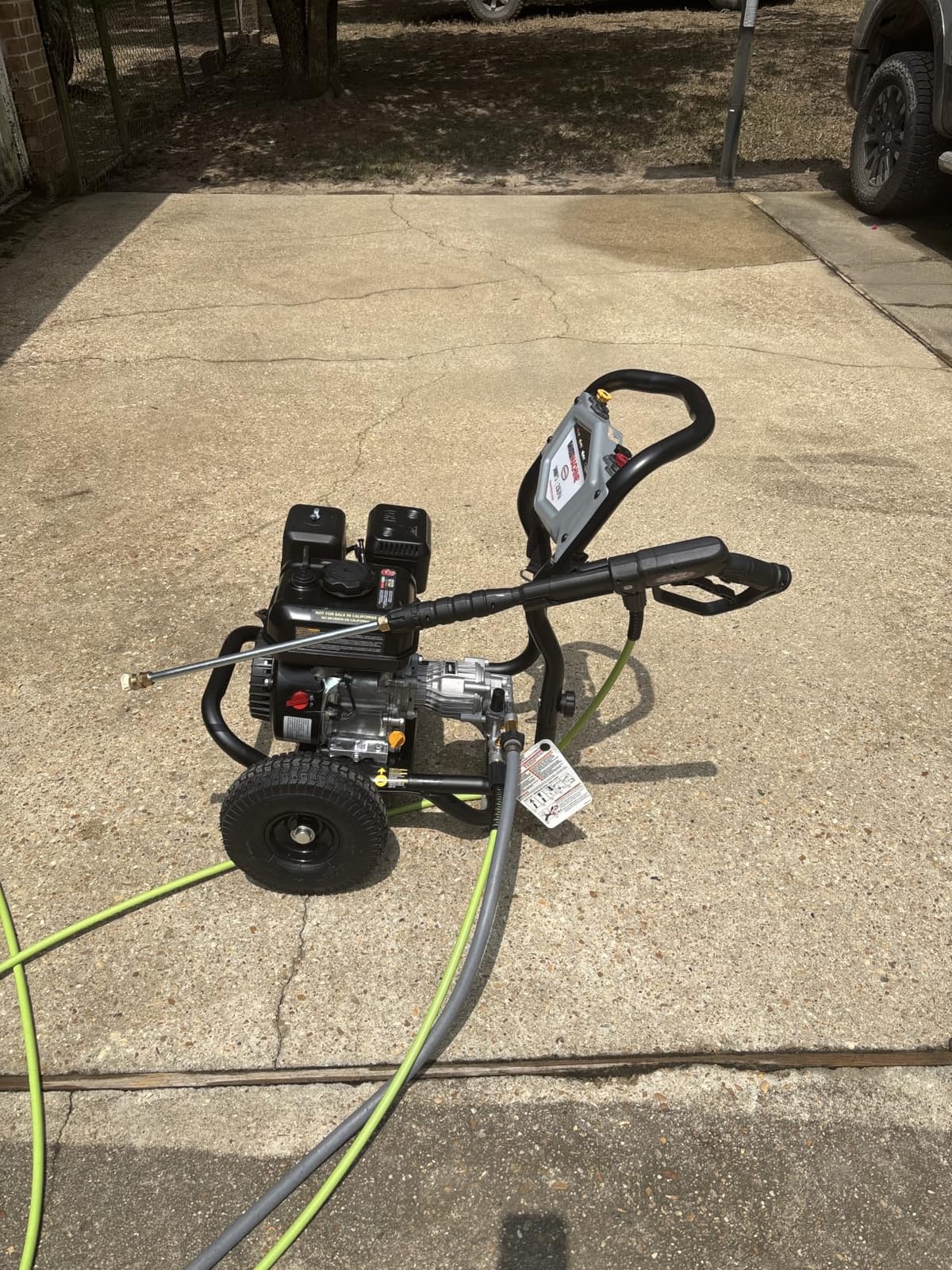
The low-profile welded steel frame sits at 61 pounds and keeps the machine balanced when you tip it back to move. Reviewers in the 2,032-review pool consistently mention easy assembly, strong driveway and siding cleaning, and reliable starting, and the recurring gripes are the California sales restriction, occasional starting difficulty, and the need to stay on top of 10W-30 oil changes.
One thing to plan for: four quick-connect tips instead of five. You get zero, 15, 40 and soap, and you lose the 25-degree fan that is genuinely useful for broad, even coverage on a flat slab. Our advice is to add a 25-degree tip in the first week you own it.
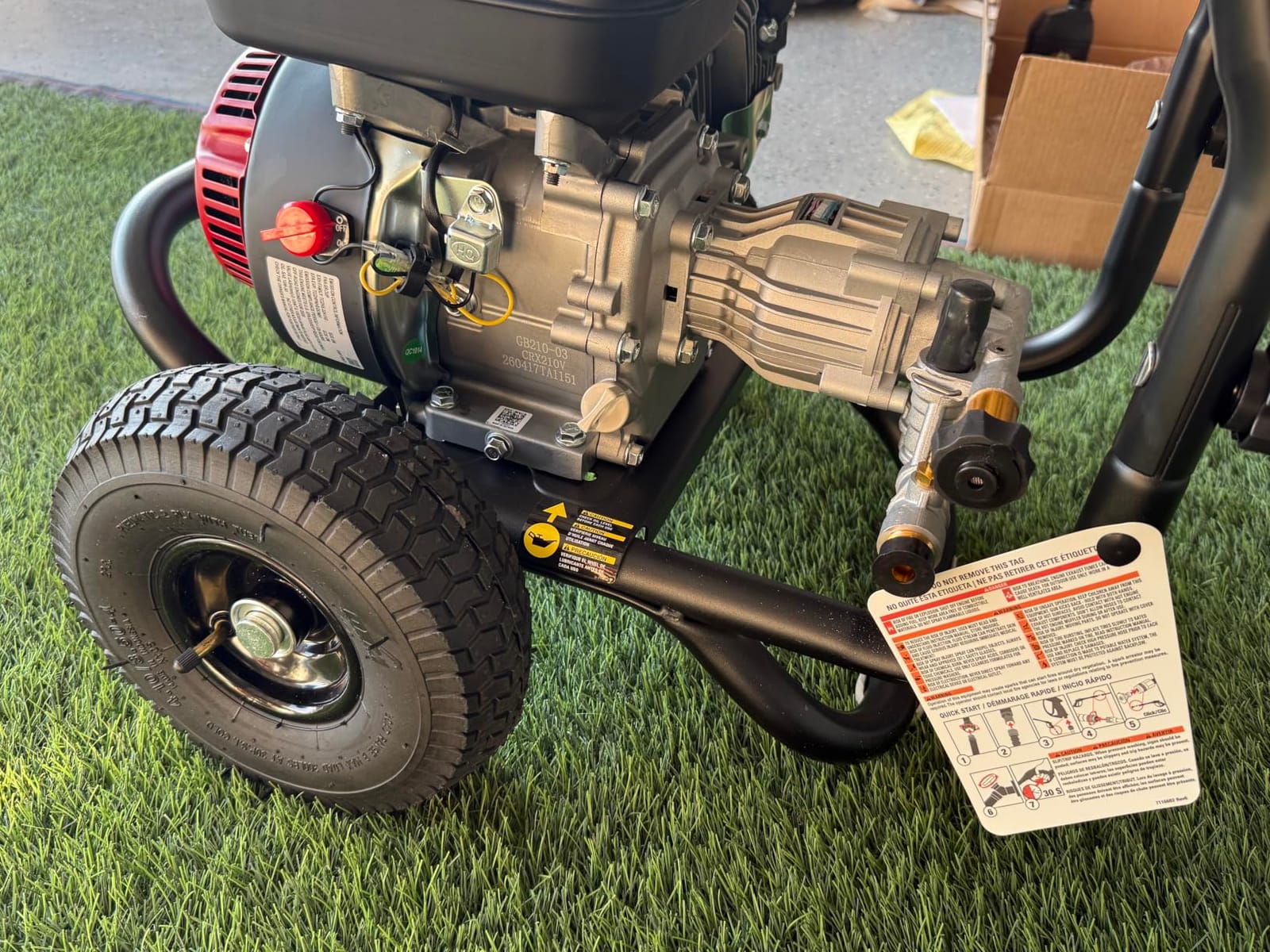
3400 PSI on a Smaller Engine
Higher pressure on a smaller engine works because the pump, not the engine, sets pressure. The 208cc CRX engine is simply driving a pump that holds a higher rated pressure, and on short homeowner duty cycles the difference shows up in handling rather than in output. The engine carries an easy-start design and low-oil shutdown.
What you give up is sustained flow under long load compared with a Honda GX200 paired with a commercial pump. On a four-car slab in summer with a 25-degree tip, you will feel that. On a two-car slab with a surface cleaner, you will not notice it at all.
Axial Cam Pump: Light, Simple, and Adequate for a Driveway
The OEM Technologies axial cam pump is maintenance-free and carries a thermal relief valve that protects it when water sits under pressure. Compared with a triplex plunger pump, it weighs less, costs less and asks less of you in terms of service intervals, which is the right trade for a machine that runs a few hours once or twice a year.
The trade-off appears if you adopt a rental or side-hustle schedule. A pump designed for occasional homeowner use runs hotter and lives shorter than a triplex unit when you are running it for hours several times a week. The warranty here is two years on the engine and one year on the pump, which is a fair reflection of that design tier.
Weight, Wheels and Moving Across a Driveway
At 61 pounds on a low-profile balanced frame with 10-inch pneumatic tires, this is the machine we would trust to a single operator. The tires roll over gravel, grass and curbs without dragging, and the low center of gravity means the surface cleaner wand does not tip the chassis as you pull it behind you.
The 25-foot MorFlex hose resists kinks and abrasion and uses quick-connect fittings, which means you can swap to a surface cleaner in a few seconds rather than fighting threaded couplers at the end of a long day. That speed of changeover matters more than it sounds, because the setup time is dead time on a slab.
Who Should Buy the Clean Machine
This is the one to buy if the job is a two-car driveway cleaned once or twice a year, or a mix of driveway, siding, deck and car washing. It carries more rated pressure than a two-car slab needs, at a weight most people will not think about, and the review volume behind it is the second highest we found.
Pass on it if you clean professionally several times a week, where a triplex pump earns its cost, or if you need a 50-state compliant engine for California. Budget carefully for a surface cleaner, since this listing describes a spray gun, wand and four tips rather than a rotary attachment.
3. DeWalt 3300 PSI - Longest Warranty in the Lineup
DeWalt 3300 PSI Gas Pressure Washer, 2.4 GPM, Residential Model DXPW3300-S
3300 PSI at 2.4 GPM
208cc DeWalt engine
5 year frame warranty
64 lb with 25 foot hose
+ Pros
- Five year frame and three year pump warranty
- 3300 PSI handles driveway and paint prep jobs
- Compact 64-pound design is easy to transport
- 10-inch pneumatic tires roll over uneven ground
- Five quick-connect nozzles and a 16-inch steel wand
- Cons
- 49-state compliant so not sold in California
- 2.4 GPM is below the 2.5 to 2.6 GPM rivals
- Units may arrive with minimal residual fuel
The DeWalt is the warranty play in this group, and warranty is a reasonable proxy for how a company expects its frames and pumps to age. This one is covered for five years on the frame, three years on the pump and two years on the engine, which is the longest published coverage we found among the machines in this roundup.
Performance-wise it sits in the same band as the rest of the group. At 3,300 PSI and 2.4 GPM it delivers 7,920 cleaning units, enough to strip dirt, algae and weathered paint from concrete, siding and decks, which is why reviewers most often mention it for exterior preparation before painting.
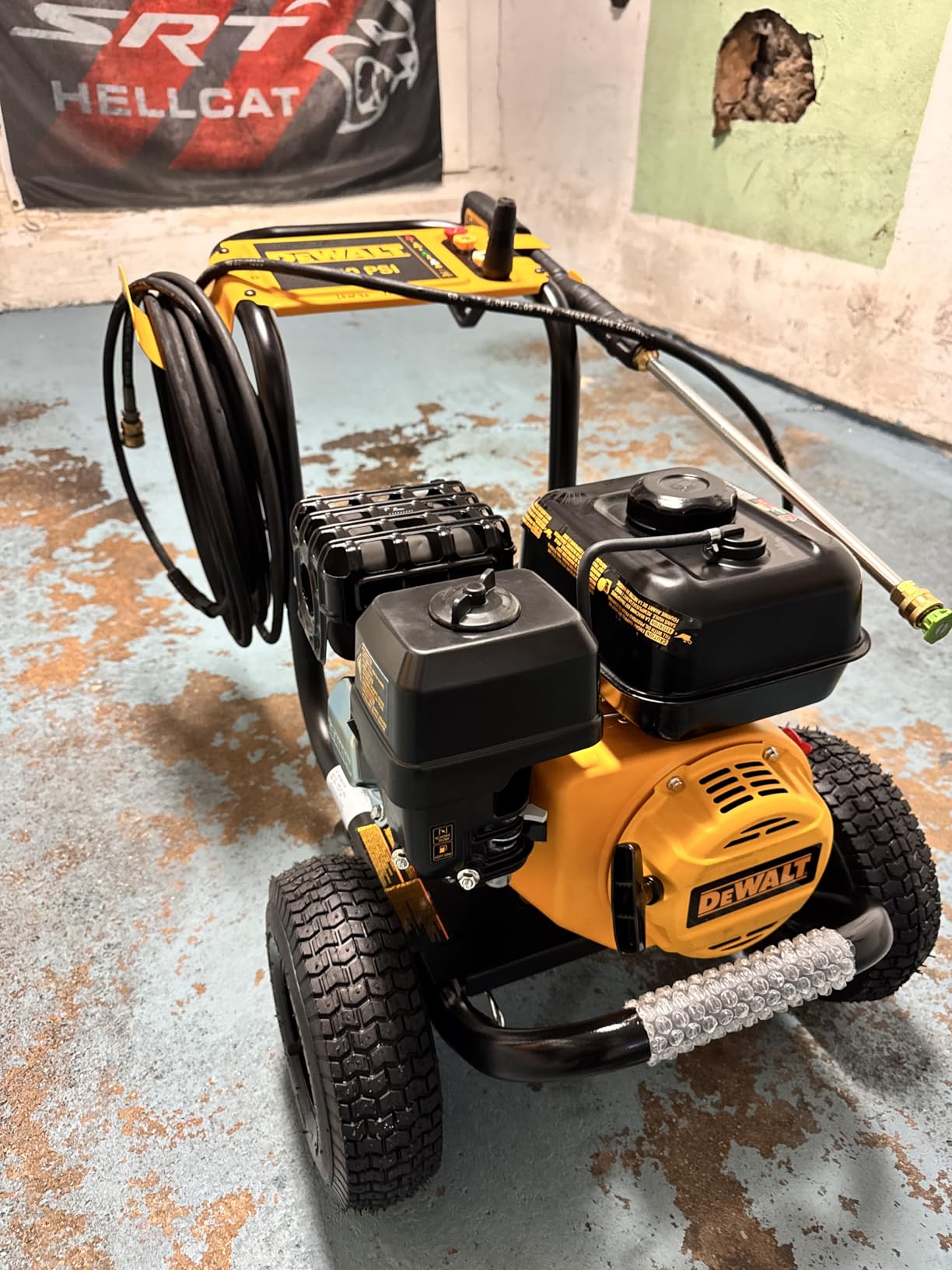
Owners in the 960-review pool rate the machine at 4.3 stars with 73 percent five-star ratings, and the praise concentrates on cleaning power, quick assembly and the warranty. The complaints are consistent and small: the 2.4 GPM flow, the California sales restriction, and a fueling note that says to keep the tank no more than half an inch below the filler neck to prevent spillage on rough ground.
At 64 pounds with 10-inch pneumatic tires and a welded steel frame, it is one of the easier machines here to move solo, and the thermal relief valve on the pump is the same safeguard that keeps a hot engine from cooking itself when you stop to reposition.
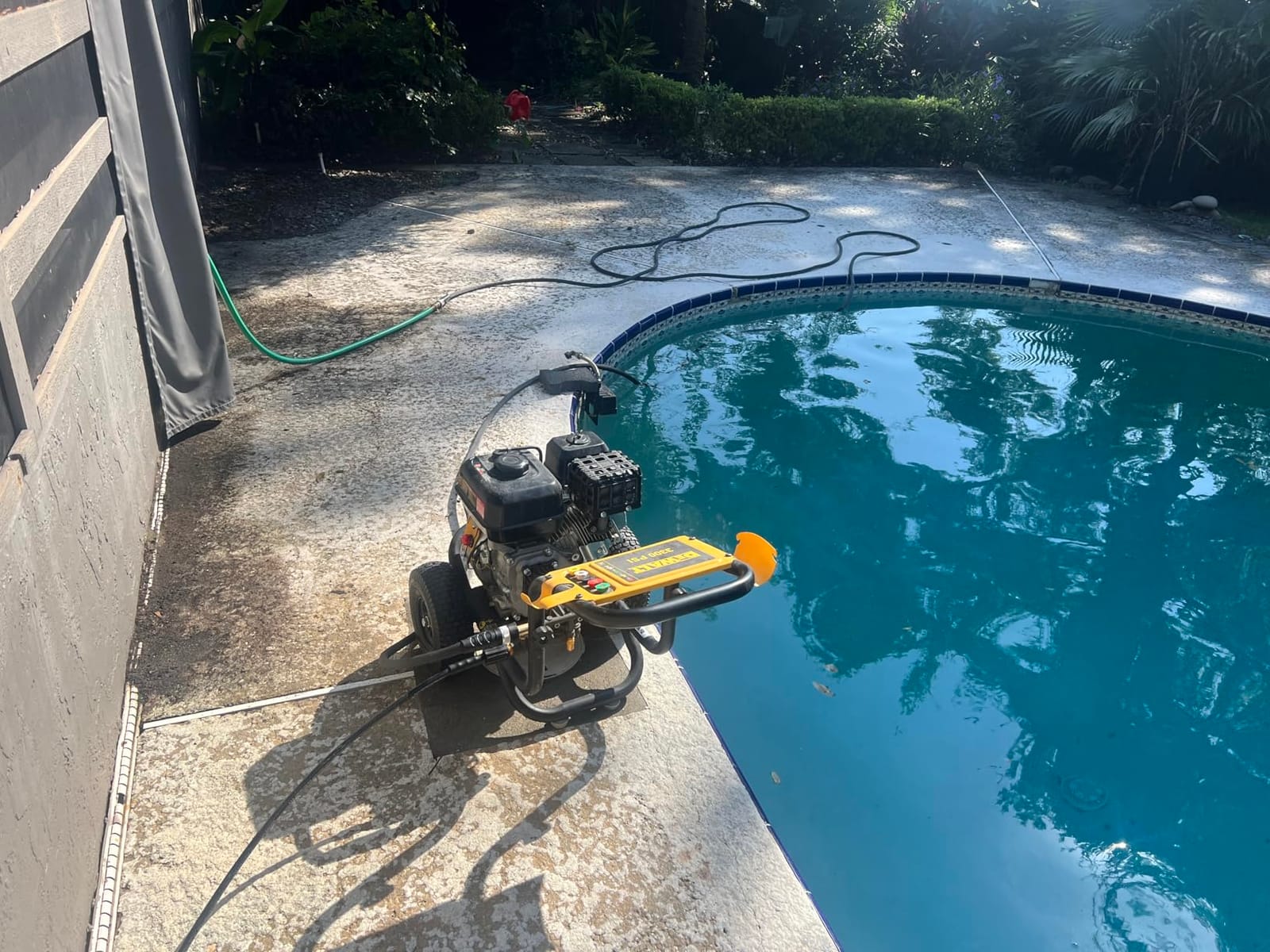
The 208cc DeWalt Engine and Easy-Start Design
The DeWalt 208cc engine is built around easy starting, which on a driveway is worth more than a slightly larger displacement. You will stop and start this machine dozens of times per clean, and an engine that fires on the first or second pull keeps the whole afternoon on schedule rather than turning into a series of small delays.
It is a four-stroke design, so there is no premixed fuel to measure or pour. The practical caveat is that these smaller OEM-branded engines are unbranded, so their longevity depends more on oil changes and fuel care than on a Honda badge, and the two-year engine term is the piece of that equation to plan around.
Why 2.4 GPM Costs You Time on a Long Slab
Flow is the number that decides how long a driveway takes. At 2.4 GPM this machine delivers roughly 4 percent less water per minute than a 2.5 GPM machine and about 8 percent less than a 2.6 GPM one, and on a two-car slab that difference disappears. On a wide four-car slab with a surface cleaner, it turns into an extra stop for a water refill and a longer stretch of wet concrete to manage.
Read it as a fair trade rather than a flaw. You give up a small amount of coverage speed and get a lighter, warranty-backed machine with the longest frame coverage in the group. For most homeowners, that is the right side of the trade.
Nozzles, Hose and Paint-Prep Duty
Five quick-connect tips, covering zero, 15, 25, 40 and soap, give this machine the most complete stock set of the mid-weight models here. That full spread matters on a driveway because the concrete is not uniform, and the edge where a slab meets a wall or a garden bed needs a wider fan than the open center of the slab.
The 25-foot abrasion-resistant hose and the 16-inch steel wand give you enough stand-off to keep the jet off the surface, and the steel wand is a good choice for job-site durability. A rotary surface cleaner is the next sensible accessory, and it will do more for finish quality than any nozzle change.
Who Should Buy the DeWalt
Buy it if warranty length is your top priority, or if the main job is exterior paint preparation on concrete and siding where you want a machine that will still be running years from now. The compact 64-pound body also suits owners who need to move the washer between a garage and a side shed without asking for help.
Skip it if you are washing the largest slab on your property and want maximum coverage speed per minute, where the flow number works against you, or if you need California availability. It is built as a 49-state compliant model.
4. Simpson Aluminum ALH3228 - Contractor Build for Daily Driveway Work
Simpson Cleaning 3400 PSI Gas Pressure Washer, 2.5 GPM Power Washer for Commercial Use, Honda GX...
3400 PSI at 2.5 GPM
Honda GX200 engine
CAT triplex pump
73 lb aluminum platform
+ Pros
- Honda GX200 commercial engine for daily use
- CAT triplex pump with a five year limited warranty
- Aircraft-grade aluminum platform resists corrosion
- Monster 5/16 inch hose resists kinks and abrasion
- Spray gun with safety lock-out
- Cons
- Command-level cost of ownership
- 49-state compliant not available in California
- Large aluminum platform built for commercial duty
The Aluminum ALH3228 is the machine we would not buy for a single driveway clean and would buy without hesitating if driveways were income. It combines a Honda GX200 commercial engine with a CAT industrial triplex plunger pump, which is the most durable pairing in this roundup and the closest thing here to equipment that treats a driveway like a job site.
It produces the same 8,500 cleaning units as the Clean Machine, at 3,400 PSI and 2.5 GPM. The difference is not the output, it is what happens over a thousand operating hours: the aluminum platform resists the corrosion that eats powder-coated steel from the bottom up, and the triplex pump is designed to run long with thermal relief protection doing the work of cooling it.
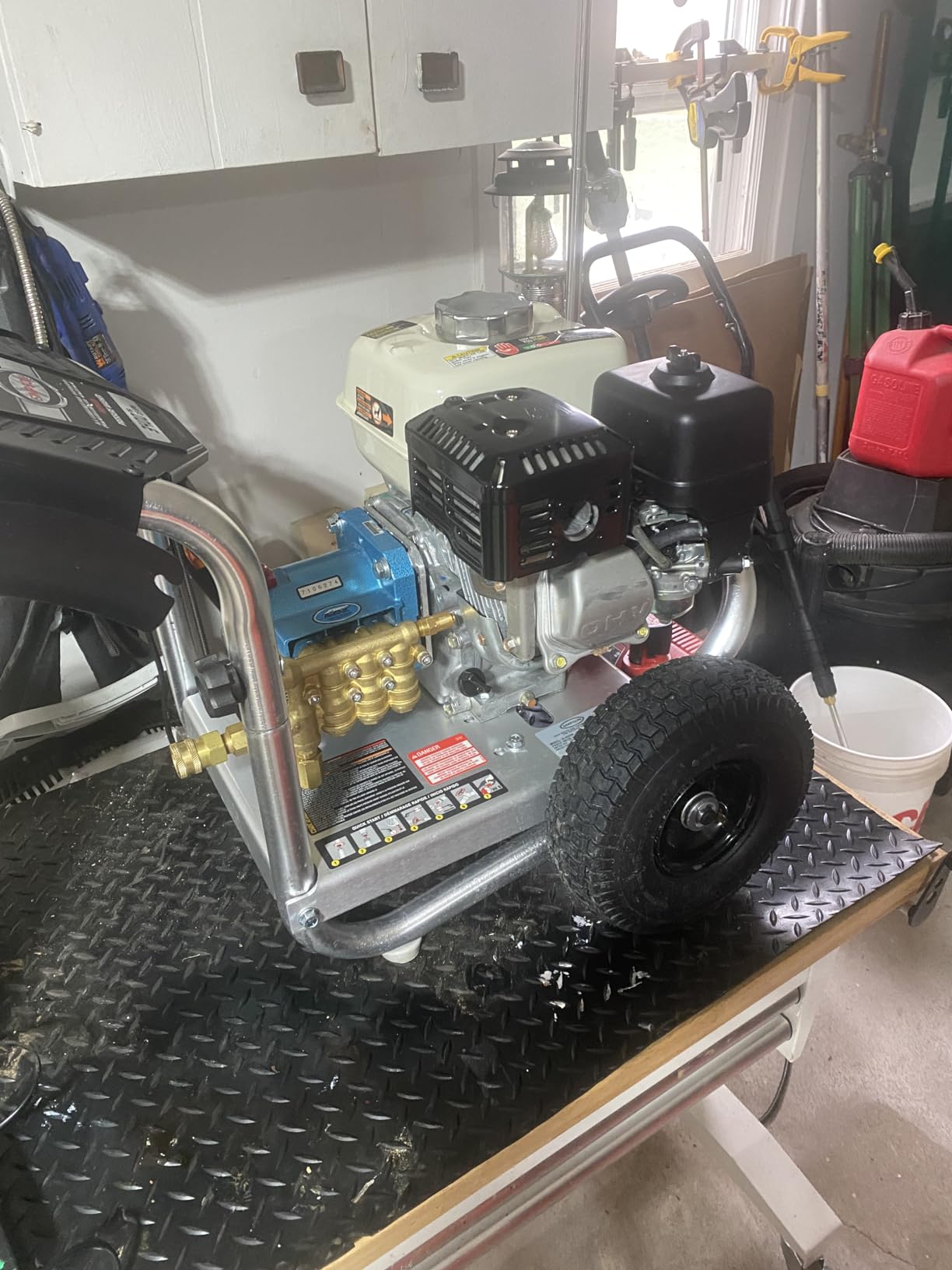
The warranty tells the same story. This machine carries a three-year limited commercial engine warranty, a five-year limited pump warranty and a one-year frame warranty, and the pump term is the strongest we found. Professionals reviewing it consistently cite the engine and pump for sustained daily use and the frame for job-site durability.
The criticism across the 570-review pool is about cost and handling rather than capability. At 73 pounds on a large chassis, this is not a machine you lift into a trunk, and the 49-state compliance rules out California sales.
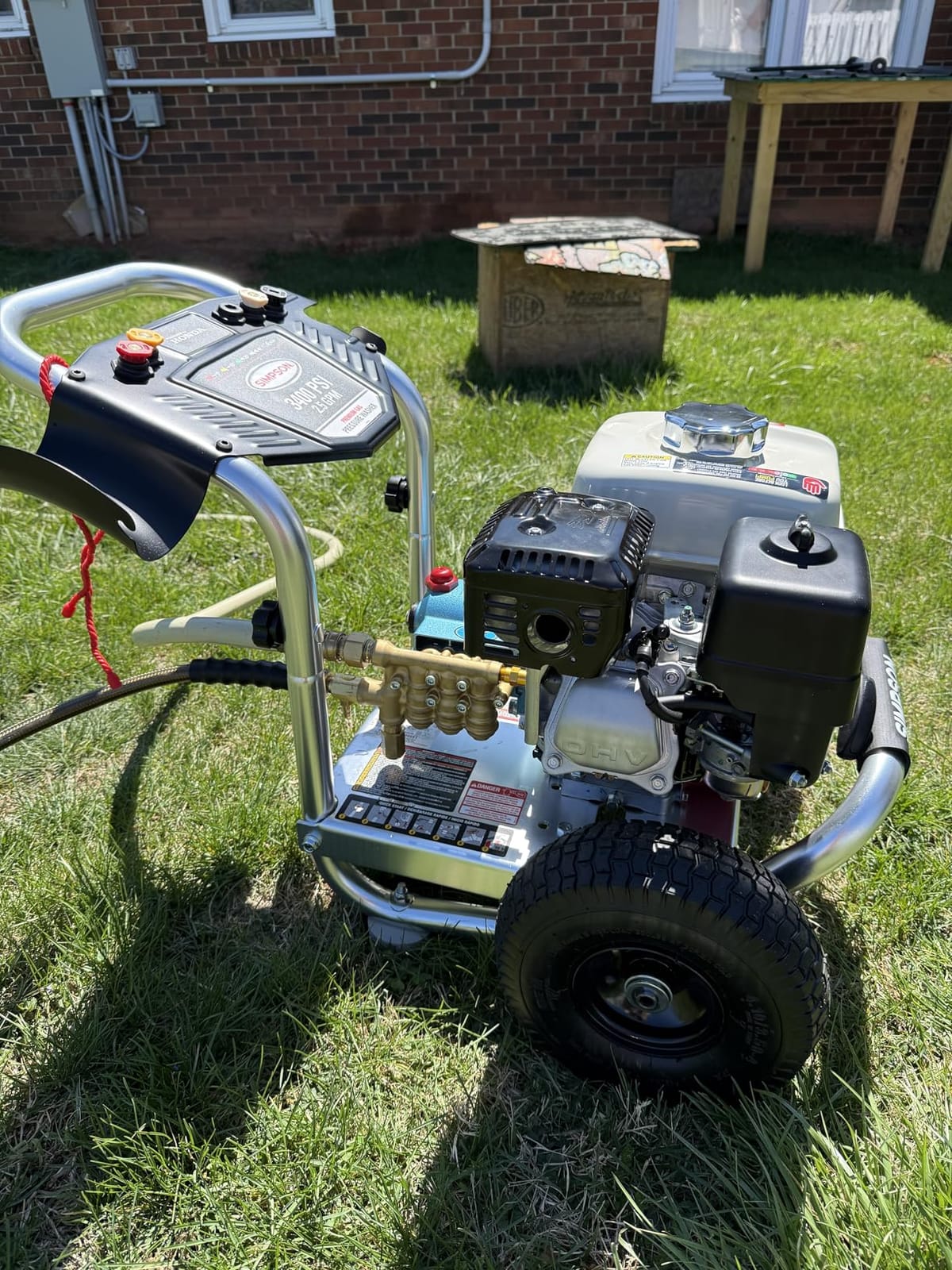
Honda GX200 and CAT Triplex Together
A Honda GX200 driving a CAT industrial triplex plunger pump is the standard commercial pairing for a reason: both parts are specified for sustained daily operation rather than seasonal duty. The pump carries thermal relief protection, so water that overheats while the trigger is closed is cooled rather than cooked, which is the single most common cause of pump failure in machines that are worked hard and rested hard.
For a side-hustle operator cleaning several driveways a week, this is the difference between a machine that stays in service and one that develops an inconsistent pressure you start apologizing for. For a homeowner, the same durability is simply insurance you will never cash in.
Aluminum Frame Versus Powder-Coated Steel
The aircraft-grade aluminum platform with brushed extruded aluminum tubing is a corrosion choice, and on driveway work that choice earns its keep. Concrete runoff is mildly alkaline, water sits on the frame, and salt from winter deicing gets tracked in. Powder-coated steel handles that for a few seasons. Aluminum handles it for a decade.
The trade is weight and cost. Aluminum tubing is heavier than the light-gauge steel used on homeowner machines, which is part of why this chassis reaches 73 pounds, and it is the main reason this is not a storage-friendly choice for a residential garage.
Cleaning Power and Hose Durability
The Monster 5/16-inch high-pressure hose is the thickest hose in this group, and thickness is a durability feature on a machine that gets dragged across concrete daily. A 5/16-inch diameter resists kinking far better than the thinner 1/4-inch hoses on homeowner models, which matters when you are hauling a long loop back to the machine after each slab.
Five quick-connect tips, a 16-inch steel wand and a spray gun with a safety lock-out complete a professional kit. The lock-out is not a gimmick on a machine that can be running at full pressure while you walk around it, and we would want that feature on any gas unit we owned.
Who Should Buy the ALH3228
Buy it if you clean multiple driveways per week, if you rent equipment as a side business, or if you intend to keep one machine for a decade. The five-year pump warranty and the aluminum platform make it the lowest-cost-per-hour option in this roundup for high-hour users.
Pass on it for annual residential use. The Clean Machine delivers identical rated cleaning power in a lighter, smaller, cheaper-to-store package, and a residential owner will not earn back the difference. It is also a 49-state compliant model.
5. Ezasin 3500 PSI - Raw Pressure for Old Rust and Oil Stains
Ezasin Gas Powered Pressure Washer 3500 PSI - 2.3 GPM Heavy Duty High Power Washer,212CC 7HP Engine...
3500 PSI at 2.3 GPM
7HP 209cc 4-stroke engine
Axial aluminum pump
Onboard soap tank
+ Pros
- 3500 PSI strips driveway grime and weathering
- 7HP 209cc OHV engine starts easily on recoil
- Onboard soap tank avoids a separate siphon
- 10-inch tires and dual front rubber pads add stability
- Compact 63-pound body fits most trunks
- Cons
- Only four nozzle heads and no 15 degree tip
- 2.3 GPM is slower across large slabs
- Residual factory fuel odor and a hose gasket to seat
The Ezasin is the pressure specialist in this group. At 3,500 PSI it is the second highest rated pressure here, and it is the machine we would reach for when a slab has a specific, localized problem: a rust fan under a fence line, a set of old oil spots, or a patch where a chemical sealer has failed and the concrete underneath is genuinely stained rather than dirty.
Those stains are a pressure problem, not a flow problem. Oil that has soaked into concrete pores and rust water that has bound to the surface both need a narrow, hard jet to break the bond, and this machine delivers 8,050 cleaning units with the emphasis on the pressure side.
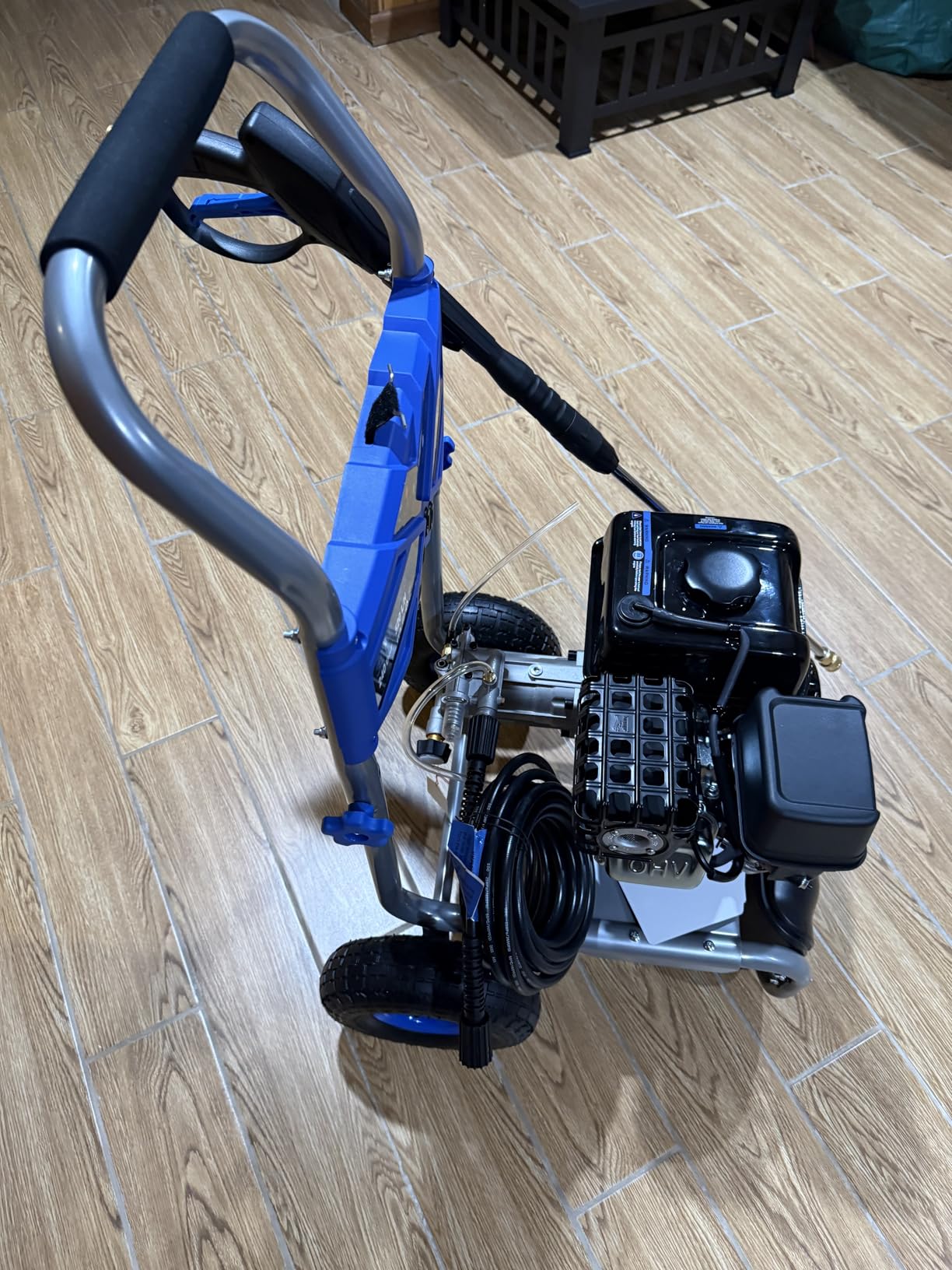
Owners in the 229-review pool give it a 4.4 rating, and they report strong enough pressure to strip years of driveway and siding grime along with easy first-pull starting. The gripes are consistent: the 2.3 GPM flow limits throughput on wide slabs, and a faint gasoline odor from factory testing shows up on some units.
Two setup notes are worth repeating. The manufacturer calls for SAE 10W-30 oil with a 0.5 liter initial fill, and it asks that the hose gasket be inserted first to prevent leaks. Both are five-minute steps that prevent the two most common early complaints on this kind of machine.
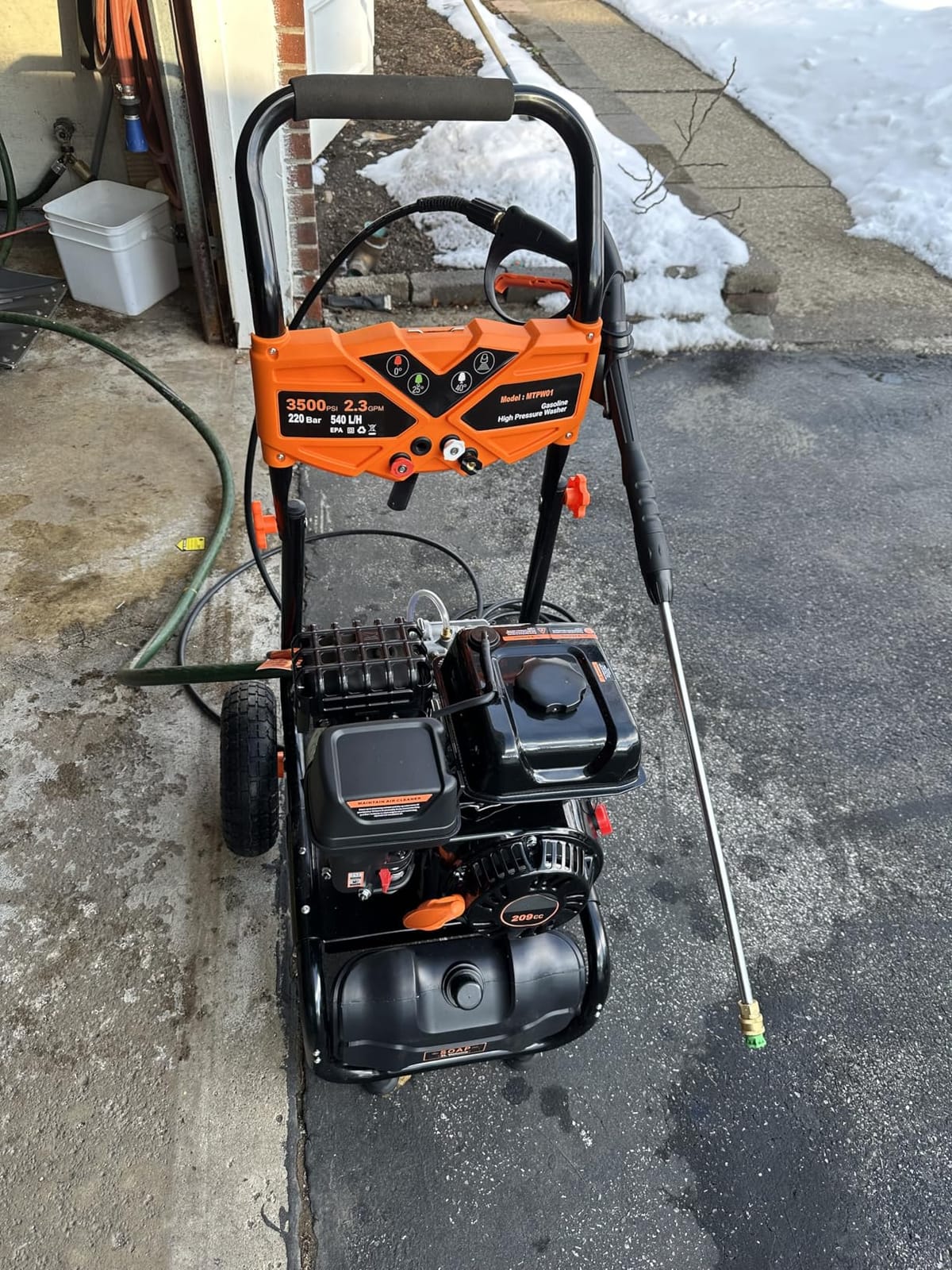
3500 PSI Against Sealed and Embedded Stains
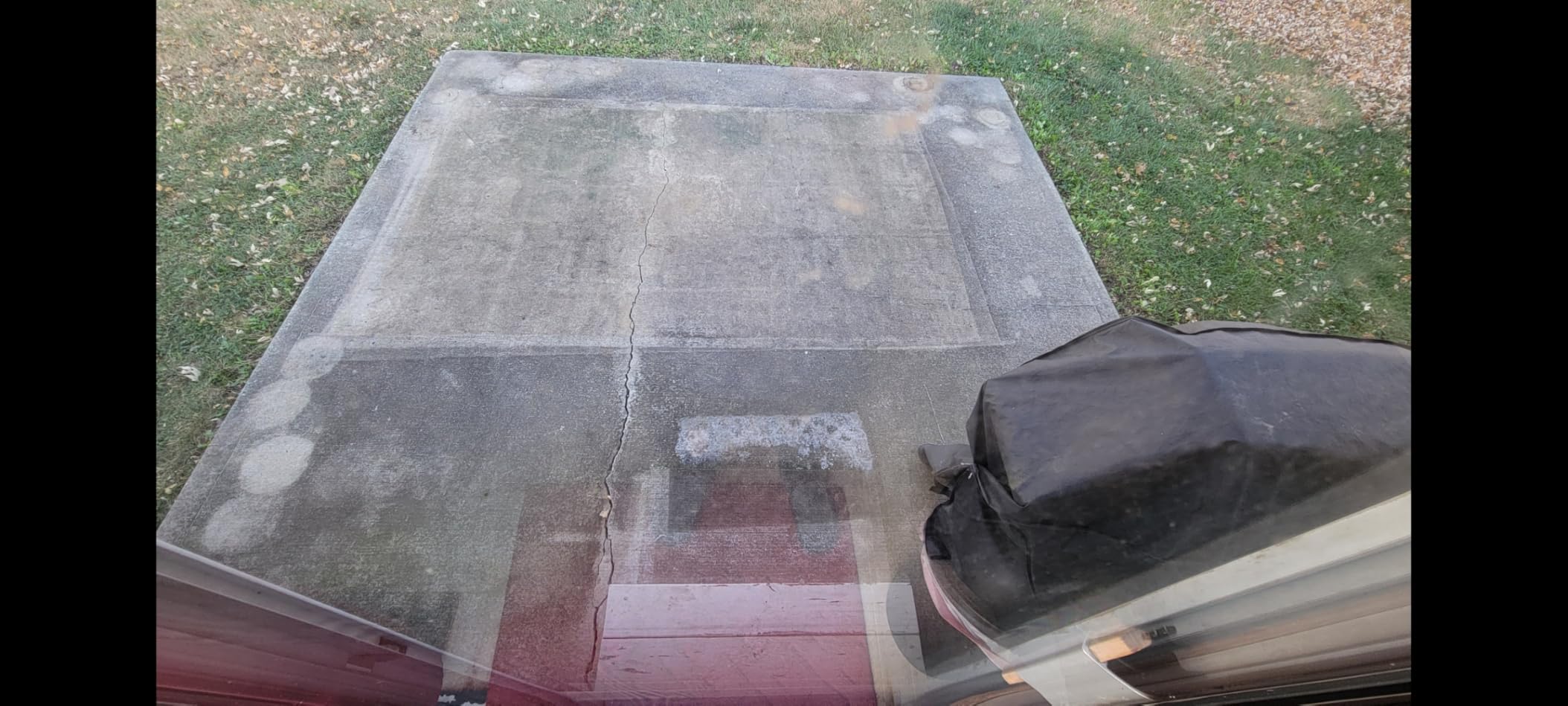
Concrete is a porous surface, and a stain that has penetrated it cannot be rinsed off. It has to be broken apart chemically so the oil or rust becomes something water can carry away, or broken apart mechanically with enough pressure to powder the surface very slightly. This is exactly the situation where extra pressure earns its place.
The technique still matters more than the number. A zero-degree tip held at a slow, deliberate walking pace with the wand held a few inches off the surface will lift a stubborn spot that a 40-degree tip wanders past. Keep the tip moving, and stop when you see the stain break rather than when the patch looks perfect.
The 7HP 209cc Engine and the Onboard Soap Tank
The 7HP 4-stroke OHV 209cc engine with recoil start is one of the larger engines relative to its pump output in this roundup, and owners report easy first-pull starting. Four-stroke means no oil mixing, which removes the most common error first-time gas washer owners make.
The onboard soap tank is the feature that makes this machine practical for a driveway rather than just powerful. Applying detergent from a tank instead of a siphon hose and a separate container means one person can pre-treat an entire slab, dwell for the required time, and then hit it with the rinse pass. That sequence is the whole oil-stain workflow, and having the tank built in removes a step.
What 2.3 GPM Costs on a Long Slab
At 2.3 GPM, this is a slower coverer than the 2.5 and 2.6 GPM machines here. For a two-car slab with concentrated stain work, throughput is irrelevant. For a wide four-car slab where you are doing a broad rinse pass, you will spend noticeably longer moving water, and more of the slab stays wet at once.
Pair that with a rotary surface cleaner and the penalty shrinks, because a surface cleaner converts flow into forward movement more efficiently than a wand. The nozzle kit here is limited to zero, 25, 40 and soap, with no 15-degree tip in the box, so plan to add one.
Who Should Buy the Ezasin
Buy it if your driveway problem is stubborn local staining rather than a general layer of grime, or if you want detergent built into the machine so one person can run the whole pre-treat-and-rinse sequence. The compact 63-pound body and dual front rubber pads also make it stable on grass and gravel approaches.
Pass on it if you are cleaning the largest slab in your neighborhood on a schedule, since the flow number works against you there. Treat the four-nozzle kit as a starting point rather than a complete set, and expect a couple of setup minutes with the oil and gasket before the first start.
6. Westinghouse WPX3000 - Lightest Steel-Frame Option with a 3-Year Warranty
Westinghouse WPX3000 Gas Pressure Washer, 3000 PSI and 2.3 GPM, Spray Gun and Wand, 4 Nozzle Set...
3000 PSI at 2.3 GPM
212cc 4-stroke OHV engine
50.7 lb with never-flat wheels
3 year limited warranty
+ Pros
- 3000 PSI at 2.3 GPM restores concrete and siding
- Lightest frame here at 50.7 pounds
- Never-flat wheels need no maintenance
- Super-flex 25-foot hose and four quick-connect nozzles
- Three year limited warranty with nationwide service
- Cons
- Recoil starting can be hard and hot restarts resist
- Side-mounted garden hose connection can chafe
- Hose is stiff and prone to kinking
The Westinghouse is the machine we would hand to someone who has never owned a gas pressure washer. It is the lightest chassis in the group at 50.7 pounds, it has never-flat wheels that need no attention, and it carries a three-year limited warranty backed by a nationwide service network, which are three of the four things first-time owners worry about most.
On the driveway itself, 3,000 PSI at 2.3 GPM produces 6,900 cleaning units. That is the lowest figure in this roundup, and it is still comfortably enough to lift dirt, algae and mildew from a residential slab. It is the least machine that does the job, which is a reasonable place to start.
The 212cc four-stroke OHV horizontal shaft engine is a simple recoil-start design, and the engine is EPA compliant. The 0.95 gallon fuel tank is smaller than most, which means one more fuel stop on a long job, though horizontal shaft layout is the arrangement that tends to run well in side-of-house storage.
Reviewers give it 4.4 stars across 142 reviews with an unusually large four-star band, and the praise concentrates on cleaning power for concrete and siding and on how easy the frame is to move. The most common complaint is starting effort, including one recurring oil-level issue that Westinghouse support resolved by correcting the fill.
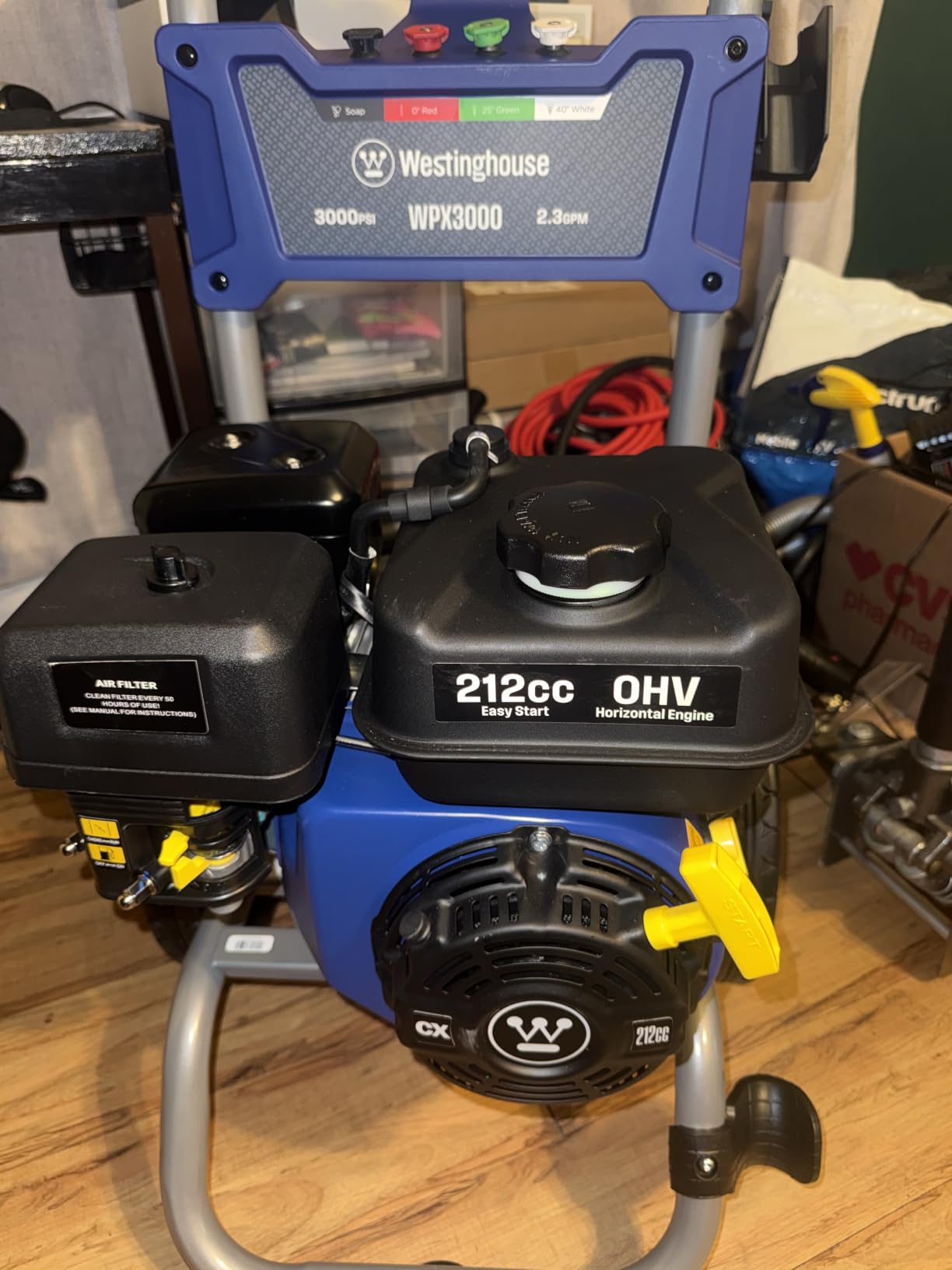
212cc Horizontal Shaft Engine and Recoil Start
There is no electric starter on this machine, which means starting is a pull cord and a fuel valve. That is a genuine simplicity advantage: no battery to maintain, no starter that fails in cold weather, no GFI to trip in the rain. The cost is the physical effort of the pull, and owners do report that it can be hard, particularly on a hot restart until the engine cools.
If a hard pull worries you, the fix is a technique fix rather than a machine fix. Squeeze the spray trigger first to relieve pump pressure, set the choke for a cold engine, and pull with the arm rather than the wrist. A pressure-locked pump is the most common reason a gas washer seems not to start.
3000 PSI at 2.3 GPM: The Entry Point
This is the lowest pressure and lowest flow pairing in the roundup, at 6,900 cleaning units, and it is the one number to be honest about. It will clean a driveway. It will clean it more slowly, and the surface cleaner matters more here than on a higher-flow machine because a rotary head makes better use of a limited stream of water.
What you get for that restraint is a machine at 50.7 pounds, with no throttle control so the engine runs at a single speed, and a simpler mechanical package with fewer places to fail. For annual use on a modest slab, those are the numbers that matter.
Never-Flat Wheels and Moving Alone
Never-flat wheels are an unglamorous feature with a real effect on driveway work. You are crossing a driveway to reach the far corner, and a pneumatic tire goes soft, flats, and starts dragging exactly when the frame is loaded. Never-flat wheels roll smoothly over the same surface every time, and the steel frame they sit on is described as tough.
The one handling issue owners raise is the side-mounted garden hose connection, which can chafe against the wheel as the machine is moved. Route the supply hose differently or secure it before you start rolling, and it is a non-issue.
Who Should Buy the Westinghouse
Buy it if you are a first-time gas washer owner, if you want the lightest machine you can carry, and if your driveway is a modest slab cleaned once or twice a year. The three-year warranty and nationwide service support reduce the risk of buying a brand you have not owned before.
Pass on it if you have a very large slab, where the 2.3 GPM flow will show, or if you dislike the supplied hose. Reviewers describe it as stiff and prone to kinking, and a replacement hose is a much better use of money than fighting a coil all afternoon.
7. VEVOR 3600 PSI - The Highest Flow and Pressure Combination Here
VEVOR Gas Pressure Washer, 3600 PSI 2.6 GPM, Gas Powered Pressure Washer with Copper Pump, Spray Gun...
3600 PSI at 2.6 GPM
Full copper pump
5 quick-connect metal nozzles
26 foot abrasion resistant hose
+ Pros
- Highest flow rate in the group at 2.6 GPM
- Copper pump resists heat and pressure fluctuation
- Five quick-connect metal nozzles for full range
- 26 foot hose with on-machine accessory storage
- Never-flat 10-inch wheels and ergonomic handle
- Cons
- Recoil start often needs more than one or two pulls
- Some units reported a hose leak near the wand
- 0.8 gallon fuel tank means frequent refills
The VEVOR posts the largest cleaning-power number in this roundup. At 3,600 PSI and 2.6 GPM it multiplies out to 9,360 cleaning units, ahead of every Simpson, DeWalt and Westinghouse here, and it is the fastest coverer on paper for a wide slab. If raw output per dollar is the only question, this is the answer.
That is also where the nuance sits. A 106-review history is a much thinner evidence base than the 2,295 behind our first pick, and the recurring complaint across that history is starting effort. Recoil start often needing more than one or two pulls is annoying rather than disqualifying, but it is the piece of feedback that shows up most often.
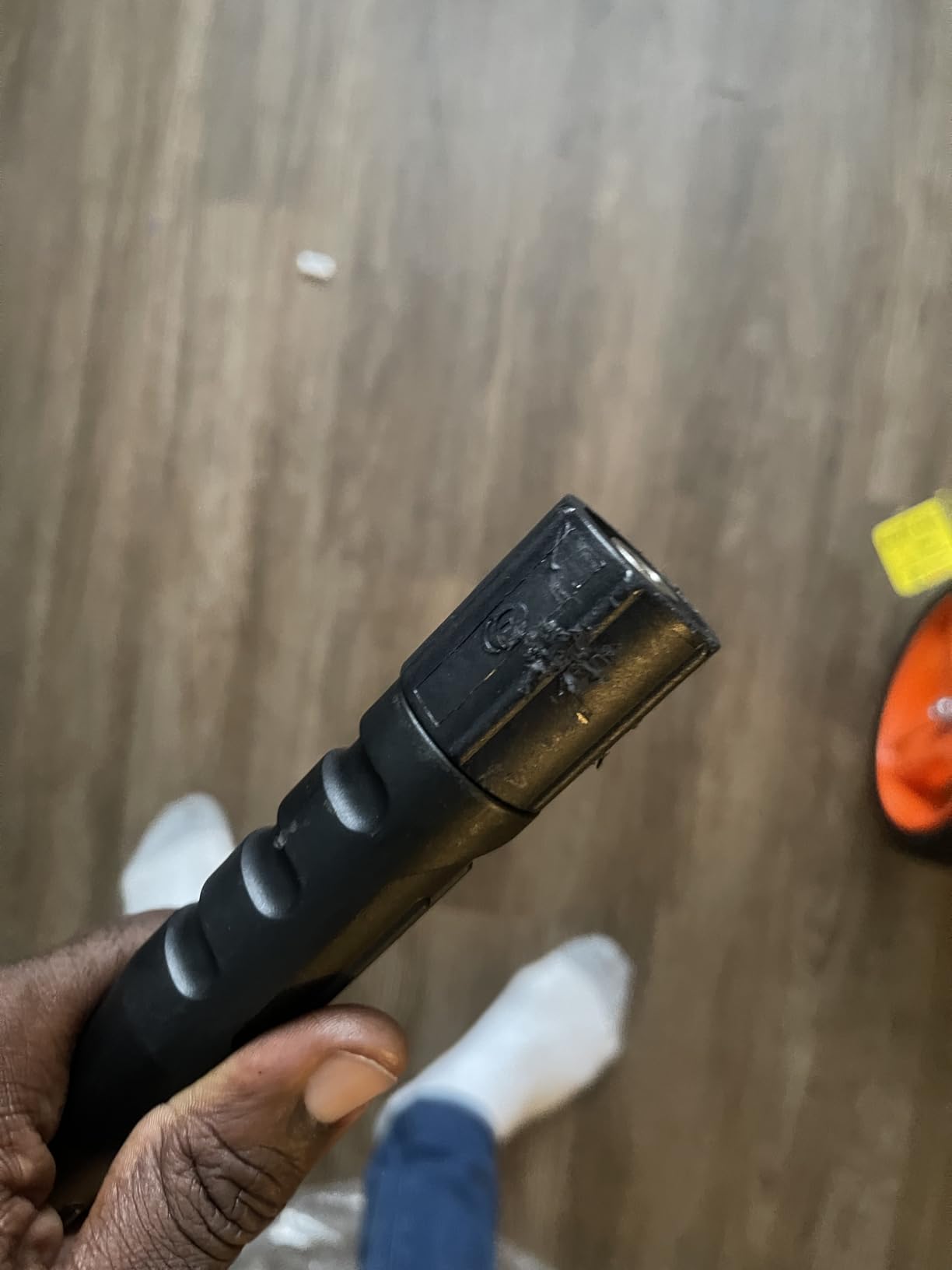
Otherwise the feedback is positive about the combination of pressure and flow, the build, and maneuverability around the yard. Reviewers rate it 4.2 stars across 106 reviews with 67 percent five-star, and one detailed report describes the supplied hose springing a small leak near the wand within about twenty minutes of use, which is a parts-quality flag rather than a design flaw.
Two practical notes. The 0.8 gallon fuel tank is the smallest here, so budget refills into the plan. And accessories store on the machine, which sounds minor until you spend a driveway looking for the 25-degree tip you used on the last one.
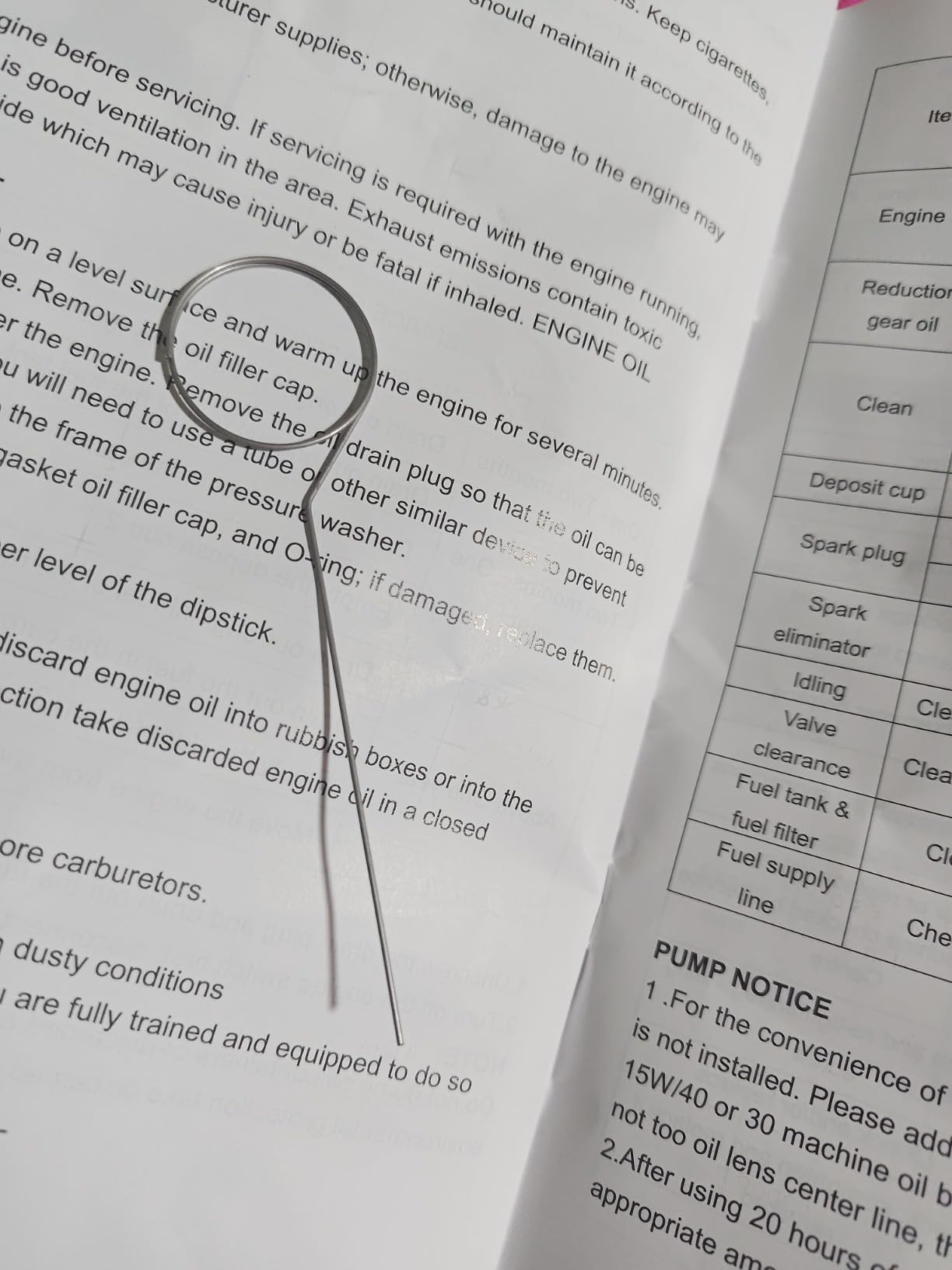
Copper Pump and What the Material Changes
The pump is described as full copper, built to withstand frequent high-pressure use with water and cleaners. Copper has a genuine thermal advantage over the aluminum and cast-alloy housings common at this level, and it also resists the pressure fluctuation that shows up as an uneven finish as a surface cleaner moves across a slab.
Uneven pressure is the hidden failure mode of a driveway clean. When pressure pulses, the rotary head slows and speeds up, and the result is a visible banded finish that no amount of rinsing fixes. A steadier pump is why finish quality and pump material are related on this kind of job.
3600 PSI at 2.6 GPM for Wide Slabs
At 2.6 GPM this machine delivers about 13 percent more water per minute than a 2.3 GPM machine. Across a four-car slab, that is the difference between a long afternoon with a lot of standing water and a shorter session where the concrete has time to dry between passes.
The 3,600 PSI figure also puts this machine at the top of the pressure range in this group, which is useful for the same stain work the Ezasin handles, and it is the number that makes this machine attractive for rust fans and old paint on concrete. Keep the same discipline on technique, since the extra pressure raises the consequence of a bad nozzle choice.
Hose, Nozzles and the Small Fuel Tank
Five quick-connect metal nozzles covering zero, 15, 25, 40 and soap give it a full range, and metal tips resist damage from dropping better than plastic ones. The 26-foot hose is the longest listed here, which extends the working radius enough to reach most driveways without moving the machine.
The 0.8 gallon tank is the drawback. On a full driveway clean with a surface cleaner you will refill more often than you would with a machine carrying nearly three times the capacity, and interrupting a wet slab mid-pass is how you end up with overlapping edges that show.
Who Should Buy the VEVOR
Buy it if you have the widest slab of anyone on your list and you want the most cleaning power and flow available without stepping up to a commercial chassis. The five metal nozzles and the 26-foot hose also make it a well-stocked kit out of the box.
Pass on it if you want a long ownership record or a confident warranty story, since the review base here is thin and one report describes a hose leak early in use. Check your recoil-start technique before the first clean, and keep spare fuel on hand for the small tank.
8. PowerSmart 3400 PSI - Smallest Footprint for Garage Storage
PowerSmart Gas Pressure Washer 3400 PSI, 2.5 GPM Gas Powered Pressure Washer, 212CC Engine...
3400 PSI at 2.5 GPM
212cc 4-stroke OHV engine
Foldable handle
31 pounds
+ Pros
- 3400 PSI at 2.5 GPM in a 31 pound body
- 212cc four-stroke starts on the first pull
- Foldable handle stores in a small garage or shed
- Five quick-connect nozzles for good versatility
- No cord drag and no GFI trips
- Cons
- Some units arrived with broken or missing parts
- Reported as noisy and light on heavy concrete work
- Oil fill and hose connection points are awkward to reach
The PowerSmart solves a problem the rest of this roundup ignores: storage. At 31 pounds it is by far the smallest machine here, and the wheeled frame has a foldable handle that lets it stand against a garage wall in roughly a third of the footprint of a full-size chassis. In a home with a shared garage, that is worth more than a hundred extra PSI.
Output is not the sacrifice you would expect. At 3,400 PSI and 2.5 GPM it produces 8,500 cleaning units, matching the Simpson Clean Machine and the contractor-grade Simpson, which is a genuinely competitive number to find in a machine you can lift with one hand.
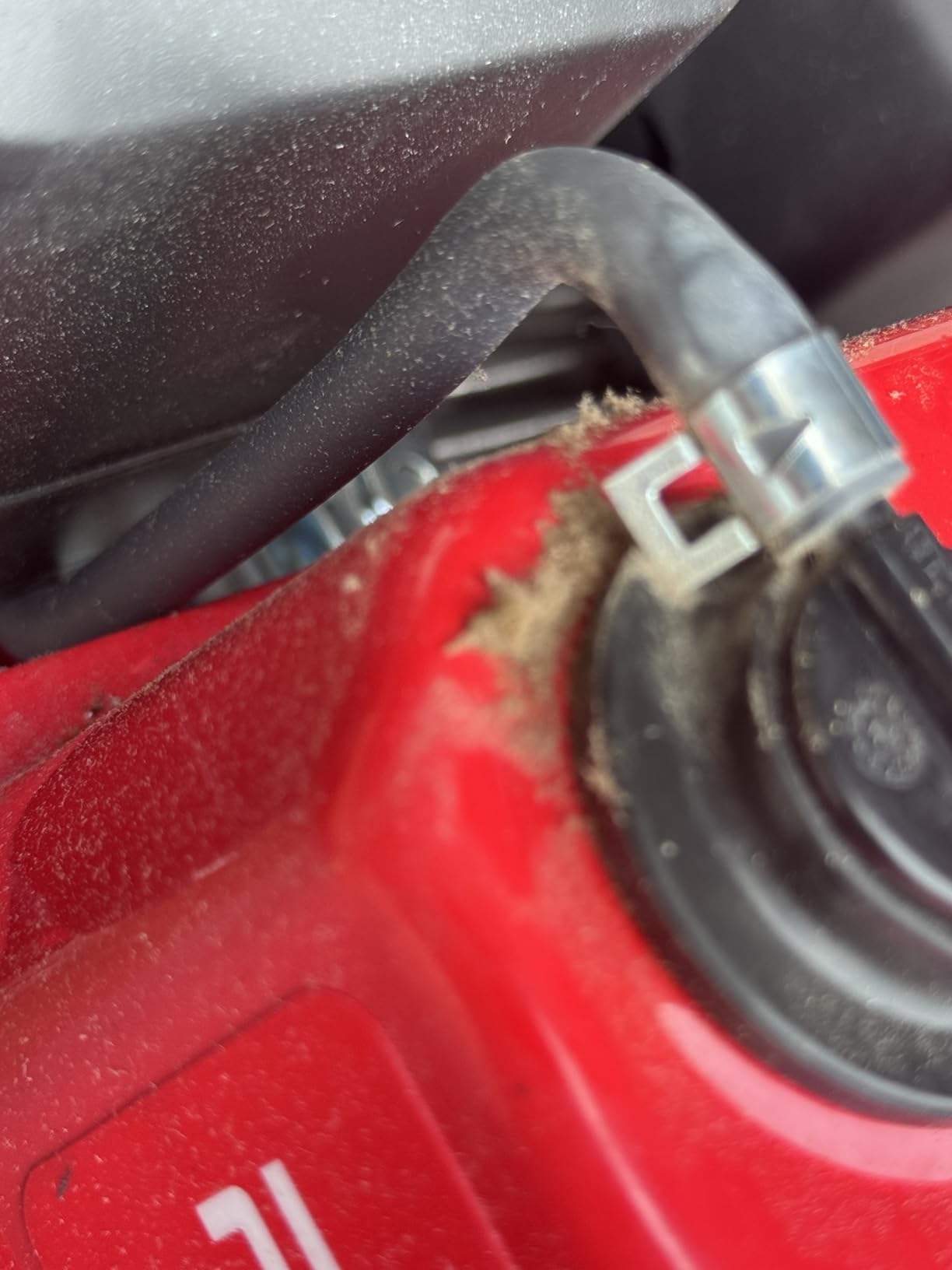
The 212cc four-stroke OHV engine is designed around an easy-start system and needs no oil and gas mixing, which removes the two most common first-run errors. Owners report that it starts on the first pull, and the 5 quick-connect nozzles give it the same spread as heavier machines in the group.
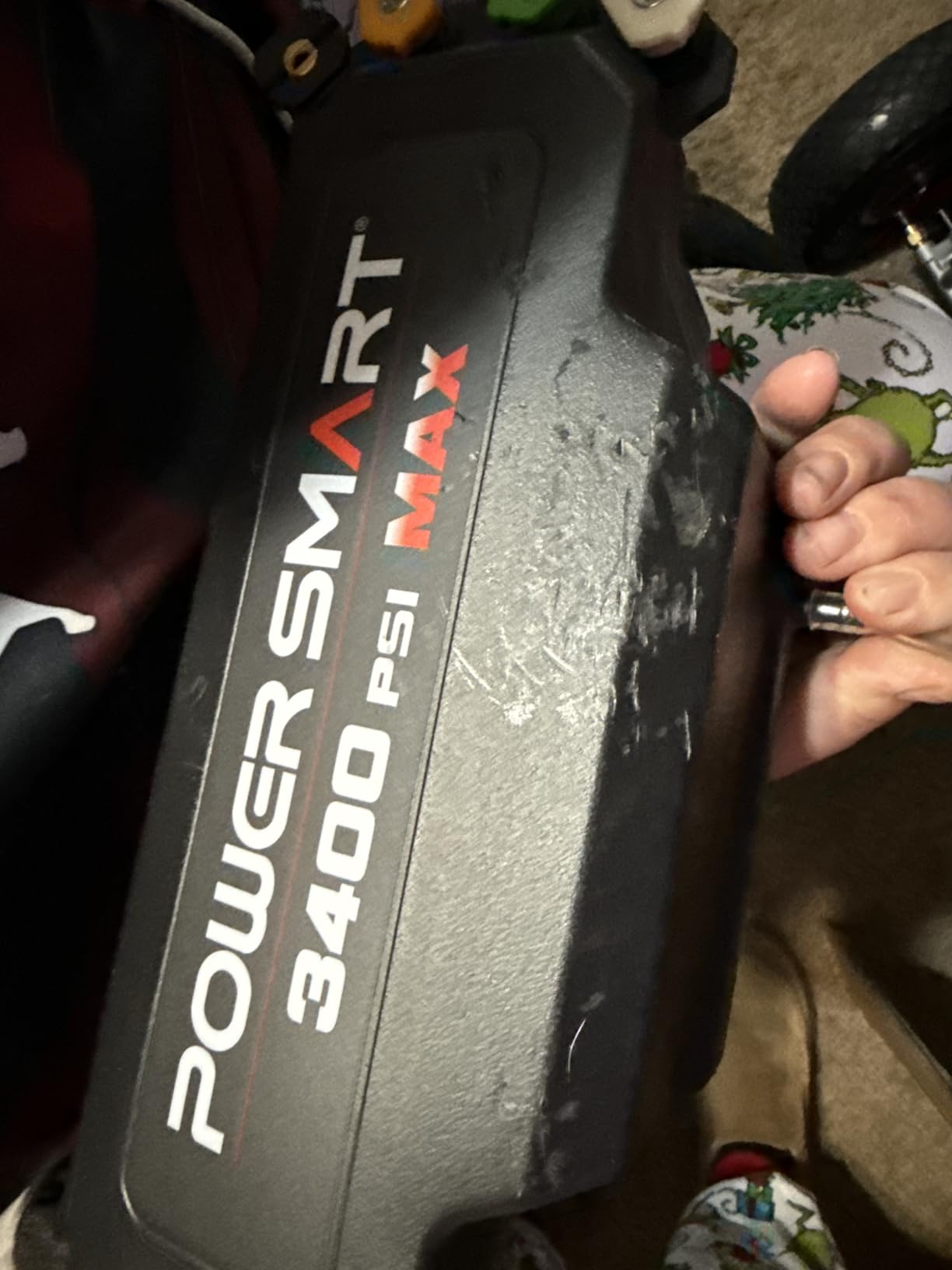
The feedback is mixed where it matters. Reviewers rate it 4.2 across 97 reviews with 70 percent five-star, and the recurring criticism is build consistency, including one account of a unit arriving with broken parts and oil leaks, plus reports of above-average noise and less power than expected on heavy concrete work.
The 31-Pound Foldable Body
Compare that to the 74.8 pounds of our first pick and the 50.7 pounds of the lightest steel-frame machine, and the practical difference is obvious. This machine moves from a storage closet to the driveway by one person, sits on a shelf when it is not in use, and can be carried over a step or a threshold without a second pair of hands.
The 10-inch wheels and 22.4 by 18.5 by 34.8 inch footprint make it easy to maneuver on grass approaches, and gas power means no cord to drag across a wet driveway and no GFI to trip when the ground is damp.
212cc Four-Stroke OHV Simplicity
Four-stroke means separate oil and fuel, which means no premixed fuel to measure in a shed with poor light. The user-friendly pull-start mechanism is designed for exactly the once-a-year owner this machine suits, and the 212cc displacement is enough to drive the pump without feeling strained.
The awkward detail owners raise is access. The oil fill and the hose connection points sit close to the wheels, so you may need to tip or rotate the machine to reach them. Plan a clear spot for the machine before you fill it rather than fighting it in a corner.
Nozzle Set, Wand and Realistic Expectations
Five quick-connect tips covering zero, 15, 25, 40 and soap give this machine a full range, and the 27-inch wand gives you usable stand-off from the jet. That is enough to cover every driveway task short of stripping bonded paint, and the 0, 15 and 25-degree spread covers the broad, even passes a slab needs.
Set expectations with the noise and power feedback in mind. Owners describe it as loud, which is common for a small-displacement engine, and several report it feeling light on heavy concrete work. For a normal seasonal clean with detergent and a surface cleaner, it performs as expected. For hours of daily commercial work, it is not the right machine.
Who Should Buy the PowerSmart
Buy it if garage or shed space is genuinely tight, if you want to move the machine solo without planning, and if a once-a-year driveway and siding clean is the workload. Gas power at 8,500 cleaning units in a 31-pound package is a real combination for a small footprint.
Pass on it if you are buying to earn money with it, or if you need a long, well-documented ownership record. Inspect the machine on arrival, since the reports of missing or broken parts are specific enough to be worth checking the frame, wand, and hose connections before you fill it with oil.
Why a Surface Cleaner Matters More Than Raw PSI on a Driveway
A surface cleaner is a rotary attachment that spins two or more spray nozzles inside a housing you push across the slab, instead of a single jet you swing by hand. It does two things a wand cannot: it keeps the distance from the surface constant, and it overlaps each pass evenly. That combination is what removes the stripe marks and ladder lines that hand work leaves behind, and it is why the same machine covers a driveway roughly twice as fast once one is fitted.
The honest part of that equation is that a surface cleaner amplifies whatever pressure you feed it. Paired with a wand, a 3,000 PSI machine can be used carefully. Paired with a rotary head, 3,500 PSI is easy and 4,000 PSI is a real risk on new concrete. Buy the washer for the job, not the other way around.
Timing, roughly, for a residential slab: a two-car driveway of around 400 square feet takes under an hour with a 15-inch surface cleaner and closer to two hours with a wand. A four-car driveway of 800 square feet runs about an hour and a half to two hours with a surface cleaner. A 20-inch head covers roughly twice the width of a 15-inch head, and the saving is a shorter walk, not more pressure.
Most of the machines in this roundup ship with a spray gun, wand and quick-connect tips rather than a rotary attachment, so budget for one separately and plan the connection. Standard M22 quick-connect fittings, which most of these machines use, accept the common surface cleaner attachments without an adapter.
How to Remove Oil, Rust and Tough Stains from Concrete
Oil and rust on concrete are not surface dirt. They have bound to the pores, so the order of operations matters more than the pressure you bring to the job.
- Pre-treat first. Apply a concrete-safe detergent or degreaser to the stain and let it dwell according to the label. Most stubborn driveway stains stop being stubborn at this step alone.
- Avoid bleach on concrete. Bleach etches cement and can leave the slab lighter than the surrounding area, which shows far more than the stain did.
- Work the stain with pressure, not dwell time. Use a zero-degree or 15-degree tip, keep the wand a few inches from the surface, and move it slowly. Hold it still and you will powder the surface instead of lifting the stain.
- Rinse and check before moving on. Rinsing pulls the loosened contaminant out of the pores. A second detergent application is usually worth more than a second round of pressure.
- Seal after the slab is fully dry. A driveway sealer applied to clean, dry concrete is what stops the next oil or rust event from becoming a permanent mark.
Rust runoff is a slightly easier case than oil, because the stain sits nearer the surface and breaks up with detergent and moderate pressure. Oil needs the longer dwell and a dedicated degreaser. Both are far cheaper to solve with chemistry than with the extra 500 PSI a 4,000 PSI machine would cost you to manage.
How We Chose These Gas Pressure Washers
We built this roundup around the driveway job rather than the spec sheet. Every machine here is a gas cold-water pressure washer in the residential-to-commercial bracket, and every one clears 2.3 GPM and 3,000 PSI, which is the floor for concrete work.
For each machine we normalized the published pressure and flow, computed cleaning units, and then checked the parts that determine whether that number survives a two-hour job: pump type, engine brand and displacement, frame material, wheel size, and hose diameter. Review volumes, warranty terms and recurring complaint patterns across the customer review pool carried equal weight, because a 4.4 rating on 142 reviews tells you less than a 4.3 on 2,295.
We want to be straightforward about limits. We compared published specifications, warranty terms and thousands of customer reviews rather than running each machine on a calibrated flow rig, so cleaning-unit figures here are calculated from rated numbers, not measured at the nozzle. Where a listing omits a specification, such as pump type on one of the lighter machines, we have said so rather than estimated it.
Driveway Pressure Washer Buying Guide
Match PSI and GPM to Your Driveway Size and Stain Severity
Start with the slab, not the number. A two-car driveway of roughly 400 square feet covered in ordinary grime and algae will come clean with 3,000 PSI and 2.3 GPM, which makes the Westinghouse or the Clean Machine the right purchase. A four-car slab of 800 square feet with oil spots and rust fans is a job for 3,300 to 3,600 PSI and 2.5 GPM or more, where the flow starts to matter as much as the pressure.
Cleaning power, or CU, is the shortcut. Multiply the two numbers and you have a single figure. Under 7,000 CU covers a small clean driveway. 7,000 to 9,000 CU covers a residential slab with real staining. Above 9,000 CU is where you are buying speed and headroom, and the machines in this roundup all fall in that band.
Above 4,000 PSI, ask yourself honestly whether the job needs it. Forum consensus is consistent that most owners overestimate the pressure they need and underestimate the flow they want, and that buying too much power makes a machine harder to handle without making a driveway cleaner.
Engine Brand and Displacement
Engine brand is the most reliable durability signal a buyer can use. A Honda GX200 is the reference point that owners on buying-advice forums actually respect, and it appears twice in this roundup. Four-stroke engines across the group mean no oil and fuel mixing, which removes the most common first-run error.
Displacement sets how much work the engine does before it feels loaded. The 208cc and 212cc engines in the mid-weight machines here are adequate for occasional use and will feel strained during hours of continuous operation. If you already know you will be cleaning weekly, an engine in that range paired with a triplex pump is the configuration to pay up for.
Triplex Versus Axial Cam Pumps
A triplex plunger pump uses three pistons firing in sequence, which smooths water flow and is built for long service life. An axial cam pump is lighter, cheaper and completely adequate for a machine that runs a few hours a year. This is the single clearest divide between a homeowner machine and a contractor machine in our lineup.
Check the certification language while you are comparing. A listing that states a certification such as CETA or EPA is describing a tested or compliant figure, while a headline number labeled only as maximum pressure is the relief valve rating. Several machines in this roundup list CETA or EPA compliance explicitly, and that is the number to trust.
Hose Length, Nozzles and Quick-Connects
Hose length sets your working radius. The machines here run 25 and 26 feet, which covers most residential driveways without moving the machine, and the one inch difference between them is not worth deciding on. Thicker hoses resist kinking, which matters more on a machine you drag across concrete for hours.
Count the quick-connect tips. Five tips covering zero, 15, 25, 40 and soap is the complete set. A four-tip kit that omits the 15 or 25 degree fan will slow you down, and adding one tip is a trivial fix compared with starting short. Look for M22 quick-connect fittings, since that is the standard that surface cleaners and replacement parts use.
Avoid Etching Concrete and Leaving Stripe Marks
Concrete etches when a narrow jet is held too close for too long. The zero-degree tip is the most aggressive tool in the kit, and it is the one most likely to leave a scar that stays for years. Keep the wand moving, hold proper stand-off distance, and use the wider fan tips for broad passes.
Stripe marks come from hand technique, not from the machine. Overlapping passes, inconsistent distance and a wand swung at varying speed produce a banded finish. A rotary surface cleaner eliminates the cause rather than hiding it, and cleaning in sections small enough that you can rinse each one before it dries keeps edges invisible.
Storage, Fuel Stabilization and Winterizing
An occasional-use machine spends most of its life in storage, and the top question from owners is why it will not start in the spring. The usual answer is pump pressure: squeezing the spray trigger with the engine off relieves the locked pressure that prevents the engine from turning over. It is free to fix and it solves most hard-start complaints.
For storage, run the detergent line and the pump dry, change the engine oil, add fuel stabilizer to a partly filled tank, and store the machine somewhere dry and ventilated. Engines in this roundup carry low-oil shutdown, so topping up the oil once a year removes the most expensive failure mode entirely.
Rent or Buy: The One-Time Driveway Job
If the driveway gets cleaned once every two or three years, renting is the honest answer and the forums broadly agree. A rental unit gives you a higher-GPM machine with a surface cleaner attached, and owner reports describe a job completed several times faster than the same person would manage with a lower-flow purchased washer.
Buying makes sense when you will clean more than once a year, when you want the machine immediately rather than on a weekend that already has a line, or when you plan to use it for siding, decks and fences as well. Our pump and pressure equipment guide covers the other high-flow tools worth owning alongside one of these washers.
Whichever route you take, the surface cleaner is the deciding factor for finish quality on the slab. A rented machine with a fitted surface cleaner will produce a better result than a purchased wand-and-nozzle setup at the same pressure, and that is worth remembering before comparing pressure numbers.
Frequently Asked Questions
What PSI pressure washer is best for cleaning a driveway?
For residential concrete, 3,000 to 3,500 PSI at 2.5 GPM or more, with a rotary surface cleaner attachment, is the right range. Pressure above 2,000 PSI lifts dirt and the 3,000-plus range strips algae, rust water and embedded oil. Flow rate covers ground fast, and the surface cleaner keeps the finish even.
Is 3000 PSI enough for a driveway?
Yes. 3,000 PSI is the standard residential driveway figure and strips dirt, algae, mildew and most staining when paired with detergent. Add 2.3 GPM or more flow and a surface cleaner, and you have everything a two-car or four-car slab needs. Go higher only for bonded paint or severe rust.
Do pressure washer surface cleaners actually work?
Yes, and they are the single biggest upgrade for driveway work. A rotary head holds a constant distance from the slab and overlaps passes evenly, which removes the stripe marks hand work leaves behind. On the same machine, a surface cleaner covers a driveway roughly twice as fast as a wand.
Can I use a pressure washer to remove oil stains from my driveway?
Yes, but detergent does most of the work. Apply a concrete-safe degreaser, let it dwell, then hit the spot with a zero-degree or 15-degree tip held a few inches off the surface and moving slowly. Avoid bleach, which etches concrete and can leave a patch lighter than the surrounding slab.
How do I know if my pressure washer unloader is bad?
Signs include the trigger feeling stuck, the pump running hot and loud without water at the nozzle, pressure that will not drop when you release the trigger, and a machine that will not start until you squeeze the trigger with the engine off. Those last two share a root cause, and that simple trigger squeeze solves most hard-start complaints.
The Verdict for Driveway Owners in 2026
The best gas pressure washers for driveways are not the ones with the biggest number on the box. They are the machines that hold their rated pressure through a long pass, push enough water to finish before the slab dries, and come with an engine you can start again in September. Every machine here meets 3,000 PSI and 2.3 GPM. The differences that matter are the pump, the flow and how much of your Saturday you get back.
Choose the Simpson PowerShot PS3228 for a large slab with stubborn stains and a long ownership horizon. The Honda GX200 and AAA triplex pump combination is the most complete driveway package we found, and the 2,295-review history behind it is the most proven.
Choose the Simpson Clean Machine for a two-car driveway cleaned once or twice a year, where 3,400 PSI and a lighter frame are the better trade. Choose the DeWalt if warranty length decides it, and the Westinghouse if you have never owned a gas washer and want the lightest machine with a three-year term behind it.
Choose the Ezasin for local rust and oil staining, the VEVOR for the widest slab and the highest published cleaning power, and the PowerSmart if garage storage space is the constraint. For daily work on other people’s driveways, the Simpson Aluminum ALH3228 is the machine that will still be running in a decade.
Before you buy any of them, add a rotary surface cleaner to the plan. On a driveway, it changes finish quality and coverage speed more than any pressure upgrade will, and it is the accessory every one of these machines benefits from. Our other seasonal driveway and yard gear picks are collected in the cold-weather yard equipment guide if you are planning the full-property refresh.