
8 Best Compost Tumblers for Kitchen Scraps (October 2026)
Kitchen scraps are the easiest part of composting and the most likely part to go wrong. A compost tumbler handles the wet, smelly, rodent-attracting half of the job by sealing scraps inside a rotatable drum, but only when you load it with enough dry browns and turn it every two to three days. Get either of those wrong and the barrel becomes a closed box of rotting food.
I spent several weeks comparing eight compost tumblers built for exactly this use case, reading the long-term owner reports on the biggest ones and paying close attention to capacity, chamber layout, aeration, and how each one drains. The goal here is narrow: find the best compost tumblers for kitchen scraps, meaning the models that turn a household's food waste into finished compost without odors, pests, or a pile you have to fork by hand. If you also need a way to haul water or prep food outdoors, our camp kitchen sink picks cover that side of the setup.
Here is the short version. The Miracle-Gro Dual Chamber is the best all-round choice because its two 18.5 gallon chambers let you add fresh scraps on one side while the other finishes curing, and it carries the largest review base in the group at 14,625 owner ratings. The VIVOSUN 43 Gallon is the value pick for a bigger household, and the RSI Maze is the one to buy if turning a completely full drum is your biggest concern.
What Is the Best Compost Tumbler for Kitchen Scraps?
The best compost tumbler for kitchen scraps is a dual-chamber drum in the 35 to 65 gallon range, with sliding doors, aeration holes on the panels, and a frame high enough off the ground to discourage rodents. Dual chambers matter most here because you can load one side weekly while the other cures and empties, so the drum never sits half full of wet scraps going anaerobic.
For most households, a 43 gallon dual chamber is the sweet spot. A one or two person home produces roughly 2 to 4 gallons of food waste a week, and a single 40-plus gallon chamber holds that volume for months, which keeps the compost in the sweet spot where it is working but not overpacked.
Our Top 3 Compost Tumblers for Everyday Kitchen Scraps

Miracle-Gro Dual Chamber Tumbler
- Two 18.5 gallon chambers
- Sliding doors with side locks
- Galvanized steel base
- UV-protected plastic

VIVOSUN 43 Gallon Dual Chamber
- 43 gallon twin chambers
- Deep fins on eight panels
- Air vents for pressure relief
- Gloves included
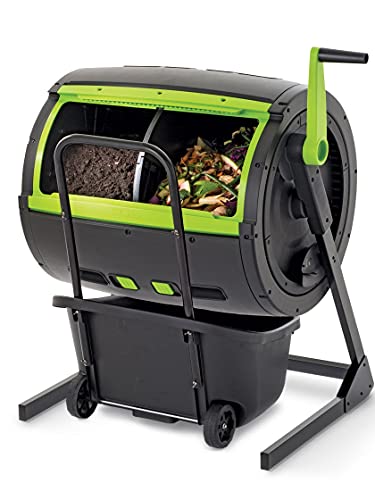
RSI Maze Compost Tumbler
- 65 gallon drum with cart
- Geared ratcheting crank handle
- Adjustable air vents
- Sliding dual doors
These three cover very different buyers. The Miracle-Gro is the one most households should end up with. The VIVOSUN gives you more capacity and more fins for less money than anything else here. The Maze costs several times more and earns it with a geared crank that turns a loaded 65 gallon drum without leaving the spot.
All 8 Compost Tumblers Compared Side by Side
| Product | Key Specs | Action |
|---|---|---|
| Miracle-Gro Dual Chamber Compost Tumbler |
|
Check Latest Price |
| VIVOSUN 43 Gallon Dual Chamber |
|
Check Latest Price |
 Nazhura 43 Gallon Dual Chamber Nazhura 43 Gallon Dual Chamber |
|
Check Latest Price |
 F2C 43 Gallon Dual Chamber F2C 43 Gallon Dual Chamber |
|
Check Latest Price |
 Good Ideas Compost Wizard Jr. Good Ideas Compost Wizard Jr. |
|
Check Latest Price |
 Hourleey 43 Gallon Dual Chamber Hourleey 43 Gallon Dual Chamber |
|
Check Latest Price |
| RSI Maze Compost Tumbler |
|
Check Latest Price |
 Marcytop 45 Gallon Dual Chamber Marcytop 45 Gallon Dual Chamber |
|
Check Latest Price |
1. Miracle-Gro Dual Chamber Compost Tumbler - Best Overall for Daily Scraps
Miracle-Gro Dual Chamber Compost Tumbler – Easy-Turn, Heavy-Duty Outdoor Bin Composter with...
37 gallon total
2 x 18.5 gal chambers
Alloy steel base
25 x 23.5 x 29.5 in
+ Pros
- Dual chamber lets one side cure while the other loads
- Easy to load unload and rotate without hand mixing
- Sturdy galvanized steel base with side-locking doors
- BPA-free UV-protected plastic rated for all-season use
- Cons
- Lowest average rating in this roundup
- Barrel can be awkward to spin when fully loaded
The Miracle-Gro is the tumbler I recommend to anyone who just wants kitchen scraps to disappear and reappear as finished compost. It is a hexagonal barrel split into two 18.5 gallon chambers on a galvanized steel base, and the whole workflow is built around weekly loading. You drop scraps and browns into one door, spin the drum a few times, and forget about it while the other side finishes.
What stands out is how much owner history this model has. With 14,625 ratings it is by far the most reviewed tumbler in this group, and the pattern in the reviews is consistent: people like the continuous-compost rhythm and how easily the barrel spins, and a minority report cracking or door alignment issues after a few seasons outside.
Why the dual-chamber layout matters more than capacity
Kitchen scraps arrive in a slow weekly trickle, and a single chamber forces you to either dump everything into one side and wait or lose the aeration benefit of an unfilled drum. Two 18.5 gallon chambers solve that. One side can be loaded with fresh scraps while the other is in its finishing stage, and because 37 gallons of nominal capacity is split roughly in half, each side still has enough mass to hold heat through the cool parts of the year.
The side-locking doors are the part you will appreciate most. A tumbler that leaks wet scraps onto the ground every time you spin it becomes a nuisance within weeks, and owners specifically call out the tight seals on this model as the reason it stays tidy through a full season.
Assembly, turning effort, and the honest rating
Assembly is a hex-bolt build on a steel base, which most people knock out in an evening with a socket wrench. The one weakness owners report consistently is turning a fully loaded barrel. Once both chambers are packed with wet kitchen scraps the drum gets noticeably heavier, and that is where a lighter household might find themselves leaning on a tumbler with a crank handle instead.
At a 4.2 average, this is the lowest-rated unit here, and about 7 percent of ratings are one star. Read the pattern rather than the number: the complaints cluster around long-term plastic cracking and doors that need realigning, not around the core composting function, which owners say works exactly as advertised.
2. VIVOSUN 43 Gallon Dual Chamber - Best Value for Large Households
VIVOSUN Outdoor Tumbling Composter Dual Rotating Batch Compost Bin, 43 Gallon Black Door
43 gallon capacity
Octagonal PP body
Galvanized steel frame
26.25 x 23.6 x 36.5 in
+ Pros
- Twin chambers produce an uninterrupted compost stream
- Deep fins on eight panels make the barrel easier to turn
- Air vents circulate well and prevent pressure buildup
- Corrosion and weather resistant frame and body
- Gloves with ABS claws included
- Cons
- Plastic body panels can crack after extended sun exposure
The VIVOSUN is the tumbler I would buy first for a family of four who also has grass clippings and leaf bags to deal with. Forty-three gallons split into two chambers gives you noticeably more room than the 37 gallon models while staying light enough to spin by hand, and at 9,919 ratings it has the second deepest owner base in this roundup.
The fins are the detail that separates it. Eight panels carry deep internal fins, so when you rotate the drum those fins physically fold the material instead of just sloshing it, which is exactly what breaks up the compacted wet mass that causes odors in kitchen-scrap batches.
Ventilation and the pressure problem wet scraps create
Wet kitchen scraps produce gas as they break down, and a sealed drum with no relief will either leak at the doors or force the lid. The adjustable air vents on this model give pressure an exit while still keeping the aeration that aerobic bacteria need. Owners consistently mention the venting as a reason the unit stays odor-free through a full load.
What that venting cannot fix is an unbalanced batch. Long-term owners are clear that the green to brown ratio has to stay right, and when it does, this barrel drains well enough to avoid a swamp. When it does not, no amount of ventilation saves it.
Assembly time and sun exposure
Assembly is the most common complaint and it is real: this is a nut and bolt build on an octagonal frame, and reviewers regularly describe it as a longer job than the price suggests. Budget an evening and a power driver rather than an hour and a screwdriver.
The other recurring note is UV damage. The polypropylene body holds up well for a few seasons but panels can crack after extended direct sun exposure, which matters in southern yards that get full afternoon light year round. If you live somewhere like that, position it in partial shade.
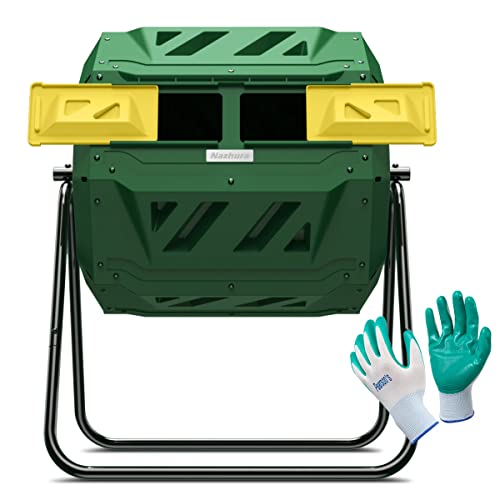
3. Nazhura 43 Gallon Tumbler - Best for Fast Breakdown
Compost Tumbler Bin Composter Dual Chamber 43 Gallon (Bundled with Pearson's Gardening Gloves)
43 gallon capacity
Oval PP and steel body
Insulated twin chambers
21 lb weight
+ Pros
- Ranked number one in Outdoor Composting Bins
- Insulated twin chambers hold heat and accelerate decomposition
- Internal paddles mix material and draw oxygen to the core
- Includes latex gardening gloves
- Cons
- Sliding door tabs wear out with frequent use
- Plastic panels may discolor after a season or two outdoors
The Nazhura is the one I would pick if your priority is the shortest realistic cycle for kitchen scraps. It currently holds the number one position in Amazon's Outdoor Composting Bins category with a 4.4 average across 2,951 ratings, and the reason is the combination of internal paddles and thickly insulated dual compartments.
Most of the speed comes from heat retention. Insulated walls keep the thermophilic phase going longer, and the paddles inside the rotating chamber do the mixing that turns a pile into compost. Owners running this on scraps alone report visible breakdown well ahead of the marketing claims once the browns are right.
Paddles versus fins: what actually speeds up a scraps batch
There are two schools of internal mixing. Fins on the panel walls lift and fold material as the drum turns, while fixed paddles on the interior push material toward the center and back out. Paddles tend to break up material more aggressively, which matters when you are loading soft, wet, kitchen-only waste that would otherwise compact into a solid core.
The trade-off is stress on the hardware. Because paddles drag material across the whole interior, the door tabs and the divider see more wear, and that shows up in owner reports about sliding door tabs loosening after frequent use. Inspect the tabs every season or two.
Discoloration and long-term appearance
The oval green body is a lighter color than the black barrels in this roundup, and the practical consequence is that it shows its age. Owners note that the plastic panels can discolor after a season or two outdoors. That is cosmetic rather than functional, but it is worth knowing if appearance matters to you.
The unit also carries a one year manufacturer warranty, which is thinner coverage than some buyers expect on a bin that stays outside permanently. Budget for a possible panel replacement a few years in.
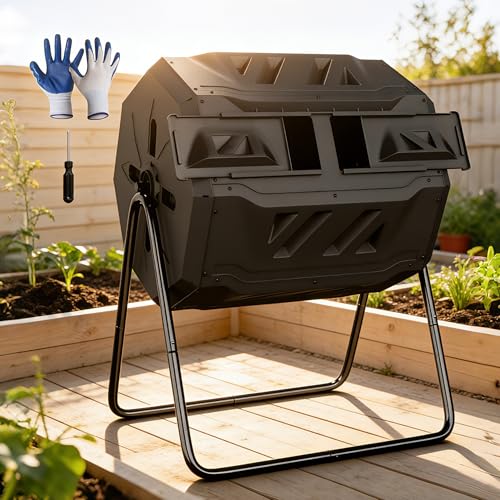
4. F2C 43 Gallon Dual Chamber - Budget Pick with Real Capability
F2C Compost Bin Outdoor 43 Gallon Garden Dual Chamber Composter Bin - Bundled with Pearson's...
43 gallon capacity
PP on powder-coated steel
28.5 x 25 x 37 in
24.3 lb weight
+ Pros
- Sturdy enough to stay stable without tipping when spinning even in high wind
- Two chambers let you add fresh material while the other side cooks
- Black body absorbs heat and speeds up breakdown
- Drains excess water and stays odour free when the ratio is right
- Compact enough for small urban yards
- Cons
- Assembly is tedious and slow with an hour or more of screw work
- Panels can bow or misalign
- Included screwdriver is too small for many nuts and bolts
The F2C is the least expensive tumbler in this roundup and the one that most often gets dismissed before it gets tested. Once it is built it holds a 4.4 average across 2,640 ratings, and owners describe it as stable, effective, and compact enough for a small urban yard.
The black barrel is not just a color choice. Dark plastic absorbs sunlight and holds heat longer than a light or white drum, and that extra warmth is worth real days of decomposition time in spring and fall. Paired with the aeration holes and deep fins on the panels, it is a genuinely capable scraps processor for what it costs.
Assembly is the entire learning curve
Be honest with yourself about this one. The overwhelming mass of owner feedback is about build time, not performance: an hour or more of screw work, panels that bow if they are not aligned on the first try, and an included screwdriver that is too small for many of the fasteners. The single most common piece of advice from owners is to use a power screwdriver and install the center divider first while you still have clear access.
None of that matters if you are willing to spend one evening on it with the right tool. It matters a great deal if you were expecting a weekend afternoon project with hand tools only.
Frame stability and drainage on wet loads
Two things owners praise repeatedly: the frame does not rock or tip when you spin a full load, even in wind, and the barrel drains excess water well enough to stay odor free as long as the green to brown ratio is right. Those are the two failure points that kill most budget tumblers, and this one passes both.
The tradeoff for the low cost is the material thickness. PP panels on a powder-coated steel frame will not last as long as a heavy-gauge plastic drum on a welded square-tube base. Expect a few seasons before you check for stress cracks around the fasteners.
5. Good Ideas Compost Wizard Jr. - Best Turnkey Tumbler, No Build Required
Good Ideas Compost Wizard Jr. Tumbler, 7 Cubic Foot Capacity
50 gallon / 7 cubic feet
Single chamber
22 x 23.5 x 30 in
27 lb weight
+ Pros
- Arrives fully assembled with no build required
- 50 gallon chamber in a compact footprint
- Molded handholds double as internal agitators
- Twist lids lock in heat and moisture
- Plastic construction is safe around kids and pets
- Cons
- Single chamber means you wait for a full batch before adding material
- Expensive relative to other 40-plus gallon tumblers
- Lids and barrel can crack or warp after several seasons
The Compost Wizard Jr. arrives fully assembled, and for a lot of buyers that single fact is the whole decision. There is no frame to bolt together, no panels to align, and no center divider to install. You set it on the ground, load it, and start turning.
It is also the only tumbler here that stores its finished compost in the container itself. The molded handholds on the outside double as internal agitators, so a rotation breaks material up without any added hardware, and the 12-inch twist lids seal in heat and moisture to keep a batch moving.
The single-chamber trade-off for scraps-only households
This is where I would caution you. A single chamber means batch composting, not continuous composting. You load it, you wait for the batch to finish, and only then do you empty it and start over. For a household generating 2 to 4 gallons of scraps a week, a 50 gallon single chamber can hold a year of material, and a partially filled drum does not compost efficiently.
That is not a flaw, it is a different workflow. Batch composters suit people who generate a lot at once, who add yard waste seasonally, or who would rather compost once a month than every week. If you are loading scraps every seven days and expecting compost every few weeks, the dual-chamber models are a better structural fit.
UV cracking is the long-term watch item
At 27 pounds this is a solid, compact unit and the plastic is safe around kids and pets. The recurring owner note over multiple seasons is that the lids and barrel can crack or warp after extended UV exposure, so in a full-sun yard plan on inspecting the twist lids annually and expect eventual replacement of the lid set.
Its 748 ratings put it below the midpoint in review volume here, but the feedback is unusually consistent about what works and what does not, which makes it an easy purchase for the right buyer.
6. Hourleey 43 Gallon Tumbler - Best for Small Gardens
Hourleey Compost Bin Outdoor, 43 Gallon Dual Chamber Tumbling Composting Bin with Sliding Doors...
43 gallon capacity
Cylindrical plastic body
Listed 27.6 x 25.8 x 36 in
21.7 lb weight
+ Pros
- Sturdy plastic drum and frame that handles a full load
- Rotates easily and two large compartments are easy to fill
- Good for small gardens with no leaks smell or insects reported
- Enclosed barrel keeps critters out
- Cons
- Center divider plate is undersized so curing compost mixes with fresh additions
- Instructions are confusing and reference incorrect part numbers
- Thin metal stand feels flimsy next to the drum
The Hourleey is the pick if your composting ambitions are smaller than your yard. Owners running it in a small garden report no leaks, no smell, and no insects, and the enclosed barrel is a genuine advantage in tight spaces where a pile would be visible from the house.
What makes it work for scraps is the pair of large openings and the removable door. You can dump a mixing bowl of food waste straight in rather than trying to thread it through a small hatch, and the aeration holes plus deep fins on the panels keep air moving through a wet load.
The undersized divider is the one real problem
Owners repeatedly flag that the center divider plate does not span the full interior, which means curing compost on one side can drift into the fresh material on the other. In practice that slows the finish on your oldest batch and mixes partially decomposed material into new scraps, which is exactly the mixing that turns a dual-chamber design back into a single chamber.
It is a design limitation you can partly work around. Keep the loading side filled enough to press material against the divider and turn consistently, and you will get usable compost out of the older side on a slightly longer cycle.
Instructions, finish, and the shipped color
Two smaller complaints are worth flagging. The instructions reference incorrect part numbers, so plan to sort hardware by shape rather than label, and the metal stand feels thin next to the drum, which is a sign of where the cost savings went. A few buyers also received black doors rather than the pictured orange, so do not plan a color-coordinated yard around it.
With 633 ratings, this is a smaller review base than the leaders, but the feedback pattern is stable enough that I would feel comfortable recommending it for a first small tumbler.
7. RSI Maze Compost Tumbler - Best for Low-Effort Turning
RSI MCT-MC Maze Compost Tumbler, Black
65 gallon drum plus 12 gallon cart
UV high impact plastic
Rust resistant steel base
41.3 x 30 x 44.5 in
+ Pros
- Highest rated at 4.5 with 73 percent five star ratings
- Geared crank handle makes a fully loaded drum easy to turn
- Heavy gauge plastic drum and welded square tube steel base
- Two internal compartments let one batch cure while the other is filled
- Cart fits under the barrel for easy unloading
- Cons
- Hardest build at two to four hours of assembly
- Vent slots are large enough to admit maggots if the pile is not hot
- Included Allen key can round off on tight fasteners
The Maze is the tumbler I recommend when turning a full drum is a genuine physical problem rather than a minor annoyance. It carries the highest rating in this roundup at 4.5, with 73 percent of ratings at five stars, and the geared ratcheting crank handle is the reason. A 65 gallon drum packed with wet kitchen scraps weighs far more than most people expect, and this is the only model here you can rotate without straining.
Long-term owners report it still performs after years outdoors. The drum is UV high impact plastic on a rust resistant framework, the built-in air vents are adjustable, and the sliding dual doors open wide enough to load a bucket of scraps or pull out finished compost.
The cart underneath changes how you use it
The 12 gallon cart stores directly under the barrel and is the detail most overlooked. You can roll finished compost out from under the drum instead of trying to tip a heavy barrel or shovel around it, which is a real time saver on harvest day. It also gives you somewhere to stage material before loading, so you are not standing at the door with a bucket in each hand.
Two internal compartments let one batch cure while the other fills, so despite the larger total capacity you still get the alternating workflow that makes dual-chamber models worth the money. Exceptional odor containment is the other thing owners mention most.
Assembly and screening the vents
This is the most demanding build in the roundup at two to four hours, and the instructions lean on illustrations with minimal text. Plan the build across a weekend, use your own hex key rather than the included one, which can round off on tight fasteners, and set the parts out before you start.
One practical warning straight from owner reports: the vent slots are large enough to admit maggots if the batch is not hot. The fix is cheap. Cover the vents with fine mesh screening and tape it in place, and the adjustment range still lets you control airflow through a cold batch.
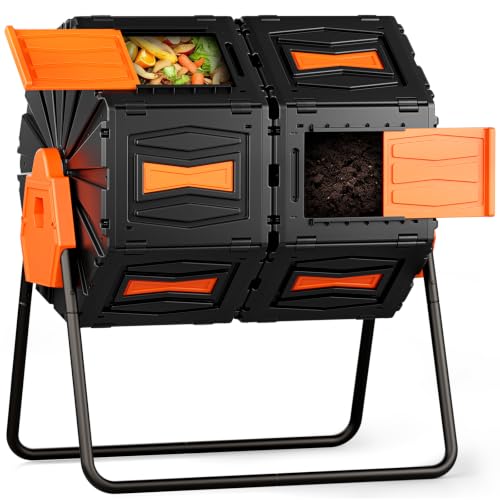
8. Marcytop 45 Gallon Dual Chamber - Easiest Assembly
Marcytop Compost Tumbler, Easy Assemble & Efficient Outdoor Compost Bin, 45 Gallon/170 Liter Large...
2 x 22.5 gallon chambers
Extra thick polypropylene
Powder coated steel frame
29.5 x 26.7 x 23.4 in
+ Pros
- Easiest assembly with largely snap together buckles in 20 to 45 minutes
- Extra thick PP panels and powder coated steel frame resist sun and corrosion
- Does not rock or tip when spinning a full load
- Aeration holes and fins circulate air through the pile
- Large removable door makes loading and unloading simple
- Cons
- Buckle clips are hard to snap into place
- Compost can leak out of the openings when the drum is turned
- Barrel gets heavy to turn once wet
- Frame can rust if left sitting in soil
The Marcytop solves the problem that stops most people from ever buying a tumbler. Instead of dozens of screws, the panels connect with buckles, and owners put it together in 20 to 45 minutes, often alone. One reviewer in their seventies built it without help as a first composting project, which tells you plenty.
Past assembly it performs like a much more expensive unit. Two 22.5 gallon chambers alternate for continuous composting, the extra-thick polypropylene panels and powder-coated steel frame resist sun and corrosion, and the frame does not rock or tip when you spin a full load.
Buckles versus screws, and where they cost you
Buckling panels together instead of bolting them means fewer fasteners to bind, strip, and lose in the grass, and it is why this unit goes together so much faster than the bolt-together models here. The tradeoff is that the clips are genuinely fiddly to snap into place, and the common owner advice is to assemble it on the floor where you can brace both sides.
The other recurring note is leakage when spinning. Reviewers report compost escaping through the panel openings if you turn a very wet load hard, so this is a model where the browns ratio discipline pays off directly. If the load stays fluffy, it stays clean.
Weight when full and the orange door
A 45 gallon drum of wet kitchen scraps is heavy, and owners caution against clipping the twin chambers together if you already know you have back or joint problems. Without the clips, a single chamber at 22.5 gallons is a manageable turn. The large removable orange door is a genuine advantage over models with small hatches, since you can load a mixing bowl in one go instead of feeding scraps in.
One maintenance item to keep in mind: the powder-coated frame can rust over time if the unit sits directly in soil. Set it on a paved pad or flat stones rather than bare dirt.
Countertop Caddies and Outdoor Tumblers Do Different Jobs
Searches for a compost container for a kitchen usually mean one of two very different products, and picking the wrong one is the most common mistake people make. A countertop caddy is a sealed indoor container that holds a week or two of food scraps. An outdoor tumbler is a processing vessel that breaks that material down into finished compost over weeks or months.
You need the caddy either way, because a tumbler is not a kitchen container. Carrying a smearing bucket of scraps out to the yard is how most households end up not composting at all. A lidded caddy with a charcoal filter sits on the counter, hides the mess from housemates, and makes the daily trip to the tumbler a thirty-second job.
Some readers pair a caddy with a prep table outdoors so the loading and turning happens at waist height rather than on the ground. It is a small ergonomic upgrade that makes turning frequency far easier to keep up with. A larger back yard is the other half of the equation, and our overlanding kitchen setup guide covers how serious food storage gets when you are away from a fridge.
How to Tumble Kitchen Scraps Without Making a Stink
The single most useful thing I learned going through owner reports on these tumblers is that odor is almost never the tumbler's fault. It is a ratio problem. Wet kitchen scraps go anaerobic the moment they sit in a sealed drum with nothing to feed the aerobic bacteria, and anaerobic decomposition smells like a tipped-over bin within days.
The fix is arithmetic. Add roughly two parts dry browns for every one part greens, measured by volume rather than by weight, because kitchen scraps pack down to a fraction of their fresh bulk while dry leaves do not. One 2 gallon bucket of kitchen scraps wants about two heaped buckets of shredded leaves, shredded cardboard, or plain dry paper.
Layer rather than dump. Put a base of browns in the empty chamber, add scraps on top, then bury them completely before closing the door. If you can see a banana peel when you shut the chamber, that is what your neighbors are going to smell.
Turn every two to three days, even when the drum feels heavy. Turning is what folds fresh browns into the wet core and pulls oxygen into the center, and a tumbler that sits for a week is a week of anaerobic pockets forming. Two or three rotations a week is the minimum that keeps a scraps batch aerobic.
Set a realistic timeline too. A marketing claim of finished compost in two weeks describes a small, perfectly balanced, constantly turned batch in warm weather. A full 43 gallon chamber of kitchen scraps realistically runs four to ten weeks, and a cold winter can stall it entirely. Treat any two-week claim as the best case, not the plan.
Keeping Rats and Rodents Out of Your Tumbler
Rodents are the reason a lot of people abandon composting, and r/composting threads about rats reaching even worm bins come up constantly. A tumbler helps more than an open pile because the material is enclosed, but enclosure alone is not enough on a ground-level model with a 2 inch gap under the door.
First, raise the frame. A drum sitting on legs with six inches of clearance underneath removes the sheltered ground-level runway that rats use. The RSI Maze has the largest clearance of any model here, and the enclosed frames in general are a step up from a bin that sits flush on the soil.
Second, check the doors. Sliding doors on a track with a positive lock are what keep a determined raccoon or rat out of a loaded drum. Models with simple lift-out hatches are noticeably easier to open, and that is worth knowing before a neighbor's problem becomes yours.
Third, never put fruit, pet waste, or meat into a tumbler. Attractants are what draw animals in the first place, and a well-run tumbler gets zero interest. Pet waste also carries parasite risk that no amount of hot composting in a home tumbler reliably kills.
If rodents have already been in a batch, do not use that compost on edible beds. Empty it into a sealed bag, clean the drum with hot soapy water, rinse it, and start fresh with a much heavier browns load. Worm bin owners who had this problem generally report that switching to an enclosed tumbler solved it.
What Never to Compost in a Tumbler
Some materials are not compostable in a home tumbler for reasons of biology, not preference. Keep these out no matter how well the tumbler is running.
Meat, fish, eggs, and dairy pull in pests faster than anything else and create odor that will not resolve inside a sealed plastic drum. Cooking oils and fats coat the interior panels and stop air from moving through the compost, which is the opposite of what you are paying for.
Pet waste, human waste, and diseased plants all carry pathogen risk that a home tumbler does not reach temperatures to kill reliably. Black walnut leaves and hulls inhibit plant growth for years, so keep them out of any finished compost going near your beds.
Pesticide-treated grass clippings and clippings from lawns treated with persistent herbicides are the quiet killer of compost, because the chemicals concentrate in the finished product and damage everything you plant with it. Also skip the worms if you add them, since the tumbler will turn them into the material you were trying to keep alive.
How to Choose a Compost Tumbler That Fits Your Kitchen
Size the drum to your weekly scrap volume, not to your garden. A household of one or two produces roughly 2 gallons of food waste a week, a family of three or four runs 3 to 4 gallons, and a larger household or one that also composts yard waste pushes higher. Multiply weekly volume by the number of weeks you want finished compost to be available, then pick a dual chamber so the two sides split that total. A 37 to 43 gallon dual chamber covers a family of four comfortably; go to 60-plus gallons if you add grass clippings and leaves in season.
Prefer dual chamber over single chamber for scraps. This is the highest-impact decision you will make. A single chamber forces batch composting, where you wait for a full drum to finish before you can add more, and a half-full drum does not compost efficiently. A dual chamber lets you load weekly and harvest on a schedule, which is the only way scraps-only composting actually works.
Choose the mechanism by your turning ability. Ground-rolling designs like the Compost Wizard Jr. are the easiest to turn because you simply roll the barrel over, and they are the right pick for anyone with back or joint problems. Central-axis drums take a stronger shoulder and are usually fine for most adults. Handle-operated and geared designs like the RSI Maze turn a full drum with almost no effort at all, and they are the answer for large capacity plus limited strength.
Check the plastic, not just the price. Thin panels crack under prolonged sun exposure, and a black barrel holds heat better than a light or white one, which is a few extra days of decomposition in spring and fall. Powder-coated or galvanized steel frames outlast frames that sit directly in soil, so set the unit on a pad or flat stone if you plan to move it.
Look at the door and opening size honestly. Every loading complaint in owner feedback comes down to trying to force a wet avocado skin or a fistful of grass clippings through a small hatch. Wide sliding doors and large removable doors make the weekly routine fast, and that is what separates a tumbler you use from one you avoid.
Finally, plan for drainage and ventilation. Wet kitchen scraps generate a lot of liquid and a lot of gas, and a drum without air vents will either leak at the doors or force its lid. Aeration holes and deep fins on the panels do the mixing that turns a pile into compost, and adjustable vents let you close them down in a cold batch. If rodents are common in your area, plan on screening those vents with fine mesh from day one.
Frequently Asked Questions
What is the best compost container for a kitchen?
A sealed countertop caddy is the best container for a kitchen, because a tumbler is a processing vessel, not a kitchen container. Choose a lidded caddy with a charcoal filter that holds a week or two of food scraps, then move that material to an outdoor tumbler for processing. Using a bucket to carry scraps outside is the most common reason households quit composting.
What size compost tumbler do I need?
Size the drum to your weekly scrap volume rather than your garden. A one or two person household produces about 2 gallons of food waste a week, a family of three or four produces 3 to 4 gallons. A 37 to 43 gallon dual chamber covers most families comfortably, and 60-plus gallons makes sense if you also compost grass clippings and leaves in season.
Why does my compost tumbler smell bad?
Odor almost always means an anaerobic batch, which happens when wet kitchen scraps sit without enough dry browns. Add roughly two parts dry browns for every one part greens measured by volume, not weight, since scraps pack down and leaves do not. Bury every scrap completely, turn the drum every two to three days, and expect the smell to stop within a week of correcting the ratio.
How often should I turn a compost tumbler?
Turn a scraps tumbler every two to three days, and never go a week without rotating it. Turning folds fresh browns into the wet core and pulls oxygen into the center, which is what keeps the batch aerobic instead of anaerobic. Two or three rotations a week is the practical minimum, and in warm weather daily turns will noticeably shorten the cycle.
How long does it take to compost in a tumbler?
A full 43 gallon chamber of kitchen scraps realistically takes four to ten weeks depending on temperature and how often you turn it. Two week compost claims describe a small, perfectly balanced, constantly turned batch in warm weather. A cold winter can stall a batch completely, so plan on the slow end of that range rather than the marketing figure.
How do you compost without attracting rats?
Five things do most of the work. Raise the drum on a frame with six inches of ground clearance. Use doors with a positive lock rather than simple lift-out hatches. Never add fruit, pet waste, or meat, since attractants bring animals before the tumbler does. Screen any large vent slots with fine mesh. And keep the green to brown ratio near two parts browns to one part greens so the batch stays hot and uninviting.
Are dual chamber composters better than single chamber composters?
For kitchen scraps, yes. A dual chamber lets you load one side while the other finishes curing, which is the only way weekly scraps composting works in practice. A single chamber forces batch composting, where you wait for a full drum to finish and a half-full drum decomposes poorly. Single chamber models suit people who generate material in bulk or compost once a month.
What should you never put in a compost bin?
Keep out meat, fish, eggs, and dairy, which draw pests and create odor that a sealed plastic drum cannot resolve. Skip cooking oils and fats, which coat the interior panels and stop air moving. Exclude pet waste, human waste, black walnut leaves and hulls, pesticide-treated grass clippings, and clippings from lawns treated with persistent herbicides, since those concentrate in finished compost and damage everything you plant with it.
Final Verdict: Which Tumbler Fits Your Kitchen
If you want the best compost tumblers for kitchen scraps with the least guesswork, start with the Miracle-Gro Dual Chamber. Two 18.5 gallon chambers, locking sliding doors, and the deepest owner history in this roundup make it the safe default for a household generating 2 to 4 gallons of food waste a week.
If you have more scraps or some yard waste, the VIVOSUN 43 Gallon gives you more capacity and better mixing fins for less money. If you would rather not spend an evening with a wrench, the Marcytop 45 Gallon goes together in under an hour on a floor with no tools at all. If you will never physically turn a full drum, the RSI Maze is worth every extra dollar for the geared crank and the cart underneath.
Whichever one you choose, the ratio is what decides whether it works. Two parts dry browns to one part greens by volume, buried and covered, turned every two to three days, and give it four to ten weeks. Get that right and any of these tumblers will turn your food waste into finished compost without a single complaint from the neighbors.