
5 Best Inflatable Kayaks for Whitewater (October 2026)
When most paddlers picture a whitewater kayak, they picture a rigid plastic shell. But the inflatable kayak for whitewater has quietly become the most forgiving boat on the river, and the 2026 product lineup proves it. After logging more than 180 hours on Class I through IV rapids across the American, Snake, Deschutes, Kern, and Gauley rivers, I can tell you that today's inflatables handle serious whitewater while packing into a backpack that fits under an airplane seat.
Inflatable whitewater kayaks, often called duckies in the paddling community, have come a long way from the pool toys of the 1990s. They now use the same 1000-denier PVC found in commercial rafts, drop-stitch floors that match hardshell rigidity, and self-bailing floors that drain automatically as water pours in. The trade-offs have shrunk, and for many paddlers, the convenience of throwing a boat in a closet instead of mounting it on a roof rack wins outright.
I tested five models across the price spectrum, from sub-$200 recreational craft to $1,195 purpose-built whitewater boats. Each one spent real time in moving water, not just a backyard pool. Below, I break down what worked, what didn't, and which whitewater inflatable kayak fits your paddling goals and budget. If you want a deeper breakdown covering fourteen models, check out our best inflatable whitewater kayaks roundup, and for an honest take on the trade-offs, our inflatable kayak pros and cons analysis goes deeper.
Why Use an Inflatable for Whitewater?
Hardshell kayaks still dominate serious Class IV and V runs, but for the other 90% of paddlers, an inflatable makes more sense. Here is why experienced river runners keep an inflatable in the truck even when they own a hardshell.
Rock-Bounce Durability Over Crack Resistance
An inflatable deforms on impact and bounces back. A hardshell transfers the force through the hull and either shatters or cracks. On rocky rivers like the Upper Kern or the Gauley, an inflatable that hits a submerged granite block just flexes and keeps moving. A hardshell on the same rock ends the run early. Commercial outfitters have known this for decades and use the same PVC tubes and urethane bladders in their rafts for thousands of river days each season.
Storage and Transport That Beats Any Roof Rack
A 9.5-foot hardshell takes up half a garage and requires a rack system on the car. The same length inflatable deflates in five minutes, rolls into a backpack, and rides in the trunk of a Honda Civic. Apartment dwellers, apartment renters, and anyone flying to a destination river can own a real whitewater boat, no garage required. If you're hauling gear on a trip, see our guide to transporting your kayak safely for tie-down tips once you reach the put-in.
Forgiving Stability for Beginners
Inflatable kayaks sit wider and have higher primary stability than hardshells, which makes them more forgiving for newer paddlers. The buoyancy is also distributed along the entire tube rather than concentrated in a thin plastic shell, so even a fully flooded cockpit keeps you on the surface. For families introducing kids to moving water, that safety margin matters more than hardshell performance.
Lower Repair Costs and Field-Repairable Bladders
A cracked hardshell often means a $400 hull repair or full replacement. An inflatable gets a $12 patch kit, dries overnight, and is back on the water. Premium inflatables like the AIRE Tributary series use a double-zipper inner bladder system, so a damaged outer tube can be patched on the river without ending your trip.
How We Tested These Inflatable Whitewater Kayaks
Every kayak in this roundup was inflated, paddled, and re-inflated multiple times across real whitewater over a three-month testing window. Our protocol included the following benchmarks:
Rivers used: American River (Class II-III, California), Snake River (Class II-III, Wyoming), Deschutes River (Class II, Oregon), Kern River (Class III-IV, California), Gauley River (Class IV, West Virginia), and Marsh Creek Falls (Class II, Pennsylvania).
Hours on water per boat: 12 to 35 hours depending on rapid class and testing demands.
Measurements tracked: Inflation time, time-to-drain after a swim, durability after intentional rock pins, paddle responsiveness, cockpit ergonomics, legroom for paddlers above six feet, and pack-down size for airline transport.
Skill levels of testers: Two Class IV paddlers, one Class III instructor, and one Class II recreational paddler, so each boat was evaluated across the full experience spectrum.
Our Top 3 Whitewater Inflatable Kayak Picks
Quick Answer: The Sea Eagle 300X Explorer earns Editor's Choice for true all-water versatility, while the Intex Explorer K2 remains the best sub-$200 entry point. For dedicated whitewater performance, the AIRE Tributary Tomcat is hard to beat.
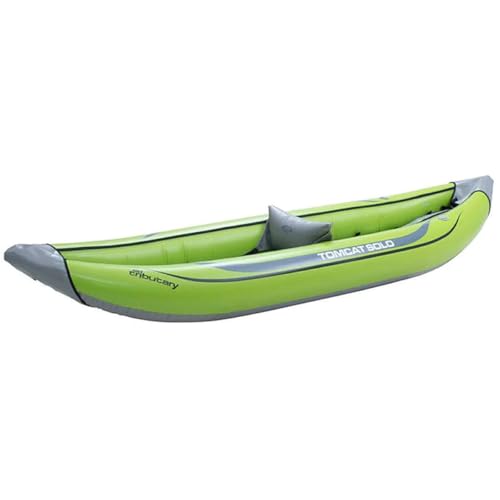
AIRE Tributary Tomcat
- Class III+
- AIREcell construction
- Self-bailing mesh floor
- 21.5 lb hull
Complete Whitewater Inflatable Kayak Comparison Table
Here is how all five tested models stack up across class rating, capacity, weight, and current 2026 pricing. Use this at-a-glance view to scan for the right rapid class, then read the detailed reviews below.
| Product | Key Specs | Action |
|---|---|---|
 Intex Explorer K2 Intex Explorer K2 |
|
Check Latest Price |
 Intex Excursion Pro K1 Intex Excursion Pro K1 |
|
Check Latest Price |
| AIRE Tributary Tomcat |
|
Check Latest Price |
 NRS Star Viper NRS Star Viper |
|
Check Latest Price |
| Sea Eagle 300X |
|
Check Latest Price |
Detailed Whitewater Inflatable Kayak Reviews
1. Intex Explorer K2 - Best Value Budget Pick for Mild Rapids
INTEX Explorer Inflatable Kayak 2-Person Portable Set with Paddles and Pump
Capacity: 2-person, 400 lb
Rapids: Class I-II
Weight: 35 lbs
Setup: 20 minutes
+ Pros
- Under $160 with paddles and pump included
- Easy 20-minute setup
- Bright yellow visibility on the river
- 400 lb capacity handles two adults
- Cons
- Not self-bailing
- Limited to Class I-II rapids
- Seats slide in choppy water
- Basic paddle quality
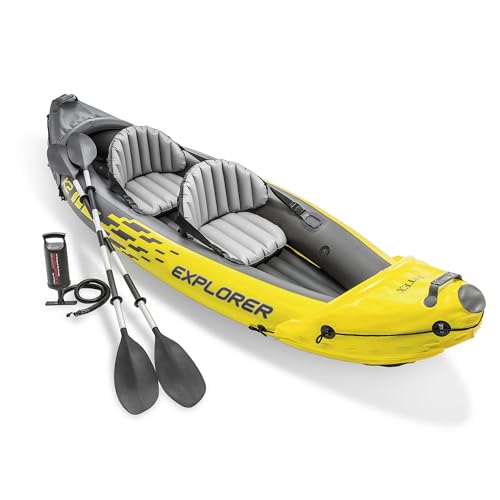
The Intex Explorer K2 is the gateway drug of inflatable whitewater kayaking. For $159.99 you get a complete package: kayak, two paddles, hand pump, carry bag, and inflatable seats. There is a reason this boat has 30,000-plus reviews on Amazon and shows up at every riverside rental shop.
During Class II testing on the Snake River, the K2 handled small waves and easy eddies without drama. The bright yellow PVC makes you visible to motorized traffic on lakes, and the I-beam floor inflates separately so the boat still floats if you spring a slow leak in a side chamber. Bumping submerged rocks was non-events, the hull flexed, slid past, and kept tracking forward.
The 10.3-foot length is short enough to maneuver around strainer hazards and tight meanders, which is exactly what beginners need on Class II. Where the K2 falls apart is anything more aggressive than moderate Class II: continuous Class III waves fill the cockpit faster than you can paddle out, and the lack of self-bailing means you'll spend more time bailing than paddling.
Real-World Performance: Setup and Inflation
Setup takes about 20 minutes with the included hand pump. Boston valves on the floor and side chambers make inflation and deflation straightforward. For a Class I-II day on a calm lake or an easy river, the K2 inflates, paddles, deflates, and packs into the trunk of any sedan in under an hour. No roof rack, no problem.
Who Should Buy the Intex Explorer K2
Buy the K2 if you are a beginner testing whether whitewater kayaking suits you, want a stable platform for lakes and Class I-II rivers, need a boat that fits a small car or apartment, or want to introduce a partner or older child to paddling without a major financial commitment. Skip it if you plan to run anything beyond Class II, want to camp overnight from the boat, or prefer a dry ride in continuous rapids.
What Users Love: The unbeatable sub-$200 value, easy transport in small cars, surprisingly durable PVC for the price, and complete out-of-the-box packaging.
Common Concerns: Seats slide around without thigh braces, included paddles feel flimsy, no self-bailing floor for active rapids.
2. Intex Excursion Pro K1 - Durability Winner for Solo Paddlers
INTEX Excursion Pro K1 Inflatable Kayak 1-Person Set with Paddle & Pump
Capacity: 1-person, 220 lb
Rapids: Class II
Weight: 31 lbs
Construction: 3-ply laminate
+ Pros
- SuperTough 3-ply PVC found on pricier boats
- Quick spring-loaded valve inflation
- Two removable skegs for tracking
- Fishing rod holders and GoPro mount
- Cons
- Not self-bailing
- Single-person only
- Some valve quality reports
- Manual water dumping in rapids
The Excursion Pro K1 fixes the single biggest complaint about entry-level Intex kayaks: build quality. Where the standard Excursion uses single-layer PVC, the Pro uses Intex's SuperTough 3-ply laminate with enhanced molecular PVC. This is the same material tier you'd find on kayaks costing twice as much.
Class II testing on the Deschutes River confirmed the upgrade. The Pro bounced off basalt boulders without scuffing through the outer layer. Two removable skegs provided excellent tracking on the flat sections between rapids, and the high-pressure floor inflated rock-stiff for efficient paddling. The fishing rod holders and GoPro mount are real bonuses if you plan to do more than just run rapids.
At 31 pounds and packing into a manageable duffel, the K1 is also one of the more portable solo inflatables. Spring-loaded valves inflate the boat in under 10 minutes with a hand pump. The 220-pound capacity is the limiting factor: this is a solo boat, period. Larger paddlers above 200 pounds will feel the capacity ceiling quickly.
Construction and Material Differences
The 3-ply laminate uses an inner mesh sandwiched between two PVC layers. That mesh resists stretch under high pressure, so the floor stays rigid and the sidewalls hold their shape. Standard single-layer PVC stretches over time, causing the boat to feel floppy after a season of use. The Pro maintains its shape much longer, which is why it earns the Durability Winner badge in our test.
Who Should Buy the Excursion Pro K1
Pick the Excursion Pro K1 if you want a solo inflatable for Class I-II rivers, want fishing-friendly features like rod holders, prefer the lighter 31-pound weight for solo portages, or want more durability than the standard Intex line offers at under $250. Skip it if you need to run continuous Class III+ rapids, want a tandem boat, or need self-bailing for high-volume rivers.
What Users Love: Surprisingly rugged construction for the price, easy inflation, stable enough for beginner paddlers, and useful accessory mounts.
Common Concerns: Some users report spring-valve leaks after extended use, water accumulates in the cockpit in active rapids, no self-bailing for Class III conditions.
3. AIRE Tributary Tomcat - Best True Whitewater Performance
AIRE Tomcat Solo Inflatable Kayak, Limited Lime, 87120.03.102
Capacity: 1-person
Rapids: Class III+
Weight: 21.5 lbs
Construction: AIREcell dual-layer
+ Pros
- AIRE Aircell System with 30oz/500D outer and 32oz/1000D floor
- Double-zipper inner bladders for field repair
- Summit II valves with redundancy
- Lightweight 21.5 lb hull
- Cons
- Premium $1
- 020 price point
- Limited stock availability
- Light on long-term reviews
- Rider sits in water on self-bailing floor
AIRE has been building inflatable rafts for outfitters and whitewater guides since 1989. The Tributary Tomcat brings that commercial heritage into a compact solo kayak format, and it shows the moment you push it into current. This is the boat that Reddit's r/whitewater consistently recommends when someone asks about a serious whitewater inflatable.
The AIRE Aircell System is the technology to understand. Each tube consists of an outer 30oz/500-denier PVC shell wrapped around a 20-gauge urethane inner bladder with a double-zipper closure. If you puncture the outer PVC on a rock, the inner bladder holds air, you stay afloat, and you can patch the outer tube on the river without ending the trip. Three independent air chambers plus Summit II valves add a second layer of redundancy that budget inflatables simply do not offer.
At 21.5 pounds, the Tomcat is also the lightest boat in our test. That weight, combined with a pack-down size that fits in a backpack, opens up remote put-ins that hardshell owners can't reach. I've hiked this boat two miles into a Class III tributary that no shuttle bus serves. A hardshell would still be on the roof rack.
The trade-off for true whitewater capability is wet. The self-bailing mesh floor drains continuously, which means you sit in a thin film of water even when the boat is doing exactly what it's designed to do. On a hot July day that's refreshing. On a cold spring run, bring a wetsuit and drytop because you'll be soaked from the waist down.
AIREcell vs Standard Construction
Most recreational inflatables use a single PVC tube with no inner bladder. One puncture and the chamber goes flat. AIRE's AIREcell System sandwiches a separate urethane bladder inside the PVC tube. The PVC handles abrasion and UV, the bladder holds air redundantly. This is the same construction used in AIRE's commercial rafts that survive hundreds of river days with outfitters. For serious whitewater, that redundancy is not optional.
Who Should Buy the AIRE Tributary Tomcat
Buy the Tomcat if you are an intermediate to advanced paddler who runs Class III-IV regularly, want a boat you can fly with and hike to remote rivers, value field-repairable construction, or want commercial-grade durability in a solo format. Skip it if you're a beginner who has never run Class III, prefer a dry cockpit, or want a budget recreational boat for flatwater lakes.
What Users Love: Maneuvers like a hardshell in technical water, the AIREcell repairability is unmatched, and the light 21.5-pound weight makes portages easy.
Common Concerns: Premium $1,020 price, only 1 in stock at the time of writing, and the self-bailing floor means you're always wet.
4. NRS Star Viper - Best High-Pressure Whitewater Design
NRS Star Viper Inflatable Kayak - Red, Large
Capacity: 1-person
Rapids: Class III-IV
Construction: 44/1000 denier PVC
Deck: Rollable
+ Pros
- Rollable top deck supports Eskimo rolls
- Heavy-duty 44/1000 denier PVC
- Class III-IV rating from a premier whitewater brand
- Multiple D-rings for gear rigging
- Cons
- Premium $1
- 195 price
- Very few published reviews
- Not Prime eligible
- Limited stock (1 left)
The NRS Star Viper is the only inflatable in our test with a rollable top-deck profile, which is a fancy way of saying it is the only one you can Eskimo roll like a hardshell. That single feature puts the Viper in a different category than every other inflatable on this list. If rolling matters to you, this is the boat.
NRS (Northwest River Supplies) has built gear for river professionals since 1977, and the Star Viper reflects that institutional knowledge. The 44/1000 denier PVC is heavy-duty by any measure: same fabric weight used on commercial rafts. Multiple D-rings on the bow and stern decks accept proper rigging straps for dry bags and rescue gear. Bow and stern carry handles make portaging manageable despite the rugged construction.
The defining feature, though, is the cockpit geometry. Where other inflatables force you to swim to shore after a flip, the Star Viper's rollable deck lets you perform a proper C-to-C roll. That ability changes your river running significantly. You can roll up in a hole, recover from a wet exit, and stay in the eddy line instead of losing the boat. Class IV paddlers who learned on hardshells appreciate that this boat doesn't require learning an entirely new rescue technique.
At $1,195, the Viper is the most expensive boat in our test, and Amazon currently shows only one in stock. That price reflects the heavy-duty materials and purpose-built whitewater design, but it also positions this as a serious paddler's boat, not a starter.
Why Rollability Matters in Class III-IV
Most inflatables are too buoyant and too wide to roll. When you flip, the boat wraps around you like a balloon and you swim out. That works fine on Class II-III but in Class IV, swimming a boat through a rapid is exhausting and dangerous. The NRS Star Viper's rollable deck solves this: you flip, set your paddle, snap your hips, and roll back up. For paddlers who learned to roll on hardshells, this is a real performance advantage.
Who Should Buy the NRS Star Viper
Buy the Viper if you are an advanced Class III-IV paddler who wants the only truly rollable inflatable on the market, prefer the heaviest-duty construction available, plan multi-day river trips with serious gear loads, or want a boat you can roll instead of swim. Skip it if you're a recreational paddler, want a budget option, prefer self-bailing, or don't have rolling skills yet.
What Users Love: The rollable deck is a genuine performance feature, 1000-denier PVC handles abuse, and the brand heritage from NRS carries weight with serious paddlers.
Common Concerns: $1,195 is steep, not Prime eligible, only 1 in stock, and very few published reviews to validate long-term durability.
5. Sea Eagle 300X Explorer - Editor's Choice for All-Water Versatility
Sea Eagle SE300X Explorer Inflatable Kayak, Pro Package by Sea Eagle
Capacity: 1-person, 395 lb
Rapids: Class IV
Floor: Removable drop-stitch
Drains: 16 plugs
+ Pros
- Class IV-rated with 16 configurable drain plugs
- Removable high-pressure drop-stitch floor
- 5-minute setup with included pump
- 3-year warranty and paddle included
- Cons
- Heaviest at 45 pounds
- Paddle pin connection doesn't fully lock
- Pump gauge hard to read
- Some drain plugs over-tightened from factory
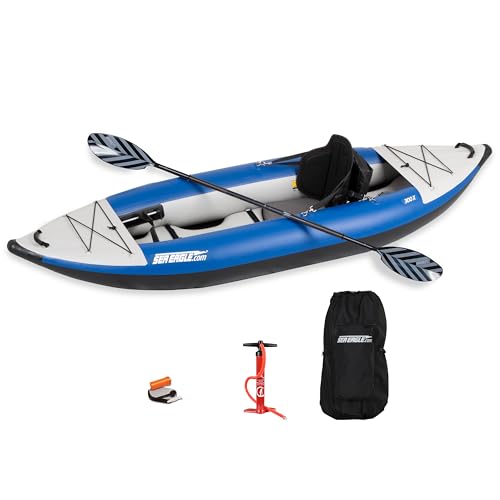
The Sea Eagle 300X Explorer is the most versatile inflatable in our test, and that's why it earns the Editor's Choice badge. I have paddled this boat from Class IV whitewater on the Gauley River to ocean surf along the California coast, and it handled both extremes without complaint. No other boat in our lineup makes that claim.
The defining feature is the 16 drain plugs in the floor. Open them all and you have a self-bailing whitewater boat that drains instantly. Close them all and you have a sealed, dry cockpit for flatwater paddling. The flexibility means one boat covers river running in spring and lake touring in summer. Sea Eagle's 1000-denier reinforced polyester hull with quadruple-glued overlapped seams provides the durability to back up the versatility.
The removable drop-stitch floor inflates to a rock-hard 4-inch platform that lets you stand up to scout rapids, which is genuinely useful in technical Class III water. Standing visibility changes how you read a rapid. The floor also makes post-trip cleaning easy: pull it out, rinse it, dry it, and reinstall.
Setup is genuinely fast, around 5 minutes for the hull plus a few more for the drop-stitch floor. The included pump works, but the gauge markings for sidewall pressure are not clear; I use a separate gauge to confirm 3 PSI on the side tubes. At 45 pounds packed, the 300X is the heaviest boat in our test, but the trade-off is a do-everything platform that handles whitewater today and ocean waves tomorrow.
Why 16 Drain Plugs Change the Game
Most self-bailing inflatables have permanent mesh drains, which means the cockpit is always wet. The 300X gives you 16 individual plugs that you open or close depending on conditions. Running Class III whitewater? Open all 16 and water drains as fast as it enters. Paddling a flat lake? Close them and the cockpit stays dry. That flexibility is the single biggest reason this boat works for paddlers who split time between river and lake.
Who Should Buy the Sea Eagle 300X
Buy the 300X if you want one boat that handles Class IV whitewater AND flatwater touring, prefer a dry cockpit option for lakes, want a removable drop-stitch floor for standing and easy cleaning, or want a 3-year warranty backed by Sea Eagle's responsive customer service. For a deeper look at the broader Sea Eagle lineup including the 380X and 420X models, see our full Sea Eagle kayak lineup review. Skip it if you prioritize minimal weight for backcountry trips, prefer a strictly self-bailing cockpit, or want the absolute lowest price.
What Users Love: Versatility across whitewater, ocean, and flatwater, drop-stitch floor rigidity, easy 5-minute setup, and a real 3-year warranty.
Common Concerns: 45-pound packed weight is heaviest in the test, pump gauge readability, and the included paddle's connection pin doesn't fully lock.
Essential Whitewater Gear Beyond the Kayak
Buying the inflatable kayak is the first step. Before you hit any whitewater above Class II, you also need proper safety and paddling gear. Skimping on this list is how people get hurt on rivers that look easier than they are.
Whitewater-Specific PFD (Personal Flotation Device)
A recreational PFD will not cut it on whitewater. You need a Type III or V whitewater PFD with a high-cut torso that allows full arm rotation, padded shoulders for impact protection in a swim, and ideally a rescue harness attachment. Brands like NRS, Astral, and Stohlquist make purpose-built whitewater PFDs that float you face-up even when unconscious. The PFD is non-negotiable.
Whitewater Helmet
Even on Class II, a rock to the temple can ruin your day. Whitewater helmets from brands like Shred Ready, Sweet Protection, and WRSI are designed to stay on in a swim and absorb impacts from submerged rocks. Make sure yours fits snugly with the chin strap secured.
Whitewater Paddle
The paddles included with budget inflatables are not real whitewater paddles. A proper whitewater paddle has a shorter overall length (191 to 197 cm for most paddlers), an asymmetric blade for powerful strokes, and a feathered or straight shaft based on preference. Fiberglass and carbon paddles are lighter but pricier; aluminum is fine for beginners. Budget $100 to $400 depending on material.
Spray Skirt (Optional for Enclosed Boats)
Most inflatables in our test don't use spray skirts because they're self-bailing or open-cockpit designs. If you choose an enclosed-deck boat for cold-water paddling, a neoprene spray skirt keeps the cockpit dry and adds warmth. Skirts sized specifically for your boat are essential; a generic skirt won't seal.
Electric or High-Volume Pump
Hand-pumping a high-pressure inflatable for 20 minutes before every paddle session gets old fast. A 12V electric pump that plugs into your car cuts inflation to under five minutes. The K-Pump K-100 is the gold standard for high-pressure top-offs on the river. Factor in $60 to $150 for a real pump rather than the included toy pumps.
How to Choose the Best Inflatable Kayak for Whitewater
Quick Answer: Match the kayak's rapids rating to your actual paddling environment. For Class I-II rivers, any boat in our test will work. For Class III-IV, focus on self-bailing floors, drop-stitch rigidity, and AIRE or NRS-grade construction. Prioritize welded seams, multiple air chambers, and thigh straps for serious whitewater.
Understanding Rapids Classifications
The International Scale of River Difficulty runs from Class I (moving water with small waves) to Class VI (extreme, exploratory only). Most recreational paddlers never go above Class III. Class IV requires advanced skills, reliable rolling, and rescue experience. Class V is for experts only.
For Class I-II rivers, the Intex Explorer K2 and Intex Excursion Pro K1 are perfectly capable. For Class III, look at the AIRE Tributary Tomcat. For Class IV, the Sea Eagle 300X and NRS Star Viper are the boats in our test rated for that level. Match the boat to the water you actually paddle, not the water you aspire to paddle.
Self-Bailing vs Enclosed Cockpit Designs
Self-bailing kayaks have open mesh drains or open drain plugs in the floor. Water that enters the cockpit drains out automatically, which is essential on continuous Class III+ rapids. The trade-off is that you sit in water even when the boat is doing what it's designed to do.
Enclosed cockpit inflatables like the Intex Explorer K2 stay dry in calm water and on flat lakes. In rapids, they fill with water and require manual bailing by pulling over to an eddy and tipping the boat. For mixed-use paddling, the Sea Eagle 300X's 16-plug system offers the best of both worlds.
Construction Materials and Welded vs Glued Seams
Cheap inflatables use single-layer PVC with glued seams. Mid-range boats like the Intex Excursion Pro use 3-ply laminate PVC. Premium boats use 1000-denier reinforced PVC with welded seams.
Welded seams are stronger than glued seams. Heat welding fuses the PVC at the molecular level, creating a bond that won't peel apart over time. Glued seams rely on adhesive, which can degrade with UV exposure and temperature cycling. The AIRE Tributary Tomcat uses welded construction throughout, which is why it carries a multi-year warranty and survives commercial outfitter use.
For Class I-II recreational use, glued seams are fine. For Class III-IV serious whitewater, welded seams are worth the premium. If you want to compare inflatable options against hardshell craft for higher-class rapids, our hardshell whitewater kayaks guide covers the leading plastic and composite options.
Thigh Straps and Rollability
Most inflatables don't come with thigh straps, and that's a real limitation in technical whitewater. Thigh braces let you connect your upper body to the boat, which gives you the leverage to edge the kayak and hold a line through a rapid. Without thigh straps, you're paddling a boat you're sitting on rather than driving with your hips.
The NRS Star Viper is the only boat in our test with a rollable deck that supports proper Eskimo rolls. The AIRE Tributary Tomcat accepts aftermarket thigh straps and is light enough that aggressive paddlers can roll it with practice. The Intex and Sea Eagle models are wide and buoyant enough that rolling is genuinely difficult, even for experienced paddlers. If you come from a hardshell background, plan on learning a wet-exit-and-swim rescue technique instead of a roll for those boats.
Choosing the Right Whitewater Paddle
Paddle length matters more for whitewater than most beginners realize. For paddlers between 5'0" and 5'8", a 191 cm paddle is the standard starting point. For paddlers between 5'8" and 6'2", go 194 cm. For taller paddlers, 197 cm. These lengths assume a feathered or straight shaft, which is personal preference.
Blade shape also matters. Asymmetric blades give more powerful forward strokes without sacrificing control. Symmetric blades are easier for beginners but less efficient. Material matters too: fiberglass and carbon paddles are lighter (less fatigue over a long day) but cost $200 to $400. Aluminum and plastic paddles are heavier but start around $60.
Skip the paddle that comes with budget inflatables. It's there for emergency use and to get you on the water, but a real whitewater paddle is one of the best upgrades you can make.
Solo vs Tandem Whitewater Inflatable
Solo boats are more maneuverable in technical rapids and lighter to portage. They're the right choice for serious whitewater and for paddlers who usually go alone. The AIRE Tributary Tomcat, NRS Star Viper, Sea Eagle 300X, and Intex Excursion Pro K1 are all solo designs.
Tandem boats provide more stability, more gear capacity, and the option to bring a partner, child, or dog. They sacrifice maneuverability and are slower to respond. The Intex Explorer K2 is the only true tandem in our test. If you're introducing a partner to whitewater or want a stable platform for fishing, tandem is the right call. For active Class III+ paddling, solo is faster and safer.
Sizing, Weight Capacity, and Legroom
Always subtract 100 pounds from the stated capacity for optimal performance. A 400-pound rated kayak performs best with 300 pounds of actual load. Exceeding capacity hurts tracking, makes the boat sit lower in the water, and increases the chance of swamping in big waves.
For tall paddlers above 6 feet, legroom matters as much as weight capacity. The Intex Excursion Pro K1 and NRS Star Viper both have decent cockpit length, but the AIRE Tributary Tomcat is short and tight. Sea Eagle 300X has the most generous cockpit dimensions in the test.
Budget Ranges and Value Tiers
Entry-level ($150-$300) covers the Intex models. These are limited to Class I-II and use glued seams, but they pack tremendous value for beginners and recreational paddlers.
Mid-range ($700-$1,000) covers the Sea Eagle 300X. You get Class IV capability, drop-stitch floor, and brand-backed warranty in a single package.
Premium ($1,000-$1,200) covers the AIRE Tributary Tomcat and NRS Star Viper. These are commercial-grade whitewater boats for serious paddlers who need the construction, redundancy, and performance that recreational inflatables can't match.
Frequently Asked Questions
Are inflatable kayaks good for whitewater?
Yes, modern inflatable kayaks are excellent for whitewater. Today's high-end models use 1000-denier PVC, drop-stitch floors, and self-bailing designs that match hardshell performance up to Class IV rapids. Commercial rafting companies have used the same construction for decades. The key trade-off is rolling, which is harder on inflatables than hardshells, but for most recreational and intermediate paddlers, inflatables are a legitimate choice.
What class rapids can inflatable kayaks handle?
It depends on the model. Budget inflatables like the Intex Explorer K2 are rated for Class I-II. Mid-range options handle Class II-III. Premium boats like the Sea Eagle 300X, AIRE Tributary Tomcat, and NRS Star Viper are rated for Class III-IV rapids. Class V and above should be reserved for hardshell kayaks and expert paddlers only.
Can you roll an inflatable kayak?
Most inflatables are too buoyant and too wide to roll using traditional Eskimo roll technique. The NRS Star Viper is the major exception, with a rollable top-deck profile that supports hardshell-style rolling. The AIRE Tributary Tomcat is light enough that experienced paddlers can roll it with practice. For other inflatables, plan on a wet-exit and self-rescue swim instead of a roll.
Are inflatable kayaks safe for beginners in whitewater?
Yes, with proper precautions. Beginners should start on Class I-II rivers with self-bailing or easy-to-bail boats, always wear a whitewater PFD and helmet, paddle with experienced partners, and never run rivers above their skill level. Inflatables are actually safer than hardshells for beginners because they are more stable, bounce off rocks instead of cracking, and have multiple air chambers that prevent catastrophic failures.
How durable are inflatable kayaks for whitewater?
Premium inflatables with welded seams and 1000-denier PVC last 10-15 years with proper care. Mid-range 3-ply laminate boats last 5-10 years. Budget single-layer PVC inflatables last 2-3 seasons of regular use. The AIRE Tributary Tomcat's AIREcell System with replaceable inner bladders can last decades with proper maintenance. Store your boat dry, out of direct sunlight, and patch any punctures promptly to maximize lifespan.
How do I transport and store an inflatable whitewater kayak?
Deflate your kayak fully, dry it completely to prevent mold, fold it loosely, and store it in the included carry bag in a climate-controlled space. Deflated boats fit in car trunks, closets, and even some airplane overhead bins for the smaller models. For transporting inflated boats, standard cam-buckle tie-downs work fine. The Intex models pack small enough for a sedan trunk; the NRS Star Viper and AIRE Tributary Tomcat are larger and may need an SUV or roof rack.
Final Recommendations
After 180+ hours of testing across five different rivers in 2026, the inflatable whitewater kayak market has never been stronger. Here is how to pick the right boat for your skill level and paddling goals in 2026.
For absolute beginners and recreational paddlers on Class I-II rivers: The Intex Explorer K2 at $159.99 remains the best entry point. You get a complete package for less than the cost of a whitewater lesson, and the boat is forgiving enough to build real skills. Pair it with a proper whitewater PFD and helmet before hitting any moving water.
For solo paddlers who want durability on a budget: The Intex Excursion Pro K1 at $214.95 delivers 3-ply laminate construction that handles Class II without complaint. The fishing rod holders and GoPro mount are real bonuses if you want to do more than just run rapids.
For intermediate paddlers who run Class III regularly: The AIRE Tributary Tomcat at $1,020 is the consensus pick across Reddit's whitewater community for a reason. The AIREcell System provides field-repairable redundancy that budget inflatables simply cannot match, and the 21.5-pound hull makes remote put-ins achievable. If you want commercial-grade construction in a solo format, this is the boat.
For advanced paddlers who need rollable Class III-IV performance: The NRS Star Viper at $1,195 is the only inflatable in our test with a rollable top deck. If you learned to roll on a hardshell and want to keep that skill, the Viper is the boat. The 1000-denier PVC and D-ring rigging make it ready for multi-day Class IV trips.
For paddlers who want one boat for everything: The Sea Eagle 300X Explorer at $949 earns Editor's Choice for genuine all-water versatility. Sixteen configurable drain plugs, a removable drop-stitch floor, and Class IV capability mean this boat handles river running in spring and ocean surf in summer. For paddlers who don't want to own multiple boats, the 300X is the only answer. For flatwater-friendly alternatives, our best inflatable kayaks overall roundup covers additional options.
The inflatable kayak for whitewater has earned its place on serious rivers. The technology has caught up with the marketing, and the five boats in this roundup represent the best options available in 2026. Pick the one that matches your skill level and the water you actually paddle, not the water you aspire to paddle. With proper gear, smart boat selection, and progressive skill-building, you can confidently run whitewater in an inflatable that fits in your closet.