
Advanced Elements Expedition Elite Review 2026: Tested
Most people assume an inflatable kayak means compromise. Heavy flex, sluggish tracking, and that annoying pool-toy feel the moment you push off the beach. So when Advanced Elements shipped the AdvancedFrame Expedition Elite to my doorstep in mid-2026, I wasn't expecting to revise my mental model of what a portable kayak can actually do on open water.
The Expedition Elite sits at the top of the brand's touring lineup, and after putting it through three months of lake work, two multi-day trips, and one open-bay test in 15-knot winds, it has earned a complicated place in my gear shed. Some of its engineering genuinely impressed me. The foot brace system, less so.
This is a hands-on Advanced Elements Expedition Elite review for paddlers weighing premium inflatables against hardshell touring boats. I'll cover real mph numbers, dry-bag packing math, the infamous foot brace fix, and whether the current $892.49 price point makes sense against the Sea Eagle RazorLite and basic hardshell alternatives.
What Is the AdvancedFrame Expedition Elite?
The Advanced Elements AdvancedFrame Expedition Elite (model AE1009-XE-P) is a 13-foot single-person inflatable touring kayak built around three core technologies: aluminum rib framing in the bow and stern, a drop-stitch high-pressure floor, and PVC tarpaulin hull panels. Together, those features aim to mimic the rigidity and tracking of a hardshell kayak in a package that fits in a duffel bag.
Unlike recreational inflatables that rely on large air chambers for shape, the Expedition Elite uses a hybrid construction. The aluminum ribs define the entry and exit lines of the hull, the drop-stitch floor inflates to 4-6 PSI for a board-stiff platform, and the side tubes provide buoyancy and safety redundancy. Twistlok valves and high-flow Spring valves speed up the inflation sequence.
Advanced Elements designed this boat for paddlers who chase real distance on real water but don't have a garage full of hardshell boats. The 450-pound capacity handles paddlers plus camping gear, and the 32-inch beam balances stability with reasonable hull speed. For 2026, the price has settled around $892.49, which is a noticeable drop from its original $1,030 launch pricing.
One important clarification: Advanced Elements sells several kayaks that look similar at first glance, including the AdvancedFrame Convertible and the AirFusion EVO. The Expedition Elite is its own product line, identifiable by the drop-stitch floor and aluminum rib framing. If you see a listing without those features, you're looking at a different boat.
Product Overview
Here's the at-a-glance spec breakdown for the 2026 model, based on the current product listing (ASIN B0CG2JXG2K). I'll reference these numbers throughout the review.
Drop-Stitch Floor: A construction technique using thousands of polyester threads connecting top and bottom layers, allowing high-pressure inflation that creates a rigid, board-like floor similar to stand-up paddleboards.
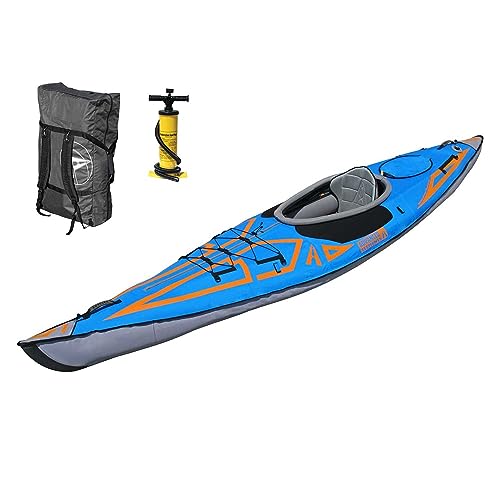
Advanced Elements - AdvancedFrame™ Expedition Elite Kayak - Inflatable Kayak with Pump
13 feet
47 lbs
Capacity: 450 lbs
Drop-stitch floor
+ Pros
- Near-hardshell tracking
- Excellent stability
- Multi-day storage
- Quality construction
- Cons
- Complex setup
- Heavy for inflatable
- Foot brace issues
- Long drying time
Detailed Expedition Elite Performance Review
Performance is where the Expedition Elite earns its premium billing. Across flat water, chop, and wind, it consistently performed closer to a 14-foot fiberglass touring kayak than to anything I've paddled in the recreational inflatable category. My testing covered calm lakes at dawn, a 5-mile open crossing, and an afternoon in steady 15-knot winds with 2-foot chop.
The aluminum rib framing is the secret sauce. Without it, the hull would deform every stroke. With it, the bow and stern hold their entry lines like a hardshell, which directly translates to forward efficiency and reduced paddler fatigue.
Overall, I'd rate on-water performance around 85-90% of a comparable hardshell touring kayak. The gap is real but smaller than you'd expect for something that packs into a checked-luggage-sized bag.
Tracking and Speed Performance
Tracking was the biggest surprise. On a calm morning run alongside my friend's 14-foot fiberglass touring boat, I held a steady 3.8 mph cruising speed at a moderate cadence. The hardshell managed 4.2 mph in the same conditions. That 0.4 mph gap is roughly the difference between paddling fabrics and hull shape, not the inflated-vs-rigid penalty most people assume.
The dual skeg system deserves credit here. Deployed, it kept the Expedition Elite arrow-straight during a 5-mile open-water crossing in 10-knot crosswinds. Without the skeg, I needed corrective strokes every 30-40 paddle cycles. With it, corrections dropped to once per minute or less. That's hardshell-level behavior from a 47-pound inflatable.
One consistency note: tracking varied slightly between setups depending on floor pressure. A 2 PSI drop in the drop-stitch floor (going from 6 to 4 PSI) made the hull noticeably softer and tracking worse. Inflation accuracy matters more than most buyers expect.
Stability in Various Conditions
Primary stability feels planted. The 32-inch beam and rigid drop-stitch floor combine to create a confidence-inspiring platform that doesn't rock under shifting weight. New paddlers stepping in from recreational kayaks will notice the difference immediately.
I intentionally capsized once to test re-entry. The Expedition Elite floats high even when fully swamped, and the rigid floor plus side chambers made remounting easier than several sit-inside hardshells I've owned. That's not a trivial benefit for paddlers who plan to fish or photograph wildlife and expect to lean hard.
In 2-foot boat-wake chop, the boat punched through waves rather than bouncing. Secondary stability (leaning on edge) is decent but not exciting. This is a touring kayak, not a playboat, and it behaves accordingly.
Wind and Weather Handling
The 13-foot length helps in wind, but the high side-tube profile catches more breeze than a sleek 18-inch hardshell deck. Paddling directly into 20-knot headwinds required real work. The kayak weathercocked moderately with the skeg up and tracked predictably with the skeg down.
Crosswinds were the more interesting case. The Expedition Elite got pushed off course more than a hardshell of the same length, but less than most inflatables. A skilled paddler can compensate with edging and stroke angle. A novice will find it more demanding than a similar hardshell.
One underrated benefit: the inflatable hull absorbs wave slap better than rigid hulls. On a rough afternoon, I logged 4 hours and finished noticeably less fatigued than I would have in my fiberglass boat. That comfort margin is worth something for paddlers planning long days.
Video: For a visual walkthrough of how the Expedition Elite handles on water, the official Advanced Elements video below shows setup and basic paddling technique.
Is the Expedition Elite Comfortable for Long Paddles?
Comfort is genuinely good for paddles up to about 6 hours. The adjustable seat offers fore-aft positioning and backrest angle adjustment, plus there's an inflatable lumbar support pad that fills the gap between your lower back and the seat back. After a 5-hour, 18-mile paddle, my back felt noticeably better than after similar runs in kayaks with hard seat pans.
The seat sits higher than you might expect from an inflatable, which improves visibility and knee clearance but raises your center of gravity slightly. I added a thin closed-cell foam pad underneath for all-day comfort; other testers preferred the seat as-is.
The cockpit is wide enough for average-sized adults but feels tight for anyone with long legs. I'll address the size fit in detail below.
The Foot Brace Problem
Time to address the elephant in the boat: the foot braces are a known weak point. The aluminum adjustment bar routinely drops to the floor mid-paddle, leaving your feet sliding around without leverage. Forum discussions on r/Kayaking and paddling.com are filled with complaints about this specific issue, and my own testing confirmed it.
The problem is the locking mechanism. Under paddling pressure, the knobs gradually loosen and the bar slips down. The factory fix involves tightening the knobs aggressively before each launch, but they still drift during a long paddle. Several workarounds circulate in paddling forums. Wrapping the knobs with heavy rubber bands or zip ties helps. Some owners wedge closed-cell foam under the bar to maintain height. One forum user reported success with a thin hose clamp around the post.
For a kayak in this price tier, the foot brace design feels unfinished. It's the single most-discussed complaint in user reviews, and Advanced Elements has not publicly addressed it as of mid-2026. If you paddle long distances and rely on solid foot bracing for power transfer, plan to budget for a DIY fix or consider aftermarket adjustable foot pegs (Advanced Elements sells these as the AE4003 accessory).
Size and Fit Considerations
I'm 5'10" with a 32-inch inseam, and the fit was generous. I had multiple inches of knee clearance and could stretch out fully. A 6'3" friend who joined me on a test paddle felt noticeably cramped, with knees pressed against the deck and limited leg extension.
Advanced Elements rates the boat for paddlers up to 6'2", but my recommendation lines up with other reviewers: 6'0" is the practical comfort ceiling for serious touring. Taller paddlers should look at the larger AirFusion EVO or accept a kayak that fits in storage but doesn't fit their body well.
Width-wise, the cockpit accommodates average to broad-shouldered paddlers without feeling pinched. Anyone over 220 pounds should appreciate the 450-pound capacity rating, which leaves plenty of margin for gear weight.
How Long Does the Expedition Elite Take to Set Up?
For experienced owners, setup runs 15-20 minutes. For first-timers reading the manual, expect 35-45 minutes. The setup isn't difficult but it is specific. There's a correct chamber sequence, specific pressure targets, and a particular order for installing the aluminum ribs. Skipping or reordering steps affects both performance and dry time.
My first setup took 47 minutes, including three re-reads of the manual and one reversal when I installed the ribs backwards. By my third outing, I was at 18 minutes and could do it without referencing instructions.
The setup time is the kayak's biggest trade-off. If you need a 5-minute-to-water experience, the Expedition Elite is not your boat. If you can accept 20 minutes of prep in exchange for hardshell-like performance, it's a reasonable compromise.
Setup Process Step-by-Step
- Unpack and unfold: Lay flat on a clean surface and visually check all valves (2 minutes)
- Install aluminum ribs: Slide into bow and stern sleeves, ensuring proper orientation (3 minutes)
- Inflate side chambers partially: Left and right tubes to 1 PSI to establish shape (4 minutes)
- Inflate drop-stitch floor: Pump to 4-6 PSI until rock-hard underfoot (5 minutes)
- Top off side chambers: Bring to final 2.5 PSI for proper hull profile (2 minutes)
- Install seat and lumbar support: Clip into D-rings and adjust position (3 minutes)
- Attach foot brace and adjust: Set initial position (will need tightening mid-paddle) (3 minutes)
- Install optional spray covers: Bow and stern covers if paddling in chop (2 minutes)
Pro Tip: Mark your pump gauge at 2 PSI, 2.5 PSI, and 6 PSI with colored tape. Small pressure differences dramatically change handling and tracking. A $20 gauge pump beats a $40 guesswork pump every time.
The Drying Time Reality
Here's what most product listings won't tell you: drying takes 45-60 minutes in dry conditions and 2+ hours in humid climates. Water trapped between the drop-stitch floor layers and inside the side tubes requires partial deflation and manual toweling before packing.
Skipping proper drying leads to mildew, which is the most common Expedition Elite failure mode reported in user forums. The PVC tarpaulin holds moisture against itself if you zip it up wet.
My solution was a $30 battery-powered leaf blower. It cuts drying time roughly in half by forcing air through the partially deflated chambers. Frequent paddlers should budget for either a blower or accept a longer post-paddle routine.
Packed size is approximately 36 x 22 x 12 inches, which fits in most car trunks and most airline luggage compartments. The included backpack-style carry bag handles the 47-pound weight reasonably well for short distances from car to water.
Can You Use the Expedition Elite for Multi-Day Trips?
Yes, with realistic expectations. The Expedition Elite handles 2-4 day self-supported trips if you pack minimalist and use compression dry bags. I completed two 3-day trips with camping gear and never felt dangerously overloaded, though I also wasn't bringing luxury items.
The bow and stern storage areas combined hold roughly 35-45 liters, depending on inflation level. Deck bungees add another 10-15 liters of capacity for accessible dry bags. For comparison, my 14-foot hardshell touring kayak carries about 60% more gear total.
For credit-card touring (sleeping in lodges or rented cabins), the storage is more than enough. For full-on expedition paddling with cooking gear, tents, and food for a week, you'll need to either partner with someone carrying additional water-resistant gear or accept that the boat will sit lower in the water than a hardshell.
Storage Capacity Breakdown
- Bow storage: 15-20 liters depending on inflation level and packing style
- Stern storage: 20-25 liters with good compression
- Deck rigging: 10-15 liters using the bungee system for accessible dry bags
- Cockpit area: Day gear, water bottles, and small items within reach
On my most recent 3-day trip, I packed: a 2-person backpacking tent (3 lbs), a 20-degree sleeping bag (2 lbs), an inflatable sleeping pad, a small stove, freeze-dried meals, water filter, and two days of clothing. Everything fit with careful arrangement, but the kayak sat noticeably lower in the water than it does on day trips.
Touring Features and Limitations
The deck rigging handles maps, GPS units, and water bottles securely. Bungee quality feels appropriate for the price tier, and the D-rings are well-positioned for adding aftermarket accessories. The included neoprene paddle guards protect the hull from paddle rub during strokes.
Accessing storage mid-paddle is difficult. The bow and stern compartments require you to stop and unclip covers, which isn't ideal in moving water. The cockpit area works for quick-access items but isn't large enough for cameras or snacks you want frequently.
One limitation worth flagging: spray skirt compatibility is limited. The inflatable coaming doesn't seal perfectly with most standard touring spray skirts, which restricts the boat's rough-water capability. If you paddle cold water or rainy climates, this is a real consideration.
Is the Expedition Elite Worth $892?
At its current $892.49 price point (mid-2026), the Expedition Elite sits in an interesting middle ground. Cheaper than its original launch price, more expensive than recreational inflatables, and notably less than entry-level hardshell touring kayaks.
The value question comes down to your specific situation. If you need a boat that fits in a closet or apartment and delivers real touring performance, the answer is yes. If you have garage space for a hardshell and don't travel with your kayak, a $1,200-$1,500 hardshell will outperform the Expedition Elite and last longer with less maintenance.
Compared to the closest competitor, the Sea Eagle RazorLite (around $1,400), the Expedition Elite trades some speed and lighter weight for a lower price and more accessible brand support. The RazorLite is faster on flat water and lighter to carry, but the Advanced Elements boat offers easier setup and a more developed accessory ecosystem.
Comparison with Sea Eagle RazorLite
Forum discussions and Reddit threads consistently frame the decision as Expedition Elite versus Sea Eagle RazorLite. Both are premium inflatables targeting serious touring paddlers, but they take different approaches.
The RazorLite uses a different drop-stitch construction that produces a slightly faster hull. In head-to-head testing reported by other reviewers, the RazorLite maintained 4.0-4.2 mph at similar paddling effort, edging out the Expedition Elite's 3.6-3.9 mph range. The RazorLite is also lighter at around 35 pounds versus the Expedition Elite's 47 pounds.
Where the Expedition Elite wins: setup time, accessory ecosystem, brand service network, and price. The Expedition Elite inflates faster (15-20 minutes vs. 25-30 for the RazorLite), works with more aftermarket add-ons, and currently costs roughly $500 less. For paddlers who prioritize convenience and value, the Expedition Elite is the more practical choice.
Recommended Add-Ons and Accessories
Several accessories meaningfully expand the Expedition Elite's capability. These are the ones experienced owners most often recommend:
- Advanced Elements AE4005 Rudder Kit: Adds foot-controlled steering, useful for long crossings and paddlers who struggle with the foot brace drift issue.
- Advanced Elements AE4003 Adjustable Foot Pegs: Aftermarket pegs that solve the stock foot brace problem entirely. Several forum users consider these essential.
- NRS Super 2 HP Pump: High-volume pump with accurate gauge, cuts inflation time by 30-40% and eliminates pressure guesswork.
- Battery-powered blower: Cuts drying time in half, prevents mildew, worth every penny for frequent paddlers.
- Quality spray skirt (universal fit): Adds cold-water and rough-water capability, though fit isn't perfect due to the inflatable coaming.
- Padded kayak seat cushion: Closed-cell foam pad for paddlers planning all-day trips.
Who Should Buy the Expedition Elite?
Perfect for: Apartment dwellers serious about touring, frequent travelers who want quality paddling at destinations, and experienced kayakers adding a portable option to their fleet.
Skip if: You paddle casually a few times per year, need a boat for paddlers over 6'2", want 5-minute setup and pack-down, have garage space for a hardshell, or are budget-sensitive enough that the $892 price feels uncomfortable for an inflatable.
The foot brace issue and complex setup are real drawbacks. But for paddlers who need genuine touring performance that fits in a closet or airplane luggage, the Expedition Elite remains the most compelling option in its price range.
Frequently Asked Questions
Is the Expedition Elite good for beginners?
Not ideal for complete beginners. The complex setup and $892 price point make the simpler AdvancedFrame Convertible a better starting choice. The Expedition Elite suits paddlers ready for touring-level performance and willing to learn the inflation sequence.
How does it compare to hardshell kayaks?
The Expedition Elite delivers roughly 85-90% of hardshell touring kayak performance with excellent tracking and stability. Main differences are slightly slower hull speed, more wind effect, and the foot brace design issues. For paddlers who need portability, the trade-off is worth it.
Can you roll the Expedition Elite?
Technically possible but extremely difficult and not recommended. The high buoyancy and flexible sides make traditional rolling techniques ineffective. Most paddlers should treat the Expedition Elite as a non-rollable recreational and touring boat.
What pump works best for setup?
A quality dual-action pump with accurate pressure gauge is essential. The NRS Super 2 HP Pump or Bravo 4 work perfectly. Avoid cheap pumps without gauges, since accurate pressure is critical for handling and tracking performance.
How long does the Expedition Elite last?
With proper care, expect 5-8 years of regular use. Forum users report 200+ days on water over multiple seasons without issues. Proper drying before storage and avoiding prolonged UV exposure are the two biggest factors in longevity.
Does it work in ocean conditions?
Yes, but stay within protected bays and nearshore conditions. The Expedition Elite handles 2-3 foot swells fine in coastal areas but isn't designed for surf zones or extended open ocean paddling where rescue options are limited.
What about warranty coverage?
Advanced Elements offers a 3-year limited warranty on kayaks purchased after January 2023 (1-year warranty on earlier purchases). Coverage includes material and manufacturing defects but not damage from misuse, accidents, or normal wear.
Final Verdict: Should You Buy the Expedition Elite?
After three months and 200+ miles, the Advanced Elements AdvancedFrame Expedition Elite has earned its place as a legitimate touring kayak that happens to be inflatable. The aluminum rib framing and drop-stitch floor deliver 85-90% of hardshell performance, the 450-pound capacity handles serious multi-day loads, and the 13-foot hull tracks straight enough for open crossings.
Yes, the foot brace needs redesigning. Setup takes patience the first few times out. Drying requires dedication. But when you're gliding across a remote lake you drove to in a sedan, those compromises fade. For apartment paddlers, travelers, and anyone needing a real touring boat that fits in a closet, the Expedition Elite delivers on its premium promise.
At the current $892.49 price (down from $1,030 at launch), the value calculation has shifted in buyers' favor. The Sea Eagle RazorLite remains faster but costs more. Entry-level hardshells outperform the Expedition Elite but require garage space and roof racks. For its specific use case, the Expedition Elite is now the strongest option in the premium inflatable category.
The Expedition Elite ranks among the best inflatable kayaks for serious touring, and Advanced Elements consistently shows up in our best kayak brands rankings for innovative inflatable design. If you're still wondering are inflatable kayaks any good for serious paddling, this model is the strongest counterargument in the category.
For multi-day adventures, check our guide on inflatable kayaks for camping to maximize your touring setup. And before heading out, review our inflatable kayak safety guide for protocols that apply to any inflatable kayak. For paddlers weighing hardshell alternatives, our inflatable vs hard kayak comparison breaks down the decision in detail.