
10 Best EC Meters for Nutrient Solutions (October 2026)
If you dose nutrients by the bottle, you are guessing. The label tells you what went in, not what your plants are actually drinking after source water, evaporation and uptake have all had a say. The best EC meters for nutrient solutions close that gap with a reading in seconds, and after running the ten meters in this guide through reservoir, runoff and source-water checks, the differences between them turned out to be far smaller than the prices suggest.
My routine has been simple. I take a reading from every pen against the same jug of nutrient solution, then repeat it after a week of daily use in a mixed reservoir, watching for drift rather than for the first reading. What matters in practice is not the decimal place on day one. It is whether the meter still agrees with a known 1.413 mS/cm standard after a month of wet probes, dry taps and one dropped-in-reservoir moment.
A note on the field: growers on r/Hydroponics repeatedly make the same point, that an EC pen is simple and cheap technology while a pH meter is not, and that the accuracy gap between an inexpensive pen and a premium one is often negligible. That is exactly what I saw. What separates a good meter from a bad one is temperature compensation, a probe you can keep wet, and a way to re-check it when it starts disagreeing with itself.
For the rest of this guide I break the field down by what each meter is actually good at: single-purpose pens for reservoir checks, combo units for pH and EC together, and the budget testers that do a respectable job until salt builds up on the probe. I have also included the storage and calibration habits that decide whether a meter survives its second year, since growers report far more failures from a dried-out probe than from bad electronics. If you are still building out the rest of your setup, our portable weather meter guide covers the environmental readings that matter on any outdoor run.
Our Top 3 EC Meters for Nutrient Solution Work
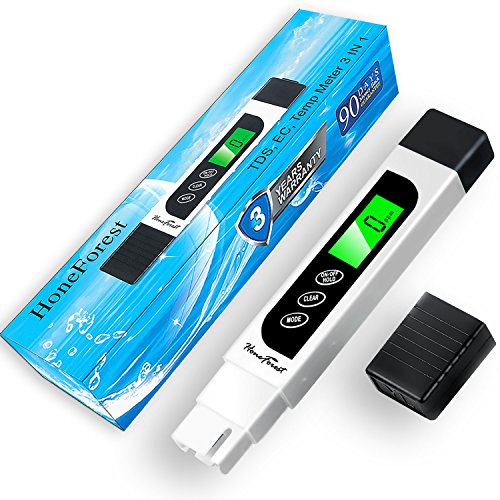
HoneForest 3-in-1 TDS/EC Meter
- Titanium alloy probe
- Big backlit LCD
- 0-9990 ppm range
- Auto-lock reading

Apera PC60 Pocket Tester
- pH
- EC
- TDS
- salinity
- temp
- Replaceable multi-parameter probe
- Full calibration kit
Quick Comparison of Every EC Meter in This Guide
| Product | Key Specs | Action |
|---|---|---|
| HoneForest 3-in-1 TDS/EC Meter |
|
Check Latest Price |
| Apera PC60 Premium Pocket Tester |
|
Check Latest Price |
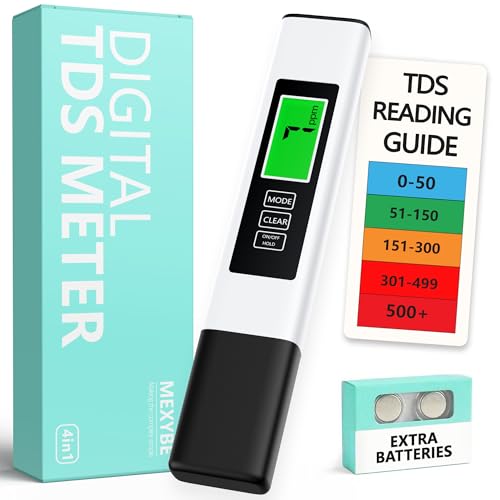
| MEXYBE 4-in-1 TDS and EC Tester |
|
Check Latest Price |
 Bluelab Commercial Truncheon Bluelab Commercial Truncheon |
|
Check Latest Price |
 Bluelab PENCON Conductivity Pen Bluelab PENCON Conductivity Pen |
|
Check Latest Price |
 Bluelab Combo Meter METCOM Bluelab Combo Meter METCOM |
|
Check Latest Price |
 HM Digital COM-80 HM Digital COM-80 |
|
Check Latest Price |
 YINMIK YK-T4 Pro YINMIK YK-T4 Pro |
|
Check Latest Price |
 UIUZMAR 4-in-1 pH and EC Tester UIUZMAR 4-in-1 pH and EC Tester |
|
Check Latest Price |
 VIVOSUN pH and TDS EC Meter Pair VIVOSUN pH and TDS EC Meter Pair |
|
Check Latest Price |
1. HoneForest 3-in-1 TDS/EC Meter - The Long-Running Favourite for Everyday Nutrient Checks
HoneForest TDS Meter, Digital Water Tester - Accurate and Reliable, Measures TDS, EC & Temperature...
TDS, EC and temperature
0-9990 ppm range
Titanium alloy probe
Big backlit LCD
+ Pros
- Consistently accurate across tap
- distilled
- filtered and RO water
- Colour-coded backlit display reads easily in low light
- Compact and light enough to carry in a pocket
- Useful for watching filter performance over time
- Cons
- Some earlier units had the coin cell battery permanently fused to the contacts
- The clear function sometimes does not clear the display
- Instructions can be confusing about holding temp and ppm
The HoneForest is the meter I keep reaching for, because it has been in circulation since 2017 and has accumulated more long-term owner reports than anything else in this guide. In side-by-side readings against a reference pen on the same jug of mixed nutrients, the numbers agreed closely enough that I never had to reach for the second meter.
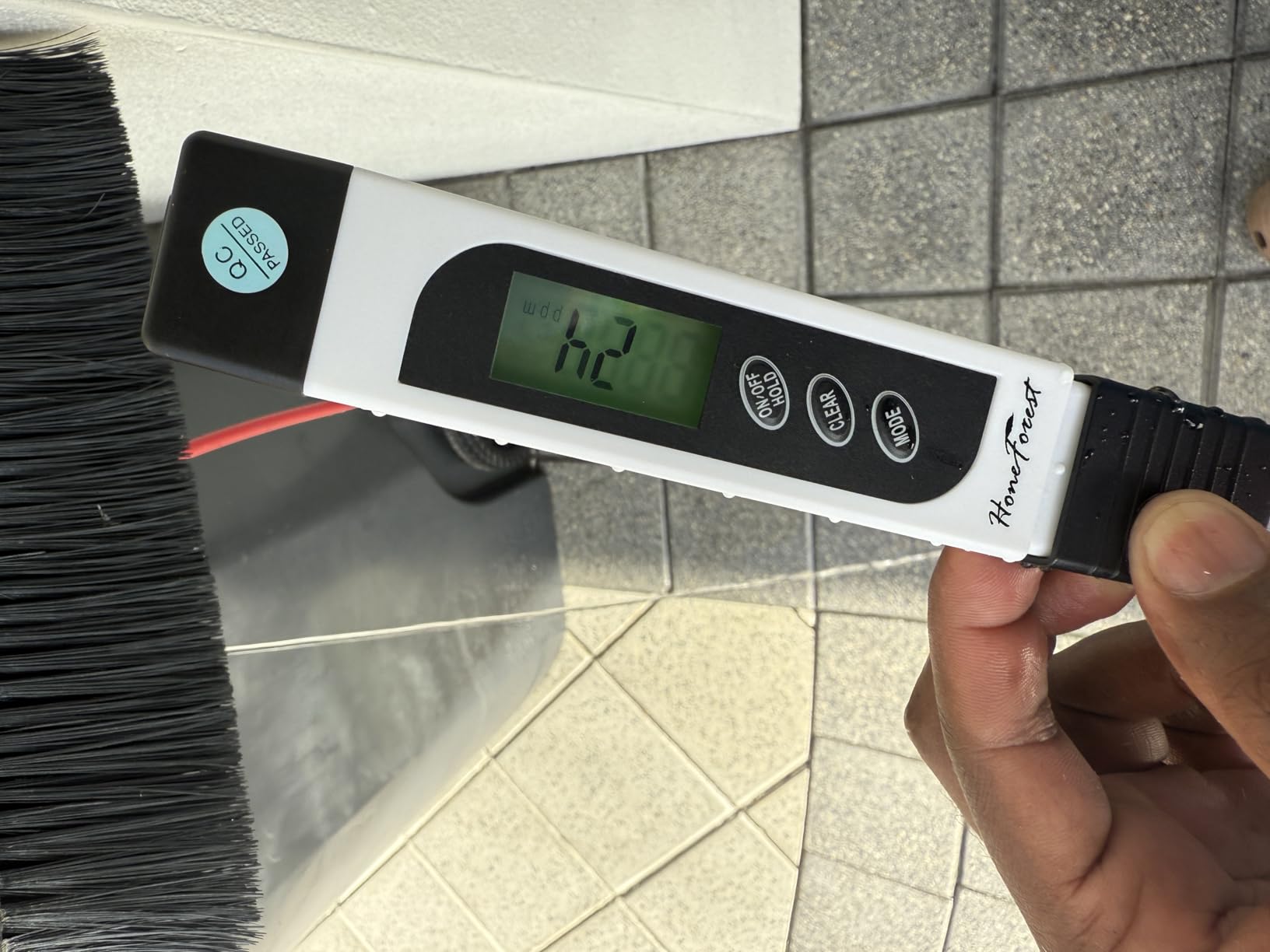
It measures TDS, EC and temperature in one probe, covers a 0-9990 ppm range, and uses a titanium alloy probe with an intelligent chip for stable results. The backlit LCD is larger than most pens at this size and colour-codes the reading so you can read it in a dim grow tent without squinting.
Display and daily handling
The auto-lock function freezes a reading so you can pull the pen out and write the number down without losing it, which matters more than it sounds in a wet room. Auto-off after two minutes of inactivity keeps the battery alive between daily checks.
At 1.62 ounces and 6.29 inches long, it is the pen I keep in my pocket rather than clipped to a rail. The included portable leather bag is a small thing that stops the probe tip knocking against a reservoir rim.
Where the titanium probe earns its place
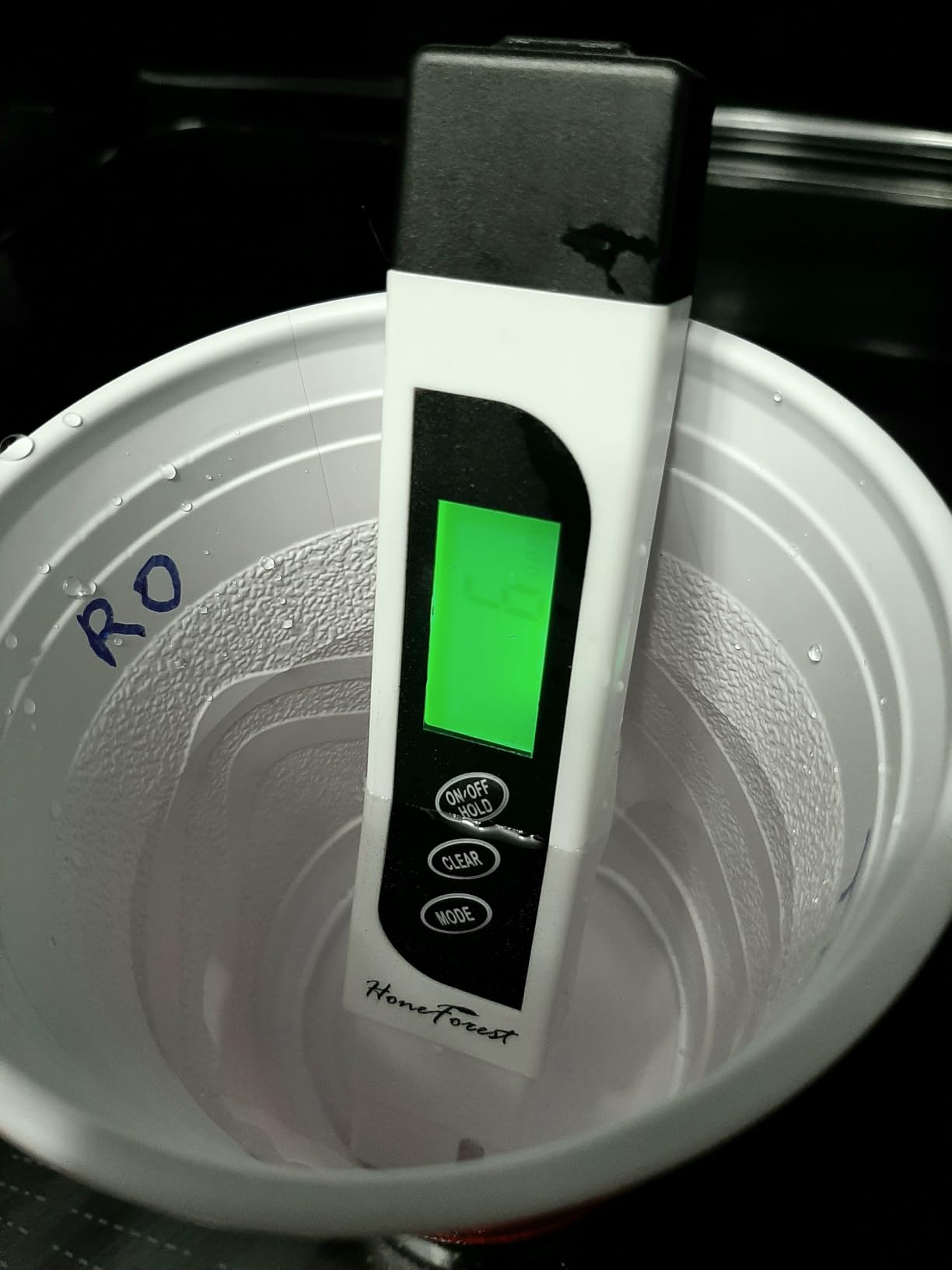
A titanium alloy probe resists the salt crust that forms on cheap bare-metal pins after a few weeks in a nutrient tank. Reviewers describe the readings as consistent across tap, distilled, filtered and RO water, and several use it to track how well a filter is performing over time.
That makes it a good meter for source-water baselines too. Measure your tap or RO water before adding anything, and you will know whether the reading you see later is your nutrients or your supply.
Where it falls short
Some earlier versions arrived with a coin cell battery permanently fused to the contacts, and the review history notes that later models appear to have addressed this. Check that yours takes a fresh battery before the first use rather than assuming it will.
The clear function does not always clear the display on every model, and the instructions are vague about the difference between holding temperature and holding ppm. Both are minor, but they cost you ten minutes the first time you pick the pen up.
2. Apera PC60 Premium Series - The Best Choice When You Want pH and EC in One Hand
APERA INSTRUMENTS AI316 Premium Series PC60 5-in-1 Waterproof pH/EC (Conductivity) /TDS (ppm...
Measures pH, EC, TDS, salinity and temp
Replaceable multi-parameter probe
Two-year instrument warranty
+ Pros
- Five measurement modes in one waterproof pocket tester
- Replaceable probe extends the life of the instrument
- Colour-coded backlit display with dual readouts
- Supplied calibration solutions and a full carrying case kit
- Cons
- pH electrode consumables require periodic replacement
- Calibration buffers take more getting used to than a single-pen meter
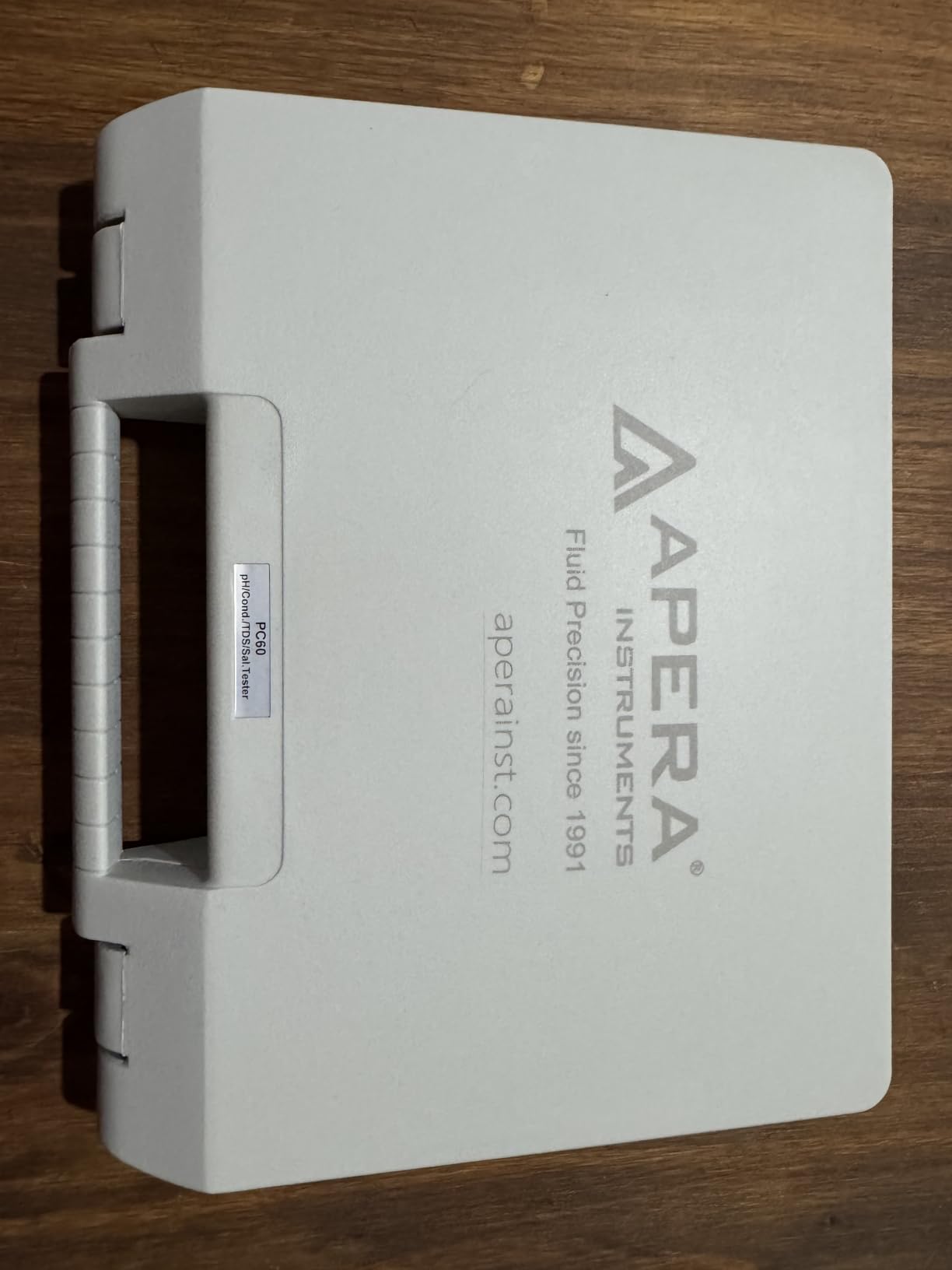
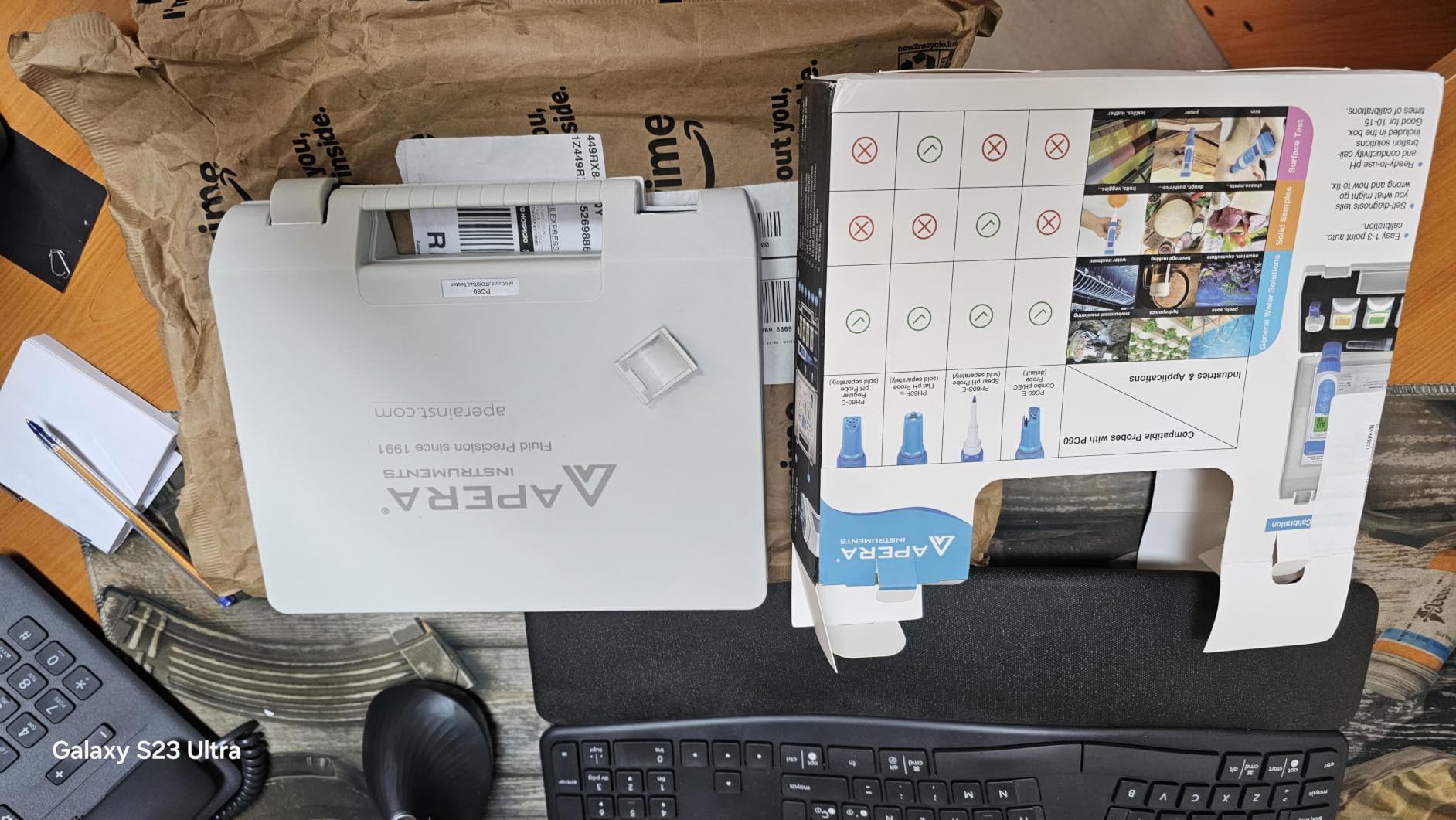
Apera is the brand that comes up most often in r/Hydroponics when people ask which meter is trustworthy without costing what a Bluelab does. The PC60 is that recommendation in instrument form: five measurement modes, a replaceable probe, and a case that already contains the calibration solutions and storage solution you need.
The replaceable multi-parameter probe is the reason this one edges ahead. When the probe eventually fails you replace a component rather than the whole instrument, which is exactly the deal breaker most growers name first.
Five modes on one probe
It measures pH, EC, TDS in ppm, salinity in ppt, and temperature, with a large clear LCD that backlights in three different colours depending on the mode. The colour coding is not decoration. It stops you reading a ppm number and mentally logging it as EC, which is the single most common beginner error in nutrient dosing.
The display shows temperature alongside whichever parameter you are measuring, so you can see at a glance whether a rising reading is concentration or just a warmer reservoir.
Calibration kit and warranty
The complete kit includes calibration solutions, bottles, storage solution, AAA batteries and a lanyard in a carrying case. You are not hunting for 1.413 mS/cm fluid in the same week you unbox the meter, which is how a lot of new meters end up uncalibrated for months.
Warranty is two years on the instrument and six months on the electrodes. The electrode term is the honest one to keep in mind, since pH sensing elements age faster than conductivity ones.
The stability indicator and where the learning curve sits
A smiley-face icon appears when the reading has settled, which removes most of the guesswork about how long to wait. Buyers describe the readings as consistent and professional for hobby and light commercial nutrient monitoring.
The learning curve is in the calibration routine, not the readings. Reviewers note that the pH buffers take more practice than a simple EC pen, and that the consumable electrode eventually needs replacing. If you only ever want EC, this is more meter than you need, and a single-purpose pen will serve you better.
3. MEXYBE 4-in-1 TDS and EC Tester - The Budget Tester That Cross-Checks Well
2026 All-New 4 in 1 Tds Meter Digital Water Tester - Accurate and Reliable TDS EC & Temp(°C,°F...
TDS, EC, temperature in C and F
0-9999 ppm range
Factory calibrated
3.53 ounces
+ Pros
- Very inexpensive entry-level tester
- Quick stabilising readings that users cross-check against costlier meters
- Lightweight with a clear display and simple two-button operation
- Reference TDS chart printed on the back of the unit
- Cons
- Readings can drift low as salts build on the probe
- Build quality perceived as cheap and flimsy
- Not waterproof beyond the sensing area
- Compact probe needs deep dipping in shallow containers
This is the meter that proves the forum claim that EC technology is simple and cheap. The MEXYBE 4-in-1 gives a stabilised TDS, EC and temperature reading in a second or two, and a large share of owners report checking it against a more expensive pen and finding the two broadly agree.
It is the sensible first instrument for a beginner who wants to learn what their reservoir is doing before investing in a kit with a replaceable probe.
Readability and the reference chart
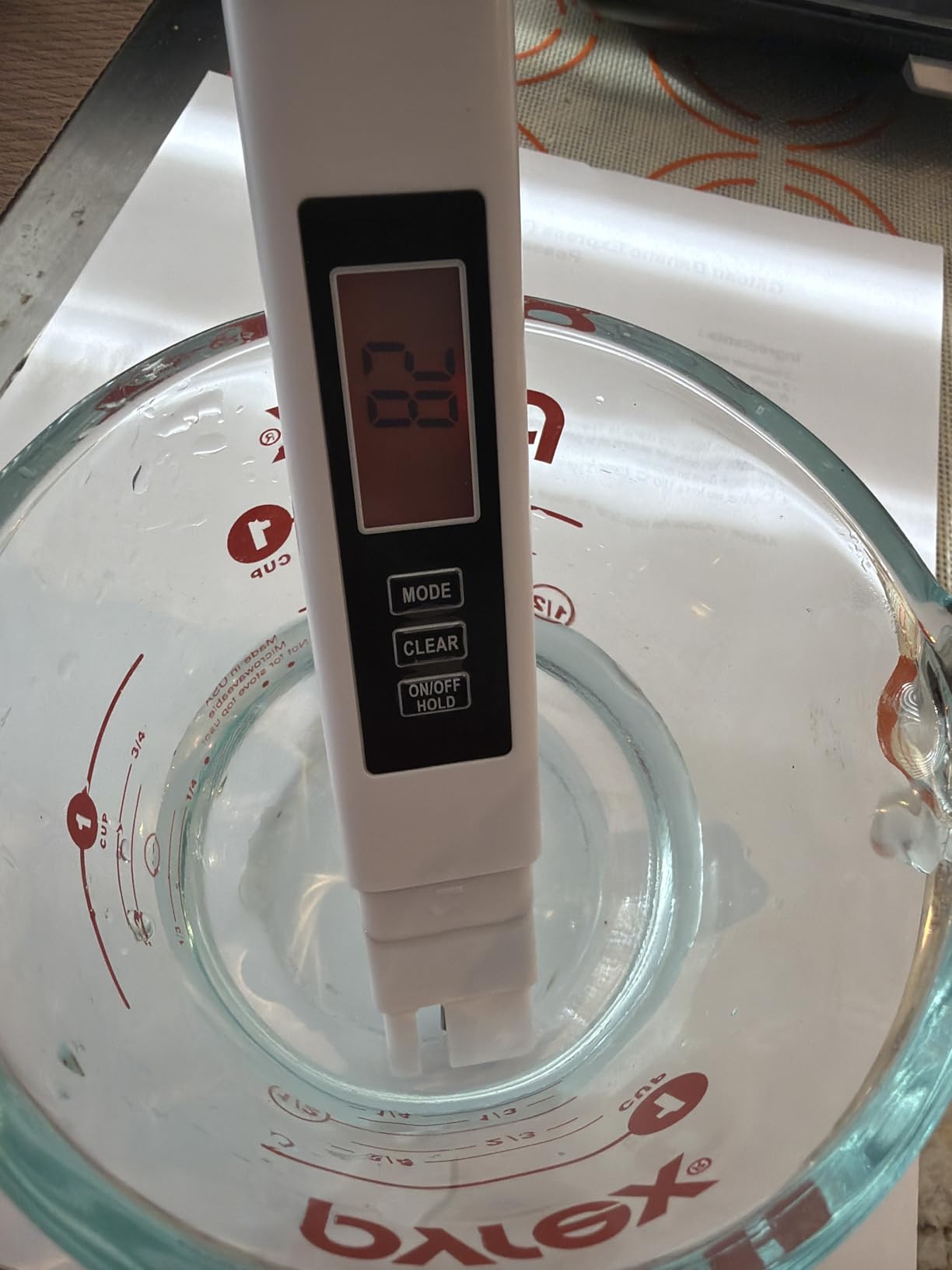
The backlit LCD is 25 percent larger than on the previous 3-in-1 models, and the auto-lock plus hold functions mean the reading stays put while you deal with a wet reservoir. A reference TDS chart printed on the back of the unit means you can interpret the number without a phone in your hand.
Two buttons and an auto-off after two minutes make it about as close to plug-and-play as a tester gets. It is factory calibrated, so it is usable straight out of the box.
Where salt build-up bites
The repeated complaint is drift, specifically readings creeping low as salts accumulate on the probe. That is a maintenance problem rather than a manufacturing one, and it is fixable with a rinse after every reading.
Construction is also described as cheap and light, and the housing is not waterproof beyond the sensing area. Keep the electronics out of the tank and this is a perfectly serviceable daily tool for a small reservoir or a propagation tray.
Which growers should buy it
Anyone running a single small system who wants the cheapest honest reading of their feed. The trade is that you give up temperature compensation sophistication and probe replaceability, and the compact probe needs a deep container to fully submerge.
If you are monitoring a large recirculating reservoir where a bad dose is expensive, step up to a model with a replaceable probe. As a cross-check tool alongside a better meter, it does a perfectly good job.
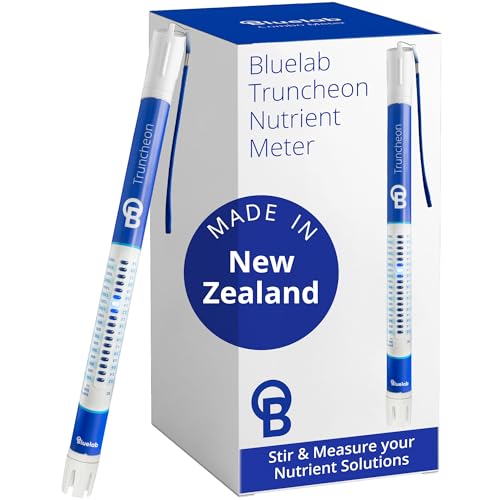
4. Bluelab Commercial Truncheon - The Reference Pen for Daily Reservoir Checks
Bluelab Truncheon Digital Nutrient Meter
0.2-3.6 EC range
Factory calibrated
Waterproof and floats
5-year warranty
+ Pros
- Highest average rating in this roundup
- Factory calibrated with no user calibration needed
- Waterproof design with no buttons or switches
- Range covers CF
- EC and both PPM conversions
- Backed by a 5-year warranty
- Cons
- Measures conductivity only and does not read pH
- Cannot be manually recalibrated by the user
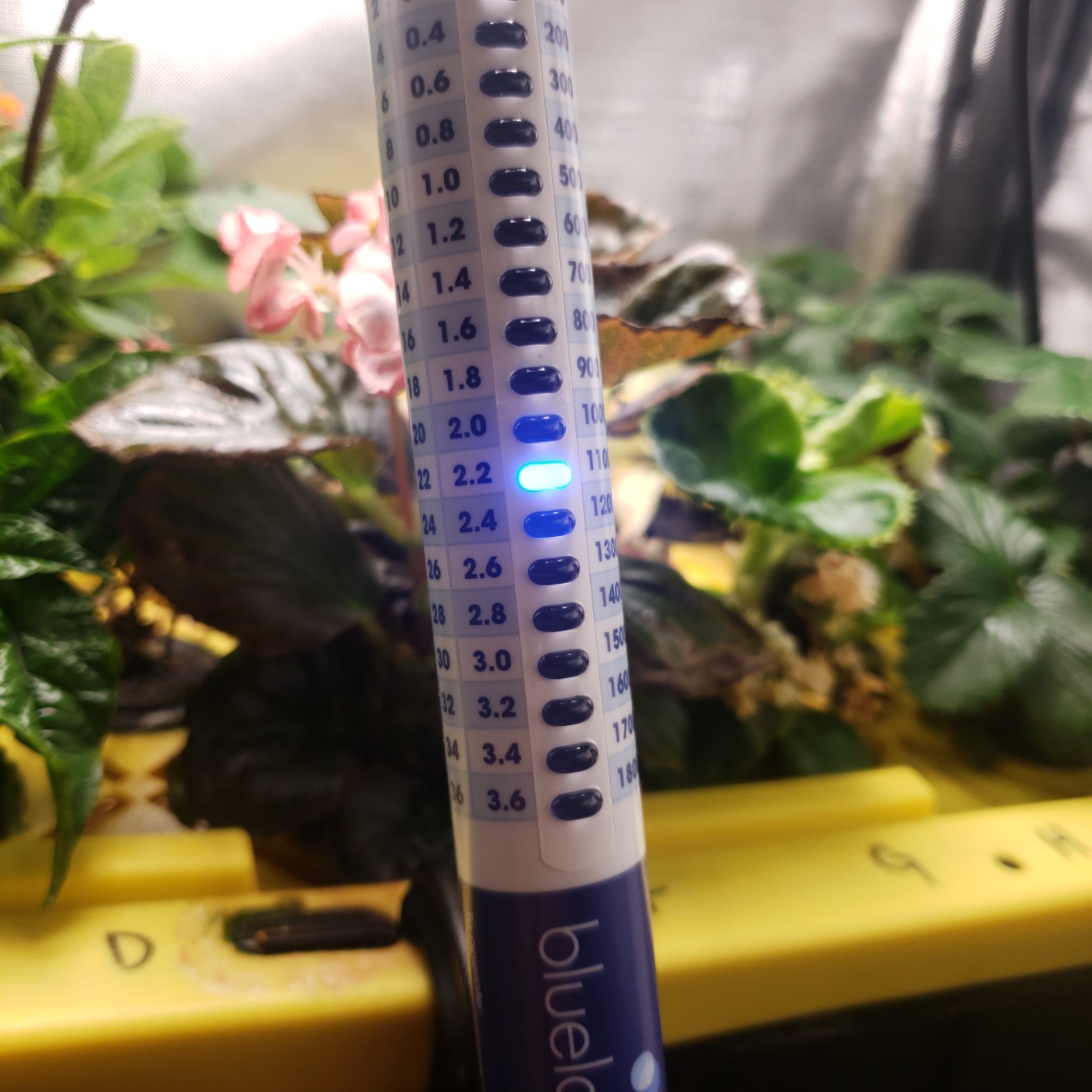
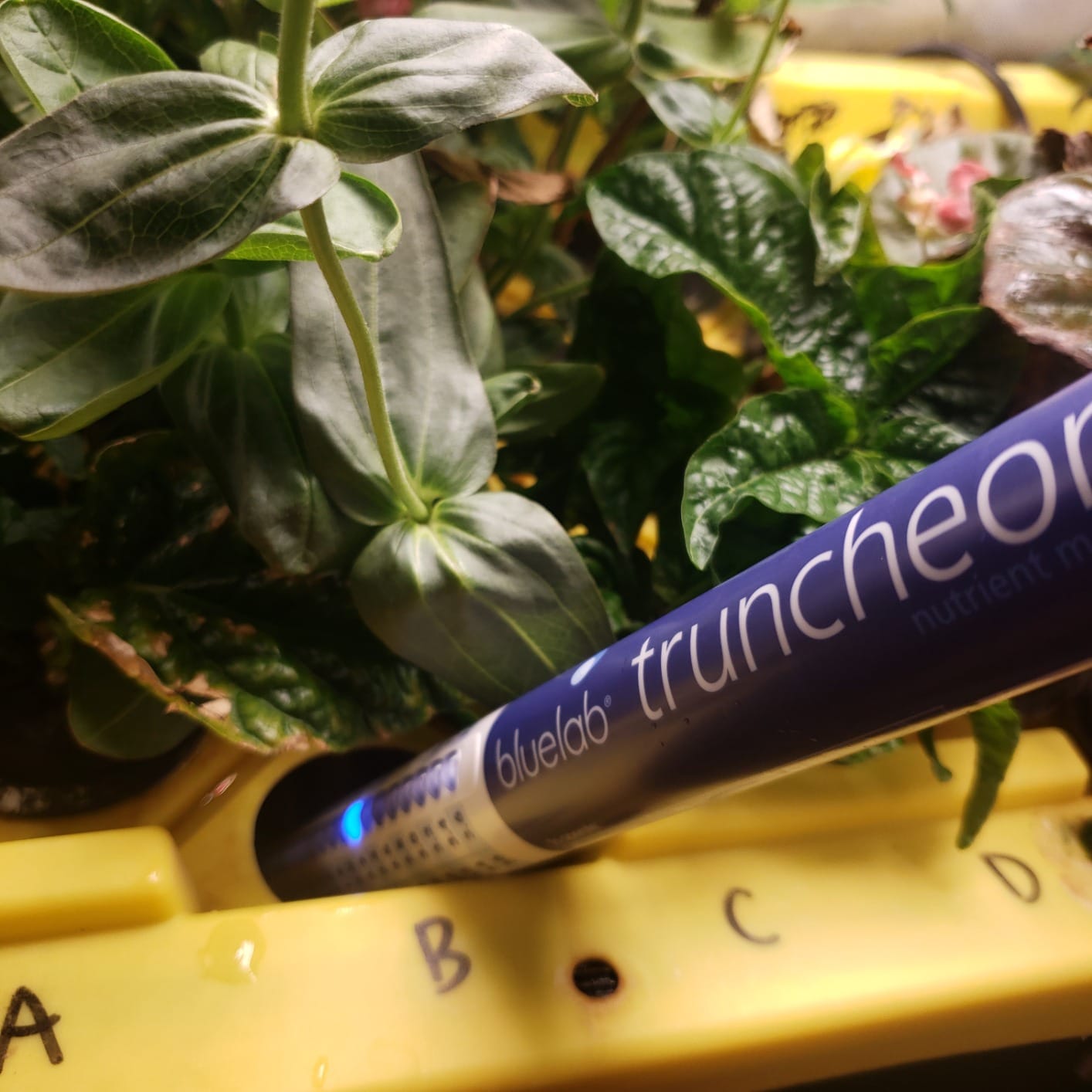
The Truncheon carries the highest average rating of any meter I tested, and owners describe it as a dependable commercial-grade nutrient meter that works while you are mixing and has held up for years in grow rooms. It is built in New Zealand and backed by a five-year limited warranty.
My reservoir routine with this pen is about as simple as measurement gets. There are no buttons and no switches, it switches off on its own, and you dunk it in the tank.
Range and scales that cover nutrient work
It measures 2-36 CF, 0.2-3.6 EC, 140-2520 ppm on the 700 scale, and 100-1800 ppm on the 500 scale. The 0.2-3.6 EC window covers seedling, vegetative and flowering targets without any need to change ranges mid-cycle.
Carrying both PPM conversions is genuinely useful. The 500 and 700 scale confusion is one of the most common sources of phantom problems in grow forums, and a meter that shows both makes the discrepancy visible instead of theoretical.
Factory calibration and what it costs you
It arrives factory calibrated and requires no calibration routine at all, with automatic temperature compensation applied to every reading. That is a real convenience in a grow room where the reservoir temperature moves a few degrees over a day.
The trade-off is stated plainly in the spec: it cannot be manually recalibrated by the user. If it ever falls out of spec, that is a service matter rather than a two-minute fix with a bottle of buffer.
For whom it is right
Growers who want a single job done reliably. The fully waterproof design means you can leave it floating in solution during a mix, which is when most dosing mistakes actually happen.
If you also need pH, this is not the meter. It measures conductivity only, and pairing it with a separate pH pen means two probes to maintain instead of one.
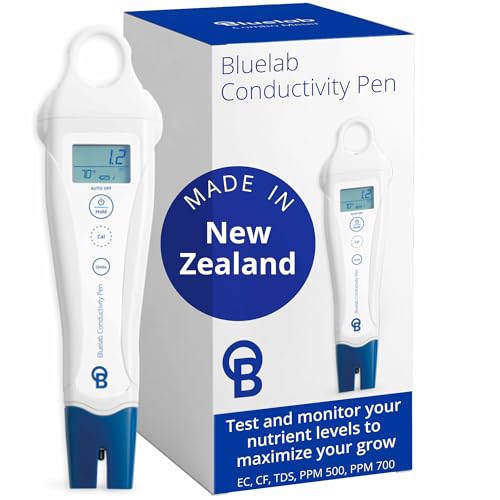
5. Bluelab PENCON Conductivity Pen - The Best Readout When You Keep Changing Scale
Bluelab PENCON Conductivity Pen and Digital TDS Meter, Water Tester for Temperature and Nutrient...
EC, PPM 500, PPM 700 and CF
Automatic temperature compensation
Waterproof and floats
Factory calibrated
+ Pros
- Build quality and long service life with a replaceable AAA battery
- Stays accurate for daily hydroponic monitoring
- Fully waterproof and floats so it can be kept in solution
- Backed by a responsive warranty
- Cons
- Water can enter through the battery compartment seam
- Probe care kit is sold separately
- No pH measurement in this pen
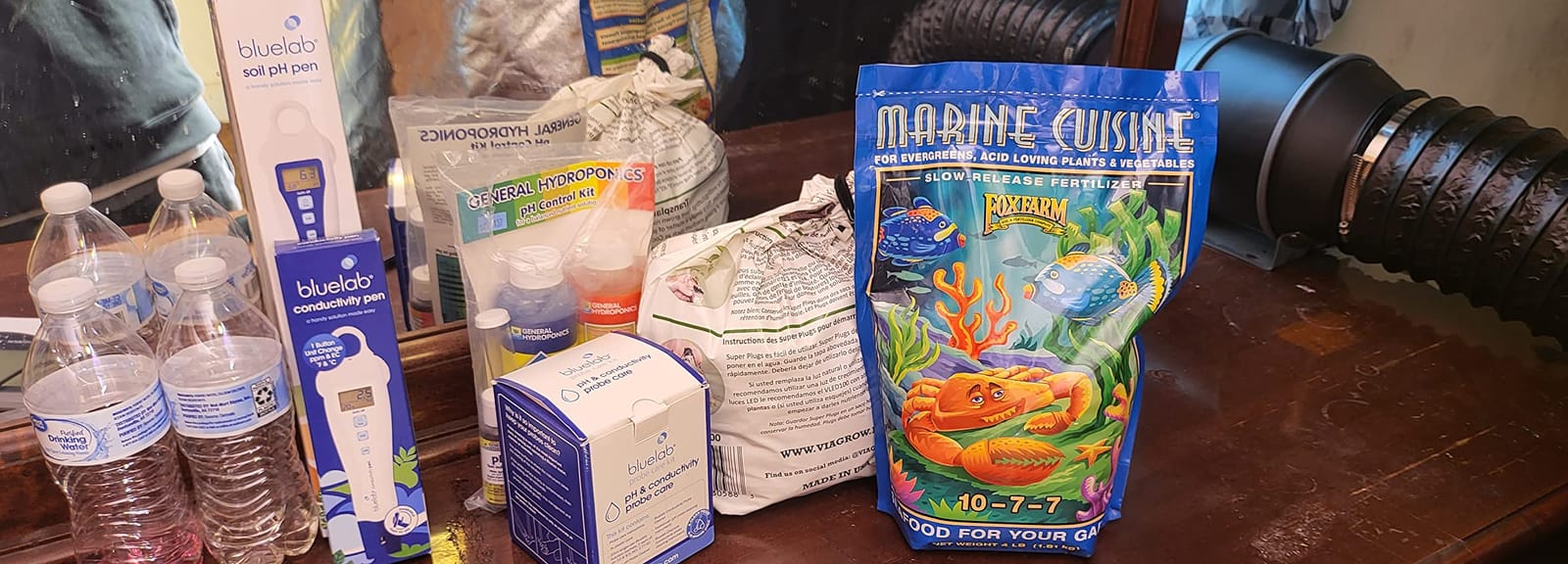
Where the Truncheon is deliberately single-purpose, the PENCON is the Bluelab for a grower who keeps changing what they compare. It shows EC, PPM on the 500 scale, PPM on the 700 scale, and CF, with automatic temperature compensation on all of them.
Reviewers rate it highly for durability and repeatable readings, often comparing it favourably to cheaper pens that stop working within a year or two.
Waterproofing and floatability
The pen is fully waterproof and floats, so it can stay submerged in solution while you work. For a reservoir check on a mixed tank, that removes the temptation to prop a meter on the rim where it can slip.
It runs on a standard AAA battery, which is the cheapest battery to replace and the easiest to find in a grow room cupboard at short notice.
Factory calibrated, with calibration optional
It ships factory calibrated, and calibration remains optional rather than mandatory. Automatic temperature compensation keeps readings comparable as reservoir temperature changes, which matters if you compare a reading in the morning against one taken after the lights have been on for a few hours.
Scales are selected as needed, so the same tool covers feed solution checks, RO or tap water baselines, and CF-style comparisons with nutrient bottle charts.
The battery seam and what to watch
The most common complaint is water entering through the battery compartment seam despite the waterproof claim, which the manufacturer resolved under warranty. Keep the cap fully seated and dry the seam after each dip as habit.
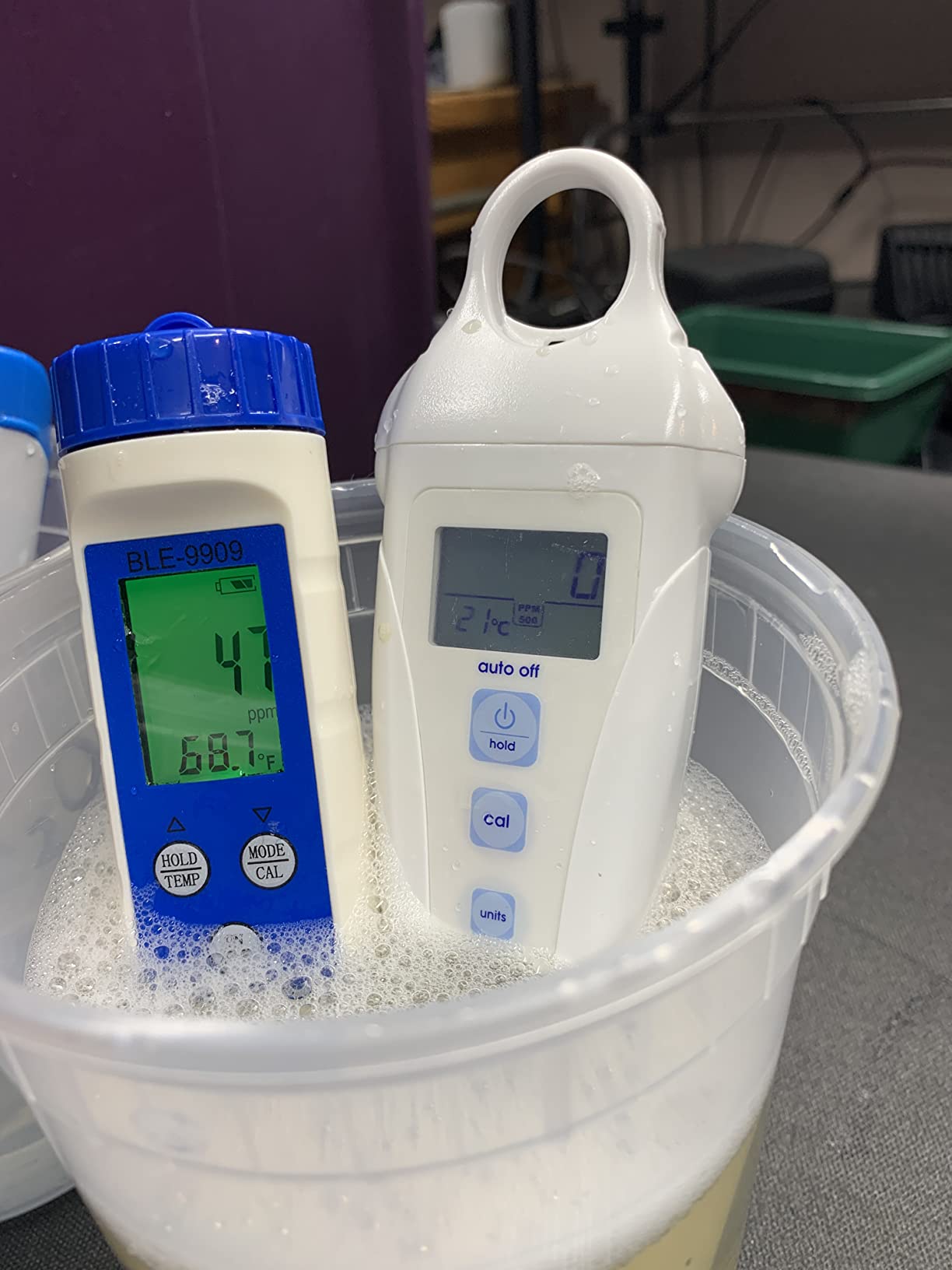
The probe care kit is sold separately, and there is no pH measurement here. Budget for storage solution and care consumables from the start, since skipping that routine is the main reason probes die early.
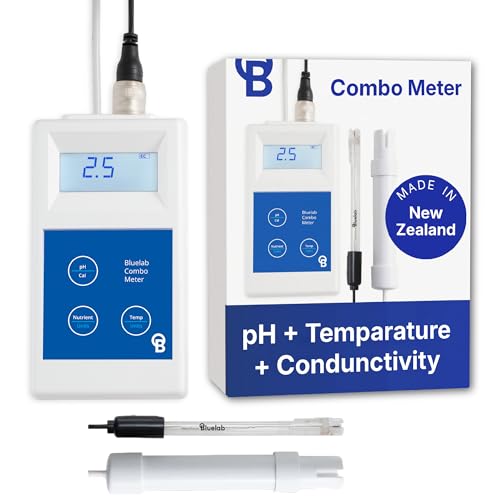
6. Bluelab Combo Meter METCOM - The Desktop Option for pH and EC Together
Bluelab Combo Meter for pH, Temperature & Conductivity in Water - Easy Calibration, Digital...
pH, EC and temperature monitoring
Automatic temperature compensation
5-year warranty
Double junction pH probe
+ Pros
- Single desktop unit reads pH
- EC/PPM and temperature at a press of a button
- One-touch two-point calibration with a calibration reminder
- Real temperature compensation and fast stable readings
- Replaceable probes at a fraction of pen-style replacement cost
- Cons
- pH probe is glass and breaks with careless handling
- Needs separate KCl storage solution and periodic calibration
- Thermometer is slow and reads whole degrees only
- Not waterproof
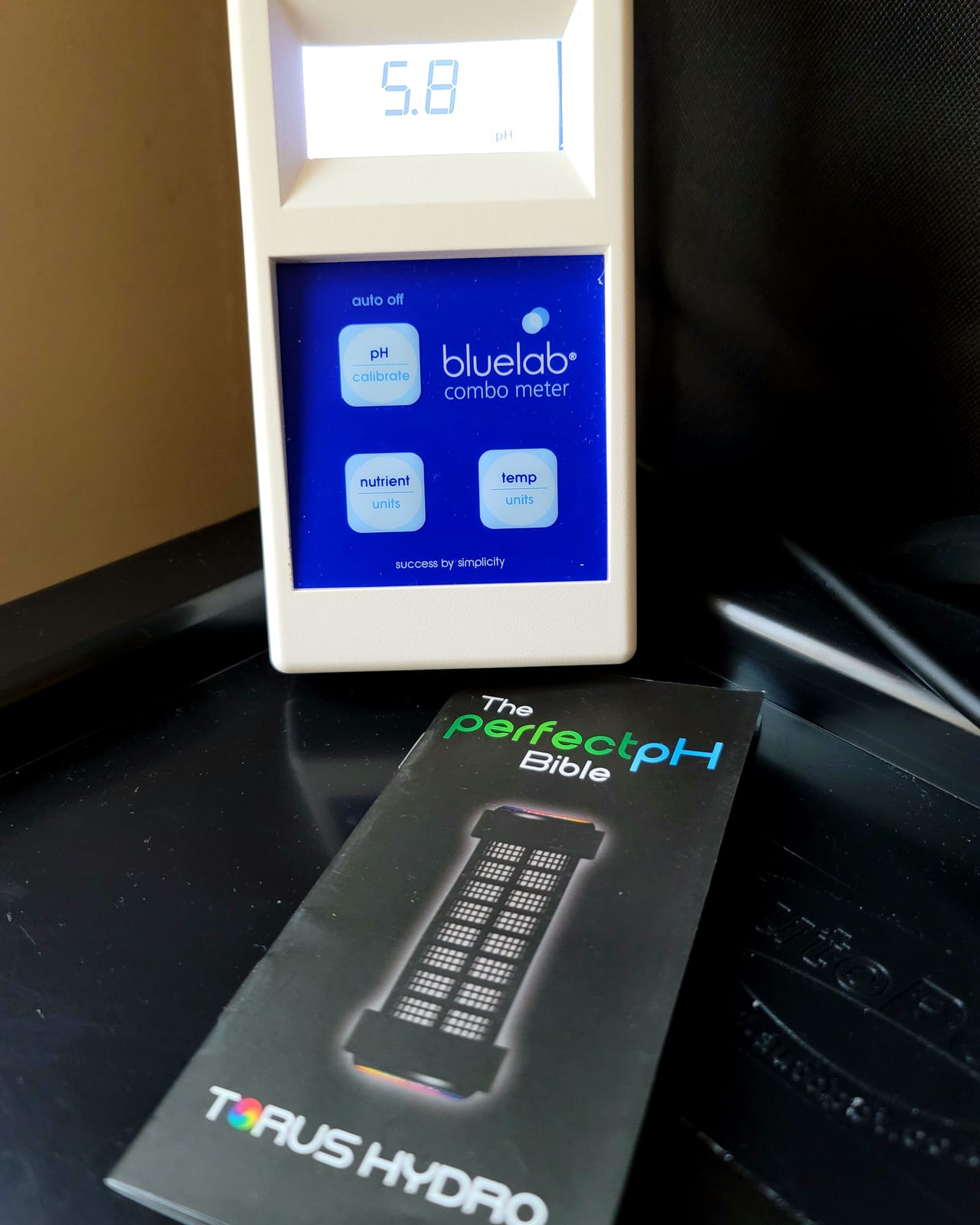
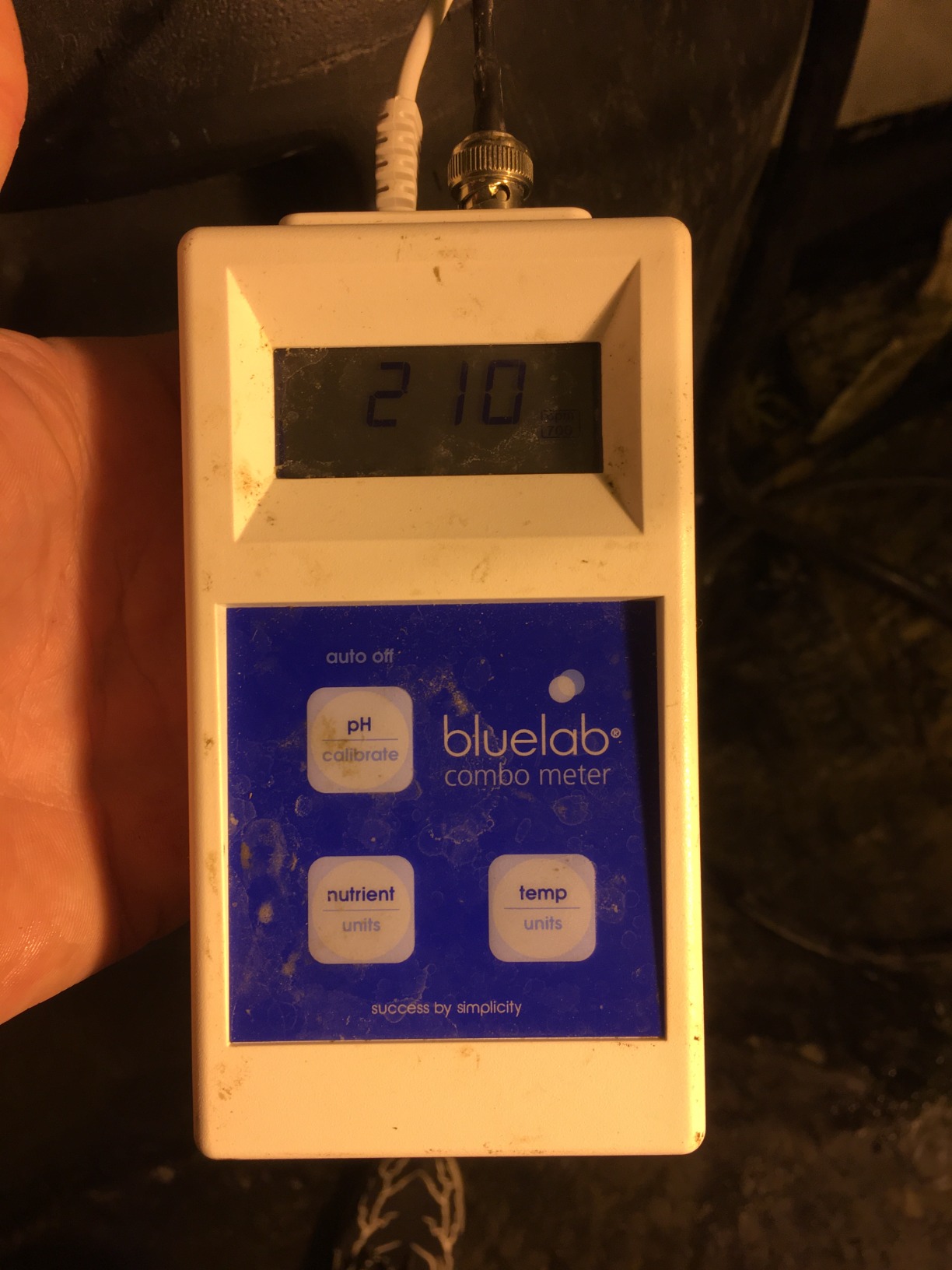
This is the meter I recommend once a system has more than one reservoir, or when you already have a pH meter and want the EC reading in the same workflow. It is a desktop unit rather than a pen, and it monitors pH, conductivity as TDS, and temperature with one press of a button.
Several owners report it outperforms far more expensive bench units, and the built-in storage cap is one of the better-designed ones I have used.
Calibration routine and the reminder
The double junction pH probe uses easy two-point calibration, and the unit prompts you when calibration is due. Conductivity and temperature are factory calibrated, so the routine burden falls on the pH channel only, which is also the only channel that genuinely needs it.
Conductivity scales include EC, PPM and CF, and automatic temperature compensation is real rather than nominal. The unit auto-offs and shows a low battery indicator, and it comes with AAA batteries, a storage cap and calibration solution.
Probes and long-term cost
Replaceable probes at a fraction of the cost of pen-style replacements is the headline here. The warranty is five years on the meter with six months on the pH probe, and the pH electrode is a consumable you should plan for rather than a surprise.
Because the probes are replaceable, this unit has a longer useful life than a sealed pen of similar capability. That is worth more over three years than any single spec on the box.
Where it does not suit
It is not waterproof and it is not meant to be dropped in a tank, so it lives on a shelf next to the reservoir rather than in it. The pH probe is glass and breaks with careless handling, so it needs a clear spot on the bench.
The thermometer channel is slow to respond and reads whole degrees only, so treat it as a reference rather than a control reading. It also requires separate KCl storage solution and periodic calibration to stay honest.
7. HM Digital COM-80 - The Meter for Bench Ranges and Brewing-Style Control
HM Digital COM-80 Electrical Conductivity (EC) and Total Dissolved Solids Hydro Tester, 0-5000 ppm...
EC in microS and milliS
TDS in ppm and ppt
Plus minus 2 percent accuracy
0.5 second response
+ Pros
- Fast 0.5 second response with stable repeatable readings
- Four scales including microS for low-conductivity work
- Solid build quality that feels like proper bench equipment
- Plug-and-play with factory calibration for most users
- Cons
- Battery compartment is very difficult to open
- Factory calibration can be off and the unit may refuse to recalibrate
- Full calibration needs specialised equipment that is not included
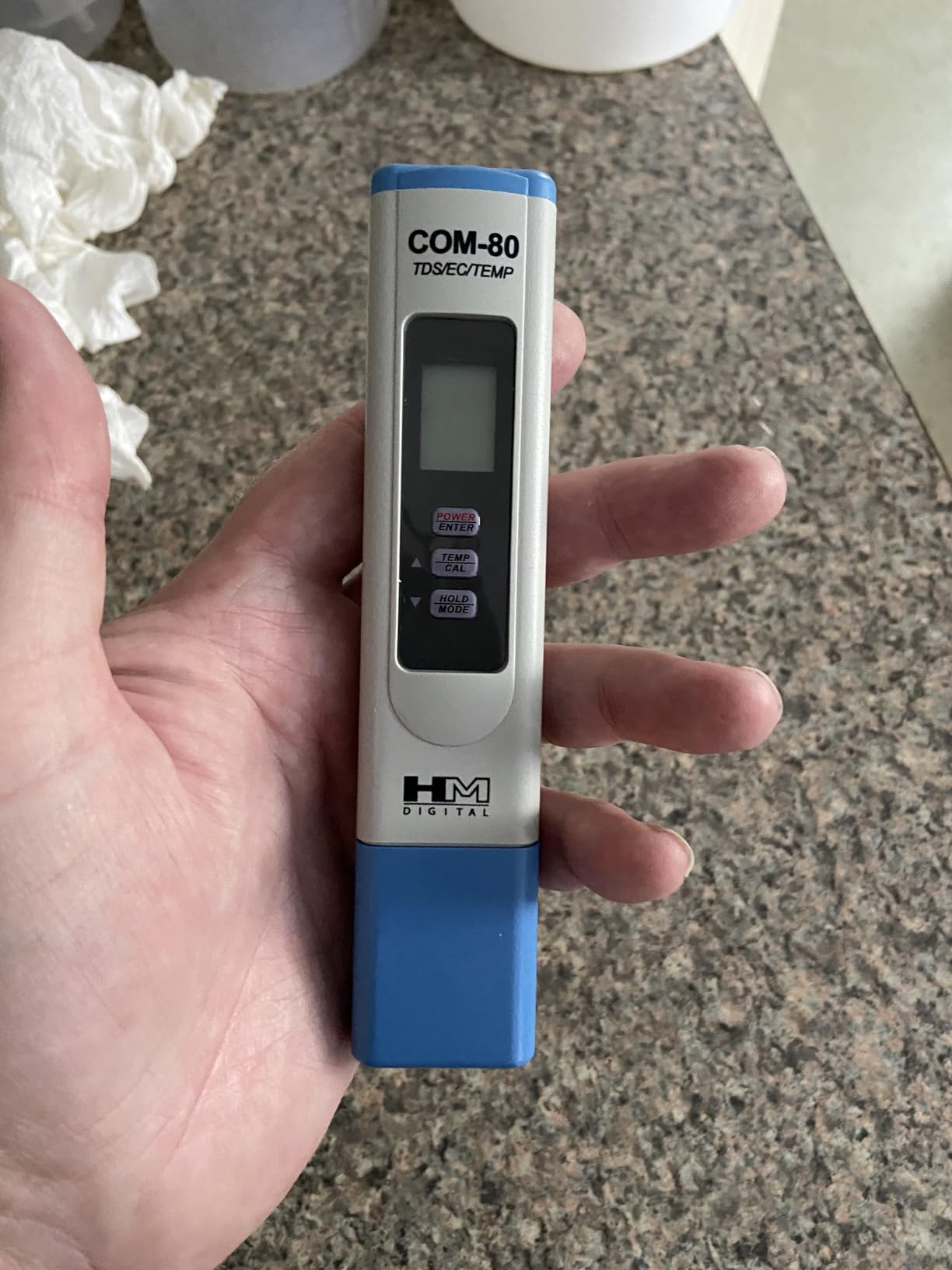
The COM-80 is the odd one out in this guide, and that is why I included it. It is a general laboratory conductivity meter rather than a grow-specific pen, and that shows up in the resolution and the range options on offer.
Users generally find it a reliable, accurate and durable meter for nutrient solution, brewing and aquarium work, with a 0.5 second response time that feels immediate in the hand.
Four scales and real resolution
It measures EC in microSiemens and milliSiemens, plus TDS in ppm and ppt, with 1 microSiemens or 1 ppm resolution, 0.1 mS on the milliSiemens scale, and readout accuracy of plus or minus 2 percent. The microSiemens range is what makes it useful for checking your source water, where readings sit well below the nutrient range.
Automatic temperature compensation is included, the housing is water resistant, and the upper temperature range reaches 80 degrees Celsius. A data-hold function freezes the reading so you can record it.
Build quality and the awkward battery door
At 2.08 ounces with a 15.3 cm body and 15.5 cm immersion depth, it feels like proper bench equipment rather than a gadget. It is powered by three LR44 batteries.
The recurring complaint is that the battery compartment is genuinely difficult to open, which is irritating but not dangerous. Plan to change the cells rarely rather than often.
Calibration reality
Most users get plug-and-play factory calibration. The sharper criticism is that on some units the factory calibration is off and the meter will refuse to recalibrate, showing an error instead, and that a full calibration needs specialised equipment which is not included.
Check it against a known 1.413 mS/cm standard the day it arrives. If it agrees, you have a very capable meter. If it does not, that is a return rather than a project.
8. YINMIK YK-T4 Pro - The Simultaneous Readout for Reservoir Management
YINMIK pH Meter for Hydroponics, 4 in 1 PPM EC Meter for Plant Nutrients
Temperature, pH and EC on one screen
1413 microS/cm buffer included
Stainless steel electrode
Automatic temperature compensation
+ Pros
- All key values displayed simultaneously
- Fast readout compared with many pen-style meters
- Stainless steel electrode supports continuous in-reservoir monitoring
- Supplied with ready-to-use pH and EC calibration solutions
- Cons
- A minority of units needed recalibration daily or failed to calibrate at all
- Not as accurate as a Bluelab reference pH meter
- Limited guidance on target nutrient levels
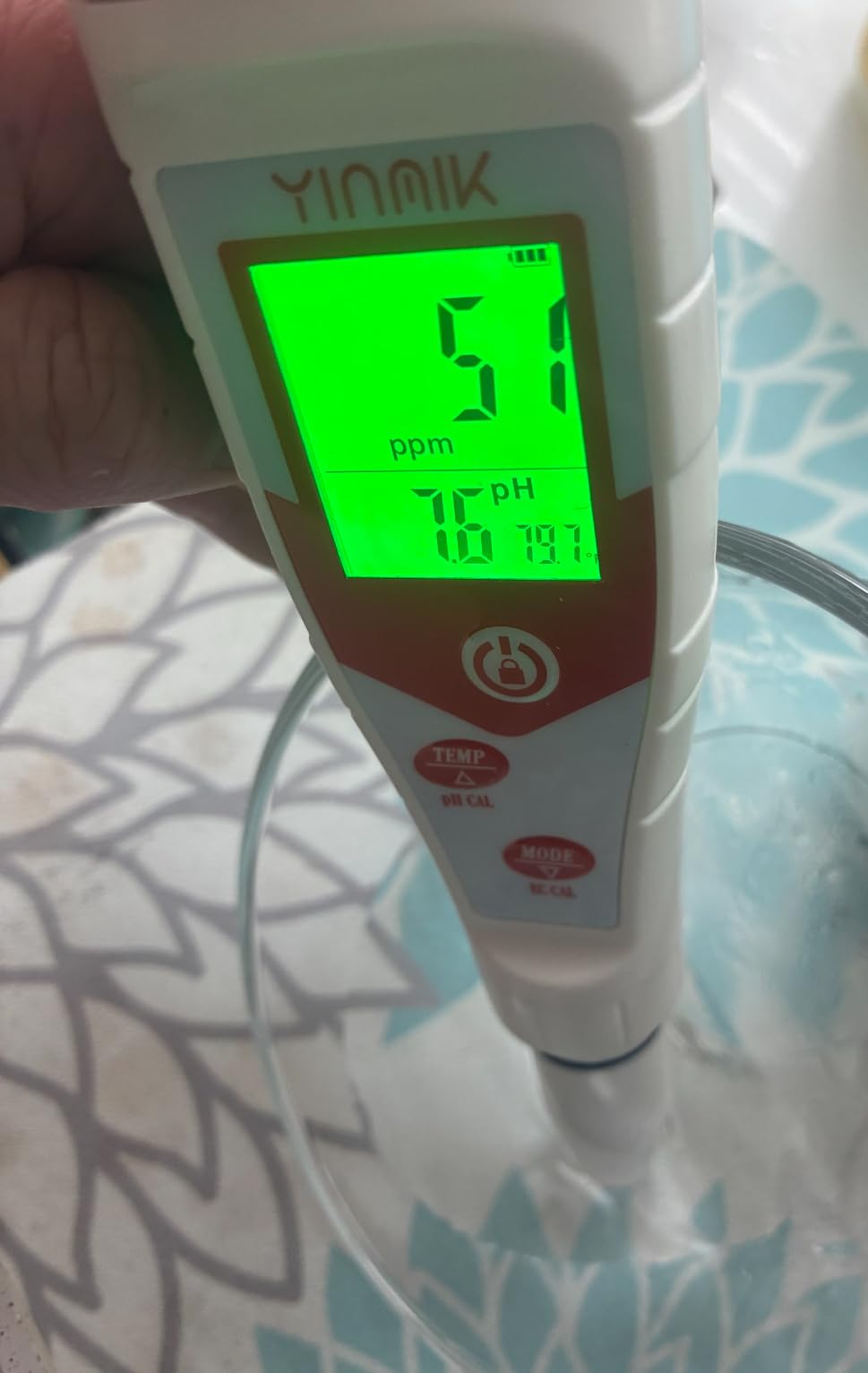
The YK-T4 Pro is a 4-in-1 tester that shows temperature, pH and EC at once rather than making you toggle between them. Most users find it fast, easy to calibrate and accurate enough for reservoir management.
Two details set it apart from the bargain testers. The supplied solutions are ready to use, including a 1413 microS/cm EC buffer and a 4.00 to 7.00 pH solution, and there is a separate pH and PPM mode for plain reservoir water alongside a pH and EC mode for nutrient solution.
Continuous immersion and temperature compensation
The extended stainless steel temperature electrode is designed for continuous immersion, so it suits a reservoir you want to watch rather than dip twice a day. Automatic temperature compensation is applied to the EC readings, which keeps comparisons valid when the tank warms during a lighting cycle.
Owners report it as far more reliable than some budget alternatives, and the fast readout compares well against Bluelab-style pens.
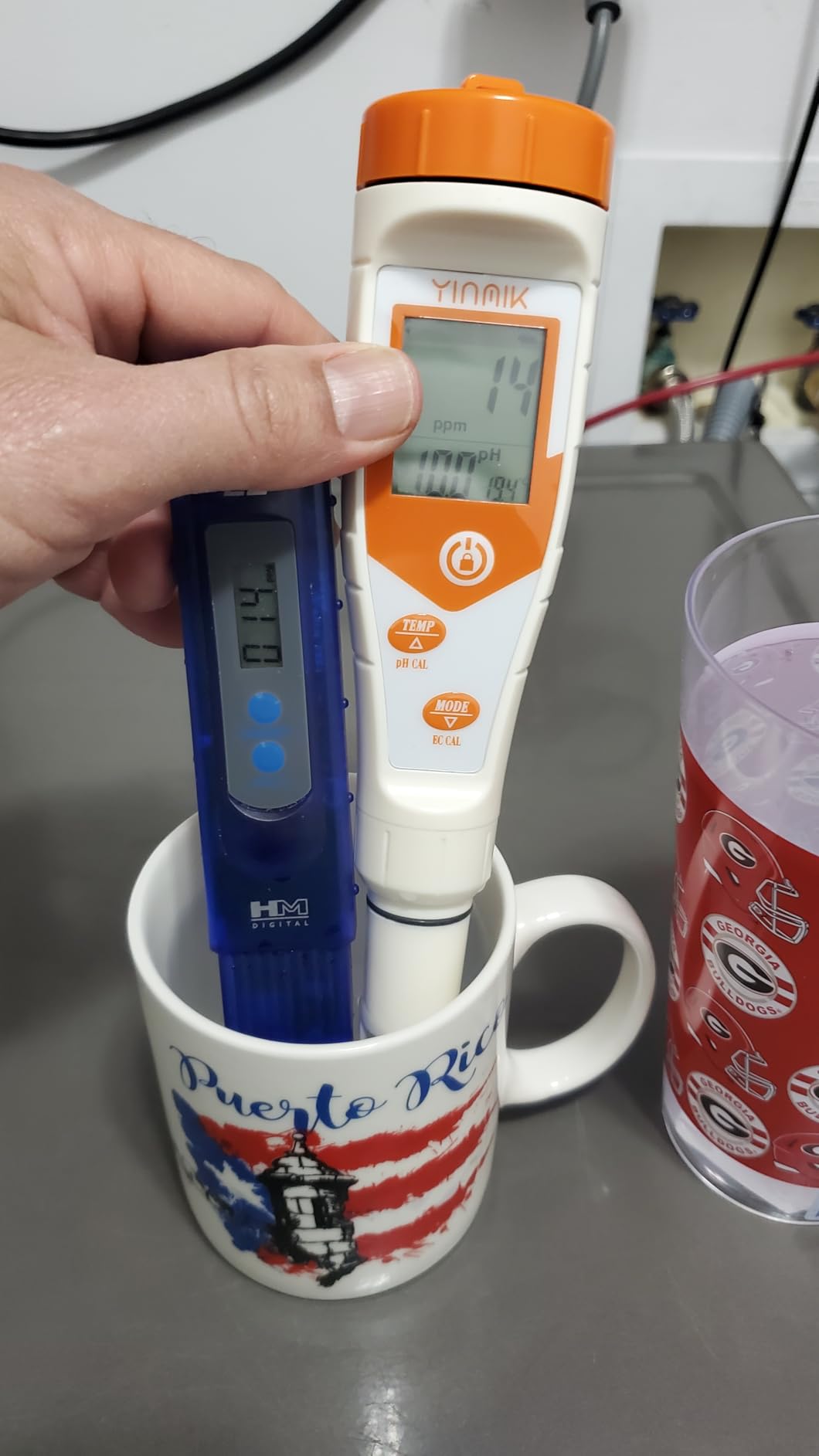
Calibration stability is the weak spot
A minority needed recalibrating daily or failed to calibrate at all, and a few owners switched back to a higher-grade meter as a result. That is the specific risk with a pH channel at this level.
It is also not as accurate as a Bluelab reference pH meter, and the guidance on target nutrient levels is limited. Treat it as a management tool for feed solution, not a laboratory instrument.
9. UIUZMAR 4-in-1 pH and EC Tester - The Best Starting Point for a First-Time Grower
UIUZMAR pH Meter for Water Hydroponics Supplies 4 in 1 pH PPM ECTester
pH, EC, PPM and temperature
Dry calibration powders included
Advanced probe
12.3 ounces
+ Pros
- Very fast stable readings users find as quick as premium meters
- pH EC PPM and temperature in one affordable device
- Calibration powder mixes with ordinary distilled water
- Large backlit display and a clear simple calibration process
- Cons
- Accuracy drifts if the probe is not kept hydrated in storage solution
- A minority report inconsistent readings or calibration that will not hold
- Probe is fragile if inserted too far
- No English manual on some units
Buyers who follow the hydration and calibration routine here report accuracy comparable to meters costing several times more, with readings matching Bluelab and Apera units in side-by-side tests. That is a strong result for an entry-level four-function tester.
It is designed around hydroponic reservoirs, DWC and aeroponic systems specifically, and it is one of the few affordable meters that also measures pH rather than just EC.
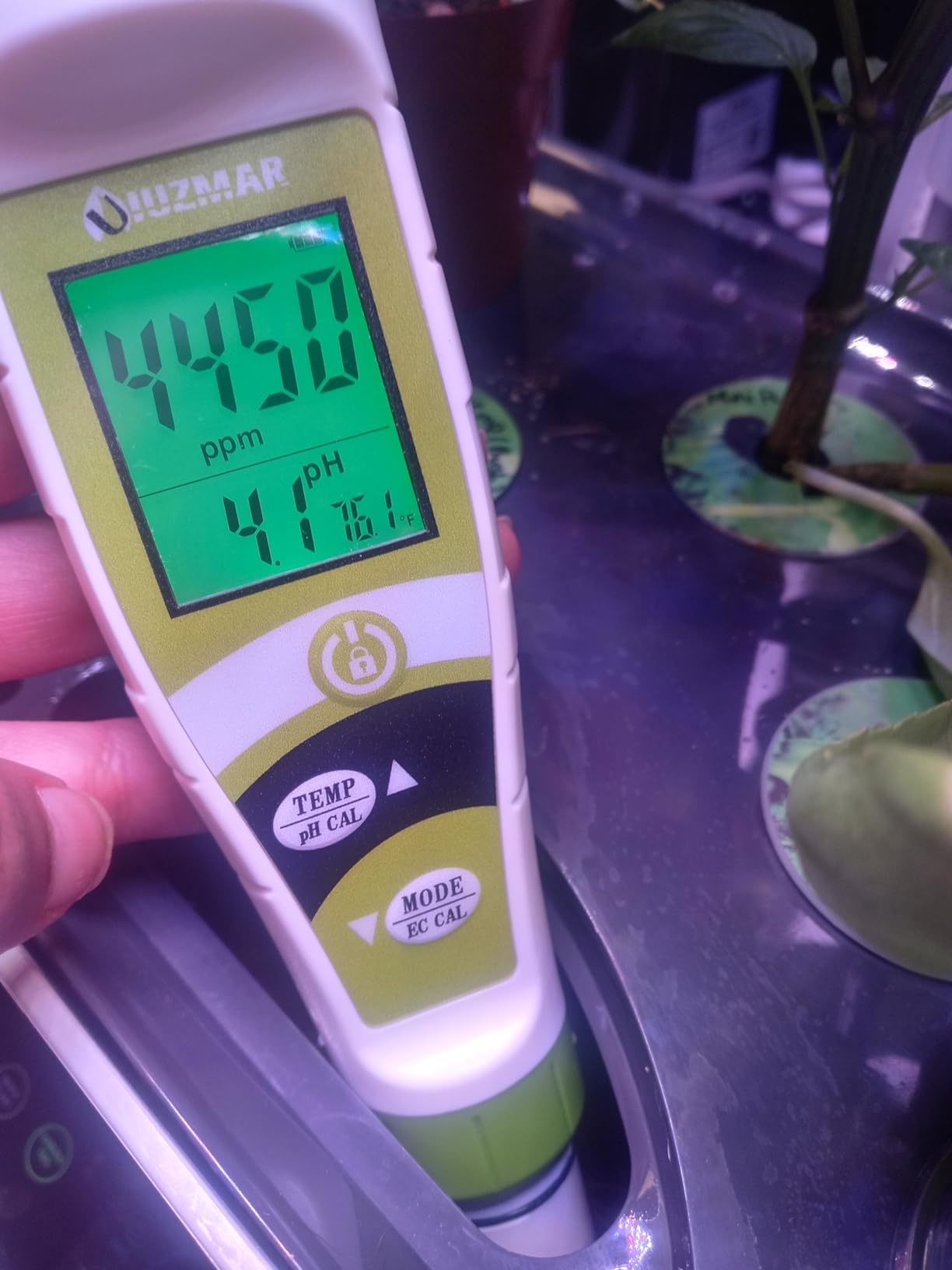
Calibration powders and a simple routine
It comes with dry pH calibration powders for the 7.00, 4.00 and 10.01 points, which you mix with ordinary distilled water. No decanting and no hunting for premixed sachets, and the three-point process is one a beginner can follow without a manual.
The backlit display shows pH, TDS, EC and temperature with clear on-screen values, and an advanced probe is fitted for stable repeatable readings.
Hydration is the whole game here
Failure to store the probe in solution is the most commonly cited cause of drift and erratic readings across owner reports. It is also the single most avoidable failure in the whole category, and the same warning applies to every meter in this guide.
A minority report inconsistent readings or calibration that will not hold, and the probe is fragile if inserted too far into a container. Some versions also arrive without an English manual, so check the listing before ordering.
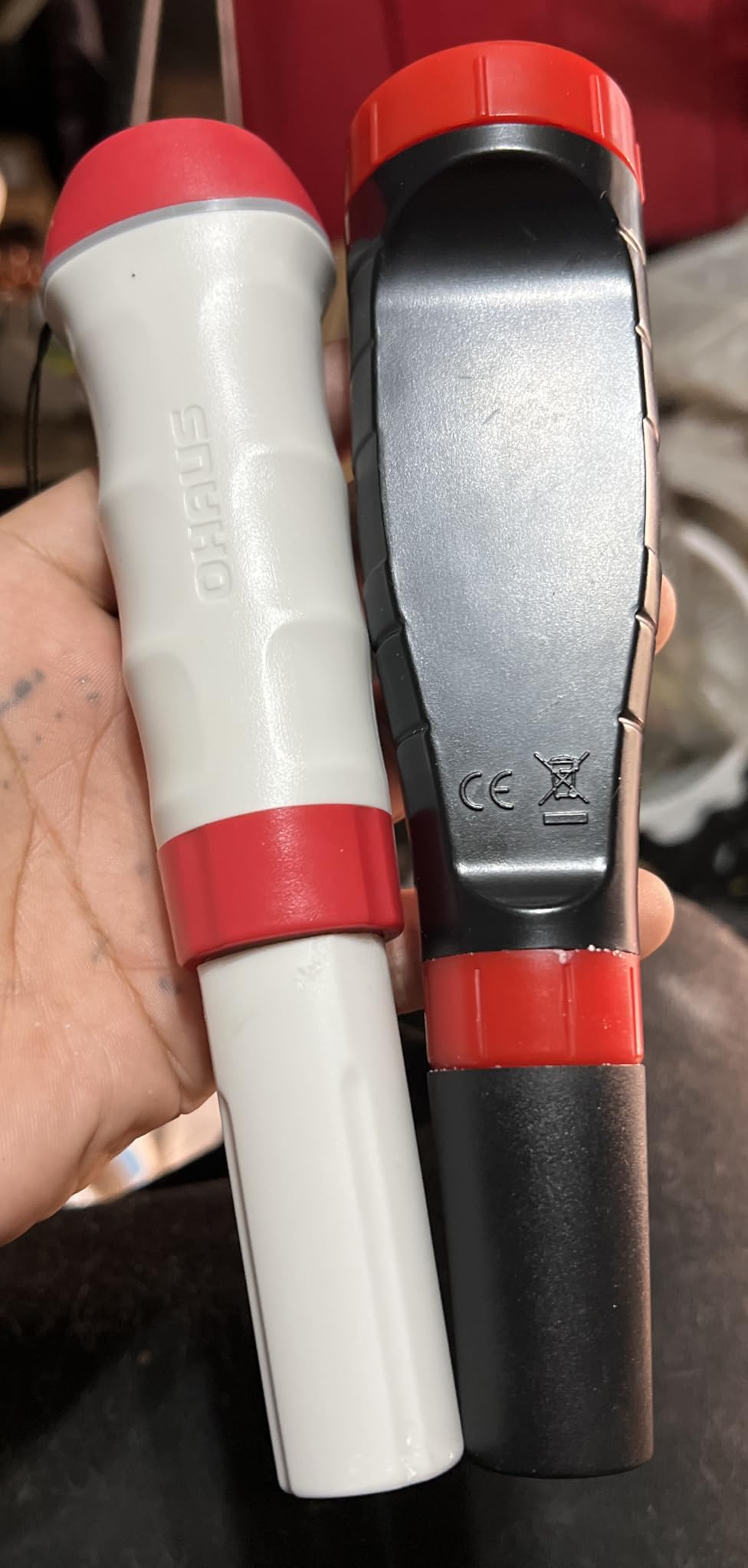
Size and handling
At 12.3 ounces and 8.9 by 2.9 by 1.9 inches, this is a bulkier handheld unit than a slim pen. It stays on a shelf beside the reservoir rather than in a pocket, which suits a fixed DWC setup better than a mobile one.
For a grower on their first cycle, having pH, EC, PPM and temperature in one device removes an entire category of mixing-up readings, and that alone justifies the extra bulk.
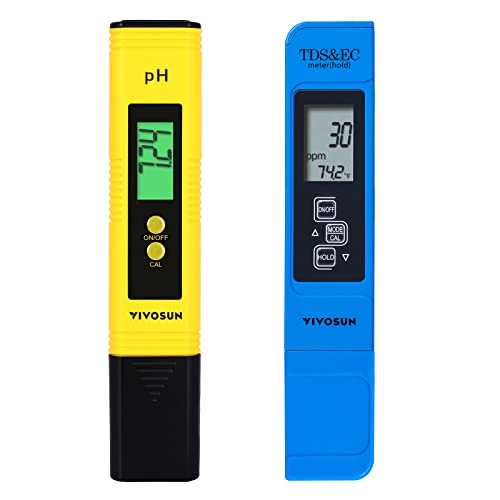
10. VIVOSUN pH and TDS EC Meter Pair - The Two-Pen Starter Pack
VIVOSUN Digital pH Meter TDS EC Meter for Water 0.01 Accuracy Hydroponics
Pack of a pH pen and a 3-in-1 TDS pen
0-14 pH range
Plus minus 2 percent accuracy
Three calibration buffers
+ Pros
- Two meters in one pack
- so a TDS fault does not end pH readings
- Comes with a protective case
- batteries and calibration buffers
- Lightweight handheld design with backlit display and hold function
- Auto-calibration and temperature compensation simplify first-time setup
- Cons
- pH readings drift and take minutes to stabilise on some units
- Three-point pH calibration is hard to complete reliably
- EC section can drift or stop working after roughly a year
- Temperature readings reported off by several degrees
- Cannot test sea water
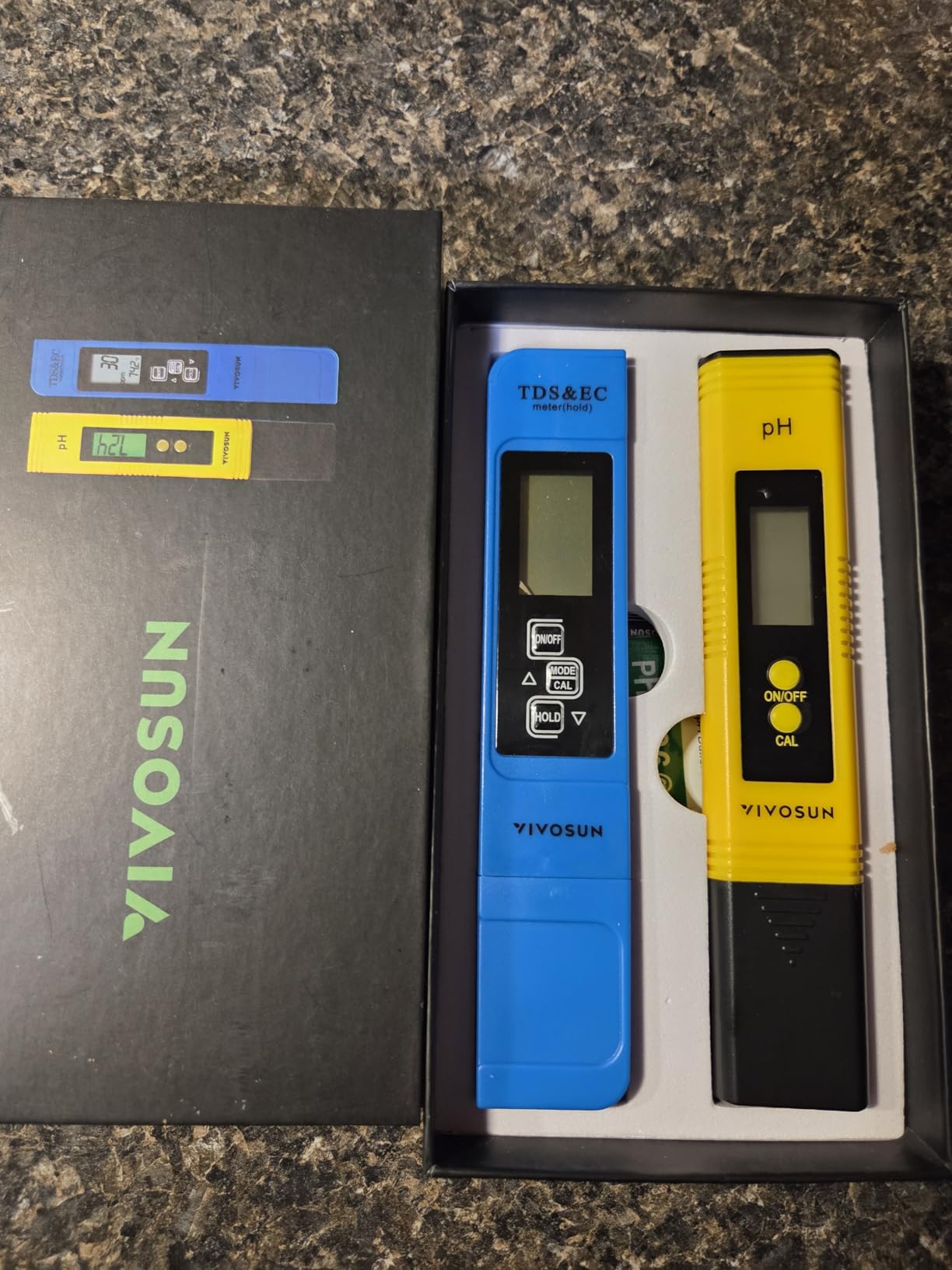
The VIVOSUN pack gives you two separate instruments, a dedicated pH pen and a 3-in-1 TDS and EC pen, and the split turns out to be the most useful thing about it. If the EC section develops a problem, your pH readings continue.
It is widely regarded as good value for basic checks, and many users confirm the readings matched reference instruments for tap and reservoir water.
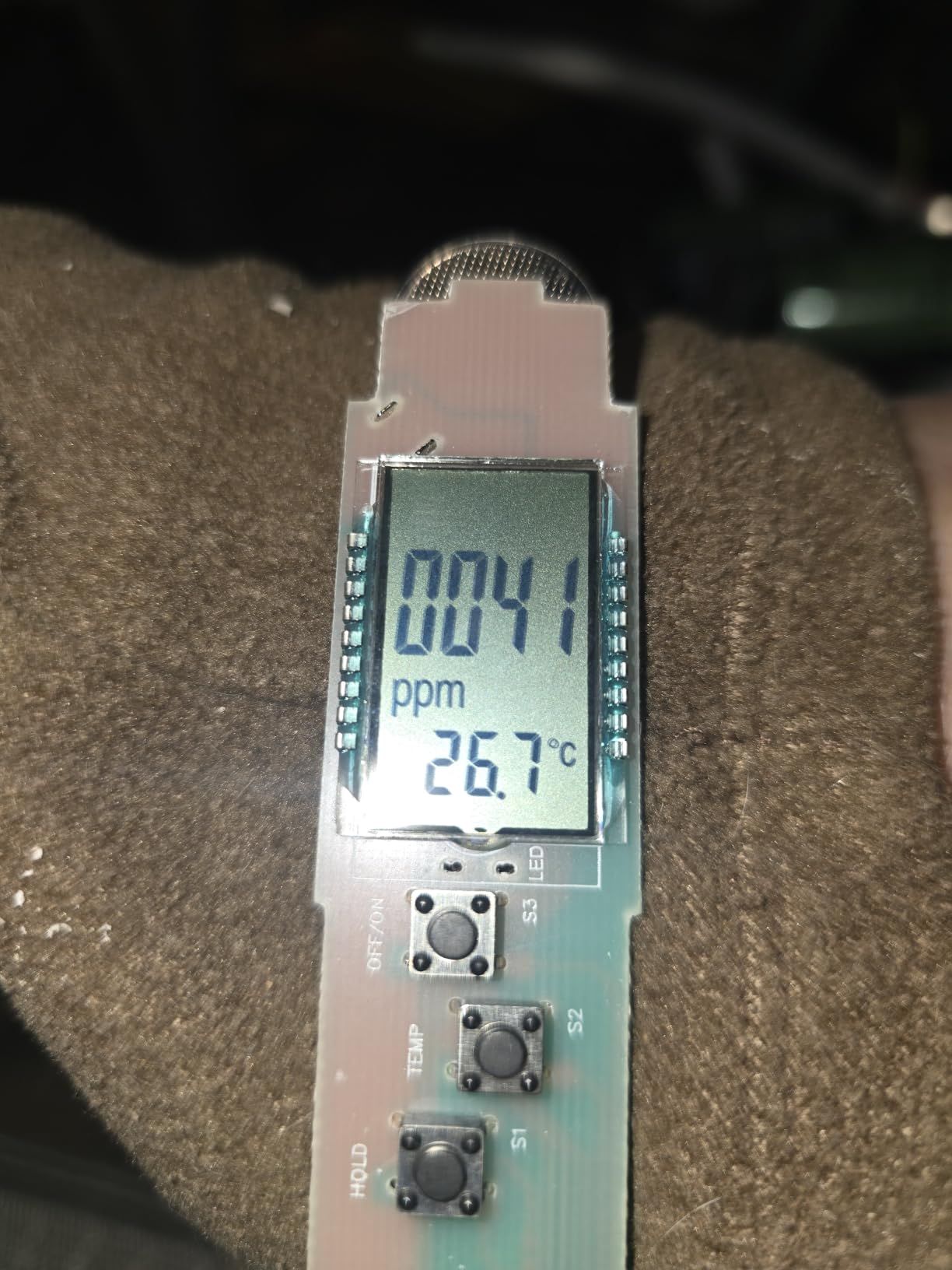
What the pack includes
The pack includes the pH meter, the 3-in-1 TDS meter and three calibration buffers, plus a protective case and batteries. The pH range is a full 0-14, and the TDS side covers 0-9990 ppm with plus or minus 2 percent accuracy.
Temperature is measured from 0.1 to 80.0 degrees Celsius, with auto-calibration and temperature compensation to simplify setup for a first-time user.
The stabilising-time problem
The most persistent complaint is that pH readings drift and take minutes to settle on some units. Three-point pH calibration is also described as difficult to complete reliably for a number of users, which is where most of the star-rating variation comes from.
For EC work specifically, the notes are better: many users confirm the readings matched reference instruments, which makes the TDS pen a reasonable daily tool even in a kit of this type.
Long-term reliability and limits
The steady complaint over a year of use is that the EC section of the TDS pen can stop working or drift. That is the deal breaker on this pack: a sealed probe means replacing the pen rather than a component.
Temperature readings are reported as off by several degrees, and it cannot test sea water. If you are working in a freshwater recirculating system or an aquarium, neither of those matters much.
How to Choose an EC Meter for Your Grow System
Decide on pen, combo unit or desktop meter by system type
A single-purpose pen is the right answer for one reservoir you check by hand. A combo pH and EC tester wins when you are running several systems and want every value in one workflow. A desktop unit with replaceable probes makes sense once you have more than one reservoir to track or you are dosing automatically, because the replaceable probes are where the long-term cost sits.
Automatic temperature compensation is not optional
Conductivity rises as water warms. A meter without automatic temperature compensation gives you a different number in the evening than in the morning for a solution that has not actually changed. Every meter in this guide except the plain budget testers either has ATC or compensates by design, and that is the single feature I would not give up.
Read EC, not TDS, and know your scale
An EC meter measures electrical conductivity of dissolved salts. TDS on most cheap pens is the same reading multiplied by a fixed conversion factor, which means a 700-scale pen and a 500-scale pen will report the same jug of solution differently. Buy in EC, or at least use a meter that shows EC, and convert yourself. If you want to track reservoir chemistry alongside your other monitoring kit, our wind meter comparison covers a different kind of instrument entirely.
Target EC by growth stage
Typical nutrient solution targets are roughly 0.8-1.0 mS/cm at seedling stage, 1.0-1.6 mS/cm in vegetative growth, and 1.8-2.5 mS/cm in flower. Always measure your source water EC before dosing, because tap water can arrive with a baseline that is a large fraction of your target.
Probe storage decides whether the meter survives
This is the buying criterion most guides leave out. Keep the probe in storage solution between readings, never dry, and never stored in distilled water. Growers repeatedly report that premature probe death comes down to storage rather than hardware, and a meter stored correctly outlives one with a better spec sheet. The same dry-versus-damp logic shows up in our guide to storing fishing rods, where moisture control is the deciding factor for far more expensive gear.
What to skip
Skip TDS-only pens with no EC readout, meters with a bare metal pin and no stated accuracy, and anything with a sealed non-replaceable probe. The community consensus is blunt on unbranded multi-function pins: they are fine for a fish tank and not fine for a nutrient reservoir you are dosing against a crop.
Cross-checking a cheap pen against a better meter
The practice most growers use is a cheap pen daily and a better meter occasionally to confirm it. Buy a known 1.413 mS/cm standard, check the everyday pen monthly, and if it walks, recalibrate or replace it. That costs a bottle of fluid a month and catches drift long before your plants show it.
Frequently Asked Questions
What is an EC meter used for?
An EC meter measures the electrical conductivity of a liquid, which in a nutrient solution is a direct proxy for the total concentration of dissolved fertiliser salts, reported in millisiemens per centimetre (mS/cm). It tells you what your plants are actually absorbing, rather than what the nutrient bottle says you added.
Which EC meter is best for hydroponics?
For a single reservoir you check by hand, the HoneForest 3-in-1 TDS and EC meter is the strongest all-round pick, with a titanium alloy probe and a large backlit display. If you also need pH in the same workflow, the Apera PC60 combines five measurement modes with a replaceable multi-parameter probe and a supplied calibration kit.
How do I calibrate an EC meter?
Rinse the probe with distilled water, immerse it in a fresh 1.413 mS/cm or 2.76 mS/cm calibration solution, stir gently, and adjust the meter until it matches the standard. Hold the reading steady, confirm the value, then rinse the probe again before returning it to storage solution. Never calibrate in distilled water alone, because there are no salts to measure.
What are the ideal EC readings for hydroponic plants?
Typical targets are about 0.8-1.0 mS/cm for seedlings, 1.0-1.6 mS/cm during vegetative growth, and 1.8-2.5 mS/cm in flower. Measure your source water before dosing, since tap or well water often arrives with a baseline reading that is a large part of your target already. Too high a reading locks nutrients up and burns leaf tips; too low starves the plant.
What happens if EC is too high in hydroponics?
A solution that is too concentrated creates osmotic stress, so the plant cannot drink even though the water is right there. You will see burnt or curled tip and edge growth first, then stalled growth as the plant stops taking up water. Too low an EC is slower and quieter, showing as pale growth and nutrient deficiency symptoms that appear well before the damage is obvious.
Do I need an EC meter if I already have a TDS meter?
Most budget TDS pens are the same conductivity reading with a fixed conversion factor, so you already have an EC measurement whether you know it or not. The catch is scale confusion: a 700-scale pen and a 500-scale pen read the same solution differently. Switch the pen to its EC scale, or convert the number yourself, and you have covered both.
Final Verdict: Which EC Meter to Buy in 2026
If you want one meter that covers daily nutrient checks without any fuss, the HoneForest 3-in-1 TDS and EC meter is where I would start. If you also need pH and you can live with a slightly steeper calibration routine, the Apera PC60 gives you five modes and a replaceable probe in one pocket case.
For reservoir work where you want zero calibration decisions, the Bluelab Truncheon is factory calibrated, waterproof, floats, and carries a five-year warranty. Growers with several reservoirs and a real pH requirement should look at the Bluelab Combo Meter, where replaceable probes spread the cost over years rather than wasting the whole unit.
On a tight budget, the MEXYBE 4-in-1 tester is honest work, and the HM Digital COM-80 is the pick if your source water sits in the microSiemens range. Whatever you choose, buy a 1.413 mS/cm calibration solution, keep the probe in storage solution between readings, and check your everyday pen against it monthly. That habit is worth more than any spec on the box, and it is what keeps the best EC meters for nutrient solutions working past year one.