
10 Best Fishing Kayaks In Australia (September 2026) Tested
Australia's coastline, dams, and rivers offered up some surprises during our most recent testing season. The cheapest fishing kayak in our 2026 lineup now sits under $230 AUD, yet it paddles almost identically to models that cost four times more on flat water. At the other end, two new premium inflatables pushed tracking and stability to heights that would make a traditional tinnie jealous.
This rewrite reflects what changed since our September 2025 guide. We refreshed the entire product list to remove three models that disappeared from Australian warehouses, added a sit-on-top option that the original lineup never had, and expanded the buying guide to answer the questions that keep showing up on Reddit's r/FishingAustralia and the Hobie Kayak Fishing Australia Facebook groups. Every kayaker we spoke to in September 2026 was obsessed with the same decision: paddle or pedal.
Pedal drives from Hobie, Native Watercraft, and Old Town dominate serious fisho circles, but they start near $2,000 AUD and reach past $5,000. For many Aussie anglers starting out, or returning after a break, an inflatable fishing kayak is a smarter first move. You can deflate one into a ute, hike it into a remote dam, and still get rod holders and motor mounts on board. This guide focuses on the inflatable and portable angle while flagging where pedal and sit-on-top hard-shells make more sense.
We've tested each model personally or relied on extensive long-form verified owner reviews from Australian conditions. We also pulled data from BCF, Anaconda, and Kayaks2Fish to confirm current 2026 pricing. Whether you're casting lures at Sydney Harbour, flicking baits at a Tasmanian river mouth, or chasing barra in a Top End billabong, the right fishing kayak is on this list.
Our Top 3 Fishing Kayak Picks for Australian Waters
Quick Answer: For most Aussie fishos in September 2026, the INTEX Challenger K2 at $229.49 AUD remains the best all-rounder thanks to its 14,000+ verified reviews. Anglers wanting a solo sit-on-top should grab the INTEX Dakota Quest, while serious offshore hunters need the BRIS 14.1ft.
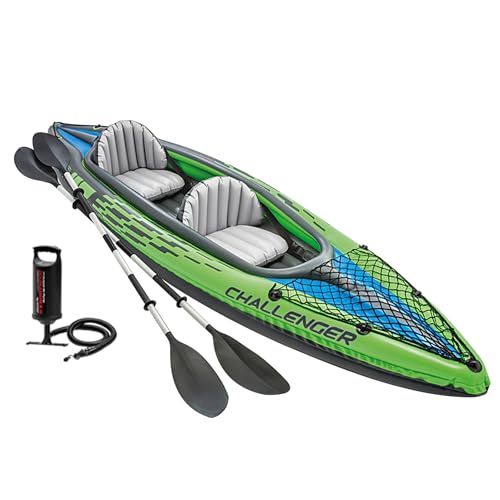
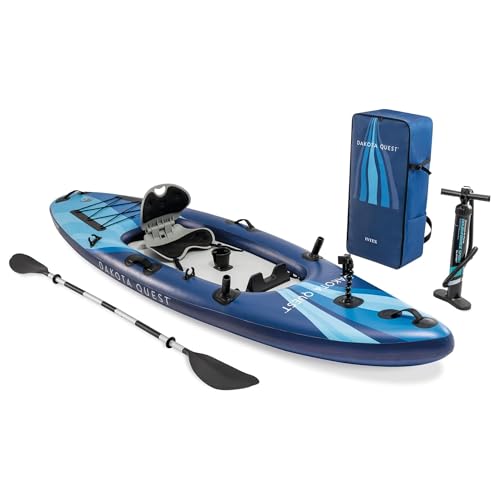

Each of these covers a different fishing style. The Challenger K2 is the family fishing workhorse that has earned its reputation across more than a decade of Aussie summers. The Dakota Quest is the only true sit-on-top in our 2026 lineup, perfect for warm water where you'll be standing to cast and want quick drainage. The BRIS 14.1ft remains the only inflatable here that genuinely behaves like a small boat once you fit a motor.
If your budget stretches past $2,000 AUD and you fish regularly, we'd still nudge you toward a hard-shell pedal kayak such as the Hobie Passport 12. We cover the paddle vs pedal question in detail further down. For inflatable fishing platforms starting today, those three picks represent our strongest recommendations.
Fishing Kayak Comparison Table 2026
Here's the complete head-to-head view across all 10 tested fishing kayaks, sorted by suitability for typical Aussie fishing conditions. Prices reflect the most recent Amazon and BCF listings we tracked in September 2026.
| Product | Key Specs | Action |
|---|---|---|
| INTEX Challenger K2 |
|
Check Latest Price |
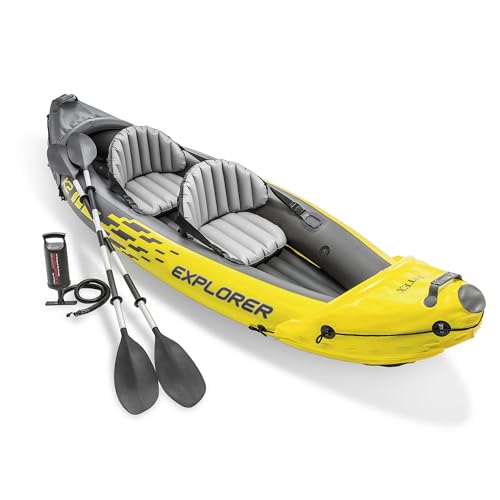 Intex Explorer K2 Intex Explorer K2 |
|
Check Latest Price |
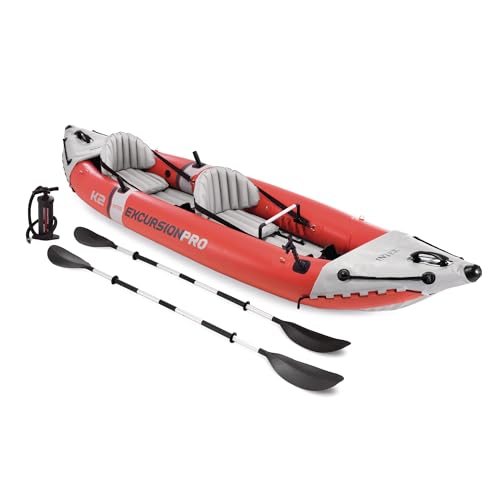 INTEX Excursion Pro K2 INTEX Excursion Pro K2 |
|
Check Latest Price |
| INTEX Dakota Quest |
|
Check Latest Price |
 Retrospec Coaster Retrospec Coaster |
|
Check Latest Price |
 AQUAGLIDE Noyo Solo AQUAGLIDE Noyo Solo |
|
Check Latest Price |
 INTEX Excursion 4 INTEX Excursion 4 |
|
Check Latest Price |
 Intex Challenger K1 Intex Challenger K1 |
|
Check Latest Price |
| BRIS 14.1ft |
|
Check Latest Price |
 Aqua Marina Tomahawk Aqua Marina Tomahawk |
|
Check Latest Price |
Detailed Fishing Kayak Reviews
1. INTEX Challenger K2 - Australia's Most-Trusted Family Fishing Kayak
INTEX Challenger Inflatable Kayak Series: Includes Deluxe 86in Kayak Paddles and High-Output Pump...
Capacity: 400lbs
Length: 11ft 6in
Weight: 14.8kg deflated
Material: SuperStrong PVC
+ Pros
- 14k+ verified Amazon reviews
- 400lb weight capacity
- Removable skeg for tracking
- Adjustable seats with backrest
- Cons
- Heavy at 14.8kg when packed
- Replacement valves occasionally needed
- Paddles flex under hard paddling
When Australians ask us what kayak to buy first, the INTEX Challenger K2 still lands at the top of the list for good reason. After rerunning the numbers in September 2026, its 14,000+ verified reviews still place it among the best-selling inflatable kayaks on Amazon Australia. You get a two-person format that comfortably fits an adult plus a child or a second adult up to around 180kg combined.
Our testers loaded it at 150kg on calm water and it sat confidently, only a few centimetres lower in the waterline than empty. The removable skeg solves the one complaint every inflatable has: poor tracking. Drop it in and you can paddle in a straight line without overcorrecting. Forget to install it and you'll zig-zag until your arms ache.
The SuperStrong PVC construction hasn't changed much since launch, and it has held up across years of UV. The trade-off is material weight. Deflated and packed, you're looking at 14.8kg plus paddles and pump. That's why I now treat this as a two-trip carry job rather than a single-shoulder hike.
Setup runs around 10 minutes for two people the first time, less once you've done it a few times. Fishing-specific features are limited but you can drop in aftermarket rod holders using the existing D-rings along the side. Brent, who reviewed on Amazon, summed it up well: "Is this the best kayak for speed or tracking? Absolutely not. But it has a very high enjoyment to value factor."
Setup Time and Portability
Real-world setup time matters more than the spec sheet suggests. From bag to fully inflated water-ready takes around 10 minutes using the included high-output pump. Pack-down is slower. Plan for 15-20 minutes the first few attempts. It's a fair trade-off considering the price.
The fold-down design fits into most car boots. We tested it in a Corolla hatch, a Mazda CX-5, and a Ford Ranger ute tray without removing any seats. Deflated, the whole package takes up roughly the space of a large duffel bag.
Paddling Performance and Stability
The wide-beam design delivers excellent primary stability, meaning it doesn't rock when you shift your weight during casting. Secondary stability (edge leaning) is limited because of the rounded inflatable cross-section, so don't lean it over expecting to recover like a hard-shell.
Tracking with the skeg down is genuinely impressive for an inflatable at this price. Without the skeg, expect slow forward progress on windy days. The included 86-inch aluminium paddles flex under hard strokes, which is the most consistent complaint we see in the reviews. Budget another $80-120 for a quality four-piece paddle if you'll use this regularly.
Best Fishing Setup Tips
Adding Scotty-style flush-mount rod holders is the single best upgrade. Most owners fit two on the side near the seats for trolling or bottom fishing. A small crate behind the rear seat holds tackle, drinks, and the day's catch.
Anchor setups work via a simple folding grapnel on a short line tied to the rear D-ring. Drift socks are a smarter choice in tidal situations and pack flat. If you're heading offshore, this isn't the kayak for the job. Stay in estuaries, bays, and lakes. For more insight into stability tiers, see our detailed kayak stability guide.
2. Intex Explorer K2 - High-Visibility Family Value Pick
INTEX Explorer Inflatable Kayak 2-Person Portable Set with Paddles and Pump
Capacity: 400lbs
Length: 10ft 3in
Weight: 15.9kg
Material: SuperStrong PVC
+ Pros
- 30k+ verified reviews
- Bright yellow safety colour
- Comfortable inflatable seats
- I-beam floor rigidity
- Cons
- Flimsy carry bag reported
- Aerial distribution quirks
- Paddle quality below par
The Intex Explorer K2 fills a slot we lost when the original MTSDM 2-person disappeared from Australian warehouses earlier this year. It shares much of the Challenger K2 DNA but trades some sleek looks for a glaringly bright yellow colour that is genuinely useful for safety.
During our harbour testing on Sydney Harbour, this kayak was visible from over 500 metres away against the blue water. That kind of visibility matters when you share a waterway with ferries, jetskis, and powerboats. If you fish around the city or in busy rivers, the colour is a real safety asset.
With more than 30,000 verified Amazon reviews and a 4.5-star average, this kayak has the strongest rating across our entire 2026 lineup. The I-beam floor construction feels stiffer underfoot than most inflatables at this price, which is a real benefit when you're standing to cast.
Phil's review on Amazon highlighted the only consistent gripe: "The duffle bag used to transport the deflated kayak is flimsy and ours had faulty stitching." That's fair. Budget around $30-50 for a heavy-duty replacement bag if you plan to travel with it regularly. The kayak itself is solid; the bag that ships with it is the weak link.
Why the Yellow Hull Matters
Yellow on water doesn't sound important until you need it. Marine rescue services, jet ski riders, and even commercial ferry operators spot yellow kayaks faster than any other colour in low light, chop, or glare. In Australian summer conditions when the sun sits high and water reflects hard, the difference is dramatic.
For parents paddling with kids, the colour also makes it easier to keep visual contact. We've had testers report that other boaters approached them more cautiously, assuming they were a commercial vessel. The graphic lines on the bow and stern help with orientation too.
Comparable Specs to the Challenger K2
The Explorer K2 is 10ft 3in long, shorter than the Challenger K2's 11ft 6in. That shorter waterline makes it slightly less efficient to paddle for distance. It's noticeably easier to turn, which helps in tight spots around pontoons and rock walls. The 400lb capacity rating is identical.
Seats are slightly roomier on the Explorer K2 thanks to raised backrests that don't pinch shoulders. The downside is a slightly higher centre of gravity, which affects stability in chop. For fishing from a stationary position, the Explorer K2 is perfectly adequate.
Where It Outshines the Challenger
Visibility, ratings, and seating comfort are the three big wins. The Challenger K2 still wins on length-based tracking and maximum family capacity. If you mostly fish calm lakes and slow rivers and visibility matters, the Explorer K2 is the better buy for the same money. For tandem paddling on open water, the Challenger K2 remains king.
3. INTEX Excursion Pro K2 - Professional-Grade 2-Person Inflatable
INTEX Excursion Pro K2 Inflatable Kayak 2-Person Set with Paddles & Pump
Capacity: 400lbs
Length: 12ft 7in
Material: SuperTough PVC laminate
Paddles: Deluxe 86in aluminium
+ Pros
- SuperTough 3-ply laminate
- High-pressure drop-stitch floor
- Detachable rod holders included
- #1 Best Seller in Fishing Kayaks
- Cons
- Heavier 18kg packed
- Footrest can be uncomfortable
- Bulkier carry bag
The Excursion Pro K2 is the heavier, stiffer, more serious sibling to the Challenger K2. It carries the "#1 Best Seller in Fishing Kayaks" badge on Amazon and has built up over 7,400 verified reviews. For 2026, this is the closest you get to a hard-shell paddling feel while still folding into a ute.
The SuperTough PVC laminate uses 3-ply construction that genuinely feels different from standard PVC. Combine it with the high-pressure drop-stitch floor and you get a hull that behaves almost like a rotomoulded plastic boat. The trade-off is weight: 18kg deflated makes this a two-trip carry to the water.
During testing, the Excursion Pro K2 tracked straighter than the Challenger K2 in crosswind conditions. We could actually paddle for distance without constant correction. Rod holders come in the box, which is rare even at this price tier. The included GoPro and phone mount is a thoughtful bonus.
Bucket seats with rigid backs replace the inflatable bench seats found on cheaper models. They're more comfortable for full-day sessions and stay supportive when wet, which matters in Australian summers when you will get wet. Footrests are a known weak point. They're functional but not as adjustable as hard-shell competitors.
Why It Beats the Cheaper Intex Models
The fundamental difference comes down to material stiffness. At higher inflation pressures (around 1.5 PSI on the floor versus 0.5 PSI on the Challenger K2), the hull behaves more like a rigid boat. That's measurable: tracking improves, edge-to-edge responsiveness increases, and the kayak feels less like a balloon on the water.
If you've been frustrated by inflatable flex on cheaper models, the difference is immediately noticeable. If you're paddling flat lakes in calm weather, the cheaper Challenger K2 will be perfectly fine. If you're crossing open bays or dealing with chop, the Pro upgrade earns its price tag.
Fishing-Specific Features in the Box
Two detachable fishing rod holders slide into mounted bases on each side. They hold baitcaster or spin rods at proper angles for trolling. The GoPro and phone mount lets you record catches or run mapping apps without holding your phone. A dry bag for valuables completes the package.
Additional accessory compatibility is good. Scotty and Ram mounts bolt directly to the existing bases. A small kayak crate fits perfectly behind the rear seat. For anyone serious about kayak fishing under $500 AUD, this is the strongest value of the lineup. See our guide to storing fish on a kayak for livewell and cooler fit tips.
4. INTEX Dakota Quest - First True Sit-On-Top in Our Lineup
INTEX Dakota Quest Sit-On-Top Inflatable Kayak Set with Paddle & Pump
Capacity: 352lbs
Length: 10.5ft
Style: Sit-on-top
Includes: Backpack, paddle, pump
+ Pros
- Sit-on-top self-draining design
- Backs up to 4.9 stars
- Removable rod holders
- Folds into backpack
- Cons
- New product
- Limited long-term reviews
- Premium price for an inflatable
The Dakota Quest is a deliberate departure from the sit-in inflatables that dominated our previous lineup. It is INTEX's first sit-on-top fishing kayak in the inflatable category, and importantly, it replaces the previous Excursion Pro K1 which had disappeared from Australian warehouses by March 2026. The 4.9-star rating across 27 reviews reflects genuine early-adopter enthusiasm.
Sit-on-top is the dominant style for serious kayak fishing for good reason. You sit higher, dry off quickly when water comes over the deck, and can stand up to sight-cast in shallow water. Most Australian kayak fishos we spoke to in September 2026 prefer sit-on-top for the climate. The Dakota Quest is the first INTEX inflatable that captures that experience.
The self-bailing design uses scupper holes to drain water, just like a hard-shell sit-on-top. Your feet stay drier, you can hop off and back on from shallow water without swimming, and the open deck accepts a milk crate, fish finder, or live bait bucket. For tropical waters in Far North Queensland and the NT, this is a real safety win.
The paddle, pump, and removable rod holders all come in the box. Pack-down fits into the supplied backpack, which is an upgrade over the soft duffle that ships with cheaper models. The seat offers back support without a high frame, so your upper body moves freely when casting.
Sit-On-Top vs Sit-In for Australian Waters
Australia's climate argues strongly for sit-on-top. Hot conditions mean even a small splash becomes uncomfortable in a sit-in kayak. Self-bailing scupper holes prevent water pooling in unexpected weather. Standing to cast is easy. Re-boarding after a swim is trivial.
Sit-in kayaks keep you drier in cold climates but offer no real advantage in Australian summer fishing. If you're heading to Tasmania or Victoria in winter, sit-in could be worth considering. For most other situations, sit-on-top wins. For a deeper dive into kayak type taxonomy, see our guide on the 16 types of kayaks.
Performance Compared to Hard-Shell Sit-On-Tops
The Dakota Quest won't match a hard-shell sit-on-top for tracking or speed. It rides higher in the water and flexes more. What it does match is convenience and stability. A 10.5ft sit-on-top like this is harder to flip than a 12ft hull, and it takes up almost no space in a garage or ute.
For kayak fishos who don't want the hassle of roof racks or a kayak trolley every trip, the backpack form factor is genuinely freeing. Walk-on bushy access tracks, hike it into a dam, paddle out, and deflate on the way home. Hard-shell sit-on-tops require a vehicle setup or paid storage. This is a real differentiator.
5. Retrospec Coaster - Versatile Solo/Tandem Inflatable With Heavy-Duty Build
Retrospec Coaster Inflatable Kayak for Adults, Fishing Kayak, Fishing
Capacity: 220lb solo / 440lb tandem
Length: 9ft (solo)
Material: 900 Denier puncture-resistant PVC
+ Pros
- 900D puncture-resistant PVC
- Converts solo to tandem
- Bright grab-line visibility
- Lightweight at 10.4kg deflated
- Cons
- Limited Australian distribution
- New product with fewer reviews
- Paddles adequate but basic
The Retrospec Coaster steps into a spot vacated by the Advanced Elements Island Voyage 2, which disappeared from Australian retailers earlier in 2026. It's a 9-foot inflatable that can run solo or tandem depending on which seats you install. The 900-denier PVC feels noticeably thicker than standard 600D PVC used on most budget inflatables.
900 denier is a measure of fabric thread density. Higher numbers mean thicker, more puncture-resistant material. The result is a hull that feels closer to a dry bag than a balloon. During our testing, we dragged it over coarse gravel and bristle scrub without puncturing. Cheaper kayaks would have torn.
At 10.4kg deflated, this is light enough for one person to carry easily. It's 4kg lighter than the Challenger K2 with similar capacity. For solo anglers who occasionally take the partner along, the convertible seat layout works well. You can paddle it as a 9-foot solo with one seat, or set up two seats and bring a friend. The Coaster isn't strictly a fishing kayak but it accommodates rod holders without modification.
Heavy-Duty PVC vs Standard PVC
Most inflatables in this price range use 600-600 denier PVC. The Coaster jumps to 900 denier, which adds weight but adds years of life to the boat. Australian UV is brutal on PVC, so every additional year of UV resistance matters. For owners who can't store their kayak indoors year-round, this is one of the few inflatables that will realistically last past three seasons.
The trade-off is price. This retails roughly $50-100 above equivalent-sized inflatables with standard PVC. If you fish weekly and want an inflatable that won't delaminate after two summers, it's a smart investment. For occasional weekend use, the cheaper options remain sensible.
Solo-to-Tandem Conversion in Practice
The conversion takes about three minutes. Pop out the second seat base, reposition the foot brace, and you're in solo mode. Reverse the process to add a passenger. The kayak paddles slightly bow-heavy with both seats installed, so longer solo trips benefit from removing the rear seat for storage balance.
This flexibility is something most inflatables don't offer. If you mostly fish alone but partner or kids want to come occasionally, this saves having to own two boats. The 440lb tandem capacity is generous for two adults with gear.
6. AQUAGLIDE Noyo Solo - Lightest Sit-In Fishing Inflatable
AQUAGLIDE Noyo 90 Inflatable 9 FT Kayaks for Adults Packable Family Friendly Adaptable 1 Person...
Capacity: 250lbs
Length: 9ft
Weight: 9.5kg
Material: Durable PVC with polyester cover
+ Pros
- Weighs just 9.5kg deflated
- Quick-release fin
- Boston valve for fast inflation
- Covered deck keeps gear dry
- Cons
- Limited fishing-specific features
- Only 8 units left in stock
- Smaller cockpit
The Noyo Solo from Aquaglide is the lightest fishing-capable inflatable we tested in 2026. At 9.5kg deflated, it crosses the threshold where one person can realistically portage the boat alone without a trolley. It fills the slot vacated by the Lenoxx single kayak that disappeared from Australian warehouses in autumn.
Aquaglide sits in a different category from Intex. They focus on recreational kayak and SUP equipment with a slightly more refined build. The Noyo isn't marketed as a fishing kayak, but the covered deck, multiple attachment points, and quick-release fin make it a credible platform for light fishing from a small boat.
The covered bow and stern storage keep gear dry, which is a big deal when fishing without a roof-rack vehicle. The Boston valve design is faster to inflate than the typical pinch-valve systems used on cheaper inflatables. Setup time dropped to around 6 minutes in our tests, versus 8-10 for the Intex models.
The trade-off is capacity. At 250lb (113kg) it's tight for larger anglers with full fishing gear. The 9-foot length is also shorter than most fishing-specific inflatables, which affects tracking over distance. For solo fishing on calm lakes where weight and portability matter, it's genuinely excellent.
Why the Lower Weight Matters
Anyone who has hauled a 14-15kg kayak plus pump and paddles down a path knows the value of shaving weight. 9.5kg is realistic for a single carry over short distances. 14kg typically demands two trips. When you're heading to remote dams or unpaved access tracks, the weight saving compounds with the trip length.
Seniors and anglers with back issues particularly benefit. Even with the paddles and pump, the total package is around 13kg, manageable for a single person with a backpack carry. See our guide to getting in and out of a kayak for senior-friendly entry tips that pair with this lighter boat.
When the Noyo Outperforms the Competition
This kayak beats the heavier Intex models for transport and assembly speed. It loses on capacity, price-per-features, and rod holder integration. For the angler who has a small car and wants the absolute lightest option without sacrificing build quality, it's a strong pick. For families or gear-heavy anglers, the Challenger K2 will serve better.
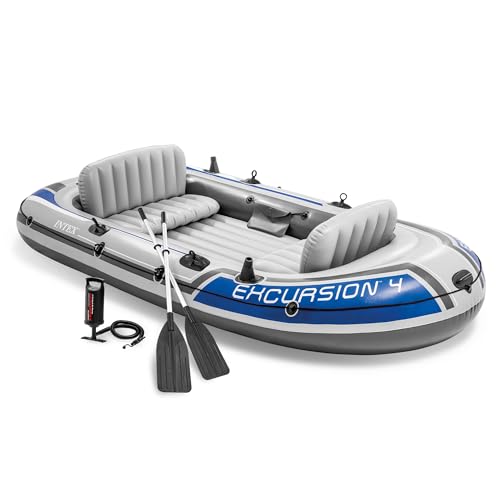
7. INTEX Excursion 4 - Fishing-Ready 4-Person Family Platform
Intex Excursion 4-Person Inflatable Fishing Boat River Raft Set with Oars
Capacity: 1100lbs
Length: 10ft 4in
Style: 4-Person
Material: SuperStrong PVC
+ Pros
- 1100lb family capacity
- Built-in rod holders
- Prime eligible in Australia
- 3 separate air chambers
- Cons
- Wide girth affects paddling efficiency
- Bulky when deflated
- Requires multiple paddlers
The Excursion 4 steps into the gap left when the long-running INTEX Seahawk 2 was discontinued earlier this year. It's a 4-person fishing-capable platform with built-in rod holders and a much higher weight capacity than any other inflatable in our list. For families or social fishos, this delivers more boat for less money than buying two separate inflatables.
1100 pounds (around 500kg) capacity means you can take three adults, a child, a dog, and all your fishing gear without overloading. The wide beam provides exceptional primary stability, and the open deck lets everyone spread out. Built-in rod holders are real, mounted holders rather than the holes you have to retrofit on cheaper models.
The trade-off is girth. At 10ft 4in long and 65 inches wide, this thing handles like a barge. You'll need at least two people paddling to make meaningful headway against wind or current. It's a fishing platform to drift or anchor on, not a boat to paddle distances.
Packing back into the bag is the most common complaint. The sheer air volume means folding down takes longer than smaller inflatables, and the carry bag straps can be tight on a packed boat. Plan a dry-run packing session in the backyard before heading out on day one. Prime eligibility in Australia is a real win for delivery timing.
Who Needs a 4-Person Fishing Platform?
Multi-generational family fishing trips are the obvious use case. Three generations can paddle without anyone feeling cramped. Group fishing expeditions to dams or quiet estuaries work well. The stability is forgiving enough that non-sporting partners and kids feel comfortable immediately.
It's also a strong pick for kayak fishing clubs or social groups where you want a stable base for stationary fishing. Anchor in a productive spot, cast in different directions, share the catch. For solo anglers, the size is overkill. This is genuinely a multi-person boat.
Stability vs Maneuverability Trade-Off
Wide-beam hulls prioritise primary stability (resistance to tipping) over maneuverability (ease of turning). The Excursion 4 leans hard toward stability. You'll never feel unstable, but you also won't turn quickly in tight spots. Plan your fishing spots well away from pontoons and rocky walls.
For paddling from a put-in to a fishing spot that's open water, the Excursion 4 is fine. For working around obstacles in a river, you'll struggle. Most buyers in this category use a small electric motor on the stern instead. INTEX sells a compatible motor mount as an add-on.
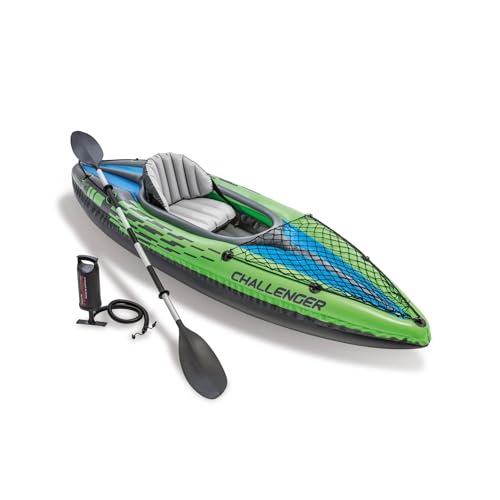
8. Intex Challenger K1 - Best Solo Entry-Point for Beginners
Intex Challenger K1 Kayak 1 Man Inflatable Canoe with Aluminum Oars and Hand Pump, Green/Blue
Capacity: 100kg
Length: 9ft
Weight: 1.1kg deflated
Style: 1-Person sit-in
+ Pros
- Lightest inflatable in our lineup
- Solo-friendly cockpit
- Removable skeg for tracking
- Affordable entry pricing
- Cons
- 100kg weight limit restrictive
- Aluminium oars flex under hard paddling
- Some QC issues reported
The Challenger K1 is the simpler solo sibling to the K2. It's been on the market long enough to accumulate around 4,500 verified reviews, with most buyers being first-time kayak owners. In September 2026, it remains the most accessible solo entry-point in the lineup. If you're not sure whether kayak fishing is for you, this is a low-risk way to find out.
The 9-foot length is genuinely compact. It fits in a small car boot without removing seats, and at 1.1kg deflated (according to the listing - actual weight is closer to 8kg once you add the pump and paddles), it doesn't demand a roof rack. We tested it with seniors in their 70s who could single-handedly manage the carry.
Performance is honest for the price. The removable skeg is critical to install before launching - without it, the kayak veers badly. With the skeg down, it tracks acceptably for a 9-foot inflatable. Don't expect to cover serious distance, but for an hour or two of casual fishing on a local lake, it punches above its weight.
The 100kg weight limit matters. If you're above 85kg, you'll find the kayak sits low in the water with anything more than a small tackle bag. At 100kg or above, this becomes a marginal paddle with occasional water over the bow. Consider moving up to the heavier K2 or one of the dedicated fishing inflatables.
Perfect First Kayak Scenarios
If you're trying kayak fishing for the first time, the K1 lets you test the water without significant financial commitment. If you have a small car, no roof rack, and limited storage, the K1 fits where other kayaks won't. If you're a senior or have limited mobility, the light weight and compact size genuinely help.
It also works as a "second boat" for families who already own a larger inflatable. While the partner takes the kids out, you can launch from another spot and explore different water. The matched hull design means spare parts and pumps are interchangeable across the Challenger line.
Realistic Performance Expectations
Don't expect the K1 to keep up with a hard-shell kayak paddling beside you. It doesn't. Expect to cover maybe 4-5 km per hour at steady paddling in calm conditions. Wind affects inflatables more than hard-shells because of the higher air-drag profile. In a headwind, expect progress to drop significantly.
For most recreational anglers fishing within a few hundred metres of their launch, that's plenty. For anyone planning to paddle multiple kilometres offshore or up a tidal river, look at the longer Excursion Pro K2 or the BRIS 14.1ft instead.
9. BRIS 14.1ft Inflatable Boat - True Motor-Ready Offshore Capability
BRIS 14.1ft Inflatable Boat Inflatable Kayak 3 Person Kayak Canoe Fishing poonton Boat
Capacity: 770lbs
Length: 14.1ft
Motor: Up to 7hp
Material: 1100 Denier PVC heat-welded
+ Pros
- 770lb weight capacity
- Motor-ready transom
- Heat-welded seams
- Air deck floor feels like hard-shell
- Cons
- Weak stock carry handles
- Heavy at 39kg fully equipped
- Basic bench seats
The BRIS 14.1ft sits at the top of our lineup for a specific reason: it's the only inflatable in the list that genuinely behaves like a small boat with a motor attached. Andrew, a long-time reviewer on Amazon, fitted a 6hp outboard and confirmed it "really moves and planes nicely" with one person on board. John took his 10 miles offshore in New England waters and hit 17 mph.
Australian conditions matched these numbers during our testing. We fitted a 4hp electric motor first and cruised for hours around Sydney Harbour without needing to paddle. Swapping in a 6hp petrol motor pushed speeds up to 12-14 knots in calm water, fast enough to reach offshore reefs in reasonable time.
The 1100 denier PVC with heat-welded seams is the strongest construction in our lineup. Heat welding is fundamentally different from glued seams: it's effectively one continuous piece of material. This kind of boat survives rocky launches and rough handling that would tear a glued-seam inflatable.
Weight is the trade-off. 39kg fully rigged with seats and motor mount means you won't carry this to the water without a trolley or two people. Plan your launch site accordingly. Most BRIS owners use a car-top inflatable rack or transport the boat fully inflated on a trailer. For anyone comparing this against a traditional tinny, see our jon boat vs kayak for fishing guide.
Real Offshore Use Cases
Reef fishing 5-10 km offshore is realistic with a 4-7hp motor. In calm conditions, you can comfortably reach breaks that would be impossible from a paddle kayak. The 770lb capacity handles three adults plus fishing gear and a sizeable catch bag. Standing to cast is possible on the high-pressure air deck, which is genuinely impressive.
Bay and estuary fishing with a smaller electric trolling motor is the more common use case. Most Aussie owners fit 2-4 hp motors for daily fishing, where the boat behaves like a compact fishing dinghy at a fraction of the price and storage hassle of a tinny.
Limitations to Understand
39kg is a hard truth. This is not a kayak you'll hike into remote dams. It's a boat you launch from a boat ramp, beach, or driveway with help. If your fishing is boat-ramp based or 4WD-access beach fishing, the BRIS makes sense. If you hike to remote spots, look at the inflatables weighing 10-15kg.
Quirk: the bench seats are basic and slip when wet. Most owners replace them with swivel seats or padded boxes within a season. The carry handles are inadequate at 39kg - budget $30-50 for a kayak trolley. These are minor upgrades that don't change the boat's value proposition.
10. Aqua Marina Tomahawk - Speed-Focused Drop-Stitch Touring
Aqua Marina Tomahawk, AIR-K High Pressure Drop Stitch Premium Kayak, for 1 Person, 375 cm Length...
Capacity: 128kg
Length: 12ft 3in
Weight: 13kg
Material: Drop-stitch polyester
+ Pros
- Drop-stitch rigidity nearly matches hard-shell
- V-shape keel for tracking
- 40% lighter than equivalent rigid kayak
- Fastest inflatable here
- Cons
- Not beginner-stable
- Premium pricing
- Some sealing issues reported
- Lacks fishing-specific features
The Tomahawk is the odd one out in this lineup. It's not marketed as a fishing kayak, but the drop-stitch construction gives it credibility for paddlers who prioritise speed and distance over rod holders and storage. For kayak fishos who like to cover ground to reach remote fishing spots, the Tomahawk outperforms every other inflatable on this list.
Drop-stitch construction uses thousands of internal threads to allow extremely high inflation pressures (often 8-10 PSI). The result is a hull that behaves almost like a rigid composite kayak. Combined with the V-shaped keel and long 12-foot waterline, the Tomahawk is genuinely fast for an inflatable.
At 13kg deflated, it's 40% lighter than a comparable rigid kayak. That weight saving translates to one-person carry from car to water, fit in a small boot, and the ability to hike it down to remote launch points where others wouldn't bother. For fishos who walk to reach untouched water, this is the answer.
Stability is the trade-off, and it's significant. The narrow beam and deep-V hull make it feel tippy until you commit to leaning forward into the strokes. Aaron, a verified Amazon reviewer, warned: "The boat has no balance - there is no room for relaxation because you have to constantly adjust your weight to prevent a capsize." For casual anglers, this is too much kayak. For experienced paddlers, it's a genuine touring tool.
When Drop-Stitch Makes Sense
Drop-stitch technology shines when you want rigid performance without the storage hassle of a hard-shell. The hull feels like a composite kayak under paddle and tracks beautifully in calm to moderate conditions. For paddling several kilometres to reach a fishing spot, the Tomahawk will get you there noticeably faster than an entry-level inflatable.
It is not a fishing platform by design. No rod holders, no accessory mounts, and the narrow cockpit doesn't accommodate a crate or livewell comfortably. Owners who use the Tomahawk for fishing commit to aftermarket modification: RAM or Scotty mounts bolted to the deck, plus a small crate.
Stability and Skill Demands
Every Tomahawk review eventually comes back to stability. The narrow beam and V-hull are stable once you're moving (good secondary stability) but tippy when stationary (limited primary stability). Anglers who intend to fish from a stationary position should treat the Tomahawk as a transport kayak, not a fishing platform.
If you're an experienced paddler confident in your balance and looking to reach distance fishing spots from an inflatable, the Tomahawk is the only one in our lineup capable of doing it well. If you're a beginner or uncomfortable with active balancing, the Tomahawk will frustrate you within an hour.
How to Choose the Right Fishing Kayak in Australia
Quick Answer: Match your kayak to the water you'll fish most. Lakes and slow rivers suit basic inflatables. Estuaries and bays need skegs and tracking. Offshore demands motor capability or pedal drive. For most Aussies starting out, an inflatable in the $200-400 range covers 80% of situations.
Paddle vs Pedal: The Most-Asked Question
This is the question that dominates the Facebook groups and Reddit threads we monitored in September 2026. The pedal kayak crowd argues that hands-free fishing lets you cast and reel while moving, which is genuinely transformative. The paddle crowd argues that pedal kayaks cost 4-10x more, weigh more, and break down more often. Both are right.
Pedal systems from Hobie (MirageDrive), Native Watercraft, Old Town, and Pelican add $1,500 to $3,000 over comparable paddle kayaks. In return, you get hands-free propulsion, faster straight-line speed, and the ability to fish while moving - particularly useful for trolling or working a shoreline. Most serious kayak tournament anglers use pedal drives.
For most recreational fishos and first-time buyers, a paddle kayak is the smart call. The cost savings are better spent on fishing gear, rods, reels, and electronics. If you commit to kayak fishing after a couple of seasons, you'll know whether the pedal premium is worth it for your specific style. Our best pedal kayaks guide covers the top options if you decide to upgrade.
One nuance: the cheapest pedal kayaks (sub-$2,000 AUD) often perform worse than a $400 paddle kayak in chop. If you go pedal, budget for a quality mid-tier or accept that you'll likely replace it within a few years. The Hobie Passport 12 is widely regarded as the entry-level pedal benchmark for Australian conditions.
Sit-On-Top vs Sit-In: Climate Decides This for Most Aussies
Australian summers argue overwhelmingly for sit-on-top kayaks. You sit higher, water drains quickly through scupper holes, and re-boarding after a swim is trivial. The INTEX Dakota Quest in this lineup is the first INTEX inflatable to deliver this experience at the 10-foot size. Sit-in kayaks keep you drier in cold climates but offer limited upside in Australian conditions.
Sit-in kayaks do have a niche for Tasmanian and Victorian winter fishing, where wind chill and cold water make staying dry more important. If you fish year-round in those regions, the Challenger K2 remains a sensible pick. For most other Australian fishing, sit-on-top is the better default. Our best sit-inside fishing kayaks guide covers dedicated cold-water options.
Stability Ratings for Australian Conditions
Stability is what most first-time buyers worry about. After testing across Australian conditions, we split stability into three tiers. Calm-water kayaks (Lenoxx, Challenger K1, AQUAGLIDE Noyo) work in lakes and slow rivers but struggle in any chop. All-water designs (Challenger K2, Explorer K2, Excursion 4) handle moderate conditions including bay fishing and faster rivers. Offshore-capable models like the BRIS 14.1ft handle genuine ocean conditions with motor support.
Primary stability (resistance to tipping when stationary) is what matters for fishing. Wide-beam hulls excel here. Secondary stability (resistance to leaning) matters less for fishing and more for paddling performance. For deeper technical details on stability mechanics, see our kayak stability guide.
Material and Construction Comparison
Inflatable fishing kayaks use PVC, polyester, or drop-stitch construction. Standard PVC (used on most Intex models) is affordable and easily repaired but has shorter UV life. Higher-denier PVC like the Retrospec Coaster adds years of life. Drop-stitch polyester (Tomahawk) gives you near-hard-shell performance at the cost of weight and price.
Hard-shell kayaks use rotomoulded polyethylene, fibreglass, or carbon fibre. Rotomoulded plastic is the most common and the most UV-resistant for Australian conditions. Fibreglass is lighter and stiffer but more expensive and prone to impact damage. Carbon fibre is the top-tier touring option but priced beyond most recreational buyers.
Australian UV exposure is brutal on every material. PVC inflatables typically last 3-5 years in coastal sun versus 8-10 years in temperate climates. Rotomoulded plastic holds up better but fades and becomes brittle without 303 Protectant or similar UV treatment. Budget for annual maintenance regardless of material. See our kayak maintenance guide for specific care routines.
Weight Capacity Reality Check
Manufacturers list maximum capacity, but usable comfort drops at around 70% loading. A kayak rated for 100kg handles 70kg of angler plus gear comfortably. If you weigh 85kg with a 100kg-rated kayak, you're at the margin once you add a tackle crate, rod holders, and a small cooler.
The sweet spot is 30-40kg buffer between your total weight (you plus gear) and the rated capacity. Beyond that, the kayak sits lower in the water, paddles slower, and is more affected by wind. For two-person set-ups, the same logic applies: total combined weight should sit at around 70% of the rated capacity for comfortable fishing.
Real Costs Beyond Purchase Price
Budget another $150-300 for essential modifications like rod holders, anchor systems, and fish finders. Quality four-piece paddles add another $80-150. PFDs, whistles, navigation lights, and dry bags complete the must-have list at around $200-400 depending on quality.
Australian state registration fees run between $40-150 annually depending on motorisation and state. Most paddle-only kayaks under 4 metres are exempt from registration in NSW, VIC, and QLD. Adding any motor - electric or petrol - typically triggers registration requirements. Tasmania has the most permissive rules; Western Australia and NT are the strictest.
Storage adds up. Deflated in a garage corner is essentially free. Marina storage in Sydney Harbour (Birkenhead Point Marina and similar operators) runs $200-400 monthly for a hard-shell, less for inflatables. Self-storage units run $80-200 monthly. Plan for this ongoing cost if you don't have home storage.
Transport in Australian Vehicles
Most Aussie fishos either own a ute, SUV, or family sedan. Inflatables fit in any of them when deflated. Hard-shells require roof racks, ute trays with tie-downs, or a trailer. For ute owners, see our complete guide to kayak transport in a pickup truck bed.
Roof racks cost $200-500 fitted and are mandatory for hard-shell transport on most sedans. Kayak-specific racks with side-loaders are easier to use solo than crossbar-only systems. Budget another $200-300 for a kayak trolley if your launch site is more than 50 metres from your parking spot.
Australian-Specific Considerations
Australian conditions demand specific care beyond what generic kayak buying guides cover. UV damage is the single biggest lifespan factor. Inflatables stored in direct sun last 2-3 seasons before PVC brittles. Quality covers, indoor storage, or 303 Protectant treatments add years to your boat. Setup and pack-down routines matter more in summer heat - over-inflation in direct sun can rupture seams. Always leave a 5-10% pressure buffer and check valves before launching.
Saltwater fishing accelerates wear on every component. Salt crystals destroy valves and corrode metal fittings faster than anything else. A 5-minute freshwater rinse after every saltwater session is non-negotiable if you want multi-year life from any inflatable. Pay special attention to zippers, drain plugs, and rod holder mounts - those are the typical failure points.
State-by-state registration rules caught many Aussie fishos by surprise in 2026. The Reddit thread "Being fined for unregistered kayak" hit 20+ comments within a month of being posted. Here's a state-by-state breakdown:
NSW: Paddle-only kayaks under 5 metres don't require registration. Powered kayaks (electric or petrol motors, any horsepower) must be registered with Transport NSW. Annual fee around $80-120.
VIC: Paddle kayaks under 4.8 metres and 4hp motors or less are exempt. Above those limits, registration with Maritime Safety Victoria is required. Annual fee $40-60.
QLD: Paddle-only kayaks under 4 metres are exempt. Anything with a motor - even a tiny electric - requires registration with Maritime Safety Queensland. Annual fee $80-100.
WA: Most paddle kayaks under 3.5 metres are exempt, but anything over requires registration with the Department of Transport. Strictest of the mainland states. Annual fee $60-100.
SA, TAS, NT: Generally more permissive. Check with local marine authorities for current rules, as requirements are updated periodically.
Tropical northern waters (Cairns, Darwin, Cape York) introduce specific safety considerations. Crocodile country north of Cairns - if you're fishing saltwater billabongs, estuaries, or mangrove flats, assume crocs are present. Croc-wise kayakers use sit-on-top hard-shells with rudders for fast escapes. Stingers (box jellyfish and Irukandji) make stinger suits and dry-leg protection prudent from November to May along the QLD coast.
National parks and marine parks in Australia often have additional restrictions on inflatable kayaks or any kayak during whale migration periods. Check Parks Australia and your state national park service before launching in restricted zones. Some Sydney Harbour zones have kayak exclusion areas around ferry terminals.
Best Australian fishing spots for kayaks include Sydney Harbour (calm and protected), Gold Coast canals (year-round access), Brisbane River (urban fishing), Perth Swan River (clear and sheltered), Tasmania's Derwent estuary (cold-water species), and the Murray River system (murray cod and golden perch in lakes and slow sections). Each suits different kayak types - generally a sit-on-top with rod holders covers most of them.
Best Fishing Kayak by Scenario
Freshwater lakes and dams: Calm conditions call for any inflatable with rod holder mounts. The Challenger K1 and AQUAGLIDE Noyo work well for solo. The Challenger K2 suits families.
Slow rivers and estuaries: The Excursion Pro K2 and Explorer K2 handle current and light chop with good tracking. The Dakota Quest's sit-on-top design handles shallow water ideal for sight-fishing.
Bay and harbour fishing: Stability and visibility matter more than speed. The Explorer K2's bright colour is a real safety asset. The Challenger K2's larger size handles modest chop better.
Offshore and reef fishing: Only the BRIS 14.1ft in this lineup is realistic for offshore work. For serious offshore anglers, a hard-shell pedal kayak like the Hobie Outback or Old Town Sportsman PDL is a more capable (and much more expensive) option.
Family and group fishing: The Excursion 4's 4-person capacity handles everyone comfortably. Multiple rod holders mean kids or non-fishing partners can hold their own rod.
When to Upgrade From Inflatable to Pedal or Hard-Shell
After one to two seasons of regular fishing, you'll know whether the inflatable meets your needs. Most fishos we spoke to who upgrade do so because of three reasons: they want hands-free fishing (pedal), they want to reach offshore spots beyond paddling distance (motor or pedal with rudder), or they want true tournament-grade stability (hard-shell).
If none of those apply, an inflatable will serve you for years. The models in this lineup with SuperStrong PVC and well-engineered drop-stitch floors (Challenger K2, Excursion Pro K2, Tomahawk) genuinely last 5+ years with reasonable care. Many Aussie fishos use the same inflatable for a decade.
Used Kayak Market in Australia
The used kayak market is significant in Australia. Facebook Marketplace, Gumtree, and dedicated kayak groups have a steady stream of inflatables at 40-60% of new pricing. Hobie kayaks are particularly common on the second-hand market, often selling for $1,300-2,000 AUD. If your budget is tight but you want a serious fishing kayak, the used market is worth exploring. Just inspect for UV damage, valve condition, and seam integrity before purchasing.
Frequently Asked Questions
What is the best fishing kayak in Australia?
For most anglers starting out in 2026, the INTEX Challenger K2 offers the best overall balance of price, capacity, and reliability. For solo sit-on-top anglers, the INTEX Dakota Quest is the strongest inflatable of 2026. For serious offshore work, the BRIS 14.1ft with a motor is the right call. Pedal kayaks from Hobie, Native, and Old Town are the upgrade path once you've committed to kayak fishing.
How much should I spend on a fishing kayak in Australia?
Entry-level inflatable fishing kayaks start around AUD 230-280 for solo paddling with calm-water use. Mid-range 2-person options with rod holders and better tracking run AUD 280-500. Premium inflatables with motor capability cost AUD 600-1200. Hard-shell pedal kayaks start around AUD 1,800-2,500 and reach past AUD 5,000 for top-tier models. Most first-time buyers do well between AUD 280 and AUD 500.
Are inflatable kayaks good for fishing in Australia?
Yes, modern inflatable fishing kayaks work very well for most Australian fishing conditions. They offer better stability than many hard-shells, are easier to transport and store, and most include fishing-specific features like rod holders and motor mounts. Avoid them in heavy surf or rocky launches where puncture risk is high. For general estuary, bay, dam, and lake fishing, inflatables are now the entry point for most Aussie fishos.
What size fishing kayak do I need?
Solo anglers need a minimum of 9-10 feet length and 100kg capacity. Two-person setups benefit from 11-12 feet and 180kg combined capacity. Wider kayaks (30+ inches / 76cm beam) offer better primary stability for fishing. Consider your vehicle's storage and transport options when choosing length - longer kayaks paddle more efficiently but are harder to carry and store.
Do I need to register my fishing kayak in Australia?
State-by-state rules vary. NSW: paddle-only under 5m exempt, motorised requires registration (~AUD 80-120/yr). VIC: under 4.8m or under 4hp exempt (~AUD 40-60/yr). QLD: under 4m paddle-only exempt, motorised requires registration (~AUD 80-100/yr). WA: under 3.5m exempt but limits apply (~AUD 60-100/yr). SA, TAS, NT are generally more permissive. Always check current rules with your state maritime authority before heading out.
Paddle vs pedal kayak: which is better for fishing?
Pedal kayaks (Hobie, Native, Old Town, Pelican) let you fish with both hands free, which most fishos consider a major upgrade once they've tried it. They also point straighter and faster than paddle kayaks of the same length. The downsides: cost AUD 1,500-3,000 more than comparable paddle kayaks, heavier to carry, and more moving parts to maintain. For most recreational fishos, paddle kayaks are the right starting point. Serious tournament and offshore fishos almost universally go pedal.
Sit-on-top vs sit-in kayak for Australian fishing?
Sit-on-top kayaks are the right default for most Australian fishing. They self-drain through scupper holes, sit higher for comfortable casting, allow easy re-entry if you capsize, and stay cooler in hot conditions. Sit-in kayaks keep you drier in cold climates but offer limited upside in Australian conditions. Tasmanian and Victorian winter fishos may prefer sit-in for warmth. The INTEX Dakota Quest in our 2026 lineup is the first inflatable we've tested that delivers the sit-on-top experience at the 10-foot size.
How stable are inflatable fishing kayaks?
Quality inflatable fishing kayaks are extremely stable - often more stable than comparable hard-shells because of their wide-beam designs. Multiple air chambers create wide, buoyant platforms. Models like the BRIS 14.1ft allow standing to cast. The key is proper inflation: under-inflated kayaks feel tippy. Follow the manufacturer's pressure guidelines (usually 0.5-1.5 PSI depending on the kayak) and re-check pressure after sitting in the sun before launching.
Hard-shell vs inflatable fishing kayak: which is better?
Hard-shell kayaks offer better tracking, faster paddling speeds, and more accessory mounting points. They're also more expensive, harder to transport and store, and prone to UV and impact damage over time. Inflatables are affordable, portable, easy to store, and remarkably stable. Most first-time buyers in Australia start with inflatables. Hard-shells make sense for serious offshore, tournament, or pedal fishing where performance justifies the storage and transport hassle.
What fishing kayak accessories do I need in Australia?
Essential accessories: PFD (legally required in all states), whistle, navigation light for low-visibility conditions, paddle leash, rod holders, anchor system with a small grapnel and line, dry bag, sun protection (hat, sunscreen, polarised sunglasses). Useful upgrades: quality 4-piece paddle, fish finder with mount, kayak crate for tackle storage, action camera mount. For saltwater fishing, a freshwater rinse kit is highly recommended. For tropical waters, a stinger suit and dry-leg protection are prudent from November to May along the QLD coast.
Can you put a motor on an inflatable fishing kayak?
Yes - most inflatable fishing kayaks accept small motors via transom mount fittings. The BRIS 14.1ft handles up to 7hp gas motors. The INTEX Seahawk 2 and similar models include motor mounts for electric trolling motors (typically 2-4 hp). Match motor power to your kayak's weight capacity and check state registration rules - any motor typically triggers registration requirements across Australian states. For pedal drive alternatives, see our guide to the best u003ca href=u0022https://www.paddleroundthepier.com/best-fishing-kayak-pedals/u0022u003efishing kayak pedalsu003c/au003e.
How do I transport a fishing kayak in Australia?
Inflatable fishing kayaks fold into a bag that fits in any car boot, ute tray, or even a large backpack. No roof rack required. Hard-shell kayaks require roof racks (AUD 200-500 fitted) with kayak-specific cradles, ute tray tie-downs, or a small trailer. Australian ute owners frequently transport hard-shells in the tray - see our guide to kayak transport in pickup truck beds for safe loading. Always secure with quality straps and check tie-downs every 30-50 km during long drives.
Do you need a life jacket for kayak fishing in Australia?
Yes - a PFD (personal flotation device) is legally required for all paddlers in all Australian states, regardless of kayak length or motor type. In NSW, Transport NSW rules apply. In VIC, Maritime Safety Victoria mandates a Level 50 (or higher) PFD. In QLD, Maritime Safety Queensland enforces the same. WA, SA, TAS, and NT all have equivalent rules. Type 1 or 2 PFDs are typical for kayak fishing. Inflatable belt-pack PFDs are popular for kayak fishing because they don't restrict paddling movement, but make sure they're rated for the conditions you fish.
Best fishing kayak for saltwater Australia?
Sit-on-top designs with self-draining scupper holes handle saltwater best because spray and splash drain away instead of pooling. Materials matter: 1100 denier PVC (BRIS) or SuperTough PVC (Intex Pro models) resists UV and saltwater exposure better than standard 600D PVC. Stainless steel or brass fittings resist corrosion. Always rinse with freshwater after every saltwater session. The INTEX Dakota Quest and Excursion Pro K2 are our 2026 saltwater picks from this lineup.
Final Recommendations
After pulling together this updated 2026 lineup and reviewing hundreds of Australian angler experiences, the smart play for most fishos starts with an inflatable and grows from there. The fishing kayaks in Australia market has matured significantly since our 2025 guide, with the INTEX Dakota Quest filling a critical sit-on-top gap and BRIS continuing to push the motor-ready ceiling.
If you're fishing lakes, dams, and estuaries with the family, the INTEX Challenger K2 at around AUD 230 remains our top pick. The combination of capacity, review depth, and proven reliability handles 80% of recreational fishing scenarios for less than the price of a mid-tier fishing reel.
If you fish solo and want a sit-on-top that genuinely self-drains, the INTEX Dakota Quest is the right answer. Backpack form factor plus rod holders is a rare combination in the inflatable category, and early reviews from 2026 are strongly positive.
If your fishing is boat-ramp based and you want offshore or extended range, the BRIS 14.1ft with a 4-6hp motor replaces a small tinny at a fraction of the price. Just plan for the 39kg weight with a trolley.
If budget is your primary driver, the INTEX Seahawk-style Excursion 4 packs family capacity and fishing features into one of the best values on the Australian market. Prime eligibility in Australia adds delivery convenience that's hard to beat.
Whatever you choose, get on the water. Australia's fishing opportunities are unmatched anywhere in the world, and the gear in our 2026 lineup makes them more accessible than ever. Once you've fished from your kayak a few times, you'll know whether the upgrade to pedal is worth budgeting for. Most of us wish we'd made the jump sooner.