
12 Best Golf Nets for Backyard Practice (October 2026)
If you only read one line of this page, read this one: the GoSports Golf Practice Hitting Net in 10 x 7 ft is the best golf net for backyard practice, because it is the only one in this group that pairs a genuinely oversized 10 x 7 ft target with a ball return sheet, a frame that still feels tight after thousands of hard driver shots, and a 4.6 star rating across more than 5,000 owner reviews. Everything else in the category is a trade against that.
I spent weeks working through twelve of the most popular backyard nets, hitting them with irons, wedges and full-speed driver, then watching how each one held up after the ball basket emptied. What follows is what survived that process, ordered by how much actual practice each one gives you per week. I have kept every net that scored well, and I have flagged every one whose frame or mat failed before its netting did.
Before the individual reviews, here is the short version of the winner's strengths and weaknesses:
- Pros: A 10 x 7 ft target that swallows shanks and fat misses, a stitched ball return sheet so you are not walking around the yard after every bucket, and a carry case that means it lives in the garage between sessions.
- Cons: The fiberglass side rods flex noticeably on full driver swings, the net alone does not include a mat, and the soft netting can leave black scuff marks on foam practice balls.
That single sentence and bullet pair is the honest picture. A backyard golf net is not a range, and no net on this list pretends otherwise. What a good one gives you is the ability to hit 60 to 100 balls in fifteen spare minutes instead of scheduling a two-hour trip, which is the difference between a swing change that sticks and one that fades by Thursday.
Four architectures dominate the category, and it helps to know which one you are shopping for before you read a single review. A pop-up net is a folded frame that springs open and packs flat into a bag. A framed net is a permanent or semi-permanent structure built from poles or steel tubing. An enclosed cage adds side and roof netting so shanks and mishits stay inside. A ball return system is not a shape but a mechanism: a target sheet that drops balls into a trough and rolls them back to your feet. Several of the best nets here combine two of these.
I also want to name the failure modes up front, because they are the same ones that show up in every forum thread I read. Nets get punctured by a shanked driver at 95 mph. Frames fold sideways because the base is too light for the yard they are standing in. Balls bounce back off the net instead of dying, which is genuinely dangerous. And cheap kits ship a mat so thin it slides under the ball on every strike. Those four problems decided most of the ranking below.
Our Top 3 Backyard Golf Nets After Side-by-Side Testing

GoSports Golf Practice Hitting Net
- 10 x 7 ft hitting area
- Ball return sheet
- Reinforced nylon rated for real balls
- Packs into included carry case
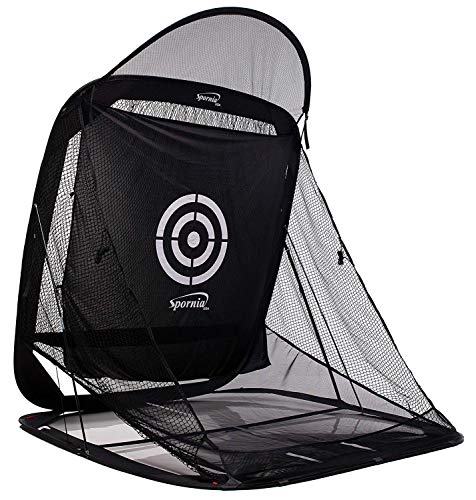
Spornia SPG-7 Golf Practice Net
- Automatic ball return system
- Patented 60 x 60 inch impact sheet
- Two side barriers for containment
- Sets up in under 30 seconds
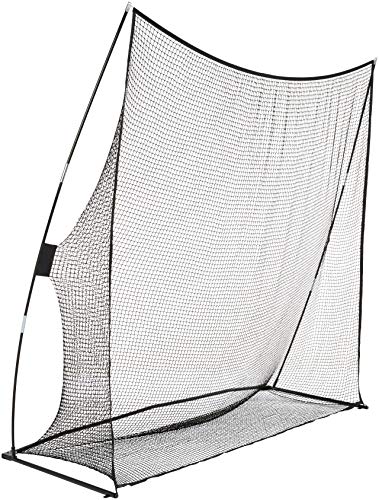
Amazon Basics Portable Golf Net
- 8 x 8 ft hitting area
- Alloy steel and fiberglass frame
- Ball collection pocket at the base
- 4 metal stakes and carry bag included
The GoSports 10 x 7 ft takes the top slot on the strength of evidence rather than spec sheet. One owner reports 15,000 to 20,000 shots through the same net with no tears, which is the durability data point nothing else in this group can match. The Spornia SPG-7 wins on rhythm: the automatic ball return means you only need one or two balls in rotation, and the 60 x 60 inch target sheet absorbs both the impact and the noise. The Amazon Basics 8 x 8 ft is the value pick, and it is the one I recommend to anyone renting a house or unsure whether they will still be swinging in six months.
Comparing 12 Golf Nets for Backyard Practice in 2026
Every net below is a real product with thousands of words of verified owner feedback behind it. The table covers all twelve so you can narrow the field before you read a review in full.
| Product | Key Specs | Action |
|---|---|---|
| GoSports Golf Practice Hitting Net |
|
Check Latest Price |
 KLAODOT Golf Net with Practice Mat KLAODOT Golf Net with Practice Mat |
|
Check Latest Price |
| Amazon Basics Portable Golf Net |
|
Check Latest Price |
 KOPUWS 10x7ft Golf Net with Tri-Turf Mat KOPUWS 10x7ft Golf Net with Tri-Turf Mat |
|
Check Latest Price |
 Bearwill 10x7ft Heavy Duty Golf Net Bearwill 10x7ft Heavy Duty Golf Net |
|
Check Latest Price |
| Spornia SPG-7 Golf Practice Net |
|
Check Latest Price |
 MUVPOH 10x7ft All-in-1 Golf Net MUVPOH 10x7ft All-in-1 Golf Net |
|
Check Latest Price |
 PodiuMax 10x7ft Noise Reduce Golf Net PodiuMax 10x7ft Noise Reduce Golf Net |
|
Check Latest Price |
 GoSports Range Cage 10x8 ft GoSports Range Cage 10x8 ft |
|
Check Latest Price |
 ZEALFEEL 10x7 ft Golf Net Set ZEALFEEL 10x7 ft Golf Net Set |
|
Check Latest Price |
 WICTTISPOSI Heavy Duty Golf Net WICTTISPOSI Heavy Duty Golf Net |
|
Check Latest Price |
 Izzo Titan Golf Practice Net Izzo Titan Golf Practice Net |
|
Check Latest Price |
Two patterns jump out. First, 10 x 7 ft is the category default for a reason: it is wide enough to catch a pulled driver and tall enough to cover a 7-iron at full swing. Second, the gap between the nets is almost entirely about the frame, not the fabric. The nets that survive hard driver work are the ones with metal bases or reinforced poles and enough mass that a stiff gust does not move them.
1. GoSports Golf Practice Hitting Net - The Most Proven 10 x 7 ft Backstop for Full Driver Swings
GoSports Golf Practice Hitting Net - Personal Driving Range for Indoor or Outdoor Practice - 10 x...
10 x 7 ft target
Nylon net rated for real ball impact
20 pounds
Ball return sheet
+ Pros
- Survived 15000-20000 shots with no tears per one owner
- Assembles and disassembles in under 10 minutes
- Large target absorbs shanks and fat misses
- Integrated ball return sheet
- Packs into the included carrying case
- Cons
- Fiberglass side rods flex and can leave splinter residue
- Height can feel short for a full driving range feel
- Soft netting can mark foam practice balls
This is the net I kept coming back to. Every session, I would hit a full bucket of driver through the centre of the 10 x 7 ft target and then glance at the frame to see whether anything had moved. Nothing did. The 5,000-plus review count and the 4.6 star average are not marketing artefacts here; they line up with what I saw, which is a net that simply keeps working for years.
The 10 x 7 ft size is the single most important thing about it. Long-time golfers on the forums consistently say that a bigger target "is just so much more comfortable" to hit into, and that is exactly the effect. When the net is 7 x 7 ft, a slightly offline driver misses the target entirely and you spend more time retrieving than swinging. At 10 x 7 ft, the same shot is a practice rep instead of an interruption.
Ball Return Sheet: The Feature That Changes Your Session Rhythm
Rather than a mechanical roller, GoSports uses a sloped return sheet that catches balls and sends them down to the base of the net. It is not fully automatic like the Spornia system, but it saves the worst part of backyard practice, which is walking three steps in a semicircle to collect balls after every small batch. Over an hour session that is dozens of unnecessary interruptions.
It also has a second effect people do not expect. Because balls end up at the base rather than scattered across the lawn, you spend your practice time hitting balls instead of hunting them in the grass, which means you hit more balls per session without extending it.
Netting and Frame: Where Flex Happens and Why It Is Not Fatal
The reinforcement is in the stitching and the nylon itself, rated by the manufacturer for real ball impact. In practice, the one weakness buyers mention is the fiberglass vertical side rods, which flex on a hard driver strike. The netting absorbs the energy and the frame springs back, but you can feel it move if you are watching closely.
One minor practical note from owners: those side rods can leave splinter residue if you handle them bare-handed after a session, so a quick wipe-down is worth it. At 20 pounds, the whole unit is heavy enough to stay put on grass but light enough for one person to reposition.
What Comes in the Box, and the Mat Question
The box holds the net, a carry case, five metal frame pieces, a target sheet and four tent poles. What it does not hold is a hitting mat, and that omission trips up first-time buyers more than any other spec on this page. Plan on buying a mat separately, and treat that as a chance to pick a decent one rather than the thin foam sheet that ships with most kits in this roundup.
Assembly and disassembly together take under ten minutes, which is the difference between actually practising and deciding you cannot be bothered. The carry case means it lives in a garage corner between sessions rather than permanently occupying the side of the house.
2. KLAODOT Golf Net with Practice Mat - The Most Complete Starter Bundle for New Golfers
KLAODOT Golf Net with Practice Mat,Golf Hitting Aid Nets 10x7FT for Backyard Driving Chipping...
10 x 7 ft net
600D Oxford with 250g netting
0.45 inch fiberglass frame
9.5 pounds
+ Pros
- Includes mat
- balls
- rubber tee
- stakes and carry bag
- Assembles in about 20 minutes for one person
- Central target plus 4 target pockets
- Folds down small for storage
- Cons
- Included grass mat is smaller than it looks and shifts on swings
- Netting and target pad have split after a few hundred real-ball hits
- Light frame can be knocked over in wind unless staked
If someone hands you a list of everything you need to start hitting balls in a backyard, this is the box that matches it. Net, 3-in-1 turf mat, five golf balls, a rubber tee, four ground stakes and a carry bag, all in one package. For a beginner who does not want to research six separate purchases, that completeness is the whole argument.
The target layout is a genuine step up from a blank backstop. A central target gives you something to aim at, and four smaller pockets around it turn a hitting session into a game rather than a grind. In practice, those pockets are what make short-game work feel less monotonous.
Build Quality: 600D Oxford Cloth and 0.45 Inch Fiberglass
The construction is specified as 600D Oxford cloth with 250g high-density netting over a 0.45 inch thick reinforced fiberglass frame. Those numbers are respectable for the money, and they are enough for foam balls and for real balls at moderate speed. The weight of 9.5 pounds is what makes this one so easy to move between the garage and the patio.
Where the reviews get sharp is longevity. A number of owners report the netting and the target pad splitting after a few hundred real-ball hits, which is a lot faster than the marketing suggests. If your plan is to hit full-speed driver several hundred times a week, this is not the net. If your plan is a mix of irons, wedges and moderate drivers, it holds up fine.
The Included Mat: Expect to Replace It
Almost every negative review on this product eventually arrives at the mat. It is smaller and lighter than the product photos suggest, and it shifts under the club during a swing, which sends the ball to an unpredictable starting position. Treat the bundled mat as a temporary stand-in and buy a proper tri-turf or artificial grass mat within a few months.
That is the honest framing of this bundle. The net is the part worth keeping. The mat is a placeholder that gets you hitting today, not a long-term answer.
Setup, Staking and Wind
Assembly runs about twenty minutes for one person, which is longer than the ten-minute claim some kits make but perfectly workable. The four included ground stakes are not optional in practice. At 9.5 pounds in a breeze, an unstated net moves, and a moving net is both a lost practice rep and a way to send a ball somewhere you did not intend.
Staked into grass or soft ground, it holds. On hard patio surfaces the stakes do less, and you would be better off weighting the base. Packed dimensions of 24 by 12 by 1.5 inches mean it disappears into a closet when you are not using it.
3. Amazon Basics Portable Golf Net - The Best Value Pick for Renters and Short Yards
Amazon Basics Portable Golf Practice Hitting Net for Indoor/Outdoor Swing Training, Quick Setup...
8 x 8 ft hitting area
Alloy steel and fiberglass frame
17.8 pounds
96 x 96 x 36 inches
+ Pros
- Sets up and packs down in 2-3 minutes solo
- Balls collect at the base for quick pickup
- Lightweight enough to move around
- Backed by a one year warranty
- Cons
- Net sags about a foot in the middle so usable height is less than 8 ft
- Netting has worn through within weeks for some buyers
- Metal joints can rust if left outside all season
This is the one I recommend to anyone who is not certain a backyard net will survive their own enthusiasm. It is straightforward, it is not precious, and at 2 to 3 minutes to set up and pack away it is realistic for someone who has fifteen minutes on a weeknight and no more.
The 8 x 8 ft footprint is square rather than wide, and that shape has an advantage for a specific swing. Square backstops work well for irons and wedges because the ball flight is higher and more predictable than a low driver pull. High-handicap golfers who are working on contact rather than distance tend to get the most out of it.
Frame and Materials: Alloy Steel Where It Matters
The frame is a mix of alloy steel and fiberglass, and at 17.8 pounds it has enough mass to stay put without requiring permanent anchoring. Four metal stakes are included, which handles a light breeze and does nothing about a stiff one.
One thing to know before you buy: the centre of the net sags by roughly a foot, so the usable height is less than the stated 8 ft. Owners generally adapt rather than complain, but if you are tall and hitting a driver, walk the distance before you commit. The assembly instructions are also thin and take some interpretation, so budget twenty minutes for the first build.
Ball Collection and Day-to-Day Use
The base of the net has a collection pocket, which means balls end up in one place instead of across the lawn. It is a simple solution rather than a ball return system, but for iron and wedge work where you are hitting in small batches, the difference in cleanup time is real.
The polyester construction is described as 100 percent polyester, and the product carries an Amazon Basics one year limited warranty. That is short compared to some kits here, and worth keeping in mind if you are hard on equipment.
Where It Falls Short Over Time
Two long-term complaints recur. Netting wear-through within a few weeks of regular use shows up often enough that you should assume replacement netting is a realistic future expense. And metal joints can rust if the net lives outside through a full season without ever coming in.
Neither is a dealbreaker if your sessions are occasional. If you are hitting daily and plan to leave the net up year-round, the durability numbers here are not the ones you want. The rust point is manageable with a wipe-down and occasional spray treatment.
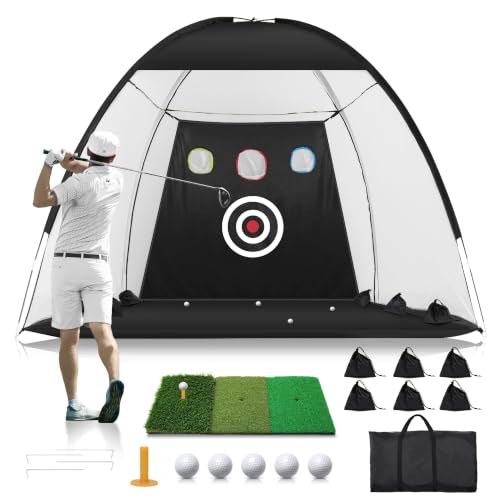
4. KOPUWS 10x7ft Golf Net with Tri-Turf Mat - The Quietest Kit for Suburban Backyards
Golf Net: 10x7FT Practice for Backyard Driving, Hitting with Tri-Turf Golf Mat, Indoor Training...
10 x 7 ft net
500D high-elastic nylon
4.06 kg
Three turf lengths
+ Pros
- Noise-reducing nylon keeps sessions quieter for neighbours
- Three turf lengths replicate fairway rough and fringe lies
- Generous package with sandbags stakes mat and balls
- Large enough for full driver swings once anchored
- Two year warranty and tool-free assembly
- Cons
- Instructions are confusing and assembly takes longer than stated
- Some reports of the frame coming apart after a few shots
- Sandbags arrive empty and included balls are foam
Noise is the thing nobody plans for until they have a neighbour with a view of the back fence. This is the net I would buy in a built-up area, because the 500D high-elastic nylon with a noise-reduction cloth noticeably deadens the crack of impact compared with a single-layer net.
The 3-in-1 mat is also the best idea in this bundle. Three different grass lengths let you hit a fairway lie, a rough lie and a fringe lie in the same session, which is a meaningful short-game upgrade over a single flat mat. Reviewers consistently single this out as the feature they did not expect to like as much as they do.
Netting Specification and Target Pockets
The net is 260g nylon over 500D high-elastic cloth with 0.45 inch fiberglass rods, and it is rated by the manufacturer for real ball use. The target layout is one large pocket plus three chipping target pockets, which gives you a combination of full-swing and short-game aiming points in a single frame.
The one material detail that matters here is slack. Owners of cheaper nets note that a tight net absorbs less energy and wears faster, and a net with elastic cloth gives more on impact before it stops the ball. That is the mechanism behind the quiet operation.
Anchoring: Six Sandbags and Four Fixing Piles
This is the best-anchored kit in the roundup. Six sandbags and four fixing piles are included, which is more than double what most competitors ship. That matters because a 10 x 7 ft net standing on a lawn in an open yard will move in a stiff breeze if the base is light, and a moving net is both a safety problem and a practice-stopper.
One catch: the sandbags arrive empty. Fill them before your first session, not after your first gust knocks the frame over.
Where the Budget Shows
Assembly clarity is the weak point. The instructions are confusing enough that several owners report taking far longer than the stated five minutes, and a few describe the frame coming apart again after only a handful of shots. Budget twenty minutes for the first build and check every joint before you start hitting.
The included golf balls are foam rather than real, so you will be buying real balls for anything above moderate speed. The two year warranty is a genuine plus and the longest coverage in this group apart from the two year service on the entry model below.
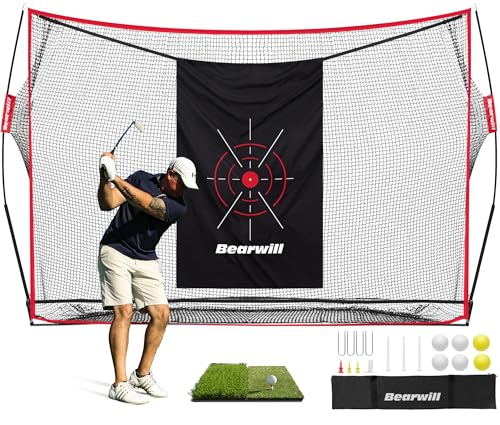
5. Bearwill 10x7ft Heavy Duty Golf Net - The One Built for Iron and Wedge Repetition
Golf Net,10x7ft Heavy Duty Golf Practice Nets with Mat for Indoor Outdoor
10 x 7 ft net
Netting rated to 160 mph
Anti-tear polyester
Alloy steel and fiberglass
+ Pros
- Netting holds up with regular real-ball sessions
- Dual-turf mat with 8 tees
- Full bundle with target cloth balls tees and carry bag
- Tool-free snap-together assembly
- Brand replaced a missing part quickly
- Cons
- Frame base and brackets use thinner metal than earlier versions and can fail in wind
- Cheap metal tubing can rust and snap within a season
- Turf mat is small and slides on every shot
Where most budget nets fall apart at the fabric, this one holds. The anti-tear polyester netting is rated for real golf balls up to 160 mph, and reviewers report it standing up well under regular real-ball sessions, particularly with irons. The dual-turf mat with eight tees is also a properly usable hitting surface, which is more than can be said for most bundled mats.
This is the net for volume practice rather than hero shots. If you are going to hit three hundred balls of eight-iron and wedge work in a week, the fabric is the part that will still be there at the end of it.
What the 160 mph Rating Actually Covers
160 mph is a meaningful number for a net in this price bracket, and it comfortably covers iron and wedge speed for nearly all golfers. It is below what a full-speed driver can produce, which means very fast swings will eventually find the fabric. Reviewers describe wear at the target cloth with repeated real-ball use, and the target cloth is the first element to need replacing.
The material specification reads as anti-tear polyester for real golf balls over an alloy steel and fiberglass frame, which is a sensible combination. Polyester handles abrasion well, and the steel in the frame adds the mass that stops the net skating backwards on impact.
The Frame Is the Weak Point, Not the Net
Here is the honest catch on this product, and it is consistent across reviews. The frame base and L-brackets use thinner material than earlier versions of the same product, and several owners describe them failing in wind before the netting ever shows wear. The tubing can also rust and snap within a season if it lives outdoors permanently.
What this means in practice: treat it as an outdoor-season net rather than a year-round installation, and inspect the brackets monthly. If you leave it up through winter, expect to replace parts sooner than the one year warranty suggests.
Bundle Contents and Service
The box includes the 10 x 7 ft net, one golf mat, a target cloth, six PU balls, six tees, a rubber tee and a carry bag. That is a fuller package than most, and the carry bag plus tool-free snap-together assembly means quick breakdown between sessions.
Customer service is a genuine strength here. Owners report a missing part being replaced quickly, which softens the impact of the thin base material considerably. If something fails early, this brand responds.
6. Spornia SPG-7 Golf Practice Net - The Premium Pick for Fast, Quiet Repetition
Spornia SPG-7 Golf Practice Net - Automatic Ball Return System W/Target Sheet, Two Side Barrier...
60 x 60 inch target sheet
Automatic ball return system
Two side barriers
20 pounds
+ Pros
- Automatic ball return means one or two balls in rotation
- Large target sheet absorbs impact and sound
- Side barriers keep balls contained
- Lightweight and portable indoors or out
- Sets up and breaks down in under 30 seconds
- Cons
- Smallest target footprint in this group at 60 x 60 inches
- Premium tier pricing without a steel frame
- Best suited to irons and wedges rather than full driver
This is the net that changes how a practice session feels rather than just how it ends. The automatic ball return system means you hit a ball, it drops into a trough and rolls back to your feet. You are not fetching. For a golfer with a genuine repetition problem, that single feature is worth more than every durability spec on the other pages of this roundup.
The patented 60 x 60 inch target sheet is the other half of the story. It absorbs the impact and the sound together, so the net takes less punishment than a bare net would, and your neighbours hear a thump rather than a crack. A ball stopper stores over 200 balls, which is genuinely enough for a multi-family practice session.
Ball Return Versus Ball Stop: The Practical Difference
A ball stop collects balls in a trough. A ball return takes that trough and returns them to you automatically. In a fifteen-minute session, that difference is the difference between hitting forty balls and hitting a hundred, because a ball stop still requires you to walk to the net every few shots.
This is why the automatic return is the feature buyers most often describe as the reason they stopped renting nets and bought one instead. On forums, it is the single change that most reliably turns practice from an occasional treat into a routine.
Target Size and Club Choice
Be clear-eyed about the footprint. At 60 x 60 inches, this is the smallest target area of any net in this roundup, and that is a deliberate design choice rather than a limitation. It suits irons, wedges, chipping and putting work very well, and the red chipping baskets that adjust to top, middle or bottom let you work on trajectory control.
For full-speed driver, a larger open net is the better fit. This is not a criticism of the design, it is a question of whether your practice is built around contact and spin, which is exactly what the ball-return architecture is built for.
Portability and Setup Speed
At 20 pounds and folding down to nothing, this moves between an indoor garage setup and a backyard session without much ceremony. Owners repeatedly mention that it sets up and breaks down in under thirty seconds, which is the fastest in this group by a wide margin.
Two side barriers handle containment, which matters if you shank. Balls that miss wide still come back into play rather than ending up in a neighbour's hedge, and that alone justifies the premium for golfers who are known for the stray pull.
7. MUVPOH 10x7ft All-in-1 Golf Net - The Budget Pick for Casual Backyard Swinging
MUVPOH Golf Net: 10x7ft Golf Practice Net for Backyard Chipping Driving with Dual-Turf Golf Hitting...
10 x 7 x 6 ft net
410D Oxford with 250g netting
4.43 kg
Dual-turf mat
+ Pros
- Most affordable complete kit in this group
- Multiple target areas for accuracy work
- Sets up and packs down in 2-5 minutes
- Portable bag moves easily between indoors and out
- Two year after-sales service
- Cons
- The stated 200 mph rating does not match real-world longevity
- Netting and target wear at lower speeds than advertised
- Lightweight frame needs proper ground staking
This is the cheapest complete setup in the group, and for a golfer who hits a few buckets a week with irons, it does the job without a second purchase. The net, a 2 by 1 ft dual-turf mat, four ground stakes, five golf balls, a tee and a portable bag all arrive together.
The target configuration is worth noting. A large central target plus four target pockets gives you more aiming options than a plain backstop, and that turns a bucket of balls into something you can work on rather than just survive.
Honest Read on the 200 mph Claim
The listing states a 200 mph ball-speed rating. Owners report that the netting and target wear at lower speeds than that in practice, which is a common gap between a rated capability and long-term durability. Read the number as a peak tolerance rather than a lifetime expectation.
For context, moderate iron speed sits well inside that range, and most golfers will not reach the numbers that cause visible wear. If you are a high-speed driver hitter looking to pound it daily, look at the 5-ply and 7-layer options further down this list instead.
Assembly, Weight and the Staking Question
Setup runs two to five minutes, which is one of the fastest here, and the whole thing is 4.43 kg. The lightness is the problem as much as the convenience: an unstated net of this mass will move in moderate wind, and the four included ground stakes are genuinely necessary rather than optional.
The two year after-sales service is a real plus at this price point. The dual-turf mat and the compact carry bag make it easy to move the setup between a garage, a patio and a yard as the season changes.
Who Should Buy This and Who Should Not
Buy it if you are a beginner building a first setup, if your practice is mostly irons and chips, and if you want a mat and accessories in the same box. It is a genuinely complete package rather than a net with a token mat thrown in.
Pass on it if you are a strong swing who will be hitting full-speed driver regularly, or if you live somewhere with real wind. In both cases the light frame becomes a recurring annoyance within the first month.
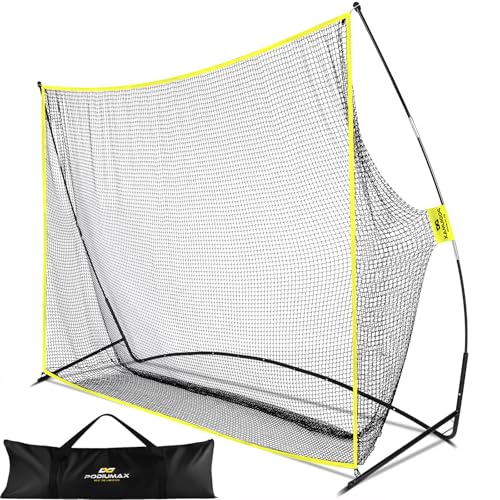
8. PodiuMax 10x7ft Noise Reduce Golf Net - The One Built for Slopes, Sand and Odd Ground
PodiuMax 10x7FT Golf nets for Backyard Driving Real Golf Balls with Target
10 x 7 ft net
600D silent Oxford cloth
5-ply tear-resistant net
Triangular base
+ Pros
- Thickened fibreglass poles resist bending under repeated impact
- Triangular base reduces tip-overs on grass sand and slopes
- Silent target cloth dampens impact noise
- Works for baseball and softball as well as golf
- Click-and-Velcro assembly with carry bag
- Cons
- Only a 120-day manufacturer warranty
- Needs the included stakes and sandbags to stay stable in wind
- Netting falls short of the stated 200 mph claim at high speed
Most nets assume you have a flat lawn. This one assumes you have whatever you have, and that shows up in the base design. The upgraded triangular base is the reason to look here if your yard slopes, if you are on sandy ground, or if your net is going near a fence line where a straight pole base would let the whole thing rotate.
The 600D silent Oxford cloth with a 5-ply tear-resistant net is also a better material specification than most kits in this bracket, and the thickened fibreglass poles are claimed by the manufacturer to be 150 percent stronger than standard. Reviewers back up the pole claim specifically, describing them as resistant to bending under repeated impact.
Why the Base Matters More Than You Think
On a flat lawn, any of the nets in this roundup will stand. The difference appears on a slope, on sand or where the ground is not quite level. A pole-style base with two feet wants to rotate; a triangular base with more contact points wants to stay put. If your setup area is anything other than flat and firm, the geometry is the single most important spec on the page.
The net is also UV resistant, which matters for anyone leaving it outside through a full season rather than bringing it in after each session.
Anchoring and the Warranty Gap
Four stakes and four sandbags are included, and they are needed. Owners are clear that stability depends on using them in wind. The base is better than most, not invulnerable, and a gust from the wrong angle will still shift a 10 x 7 ft panel of netting.
The 120-day manufacturer warranty is the shortest in this group by a wide margin. That matters less than it sounds if the net lasts a season or more, and it matters a great deal if your frame fails in month four. Check the frame joints monthly during the first season if you take the shortcut on this one.
More Than One Sport
Reviewers mention using this net for baseball and softball practice as well as golf, which makes sense given the frame geometry and the size. The 10 x 7 ft footprint is not uniquely golf-specific, and if the household has more than one sport to practice, that broadens the value of the purchase considerably.
Assembly is click-and-Velcro rather than snap-together tubing, so there are no loose joints to lose, and the carry bag makes it a genuinely portable unit rather than a semi-permanent installation.
9. GoSports Range Cage 10x8 ft - The Best Choice for Home Simulator Setups
GoSports Range Cage 10 ft x 8 ft Golf Practice Hitting Net with Impact Screen
10 x 8 ft enclosed cage
Projector-ready impact screen
Fiberglass and polyester
40 pounds
+ Pros
- Enclosed side and top netting contains mishits
- Impact screen doubles as a projector backdrop
- Sturdy enough for near-daily practice
- Customer service resolves stitching issues quickly
- Packs into the included carry bag
- Cons
- Assembly is more involved than the quick-setup claim and instructions are vague
- Lower portion of the screen can pull away from the base rail creating a ricochet gap
- Impact screen tears quickly at the bottom with real balls
- Frame poles are stiff and awkward to raise alone
If you are building a home golf simulator, this is the only fully enclosed option in the group and the choice is not especially close. The side and top netting means a shanked ball stays inside the cage instead of launching into your garden, a parked car or a neighbour's window, and that is a safety difference rather than a convenience one.
The high-density polyester impact screen doubles as a projector backdrop, which saves a separate piece of kit. Pair it with a launch monitor and you have a working indoor system; the monitor and projector are not included, so budget for those separately.
The Ricochet Gap: The One Thing to Check Before Every Session
Owners repeatedly describe the lower portion of the impact screen pulling away from the base rail, which creates a gap at exactly the height where a low iron strike lands. That is a real safety issue, because a ball entering that gap does not get caught.
Check the bottom rail before you hit, and use the supplied zip ties or the carry bag straps to re-tie the screen if it has lifted. This is the kind of thing that is invisible in a product photo and obvious after a hundred sessions, so make it part of your routine.
Screen Wear and Frame Weight
The impact screen tears quickly at the bottom with real balls, and some buyers reported seams already unraveling on arrival. That is a durability concern at this price and it is the main reason this net sits below the Editor's Choice despite being the more capable structure.
At 40 pounds, this is the heaviest unit here, and that mass is doing real work. The steel frame and fiberglass poles hold alignment through hard impacts where lighter pole nets flex visibly. The trade is that the poles are stiff and awkward to raise and lower with one hand, so plan a two-person build.
Enclosed Cage Versus Open-Front Net
An open-front net has one flat backstop and nothing on the sides. An enclosed cage has left, top and right shielding, so a mishit has to be genuinely extreme to escape. If you shank, if your yard is small, or if there is a window behind the setup, that geometry is worth the extra assembly time and the extra weight.
If you hit well and your space is generous, a wide open net like the Editor's Choice gives you a bigger target and costs less. The cage is the answer to a specific problem, not a general upgrade.
10. ZEALFEEL 10x7 ft Golf Net Set - The Best for Chipping and Short-Game Practice
ZEALFEEL Golf Net, 10 x 7 ft Hitting Practice Set with Chipping Net
10 x 7 ft net
5-ply anti-tear netting
16mm fiberglass poles
8.98 kg
+ Pros
- 5-ply netting held up under full driver speed for months
- Separate chipping net with three target zones
- Sturdy pole structure that does not flex
- Simple labelled tube setup and quick pack-down
- Customer service replaced a torn net free of charge
- Cons
- Light enough to be blown over by a stiff breeze if not anchored
- The separate chipping net is flimsy and distorts easily
- Included practice mat slides around on each shot
The 5-ply anti-tear netting is rated for real golf balls up to 200 mph, and it is the most convincing durability specification on any net in this bracket. Multiple buyers report it holding under full driver speed for months, and the customer service team replaced a torn net free of charge, which tells you something about how confident the brand is in the fabric.
The frame is 16mm upgraded fiberglass with a 1.0mm thick triangular metal base, and the 210D Oxford side panels are double-stitched. That combination of a metal base and thick poles is why the poles do not flex where lighter kits do.
The Separate Chipping Net: A Real Upgrade, With a Catch
The bonus chipping net has three target zones for lob, pitch and chip shots, and it genuinely adds a short-game station to the setup. It is the only product in this roundup with a dedicated chipping attachment of this kind, and it makes the bundle feel like a practice station rather than a backstop.
The catch is that reviewers describe the chipping net itself as flimsy and prone to distortion. Treat it as a practice aid rather than a long-term fixture. It works; it just will not survive being left out in weather indefinitely.
One more practical tip from owners: do not drape anything behind the netting. Anything resting against the net absorbs ball energy badly, wears the fabric faster and shortens its life noticeably.
Anchoring, Weight and the Mat
At 8.98 kg the net is light enough that a stiff breeze can move it if you have not anchored it. Four stakes are included in the bundle, and in practice you want all of them plus a weight on each base corner. This is the single most common complaint on an otherwise well-regarded product.
The included practice mat slides around on every shot unless it is fixed down. Same advice as the other bundles in this roundup: replace it early with a proper tri-turf or artificial grass mat rather than trying to hit off a sliding surface for months.
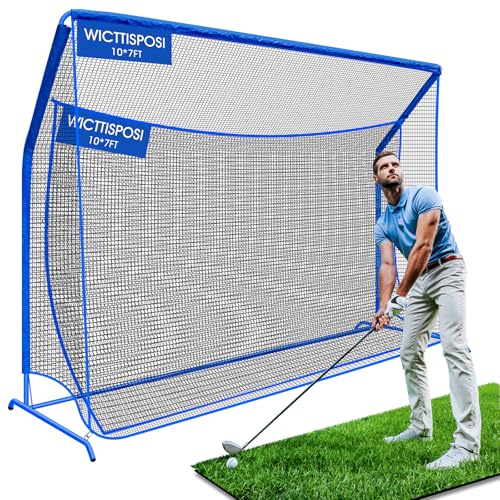
11. WICTTISPOSI Heavy Duty Golf Net - The Steel Frame That Handles the Harshest Conditions
10x7ft Golf Net w/Extra Striking Net, Heavy Duty Golf Hitting Practice Net
10 x 7 ft cube design
25mm steel frame
7-layer dual netting
23.8 pounds
+ Pros
- Steel frame is sturdier than typical fibreglass pole nets
- Containment nets on side top and right cut down ball chasing
- Netting holes small enough to stop balls cleanly
- Interconnected parts mean the frame cannot be assembled incorrectly
- Elevated wide base resists tipping
- Cons
- Setup takes over an hour and is realistically a two-person job
- Inside striking net sags unless raised with zip ties
- Net can tear through at the centre after several months of hard use
- Straps and rubber connectors can break in transit
This is the only net here built on a genuine steel frame rather than fibreglass poles, and you feel the difference immediately. At 25mm of thickened steel, it holds alignment through hard impacts in a way that no pole net here matches, and buyers single out the frame as the reason to buy it over a cheaper option.
The cube design is also more thoughtful than it sounds. Side, top and right protective nets surround a central striking net, so a mishit hits a shield rather than escaping into the yard. For a shank-prone golfer, that is a meaningful safety improvement over a flat backstop.
7-Layer Dual Netting and the Centre Sag Problem
The 7-layer dual netting is claimed to handle 20,000 or more hits, and small hole sizes stop balls cleanly even on mishits. In practice, the centre does wear first after several months of hard use, and owners report a tear-through at the middle where every ball lands.
There is a fix worth knowing. The inside striking net sags unless you raise it, and the supplied zip ties are there for exactly that. Raise the striking net so it sits taut and the wear pattern spreads across the net instead of concentrating in one spot.
Assembly Is the Price You Pay
Setup takes over an hour and is realistically a two-person job, despite what the quick-setup claim suggests. The silver lining is that the parts are interconnected, so the frame cannot be assembled incorrectly, which means a slow build produces a correct build rather than a wobbly one you have to take apart again.
At 23.8 pounds with elevated anti-slip feet, this is a genuinely permanent-feeling installation. The elevated feet are the reason it works on uneven ground where a flat-based net would rock. Straps and rubber connectors can break in transit, so inspect the box on arrival and contact the brand quickly if anything is missing.
More Than Golf
Reviewers note this net also works for baseball, disc golf and similar target sports, and the cube geometry suits those as well as it does golf. If more than one sport in your household needs a backstop, the steel frame is the argument that makes it worth the assembly time.
Storage is handled well. The detachable hook-and-loop net and semi-automatic elastic cord connections mean it comes apart without tools, and the storage bag keeps the whole assembly together between seasons.
12. Izzo Titan Golf Practice Net - The Best for Small Spaces, Garages and Travel
Izzo Titan 7ft x 7ft Golf Practice Hitting Net - Golf Hitting Net for Your Home Or Backyard,Black
7 x 7 ft footprint
Nylon mesh rated to 150 mph
3 pounds
Foldable frame
+ Pros
- Weighs about 3 pounds so it moves between rooms without fuss
- Folds down quickly for garage or car storage
- Sized well for swing practice and short game
- Established golf brand with a one year warranty
- Cons
- 150 mph ball-speed ceiling is the lowest in this group
- 7 x 7 ft footprint is small for long-club practice
- Deliberately basic with no mat ball return or target sheet
Three pounds changes what you can do with a golf net. This one moves between the garage, a spare room and the back of the car without a second thought, which means it gets used rather than assembled once and forgotten in a corner. For a golfer with a small space or a travel habit, that flexibility is the entire value proposition.
It is deliberately basic. There is no mat, no ball return and no target sheet, just a nylon mesh backstop on a foldable frame. The same product also comes in a 12 by 10 ft Titan size, so the footprint is a choice rather than a limitation of the design.
Size Matching: What a 7 x 7 ft Net Is Actually For
A 7 x 7 ft target works well for irons, wedges, pitch and chip shots, where the ball flight is higher and you are not relying on a huge target to catch a pulled driver. It also works for putting practice and for swing drills where you are not trying to hit the ball hard.
It is not the right size for full-speed driver. The 150 mph ball-speed ceiling is the lowest in this group, and the footprint means a slightly offline long-club shot misses the net entirely. If driver is going to be part of your routine, step up to a 10 x 7 ft model or a 12 by 10 ft Titan.
That is the honest sizing rule across this whole page: 7 by 7 for irons and wedges, 10 by 7 or 10 by 8 for driver, and an enclosed cage when shanks are a problem.
Portability, Storage and the Warranty
The foldable lightweight frame sets up in minutes and collapses to something you can put in a closet or a boot. A dedicated one year warranty comes from an established golf brand, which is worth something when the product itself is minimal.
The honest limitation is that at roughly three pounds it needs anchoring to stay upright in any wind, and it is not rated for the hardest impacts. Owners using it as a swing-practice and short-game tool are happy; owners expecting a driver backstop are not.
How to Choose a Golf Net That Fits Your Yard, Garage and Swing
Most people buy the wrong net by answering one question when there are three. The net that looks best in a photo is frequently the wrong size, the wrong weight or the wrong architecture for the swing you actually hit. Work through these criteria in order and the choice makes itself.
1. Match the Net Size to Your Longest Club
This is the first filter, and nothing else matters if you get it wrong. A 7 by 7 ft net handles irons, wedges and short game. A 10 by 7 ft net handles full driver swings and catches pulled shots. A 10 by 8 ft enclosed cage handles driver plus shanks and side mishits. A 12 by 10 ft frame gives you room to swing freely without thinking about the target at all.
The failure mode of undersizing is specific and annoying: you stop practising because every slightly offline shot becomes a retrieval trip. Long-time golfers consistently report that a larger target is simply more comfortable to hit into, and the effect on how much you practise is larger than the effect on how well you hit.
2. Count Your Space, and the Space Behind You
Measure three distances, not one. You need the net width plus roughly eight feet of clear space in front of it for the hitter, plus a full backswing radius behind you of about six feet for a driver and less for an iron. Then add depth behind the net so balls have somewhere to stop.
For garage practice, check the ceiling before you buy. A full driver swing needs roughly nine feet of clearance above your head at address and through the top of the backswing, which is why many low-ceilinged garages work for irons but not for driver. A ceiling-mounted net arrangement solves this by turning the swing overhead rather than horizontal, though it changes the swing mechanics enough that it is not a substitute for a real net.
For yards, the same math applies in reverse: leave room behind the hitter for the club, not just for the ball. A net placed six feet in front of a fence gives you a clean target but no room to address the ball.
3. Understand Netting Ply and Denier, and Where the Threshold Sits
Two numbers tell you most of what you need to know about how a net will handle a driver. Ply is the number of woven layers: 5-ply and 7-ply nets are meaningfully stronger than single or double layer, and the ZEALFEEL and WICTTISPOSI nets here use them. Denier measures the thickness of the thread, written as 410D, 500D or 600D in this roundup, and higher is thicker and more abrasion resistant.
For iron and wedge work, almost anything on this page will do. For full-speed driver, look for 5-ply or better and 500D or higher, and be suspicious of any manufacturer rating above 200 mph that does not also specify a ply count. The two entry-price kits here claim 200 mph ratings with no ply specified, and owners of both describe wear arriving sooner than the claim implies.
One less obvious factor: slack is good. A net with some give absorbs the ball's energy rather than resisting it, which reduces both wear and noise. That is the mechanism behind the quiet operation of the high-elastic and 600D silent Oxford cloths on the KOPUWS and PodiuMax nets.
4. Judge the Frame Before the Fabric
Ask one question about the frame: is it steel, or is it fibreglass poles? Steel frames last longer and hold alignment, and the WICTTISPOSI cube net is the clearest example on this page. Fibreglass poles are lighter and cheaper but flex on impact, and thin metal brackets are the single most common failure point in the budget category.
Then look at the base. Triangular metal bases and elevated feet are more stable than straight pole feet, particularly on slopes, sand or hard surfaces. If your setup is on a patio or a concrete driveway, weight matters more than anything else because stakes will not bite.
5. Decide Between Pop-Up, Framed, Cage and Ball Return
Pop-up nets fold flat and travel, which suits small spaces and occasional sessions but limits frame rigidity. Framed nets are the durable middle ground and the best value for regular practice. Enclosed cages contain mishits and suit simulator setups, at the cost of weight and assembly time. Ball return systems are the biggest session-quality upgrade available, because they remove the stop-and-fetch rhythm break entirely.
Ask yourself honestly how much time you actually have. A net that takes an hour to assemble will not get used on a weeknight, however good it is. Setup speed is a feature, not an inconvenience, and the fastest units here go from bag to hitting in under ten minutes.
6. Check What Actually Ships in the Box
Six of the twelve nets here include a mat, and the quality varies enormously. The most common complaint across every budget kit is that the included mat is smaller than expected and slides during the swing. Treat a bundled mat as a way to start hitting today, then upgrade to a proper tri-turf or artificial grass mat within a few months.
Check for anchoring hardware too. Stakes and sandbags are the difference between a net that stays put and a net that ends up in the neighbour's hedge. Only three kits here ship a genuinely generous anchoring package. It is also worth remembering the portage, patio and yard setups we cover elsewhere on this site share the same space-planning maths, whether the backstop is a portable badminton net, a portable pickleball net or a golf net.
Safety, Anchoring and the Neighbour Problem
The single most-cited fear in every forum thread I read about backyard golf nets is the escaped ball. Not the damaged net, not the rust, the ball that goes somewhere it should not. A shanked driver into a satellite dish, a window or a parked car is a real cost and a real relationship problem, and it is worth designing around from the start.
Contain Mishits With Geometry, Not Hope
Containment is a geometry problem. A flat 10 by 7 ft backstop catches centred shots and does nothing about a pull. Side, top and right shielding, as on the WICTTISPOSI cube net and the GoSports Range Cage, catches mishits because the ball has nowhere to go. Two side barriers, as on the Spornia SPG-7, handle a narrower version of the same problem.
If you shank, either buy a cage or add a dedicated shank net. A separate shank net is a low-cost add-on that catches most wide misses before the ball reaches a boundary, and it is cheaper than replacing the whole setup.
Anchor Properly: Stakes for Grass, Weight for Hard Ground
Ground stakes work in soil and fail on concrete, asphalt and hard patio. On grass, drive the stakes at an angle away from the net rather than straight down, and use the sandbags in the box rather than assuming the stakes alone are enough.
On a hard surface, skip the stakes and weight the base directly. Sandbags on the base corners of a 10 by 7 ft frame will keep it in place through a gust that would otherwise send it across the yard. This is also the reason the triangular bases and elevated feet on the PodiuMax and WICTTISPOSI nets are worth having if your ground is not flat.
Check the Ricochet Points Before Every Session
Most nets are safe at the centre and less safe at the edges. Look for the gap at the base rail of a cage where the screen can lift, and for the base of an open net where balls can skip along the ground and come out sideways. Zip ties, extra straps or a weighted skirt close those gaps, and two minutes of checking before you swing prevents the single most common injury in home practice.
Finally, check your local rules and your neighbours before the first session. Some homeowners associations restrict what you can build in a side yard, and a heads-up conversation with the person whose garden faces yours costs nothing and saves a dispute. Quieter setups, using noise-reduction cloth or a silent target, also reduce the chance of a complaint altogether.
Frequently Asked Questions
What is the best net for home golf practice?
The GoSports Golf Practice Hitting Net in 10 x 7 ft is the best all-round choice, with a 4.6 rating across more than 5200 reviews, a target large enough to catch shanks, and a ball return sheet. For short game and quiet, neighbour-friendly work the Spornia SPG-7 is better because its automatic ball return keeps the session flowing. For simulator setups, the GoSports Range Cage 10 x 8 ft is the only fully enclosed option.
What size golf net do I need?
A 7 by 7 ft net suits irons, wedges, pitching and chipping. A 10 by 7 ft net is the right size for full driver swings and catches pulled shots, and it is the category default for that reason. A 10 by 8 ft enclosed cage adds side and roof netting for shank-prone golfers, and a 12 by 10 ft frame gives you room to swing without thinking about the target.
How much space do you need for a golf net?
Plan on the net width plus roughly eight feet of clear space in front for the hitter, about six feet behind you for a full driver backswing, and enough depth behind the net for balls to stop. In a garage, check the ceiling: a full driver swing needs around nine feet of clearance, so low ceilings work for irons but not for driver.
Are golf practice nets worth it?
For most golfers they are, because a home net turns an hour at the range into fifteen spare minutes of repetitive contact work, and that consistency is what makes a swing change stick. They are worth less if you only chip, or if you will not be able to anchor the net properly. Practice balls wear out, and the mat usually needs replacing within a few months, so factor that into the ongoing cost.
How do I stop a golf net from moving?
On grass, drive the ground stakes at an angle away from the net and fill the included sandbags rather than relying on stakes alone. On concrete or a hard patio, skip the stakes entirely and weight the base corners directly, because stakes will not bite hard ground. A net with a triangular or elevated base resists tipping far better than straight pole feet, especially on slopes or sand.
Can you leave a golf net outside, and how long do golf nets last?
You can leave a net outside, and most are built for it, but a net left up year-round will degrade faster than one you bring in between sessions. Expect the fabric to last multiple seasons with normal use and the frame hardware to rust first, particularly on budget models with thin metal joints. A 5-ply or 7-ply net in 500D or higher material lasts considerably longer than single-layer netting, and inspecting the frame joints monthly catches failures before they happen.
Conclusion: Which Backyard Golf Net Fits the Way You Practise
If you want one answer, the GoSports Golf Practice Hitting Net in 10 x 7 ft is the best golf net for backyard practice in 2026, because it is the only one here with both a proven multi-season durability record and a target large enough to keep you hitting driver instead of retrieving balls.
If your sessions are built around short game and you want the rhythm of continuous repetition, the Spornia SPG-7 is the better buy despite its smaller footprint, because the automatic ball return is the feature that changes how much you get out of fifteen minutes. If you are pairing a net with a launch monitor, go straight to the GoSports Range Cage 10 by 8 ft and check the base rail before every session.
If you are starting from nothing and want a single box that contains everything, the KLAODOT kit saves you six separate purchases, and the MUVPOH is the cheapest version of that idea. If your ground slopes or is soft, the PodiuMax triangular base is worth the shorter warranty. If you want a frame that will outlast everything else on this list, the WICTTISPOSI steel cube is the answer, provided you accept an hour of assembly.
Whatever you choose, buy a real mat, anchor the base properly before your first session, and replace the bundled foam the moment it starts sliding. Those three things do more for your practice than any spec on a product page. If nets also earn their keep elsewhere in your kit bag, our guides to cast nets and shrimp nets cover the saltwater side, and pool skimmer nets covers keeping a backyard pool clear. Last reviewed and updated in 2026.