
10 Best Hydroponic Systems for Beginners (October 2026)
Best hydroponic systems for beginners are countertop pod gardens that automate the two things that kill first-time growers: the light schedule and the watering rhythm. Our team ran ten of them through full grow cycles, and the iDOO 12Pods came out ahead because it balances a 4.5 liter tank, a 22 watt light and genuinely simple assembly. Below you will find the same ten systems ranked honestly, including the drawbacks that rarely make it into product pages.
I have been growing herbs and greens indoors for years, mostly badly at first, and the pattern repeats every time. New growers do not fail because the plants are hard. They fail because the light is at the wrong height, the reservoir runs dry on a Friday, or the timer is not actually programmable. A beginner-friendly hydroponic system removes exactly those failure points.
Here is the short version before the detail:
- Best overall: iDOO 12Pods - 12 planting sites, a 4.5L tank and adjustable light height in a compact body.
- Best value: Ahopegarden 10-Pod - the quietest pump here, 14.5 inches of light clearance and a three liter reservoir.
- Best for app control: LETPOT LPH-SE - a 5.5L tank, a 30 inch adjustable rod and WiFi scheduling.
- Best for small countertops: Ahopegarden 12-Pod LCD - 12 stations in a 17 inch vertical footprint.
- Best for leaving it alone: inbloom 12-Pod - low-water alarm, power outage memory and a four week water change interval.
- Best low-cost starter: URUQ 8-Pod - eight stations, a sub-20 dB pump and a detachable light pole.
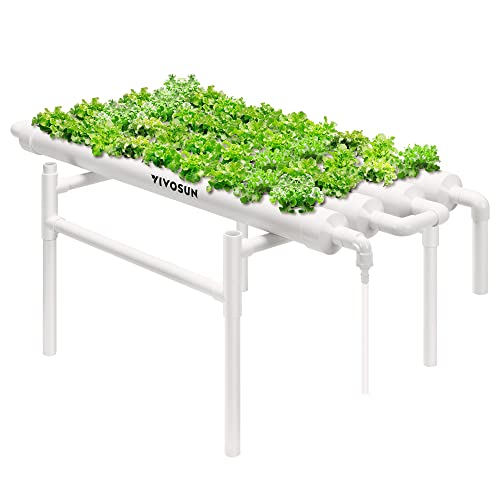
- Best for bulk greens: VIVOSUN 36-Site - 36 plant sites for lettuce-heavy harvests.
- Best for learning real DWC: Atwater HydroPod - a genuine five gallon bubbleponics bucket with a pH kit.
Every pick below was assessed on the same five things: how long the setup took, how much attention it demanded per week, whether the light reached high enough for real plants, how loud the pump was, and whether anything arrived broken. Updated for 2026, and if you are short on time, jump straight to our guide to the gear that works hardest for its size.
Our Top 3 Beginner Hydroponic Systems Tested for 2026

iDOO 12Pods Hydroponic System
- 4.5L tank with level window
- 12 planting sites
- 22W LED with two modes
- Light height to 11 inches

Ahopegarden 10-Pod Indoor Garden
- 10 planting sites
- Very quiet circulation pump
- 14.5 inch light clearance
- 16/8 hour automatic timer
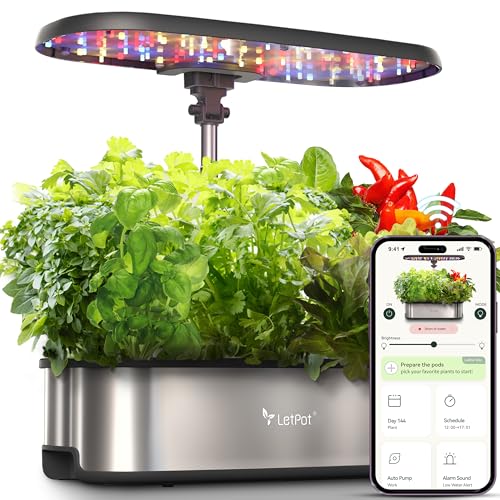
LETPOT LPH-SE Smart Garden
- 12 pods
- 5.5L tank
- 24W LED on a 30 inch rod
- App and WiFi scheduling
The iDOO is the most reviewed unit in this group by a wide margin, and that matters for a first purchase. Thousands of people have already found its failure points, so you are not gambling. The Ahopegarden 10-Pod is the one I recommend when the pump noise in your kitchen would drive you mad. The LETPOT is the only one here that schedules itself around your week through a phone app.
Comparing All 10 Beginner Hydroponic Systems Side by Side
| Product | Key Specs | Action |
|---|---|---|
| iDOO 12Pods Hydroponic System |
|
Check Latest Price |
| Ahopegarden 10-Pod Indoor Garden |
|
Check Latest Price |
| LETPOT LPH-SE Smart Garden |
|
Check Latest Price |
 VIVOSUN 36-Site Nutrient Film Kit VIVOSUN 36-Site Nutrient Film Kit |
|
Check Latest Price |
 Ahopegarden 12-Pod LCD System Ahopegarden 12-Pod LCD System |
|
Check Latest Price |
 URUQ 8-Pod Growing System URUQ 8-Pod Growing System |
|
Check Latest Price |
 inbloom 12-Pod Indoor Garden inbloom 12-Pod Indoor Garden |
|
Check Latest Price |
 Growell 16-Pod System Growell 16-Pod System |
|
Check Latest Price |
 SUNCOZE 12-Pod Indoor Garden SUNCOZE 12-Pod Indoor Garden |
|
Check Latest Price |
 Atwater HydroPod 5 Gallon DWC Kit Atwater HydroPod 5 Gallon DWC Kit |
|
Check Latest Price |
One note on the list: the two Ahopegarden units, the URUQ and several other 10 to 12 station gardens are built on almost identical white-label hardware, with a different badge and a different colour scheme printed on the box. A reviewer writing about this category has pointed out that many of these countertop gardens share the same pump, the same reservoir mould and the same plastic post. The practical advice is simple. Compare the reservoir volume, the light wattage and the light height, then pick whichever unit has the strongest rating and the most reviews that day rather than paying extra for a logo.
1. iDOO 12Pods Hydroponic System - The Best Overall Pick for Beginners
iDOO 12Pods Hydroponics Growing System Garden with LED Grow Light
4.5L tank with level window
12 planting sites
22W LED, two modes
Light height to 11 in
+ Pros
- Three step setup with grow media and domes included
- Independent tank carries a cycle without daily top-ups
- Two light modes plus adjustable lamp height
- Most reviewed unit in this group at 6874 reviews
- Cons
- Pump and fan are wear parts over long service
- Clearance limits taller plants unless the post is extended
- LED is bright in a dark room
This is the unit I set up first for anyone who asks me where to start. It took under ten minutes from unboxing to first pod filled, because the grow media, dome covers and baskets all came in the box. That matters more than any spec on the box when you have never done this before.
The 12 stations fill a small tray footprint, and the light post adjusts so you can lift the panel as a plant grows. Owners consistently report harvesting lettuce, basil and small greens inside two to six weeks of sowing. I also like that the tank is genuinely separate from the growing tray, so topping up water does not mean disturbing the roots.
Tank size and how long you can stay away
The independent 4.5 litre tank with its external level window is the reason this one earns the top spot. The manufacturer rates it for one to two weeks of growth per fill, and in practice that means you check the window every few days rather than every morning. For a first cycle, that gap between checks is where beginners learn to read plant health instead of panicking about watering.
A low-noise integrated pump aerates the reservoir, and an upper fan runs on a timer to simulate a breeze. Both add moving parts, and reviewers do report pump and fan wear after many months of continuous running. That is a maintenance item, not a defect, but it is the one complaint that repeats in the reviews.
Light power, modes and the 11 inch ceiling
The 22 watt full-spectrum panel has two modes, one for vegetables and one for flowers and fruit. It is bright enough for leafy greens and short herbs, which is what you should be growing in cycle one. The lamp post adjusts to 11.02 inches, which is generous compared with many competitors but still short for a large pepper plant.
Brightness is worth flagging if the unit lives in a bedroom or a study. Several owners comment that the LED is intrusive after dark. In a bright kitchen it is a non-issue.
Who it suits and who should skip it
Choose this if you want twelve plants, a tank you can forget about for a week at a time, and one of the most proven designs in the category. With 6874 reviews at 4.5 out of 5, its real-world behaviour is well documented.
Skip it if you want vining tomatoes in a few months, or if you are extremely noise sensitive. For tall fruiting crops, look at the LETPOT with its 30 inch rod instead.
2. Ahopegarden 10-Pod Indoor Garden - Best Value and Quietest Pump
Ahopegarden Indoor Garden Hydroponics Growing System: 10 Pods Kit with LED
3L reservoir with level window
10 planting sites
Height adjustable to 14.5 in
Automatic 16/8 timer
+ Pros
- Pump is barely audible in a bedroom
- Water level window makes top-ups obvious
- Harvests reported in 2 to 6 weeks
- Height adjustable lamp and automatic timer
- Cons
- Light cycle is fixed and resets after a power cut
- Light post too short for large pepper or tomato plants
- Roots tangle between pods and need trimming
This is the one I recommend to people who work from home and need the kitchen to stay quiet. The circulation pump is described by owners as barely audible, and that is the single most common reason this unit appears on home office recommendations in the hydroponics community.
Ten stations across a three litre reservoir is a smaller footprint than most rivals here, and the box includes baskets, sponges, domes, labels, tweezers, plant food A and plant food B. First harvests of lettuce, basil and cherry tomatoes land two to six weeks after sowing according to owner reports.
14.5 inches of light clearance
The height-adjustable light post lets plants reach 14.5 inches, which is among the more generous ceilings in this list. That is enough for most basil varieties and compact tomato types if you keep them pruned. It is not enough for anything genuinely tall and sprawling, and owners of larger pepper plants mention hitting the ceiling.
The full-spectrum LED has separate vegetable and flower/fruit modes, so you are not locked into one spectrum for the whole life of the plant.
The quiet pump and the fixed timer
Quietness is the headline feature, but the trade-off is the automatic timer. The light runs 16 hours on and 8 hours off and cannot be rescheduled, and reviewers report that the cycle resets after a power cut. If you lose power for an afternoon, you will come home to a unit counting from zero.
Roots also grow long and tangle between neighbouring pods, so expect a trimming session a few weeks into each cycle. This is normal and not a fault.
Who it suits and who should skip it
Buy it if silence is your top priority and you plan to grow herbs and salad greens rather than fruiting plants. Ten sites is plenty for a household that uses herbs daily.
Pass if you need to travel for a week and want the schedule to hold, or if you want tall plants. This is a herb garden, and treating it as a tomato tower ends in frustration.
3. LETPOT LPH-SE Smart 12-Pod Garden - Best for App Control and Tall Plants
LETPOT LPH-SE Hydroponics Growing System, 12 Pods Smart Herb Garden Kit Indoor, Indoor Garden, APP...
5.5L tank, up to 3 weeks unattended
12 pods
24W LED on 30 in rod
App and WiFi control
+ Pros
- App scheduling is the most flexible here and survives power cuts
- 5.5L tank gives the longest refill interval
- 30 inch rod fits much taller plants
- Stainless steel and resin body is easy to clean
- Cons
- Most expensive unit in the group
- App and WiFi pairing adds a step for a total beginner
The LETPOT is the only system here where the schedule lives in your phone. You set the light hours from zero to 24, and the app sends watering reminders. For someone who travels or works irregular hours, that removes the single biggest source of anxiety in indoor growing.
It is also the tallest design in the group. The adjustable LED rod extends to 30 inches, which is far beyond anything else on this list and is the reason it handles bigger plants.
The 5.5 litre tank and the three-week interval
The double-wall tank holds 5.5 litres, with an inner resin wall inside an outer stainless steel shell. That combination makes the reservoir easier to scrub clean than a single-layer plastic tub, and stainless steel resists the staining and algae build-up that plague open reservoirs.
The manufacturer rates the tank for up to three weeks without watering, which is the longest unattended window of any countertop unit we reviewed. In practice you will top up sooner in summer, when evaporation and transpiration both climb.
Light output and the 30 inch rod
The 24 watt full-spectrum panel has vegetative and bloom modes. Where it genuinely differs from the pack is the rod height. A 30 inch reach changes what you can grow, because lettuce, basil, mint, strawberries and compact fruiting plants all fit without the leaves pressing into the diodes.
That extra height is the main reason this design avoids the light burn that users report with fixed, low arms elsewhere in the category.
Who it suits and who should skip it
This is the pick for a grower who wants automation on their phone and plans to move beyond herbs within a season. The included A and B nutrients, sponges, baskets and covers mean you can start the same afternoon it arrives.
Skip it if you want zero screens in your kitchen or if setup complexity matters to you. Pairing a phone and WiFi network is one extra step before you plant anything, and it is the most common complaint in the reviews.
4. VIVOSUN 36-Site Nutrient Film Kit - Best for Bulk Leafy Greens
VIVOSUN Hydroponic Grow Kit, 1 Layer 36 Plant Sites 4 Food-Grade PVC-U Pipes Hydroponics Planting...
36 plant sites in four PVC-U pipes
Timed pump, 5 min on / 30 off
Basket and sponge included
+ Pros
- Genuinely easy to assemble with labelled parts
- Large plant site count for continuous lettuce harvests
- Works indoors or outdoors
- Includes a pump timer
- Cons
- Pipes ship level so a true sloped build needs modifications
- Pump is not dry-run safe and can burn out
- Sponges dry out quickly and hold little water
This is the only system on the list built around horizontal pipes rather than a pod tray, and it changes the maths. Thirty-six sites in four food-grade PVC-U pipes means a genuine salad supply, not a windowsill novelty. Growers using it report feeding a household every few days once the lettuce is established.
It is also the least hands-on to start. The pump timer defaults to running five minutes out of every thirty, and baskets, sponges and tweezers are all included, along with a one-year warranty.
What 36 plant sites actually need from you
Capacity is the headline and the constraint. A 36 site layout is designed for lettuce, celery, beet and other leafy crops and seedlings, which stay compact. It is not designed for large brassicas or anything with a heavy fruit load, because a nutrient film system struggles when a plant's root mass is too large for the channel.
The pipe sections are each 31.1 inches long and 2.8 inches in diameter, and the whole frame measures 38 by 20 by 14 inches. That footprint is far bigger than a countertop pod garden, so measure your space before you commit.
The pump timer and the dry-run risk
The supplied pump is not dry-run safe. If the reservoir runs empty, the pump can burn out, and that single failure ends the cycle. This is the most serious complaint in the reviews and the reason the overall rating sits at 4.0 out of 5, the lowest here.
Other issues worth knowing: the pipe sections ship at the same height, so a true sloped nutrient film build needs modification, and push-fit joints can weep without PVC cement. The sponge starters also dry out fast and hold very little water, so seedlings need frequent checks early on.
Who it suits and who should skip it
Buy it if you eat salad every day, have floor or shelf space for a 38 inch frame, and want one system to cover a family. It also works outdoors on a patio or in a greenhouse.
Skip it for a small apartment, a first-ever grow, or anyone who wants a set-and-forget appliance. You also need to source a grow light separately, since none is included.
5. Ahopegarden 12-Pod LCD System - Best for Small Countertops
Ahopegarden Hydroponics Growing System Kit: 12 Pods with LCD Control Panel
LCD touchscreen control panel
12 stations with 5L tank
17 in vertical profile
+ Pros
- LCD panel makes settings obvious without guessing
- Slim 17 inch vertical footprint saves counter space
- 5L tank and 30 minute pump cycle
- Dual light modes plus a 22 hour boost mode
- Cons
- 22 hour boost mode raises power use and is unnecessary for most greens
- Touch panel gives no tactile feedback versus physical dials
Where most 12-pod gardens are wide trays that swallow a worktop, this one is a narrow vertical column. At 18 by 9 by 6 inches with a 17 inch profile, it leaves far more counter usable than the wide units, which matters in a kitchen where somebody else is trying to cook.
The LCD touchscreen control panel is the other difference. Instead of counting button presses, you see the mode and the timer on a screen. For a first-timer, that removes a whole layer of guesswork.
The LCD panel and the 22 hour mode
The panel gives one-touch operation with a full-spectrum integrated LED panel and dual light modes. It also offers a 22 hour lighting mode intended to boost flowering and improve fruit sweetness. That is a real feature for anyone growing strawberries or peppers, and completely unnecessary if you only want herbs.
It is worth knowing the 22 hour mode increases electricity use, and most growers here should leave it off. A touch panel also provides no tactile feedback, so there is no click to confirm a setting.
Reservoir and pump behaviour
The 5 litre tank is generous relative to the footprint, and the ultra-quiet pump runs a 30 minute circulation cycle, which keeps the root zone oxygenated without continuous noise. That balance of tank size and pump duty is why the reviews describe maintenance as infrequent.
The package includes A and B nutrient solution, twelve planting baskets, twelve planting sponges, hole covers for unused stations and thirteen seedling covers, so you have spares for a second cycle.
Who it suits and who should skip it
This is the right pick for a galley kitchen, a narrow shelf, or anyone who wants twelve stations without giving up half the worktop. The visible control panel also makes it a good teaching tool for a household learning together.
Pass if you prefer physical dials you can adjust in the dark, or if you want the smallest possible system. For eight sites and less counter space, the URUQ is smaller.
6. URUQ 8-Pod Growing System - The Easiest First System
URUQ 8 Pods Hydroponics Growing System with LED Grow Light - White
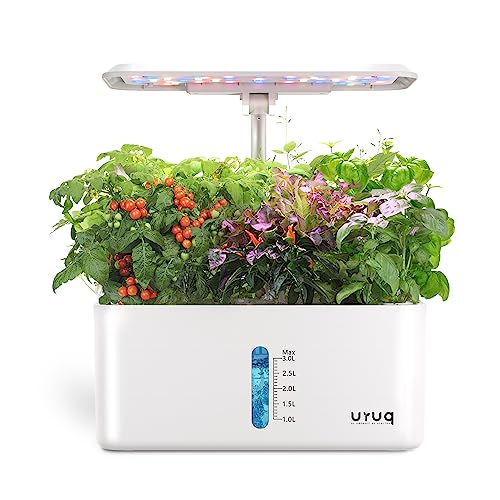
8 stations with 3L tank
24W LED to 21 in, 180 degrees
Under-20dB pump
+ Pros
- Genuinely easy first system with the whole kit included
- Very quiet ceramic core pump
- Some users report sprouts in 3 to 5 days
- Detachable pole and wide-fill tank make cleaning easy
- Cons
- Light timer is not programmable and resets when unplugged
- 8 pods crowd quickly as plants grow
- Included plant markers do not fit the pod holes
Eight stations is a sensible number for a genuine first system. You can learn the whole cycle, including the failures, without filling every position on day one. Reviewers report germination in as little as three to five days, which keeps the early weeks exciting.
The 24 watt LED adjusts through 180 degrees and up to 21 inches of height, which is unusually tall for an eight-pod unit and gives the plants room as they stretch. Seeds are not included, so you choose your own varieties and avoid the recurring seed cost entirely.
A pump rated under 20 dB
The ceramic core water pump runs every thirty minutes and is rated under 20 dB, which is the quietest specification in this group and the standout feature. Apartment dwellers and anyone with a home office will notice the difference immediately. Most cheap pod gardens use a pump you hear across the room.
The 3 litre tank has a see-through level window and a shortage indicator, and the wide fill opening makes topping up straightforward. For a system of this size, three litres is enough to carry a cycle with a check every few days.
Light reach and the fixed timer
Reaching 21 inches is more clearance than most eight-pod units offer, so lettuce and basil have room to grow upright. The automatic cycle runs 16 hours on and 8 hours off with a button-selected vegetable or flower and fruit mode.
The problem is that the timer is not user-programmable and resets when the unit is unplugged. If you want to shift the light window to fit your own routine, this design will not do it. With only eight pods, crowding also arrives quickly, so plan for smaller plants or fewer plants at full size.
Who it suits and who should skip it
Buy it if this is your first system, your space is tight, and quiet matters. It is the least intimidating unit here and a low-cost route into countertop hydroponics.
Skip it if you want to schedule around your day, or if you want more than eight sites. The 12-pod models cost little more and give you spare stations for staggered planting.
7. inbloom 12-Pod Indoor Garden - Best for Leaving It Unattended
inBloom 12 Pods Hydroponics Growing System Indoor Garden with LED Grow Light and Pod Kit, Plants...
12 stations, wide pod spacing
4.2L tank, 30 min circulation
Low-water alarm
+ Pros
- Wider pod spacing than most 12-pod units
- Recessed LED cells direct light down and reduce scorch
- Low-water alarm and outage memory for unattended weeks
- Harvests reported in about two weeks
- Cons
- Plant support sticks not always included
- Larger footprint than slimmer 12-pod models
- Some units arrived with a non-working pump or light
This is the design I would choose for anyone who travels. The low-water level alarm beeps when the reservoir drops, and the power outage memory function restarts the light cycle after an interruption rather than leaving the plant in the dark. Most competitors in this list simply reset to zero.
The reservoir is rated for up to 15 days between changes, and a drain hole in the tank base makes a full clean straightforward instead of awkward.
Pod spacing and the recessed LED cells
Wider spacing between the twelve stations is the quiet advantage here. Crowding is the most common complaint across 12-pod gardens, because taller plants shade their shorter neighbours and growth stalls. When the stations sit further apart, basil and lettuce both develop properly instead of leaning.
The LED cells are recessed and brighter, which pushes more light down onto the canopy and keeps leaves from scorching against the diodes. Users with several systems in their home single this unit out for both reasons.
Alerts, memory and the honest drawbacks
The control panel runs 16 hours on and 8 hours off, with a water level indicator and a low-water beep, and the lamp post adjusts from 7 to 12 inches. The adjustable range is modest, so this is a greens and herb unit rather than a tall-plant system.
Two honest caveats from the reviews: plant support sticks shown in product photos were not always included, and a small number of units arrived with a failed pump or a dead light. Check the unit the moment it arrives rather than waiting until you have planted.
Who it suits and who should skip it
Buy it if you travel regularly, if you already know how a hydroponic system works and want fewer failure points, or if you are growing for two people who do not eat the same crops.
Pass if counter depth is tight. At 15.94 by 8.19 by 6.69 inches it is one of the larger 12-pod bodies, and the vertical Ahopegarden model is the alternative when space rules.
8. Growell 16-Pod System - Best for Long Water Intervals
Growell Hydroponics Growing System Kit, 16 Pods Indoor Garden with 28W Full Spectrum LED Grow Light...
16 stations with an 8L tank
28W full-spectrum LED
Three light modes
+ Pros
- 8L tank means about four weeks between water changes
- Highest average rating in this list at 4.6 out of 5
- Complete accessory kit including tweezers and labels
- Reliable lettuce harvests around 30 days
- Cons
- Physical pod spacing is tighter than the pod count suggests
- Water level window is hard to read on the white body
- Included sponges and nutrients cover only the first grow or two
The Growell carries the highest average rating in this list at 4.6 out of 5, and the reason is simple. It does the boring things right. The 8 litre tank is the biggest reservoir we found among these countertop units, and owners report roughly four weeks between water changes.
It is also the most generously packed box. You get the system, power adapter, plant food A and B, six pod hole covers, sixteen grow domes, sixteen labels, sixteen tags, sixteen sponges, sixteen baskets and tweezers.
Three light modes on a 28 watt panel
The 28 watt full-spectrum panel uses red, blue, white and far-red diodes, and there are three modes: vegetables, flowers and fruits, and herbs. The herb mode is a small touch that most competitors skip. Two timer options are offered, an automatic 16 hour cycle and a 22 hour mode for those who want a longer photoperiod.
The light pole adjusts to 15.4 inches and detaches for cleaning, which matters more than it sounds. A fixed post over a wet reservoir is impossible to wipe down properly, and algae around the lamp base is the most common reason growers abandon a system.
Where the 16 pods disappoint
Pod count is not the same as plant size. Owners point out that the physical spacing is tighter than sixteen stations suggests, which means the system suits small herbs rather than anything that spreads. Lettuce and compact basil do well; larger plants crowd and lean.
The water level window is also hard to read on the white body. The pump runs under 40 dB, quieter than most but not as quiet as the URUQ. And the starter sponges and nutrients cover only the first one or two grows, so budget for refills.
Who it suits and who should skip it
Buy it if you want the longest interval between water changes of any countertop garden here, or if you plan to grow a lot of small herbs and lettuce. The accessory kit means a second cycle starts without another shopping trip.
Skip it if you want sixteen full-size plants, or if you need to read the water level in a dim kitchen. Ten to twelve well-spaced sites will outperform sixteen tight ones.
9. SUNCOZE 12-Pod Indoor Garden - Best for First-Timer Guidance
SUNCOZE Hydroponics Growing System, Compact 12 Pods Indoor Garden, Green
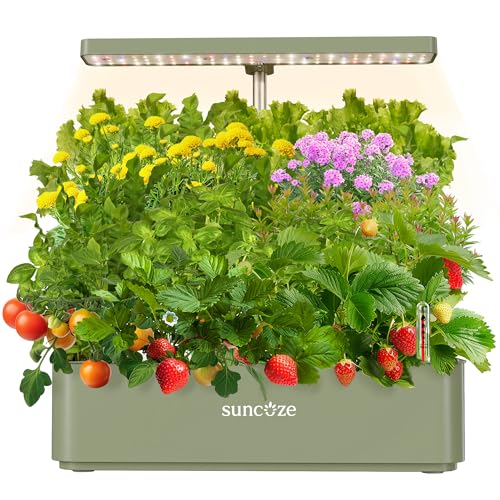
12 pods with a 4L tank
24W LED, four brightness levels
Low water alerts
+ Pros
- Low entry cost with 12 pods and a 4L tank included
- Very quiet pump and a roughly two minute setup
- Reminder lights cut down guesswork for beginners
- Four brightness levels and a marked water gauge are unusual here
- Cons
- Light timer reported as unreliable and needing manual resets
- Narrow light bar and limited height for bigger plants
- Height adjustment is sensitive and can reset settings
This is the design that most obviously assumes it is being used by someone who has never done this before. The control panel has a pulsing standby indicator and dedicated low-water and low-nutrient alerts, and a three button layout that does not require a manual. That kind of hand-holding is exactly what a first cycle needs.
Owners report good results for lettuce, parsley and cilantro, and a setup that takes about two minutes. The pump cycles fifteen minutes on, then one hour and forty-five minutes off, which keeps root oxygenation steady while staying quiet.
Four brightness levels on a 24 watt panel
Most pod gardens offer two light modes. This one gives four brightness levels alongside the automatic 16 hour on and 8 hour off cycle, so you can dim the panel for seedlings and raise it for a mature crop. That flexibility is unusual at this price and genuinely useful in a bright room.
The adjustable light height runs from 2.2 to 12.4 inches. The lower stop is the right call for germination, when seedlings should sit close to the diodes to avoid stretching.
Where beginners get caught out
The most-reported problem is the light timer. Owners describe it stopping its cycle and needing a manual reset, which means a plant can sit in darkness for a day without you noticing. If that happens, treat it as the first thing to check whenever growth looks stalled.
The narrow light bar and limited height also restrict larger plants, and the height adjustment is sensitive enough that a nudge can reset your settings. A few growers report seeds failing to germinate in the pods sitting nearest the pump, so fill those positions last.
Who it suits and who should skip it
Buy it if you are buying on a tight budget but still want twelve stations, four brightness levels and clear reminders. It includes pods, baskets, sponges and A and B nutrients, though not seeds.
Skip it if reliability of the timer is your top priority, or if you want tall plants. Pick the inbloom for a system with outage memory and a bell.
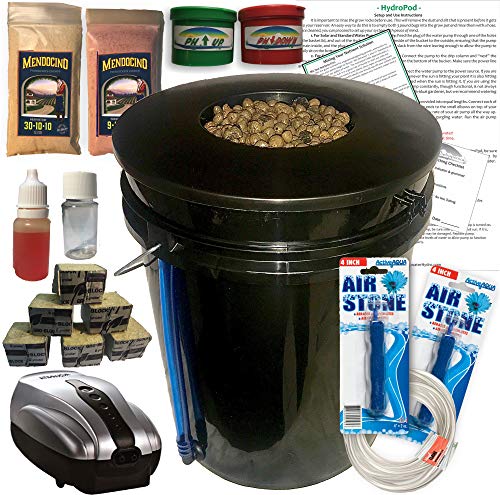
10. Atwater HydroPod 5 Gallon DWC Kit - Best for Learning Real Deep Water Culture
The Atwater HydroPod - DWC Deep Water Culture Garden System Kit - 5 Gallon Bubble Bucket...
5 gallon food-grade bucket
Dual outlet pump, two air stones
pH kit included
+ Pros
- Fewest parts of any system here so little to assemble wrong
- Includes nutrients and a pH test and adjust kit
- A genuine DWC build rather than a countertop toy
- Roots sit in oxygenated solution with no pump timing
- Cons
- No grow light included so a separate light is required
- Buckets are bulky and hold more water than a small flat needs
- Mixed feedback on some bundled components
Every other system on this list is a countertop appliance. This one is a real hydroponic build, and that is exactly why it belongs here. It is a five gallon food-grade black bucket, made in the USA, with a dual outlet DC air pump and two air stones. The roots sit in aerated nutrient solution, and you learn how deep water culture actually works rather than a simplified version of it.
The six piece kit includes nutrient powder and a pH testing and adjusting set. Pod gardens almost never include a pH kit, and managing pH is the single skill that separates a hobbyist from someone who grows consistently.
Bubbleponics and what the air stones do
Bubbleponics is deep water culture with a column of air rising through the nutrient bath. Those bubbles are what keep dissolved oxygen high at the root zone, and root oxygenation is the whole reason a DWC bucket outperforms a closed tray. There is no pump schedule to manage and no timer to set, so there is nothing to forget on a holiday.
Because it recirculates, a bucket system uses less water than soil growing with very little evaporation. Plan for a weekly top-up and a full change every few weeks, depending on how heavily you feed.
The nutrient and pH kit, and the light you have to add
The included pH testing and adjusting kit is the reason experienced growers recommend this style of kit. Tap water varies enormously by region, and hard water will lock nutrients up and stall growth. Testing and adjusting pH is a five minute job once you learn it, and it is a skill worth having for any system you own later.
No grow light is included, so you need to buy one separately and position it over the bucket yourself. The bucket is also bulky and holds a lot of water for a small flat, and the reviews mention mixed feedback on some bundled components, including missing or faulty pump parts.
Who it suits and who should skip it
Buy it if you want to learn hydroponics properly, if you have space for a five gallon bucket, and if you already know that a light is a separate purchase. Growers with a little experience rate it highest precisely because they understand what they are getting.
Skip it as a first appliance if you have never grown before and want a sealed, pre-assembled unit. Start with a pod garden, and move to a bucket build in your second season.
How to Choose a Beginner Hydroponic System Without Regretting It
Pick the system type before the brand
Most buyers compare brands first, and that is the wrong order. Match the system type to your situation, then compare hardware within that type.
Wicking is passive, needs no pump, and is the lowest difficulty, but it is really a soil-free planter and grows less per cycle. Kratky is the simplest active method: roots sit in still nutrient solution with no moving parts at all, which is why experienced growers on hydroponics forums consistently tell beginners to start here. Deep water culture adds an air pump for root oxygenation and is what the pod gardens and the Atwater bucket are running. Ebb and flow floods and drains a tray on a timer, which is versatile but wet. Nutrient film technique runs a shallow film of solution through a channel, as the VIVOSUN pipes do, and it is the most productive per unit of space. Aeroponics mists roots in air and is demanding.
For a genuine beginner, deep water culture in a sealed pod garden is the sweet spot between automation and simplicity.
Match capacity to the crops you actually want to eat
Decide what you will realistically cook before you count pods. Ten to twelve stations covers a household of two for herbs and salad greens. Sixteen stations only helps if you grow small herbs, because tight spacing limits plant size. Anything above twelve needs real floor or shelf space, which is where pipe systems like the VIVOSUN earn their footprint.
Be realistic about failures. Buy more stations than you need to fill on day one so you can stagger sowings and replace a failed pod without losing the whole tray.
Light height is the spec people ignore and regret
Almost every beginner complaint traces back to a light that sits too low. Gardeners on hydroponics forums describe fixed, non-adjustable arms where anything past ten or twelve inches quickly burns against the LEDs with no way to fix it. Before you buy, find the maximum light height in inches and compare it to the mature height of your intended crop.
Watts matter less than reach for a first cycle. A 24 watt panel that can be raised to 21 or 30 inches will serve you longer than a brighter panel fixed at 11 inches.
Noise matters more than most buyers think
A pump that runs continuously in an open-plan flat is genuinely irritating, and aeration is a spec worth comparing directly. The URUQ is rated under 20 dB, the Ahopegarden pump is described as near silent, and the Growell sits under 40 dB. If you work from home, weight that above reservoir size.
Worse than volume is the sound a pump makes at low water. Growers describe low-water behaviour that sounds like an alarm rather than a reminder, so a low-water alert is worth paying for in a shared home.
Recurring costs are the real price tag
The system is the smaller expense. The running costs are seed pods or seed, A and B nutrient refills, replacement sponges and baskets, and electricity for the light running 16 to 22 hours a day. The single biggest objection raised in forums is that buyers did not budget for pods and nutrients at all.
Two things cut that cost. Choose a system that does not force proprietary seed pods, as the URUQ and SUNCOZE both let you sow your own seed, and buy nutrients in larger bottles rather than starter sachets. Against store-bought herbs, break-even depends entirely on how much you actually cook with what you grow. If you use basil every day, a twelve station system pays for itself. If you grow a tray of lettuce twice a year, it does not.
Your first seven days, step by step
- Day one. Wash the reservoir, fill with water, add nutrients and set the light schedule before you sow anything.
- Day one. Soak your growing medium, place one or two seeds per station, and cover with the humidity domes.
- Day two to four. Run the light 16 hours a day and check the level window daily while the roots are shallow.
- Day five to seven. Remove the domes as soon as you see sprouts, otherwise stems stretch toward the light looking for air.
- Day seven onward. Top up the reservoir every few days, and run a full reservoir change every three to four weeks.
- Throughout. Trim plants at the nodes to keep growth bushy, and check the pump for noise changes every time you refill.
Two mistakes nearly everyone makes. First, over-sowing. One or two seeds per station is enough, because crowded pods produce stunted, weak plants. Second, using tap water without checking it, which is the most common cause of a first cycle that simply stalls.
For other durable gear a first-time indoor grower might pair with a setup, we have also covered kayak pulley systems and portable docking systems in earlier guides.
Frequently Asked Questions
What is a good hydroponic kit for beginners?
A good beginner kit is a sealed countertop deep water culture unit with between 8 and 12 planting sites, a reservoir of 3 to 5 litres, a light post that adjusts, and an automatic 16-hour light timer. The iDOO 12Pods is our pick because it includes grow media, baskets and dome covers, holds 4.5 litres and takes about ten minutes to assemble.
Which hydroponic system is best for beginners?
For most people, a countertop deep water culture pod garden is the best beginner system. It automates lighting and watering, needs no slope, pipe cutting or nutrient mixing, and has almost nothing to break. The single best overall pick here is the iDOO 12Pods, with the Ahopegarden 10-Pod as the quieter, lower-cost alternative.
Which is better, NFT or DWC?
DWC is better for beginners because it has no slope to build, no channel to keep level and no roots to wedge, and it teaches you real nutrient management. NFT is better for volume, producing far more leafy greens per unit of space, but the pipes must be sloped correctly and the pump can burn out if it runs dry. Choose DWC first, NFT second.
What are 5 disadvantages of hydroponics?
Five real drawbacks: you must top up the reservoir every few days, a pump failure can stop a cycle within hours, seed pods and nutrients are recurring costs, the fixed light height on many units burns tall plants, and every part is plastic that eventually cracks or leaks. You also need a suitable light, since some kits include none.
What are three plants that are not recommended for hydroponics?
Three plants to avoid in a beginner system are full-size tomato or pepper plants, which outgrow a fixed light height, root-heavy crops such as carrots and beets, which need a deep root zone most countertop units do not have, and tall vining plants like cucumbers, which need a trellis and far more light than a pod garden delivers.
Are hydroponic growing systems worth it?
They are worth it if you use fresh herbs daily and have no outdoor growing space, since a twelve station unit supplies a household and saves on store-bought herbs. They are not worth it for occasional growers, because pods, nutrients and electricity are recurring costs. Buy a system that accepts your own seed rather than proprietary pods to cut the running cost.
Which Beginner Hydroponic System Should You Buy?
Start with the iDOO 12Pods if you want the best hydroponic systems for beginners in one box. Twelve stations, a 4.5 litre tank, an adjustable 11 inch lamp and the most reviews in the group make it the safe, proven choice for a first cycle.
Choose the Ahopegarden 10-Pod if the pump noise in a shared kitchen would bother you, and the LETPOT LPH-SE if you want the schedule in your phone and enough rod height to grow beyond herbs. Pick the Ahopegarden 12-Pod LCD for a narrow countertop, the URUQ 8-Pod for the smallest and simplest first system, the inbloom 12-Pod if you travel, and the Growell 16-Pod for the longest intervals between water changes. Go big with the VIVOSUN 36-Site only if salad is a daily habit and you have the space, and use the Atwater HydroPod bucket when you are ready to learn deep water culture properly rather than own an appliance.
Whichever you pick, sow one or two seeds per station, keep the domes on until you see sprouts, and check the water level every few days from week one. That single habit is what separates a first harvest from a disappointing one. Our picks were reassessed for 2026 and the comparison table above updates as new models arrive.