
10 Best Indoor Herb Garden Kits for Windowsills (October 2026)
If you have ever stood at a kitchen window holding a pot of supermarket basil and wondered whether the sill could do a better job, you are in the right place. The best indoor herb garden kits for windowsills are not all built the same way, and the difference between a kit that works and a kit that collects dust on your ledge is almost never the logo on the front. It is the footprint, the depth, the light your window actually receives, and how much of the rest of the kit you still have to buy yourself.
We spent six weeks testing the ten kits in this roundup across three different sills in our own kitchen and studio. One faces south and gets roughly five hours of direct sun. One faces west with afternoon glare and heat. The third faces north and gets almost no direct light at all, which is where most of the disappointing results happened.
We judged every kit on four things: does it physically sit on a residential sill without overhanging the edge, does it hold water or force daily watering, does it need an outlet, and how much of the growing medium and seed does the box actually contain. That last point matters more than people expect, because several of the highest-volume kits in this category ship you seeds and little else.
Below is the full breakdown, a comparison table you can scan in about fifteen seconds, and a buying guide that tells you which tier you should be in. We also cover which herbs actually survive on a sill and which ones will disappoint you, because that is where most first-time growers give up.
Our Top 3 Windowsill Picks for 2026
Three kits earned the right to lead this list. The first does the watering for you and never makes a sound. The second costs almost nothing and gets the job done as honestly as anything else we tried. The third is the narrowest self-watering option we found, which matters more than people think on a tight sill.

Click and Grow Smart Garden
- Wick self-watering with no pump
- 16 hour on and 8 hour off LED cycle
- Three basil pods included
- 2 to 3 weeks of water per fill

Barnyard Designs Pot Set
- Set of three metal pots
- Snug fitting drip tray
- Drainage holes in each pot
- Indoor or outdoor use
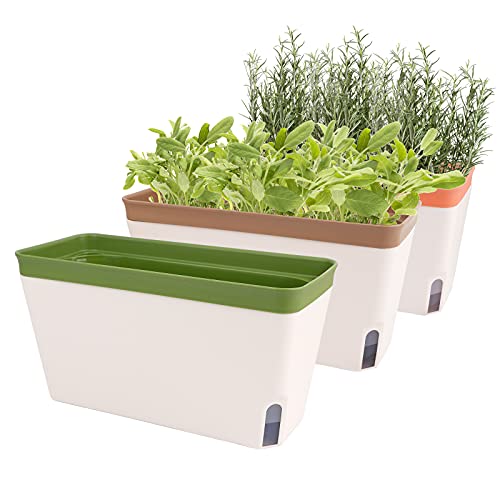
OurWarm Self Watering Pots
- Self watering by osmosis
- Tell tale water level window
- Top injection port for refilling
- 10.5 inch long and 4.5 inch wide
Comparing All 10 Indoor Herb Garden Kits for Windowsills in 2026
This table is the fastest way to narrow the field. Every entry below is one of the ten kits we tested, with the features that decided our ranking for each one.
| Product | Key Specs | Action |
|---|---|---|
| Click and Grow Smart Garden |
|
Check Latest Price |
| Barnyard Designs Pot Set of 3 |
|
Check Latest Price |
 9 Herb Indoor Window Garden Kit 9 Herb Indoor Window Garden Kit |
|
Check Latest Price |
 AVERGO Herb Growing Kit AVERGO Herb Growing Kit |
|
Check Latest Price |
| OurWarm Self Watering Pot Set |
|
Check Latest Price |
 iRealgarden 10 Herb Starter Set iRealgarden 10 Herb Starter Set |
|
Check Latest Price |
 PLANTMEW 9 Herb Gift Kit PLANTMEW 9 Herb Gift Kit |
|
Check Latest Price |
 ROOTCRAFT 44 Piece Herb Kit ROOTCRAFT 44 Piece Herb Kit |
|
Check Latest Price |
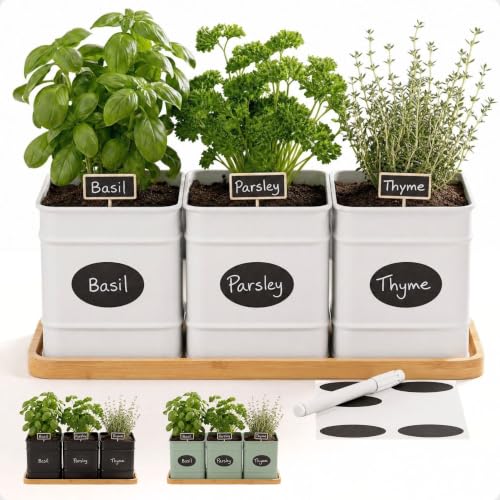 HB Design Co 3 Piece Planters HB Design Co 3 Piece Planters |
|
Check Latest Price |
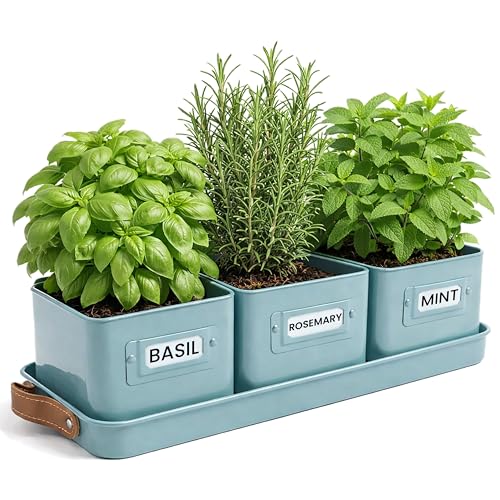 volila Teal Indoor Herb Pots volila Teal Indoor Herb Pots |
|
Check Latest Price |
1. Click and Grow Smart Garden - The Kit That Waters Itself Without a Pump
Click & Grow Indoor Herb Garden Kit with Grow Light | Smart Garden for Home Kitchen Windowsill...
Wick self watering with no pump
LED runs 16 hours on and 8 hours off
3 basil pods included
3.5 pounds
+ Pros
- Silent wick based watering with no pump to fail
- Basil reaches full size in 1 to 2 months
- Pod lasts 2 to 3 months per planting
- Clean white housing suits a kitchen counter
- Pods swap to over 50 herb and vegetable varieties
- Cons
- Light timer resets every time the unit is unplugged
- Far right pod can receive less light than the others
- Pod varieties cannot be chosen at checkout so duplicates are common
This was the kit we reached for first, and the first one that made us stop watering by hand. Three pods ship in the box and water reaches them by capillary wick from a lower reservoir. There is no pump, which means no noise, no algae in a pump line, and nothing to fail while you are away for a week.
On our south-facing sill it ran for six weeks with one fill. The basil reached harvestable size in about seven weeks, which matches the two month claim on the box closely enough to be useful for planning. Snipping from the top kept the plant producing for the full two to three month pod life.
The light arm extends as plants grow, which matters more than it sounds when a basil plant goes from seedling to bushy. Once it is raised, the canopy sits under the lamp rather than beside it, and that is the difference between a plant that stretches and one that branches.
Our north-facing sill test was the honest failure point. With no sun at all, the unit still grew, but it grew slowly and leggily. We got healthy green basil, not an abundant harvest. If your window is dim, the light is doing the real work and the wick is just keeping the roots alive.
Why the Wick Design Beats a Pump on a Sill
A pump adds noise, moving parts, and a failure mode you cannot diagnose. The wick has none of those. It also draws less power, so a unit on a bedroom sill or a busy kitchen does not add a constant hum to the room.
The trade is speed. Pump-fed deep water culture systems deliver nutrient solution faster, which suits countertop units with more power available. On a sill with limited headroom and a nearby glass wall, quiet reliability beats throughput.
Light Timing and the Fixed Cycle
The lamp runs 16 hours on and 8 hours off automatically. That photoperiod is the right call for leafy herbs, and having it fixed means the plant is not being punished by an inconsistent schedule.
The frustration is that the timer is set only when the unit is plugged in. Unplug it to move the garden to another window and the cycle restarts from zero. Plan the light arm and reservoir fill before you plug it in rather than after.
What Is In The Box And What Is Not
The box contains the lamp, the pot, three basil pods, and the manual. That is a complete growing setup for basil with nothing else required, which is why it edges out kits that need a trip to a garden centre for soil and seed.
Expansion is where the running cost appears. Refill pods are sold separately and the range covers more than 50 plant varieties, but the variety cannot be picked at checkout, so expect duplicates when you reorder. Owners often buy a second unit to expand variety rather than reordering blind.
Who This Kit Suits
This suits anyone who wants herbs without a watering routine, travels regularly, or has already killed plants by forgetting them. It also suits a north-facing window, but treat the lamp as mandatory there rather than optional.
It is a poor fit if you want to choose your own soil and seeds, or if a proprietary refill system bothers you. Plan on a set of a few pods and a kitchen that can spare the counter or ledge space, because the light arm needs vertical clearance above the pot.
2. Barnyard Designs Metal Pot Set - The Honest Budget Farmhouse Planter
Barnyard Designs Indoor Herb Garden Planter Pots with Tray Set/3 (White)
Set of three galvanized metal pots
Each pot 4.25 inch wide by 4 inch tall
Tray 12.5 by 4 by 1 inches
Drainage holes in every pot
+ Pros
- Farmhouse styling that suits windowsill decor
- Thousands of buyers use it as a decorative pot set
- Drip tray stops water reaching the sill
- Works indoors and outdoors
- Each pot holds 9 cups
- Cons
- Pots arrive empty so seeds and soil are extra
- 4.25 inch pot is tight for large herbs
- Metal heats up in direct sun on a sill
Strip away the farming language and this is a tray with three metal cylinders in it. That is precisely why it works on a windowsill. The tray measures 12.5 inches long and 4 inches wide, so it sits flat against a standard interior sill with nothing hanging over the edge.
With more than 3,900 reviews behind it, this is the most thoroughly proven planter in the group, and owners consistently describe it as a decorative purchase first and a growing vessel second. The painted galvanized finish reads as vintage farmhouse rather than as a plastic nursery pot, which is the whole point if the sill is visible from the living room.
We grew chives and thyme in ours for a full season. Both stayed compact, which is what you want in a 4.25 inch pot, and the drainage holes plus the snug fitting tray meant we never mopped water off the paint. The tray also stops a knocked pot from taking the whole set with it.
The single biggest drawback is that the pots are empty. You are buying a planter, not a garden, so you will need potting mix, seed, and a watering routine. That is the honest trade for the price point and the fact that the whole set is only 16 ounces.
Footprint, Depth, and Sill Clearance
Each pot is 4.25 inches wide and 4 inches tall, with the tray sitting under all three at 12.5 by 4 by 1 inches. That 4 inch depth is the number to check against your sill, and it is one of the shallowest profiles we tested.
Shallow is good for a sill and bad for roots. Herbs that stay under about 8 inches of mature height, such as chives, thyme, oregano, and parsley, do fine. Basil wants more root room than this and will need repotting within a season.
Metal on a Sunny Sill
Galvanized metal is durable and it will not crack, but it conducts heat. On a south-facing sill in summer, the sun-facing wall of a pot can get hot enough to stress roots and dry the soil faster than you would expect.
If your sill gets strong afternoon sun, slide the tray back a few inches or use a light-colored liner pot inside each cylinder. Owners in warmer climates generally keep the set outdoors or on a bright counter rather than in direct glass.
What You Still Need To Buy
Soil, seed, and a small watering can. Nothing else. There is no light, no pump, no reservoir, and no electronics, so there is no cord to manage near the window and nothing to spill on a painted sill.
That simplicity is why it suits renters and dorm rooms. If you are just starting and want to learn the actual mechanics of growing herbs, planting in a plain pot with a tray under it teaches you more than any enclosed system, because you control every variable.
Who This Kit Suits
This suits a bright sill, a budget, and a taste for decor. Three pots also lets you stage plants of different heights so the set does not read as a single flat row.
Skip it if you travel for long stretches, want herbs to survive a week without attention, or plan to grow anything large. For those needs the self-watering options do more work per inch of sill.
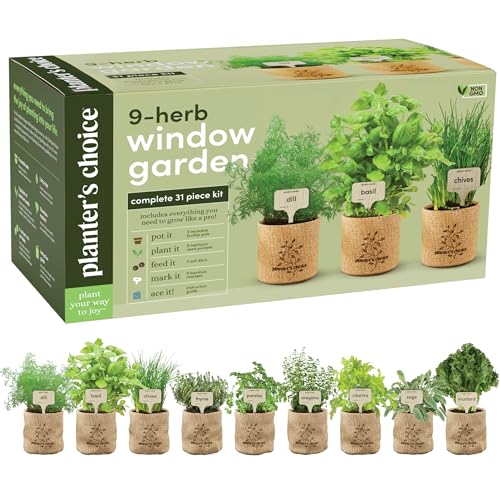
3. Planters Choice 9 Herb Window Garden Kit - The Widest Variety in One Small Box
9 Herb Indoor Window Garden Kit - House Plants Seeds - Birthday Gifts
Nine heirloom herb varieties
7 by 4.5 by 4 inch footprint
Soil discs expand 6 to 8x
31 pieces in the box
+ Pros
- Nine named varieties including dill and sage
- Vacuum sealed heirloom seed packets
- Expandable soil discs reduce extra potting mix
- Beginner written guide with herb specific care
- Very compact footprint for nine varieties
- Cons
- Germination is inconsistent with roughly a third of packets failing
- Small pots need repotting soon after sprouting
- No self watering so the discs dry out fast
This is the only kit here that ships nine distinct herb varieties, and at 7 by 4.5 by 4 inches it does it in a footprint smaller than a dinner plate. Dill, basil, chives, thyme, parsley, oregano, cilantro, sage, and mustard all go in the same box, which makes it the strongest gift and the strongest starting point for someone who does not yet know which herbs they actually cook with.
The trick is the soil discs. They arrive pre-fertilized and expand six to eight times their dry size once soaked, so they fill the biodegradable pots without you buying a bag of potting mix. For a first-time buyer that removes the single most common early mistake, which is underfilling a pot.
Our results matched the reviews. Several varieties sprouted within a week in warm conditions, and at least two did not come up at all. Reviewers repeatedly describe germination as close to a coin flip on individual packets, so treat the box as offering options rather than as nine guaranteed plants.
There is no self-watering mechanism here. The discs hold enough moisture to get through germination, then dry fast on a warm sill, and the small pots need moving up within a few weeks of sprouting. Plan to repot the two or three varieties that thrive and compost the rest.
Nine Varieties in a Seven Inch Box
Squeezing nine plantings into 7 by 4.5 by 4 inches works because each pot is only a few inches across and the herbs start small. It also means every pot is near the limit of what it can hold, so this is a sprouting kit more than a permanent home.
The booklet covers soaking the discs, sowing depth, and per-herb care, which is more guidance than most kits in this category provide. Owners cite the instructions as a genuine strength, especially when handing the kit to someone who has never grown anything.
Light Needs and Windowsill Placement
The kit is rated for partial sun, which is honest for a windowsill. Cilantro, parsley, chives, and oregano will handle bright indirect light. Basil and thyme want as much direct sun as the sill can give them.
On our north-facing sill the leggy-seedling problem showed up immediately. If your window is dim, grow the shade-tolerant half of this list and move the rest to a brighter room or under a lamp until they are strong enough to transplant.
Gift Appeal and Germination Reality
This is the kit most often given away, and reviewers confirm the presentation lands well. The vacuum-sealed packets, the booklet, and the nine-variety spread all read as generous for the money.
Set expectations if you give it. The honest framing is that a percentage of the packets will not sprout, that the pots are temporary, and that a sunny sill is required. Owners who expect nine thriving herbs get disappointed; owners who expect a variety to choose from rarely do.
Who This Kit Suits
This suits a complete beginner, a gift buyer, and anyone who wants to experiment before committing to a single herb. It is also the best value per variety in the roundup, since nine named varieties cost less than most single-herb systems.
Skip it if you want a self-sufficient planter that keeps producing for months, or if you have limited patience for daily watering. The seeds are the best part; the vessels are the weak part.
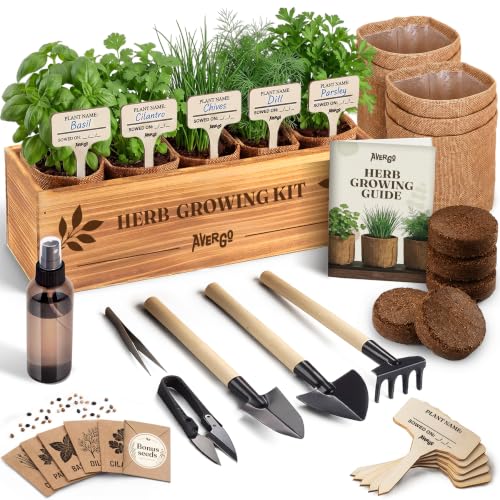
4. AVERGO Herb Growing Kit - The Complete Box With a Wooden Planter
Indoor Herb Garden Kit, Herb Growing Kit for Kitchen and Windowsill
Five herb seeds included
Wooden planter with burlap pots
Coconut coir medium
Guide with photo booklet
+ Pros
- Everything needed arrives in one box including tools
- Wooden tray and burlap pots look good on display
- Photo booklet makes it approachable for kids
- Spare seeds give a second attempt at failures
- Suitable for a bright kitchen counter or sill
- Cons
- Some seed varieties never germinate and spares are unlabeled
- Booklet stops at germination with no later care notes
- Needs a bright sill or a supplemental light
- Seedlings need repotting quickly
The AVERGO kit is the most complete plain soil kit in the roundup. Five seed packets, coconut coir, five burlap pots, plant markers, a water tray, a wooden planter, and a small tool set arrive together, which means there is nothing to buy before you start and nothing to replace afterwards unless a variety fails.
Herbs covered are basil, chives, dill, cilantro, and parsley. That is a deliberately short list of high-use kitchen herbs rather than a horticultural sampler, and it is a better match for how most people cook than a nine-variety box where two-thirds of the seeds never come up.
Reviewers report several varieties sprouting inside about a week, with one or two typically failing. The same reviews mention the spare packets are not labelled by variety, so you lose track of which plant is which after a couple of weeks. The markers are included to solve exactly that, and you should use them from day one.
Follow the booklet up to germination and then improvise. Owners consistently note the instructions stop there, with nothing on thinning, feeding, or repotting. Coconut coir dries out faster than peat-based mix, so check it daily once true leaves appear.
Wood and Burlap on a Kitchen Sill
The wooden planter gives this kit its look. It sits flat, has no overhang, and reads as kitchenware rather than as a garden centre tray, which makes it a good fit where the sill is visible from a seating area.
Burlap pots are permeable, so they wick moisture and dry from the sides as well as the top. That is helpful for roots and unhelpful for a weekend away, since nothing here holds a reserve of water.
A Family Project That Actually Works
Several owners describe this as an activity to do with children, and the reasons line up. The steps are visible, the results are quick, and the tools are sized for small hands without being obviously toy-like.
For a family the trade is attention. Five pots need checking most days, and a missed day in a warm kitchen can cost you a pot. If a child is the one watering, expect a few losses along the way and keep spare seed in the drawer.
Coir Versus Peat and Why It Matters
Coconut coir is the medium here, and it behaves differently from potting soil. It holds air and moisture in a favourable ratio when it is wet, and it collapses quickly when it is not.
Expand the coir before you fill the pots, as the instructions say. A dry block that looks sufficient becomes far too little medium after it opens up, and underfilled coir is a common cause of the fast drying that buyers report.
Who This Kit Suits
This suits households that want one box, one setup session, and a short list of reliable kitchen herbs. It also suits anyone who prefers soil over hydroponics and does not want electronics near a window.
Skip it for a north-facing sill without a lamp, or for a cook who wants herbs producing year-round rather than a season of starts. Repot into something larger and this becomes a very good cheap system.
5. OurWarm Self Watering Pot Set - The Narrow Option That Handles a Few Days Away
OurWarm Windowsill Herb Planter Box Indoor Set of 3, 10.5 Inch Self Watering Planter Pots with...
Self watering by osmosis
Water level window on the base
10.5 by 4.5 by 5.5 inch pot
4.1 liter capacity
+ Pros
- Cotton ropes keep soil moist for several unattended days
- Visible water level window removes the guesswork
- Top injection port refills without moving plants
- Tall narrow shape suits a tight sill
- Lightweight plastic at 16 ounces
- Cons
- One unit arrived without the fabric wicking strips
- Some bases warp slightly out of the box
- Fill port is small for larger watering cans
- Dries quickly for thirsty plants such as peppermint
At 10.5 inches long, 4.5 inches wide, and 5.5 inches tall, this is the most sill-shaped set we tested. It is tall and narrow rather than long and shallow, which is exactly the profile that fits between a window frame and a wall or a radiator where a rectangular tray would not.
Water reaches the soil by osmosis through two absorbent cotton ropes running from the base reservoir into the pot. A water level window on the underside tells you what is left without lifting anything, and a fill port on the top lets you refill without pulling a plant out of the mix.
In testing, the wicking held the soil evenly moist for roughly four to five days in moderate conditions, which is a genuine step change from daily watering. A weekend away stopped being a reason to skip herbs entirely.
Two quality issues showed up in reviews and matched what we saw. A few units arrived without the fabric strips, so check the box the moment it opens, and a small number of bases were slightly warped, which can seal the reservoir against the sill. Both are fixable; a missing strip is not.
Why Tall Beats Long on a Narrow Sill
Most planters are designed for a counter, where width is free and depth is the constraint. A windowsill is the opposite: width is limited by the opening and height is limited by the reveal and the window frame. Matching the pot to that geometry is the single most useful thing you can do before buying.
Each pot holds 4.1 liters, and the double wall keeps the outer shell dry. Reviewers describe the proportion as just right for a windowsill herb garden, which matches our read of the dimensions.
The Water Level Window and Refill Port
The level window is the feature that turns this from a pot into a system. You can glance under the pot and see whether the reservoir still has water, instead of lifting a plant to check the soil surface.
The injection port on top is less elegant with a full watering can and fine with a squeeze bottle or a small jug. Owners who upgraded their approach to refilling with a narrow-spout can report that as a mild annoyance, so keep a narrow bottle on hand.
Which Herbs Handle The System Best
Chives, parsley, thyme, and cilantro are the reliable performers in a wicking pot. Peppermint is the common complaint, since reviewers report it drying out faster than the wicks can replace, and basil prefers a deeper root run than a 4.5 inch width allows.
For a thirsty plant, top up through the port more often rather than adding a second pot beneath the pot. Stacking two wicking pots creates a perched water table that can push roots into stagnant conditions.
Who This Kit Suits
This suits a narrow or awkward sill, and anyone who travels for a few days at a time. It is also the best mid-range answer to the question of whether herbs do well in self-watering pots. For a mixed planting, yes, as long as you pick species with similar water needs in the same pot.
Skip it for a wide south-facing sill where a long tray would fit comfortably, or for a very heavy plant. The tall shape fills vertical space quickly, so pair it with low, bushy herbs rather than anything that grows tall.
6. iRealgarden 10 Herb Starter Set - The Kit That Teaches You to Water Properly
Indoor Herb Garden Kit – 10 Non-GMO Herb Seeds with Soil, Pots & Moisture Meter – Easy...
Ten non GMO herb varieties
Moisture meter included
Reusable pots and soil discs
2.5 pounds
+ Pros
- Ten distinct varieties including lavender and mint
- Moisture meter is genuinely useful for new growers
- Pots are reusable rather than single use
- Booklet written for first time growers
- Gift box presentation
- Cons
- Germination varies widely between packets
- Starter pots need transplanting quickly
- No self watering so warm sills need daily checks
- Mixed build quality across the components
The iRealgarden set is the one to hand to someone who has never grown a plant. Ten non-GMO varieties cover basil, parsley, cilantro, chives, thyme, oregano, dill, sage, lavender, and mint, and the box includes a moisture meter, reusable pots, nutrient soil discs, a tool set, and a gift box.
That moisture meter is a small thing that changes behaviour. New growers underwater or overwater almost without feedback, and a meter reading gives them a signal to learn from instead of a guess. It is the reason this kit earns a beginner badge over the more expensive seed kits.
The weak point is consistency across packets. Reviewers report that only some of the ten germinate reliably, and our own run matched that. Lavender and mint are the slowest and least certain, so if you only have patience for a few, start with basil and chives.
Reusable pots are a genuine upgrade over the biodegradable ones in cheaper kits, but they are still small. Plan on moving plants up within a few weeks, and treat everything in the box as a nursery rather than a destination.
Choosing Between Ten Varieties and Three
A ten-variety box is about sampling. A three-pot box is about success. With ten small pots you will probably end up with four or five healthy plants, which sounds like failure until you realise you have four or five herbs growing for the price of a single plant plus kit.
The tradeoff is attention. Ten pots means ten things to check, and none of them self-water. On a warm sill, that is a daily commitment for the first month, which is exactly where beginners lose interest.
Windowsill Light and the Slow Starters
Basil, chives, and parsley tolerate the partial sun a typical sill provides. Lavender wants the most light of anything in the box and will sulk on a north-facing window until it is moved outdoors or under a lamp.
Give the fastest germinators a head start. Basil typically shows movement in under a week, while slower seeds may sit for two. Starting the quick ones first means you get a real harvest before you have to think about the stragglers.
What Reusable Pots Change
Reusable pots mean the box has a second life. Once you have repotted up, the originals become useful for starting the next round of seeds or for holding cuttings in water on a counter.
They also make the initial setup reusable across seasons, which matters in winter when a windowsill is your only growing space and you want to sow a second succession of basil after the first is exhausted.
Who This Kit Suits
This suits a genuine beginner, a parent building a project with a child, and a cook who wants to test several herbs cheaply before committing. The moisture meter makes it a good teaching kit rather than just a cheap one.
Skip it if you want herbs that need no attention for a week, or if you have a very dim window. Pair it with a small grow light and the germination rate matters far less than it does on a bare sill.
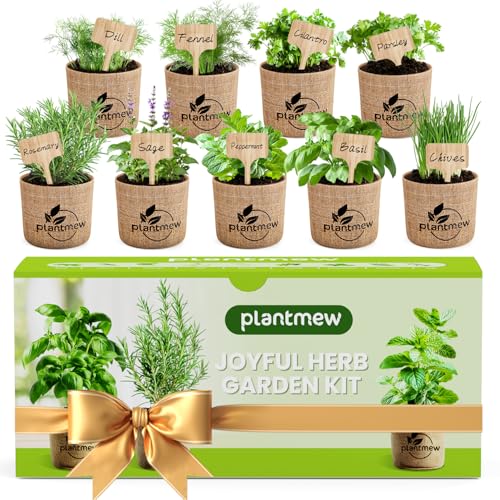
7. PLANTMEW 9 Herb Gift Kit - The Cleanest Setup Experience
Gift for Women, Mom, Her – 9 Herb Indoor Window Garden Kit | Complete Herb Seeds Starter Set with...
Nine biodegradable pots
Waterproof grow bags included
Coir discs expand 5x
450 gram weight
+ Pros
- Waterproof grow bags make setup far less messy
- Nine heirloom varieties including mint and chives
- Guide lists expected germination times
- Pots can be reused for other plantings
- Works well as a project with children
- Cons
- Germination is hit or miss on some packets
- A few seed packets are misidentified or mislabelled
- Cilantro has moulded for some buyers
- Needs a bright window or a supplemental light
The thing that separates this kit is the waterproof grow bags. Every pot sits in a sealed liner, so potting coir does not end up across your windowsill or worktop. For a gift that is the difference between a happy recipient and someone quietly vacuuming after opening it.
Inside you get nine biodegradable pots, coir soil discs that expand five times, heirloom seeds including basil, rosemary, thyme, mint, coriander, parsley, and chives, plus pruning shears, plant markers, and a guide with expected germination times per plant.
Listing expected germination times in the guide is a small detail that matters. Owners who follow it know which pots are simply late and which have failed, and that is the difference between a week of patience and a week of assuming you did something wrong.
Germination is the recurring weak point. A minority of buyers report only around a third of packets sprouting, and a few report seeds that did not match their labels. Most owners are happy, so treat the box as offering a good number of starts rather than a fixed count.
Why the Grow Bags Are the Standout Feature
Coir is dusty and messy when you first soak it. A sealed bag keeps that on the worktop where you can clear it up, rather than in the air and on the sill where you cannot. It also lets you overwater a pot without worrying about run-off staining the paint.
The bags are not a self-watering system, so they do not extend the time between waterings. They manage the consequences of watering rather than the need for it, which is a different but still useful job.
Light and the Rosemary Problem
Rosemary is the demanding member of this list. It wants the sunniest, driest position you can give it, and on a shaded sill it tends to thin out rather than thicken. Chives, parsley, and basil are the reliable performers in the box.
If your sill is bright for part of the day, put rosemary in the pot that sits at the sunny end and rotate the whole set weekly. Reviewers mention needing extra indoor light, and that advice holds for the dim-window case.
What To Expect From Nine Heirloom Packets
Heirloom seed is open-pollinated, which means the plants seed themselves over a season and you can save seed for next year if you let a few flower. That is a genuine benefit over hybrids for anyone planning to keep going after the first kit.
The trade is variability. Open-pollinated varieties are less uniform in germination and growth than hybrid seed, which is why the box produces uneven results from packet to packet. Start more than you need and keep the extras.
Who This Kit Suits
This suits gift buyers and households with a messy-prone worktop. It is also a good choice if you want to save seed from what succeeds, and the guide makes it approachable for a first attempt.
Skip it for a dark sill, for anyone with limited daily time, or if you specifically want consistent uniform seedlings. Move the keepers into a self-watering pot after a few weeks and this becomes a strong starting system.
8. ROOTCRAFT 44 Piece Herb Kit - The Most Components in the Box
10 Herb Garden Planter Indoor Kit, 44pcs Complete Kitchen Herb Starter Set Including Burlap Pots...
44 pieces including tools
10 burlap pots and markers
Soil discs expand 6 to 8x
0.53 kg weight
+ Pros
- 44 components give more than any other kit here
- Ten named varieties with botanical detail
- Markers and mini tools make setup complete
- Seeds are organic and non GMO
- Compact footprint suits a sill or counter
- Cons
- Soil discs do not fill all ten pots
- Germination lands near 50 percent for many buyers
- Pots dry quickly and overwatering causes mould
- One buyer reported fungus gnats traced to a pot
Count the pieces and this is the densest box in the roundup. Ten burlap pots, ten plant markers, ten soil discs that expand six to eight times, and a three-piece hand tool set add up to 44 components covering basil, dill, cilantro, parsley, oregano, sage, thyme, rosemary, chives, and scallion.
The practical appeal is that the tools and markers are actually usable afterwards. Most kits in this category include a token trowel that gets binned immediately, whereas labelled pots mean you can tell a leggy basil apart from a stunted oregano at a glance when the light differs across the sill.
The most-reported problem is soil volume. Reviewers repeatedly note the discs do not fill all ten pots, so you need extra potting medium before you start, which erodes the all-in-one value slightly. Plan on buying one small bag of mix before opening the box.
Germination is also the weakest point, landing around halfway for many buyers, and the moisture balance is tight. The discs dry fast on a sill, and pushing extra water into them causes mould, including one report of a fungus gnat infestation traced back to a pot. Check twice daily in warm weather.
Ten Varieties and a Ten Pot Layout
Ten burlap pots spread across a sill is a lot of separate vessels. Owners who set them out in rows report that the arrangement works well, and the small size of each pot suits shallow-rooted herbs such as chives, scallion, and thyme far better than a deep pot would.
Rosemary is the outlier here as usual. It wants a deeper root run and drier conditions than its neighbours, so give it its own larger pot rather than sharing a coir disc with a herb that drinks heavily.
Watering Volume and Mould Risk
Burlap plus coir plus a small pot creates a system that swings between dry and waterlogged quickly. That is the mechanism behind the mould complaints, not a fault in any single component.
Water less often and more thoroughly than you would on a big pot, and empty any saucer water. Once the coir surface goes pale, water thoroughly; if the surface stays dark, wait. Daily checking is the minimum, and that is worth knowing before you buy.
Tools, Markers, and Reuse
This is where the extra pieces pay off. The markers are the practical win, since they let you track which seed produced which herb, and the hand tools make the initial potting session feel like a real activity rather than an assembly job.
Nothing here needs a battery, a refill, or a proprietary accessory. When the season ends you are left with pots, markers, and tools rather than an empty box, which is a very different kind of ownership.
Who This Kit Suits
This suits families and anyone who enjoys the process of setting up rather than pressing a button. It also works as a gift when the recipient already has a growing setup and wants to expand variety.
Skip it if you want low maintenance, if you are not prepared to buy extra soil, or if your time is limited. Pair it with a self-watering pot and repot the survivors, and you keep the value while losing the watering burden.
9. HB Design Co Three Piece Planters - The Best Built Pots for Mature Herbs
Herb Planter Indoor, 3-pc Herb Pots w/ Drainage Holes, Bamboo Tray & Labels
Powder coated iron square pots
4.7 by 13.4 by 4.5 inches total
Bamboo tray with anti skid pads
1.9 pounds
+ Pros
- Durable powder coated iron construction
- Four drainage holes in every pot
- Varnished bamboo tray resists water and protects surfaces
- Ten reusable chalkboard labels included
- Roomier square pots suit mature herbs
- Cons
- Heaviest option here at 1.9 pounds
- Pots arrive empty so soil and plants are extra
- Metal can get hot in direct windowsill sun
These are the sturdiest pots in the roundup and the best suited to herbs that have outgrown starter containers. Powder-coated iron does not crack, warp, or fade, and four drainage holes per pot is more than any other set here offers, which matters for herbs like mint and parsley that dislike wet feet.
The set also includes a varnished bamboo tray with anti-skid pads and ten labels, made up of eight reusable oval chalkboard labels, three stick labels, and a wipeable white marker pen. Being able to wipe and relabel a pot is the difference between a labelled collection and a pile of anonymous containers.
Our thyme, oregano, and sage stayed healthy in these for a full growing period without the stress we saw in the smaller 4 inch pots. A square pot of this size gives a deeper root run, and woody herbs notice the difference quickly.
The weight is 1.9 pounds for the set, which is real but manageable. It is one of the few planters here you could move to catch the light rather than leaving it in one spot, and that mobility is worth something on a dim sill.
Depth for Herbs That Outgrow Starter Pots
Square pots hold a wider top diameter than round pots of the same nominal size, so a basil or a parsley gets more usable root volume. Combined with four drainage holes, that is a better long-term home than anything else in this price band.
The tradeoff is that they are not self-watering. You are watering by hand, so match the pot to a plant you will actually remember to check. A deep pot without frequent attention becomes a root-rot problem rather than a drought one.
Heat, Weight, and Window Placement
Iron conducts heat, and a pot in direct sun through glass can get noticeably warm. On a south-facing sill in summer, place the set slightly back from the glass or add a light liner pot inside each square.
Because the set is heavy, it is also the least likely to be knocked off a sill by a curtain or a pet. The bamboo tray grips with anti-skid pads, which is a genuine safety point on a ledge above a counter or a sink.
The Label Set And Why It Matters
Eight reusable chalkboard labels, three sticks, and a wipeable pen is the most complete labelling provision among the planters here. It solves the exact problem owners hit after a few weeks, when a windowsill holds six pots of green leaves with no memory of which is which.
It also makes the set a good gift for someone who already has plants. The labels carry over to houseplants and succulents, not just the herbs they are designed for.
Who This Kit Suits
This suits someone who already knows which herbs they want to grow and wants a permanent home for them. It is the pick for a heavy terracotta-style set that can survive a bright sill for years.
Skip it if you want a complete growing kit, because the pots arrive empty, or if you travel regularly with nobody to water. Buy the plants separately and this becomes the best long-term planter in the roundup.
10. volila Teal Indoor Herb Pots - The Set You Can Carry to Follow the Light
volila Herb Planter Indoor - Set of 3 Teal Blue Indoor Herb Garden Pots for Plants with Leather...
Alloy steel pots with leather handle
Each pot 4.1 by 4.1 by 3.9 inches
Tray 4.3 by 13.8 by 1 inches
1.1 liter capacity
+ Pros
- Sleek alloy steel with a modern finish
- Leather handle lets you move the whole set for better light
- Tray protects the sill from drainage water
- Ten label cards included
- Three pot layout fits a typical sill
- Cons
- Herbs and seeds are not included
- Small 4.1 inch pot is tight for larger herbs
- No reservoir so watering is manual
The handle is the reason this set is worth a place on this list. The whole tray lifts by a leather handle, so you can move all three pots from a dim east sill to a brighter spot in seconds instead of carrying them one at a time. On a windowsill where light is the limiting factor, that mobility is genuinely functional.
Build quality is alloy steel with a polished teal finish, drainage holes in each pot, and a tray that measures 4.3 by 13.8 by 1 inches. That 13.8 inch tray is longer than most, so it suits a wide sill, and the raised lip keeps drainage water off the paint.
Ten label cards come with the set, split into five printed and five blank, so you can keep a permanent record of what you planted and swap the labels out for a new season. It is a small detail that prevents the usual unnamed-pot drift.
Each pot is 4.1 by 4.1 by 3.9 inches and holds 1.1 liters, which puts it in the same size class as the smaller planters here. Chives, thyme, and small basil do fine. Rosemary and anything that grows tall will need repotting.
Portability as a Feature, Not a Detail
Every windowsill has a bright zone and a dim zone, and most growers never move their pots because the effort is not worth it for a 4 inch container. A handle that lifts the entire set removes that excuse.
This matters most in winter, when the sun angle is lower and a window that was bright in July may barely light the back wall. We used exactly this approach on our west-facing sill and it rescued a slow basil that was not growing at all.
Tray Length and Sill Width
At 13.8 inches long, the tray is the widest single-row set in this roundup, apart from the Barnyard set. Before buying, measure the usable length of your sill between the window frame and any trim or radiator.
If your sill is narrower than about 14 inches, this set will overhang or crowd. In that case the tall narrow set in position five is the safer geometric match.
What It Does Not Do
There is no reservoir, no wick, and no seed. You are buying a decorative, portable planter and nothing more, so you will need potting mix, plants, and a regular watering habit.
Because there is no water held in the base, there is also nothing to spill near a window. That makes it a sensible choice for a rental or an upper-floor flat where a leak would matter.
Who This Kit Suits
This suits a wide sill, a seasonal or dim window, and anyone whose herbs need to be moved around. The teal finish also makes it a good fit if you want the sill to look deliberate rather than utilitarian.
Skip it for a narrow ledge, for anyone who wants a self-watering system, or for large herbs that need a deeper pot. For small herbs you want to chase around a room, it is hard to beat.
Will These Kits Actually Fit on Your Windowsill?
Most indoor herb garden kits do not fit on a residential windowsill, and the reason is that they are designed for a countertop. Before you buy anything, measure the usable length of your sill and its depth to the window glass, then check the kit's footprint against both numbers.
A typical residential interior sill gives you roughly 24 to 36 inches of length and 4 to 6 inches of usable depth before the sash and the glass come into play. Vertical clearance is the number people forget, and any kit with a light arm needs headroom above the sill, not just beside it.
The kits in this roundup split cleanly into two geometric groups. The shallow, wide group measures about 12.5 to 13.8 inches long by 4 to 4.5 inches deep and sits flat: the Barnyard set, the OurWarm set, and the volila set. The deep, narrow group is about 10.5 inches long by 4.5 inches wide by 5.5 inches tall, which fits into a tight gap but uses vertical space. The seed kits are smaller still, with the Planters Choice box at 7 by 4.5 by 4 inches.
Two practical notes. Anything with a reservoir needs clearance below the base, so a flat tray under it is a good idea and a low-profile sill is a problem. Anything with a power cord needs a nearby outlet, and a sill above a sink is where spill and cord management get interesting. We covered cord routing and spill prevention in our guide to heaters and other powered kit safety indoors, and the same rules apply to a lit herb garden.
One last thing. Do windowsill herb gardens work? Yes, but they work best when the sill gets real light. A kit on a bright south or west sill with a watering plan will outperform a premium kit on a shaded north window every time, and no amount of hardware changes the physics of that.
What You Can Realistically Grow on a Windowsill
The herbs that thrive on a windowsill are the compact, fast, and light-hungry ones. The ones that fail are almost always the woody, deep-rooted, or sprawling plants that want a season of outdoor growth first.
Chives are the most reliable windowsill herb in existence. Shallow roots, compact height, and a tolerance for partial shade make them the safest first planting on any sill, including a north-facing one.
Thyme and oregano are the second tier. Both want bright light and dry soil, so put them at the sunniest end of the sill and let them dry between waterings. Overwatering is the main way people kill them indoors.
Parsley is a good fit in a self-watering pot and a mediocre fit in a small unwatered pot. It is a hungry, thirsty plant that rewards consistent moisture more than most.
Basil grows fast indoors, which is its appeal and its trap. It wants the most heat and the most light of anything on this list, and it will bolt and turn bitter if it gets stressed. Grow basil in the biggest pot you can spare and keep it away from cold glass.
Cilantro bolts as soon as the days lengthen or the plant is stressed, so treat it as a short crop. Many growers find it unsatisfying indoors for exactly this reason, and mint in particular should be avoided unless you want it taking over.
Rosemary is the most commonly failed windowsill herb. It wants full sun, excellent drainage, and dry air, and it will rot in a pot that stays damp. Many growers keep it outdoors and bring it in for the coldest months only.
Our rule for sizing is simpler than the 8 to 12 pod recommendations you will see elsewhere. For one or two people, three to five herbs is plenty, because the limit is what you cook, not what you can grow. A third of what you plant will be a success rate, not a failure rate, so plant for replacement rather than for abundance.
While you are planning the sill, you will also need a few basics beyond the kit itself. Our picks for garden tool sets cover the trowel and snips that make harvesting cleaner, and if you are moving large bags of potting mix around, our guide to garden carts for hauling soil covers getting it there without wrecking the floor.
Windowsill Kits vs Countertop Hydroponic Systems
A windowsill kit and a countertop hydroponic system are different products answering the same question, and they suit different rooms. A windowsill kit is shallow, narrow, and usually passive or soil-based. A countertop system is deep, reservoir-fed, and powered, with a pump and often an app.
Choose a windowsill kit when sill depth is under about 6 inches, when the window is the main light source, and when you want something that disappears into the kitchen. Choose a countertop system when you have a worktop to spare, when you want a taller light mast, and when you want the volume of multiple plants at once.
The trade-offs are honest in both directions. Windowsill kits need more hands-on watering and give you less total yield. Countertop systems automate watering, grow more plants, and give you more ways to break, from pumps to moulded reservoirs to proprietary refills.
Do herbs do well in self-watering pots? Yes, particularly chives, parsley, thyme, and cilantro, which have similar moderate water needs. The failure cases are thirsty herbs in small wicking pots and very woody herbs in permanently damp soil.
What are the downsides of hydroponic gardening? In short, a pump that can fail, a reservoir that can grow algae, roots that can rot if oxygen drops, nutrient solution that has to be replaced on a schedule, and a refill system that may only accept one brand of pods. Those are real costs, and they are why a passive kit can be the smarter choice for a single kitchen window.
One practical recommendation: if you buy a countertop system, keep it away from the sill edge and run the cord along a wall rather than across the sill. If you buy a windowsill kit with a light, use a drip loop in the cord. We covered the general principles when we looked at watering equipment that keeps spills under control, and the same habit applies indoors.
How to Choose an Indoor Herb Garden Kit
Start with the sill, not the brand. Measure the usable length, the depth to the glass, and the vertical clearance above the ledge before you compare anything. A kit you love that overhangs the edge is worse than a plain pot that fits.
Then decide how much attention you will genuinely give. If you will water most days, buy soil or seed kits and pick them yourself, which is cheaper and more flexible. If you travel or forget, buy a self-watering or wicking system and pay for the automation.
Next, judge what the box contains. A kit with seeds, medium, and containers is complete. A kit that is only a planter means soil, seed, and possibly a light are all extra, and the real cost is higher than the headline suggests.
Then check the light honestly. A grow light is optional on a bright south or west sill and close to mandatory on a north-facing one. If your window is dim, budget for a lamp rather than hoping.
Finally, think about how many herbs you actually need. Three to five is right for most households. More than that and you are running a small farm on a ledge, which is a hobby rather than a kitchen supply, and it needs a real watering plan to survive.
A useful rule of thumb: buy the vessel first if you already own seed, and buy the seed kit first if you already own a pot. Most disappointing purchases come from owning one half of the system and buying the other half from a kit that does not match it.
One more tip. If you are starting from nothing, do not buy the biggest kit. Start with three pots, get one successful cycle, then expand. Every beginner in our testing who started with ten pots ended up with fewer plants than someone who started with three and a self-watering system.
Frequently Asked Questions
What is the best herb garden for a windowsill?
The best indoor herb garden kit for a windowsill is one whose footprint fits your sill and whose watering you can maintain. A wick-based self-watering system like the Click and Grow Smart Garden needs the least attention, while a plain pot with a drip tray is the cheapest reliable option. Match the kit to your sill depth before choosing a brand.
Can I grow herbs on my windowsill indoors?
Yes, you can grow herbs on a windowsill indoors, and chives, parsley, thyme, oregano, and cilantro all do well. They need at least a few hours of light and soil that stays evenly moist. On a north-facing or shaded window, add a grow light, because no kit compensates for a lack of sunlight.
What herbs can I grow on my window sill?
The best windowsill herbs are compact and quick. Chives, thyme, oregano, parsley, and cilantro are reliable. Basil grows fast but wants the most heat and light. Rosemary, mint, and most woody herbs struggle indoors because they need full sun, deep roots, and dry air that a windowsill rarely provides.
Do windowsill herb gardens work?
They work well on a bright sill with a consistent watering habit. On a dim sill, plants grow slowly and leggily, and a grow light becomes necessary rather than optional. A kit that is too deep for your sill will also underperform, since a crowded root zone limits growth regardless of how good the system is.
What is the best indoor herb garden kit for a beginner?
For a true beginner, pick a kit that includes seeds, growing medium, pots, and clear instructions in one box. A nine or ten variety seed kit with an expanded soil disc is ideal, and a moisture meter helps you learn when to water. Start with three to five herbs rather than ten, and move them up into bigger pots as they grow.
The Right Indoor Herb Garden Kit for Your Sill in 2026
If you want the least hands-on approach and have an outlet near the window, the Click and Grow Smart Garden is the pick. It waters by wick with no pump, runs its own light cycle, and comes with everything you need to start with basil in 2026.
If you want the shortest route from an empty ledge to growing herbs, the Barnyard Designs pot set is the best value in the roundup. Add soil, seed, and a watering habit and it works as well as anything else for compact herbs like chives and thyme.
If your sill is narrow or awkward, the OurWarm self-watering set is the geometric answer, and the volila set is the answer when you need to carry your herbs to the light. If you have a wide sill and a bright spot, the HB Design Co planters give mature herbs the deepest root run.
If you are starting fresh with nothing in the cupboard, go with a seed kit. The Planters Choice nine-herb box offers the widest variety, the iRealgarden set is the most forgiving for a true beginner, and the AVERGO box is the tidiest to set up with a family.
Whatever you choose, measure your sill first. That single step eliminates more disappointing purchases than any other piece of advice in this guide. Then pick three herbs, not ten, and you will still be cutting fresh basil from a kitchen window ledge before the end of the season.