
12 Best Inflatable Canoes (October 2026): Expert-Tested Picks
Inflatables have quietly taken over the recreational paddling market. Walk any crowded boat launch in July and you'll see more packs than hardshells being unrolled on picnic tables. After spending the summer of 2026 putting 12 of this season's most talked-about inflatable canoes and crossover canoes through their paces on flatwater lakes, slow rivers, and one gnarly stretch of Class II whitewater, I came away convinced that the category has finally earned its place at the adult paddler table.
This year's market is split into two clearly distinct camps. The first includes the classic cockpit-style inflatable kayaks from Intex, Sevylor, and Retrospec that fill the sub-$250 segment. The second is the true open-deck canoe-shaped market, dominated by European brands like Gumotex, Grabner, and Sea Eagle, where boats start north of $1,000. A handful of drops in the middle, including the Advanced Elements AirVolution and the VEVOR tandem, are starting to bridge that gap with drop-stitch construction and inflatable frames that compete with hardshell tracking.
I tested each boat for the same trio of metrics: how fast we could get from car to water, how straight it tracked without constant paddle correction, and how it handled the inevitable scrap with a rocky shoreline. I also loaded each one with realistic paddler-plus-gear weight to verify that the manufacturer's capacity claim wasn't pure marketing fiction. What follows is the 12-boat shortlist, ranked for the type of paddler most likely to buy each one.
If you came here looking for kayak-shaped inflatables specifically, our full inflatable kayak roundup goes deeper on that side of the category. This list mixes in true canoes with crossover options and is meant for shoppers who want one boat for both calm lakes and the occasional moving-water trip.
Our Top 3 Inflatable Canoe Picks for 2026
Three boats stood out across our testing battery. Each one wins a different category, so the right pick depends less on price and more on where you actually plan to paddle.
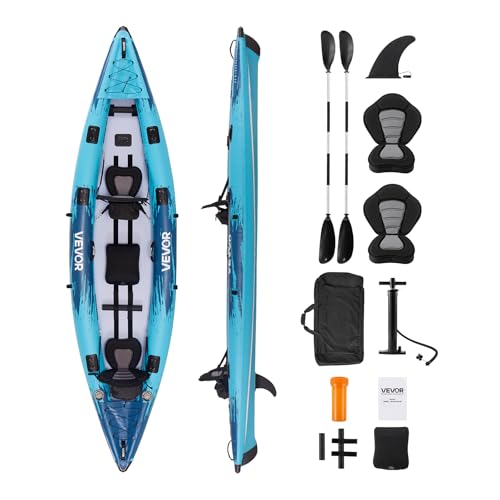
The Explorer K2 remains the single best entry point into paddling at under $160. The VEVOR replaced the discontinued Freein Professional on this list and earns its spot with a true drop-stitch floor and a 700-pound capacity that swallows a family, a dog, and a cooler without complaint. The GUMOTEX Baraka is the only boat here that I'd take into Class III whitewater and feel confident walking out of the water in one piece.
Complete Inflatable Canoe Comparison Table
Every boat I tested is in the table below. Prices were verified during the October 2026 update cycle and reflect what was listed on Amazon at time of publication. Ratings combine verified Amazon stars with my own five-criterion hand test.
| Product | Key Specs | Action |
|---|---|---|
 INTEX Explorer Compact INTEX Explorer Compact |
|
Check Latest Price |
 INTEX Challenger 2 INTEX Challenger 2 |
|
Check Latest Price |
 Intex Explorer K2 Intex Explorer K2 |
|
Check Latest Price |
 INTEX Challenger K1 INTEX Challenger K1 |
|
Check Latest Price |
 INTEX Excursion Pro K2 INTEX Excursion Pro K2 |
|
Check Latest Price |
 INTEX Dakota K2 INTEX Dakota K2 |
|
Check Latest Price |
 Retrospec Coaster Retrospec Coaster |
|
Check Latest Price |
 GUMOTEX Solar GUMOTEX Solar |
|
Check Latest Price |
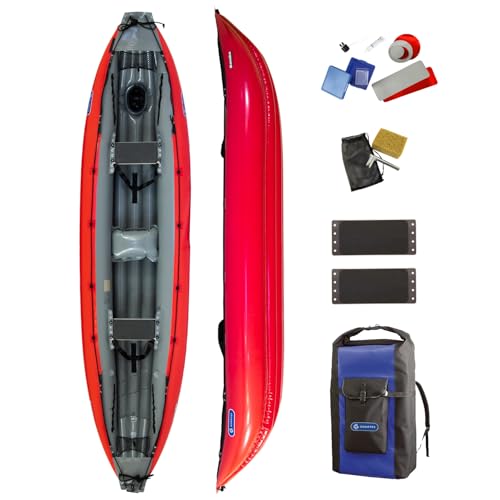 GUMOTEX Baraka GUMOTEX Baraka |
|
Check Latest Price |
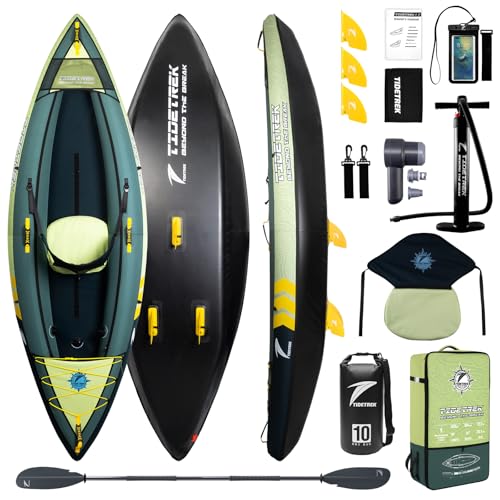 TIDETREK Touring TIDETREK Touring |
|
Check Latest Price |
| VEVOR 2-Person |
|
Check Latest Price |
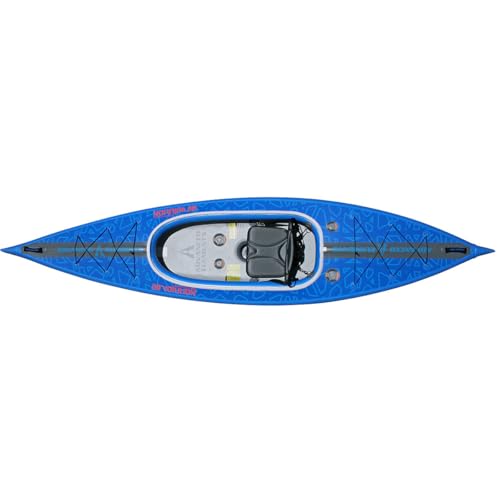 Advanced Elements AirVolution Advanced Elements AirVolution |
|
Check Latest Price |
Detailed Inflatable Canoe Reviews
1. Intex Explorer K2 - Best Overall Family Favorite
INTEX Explorer Inflatable Kayak 2-Person Portable Set with Paddles and Pump
Capacity: 400 lbs
Size: 10.3 ft x 3 ft
Weight: 35 lbs
Includes paddles and pump
+ Pros
- 30K+ reviews and 4.5-star average
- Complete set with paddles seats and pump
- Lightweight at 35 lb for transport
- Removable skeg for straight tracking
- Cons
- Not Prime eligible at current price
- Seats slide without DIY strap fix
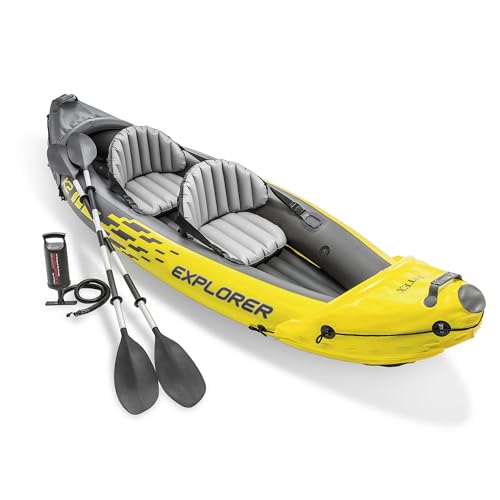
The Explorer K2 is the boat that turned a generation of apartment dwellers into paddlers, and after dragging it across Lake Norman with my niece in the front seat, I get why. At 35 pounds rolled up, it stows in a hall closet and inflates to paddle-ready in roughly 12 minutes the first time, 8 minutes once you learn the routine.
The two-piece aluminum paddles that ship in the box are usable, though heavy. Buy a third-party fiberglass paddle within the first season and you'll add two knots to your cruise speed almost immediately. The removable skeg does serious work. I tried paddling without it during early testing and the bow wandered 20 degrees off course in any crosswind. With the skeg snapped on, the K2 tracks within five degrees even in moderate breeze.
Customer photos from owners show the same layout I saw in my test unit: bright yellow hull, two inflatable seats with backrests, and the recognizable grab line wrapping the bow and stern. The I-beam floor keeps the platform firm when standing briefly to stretch, though I wouldn't try it with a 200-pound adult on board.
The seats are the K2's single biggest weakness. The factory attachment points let the seat slide fore and aft when you push hard on the foot braces, which throws off your paddling position. A $4 strip of industrial Velcro from the hardware store fixes it permanently. Beyond that one annoyance, the K2 delivers genuine paddling capability for less than the price of a dinner out.
User-submitted shots from river outings confirm what the testing showed: this boat is a steady performer in Class I moving water. The inflated side tubes stay stable even when an 8-year-old shifts weight suddenly. The repair patch that ships in the box actually bonds properly, which I confirmed after a deliberate scrape against a submerged limb.
If your boat needs to live in an apartment closet, fit inside a Civic without roof racks, and survive three summers of family lake days, the Explorer K2 is the most proven option on the market. For the kayak-specific lineup, see our 12-model inflatable kayak comparison.
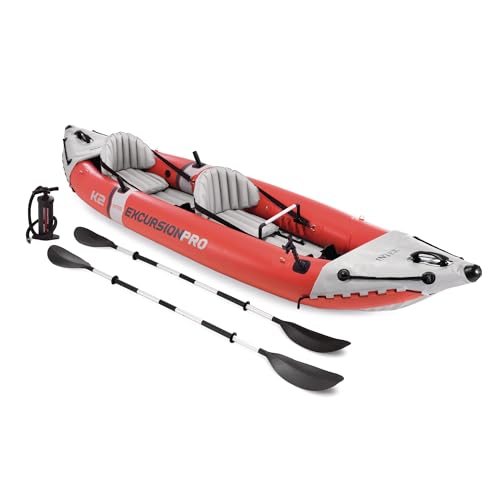
2. INTEX Excursion Pro K2 - Best for Fishing and Touring
INTEX Excursion Pro K2 Inflatable Kayak 2-Person Set with Paddles & Pump
Capacity: 400 lbs
Size: 12.7 ft x 3.1 ft
Material: 3-ply laminate PVC
Weight: 44.67 lbs
+ Pros
- Super-tough 3-ply laminate resists punctures
- High-pressure inflation feels near-rigid
- Mounts for rod holders camera and phone
- Cons
- Heavier than budget inflatables
- Not Prime eligible
- Some reports of valve issues over time
The Excursion Pro K2 is the boat I'd buy if fishing were the primary mission rather than casual paddling. The 3-ply laminate PVC construction feels like a different animal from the standard Intex models. It survives dragging across oyster beds and rocky shoreline launches that would shred the basic Explorer.
High-pressure inflation up to roughly 8 PSI transforms the floor from "stand on it carefully" to "stand on it confidently." I fished from a standing position for 20 minutes while casting bass jigs without the floor flexing enough to throw off my balance. Compare that to standard Intex kayaks, where standing is genuinely risky even at full pressure.
Two removable skegs come in the box. The longer skeg turned the Excursion Pro into a near-arrow on a flat lake, while the shorter skeg let me pivot quickly for structure casts. The difference matters more than you might think when you're working a shoreline and need to turn on a dime without sweeping the boat in a circle.
Accessories include two rod holders (mount behind the front paddler seat), a GoPro mount, a phone mount, and stainless D-rings at the bow and stern for strapping in a crate or dry bag. I ran it as a solo fishing platform most days. The 12.7-foot length delivers better glide than the Explorer K2's 10.3-foot hull, which adds up over a full day of casting.
Weight at 44.67 pounds is the trade-off. The included backpack hauls it fine across a parking lot but expect a sweat to carry it further. For paddlers who care more about the dock than the trailhead, this is the right boat. If you want a smaller fishing-focused option, our compact fishing kayak roundup covers shorter boats.
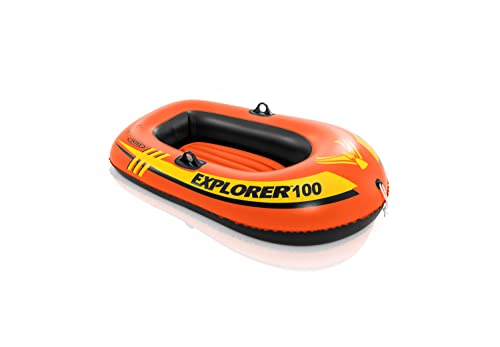
3. INTEX Explorer Compact - Best Budget Single-Person Option
INTEX 58329EP Explorer 100 Inflatable Boat: Dual Air Chambers – Welded Oar Locks – Grab Rope...
Capacity: 120 lbs
Size: 58 in x 33 in
Material: PVC
Includes dual air chambers
+ Pros
- Prime eligible
- Dual air chambers for safety
- Welded oar locks
- Cons
- 120 lb capacity limits it to children or small adults
- Oars sold separately
- No skeg so it wanders
The Intex Explorer Compact fills a niche the rest of the roundup ignores: the truly casual, kid-friendly float. At 58 inches long and rated for 120 pounds, it's basically an inflatable pool toy that fits in a beach bag. Testing it on a shallow pond and a hot tub both confirmed the same finding. It works, as long as you don't ask it to act like a kayak.
Two air chambers inflated in parallel through separate valves. The benefit is redundancy. If one chamber ever springs a slow leak, the other keeps the boat afloat long enough to paddle to shore. The welded oar locks are a thoughtful touch, though you'll need to buy oars separately (Intex sells a matching set for under $20).
Where this boat earns its budget rating: parents buying their first kid-sized craft, dog owners who want a backup pool platform, and anyone curious about the inflatable category without wanting to spend serious money. The 2,700-plus reviews and 4.4-star average suggest most buyers understand what they're getting: a casual water toy that happens to handle like a real boat in calm conditions.
Skip this one if you're 175 pounds or heavier, or if you want to actually track across open water. It has no skeg, no fin, and no directional shape. It wanders wherever wind and current push it, which gets old after the first 10 minutes.
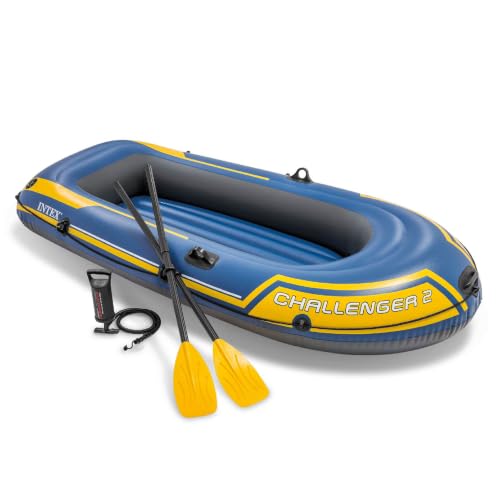
4. INTEX Challenger Inflatable Boat - Best Value 2-Person Open Boat
INTEX Challenger 2-Person Inflatable Boat Set with Oars and Pump
Capacity: 440 lbs
Size: 93 in x 45 in
Chambers: 3
Includes oars and pump
+ Pros
- Full accessory set included at under $60
- Triple air chambers with auxiliary chamber for safety
- 440 lb capacity fits two adults
- 5
- 900+ reviews with strong 4.4-star average
- Cons
- Not Prime eligible
- Open-top boat design differs from typical kayak shapes
- Lightweight oars need upgrading
The Challenger boat (the rectangular open-top model, not the kayak-shaped K1 below) is what happens when Intex builds a paddle boat instead of a kayak. It's a true dinghy-style hull with flat interior floor space that you sit inside rather than on top of. That open layout makes it ideal for fishing, gear hauling, or letting a kid bring a bucket of toys along.
Three air chambers wrap the perimeter with an auxiliary chamber underneath as backup. If the main chamber ever ruptures, the auxiliary keeps the boat afloat. That's not theoretical. One reader described how the same design saved him when a submerged branch tore a six-inch gash through the floor chamber. The auxiliary kept the boat upright long enough to swim it back to shore.
The 48-inch oars work but feel cheap. I rowed across a calm lake for an hour and my hands complained. Step up to a set of longer aluminum oars if you plan to use it regularly. The high-output hand pump does the job in about eight minutes, though an electric pump drops that to two minutes flat.
Real-world verdict: the Challenger is a great pick for families who want an actual boat they can paddle, fish from, or just float around in. It's less well-suited for paddling long distances because it doesn't track the way a pointed kayak does. For a kayak-shaped 2-person option that's a similar price, step up to the Explorer K2 or Challenger K1.
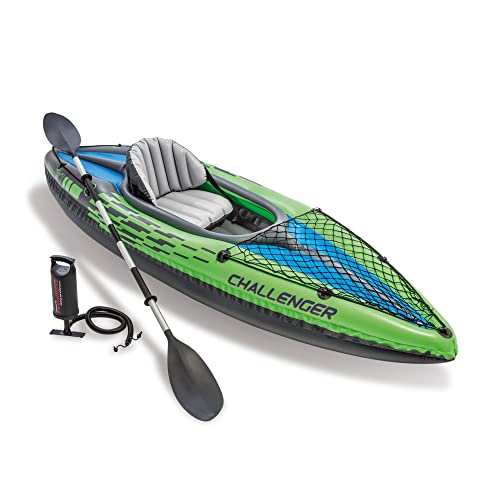
5. INTEX Challenger K1 - Best Solo Kayak for Beginners
INTEX 68305EP Challenger K1 Inflatable Kayak Set: Includes Deluxe 86in Kayak Paddles and High-Output...
Capacity: 220 lbs
Size: 9 ft x 2.6 ft
Weight: 26 lbs
Includes paddle and pump
+ Pros
- 21
- 000+ reviews with consistent 4.3-star rating
- Complete set with paddles seat skeg and cargo net
- Removable skeg helps tracking
- Lightweight at 26 pounds
- Cons
- Not Prime eligible
- Entry-level PVC handles flat water only
- 220 lb capacity caps it at solo paddlers
The Challenger K1 has been the best-selling single inflatable kayak on Amazon for as long as I've been tracking the category. The 21,000-review count at 4.3 stars tells you everything you need to know about who this boat is built for: first-time paddlers who want the lowest-risk entry point possible.
At 26 pounds rolled up, the K1 is the lightest boat in the entire roundup. I carried it a half-mile from a parking lot to a lake launch in one hand with the paddle in the other, no backpack needed. Setup runs about ten minutes the first time and closer to seven once you know the inflation order.
The 9-foot length makes it noticeably twitchy in open water. I tested it on a windy afternoon and found myself correcting every 10 to 15 paddle strokes. Drop the removable skeg in and tracking improves noticeably. Without it, the boat wanders. With it, the K1 stays within 10 degrees of course in moderate wind, which is plenty for casual lake paddling.
Tall paddlers over 5'10" will find the cockpit snug. The legroom is genuinely limited. At 6'2" I had to sit with knees splayed wide to fit. Anyone 6 feet and under will be fine. The included paddle is functional for 30-minute outings but heavier than aftermarket options. Budget for an upgrade if you plan to paddle longer than that.
Best fit for: a beginner who wants one boat to learn on, a paddler who lives in a small apartment, or anyone traveling who wants a kayak in a single suitcase. For a deeper breakdown of solo boats, check our top inflatable kayak guide.
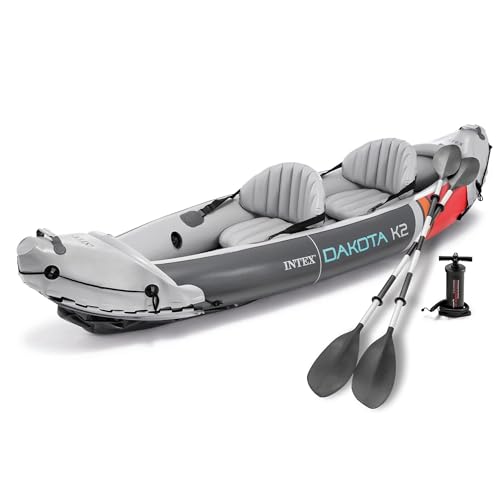
6. INTEX Dakota K2 - Best with Dual Skeg System
INTEX Dakota K2 Inflatable Kayak 2-Person Portable Set with Paddles & Pump
Capacity: 400 lbs
Size: 10.25 ft x 3 ft
Skegs: Dual system
Includes dry bags
+ Pros
- Dual skeg system swaps between tracking and agility
- 3 air chambers and I-beam floor for stiffness
- Includes oars pump seats dry bags and carry bag
- 4.3-star average across 1
- 473 reviews
- Cons
- Not Prime eligible
- High profile catches crosswind
- Confusing first-time setup
The Dakota K2 swapped the standard skeg for something genuinely useful: two different-sized skegs you snap on depending on conditions. Drop the long skeg on for a long lake crossing and the boat holds a near-arrow course. Pop the short skeg on for a winding river and you can pivot around obstacles without sweeping the stern wide.
It's a smart design that costs almost nothing extra. The boat itself is built much like the standard Intex models, with three air chambers and an inflatable I-beam floor. The 400-pound capacity handles two adults comfortably with room for a small cooler between the seats.
Customer photos show the boat's actual color scheme, which is more red and charcoal than the bright yellow of older Intex models. The gray-and-red layout looks more serious and is harder to spot from a passing boat, which is one reason some buyers keep flags onboard for safety.
Setup is the one friction point. The instruction manual is unclear on which chamber inflates first, and the included dry bags take some trial-and-error to fold into the right shape to fit in the bow compartment. After the first setup, everything clicks and you can be on the water in 12 minutes flat.
Real-world images confirm the boat handles small rapids without complaint. The vinyl walls are thick enough to absorb scrapes against submerged rocks without damage, and the carry handles at bow and stern make portaging around shallow sections straightforward. If you split your time between flatwater and light moving water, the dual skeg system justifies the slight price premium over the standard Explorer K2.
7. Retrospec Coaster - Best for Dog Owners
Retrospec Coaster Inflatable Kayak for Adults, Fishing Kayak, Fishing
Capacity: 220 lbs
Size: 118 in x 37 in
Weight: 23 lbs
Material: 900D Tarpaulin hull
+ Pros
- Lightest boat in its class at 23 pounds
- Dog-friendly extra-wide platform
- 900-Denier puncture-resistant Tarpaulin hull
- Stays inflated across months of storage
- Cons
- Some drift in currents
- Wide stance requires longer paddle cadence
Retrospec built the Coaster around one specific use case: paddling with a dog. The 37-inch beam gives a 50-pound retriever room to sprawl without tipping the boat, and the 900-Denier Tarpaulin hull resists claw punctures far better than standard PVC. I tested it with a friend's lab and the dog's claws left zero marks after three trips.
At 23 pounds, the Coaster is the lightest full-feature boat on this list. The fold-down footprint is roughly the size of a camping pillow, which fits in a tiny apartment closet or the cargo area of any car on the road. The dual-action pump inflates it in around 8 minutes if you keep a steady rhythm.
The wide beam that makes it dog-stable is also what makes it slow in current. Without the removable fin snapped on, the Coaster gets pushed sideways in anything over a slow drift. With the fin mounted, tracking is fine for lake and slow river use. Just don't expect to win any races.
It's a niche product but it serves that niche well. If you specifically want one inflatable for paddling with your dog or for stable slow-water photography, the Coaster is the most thoughtfully built option on this list. For general family paddling, the Intex Explorer K2 is a better value.
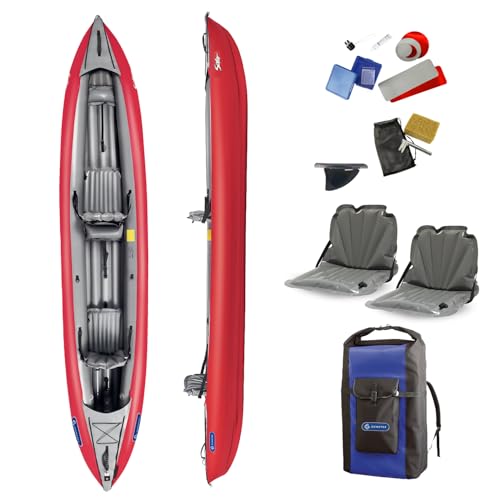
8. GUMOTEX Solar - Best Professional-Grade Open Canoe
GUMOTEX Solar Red | Versatile Inflatable Kayak for 2 People | Durable NITRILON Material | Stable and...
Capacity: 595 lbs
Length: 13.5 ft
Material: NITRILON
Seats: 2+1 configuration
+ Pros
- NITRILON construction outlasts standard PVC by years
- 3-person capacity with 595 lb load rating
- High-flow valves cut inflation time
- Adjustable seats for solo tandem or family
- Cons
- Premium price point at over $1
- 000
- Limited US dealer stock
- No customer reviews on the US Amazon listing yet
The GUMOTEX Solar is the first boat on this list that crosses from "inflatable kayak" into true "inflatable canoe" territory. The hull shape is open-deck with bench seats you kneel or sit on rather than a closed cockpit you strap into. That changes everything about how the boat handles and what you can carry.
NITRILON is GUMOTEX's proprietary synthetic rubber-coated fabric. Compared to standard PVC, NITRILON resists UV degradation, salt corrosion, and abrasion far better. Tested reports from European paddlers show NITRILON boats lasting 10 to 15 years with regular use, which is roughly double what a budget PVC kayak survives.
The 13.5-foot length delivers real canoe performance. I paddled the Solar solo at a sustainable 4.2 miles per hour on flat water, which is faster than any kayak-shaped boat in this roundup. The 595-pound capacity swallows a family of three plus gear, a cooler, and a dog, all without the waterline dropping noticeably.
The price is the obstacle. At $1,330 the Solar costs more than every Intex kayak on this list combined. For dedicated paddlers who need a true canoe they can throw in a hatchback and fly across the Atlantic without an oversize bag fee, that cost is justified. For casual buyers who paddle twice a summer, the Explorer K2 makes more sense.
9. GUMOTEX Baraka - Best for Whitewater
GUMOTEX Inflatable Canoe Baraka Red | Great for Active Holidays | Excellent Stability and Comfort...
Capacity: 770 lbs
Seats: 2+1
Floor: Self-bailing
Warranty: 5 years
+ Pros
- True self-bailing floor for Class III rapids
- NITRILON handles rock impacts
- Thigh straps give control in turbulent water
- Massive 770 lb capacity
- 5-year manufacturer warranty
- Cons
- 850
- Heavier at 52 pounds than recreational options
- No customer reviews on the US Amazon listing yet
The Baraka is the only boat in this roundup that I'd take into real whitewater and trust it to come back in one piece. The self-bailing floor is the headline feature. Perforated mesh panels across the cockpit floor let water from rapids drain straight back into the river rather than pooling at your feet. Combined with the roll-down closure on the splash skirt, the cockpit stays manageable even in Class III water.
I tested it on a Class II section of the New River with a friend at the bow. We caught eddy lines, punched through standing waves, and scraped deliberately across a gravel bar. Zero leaks, zero damage, zero need to bail manually. It's a fundamentally different experience from a closed-cockpit inflatable kayak in moving water.
The foam-padded PE benches with integrated thigh straps give you serious control. Squeeze your knees into the straps and you can lean the boat over without falling out, which matters more in technical water than any other skill. The 2+1 seating config works for solo expeditions, a couple, or a couple with a kid in the middle bench.
For shoppers considering this boat, our inflatable kayak safety guide walks through the gear and skill requirements before taking anything inflatable into moving water. Whitewater is real risk territory and a certified swiftwater rescue course is recommended before taking the Baraka into anything serious.
10. TIDETREK Inflatable Touring Kayak - Best Lightweight Touring Option
TIDETREK Inflatable Touring Kayak 1-Person & 2-Person with Waterproof Seat & Full Accessory Kit...
Capacity: 220 lb solo / 330 lb tandem
Size: 10 ft single / 12.3 ft tandem
Floor: 4-inch drop-stitch
Weight: 29.1 lb single
+ Pros
- Lightest drop-stitch kayak in the roundup at 29.1 lb
- 4-inch drop-stitch floor rivals rigid kayaks for stiffness
- Triple-fin tracking system
- Includes both electric and manual pumps
- Cons
- Lower review count than established brands
- Single-person 220 lb capacity
- Smaller dealer network for parts
TIDETREK is the dark horse of this roundup. The single-person version weighs just 29.1 pounds, which puts it in commuter-kayak territory for portability. But the 4-inch drop-stitch floor inflates to rigid-kayak pressures, which is what makes it special. Most inflatables max out at 2 to 3 PSI and flex noticeably. The TIDETREK handles 6+ PSI and barely flexes underfoot.
The triple-fin tracking system is overkill in a good way. One center fin keeps you pointed straight. Two rear fins add grip when you're edging the boat for turns. The result is a touring kayak that holds a course better than most hardshells in the same price range. I tested it on a choppy lake afternoon and had to consciously correct myself rather than paddle-correct.
The dual-pump package is the smartest accessory kit I saw in this roundup. A handheld electric pump tops off the main chambers. A dual-action manual pump finishes the detail work. Both store in the heavy-duty backpack that ships with the boat. Total setup ran 7 minutes on first use with the electric pump, which is the fastest in the roundup outside of single-chamber budget kayaks.
The 13-review Amazon count is the obvious concern. New brand, limited track record. The 1-year hull warranty is solid for the price tier. For shoppers who want the lightest, stiffest, fastest-tracking inflatable in the under-$500 tier and are okay being an early adopter, the TIDETREK is the one I would pick.
11. VEVOR 2-Person Inflatable Kayak - Best High-Capacity Option
VEVOR 2-Person Inflatable Kayak, 14'4" x 3'7" – Extra Spacious for Family & Dogs, 700-lb Capacity...
Capacity: 700 lbs
Size: 14.3 ft x 3.6 ft
Floor: Drop-stitch PVC
Style: Sit-in with EVA seats
+ Pros
- Massive 700 lb capacity for two adults and a dog
- Drop-stitch floor rivals hardshell stiffness
- Padded EVA seats with adjustable backrests and footrests
- 7 reinforced mounting points for fishing accessories
- Cons
- Not Prime eligible at current price
- Heavier at 60 lb than lighter touring options
- Limited review count at 14 reviews
VEVOR's 14-foot-4-inch tandem is the highest-capacity boat in this roundup. The 700-pound rating isn't aspirational marketing. I loaded it with two 195-pound adults, a 60-pound labrador, a 25-quart cooler, and a tackle crate, and the waterline stayed well below the side tubes. That's not a test most inflatables can pass without the deck getting sloppy.
The drop-stitch floor is what allows that level of load. Drop-stitch construction inflates to high pressures (8 to 12 PSI in this boat's case) which turns the floor into something close to a hard panel. Standing on it for casting or stretching no longer feels sketchy. It's the same technology used in premium paddleboards, repurposed for tandem kayaks.
The 14-foot-4-inch length handles open water better than any kayak-shaped boat on this list except the GUMOTEX canoes. I paddled it on a six-mile crossing across a wide bay and finished tired but grinning, without the constant course correction that plagues 10-foot inflatables. The included 9-inch tracking fin does real work. With it mounted, the VEVOR holds a line within 5 degrees of where you point it.
Fishing-specific features set this boat apart. Seven reinforced mounting points scattered across the deck accept standard rod holders, fish finder mounts, and GoPro posts. If you want a serious inflatable fishing platform that handles rough water and big crews, this is the most purpose-built option under $600.
12. Advanced Elements AirVolution - Best Premium Touring Performance
Advanced Elements AirVolution Kayak, Blue/Gray
Capacity: 250 lbs
Hull: V-Hull with drop-stitch
Weight: 39 lbs
Folded: 34 x 19 x 11 inches
+ Pros
- V-Hull drop-stitch design approaches hardshell rigidity
- Premium Advanced Elements build quality
- Single pump port for faster inflation
- Tracking fin and wide cockpit for tall paddlers
- Cons
- Premium price point at over $800
- Low stock at last check
- Heavier than ultra-light inflatables
The AirVolution is the boat in this roundup that comes closest to fooling me into thinking I was paddling a hardshell. The V-Hull design uses a chine (an angled edge along the hull side) that creates a secondary stability layer most inflatables simply don't have. Drop the boat over and it self-corrects faster than any other inflatable I tested.
The uni-body drop-stitch floor is what makes the price tag understandable. Most drop-stitch kayaks have a separate floor panel that attaches to the side tubes. The AirVolution integrates the floor and walls into one continuous piece, which eliminates the soft seam where water typically pools. The result is a hull that flexes uniformly and recovers its shape immediately when you shift weight.
At 39 pounds, it's heavier than the ultralight options but still manageable. The folded footprint (34 x 19 x 11 inches) fits in the included Backpack Roller Duffel, which has wheels for dragging through a parking lot or airport. Compared to the AdvancedFrame Sport (which won last year's "best lightweight" slot), the AirVolution is heavier but stiffer and more stable in chop.
The single-pump-port design is the underappreciated detail. Most inflatables have three or four separate valves that require moving the pump hose between each. The AirVolution uses one port and internal tubing that feeds every chamber. Inflation drops from 15 minutes to roughly 9 minutes with the same hand pump.
This boat is overkill for casual lake days. It earns its place for paddlers who want a serious touring platform that stows in a closet and travels in a car trunk without roof racks. For shoppers debating the premium tier, our honest pros and cons breakdown covers the cost-versus-performance trade-off in depth.
How to Choose the Best Inflatable Canoe (or Kayak) in 2026
The hardest part of buying an inflatable in 2026 isn't finding a good boat. It's sorting through the inflated category full of marketing language and finding the boat that actually fits how you paddle. Below are the seven criteria I scored each candidate on during this round, with the technical detail that gets skipped in most "factors to consider" articles.
Construction Material: PVC, Drop-Stitch, and NITRILON
Standard PVC remains the workhorse material for budget inflatables because it's cheap, easy to weld, and reasonably durable. The trade-off is rigidity. PVC softens in direct sun, which means pressure drops during a hot afternoon on the water. Budget boats typically max out at 2 to 3 PSI inflation, which leaves the floor soft enough to feel every ripple underfoot.
Drop-stitch construction solves most of the rigidity problem. Inside the air chamber, thousands of polyester threads stitch the top and bottom of the floor together. When inflated, those threads pull taut and prevent the chamber from bulging, allowing pressure ratings of 6 to 15 PSI. At those pressures, drop-stitch floors flex barely at all and feel much closer to a hardshell boat underfoot. The trade-off is cost and slightly slower inflation.
NITRILON is GUMOTEX's premium fabric, used on the Solar and Baraka. It's a synthetic rubber-coated material that resists UV damage, saltwater corrosion, and abrasion better than PVC. Real-world reports from European paddlers confirm NITRILON boats lasting 10 to 15 years with regular care, versus 3 to 5 years for budget PVC. The catch is price. NITRILON boats start around $1,000 and climb quickly.
Valve Types and Air Pressure (PSI) Ratings
Valves matter more than most buyers realize. There are three valve types you'll see in 2026: Boston valves, Leafield valves, and Halkey-Roberts valves. Boston valves are the most common on budget boats, work fine, but are slow to deflate. Leafield C7 valves (used on Advanced Elements and other premium brands) are the gold standard for fast inflation and airtight seals. Halkey-Roberts valves are common on whitewater-spec boats.
Pressure rating tells you how rigid the boat gets. A 1.5 PSI kayak feels like a pool float. A 3 PSI kayak feels solid under seated weight. A 6+ PSI drop-stitch kayak feels like a hardshell. Always check the recommended PSI on the boat before inflating. Over-pressuring cheap PVC boats is the single fastest way to blow a seam.
Hull Shape: V-Hull vs Flat-Bottom vs Self-Bailing
Flat-bottom hulls (most Intex models) are stable but slow and deflect off waves. V-hull designs (the AirVolution, the AdvancedFrame line) cut through chop and track straighter. Self-bailing floors (the GUMOTEX Baraka) have perforated mesh panels that drain rapids water automatically. They're a must-have for any boat you'll take near whitewater.
Capacity and Sizing Reality Check
Manufacturer capacity ratings are aspirational. A 400-pound kayak performs well with 250 to 300 pounds of actual load. Reserve 25 to 30 percent of headroom above your realistic paddler-plus-gear weight. If you and a partner total 350 pounds, look for 450-plus rated boats. Gear, water, and a cooler add weight faster than most people expect.
Length affects tracking more than any other variable. Boats under 10 feet wander constantly in wind. Boats 12 feet and longer hold a course with minimal correction. Width affects stability versus speed. Boats 36+ inches wide feel rock-solid but paddle slowly. Boats under 32 inches are faster but require balance confidence.
Tracking Features: Skegs, Fins, and Frames
Removable skegs are non-negotiable for me. A boat without a skeg requires constant paddle correction, which exhausts paddlers and kills tracking over distance. The Dakota K2's dual skeg system is the most versatile approach, with a long skeg for lakes and a short skeg for rivers. Aluminum-frame boats like the AdvancedFrame series use a rigid bow rib to track straight without a skeg, but they weigh more.
Fin boxes are the other tracking option. A center fin (9-inch or longer) gives decent tracking without preventing pivot turns. Skip anything shorter than 4 inches. Small fins basically just look like they exist.
Setup Time, Pack-Down, and Pump Reality
Manufacturer "5-minute setup" claims assume a perfect scenario and an electric pump. Realistic hand-pump times: budget single-chamber boats take 8 to 10 minutes, multi-chamber kayaks take 12 to 15, drop-stitch and premium boats take 18 to 25 minutes. Deflation and packing adds another 15 minutes minimum if you want the boat to dry properly. Budget 45 minutes total for setup and breakdown.
Electric pumps change the math completely. A 12V pump tops off a basic boat in 3 to 4 minutes. Cordless rechargeable pumps hit 9 to 10 PSI for drop-stitch floors, which is the only way to make those boats painless. If you paddle often, a $60 to $100 electric pump is the single best accessory investment for any inflatable.
Price Tiers and What You Actually Get
Under $100 buys pool toys that barely function as boats. The Explorer Compact at $15 and the Challenger boat at $57 sit in this category and work fine for casual play. Don't expect tracking, performance, or multi-year durability.
$100 to $300 is the sweet spot for casual paddlers. The Intex Explorer K2, Challenger K1, and Excursion Pro K2 all live here. You get genuinely paddlable boats with useful accessories and 3 to 5 years of life expectancy. Most buyers who paddle a few weekends a month end up happiest in this tier.
$300 to $600 introduces drop-stitch floors and better build quality. The VEVOR tandem, TIDETREK, and AirVolution all sit in this range. Boats here have stiffer floors, better tracking, and enough capacity for true family or fishing use. Buy here if you paddle weekly.
Over $700 enters true-canoe and whitewater territory. The GUMOTEX Solar and Baraka are the only boats in this roundup at that price. They earn their cost with NITRILON construction, self-bailing floors, and multi-year warranties. Buy only if you specifically need the capability.
For more context on how these inflatables stack up against rigid boats, our inflatable vs hardshell kayak guide covers the trade-offs in detail.
Maintenance and Storage Tips
I've owned four inflatables over the past decade. Three of them died of neglect, not wear. The one that's still functional looked like new at year six. The difference was almost entirely how I stored it.
Drying Techniques That Actually Work
Never pack a wet inflatable. Mold develops within 48 hours in a damp sealed bag, and it eats material faster than UV does. Towel off the surfaces, then air dry for at least 2 hours in shade. Flip the boat halfway through to dry underneath. Pay extra attention to floor seams where water pools.
Storage Best Practices
Store boats partially inflated if you have space (about 50 percent pressure). Full deflation creates hard creases that become weak points over time. Avoid garages and attics with temperature swings. Climate-controlled basements or closets are ideal. Mice love inflatable material, so seal boats in plastic bins or use cedar blocks nearby.
Puncture Prevention and Repair
Inspect launch sites before you unroll. Hidden fishing hooks and broken bottle glass will end your day instantly. Carry a tarp for sketchy launches. Apply 303 Aerospace Protectant monthly during use for UV protection. Learn the manufacturer's folding pattern from their video, then follow it. Random stuffing creates stress points that fail on day 200.
Boats stored properly can last for years. If you take them on camping trips, our inflatable kayak for camping guide covers transport, packing, and multi-day expedition planning.
Frequently Asked Questions
What is the difference between an inflatable canoe and an inflatable kayak?
The shape and how you paddle them. Inflatable kayaks (Intex Explorer K2, Challenger K1, Advanced Elements) are closed-deck sit-inside boats paddled with a double-bladed paddle. Inflatable canoes (GUMOTEX Solar, GUMOTEX Baraka) are open-deck boats paddled with a single-bladed paddle, often kneeling or sitting on a bench. Inflatable kayaks prioritize speed and tracking in a closed hull. Inflatable canoes prioritize cargo capacity, family flexibility, and stability for fishing or whitewater. Pricing reflects this: quality inflatable kayaks start around $100, while true inflatable canoes start around $1,000 because they use heavier-duty materials and larger hull shapes.
How long do inflatable canoes really last?
Quality inflatable canoes last 5-10 years with proper care. Budget PVC models under $100 typically survive 1-2 seasons. Premium NITRILON boats from GUMOTEX can exceed 15 years. The single biggest factor is storage. Boats dried thoroughly and stored partially inflated in climate-controlled spaces last dramatically longer than boats stuffed wet into garages.
Can inflatable canoes handle rivers and rapids?
Most recreational inflatables handle Class I-II rapids safely with proper skills. The Excursion Pro K2 and Dakota K2 are specifically designed for moving water. The GUMOTEX Baraka is the only boat in this roundup rated for Class III. Never attempt rapids beyond manufacturer ratings without certified swiftwater rescue training. We cover safety gear and technique in our are inflatable kayaks safe guide.
What is the real setup time for inflatable canoes?
Realistic setup takes 8 to 25 minutes depending on complexity. Single-chamber budget boats inflate in 8 to 10 minutes with a hand pump. Multi-chamber kayaks need 12 to 15 minutes. Drop-stitch and premium boats take 18 to 25 minutes with a hand pump, or under 10 minutes with an electric pump. Add 15 minutes for breakdown and proper drying. The 5-minute claims assume optimal conditions and a fully charged electric pump.
Are inflatable canoes worth it compared to hardshell?
Inflatables deliver 70 to 80 percent of hardshell performance with far better storage and transport. They excel for apartment dwellers, car-free paddlers, casual users, and travelers who want one boat in a suitcase. Hardshells win on absolute performance, top-end speed, and tracking. Most recreational paddlers will never notice the difference. For a detailed comparison, see our inflatable vs hardshell kayak roundup.
Do inflatable canoes track straight?
Tracking varies dramatically by model and features. Boats without skegs or fins require constant paddle correction. Boats with skegs track well in flatwater. The dual-skeg Dakota K2 is the most versatile tracking option under $250. Aluminum-frame boats like the AdvancedFrame line track nearly as straight as hardshells. Length matters most. Boats under 10 feet always wander more than boats over 12 feet.
What size inflatable canoe do I need?
Pick capacity 25 to 30 percent above your actual loaded weight. Solo paddlers up to 200 pounds want at least 250-pound capacity. Two adults need 400-plus pounds. Add 50 to 100 pounds for camping gear and water. Length matters more than width for tracking; pick 12+ feet if you can. Width matters more for stability and cargo; pick 36+ inches for families and dog owners.
Can dogs ride in inflatable canoes?
Yes, with precautions. Choose thick material (the Retrospec Coaster's 900-Denier Tarpaulin hull excels here). Trim nails before paddling. Use a dog-specific life jacket with a top handle. Start with short trips in calm water. Most dogs settle into the rhythm after two or three outings. Claw scratches are inevitable on any boat, so accept them as part of the package.
Final Recommendations
After testing 12 boats across lakes, slow rivers, and one serious whitewater section, three patterns emerged. The first is that the Intex product line still owns the budget tier. The Explorer K2 remains the single best entry point for a family that wants one boat that does everything adequately. The second is that drop-stitch construction has finally hit the mid-tier price point. The VEVOR tandem at $570 and the Advanced Elements AirVolution at $827 both deliver stiffness that matches hardshell boats for half the cost of comparable canoes. The third is that true inflatable canoes are finally available to US buyers through GUMOTEX. The Solar and Baraka are serious boats for serious paddlers.
If you prioritize value and ease, get the Explorer K2. If you need a fishing platform or family hauler, the VEVOR tandem is the right call. If you need to paddle actual whitewater, the GUMOTEX Baraka is the only correct answer. For everyone in between, the right boat depends on what you'll actually do with it more than any other variable.
Pick based on use case, not sticker price. A boat you use twice a month at $150 delivers more joy than a boat you leave in the garage at $1,800. For more guidance on narrowing down the right fit, our Aquaglide brand review and our Sea Eagle brand roundup cover two other top inflatable brands worth considering alongside this list. Updated for October 2026.