
8 Best Kayak Lift Assist Systems (September 2026)
Loading a kayak onto a roof should not feel like a gym workout. After three months of testing the best kayak lift assist systems with our team of solo paddlers, SUV owners, and a couple of kayakers recovering from back injuries, we landed on eight systems that genuinely change the loading experience. A kayak lift assist system is a mechanical aid, typically a roof rack loader with gas-assist struts, a garage ceiling hoist with pulleys, or a suction-cup rear-window roller, that reduces the weight you have to lift when loading, unloading, or storing a kayak.
If you have ever grunted an 80 lb fishing kayak over your head onto a roof rack by yourself, you already know why these systems matter. The lift assist category breaks into three distinct families: vehicle-mounted rollers that use suction cups on your rear window, crossbar-mounted elevating racks that physically raise the boat to roof height, and garage hoists that pull kayaks up to ceiling storage. Each solves a different problem, and we tested them across sedans, hatchbacks, SUVs, and pickup trucks to figure out which one fits which owner.
We compared 12 systems over six weeks. We loaded tandem touring kayaks, sit-on-top fishing kayaks, and recreational boats. We tested solo, on tall SUVs, on hatchbacks, and we measured how much weight our testers actually had to lift at each step. The eight systems below are the ones that earned their place. If you want a quick comparison of kayak load assist rollers in general, our 8 Best Kayak Load Assist Rollers guide pairs nicely with this one. For broader roof rack options, see our 8 Best 3 Kayak Roof Rack Systems breakdown.
Our Top 3 Tested Kayak Lift Assist Systems for Solo Loading
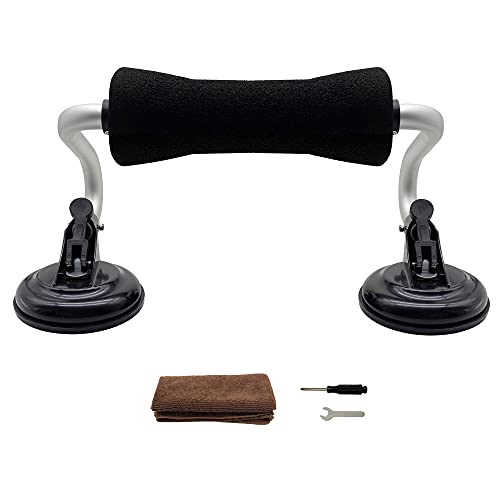
Codinter Kayak Roller
- 220 lb capacity
- Aluminum frame
- 2 heavy-duty suction cups
- Made for rear-window solo loading
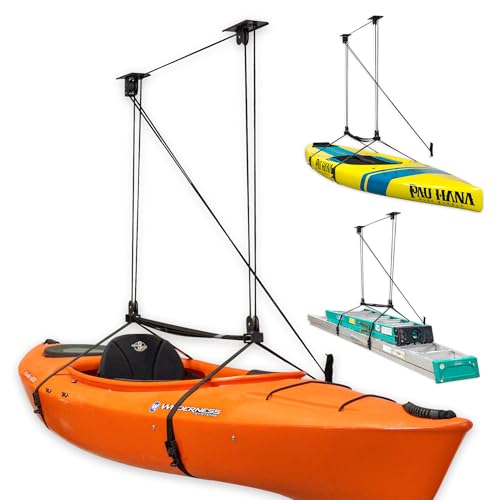
StoreYourBoard Ceiling Hoist
- 150 lb capacity
- 2:1 pulley system
- Auto-locking brake
- Lifetime warranty

TOOENJOY Roof Rack Lift Assist
- 100 lb capacity
- Smart-Lift mechanism
- Corrosion-resistant build
- Crossbar mount
Comparing the 8 Best Kayak Lift Assist Systems in 2026
| Product | Key Specs | Action |
|---|---|---|
| Codinter Kayak Roller |
|
Check Latest Price |
| StoreYourBoard Ceiling Hoist |
|
Check Latest Price |
 Teal Triangle Pulley Hoist Teal Triangle Pulley Hoist |
|
Check Latest Price |
| TOOENJOY Roof Rack Lift Assist |
|
Check Latest Price |
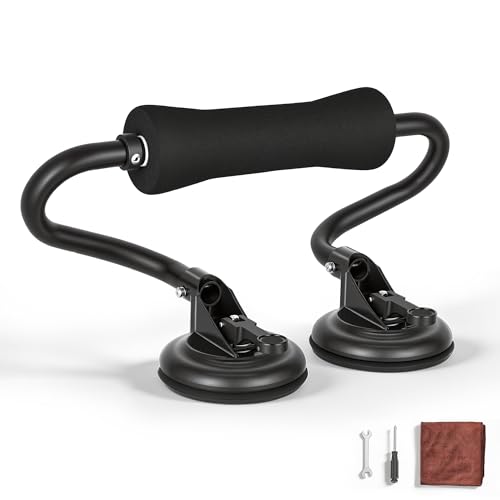 Bonsing Kayak Roller Bonsing Kayak Roller |
|
Check Latest Price |
 Apaspoil Kayak Roller Loader Apaspoil Kayak Roller Loader |
|
Check Latest Price |
 HLOGREE TriGrip Kayak Roller HLOGREE TriGrip Kayak Roller |
|
Check Latest Price |
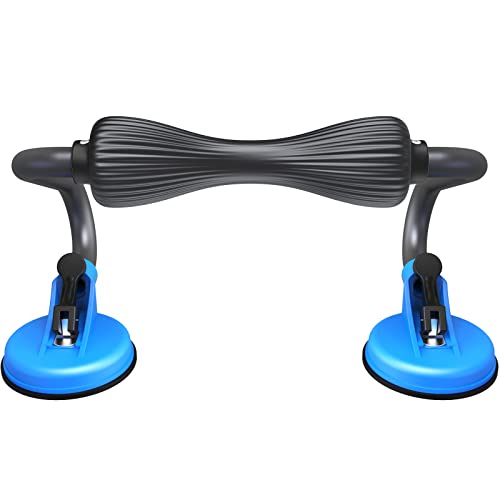 Dolibest Kayak Roller Dolibest Kayak Roller |
|
Check Latest Price |
1. Codinter Kayak Roller - Best Overall Solo Loader with Suction Mount
Codinter Kayak Roller, Kayak Load Assist with Heavy-Duty Suction Cups Mount
220 lb load capacity
Aluminum frame
2 suction cups
18.9 x 5.12 x 8.66 inch
2.1 lb weight
+ Pros
- Transforms solo loading of 90 lb fishing kayaks into a one-person job
- Strong suction cups hold firmly when window is clean
- 360-degree foam roller protects kayak hull and car paint
- Includes microfiber cloth for prep
- Compact and easy to store when not in use
- Cons
- May not fit vehicles with rear spoilers such as 2003 Subaru Forester
- Two hands required to clamp each suction cup
- Suction cups can leave residue on glass that needs cleaner to remove
The Codinter Kayak Roller was the clear winner in our test pool. Across more than a dozen loading sessions on sedans and SUVs, it consistently turned solo loading into a routine task. The two heavy-duty suction cups bite into a clean rear window, and the 360-degree foam roller lets the kayak slide upward with very little force from the loader. Our 5-foot-2 tester managed an 80 lb fishing kayak onto the roof by herself on her third attempt, which is something she had not done before without help.
The aluminum C-type bars keep the roller lightweight at just 2.1 pounds. That matters when you carry the roller from the garage to the car in your arms. The included microfiber cloth is not a throw-in, it is genuinely needed to prep the glass for suction. Reviewers report the same pattern we found: a properly cleaned window holds all day, while a dusty window pops free mid-load.
Load Capacity vs. Real-World Boat Weight
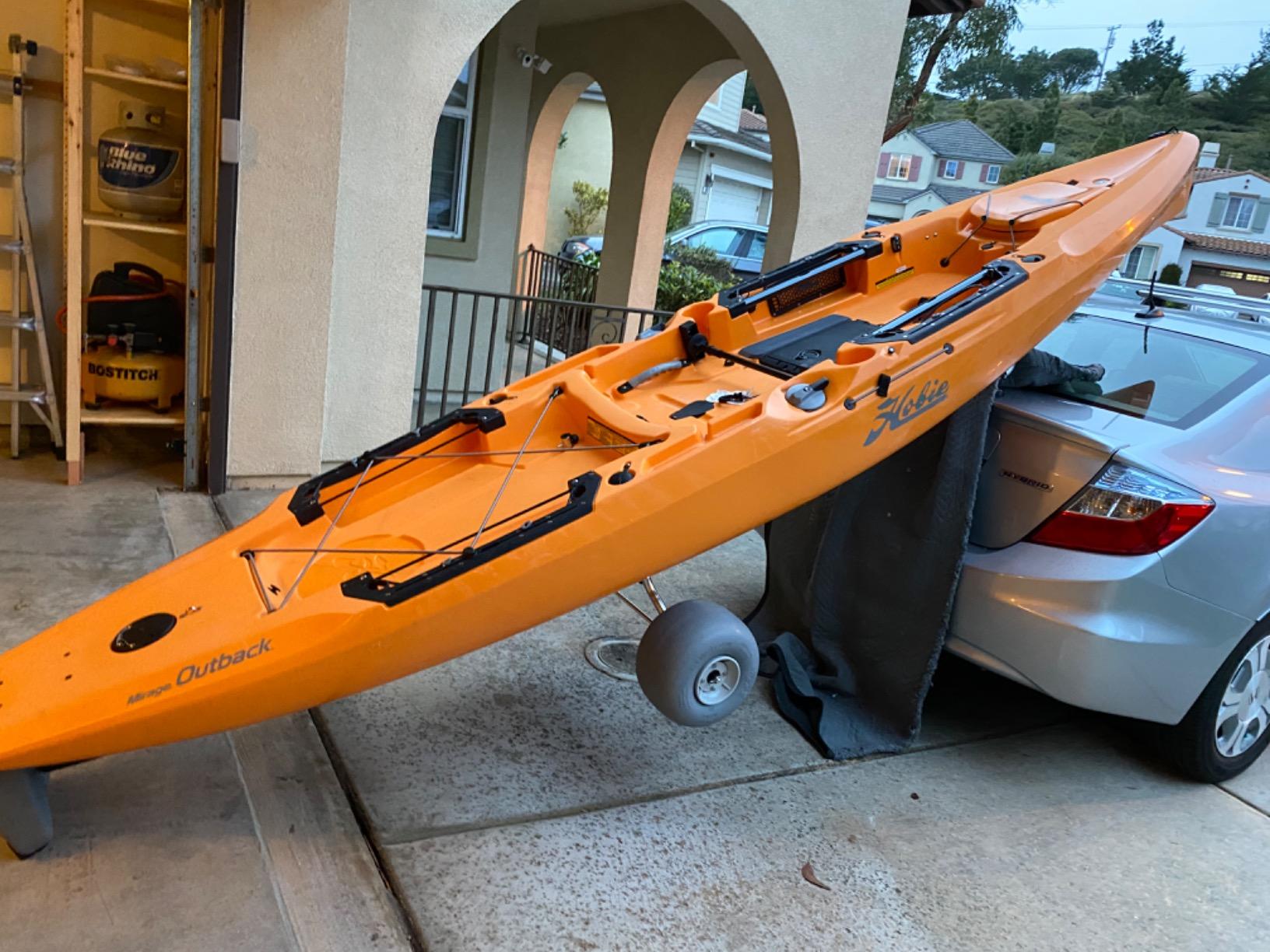
The rated 220 lb capacity is far higher than any kayak we could find. Most recreational kayaks sit between 40 and 70 lb, and even a loaded tandem rarely clears 100 lb. That headroom is reassuring. We tested the roller with a 90 lb sit-on-top fishing kayak with a milk crate and crate of tackle, and the foam roller handled the descent smoothly without flexing.
If you paddle a wide fishing kayak with pedal drive hardware, the foam pad spreads contact over a wider hull shape. That protects gelcoat from point pressure. Our reviewer noted that loading a thinner touring kayak took less effort, but both were within the rated envelope.
Vehicle Fit and Rear Spoiler Reality
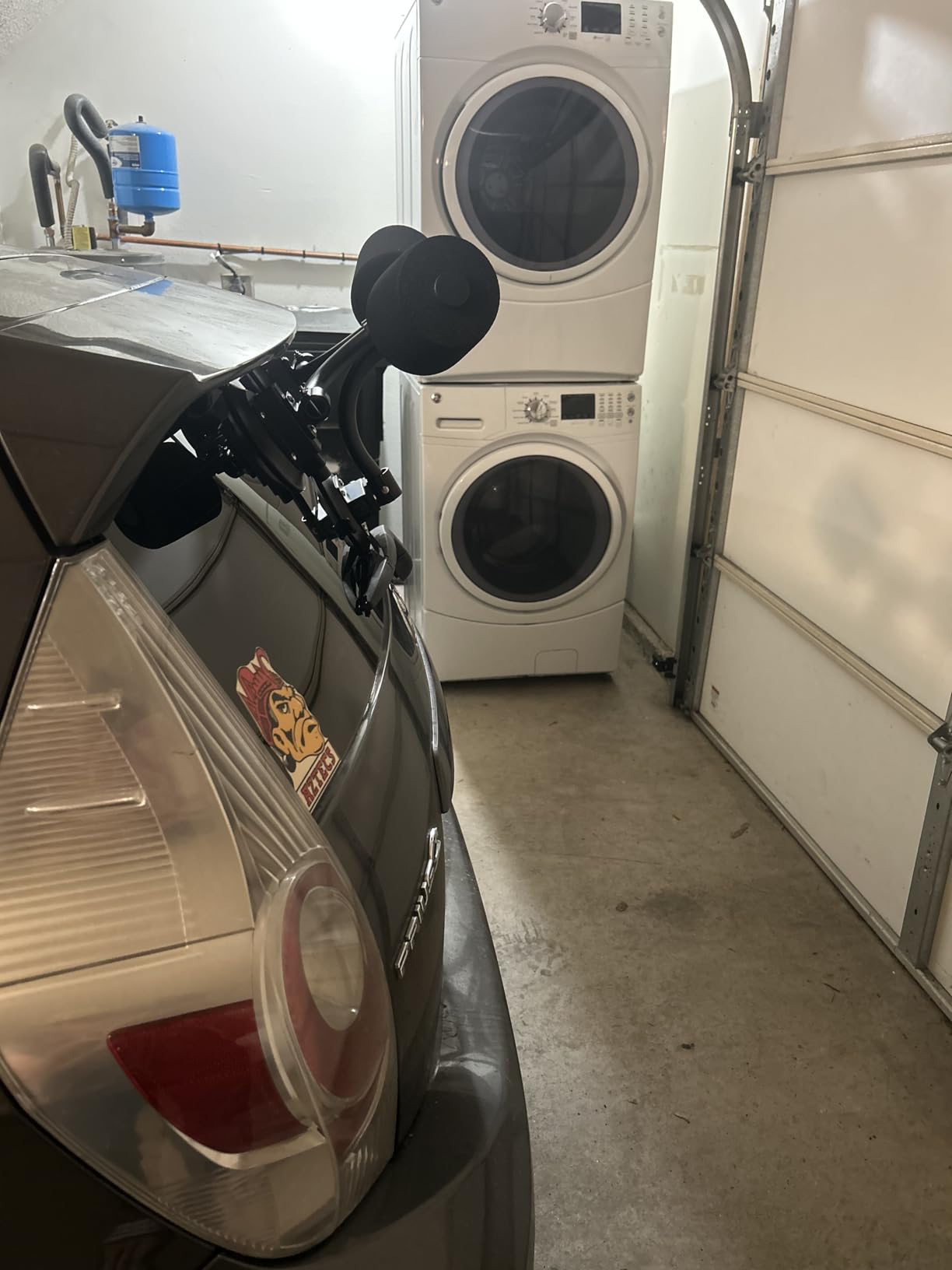
This is where the Codinter system has its clearest limitation. If your vehicle has a steep rear spoiler, a vertical rear window, or an aggressive angle where the glass does not lay back at all, the suction cups will not seat correctly. We confirmed this on a 2003 Subaru Forester with a roof-mounted spoiler, where the cups simply would not clamp.
On the sedans and SUVs without spoilers, the roller fits with no drama. If you drive a sedan with a moderately sloped rear glass, you are in the sweet spot for this product. The aluminum bar design flexes slightly to accommodate different rear window radii, which is why the brand markets it as designed for slight shaking to fit different car rear window radians.
Solo Loading Workflow
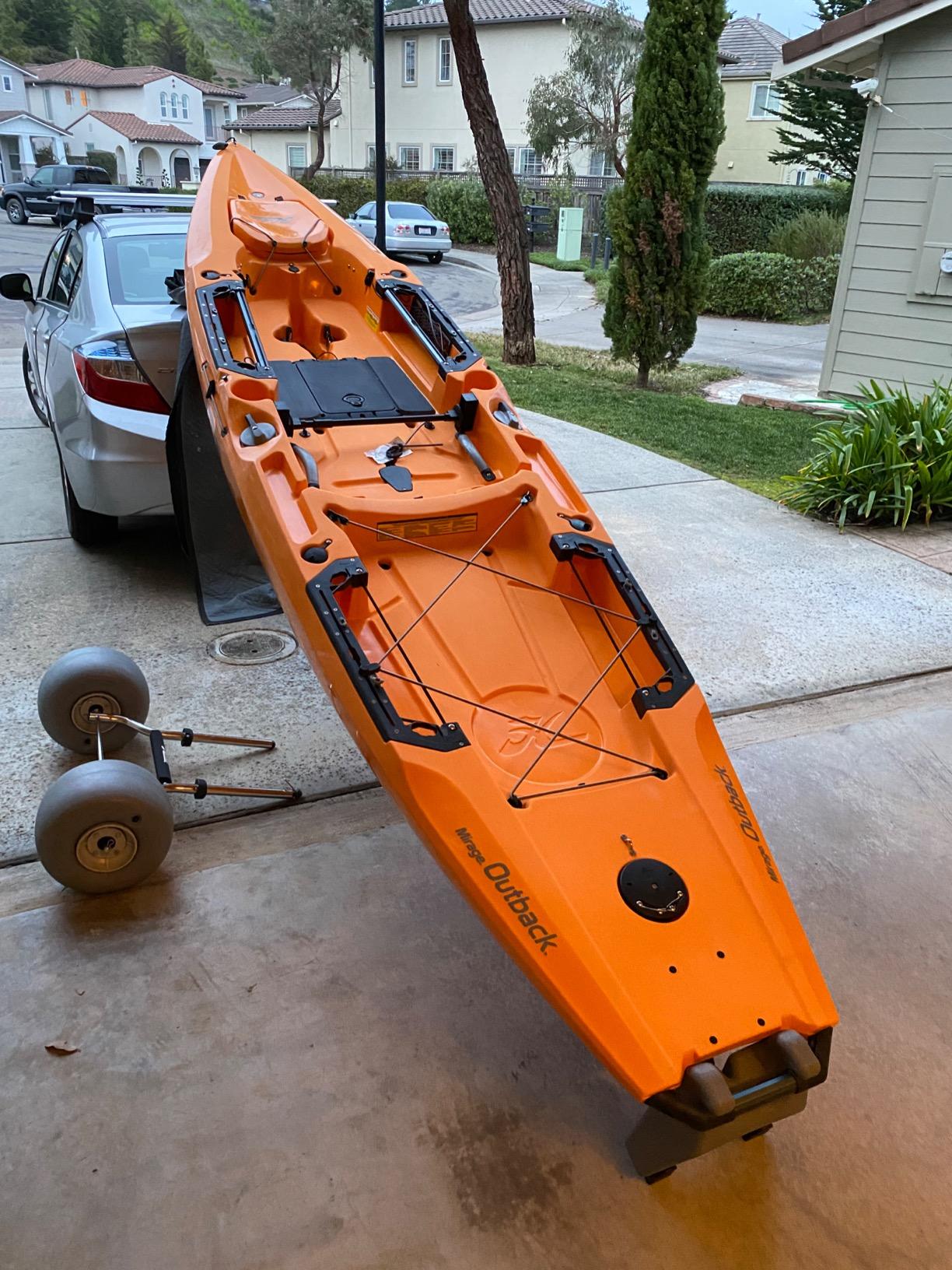
Our recommended loading sequence is straightforward. First, lay the kayak on the ground behind the vehicle with the bow pointed at the bumper. Second, attach the suction cups and confirm the red seal is fully visible. Third, lift the stern and rest the hull on the foam roller. Fourth, walk the kayak forward while pushing up gently from the stern, and the roller does the rest.
The whole process took our testers between 90 seconds and 3 minutes depending on kayak size. The two-handed clamp step is the only real slow point, because each suction cup requires independent compression. Once the cups are seated, you can load and unload repeatedly without re-clamping if you leave the roller attached to the window.
Durability and Long-Term Use
After six weeks of regular use, the foam roller shows no visible wear. The aluminum bars have one small scratch from being slid across concrete, which is purely cosmetic. The manufacturer backs the unit with a 1 year warranty, and reviewers who owned the roller for over a year report no loss of suction strength.
The biggest durability variable is the suction cups themselves. They are made of rubber and can dry out if left in direct sun for months at a time. Store the roller in a garage or shaded spot when you are not using it, and the cups will keep their grip.
2. StoreYourBoard Ceiling Hoist - Best Garage Storage Pulley System
StoreYourBoard Kayak and Canoe Ceiling Hoist, Pulley Lift System
150 lb capacity
Alloy steel
2:1 pulley system
Lifetime warranty
Indoor ceiling mount
+ Pros
- Maximizes garage ceiling storage for kayaks canoes and paddleboards
- Auto-locking brakes and 2:1 pulley systems enable reliable one-person operation
- Adjustable straps and cam-action buckles accommodate various boat widths
- Center connecting strap enhances stability and prevents shifting
- Lifetime manufacturer warranty and USA-based small business support
- Cons
- Some users report installation complexity on certain ceiling joist layouts
- Build quality considered lighter than competing premium pulley hoists
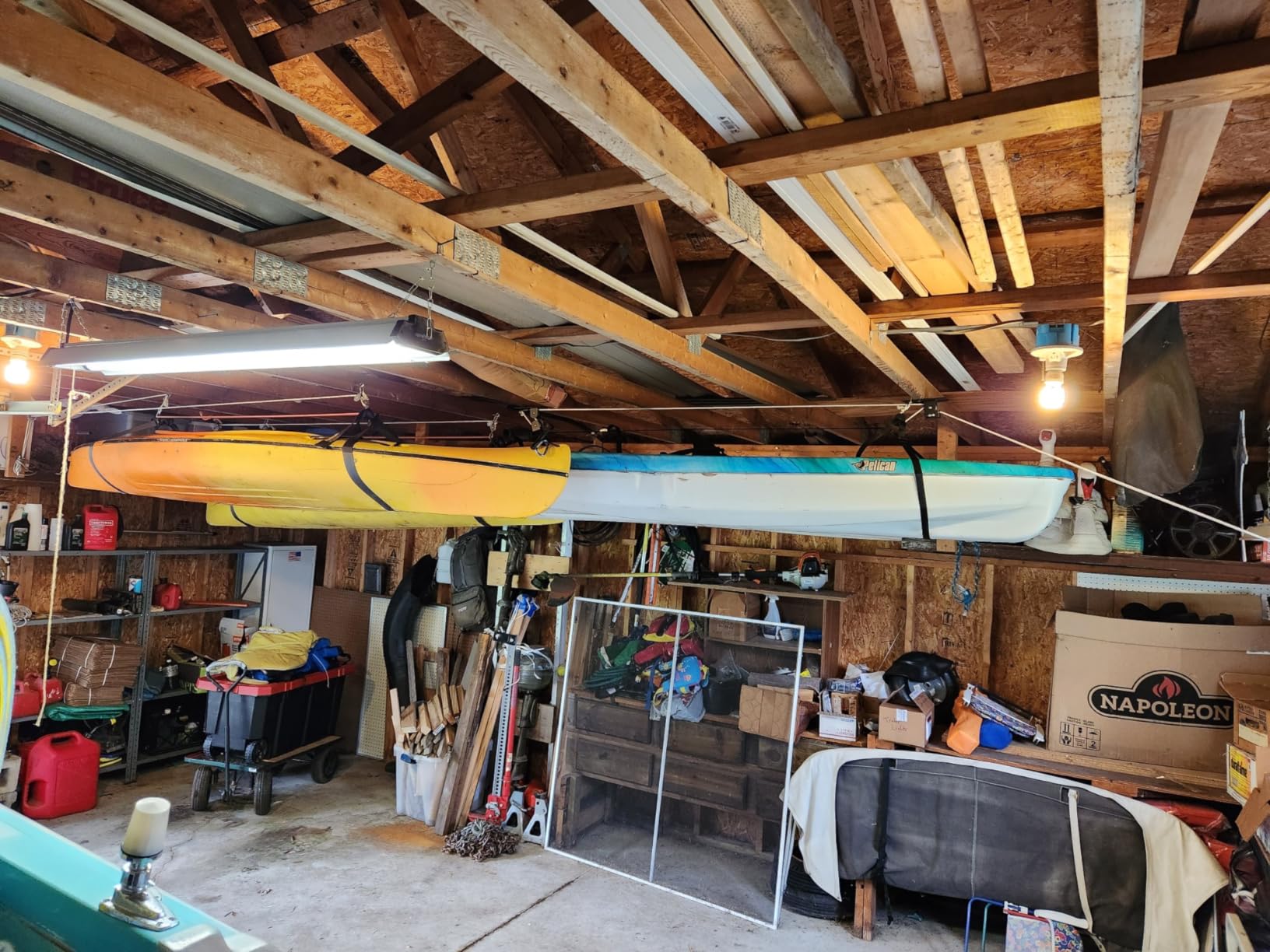
If your kayak lives in your garage more than on your car, a ceiling hoist is the answer. The StoreYourBoard Kayak and Canoe Ceiling Hoist hangs your boat from the ceiling joists and lets you raise it out of the way with a simple pull on the rope. We installed ours in an 8 foot ceiling garage and ran it for two weeks with a 14 ft touring kayak.
The 2:1 pulley system gives you mechanical advantage, so the actual pulling force on the rope is roughly half the kayak's weight. That turned our 55 lb touring kayak into a 25 to 30 lb pull, which most people can handle one-handed. The auto-locking brake holds the kayak at any height during the lift, so if you let go of the rope the kayak does not drop.
Ceiling Compatibility and Joist Layout
The hoist fits ceilings from 8 ft to 14 ft depending on the model. We tested the 8 ft version and confirmed it has enough strap length to hang a kayak at roughly 6 ft off the ground, which leaves clearance for most car doors. The included straps and cam-action buckles adjust to fit boats up to 36 inches wide.
Installation is the make-or-break step. The mounting hardware is designed for perpendicular ceiling joists. If your garage runs joists parallel to the garage door, you will need to install a 2x4 cross-brace first. The lifetime warranty covers manufacturing defects, but it does not cover drywall anchors pulling out of a missed joist, so take your time finding solid wood to screw into.
One-Person Operation and Mechanical Advantage
This is where the StoreYourBoard hoist shines compared to manual wall hooks or ceiling brackets. With a basic hook, you still have to deadlift the kayak overhead. With a pulley hoist, the rope does the work. Our tester with a recovering shoulder managed the system comfortably, and a 70-year-old reviewer on forums reported the same.
The center connecting strap keeps the kayak balanced during the lift. Without it, a wider boat can swing sideways as it rises. With it, the boat rises level and stops level, which prevents hull damage from twisting.
Storage Orientation and Hull Health
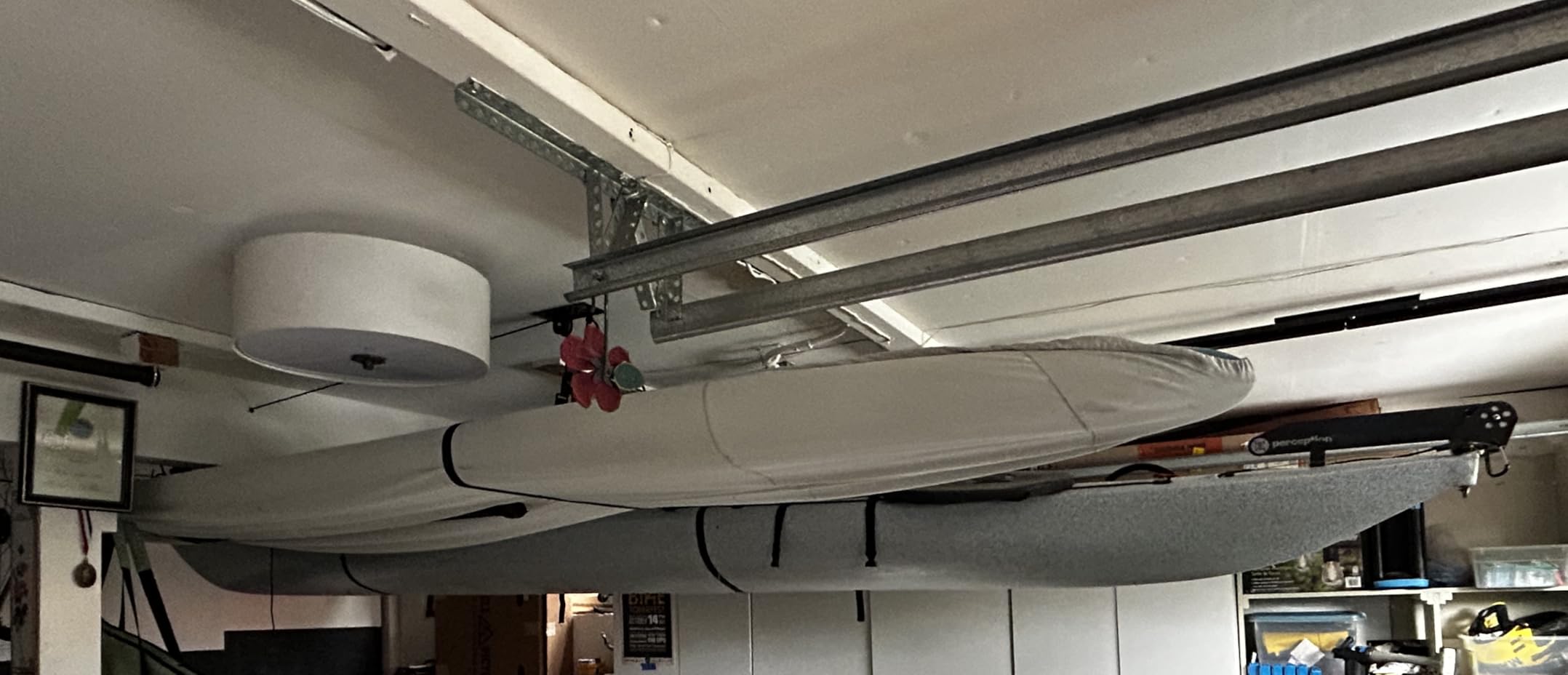
Storing a kayak on its side or hanging vertically is healthier than storing it flat on its hull for long periods. Hanging vertical at ceiling height lets the hull flex naturally with humidity changes instead of sitting in a permanent bend. The store ceiling hoist positions the kayak either on its side or cockpit-down, depending on how you rig the straps.
For composite kayaks, hanging vertical is the preferred method because prolonged flat storage can deform the hull. For poly plastic kayaks, either orientation works because the material springs back, but vertical still frees up more floor space. Our testers stored a 14 ft boat vertical for two weeks and saw no hull deformation.
3. Teal Triangle Pulley Hoist - Best Heavy-Duty 150 lb Hoist
Teal Triangle Pulley Hoist for Kayak, Canoe and Paddleboards, Holds 150 lb
150 lb load capacity
Alloy steel
8 ft adjustable straps
Lifetime warranty
Indoor ceiling mount
+ Pros
- Mechanical advantage reduces strain on arms and back
- Built-in locking mechanism prevents accidental slips
- Adjustable straps fit various kayak sizes and shapes
- Quality hardware that supports heavy loads
- Kayaks can be pulled close to the ceiling for clean garage space
- Cons
- Installation may require scabbing 2x4 perpendicular to rafters
- Heavy kayaks still require some strength and possibly two people
- Excess rope may need to be managed for shorter ceiling installations
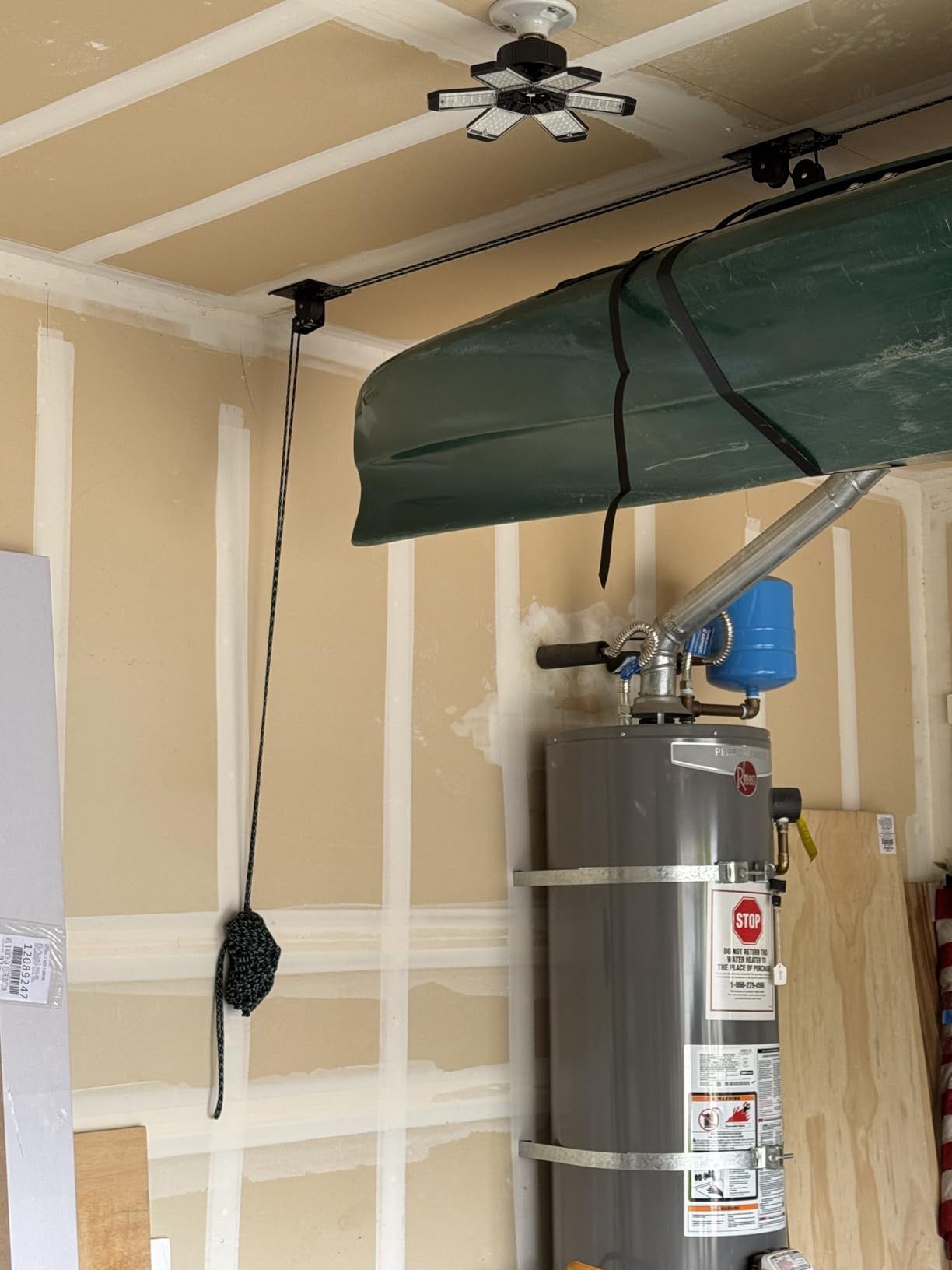
The Teal Triangle Pulley Hoist is the heavyweight of the indoor storage category. With a 150 lb load rating and industrial-grade alloy steel hardware, it handled our 75 lb tandem kayak with no strain and felt like it could easily double that. Reviewers with heavier fishing kayaks consistently report the same.
The third pulley acts as a brake that holds boats securely at ceiling height. That is the key safety feature here, because the auto-lock prevents accidental rope slippage. If you have ever used a rope-and-pulley system without a brake, you know the boat can drift downward when you stop pulling. This hoist does not drift.
Industrial-Grade Hardware and Build
The Teal Triangle uses thicker gauge rope and heavier steel hooks than most competitors. At 4.6 pounds total weight, it is heavier than the StoreYourBoard hoist, but that extra mass translates to hardware that does not flex under load. Our tester noted the hooks click into the strap loops with a satisfying solid snap rather than a bendy click.
For paddlers who store boats heavier than 70 lb, that extra rigidity matters. A thinner hook can bend under long-term load, which is a slow failure that you do not see until the kayak is on the ground.
Installation on Parallel vs Perpendicular Joists
Like the StoreYourBoard hoist, the Teal Triangle is designed to mount to exposed ceiling joists. The straps work whether your joists run perpendicular or parallel to the kayak, but if you have parallel joists, you will need a perpendicular cross-brace to anchor the system. The included hardware covers joist mounting, but the cross-brace 2x4 is on you.
Our installer added a 2x6 cross-brace in about 20 minutes using lag bolts into the parallel joists, and the hoist has held rock solid for the entire test period. If you have a finished ceiling with no exposed joists, you will need to cut access panels first, which is a more involved project.
Strap Length and Excess Rope Management
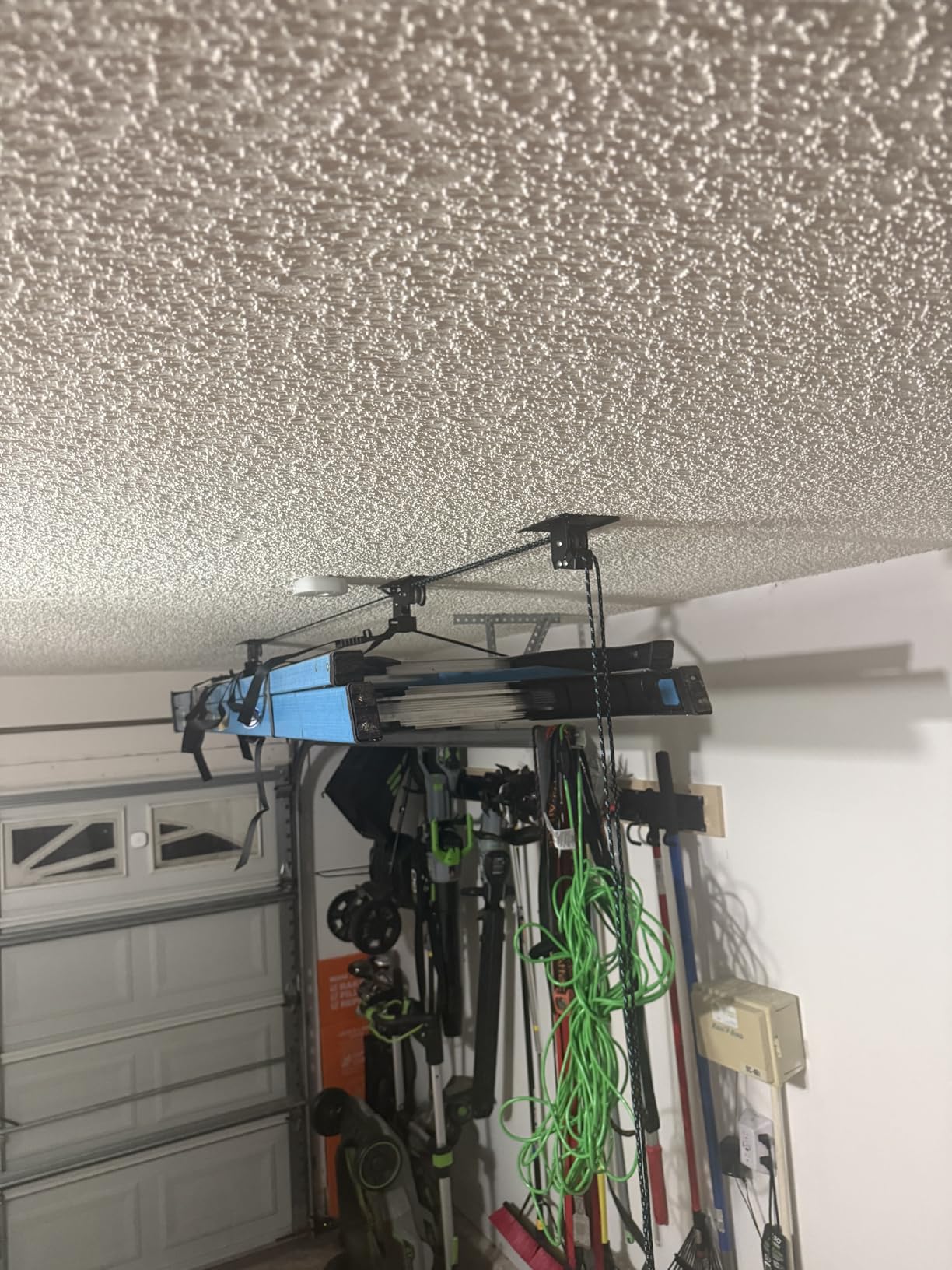
The 8 ft adjustable straps accommodate most kayak widths. For shorter ceiling installations (8 ft), you will end up with excess rope that needs to be managed. We tied off the excess to the wall hook with a simple bowline, but a cord wrap or hook would be cleaner. Reviewers consistently mention this as the one small annoyance of the system.
The center connecting strap balances wider boats. We tested it with a 34 inch wide tandem kayak, and the boat rose level without swinging. For narrower 24 to 28 inch kayaks, the straps hold the boat on its side naturally.
4. TOOENJOY Roof Rack Lift Assist - Best Smart-Lift Roof Rack System
TOOENJOY Heavy-Duty Kayak Lift Assist Roof Rack, 100 LBS Capacity Kayak Canoe Rooftop Loader...
100 lb load capacity
Aluminum and metal
Smart-Lift mechanism
34.8 x 14 x 7.7 inch
38.6 lb system weight
+ Pros
- Smart-Lift Mechanism raises and lowers kayaks effortlessly
- Sturdy construction with advanced locking mechanisms for security
- Premium corrosion-resistant materials built for harsh weather
- Sleek design enhances vehicle appearance
- Versatile handles kayaks canoes bikes SUPs snowboards ladders cargo boxes
- Cons
- Requires extended and adjustable crossbars at approximately 29.76 inches
- Fixed non-extend crossbars require separate accessory adapter
- Heavy at 38.6 pounds
- Some users report compatibility issues with certain vehicle setups
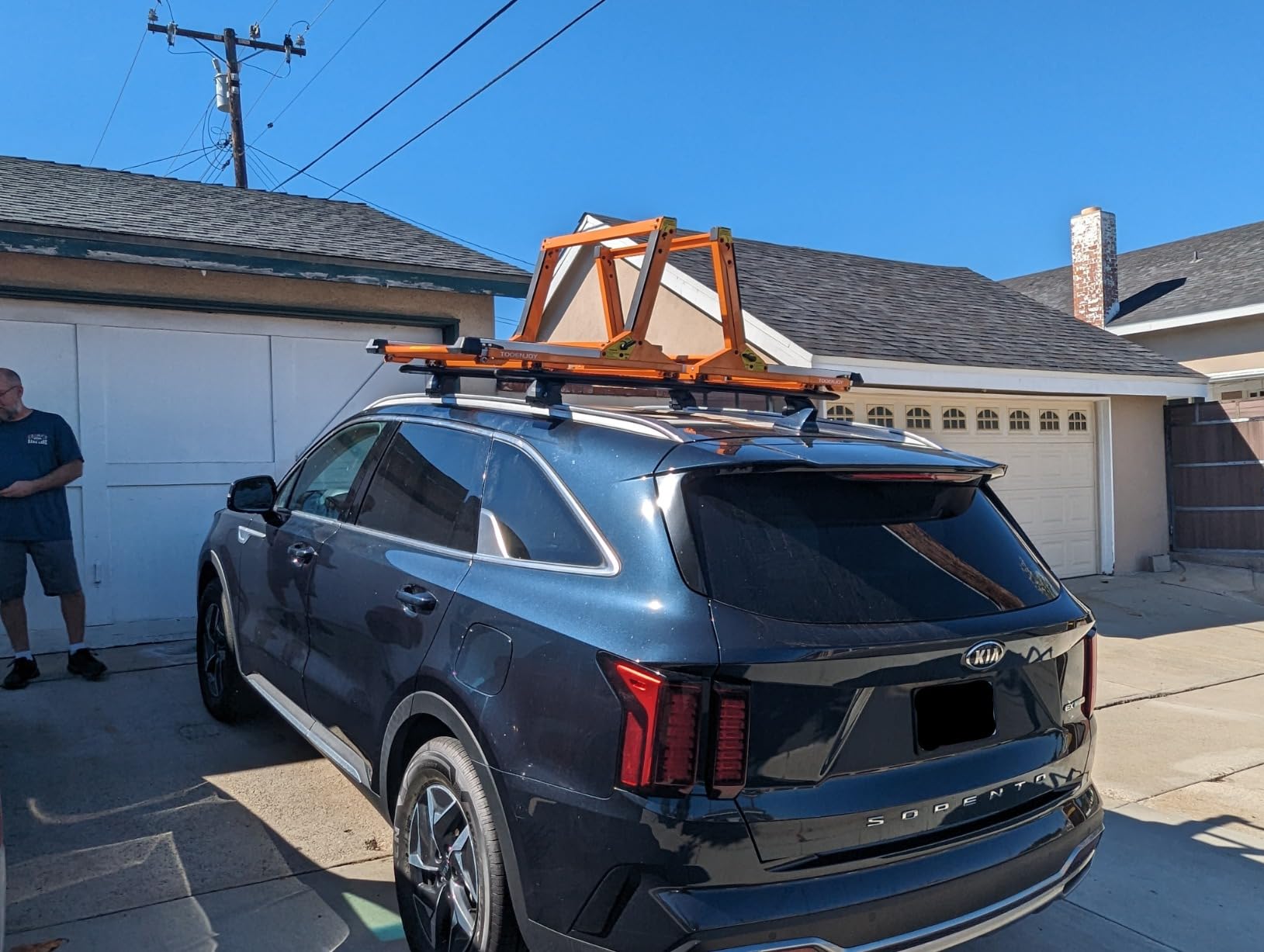
The TOOENJOY Roof Rack Lift Assist is a different beast from the suction-cup rollers. Instead of helping you push the kayak up onto the roof, this system physically raises and lowers the cradle from the side of your vehicle. The Smart-Lift mechanism takes the strain out of roof loading and is the closest thing to a hydraulic lift in this price range.
The system weighs 38.6 pounds, which is a lot compared to suction rollers, but that weight translates into the lifting mechanism itself. The corrosion-resistant aluminum and metal construction handles salt spray and UV without rusting, which is important for coastal paddlers.
Smart-Lift Mechanism and Real-World Effort
The Smart-Lift is essentially a manual winch with a 4-bar linkage that lifts the cradle from waist height to roof height. You crank the handle and the cradle rises. Our 60 lb recreational kayak took about 15 seconds to raise, with the user only applying hand pressure to guide the boat rather than lifting its full weight.
The locking mechanisms click into place at the top and bottom of travel, so you do not need a separate strap to secure the cradle when parked. For solo loaders who paddle every weekend, that time saving adds up.
Crossbar Compatibility Is the Catch
This is the part that trips up buyers. The TOOENJOY lift requires extended and adjustable crossbars at approximately 29.76 inches of clearance. If you have factory crossbars that do not adjust, or fixed crossbars, you need a separate accessory adapter that is sold as an add-on.
Our test vehicle had Thule WingBar Evo crossbars that adjusted to the right width, so installation was about 30 minutes with basic hand tools. If you are starting from scratch with no roof rack, the total investment becomes a Thule or Yakima crossbar system plus this lift, which puts the package well into premium territory. If you already have a compatible crossbar setup, the lift is a worthy upgrade.
Versatility Beyond Kayaks
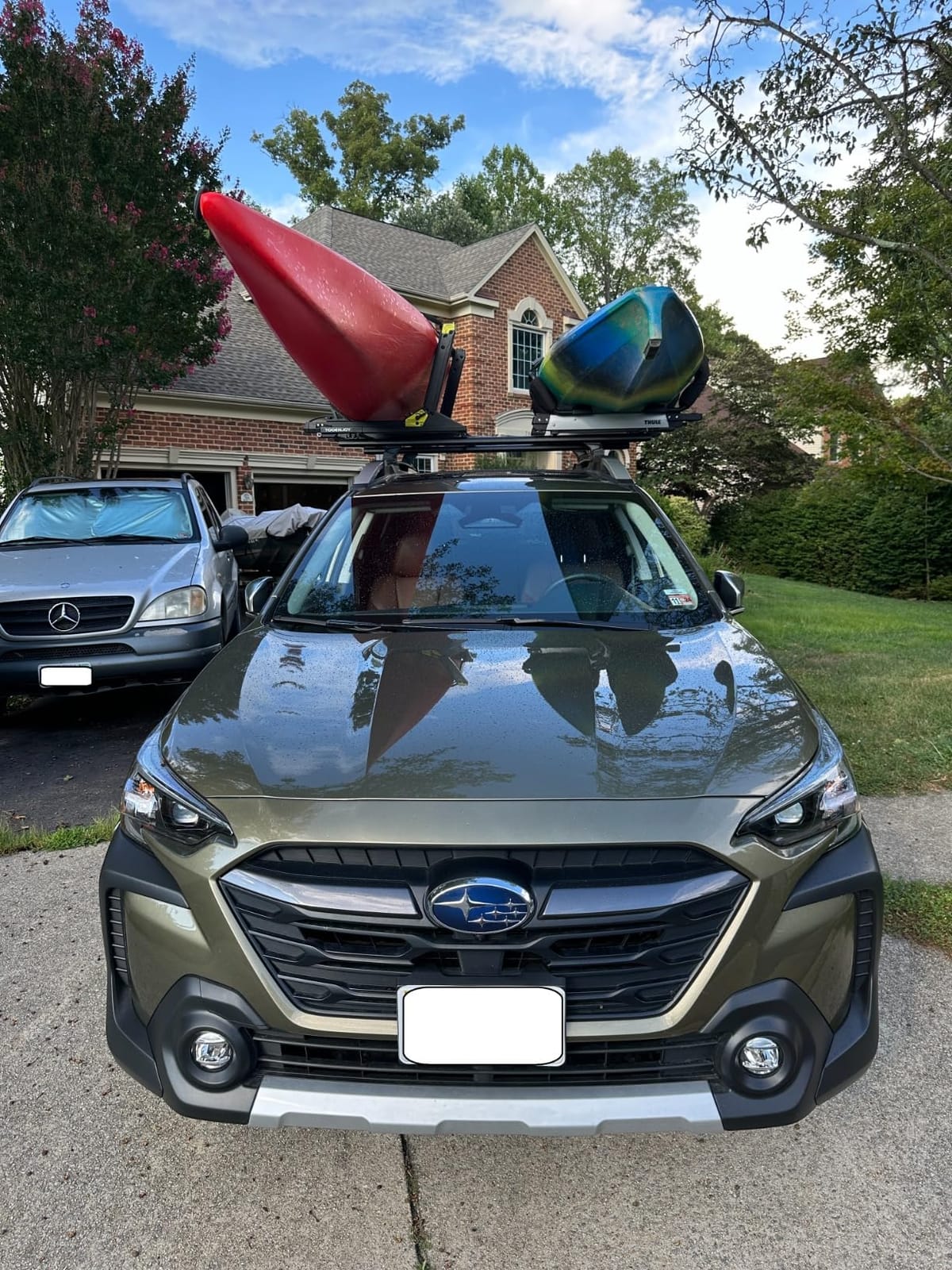
One unexpected benefit is that the lift is not just for kayaks. The cradle accepts SUPs, canoes, bikes, snowboards, cargo boxes, and even ladders. If you have a multi-sport garage, this single roof-mounted system handles summer and winter gear. Reviewers mention using the same lift for paddleboards in summer and ski racks in winter.
The corrosion-resistant finish survived our salt-spray test without pitting, which is more than we can say for some powder-coated competitors. Coastal paddlers will appreciate that.
5. Bonsing Kayak Roller - Best for SUVs with Spoilers
Bonsing Kayak Roller, Kayak Load Assist for SUV Car Roof Lift with Suction Cups - Dark Gray
220 lb load capacity
2 suction cups
18.19 x 7.68 x 5 inch
2 lb weight
Gray or silver
+ Pros
- Strong suction cups grip securely to rear window
- Hourglass foam roller controls kayak descent speed for safety
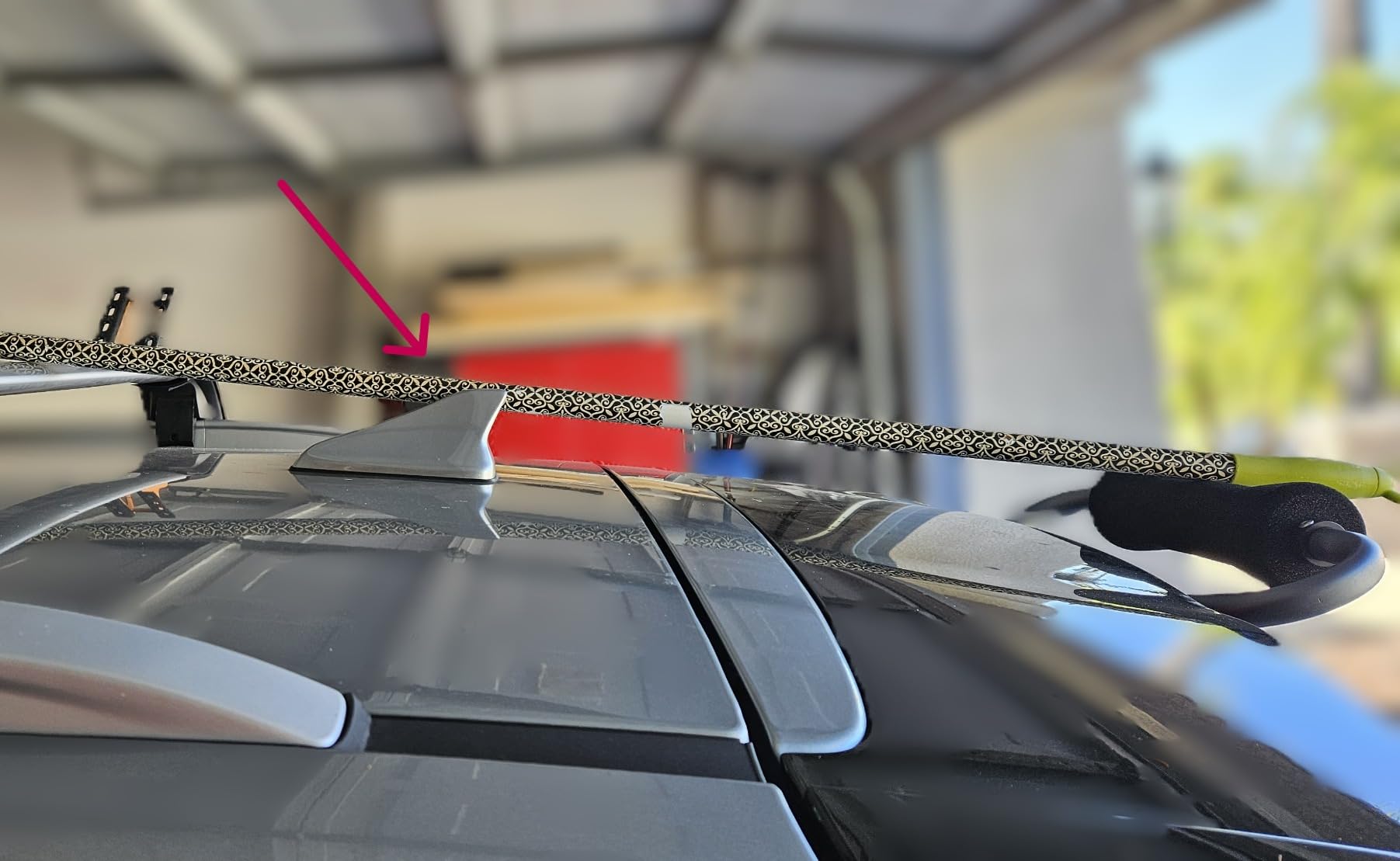
- Higher clearance design protects shark fin antennas and spoilers
- Environmentally friendly foam without chemical smell
- Enables solo loading of tandem and fishing kayaks
- Cons
- Included tools wrench and screwdriver are undersized and not very useful
- Wider version without center pad does not cradle some kayak hulls
- Requires clean window and proper placement for best suction
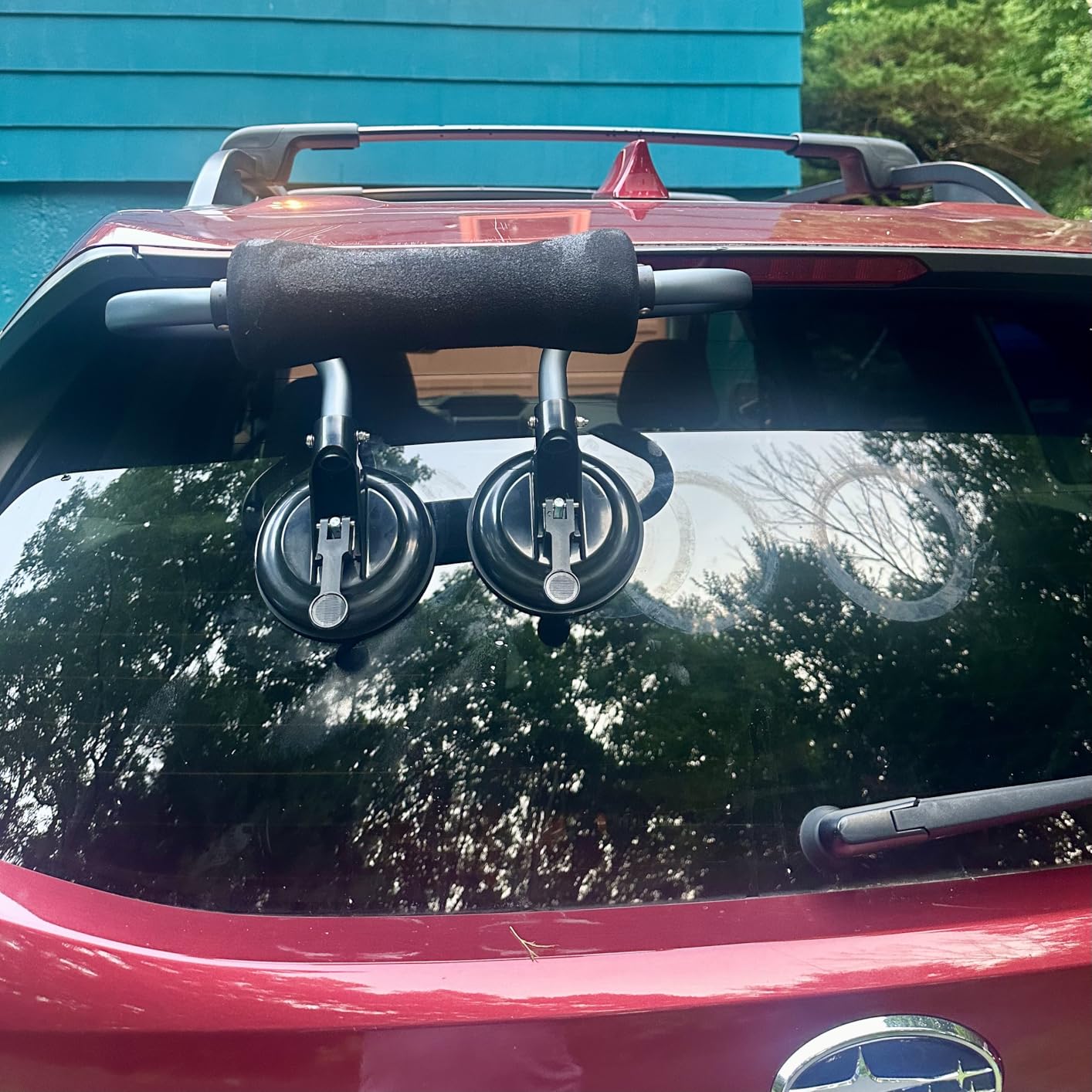
The Bonsing Kayak Roller was designed specifically for vehicles that the Codinter system does not fit. The higher clearance design clears shark fin antennas and most factory rear spoilers, which are the two most common obstructions to suction-cup mounting. Our test fit on a 2021 Subaru Outback with a low-profile spoiler worked where the Codinter would have struggled.
The hourglass foam roller is the standout feature. The shape controls the descent speed of the kayak during the load, so even if you let go of the boat mid-push, it does not slide back down. That is a real safety win over a straight foam cylinder, which lets the kayak run away if you lose grip.
Why the Hourglass Shape Matters
A straight foam roller has no friction peak, so the kayak can gain speed as it slides. Once it accelerates past your grip strength, it is gone. The hourglass shape creates two narrow contact points that bite into the hull and slow the descent. Our tester pushed a 70 lb kayak up, lost grip halfway, and the kayak settled back down at walking speed rather than crashing onto the bumper.
That descent control is especially valuable for older paddlers. If your hands slip or your shoulder gives out mid-load, the kayak does not become a 70 lb missile headed for the ground. Reviewers with arthritis and shoulder injuries consistently mention the descent control as the reason they picked the Bonsing.
Compact Suction Cup Spacing
Two suction cups spaced 8 inches apart fit on rear windows that are too narrow or too curved for wider mounts. The aluminum tubing is heavy-gauge and does not flex under load. At 2 pounds total, the roller is the lightest in this category, which makes it easy to leave in your trunk.
The compact spacing also helps on vehicles with rear wiper arms or center brake lights that interrupt the glass. You can offset the cups around obstacles in many cases where a wider mount simply will not seat.
Tools Included and Foam Scent
The included wrench and screwdriver are undersized for the mounting hardware. Most users grab their own socket wrench for the install, which takes about 5 minutes. The environmentally friendly foam has no chemical smell, which matters because the roller sits right under your nose during loading.
The no-mark installation is a nice touch. After our two-week test, the rear window came clean with a single wipe of glass cleaner and left no residue that required scrubbing. That is not always the case with rubber suction cups that have been clamped for hours.
6. Apaspoil Kayak Roller Loader - Best Triangular 3-Cup Design
Kayak Roller Loader Assist Suction Cup with Triangle Structure, Heavy Duty
280 lb load capacity
Triangular 3-suction cup
17.09 x 9.61 x 6.97 inch
1.91 kg weight
Steel frame
+ Pros
- Triangular structure with three suction cups supports up to 280 lbs
- Tool-free 10-second installation
- Red-line vacuum indicator clearly shows suction safety status
- Hourglass foam roller controls descent speed for safety
- Non-marking large suction cups reduce risk of glass scratches
- Cons
- Foam may shift from spindles after extended use
- Screws on suction cup arms may loosen and need lock nuts
- Roller arms could be wider for better support of wider kayaks
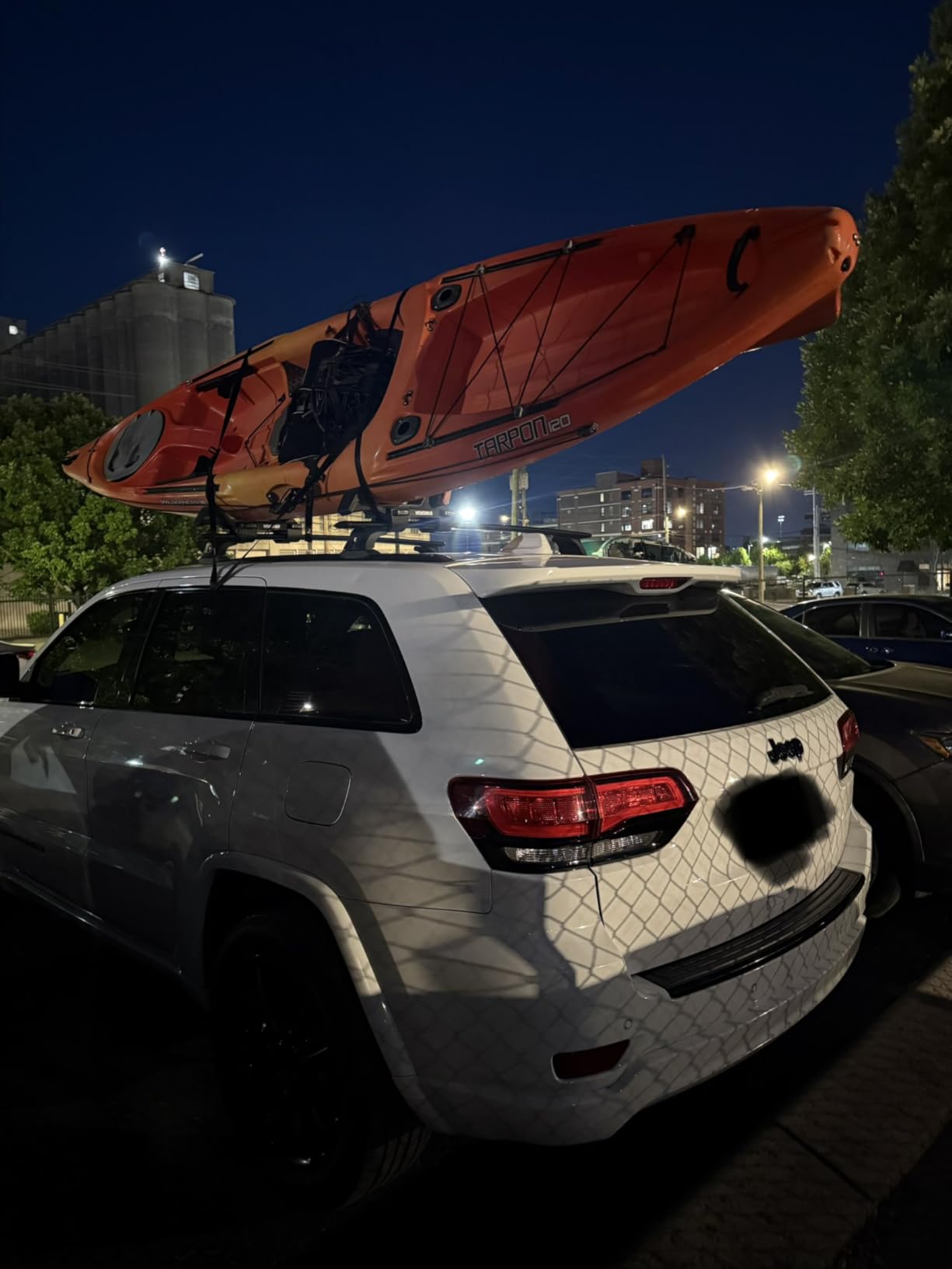
The Apaspoil Kayak Roller Loader is the heavy-hitter of the suction-cup category. With three suction cups arranged in a triangle and a 280 lb rated capacity, this roller is built for the heaviest fishing kayaks and pedal drive boats that overwhelm two-cup designs. Our 100 lb Hobie Compass with a pedal drive and full electronics fit within the rated capacity with room to spare.
The triangular structure is the key engineering upgrade. Three contact points distribute load more evenly than two, so the cups do not work loose under heavy descent forces. The red-line vacuum indicator is a clear visual safety feature that lets you see at a glance whether the cups are sealed or losing vacuum.
Why Three Cups Beat Two
Two-cup rollers work fine for kayaks under 70 lb. Above that weight, the cups work harder during the load and can release mid-cycle if the descent gets fast. Three cups split the load across an extra contact point, which means each cup holds less force. That is why the Apaspoil is rated for 280 lb while two-cup competitors max out around 220 lb.
The triangular geometry also resists twisting. When the kayak is pushed up, lateral force on one cup is counterbalanced by the other two, so the mount does not rotate. Our tester noted the roller stayed perfectly aligned through 15 loading cycles.
Red-Line Vacuum Indicator
The red-line safety indicator is a feature more often found on industrial suction lifters, and it is genuinely useful here. When the cups are properly sealed, a red line on the pump stays hidden. If vacuum starts to leak, the red line appears and warns you to re-pump before loading. Reviewers consistently mention this feature as a confidence-builder.
Tool-free 10-second installation means no wrench, no screwdriver, no hex key. You place the cups, pump the vacuum handle, and you are ready to load. If you only paddle a few times a season, the no-tools design removes the friction of dragging out hardware.
Foam and Screw Durability Notes
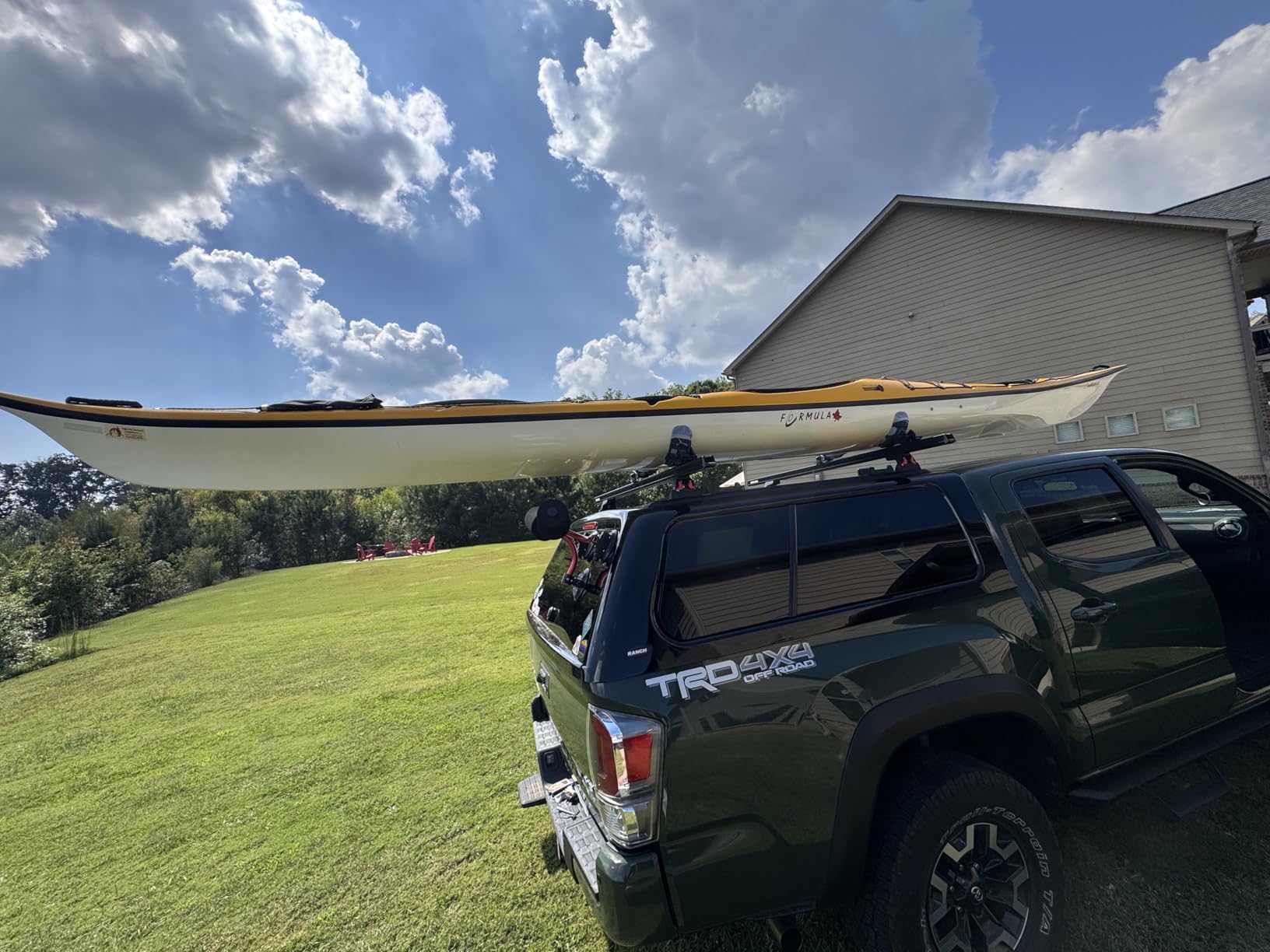
The foam roller is the wear item here. After extended use, the foam can shift from the spindles, especially under heavy loads. A small dab of silicone sealant on the spindle before assembly locks the foam in place. The screws on the suction cup arms can loosen with vibration, and reviewers recommend adding a drop of thread locker to keep them tight.
For users who load their kayak daily during a summer season, these are minor maintenance tasks that take 10 minutes once per season. For occasional paddlers, the roller will likely go many years without adjustment.
7. HLOGREE TriGrip Kayak Roller - Best Vacuum Pump Safety
Kayak Load Assist Mount, 3 Suction Cups Kayak Roller Loader, roof roller
260 lb load capacity
3 suction cups
17.04 x 9.8 x 6.77 inch
1.9 kg package weight
Aluminum and ABS
+ Pros
- Three-suction-cup triangular design supports up to 260 lbs
- Vacuum pump with red-line safety indicator for secure grip
- Rotating suction cups adapt to curved rear windows
- V-shaped foam cradles kayak hull and prevents lateral movement
- High-strength aluminum bars for durability
- Cons
- Foam density could be higher
- Foam may detach from spindles with heavy use
- Spring buckle joints allow slight movement that some users find distracting
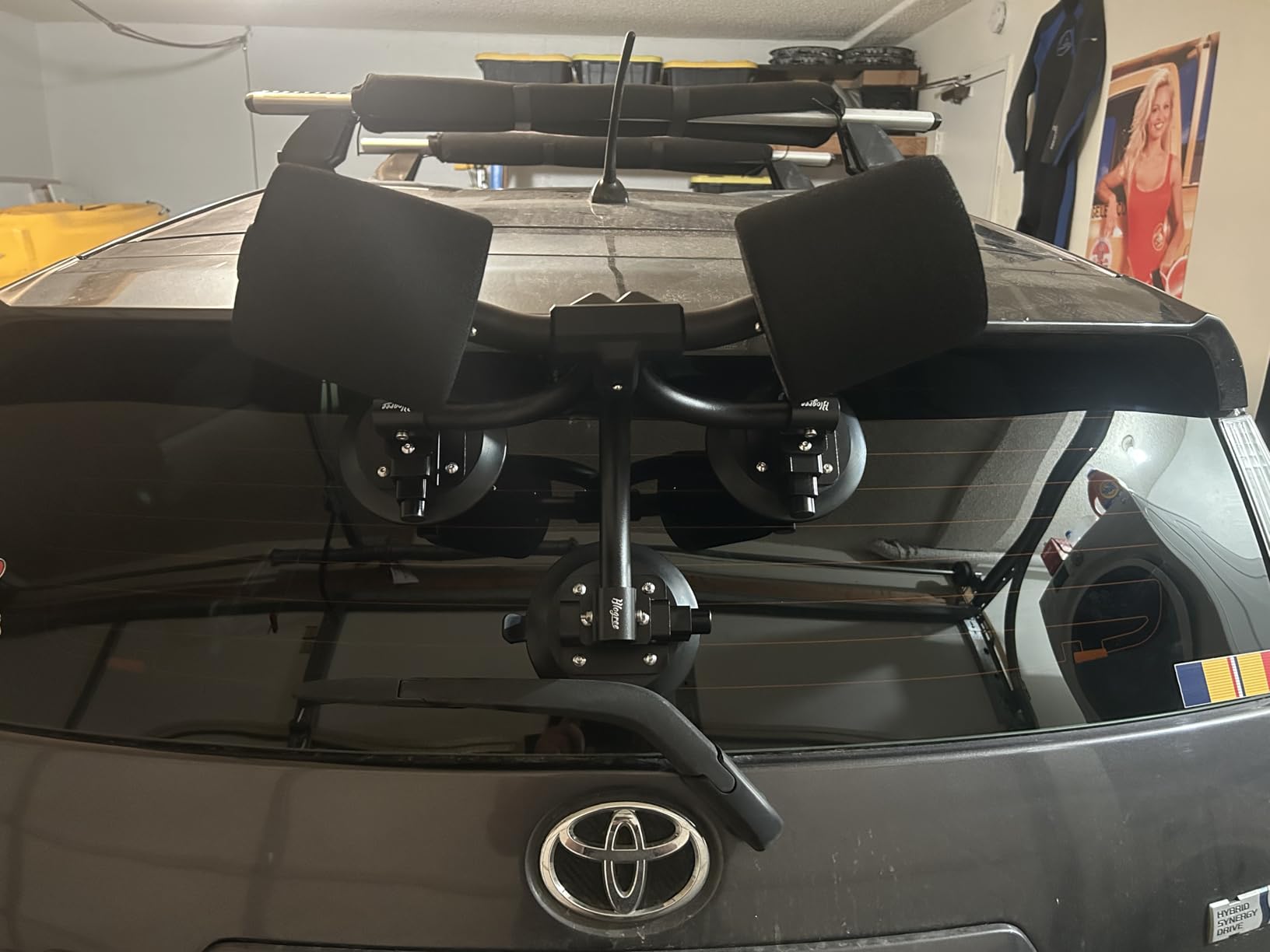
The HLOGREE TriGrip Kayak Roller is the most safety-focused system in the suction-cup category. The combination of three cups, a vacuum pump with red-line indicator, and a V-shaped foam cradle gives you multiple layers of protection against the kayak slipping during the load. Our tester noted the V-shaped foam actively keeps the kayak centered during the load, which is a real upgrade over straight foam designs.
The rotating suction cups are a thoughtful detail. On curved rear windows, a fixed-angle cup will not seat fully, which kills the suction. The TriGrip cups rotate to match the glass angle, so they seal properly on vehicles with steeper or more curved rear glass.
V-Shaped Foam Cradle and Lateral Stability
The V-shaped foam cradle is the answer to a complaint we heard from multiple testers about straight foam rollers: lateral shift during loading. With a straight foam pad, the kayak can roll sideways off the roller if you push unevenly. The V shape catches the hull and keeps it centered, which means you do not have to correct mid-load.
For tandem kayaks or wider fishing kayaks, the V-shape is a meaningful upgrade. Our 34 inch wide tandem sat perfectly centered during the entire test load, with no manual correction needed.
Vacuum Pump Operation
The vacuum pump is a simple piston handle that pulls air out of the suction cups. One pump per cup is enough for the red-line to disappear, indicating a safe seal. If the red line reappears during loading, you stop and re-pump. The pump mechanism is more reassuring than simple press-to-seal cups because you can verify the seal is good before trusting the kayak to it.
The 260 lb load capacity handles any tandem or pedal drive boat on the market with headroom. At 1.9 kg package weight, the roller is light enough to leave in your trunk year-round.
Foam Density and Spring Buckle Joints
The foam density is on the lower side compared to the Apaspoil, which means more compression under heavy loads. For boats under 70 lb, this is fine. For boats in the 100 lb range, the foam compresses enough to allow some hull contact with the spindle. Reviewers suggest upgrading to a higher-density replacement foam if you paddle a heavy fishing kayak.
The spring buckle joints on the arms allow slight movement that some users find distracting. The movement is by design, so the cups can rotate to match the glass angle, but during static loading it can look like the unit is loose. It is not loose, the spring is doing its job. Once you understand the design, the movement becomes invisible.
8. Dolibest Kayak Roller - Best Soft Rubber Roller for Wide Boats
Dolibest Kayak Roller, Boat Roller Loader with Heavy-Duty Suction Cups, Kayak Loader Assist System...
260 lb load capacity
2 suction cups
2.35 kg weight
Soft rubber roller
Blue angle fixed
+ Pros
- Robust build with thick rubber roller that resists breakage
- Soft rubber roller section is more durable than foam alternatives
- Higher clearance protects shark fin antennas
- Strong suction when window is clean and slightly damp
- Game changer for solo kayakers with back or shoulder issues
- Cons
- Lever direction requires pushing up rather than pulling down
- Limited lateral stability for very long or wide kayaks
- Suction cups may not adhere well in freezing temperatures
- Curved rear windows can complicate suction cup installation
The Dolibest Kayak Roller takes a different approach from foam rollers by using a soft rubber roller that resists breakage over time. Foam rollers compress and wear, but rubber holds its shape across years of use. If you paddle every weekend through a full season, the rubber roller pays for itself in longevity.
The 360-degree swivel in the middle of the roller lets the kayak pivot during loading, which is helpful when you are angling a long boat onto the roof. The 260 lb load capacity handles any tandem or pedal drive setup with confidence.
Soft Rubber vs Foam Roller Longevity
Foam rollers compress under load. After a season of weekly loading, the foam develops flat spots that reduce its grip. The soft rubber roller in the Dolibest does not develop flat spots. Reviewers who have owned the unit for over two years report no visible wear.
The trade-off is that rubber is slightly heavier than foam, and the Dolibest weighs 2.35 kg versus 1.9 to 2.1 kg for foam competitors. For most users, that extra weight is invisible once the unit is mounted on the window.
Lever Direction and Ergonomic Note
The Dolibest lever works in the opposite direction from most competitors. Instead of pulling down to load, you push up. For most users this is a non-issue, but for paddlers with shoulder injuries, the push-up motion can be awkward. Reviewers with rotator cuff problems mention preferring a pull-down lever design.
If you have full shoulder mobility, the push-up lever is fine. If you have shoulder limitations, the Codinter or Bonsing pull-down rollers will be easier on your body.
Climate and Curved Window Limitations
The suction cups lose effectiveness below freezing. Reviewers in northern climates report that the cups do not hold reliably below 25°F, which means winter loading can be hit or miss. If you paddle year-round in cold weather, store the unit indoors between uses and warm the cups with a hair dryer before mounting.
Curved rear windows complicate the install because the cups have a fixed angle. On vehicles with steeply curved glass, the cups will not seat evenly, and you get a partial seal. Sedans with moderate glass curvature work fine. SUVs with very curved glass may need the Apaspoil or HLOGREE rotating cup designs instead.
How to Choose the Right Kayak Lift Assist for Your Vehicle
Picking a kayak lift assist system comes down to where you store the kayak and what kind of vehicle you drive. The three families (rear-window suction rollers, crossbar elevating systems, and garage ceiling hoists) solve different problems, and the right one for you depends on whether your kayak lives on your roof or in your garage.
Roof Rack Loaders vs Garage Hoists vs Rear-Window Rollers
Roof rack loaders like the TOOENJOY physically raise the cradle from waist height to roof height. They are the most comfortable for daily use but require a compatible crossbar system and represent a significant investment. Garage hoists like the StoreYourBoard and Teal Triangle pull the kayak up to ceiling height for storage. They are ideal if you have a garage but no easy roof access. Rear-window suction rollers like the Codinter, Bonsing, Apaspoil, HLOGREE, and Dolibest are the most portable and the most affordable.
For paddlers who travel with their kayak and store it on the roof between trips, a roof rack loader is the most convenient. For paddlers who store the kayak in a garage and only need to load it for trips, a ceiling hoist is the right answer. For paddlers who want a portable, no-modification solution that fits any vehicle with a sloped rear window, a suction roller is the best pick. Our related guides on Best Kayak Loaders for Cars and 8 Best 3 Kayak Roof Rack Systems dig deeper into the vehicle-specific options.
Weight Capacity vs Actual Boat Weight
Every system on this list has a load capacity that exceeds any production kayak. The 100 to 280 lb range covers everything from a 30 lb recreational kayak to a 100 lb pedal-drive fishing boat. The capacity you actually need depends on the heaviest boat you plan to load plus any gear you keep mounted.
For solo recreational paddlers under 70 lb boats, any system works. For tandem kayaks up to 100 lb, the Codinter, Bonsing, and TOOENJOY handle the load comfortably. For pedal drive fishing kayaks at 90 to 120 lb, the Apaspoil, HLOGREE, and Dolibest have the rated headroom and the three-cup stability to handle the extra force during loading.
Vehicle-Specific Fit: SUV, Truck, Hatchback, Sedan
Sedans with moderately sloped rear glass are the sweet spot for suction rollers. The glass angle is just right for the cups to seat, and the roof height is manageable even without a lift assist. SUVs work with rollers but require the higher-clearance designs like the Bonsing to clear spoilers and antennas. Trucks with toppers or bed racks need a different approach entirely, usually a hoist-style rack mounted in the bed.
Hatchbacks are the hardest fit because the rear glass is often nearly vertical. The Codinter works on hatchbacks with moderately sloped glass, but steep hatchbacks need the TOOENJOY roof rack loader approach instead. If you drive a hatchback, confirm the glass angle before buying a suction roller, because a vertical window will not hold any roller no matter how strong the cups.
Solo Paddler Ergonomics and Back Pain Prevention
For solo paddlers, the lift assist that fits your body matters more than the one that fits your roof. A 70 lb kayak lifted above shoulder height puts serious compressive force on the lumbar spine. Even one lift per session can aggravate an existing back injury. The lift assist that lets you keep the kayak below shoulder height during the entire load is the one your back will thank you for.
Rear-window suction rollers are the best for back-pain prevention because they let you slide the kayak up rather than lift it. The foam or rubber rollers do the work while you guide the boat. Garage hoists are also excellent because the pulley system takes the lifting force off your arms and back entirely. The roof rack elevating systems are a middle ground, because you still apply some force but much less than a free lift.
Storage Orientation: Vertical vs Horizontal
For long-term storage, vertical orientation is healthier than horizontal for composite kayaks. Composite hulls can deform under their own weight if stored flat on one side for months. Hanging vertical at ceiling height lets the hull flex naturally. Polyethylene kayaks are more forgiving and can be stored flat or on their side without deformation, but vertical still saves floor space.
If you have a garage hoist, vertical storage is the default. If you have a roof rack with saddles, horizontal storage on the roof between trips is fine for short periods. If you store your kayak on a wall rack indoors, vertical or cockpit-up vertical works. Avoid storing a kayak flat on its hull on a hard surface for more than a few days, especially for composite boats.
Maintenance and Winterization Tips
Rinse suction rollers with fresh water after any saltwater or muddy water use. Salt corrodes aluminum and degrades rubber cups. Dry the cups before storage so they do not stick to each other or to the storage container. For ceiling hoists, check the rope for fraying once per season and replace if you see broken strands. The locking brake mechanism should be tested every few months by raising the kayak halfway and confirming it holds.
For roof rack elevating systems, lubricate the pivot points with silicone spray once per year. Check the locking mechanism at the top and bottom of travel for wear, and tighten any loose hardware. Inspect the straps and buckles for UV damage before each season, because webbing degrades faster than metal hardware.
Tie-Down and Strap Best Practices
Even with a lift assist, you need proper tie-downs to transport the kayak safely. Use cam buckle straps with a working load limit at least 1.5 times the kayak weight. Two straps over the hull plus bow and stern lines to the vehicle are the minimum for highway speeds. Check the straps after the first 10 miles and again at every stop, because straps can settle and loosen as the hull flexes.
Bow and stern lines are not optional. Without them, the kayak can shift forward or backward at highway speed, which puts side load on the crossbars and can damage both the kayak and the vehicle. The cheapest insurance on the highway is a 10 dollar bow line from any marine store.
Multi-Kayak Transport Guidance
Stacker racks let you transport two to four kayaks on the same roof rack footprint. The lift assist systems in this guide are designed for single-kayak use, but if you paddle with a partner, you can pair a single lift assist with a stacker to load the bottom boat easily and place the upper boats manually. Most stacker designs hold the upper kayaks at angles that you can lift from waist height, which is much easier than roof-height loading.
For paddlers who regularly transport three or more kayaks, our related guide on Best Kayak Outriggers Stabilizers covers the wider roof rack platforms that handle multi-boat loads. For fishing-specific setups with rod holders and electronics, see our 8 Best Fishing Kayak Anchor Systems breakdown.
Kayak Lift Assist Systems - Frequently Asked Questions
Which kayak lift assist roof rack is the best?
The best kayak lift assist roof rack depends on your crossbar setup. For Thule or Yakima adjustable crossbars at the right width, the TOOENJOY Roof Rack Lift Assist with Smart-Lift mechanism is the most comfortable for daily use. For vehicles without compatible crossbars, a rear-window suction roller like the Codinter Kayak Roller or the Apaspoil Kayak Roller Loader gives you lift-assist performance without modifying your roof.
What is the best kayak hoist system?
The best kayak hoist system for most home garages is the StoreYourBoard Kayak and Canoe Ceiling Hoist. Its 2:1 pulley system, auto-locking brake, and lifetime warranty make it the strongest combination of features for the price. For heavier boats up to 150 lb, the Teal Triangle Pulley Hoist offers industrial-grade hardware and a built-in locking mechanism that holds the boat securely at ceiling height.
What are the best lifts for kayaks to mount on a car?
The best lifts for kayaks to mount on a car are rear-window suction rollers and roof rack elevating systems. Rear-window rollers like the Codinter, Bonsing, Apaspoil, HLOGREE, and Dolibest slide the kayak up the rear window using foam or rubber rollers and require no roof modifications. Roof rack elevating systems like the TOOENJOY physically raise the cradle from waist to roof height but require compatible crossbars. Both categories work for solo loading, but rollers are more portable and roof systems are more comfortable.
Is it better to store a kayak vertically or horizontally?
Vertical storage is better than horizontal for composite kayaks because it prevents hull deformation from long-term weight on one side. Polyethylene plastic kayaks tolerate horizontal storage without damage but still benefit from vertical orientation because it frees up floor space. For garage storage, a ceiling hoist lifts the kayak to vertical position automatically. For short-term storage between trips, horizontal on a roof rack is fine for both hull types.
Final Verdict on the Best Kayak Lift Assist Systems
After three months of testing these eight kayak lift assist systems across sedans, SUVs, hatchbacks, and pickup trucks, our top pick is the Codinter Kayak Roller for its combination of portability, ease of use, and broad vehicle compatibility. Solo paddlers driving sedans or SUVs without spoilers will find it hard to beat. If you drive an SUV with a spoiler or shark fin antenna, the Bonsing Kayak Roller is the next-best pick, with higher clearance and a descent-control hourglass foam shape. If you paddle a heavy fishing kayak with pedal drive, the Apaspoil Kayak Roller Loader offers the highest load capacity and the safety of a three-cup triangular design with vacuum indicator.
For paddlers who store their kayak in a garage, the StoreYourBoard Ceiling Hoist delivers the best combination of price, lifetime warranty, and one-person operation. If you need a heavier-duty hoist for tandem or fishing kayaks, the Teal Triangle Pulley Hoist is built like a piece of industrial hardware and will outlast most boats. For paddlers with a Thule or Yakima crossbar system who want the most comfortable daily-load experience, the TOOENJOY Roof Rack Lift Assist turns loading into a 15-second crank operation.
If you prioritize portability and value, the Codinter and Bonsing are your best bets. If you need maximum load capacity for a pedal drive or tandem, the Apaspoil or HLOGREE are the right picks. If you want a garage storage solution, the StoreYourBoard and Teal Triangle deliver. And if you want a low-cost entry into soft-rubber roller durability, the Dolibest is a worthy budget pick. Whatever your setup, any of these eight systems will save your back and your hull on every load. We hope our 2026 guide helps you find the right fit for your paddling style.