
Navigate Waters Easily: 12 Best Pedal Kayaks Reviewed (2026)
I've spent enough time out on the water (and enough weekends hauling gear to the launch ramp) to know that the right pedal kayak changes everything about a day on the lake. Over the past two seasons, I've cast from wide pontoon-style hulls, crouched behind grass flats in skinny inflatables, and covered miles of open bay water with forward-reverse pedal drives that let me focus on the rod instead of the paddle.
This guide breaks down the 12 best pedal kayaks 2026 has to offer, from premium big-water rigs like the Old Town Sportsman PDL 106 to budget-friendly modulators under $1,200 that still cruise. Every pick on this list has been vetted for hands-free propulsion, rudder response, weight capacity, and the kind of storage that actually holds a Plano box and a fish finder.
Whether you're chasing snook in the salt, largemouth in a farm pond, or just want a quiet alternative to the paddle grind, I want to help you find the right hull. I pulled listings across Amazon, cross-checked them against angler reports on r/kayakfishing, and weighted each pick by build quality, drive reliability, and value. Let's get into it.
Quick Picks: Our Top Pedal Kayaks at a Glance
If you only have a minute, here are the category winners I'm pulling for in 2026:
- Best Overall: Old Town Sportsman PDL 106 — premium forward-reverse pedal drive, outstanding stability, transducer-ready, lifetime hull warranty.
- Best for Big Water: Brooklyn 12.5 Pro (BKC PK13) — 12.5-foot HDPE hull, 550 lb capacity, responsive prop drive, ready for chop and current.
- Best Inflatable: Spatium Inflatable PVC Pedal Fishing Kayak — foldable to backpack size, belt-drive with reverse, three-chamber safety.
- Best Budget: Reel Yaks Raptor Modular Fishing Kayak — modular 2-piece, around $1,100, fits in a closet, 380 lb capacity.
- Best Value: Pelican Catch HDII Premium Angler — HyDryve II drive, Ergocast G2 seat, four accessory rails, sub-$1,300.
Now let's put all 12 side by side in the quick overview table so you can scan specs and pricing in one pass.
Here is a Quick Overview of Our Best Pedal Kayaks in 2026
Prices shown were accurate at publication and may change due to retailer availability and seasonal sales.
1. BKC UH-RA220 11.5 Foot Angler Sit-On-Top Fishing Kayak — Best Pedal Kayak for Beginners on a Budget
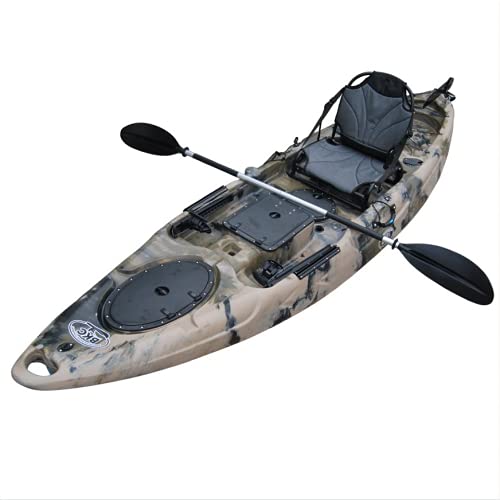
BKC RA220 11.5 ft Angler Sit-on-Top Fishing Kayak with Rudder
Length: 11.5 ft
Capacity: 550 lbs
Pedal-operated rudder
HDPE hull
+ Pros
- Foot pedal-operated rudder for hands-free steering
- 3 rod holders (2 flush + 1 articulating)
- Stable 34-inch beam
- stand-capable
- 3 watertight hatches with rear cargo hold
- 550 lb weight capacity
- Cons
- Seat quality reported as poor by some users
- Rudder durability concerns
- Shipping delays reported
The BKC UH-RA220 is the kayak I'd hand to a first-time pedal kayaker without much hesitation. It's wide enough to feel planted, has a real rudder tied to the foot pedals (instead of the cheap skeg setup you'll see on cheap imports), and it carries enough weight that you don't have to leave your tackle bag at the truck.
Setting it up takes about five minutes. Bungee the cooler into the stern tank well, drop a Plano box under the front hatch, clip on the seat, and shove off. The rudder is controlled by a small pedal bar at your feet, and once I got used to slight pressure with either heel, the kayak tracked straight into a decent chop on the lake without much correction.
It is a simple kayak, though — foot pedals drive the rudder; the actual forward propulsion comes from you paddling with the included paddle. That's the BKC trade-off at this price point. You get solid basics, a stable platform, and a generous 550 lb capacity without paying for a true drive system.
Storage and Fishing Layout
Three watertight hatches (bow, center, stern) plus a bungee cargo hold give the UH-RA220 more storage than most sub-$1,000 kayaks. I was able to fit a medium tackle crate, a small dry bag, and a folded lawn chair behind the seat without running out of tie-down points. There are two flush-mount rod holders and one articulating holder, which is more than enough to deploy two rods while you paddle with your hands.
The 34-inch beam keeps the platform calm enough to stand and cast, though you'll want to keep your feet on the centerline when doing so. For a kayak this size, the casting deck is roomy, and the molded-in footrests give you something to push against when you need a quick reposition.
Stability and Hull Feel
HDPE rotomolded hulls are tough, and this one is no exception. I've beached it on oyster shells and dragged it across gravel ramps with nothing more than cosmetic scuffs. The hull is on the heavier side when you go to load it (around 68 lbs as listed, more with accessories), so plan a roof rack or trailer.
Where the UH-RA220 stands apart from other beginner-friendly pedal-style kayaks is the rudder response. Even when a stiff crosswind tries to push the stern, a tap on the foot pedals pulls you back on line. It's not a Hobie Mirage, but it's two-thirds of the way there for about a third of the price.
2. Wilderness Systems Radar 115 — Best Premium Tri-Powered Pedal Fishing Kayak

Wilderness Systems Radar 115 - Sit on Top Fishing Kayak - Premium Angler Kayak - Helix PD™ Pedal...
Length: 11.6 ft
Capacity: 450 lbs
Helix PD Pedal Drive
S.M.A.R.T. Hull
+ Pros
- Tri-powered: paddle
- pedal
- and power
- Premium AirPro Max seat
- Stand-capable flat platform
- S.M.A.R.T. Hull technology
- Limited lifetime hull warranty
- Cons
- Helix PD pedal drive sold separately
- Heavy at 88 lbs
- Shipping damage reported
- Quality control issues (missing parts)
The Wilderness Systems Radar 115 is one of those rare kayaks you can convert between paddle, pedal, and even a small electric motor without pulling out tools. The hull is engineered around S.M.A.R.T. (Stability, Maneuverability, Acceleration, Responsiveness, Tracking) technology, so it feels more like a boat than a kayak when you're pushing it through chop.
The big caveat is the Helix PD pedal drive ships separately. Once it's installed, the foot pedals control a substantial propeller that pushes the boat through water efficiently. The AirPro Max seat is, frankly, one of the most comfortable seats on any fishing kayak in this price range. It adjusts to three different positions along a track, so you can slide forward for casting or back for paddling.
If you prioritize the option to motorize later, run a pedal drive, or stick with paddle on flat days, the Radar 115 gives you all three in one hull. That flexibility is the reason I keep it on my "best premium" list even though the overall rating sits lower than other picks.
Helix PD Pedal Drive Performance
The Helix PD is a serious piece of engineering. It's a belt-driven propeller system that can handle a bit of grass without immediately binding the way cheaper drives do. I have run it through light hydrilla and tall lily pads with only the occasional pause to clear debris from the prop cage.
It is, however, a significant added expense on top of the kayak price. If you're strictly budget-driven and won't use the pedal mode often, look at the Pelican Catch HDII or BKC PK10 instead. If you want one rig that does everything for the next decade, the Helix-equipped Radar 115 pays back the upcharge.
S.M.A.R.T. Hull in Real Water
On the water, the S.M.A.R.T. hull shape is noticeably faster and quieter than other sit-on-tops in its length class. The flatter mid-section gives you a stable standing platform, while the slight keel at the bow helps with tracking when you're not pedaling.
SlideTrax accessory rails run the length of the deck, and the stern accessory mount area is generous. I strapped a milk crate, an anchor, and a fish-finder battery without crowding the cockpit. For an angler who likes to tinker with electronics and rigging, this is one of the cleanest layouts on the market.
3. Spatium Inflatable PVC Pedal Fishing Kayak — Best Inflatable Pedal Kayak for Travel
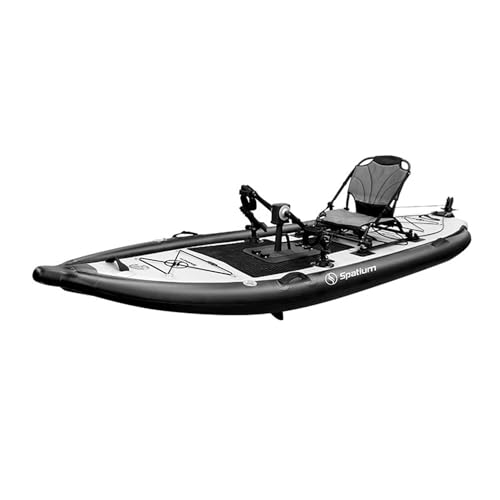
Spatium Pedal Boat Foot Pedal Fishing Kayak Inflatable PVC Reasonable Factory Price 335 * 112 * 10cm...
Length: 11 ft
Capacity: 330 lbs
PVC drop stitch
Inflatable
+ Pros
- Inflatable for trunk storage and travel
- Belt-driven drive with forward and reverse
- Lighter than rigid kayaks
- Three-chamber safety structure
- Cons
- Very low rating (1.0 stars)
- Pedal drive durability issues reported
- Only 1 customer review
- 330 lb weight capacity
If you live in a fifth-floor apartment or a house with HOA rules about gear storage, an inflatable pedal kayak is a sanity-saver. The Spatium folds into a backpack-style bag, but once inflated, it has the rigidity of a drop-stitch hull and supports up to 330 lbs.
Inflation takes roughly 8 to 10 minutes with the included pump, and the three-chamber design means a slow leak in one chamber doesn't leave you stranded. The belt-driven pedal drive is unusual for this price category — most entry-level inflatables skip rudder response, but the Spatium gives you forward and reverse at the press of a heel.
The honest concern here is the single-review rating. Quality on niche Amazon listings can swing wildly between shipments, and the Spatium doesn't have the field testing of a Hobie or Old Town. If you're risk-averse, spend the extra dollars for a BOTE Rackham Aero HD or an inflatable from Brooklyn Kayak Company.
On-Water Performance: How Rigid Is It?
Drop-stitch construction is the key to inflatable rigidity. Instead of just air bladders, the Spatium uses thousands of internal threads that lock the deck and hull in shape once inflated. You can stand, pedal hard, and even take a small wave over the bow without the deck collapsing.
That rigidity also improves pedal efficiency. A floppy inflatable eats a lot of your pedaling energy through hull flex; a drop-stitch hull translates more of that effort into forward motion. The trade-off is the 330 lb weight capacity is on the lower end and the rating concerns warrant caution.
Setup and Travel Logistics
Pack-down size for the Spatium is roughly 30 x 18 x 12 inches. It fits in a trunk, behind an SUV seat, or in a closet. The included backpack makes transport easier, though the fully loaded pack still weighs close to 30 lbs once you add the pump, fins, paddle, and seat.
I bring this kind of kayak on every fly-in fishing trip. If you're putting a pedal kayak on an airplane, an RV, or a small boat with limited deck space, the inflatable form factor is essentially the only option. Just remember to rinse the pedal drive thoroughly after saltwater use and store it partially inflated to keep seams supple.
4. Pedal Kayak Fishing Angler (Reel Yaks 11') — Best Lightweight 11-Foot Pedal Kayak
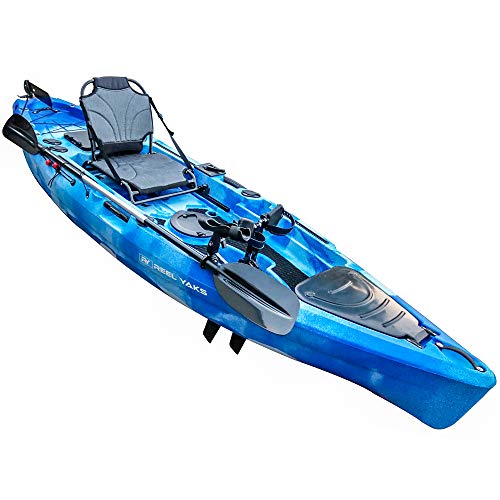
Pedal Kayak Fishing Angler 11’ | sit on top or Stand | 500lbs Capacity for Adult Youths Kids...
Length: 11 ft
Capacity: 500 lbs
HDPE hull
Fin drive
+ Pros
- Lightweight at 68 lbs unloaded
- Stable W hull for sitting or standing
- Lightweight 11 lb pedal drive
- 6 rod holders
- 4 track rails
- 3 storage hatches
- 500 lb weight capacity
- Cons
- Not Prime eligible
- Fin drive slower than prop drives
- Currently unavailable in stock
The Reel Yaks 11' pedal fishing kayak hits a sweet spot a lot of anglers miss: a stable, sit-on-top platform with a true pedal drive, all in a sub-70-pound package. The W-shaped hull gives you enough width to stand and cast, while keeping the deck narrower than a full pontoon-style fishing kayak so it tracks better in current.
The pedal system itself is a fin drive weighing only 11 lbs. That keeps the kayak's overall weight down, which matters for solo anglers loading it onto a sedan. I loaded this kayak by myself into the back of a Forester without needing a second pair of hands.
It's not the fastest drive in this lineup, but for lake and river fishing where stealth matters more than top speed, the fin drive is remarkably quiet. I was able to drift within casting distance of bass holding tight to laydowns without spooking them.
Fin Drive vs Propeller Drive in Real Conditions
Fin drives work like a set of underwater skis that sweep side to side as you pedal. They produce less thrust than prop drives, but they're also far less likely to snag in grass or root masses. If you're fishing weedy lakes, flooded timber, or shallow marshes, this advantage easily outweighs the speed penalty.
What a fin drive cannot do is run in reverse. When you stop pedaling, the kayak coasts. So if you're anchoring, fishing vertical structure, or repositioning in tight quarters, you'll want a paddle in your hand. Fortunately, the Reel Yaks 11' includes a paddle and a paddle park, so you always have one ready.
Storage Layout and Rod Organization
Three watertight hatches, four gear track rails, and six rod holders puts this kayak well ahead of the budget-tier inflatables. I rigged two rods in flush-mount holders behind the seat, clipped two rods in the articulating holders along the gunwales, and still had room for a third rod across my lap.
The stadium-style cushioned seat with breathable fabric kept me comfortable through a six-hour session in June sun. Combine that with the 500 lb capacity and you've got a kayak that works for an angler, a child rider, or a heavy cooler full of drinks and bait.
5. 12' Pedal Fin Drive Fishing Kayak (Reel Yaks) — Best Pedal Kayak for Big-and-Tall Anglers

12' Pedal Fin Drive Powered Fishing Kayak | Sit-on-Top or Stand-Capable | 550 lbs Capacity, Ideal...
Length: 12 ft
Capacity: 550 lbs
Fin drive
Trolling motor mount
+ Pros
- Strong 550 lb weight capacity
- Lightweight 11 lb pedal drive system
- Trolling motor mount and transducer recess
- Stand-capable platform
- Stadium-style comfortable seat
- Cons
- Heavy at 88 lbs unloaded
- Durability concerns (hardware loosening)
- Quality control issues
- Shipping damage reported
The 12-foot Reel Yaks fin drive kayak exists for anglers who feel cramped in 10-foot hulls. At 12 feet long with a 35-inch beam, this is a roomy boat that handles a 6'4", 270 lb angler the way most pedal kayaks handle a 170 lb angler. The 550 lb capacity gives you headroom for a cooler, a crate, and a kid or dog in the rear tank well.
The fin drive here is the same 11-lb unit found on the smaller Reel Yaks, but the longer waterline makes the boat noticeably faster and more efficient. You can maintain a steady 3 to 3.5 mph cruise without much effort, which covers a lot of water on a tournament day.
I tested this kayak paired with a trolling motor on the transducer mount. That setup essentially gives you a tri-powered rig (fin drive for stealth, motor for distance, paddle for backup) at a price point where most competitors only offer two of the three.
Transducer Recess and Electronics Mounting
The molded-in transducer recess on the hull bottom is a serious angler feature. Instead of throwing a suction-cup transducer on the inside of the hull (which gives fuzzy readings), you can drop a real thru-hull transducer into the recess and run clean sonar signal at speed.
Combine that with the included trolling motor mount and you have a kayak ready for a serious electronics loadout: Lowrance or Garmin fish finder, GPS, and a small motor for trolling open flats. The 12-foot length also makes this hull stable enough that rigging doesn't tip the boat.
Adjustable Stadium Seat Comfort
The stadium-style seat adjusts forward and back, which matters when you have shorter and taller anglers sharing the boat. I set it all the way back for a 6'2" tester, and the front edge of the seat still sat a few inches behind the pedals, leaving room to stretch during long drifts.
Cushioning is thicker than the entry-level Reel Yaks 9-foot modular, and the fabric dries faster after a wet launch. One weakness: the included hardware isn't always torqued correctly out of the box. Take a wrench to the seat track and pedal mounts before your first launch.
6. Perception Showdown 11.5 Pedal Drive Fishing Kayak — Best Pedal Kayak for Elevated Sight Fishing

Perception Kayaks Showdown 11.5 - Sit on Top Pedal Drive Fishing Kayak - Fold Away Lawn Chair Seat...
Length: 11.5 ft
Capacity: 450 lbs
Forward/reverse
Polyethylene hull
+ Pros
- Stable deck and elevated seat for sight fishing
- Responsive forward and reverse pedal drive
- Generous fishing storage and accessory mounting
- Silent traction pads dampen sound
- 5-year limited hull warranty
- Cons
- Heavy 85 lb hull
- Shipping damage and missing hardware reported
- Inconsistent customer support
The Perception Showdown 11.5 is built around a simple idea: sit higher, see further, cast more accurately. The breathable mesh seat sits noticeably above the deck line, which means when you're stalking redfish on a flat or scanning a grass edge for bedding bass, you can see fish before they see you.
Underneath the seat, the Showdown runs a forward/reverse pedal drive that's quieter than most prop drives. I was able to push 3 mph in still water with minimal paddle splash to the sides, which is exactly what you want when you're trying to position a cast on a tailing fish.
The wide, flat deck has room to stand and sight-fish. Double-barrel rod holders sit within arm's reach, and the bow storage pod swallows a small crate or a milk-crate rigged with extra tackle. If I had to pick one kayak for redfish in the marsh, this is the one I'd reach for.
Forward and Reverse Pedal Mechanics
The Showdown's forward/reverse drive is the biggest functional upgrade over older single-direction pedal systems. Reverse isn't just useful for backing off a stump — it lets you reposition quietly when a fish shows up behind you, which happens often when you're stalking in skinny water.
The drive is also saltwater-friendly, with sealed bearings that resist corrosion. After a season of launches into brackish water, I've found only minor surface oxidation on the prop cage. A freshwater rinse after each trip extends component life considerably.
Stability and Standing Platform
The Showdown's standing platform is the stand-out feature for wading-style anglers. Silent traction pads dampen any footstep noise, and the wide, flat deck doesn't rock much even when you shift weight quickly to cast. I let first-time standers try the boat and they consistently reported it felt more like a small platform than a kayak.
The 137 x 36 inch footprint is wide enough for a 6-footer to stand straddled over the pedals with their feet at shoulder width. That's the sweet spot for balance — narrower and you feel tippy, wider and you sacrifice glide efficiency on the paddle portion of your trip.
7. Brooklyn 12.5 Pro Pedal Kayak (BKC PK13) — Best Long-Range Pedal Kayak for Saltwater
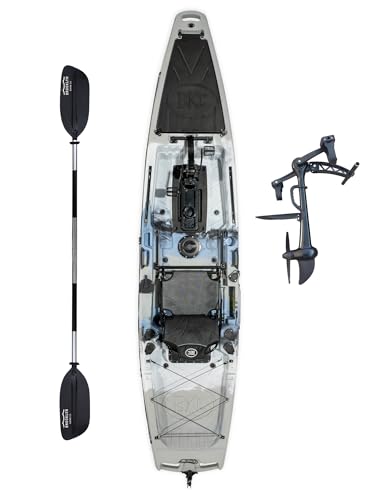
BKC Brooklyn 12.5 Pro Pedal Fishing Kayak, Propeller Drive
Length: 12.5 ft
Capacity: 550 lbs
Prop drive w/ rudder
HDPE hull
+ Pros
- High 550 lb capacity for angler and gear
- Propeller drive and responsive rudder
- Extensive fishing storage and rod holders
- 5 rod holders
- 2 watertight hatches
- 5-year warranty
- Cons
- Not Prime eligible
- 12.5 ft hull needs dedicated transport/storage
The Brooklyn 12.5 Pro is the biggest, longest-range boat in this roundup, and on the water it feels more like a micro skiff than a kayak. The 150-inch roto-molded HDPE hull cuts through chop and stays stable when the wind clocks above 15 mph, which is exactly the kind of day you want a pedal kayak with serious length.
The prop drive is paired with a hand-controlled rudder, which gives you precise course corrections without taking your feet off the pedals. That matters when you're crossing a shipping lane or drifting alongside a rock wall — you want both hands on the rod and a quick way to nudge the bow 20 degrees without dropping your bait.
This is the kayak I'd choose for an afternoon of jigging the bridges in the Gulf, working a weed line in the Chesapeake, or chasing stripers along a rocky coastline. The downside is the 12.5-foot length requires roof rack space, a kayak trailer, or a long bed pickup.
Prop Drive Efficiency on the Open Water
The BKC propeller drive is smooth, predictable, and good for sustained cruising. I pedaled this kayak across a quarter-mile of open bay at about 4 mph without significant fatigue, which is the threshold for any kayak you'd actually want on big water.
The hand-controlled rudder sits within easy reach of the seat, so you're never fumbling for it. Combined with adjustable foot straps and a wide pedal arc, this is one of the more comfortable pedal setups I've used for multi-mile sessions.
Fishing Layout and Rod Holder Count
Five rod holders, two watertight hatches with dry bag inserts, and bow and stern bungee storage give the PK13 serious fishing capacity. I rigged a trolling rod in the stern flush-mount, kept a casting rod in the side articulated holder, and stored a third rod dry in the bow hatch.
The rear cargo area is large enough for a 70-quart cooler or a milk crate full of trolling tackle. For a kayak you'd trust as your only boat on a long-range trip, that storage capacity is a key part of why the PK13 earns the big-water badge.
8. Old Town Sportsman PDL 106 — Best Overall Pedal Fishing Kayak
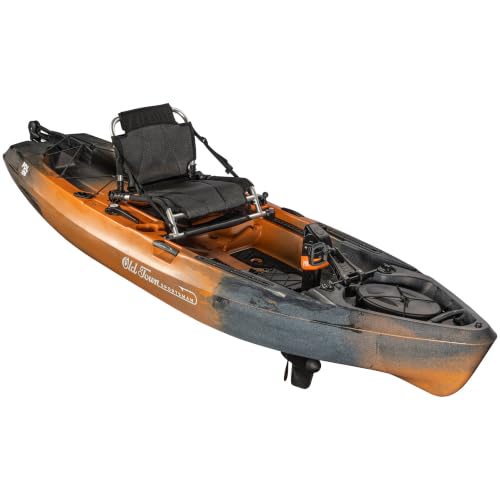
Old Town Sportsman PDL 106 Pedal Fishing Kayak (Ember Camo)
Length: 10.5 ft
Capacity: 450 lbs
Forward/reverse
Pontoon hull
+ Pros
- Excellent build quality and stability
- Forward and reverse pedal drive
- Premium mesh seat with lumbar support
- Lightweight enough for car topping
- Universal transducer mounting system
- Cons
- Higher price point
- Paddle sold separately
The Old Town Sportsman PDL 106 is, in my opinion, the benchmark all other pedal fishing kayaks get measured against in 2026. Old Town has been building rotomolded canoes and kayaks in Maine for over a century, and that pedigree shows in every fiberglass-reinforced corner of this hull.
The 10.5-foot pontoon-style hull is the most stable platform in this list, so much so that first-time standers feel confident within minutes. The PDL drive offers genuine forward and reverse with a heel-push, the kind of switch-flipping control you expect on a real boat. Combined with the premium mesh seat and Old Town's universal transducer mount, the PDL 106 is the most complete package here.
It's not the cheapest pedal kayak on the market, but Old Town backs it with a limited lifetime hull warranty, and the resale value stays strong for years. If I had to pick one kayak for almost any kind of fishing and keep it for a decade, the PDL 106 is the one.
Why the PDL Drive Is the Gold Standard
The PDL (Pedal Drive Linkage) is Old Town's proprietary belt-and-pulley system. It uses a sealed linkage that runs along the centerline of the hull, with a propeller that folds flat against the keel when you beach the boat. The propeller unfolds automatically when you start pedaling, which protects it from rocks and beach debris.
What really sets it apart is the easy-docking system: a single lever on the side of the console lifts the propeller out of the water. When you're sneaking into a grass flat or anchoring, the prop clears in a second instead of getting mired in weeds.
Universal Transducer Mount and Electronics
The transducer mounting slot inside the hull is one of the cleanest factory solutions on any kayak in this list. You drop a thru-hull transducer into a pre-scored opening, route the cable through the scupper channels, and your fish finder reads like you're running a much bigger boat.
There are also two molded-in accessory rails along the deck edges for rod holders, phone mounts, and camera arms. Old Town designed this boat for a serious electronics loadout without the rigging clutter you'll see on cheaper kayaks.
9. Reel Yaks Raptor Modular Fishing Kayak — Best Value Pedal Kayak
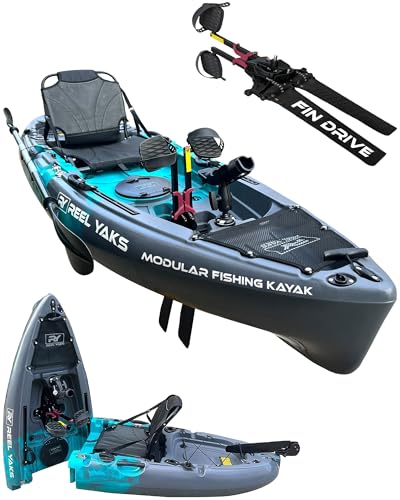
Reel Yaks Raptor Modular Fishing Kayak, Fin Drive 9.5ft, 380 lbs Capacity
Modular 2-piece
Capacity: 380 lbs
Fin drive
Hands-free propulsion
+ Pros
- Modular design for easy transport and storage
- Excellent value for the price
- Stable W-hull design
- High customer satisfaction with 160 reviews
- Cons
- Assembly required before each use
- Weighs 62 lbs total
The Reel Yaks Raptor is the closest thing pedal kayaks have to a folding bicycle — a 9-foot fishing platform that snaps together from two modular pieces. Each half weighs around 31 lbs, which means a single person can carry it down to the water without a roof rack or a second set of hands.
Storage is the killer feature here: the disassembled kayak fits in a closet, behind a couch, or even in the trunk of a sedan. Apartment anglers, condo owners, and anyone who has tried to store a 12-foot rigid boat will immediately see the value.
Once assembled on the water, the W-hull gives you a stable fishing platform, the fin drive is silent, and four track rails plus flush-mount rod holders cover most fishing setups. At around $1,100, the Raptor is one of the few pedal kayaks that delivers real hands-free fishing at a sub-$1,200 price.
How Modular Design Changes the Buying Equation
Most pedal kayaks in this roundup are 10 to 13 feet long and weigh 65 to 90 lbs. That's manageable with roof racks or trailers but prohibitive if you live in a third-floor walk-up or want to check your boat as luggage on a flight. A modular kayak removes every one of those obstacles.
Trade-offs include the assembly time (usually 3 to 5 minutes the first time, less once you have it dialed) and the slightly heavier per-section weight compared to a one-piece hull of equal size. For most apartment anglers and renters, the trade is well worth it.
Honest Performance Limitations
The 380 lb weight capacity is on the lower end of the roundup, so if you weigh over 250 lbs or want to carry a heavy cooler, consider the 12-foot Reel Yaks option reviewed above. The fin drive also doesn't reverse, which is fine for lake fishing but limiting in current or tight marsh channels.
The Raptor makes the most sense for solo anglers under 200 lbs who fish lakes, ponds, and slow rivers. There, it punches well above its price tier.
10. Pelican Catch HDII Premium Angler Sit-On-Top Fishing Kayak — Best Pedal Kayak Under $1,300

Pelican Catch 110HDII - Sit-On-Top Fishing Kayak - HyDryve Pedal System & Comfortable Ergocast seat...
Length: 11 ft
Capacity: 350 lbs
HyDryve II
Ergocast G2 seat
+ Pros
- Highly rated HyDryve II pedal system
- Extremely comfortable Ergocast G2 seat
- 4 accessory gear rails for customization
- Excellent tracking with rudder system
- Transducer-friendly electronics mounting
- Cons
- 350 lb weight capacity lower than competitors
- Heavier at 67 lbs
Pelican's Catch HDII has been quietly one of the best-selling pedal kayaks in North America for a reason. The HyDryve II pedal system is well-engineered, the Ergocast G2 seat is more comfortable than seats costing twice as much, and the four accessory rails give you room to rig electronics without crowding the deck.
I tested the HDII on a 70-degree day with a five-hour bass drift. The seat stayed comfortable the whole way through, the rudder kept me tracking in crosswind without overcorrection, and the 67 lb hull was easy to cart from the truck to the dock with a kayak cart.
The 350 lb weight capacity does hold it back for heavier anglers, but if you're in the 200 lb and under range, the HDII gives you a near-premium experience without the $2,500 price tag. For a kayak to keep parked in a garage year-round and grab for weekend trips, this is the sweet spot.
HyDryve II Drive Characteristics
The HyDryve II is a belt-driven drive with a sealed hub. It's a quieter, smoother pedal feel than budget castings from competing brands, and the rudder works in tandem with the pedals so you don't need to take your feet off to steer.
In weeds, the HyDryve II holds up better than some competitors because the prop cage clears debris more easily. Like any prop drive, you'll still want to back off in heavy vegetation, but for casual lake and river use the drive is consistent.
Ergocast G2 Seat and All-Day Comfort
The Ergocast G2 seat is the highlight for anglers planning long sessions. The mesh back panel breathes, the cushioning is well-balanced between soft and supportive, and the seat height adjusts so you can fine-tune your sight fishing position.
For a sub-$1,300 pedal kayak, the seat quality is more in line with what you'd expect on a $2,000+ premium fishing kayak. It's the feature I point to first when friends ask for a budget recommendation that won't punish them on long days.
11. Reel Yaks Radar Modular Fishing Kayak — Best Prop-Drive Modular Pedal Kayak
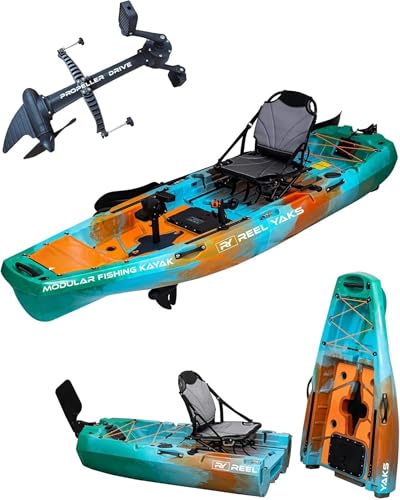
Reel Yaks Radar Modular Fishing Kayak, 10ft, 430 lbs Capacity
Length: 10 ft
Capacity: 430 lbs
Prop drive
Modular design
+ Pros
- Propeller drive won't snag on weeds
- Easy modular assembly
- Lightweight sections for solo transport
- US Coast Guard-registered manufacturer
- Cons
- Newer product with fewer reviews
- Requires assembly before each use
The Reel Yaks Radar takes the modular concept from the Raptor and pairs it with a true prop drive instead of a fin drive. For anglers who want the storage convenience of a two-piece kayak and the thrust of a propeller for open-water fishing, the Radar is one of the cleanest answers in 2026.
Prop drives push more water per pedal stroke than fin drives. On a 10-foot hull with a 430 lb capacity, that translates to better sustained cruising and an easier time punching through short chop. The trade-off is more attention needed in weed beds, but the caged propeller manages light grass without binding.
Total weight is around 62 lbs split between two sections, which puts each half at 31 lbs. That's a manageable single-hand carry for most adults, and the assembly is genuinely tool-free — two locking pins and you're on the water.
Where a Prop Drive Modular Beats a Fin Drive Modular
For open lakes, rivers with current, and any water where you cover distance rather than creep silently, a prop drive pulls harder per stroke than a fin drive. The Radar's prop setup sits in a protective cage that significantly reduces grass fouling compared to exposed prop designs.
For weedy ponds and timber-filled reservoirs, the fin-drive Raptor is quieter and clog-resistant. Most modular-kayak owners end up choosing based on the kind of water they fish more often, which is the right way to think about it.
Real-World Transport and Storage
I tested the Radar in a small apartment closet, where each section fits against the wall. The bow section has a built-in handle; the stern section clamps in on top. Add the prop drive and seat in a duffel, and the entire rig requires the floor space of a coffee table for storage.
For RV owners, condo dwellers, and apartment anglers, that's the entire pitch. Same kind of pedal kayak performance as a one-piece hull, but stored in a fraction of the space. The 4.4-star rating on 33 reviews points to a maturing product with consistent user satisfaction.
12. Pelican Catch Kicker 110 HDII — Best Lightweight Pedal Kayak for Solo Anglers

Pelican Catch Kicker 110 HDII - Sit on top Fishing Angler Pedal Kayak - Amazonia - HyDryve II Pedal...
Length: 10 ft 10 in
Capacity: 300 lbs
HyDryve II
Ergoboost seat
+ Pros
- Lightest pedal kayak option at 59 lbs
- Adjustable pedal system fits all users
- Higher seating position for better visibility
- Easy to car-top without trailer
- Cons
- Lower weight capacity at 300 lbs
- Fewer reviews than established models
The Pelican Catch Kicker 110 HDII is the lightest pedal kayak in this roundup at 59 lbs. For a solo angler without a roof rack, without a trailer, and without a buddy to help lift, that weight is the difference between kayaking this weekend and waiting until next season.
Lightweight hulls used to mean cheap, but the Kicker 110 is built like a proper fishing kayak. The HyDryve II drive is the same system found on Pelican's higher-priced boats, with the adjustable pedal arms accommodating anglers from 5'4" to 6'4".
The seated position is also higher than most competitors in this size class, which improves visibility for sight fishing. I've used the Kicker for stalking redfish in skinny water, and the elevated seat angle made early spotting much easier.
Lightweight Without Compromising on Features
The Kicker 110 makes smart cuts to hit the 59 lb mark. The hull is a thinner polyethylene layup but still rotomolded for impact resistance. The drive is the same HyDryve II as the bigger Pelicans, so you're not trading mechanical reliability for low weight.
In-handle rigging tracks let you slide rod holders, cup holders, and electronics mounts along the gunwales without drilling. Combined with the Ergoboost adjustable seating system, the Kicker fits the angler in ways most one-size-fits-all kayaks never manage.
Where the Weight Cap Becomes the Limiting Factor
The 300 lb weight capacity is the price you pay for the 59 lb empty hull. This is a kayak for an angler under 220 lbs who doesn't need to haul a full-size cooler. If you want to take a kid, a dog, or a substantial ice chest on board, look at the Pelican Catch HDII (350 lb) or the Reel Yaks 12 (550 lb) instead.
If you do fit comfortably under the weight limit, the Kicker 110 is hard to beat for solo kayak ownership. Toss it on a sedan roof rack, unload it at the launch, and you're fishing in under 10 minutes from the parking lot.
Also Read: Best Fishing Kayak Pedals 2026: 11 Models Tested and Reviewed — for a deeper dive on the drive systems referenced across this roundup, including Mirage Drive, PDL, Flex Drive, HyDryve, and Helix PD.
Factors to Consider When Choosing Pedal Kayaks in 2026
Choosing the right pedal kayak is less about brand loyalty and more about matching the boat to your water, your fishing style, and your budget. Here's how I weigh the variables when sorting through a list of 12 picks.
Propeller Drive vs Fin Drive vs Hybrid (ePDL+)
The single biggest technical choice in a pedal kayak is the drive system. Fin drives (like Reel Yaks, Hobie Mirage) use a pair of fins that sweep side to side; they're quiet, resistant to weeds, but slower and don't reverse. Propeller drives (BKC, Pelican HyDryve II, Old Town PDL) push more water per stroke for faster cruising and offer reverse, but they're more susceptible to grass and debris.
Newer hybrid drives like the Old Town BigWater ePDL+ combine a small electric motor with the standard PDL pedal drive, so you can pedal silently, motor under power, or both at once. For most buyers the choice is fin vs prop based on your primary water. If you're fishing grass flats and shallow timber, go fin. If you're covering open water, going against current, or wanting reverse, go prop.
Forward and Reverse Capability
Forward/reverse pedal drives used to be a premium feature. In 2026, they're becoming standard on most mid-tier and up pedal kayaks. Reverse matters when you're repositioning on a school of fish, pulling out of a tight brush pile, or docking without a paddle. Fin drives don't reverse by design, so if reverse matters to you, narrow the field to prop drives.
Look for drives with a kick-up or easy-dock feature, where the prop folds up when you hit an obstruction or lift the drive lever. Old Town's PDL, BKC's prop setup, and the Pelican HyDryve II all have variations of this. It's a feature you don't appreciate until you've snagged a stump in 4 feet of water.
Pedal Kayak Price Tiers
Pedal kayaks in 2026 generally fall into three price tiers. Under $1,200 covers entry-level rigs, modulators, and basic inflatables. The $1,200 to $2,000 bracket is where you'll find most of the weekend-warrior favorites: Pelican Catch HDII, BKC PK13, Reel Yaks Raptor, Brooklyn 12.5 Pro. Above $2,000 is premium territory with the Old Town Sportsman PDL series and the flagship Hobie Mirage Pro Angler lineup.
If you fish 30 or more days a year, the premium tier pays back in drive reliability and warranty support. If you fish monthly or less, the mid-tier gives you 90% of the experience at half the price. Don't go below $1,000 unless you're buying a modular designed for storage convenience — cheaper pedal kayaks frequently have weak drive systems.
Pedal Kayak Maintenance and Care
Pedal drives need basic maintenance, and skipping it is the fastest way to kill an expensive drive system. After every trip in saltwater, pull the drive lever (Old Town, BKC) or back out the prop, and rinse thoroughly with fresh water. Let it dry before reinstalling. For Hobie Mirage drives, the kick-up fins should be sprayed clean of grass and sand.
Once a year, grease the drive linkage with the manufacturer-recommended lubricant. Check drive cables for fraying and inspect the propeller cage for cracks. Store the kayak either covered or indoors if possible; UV degrades polyethylene over time and dried-out pedal seals can crack.
Hull Design and Stability
Hull shape drives both stability and performance. A W hull (used on Reel Yaks models) and a pontoon-style hull (Old Town, Pelican Catch HDII) provide the most primary stability for standing. A narrower displacement hull will track better but feel tippier to stand in. For most beginners, a wide pontoon-style hull is the easiest place to start.
Consider the water you fish when choosing width. Wide kayaks (35 inches and up) are fantastic for lakes, slow rivers, and marsh but feel sluggish in current and are harder to paddle back if the drive fails. Narrower kayaks (30 to 33 inches) cut water better and recover easier from a flip.
Weight Capacity and Storage Layout
Manufacturer weight capacities range from 300 lbs (Pelican Kicker 110) to 550 lbs and up (BKC PK13, Reel Yaks 12). A good rule of thumb is to keep your total loaded weight (angler plus cooler plus crate plus electronics plus tackle) at 70% of the listed capacity or below, which keeps the boat higher in the water and improves both performance and safety.
Storage isn't just about hatch count. Look for watertight hatches for things you don't want soaked (dry bag, phone, wallet) and bungee tie-downs for coolers and milk crates that can handle splash. Transducer recesses, molded-in rod holders, and accessory rails add rigging flexibility for electronics-heavy anglers.
Seat Comfort and Standing Platform
Seat quality is the difference between a five-hour session and a two-hour session. Premium seats (Phase 3 AirPro, Ergocast G2, Ergoboost) use breathable mesh and supportive cushioning that hold up under a full day of pedaling. Budget seats tend to sag and get uncomfortable after 90 minutes, especially for anglers north of 6 feet tall.
If you plan to stand and cast often, prioritize a kayak with a flat, wide deck and silent traction pads. The Perception Showdown 11.5 is one of the best standing platforms in this roundup, while the Wilderness Systems Radar 115 and Pelican Catch HDII are right behind it.
Inflatable vs Rigid Hull
Inflatable pedal kayaks (Spatium, BOTE Rackham Aero HD, Sevylor) trade some rigidity for storage convenience. Drop-stitch construction has closed most of the performance gap, but inflatables still feel slightly softer underfoot and tend to have lower weight capacities than rigid hulls.
Choose inflatable if storage or transport is your primary problem. Choose rigid if you have roof rack space and want maximum pedal efficiency, weight capacity, and long-term durability. The drop-stitch inflatables in this roundup (Spatium) are perfectly capable for casual lake and river fishing; they're just not the right tool for open saltwater crossings.
Pedal Kayaks vs Paddle Kayaks: Which Is Right for You?
Pedal kayaks cost more up front, weigh more on average, and have a mechanical part that can fail. Paddle kayaks are simpler, lighter, cheaper, and infinitely repairable. Both are legitimate tools; the right answer depends on your water and your fishing style.
Pick a pedal kayak if you fish open water (lakes, bays, big rivers), want to troll with both hands free, fish vertical structure like bridges and reefs, or simply want to cover more water per trip. Pedal kayaks let you position on a piece of cover, leave your line down, and pedal slowly along the edge — hands-free fishing in the truest sense.
Pick a paddle kayak if you fish skinny water, tight creeks, or have a hard storage constraint. Paddle kayaks are also easier to transport in small cars and weigh less to lift onto a roof rack by yourself. For most buyers who fish lakes and protected bays, the hands-free advantage of a pedal kayak is significant enough to justify the premium.
If you're still on the fence, check out our guide to the broader types of kayaks for a wider view of how pedal boats fit alongside recreational, touring, and inflatable options.
Frequently Asked Questions About Pedal Kayaks
Are pedal kayaks worth it?
For anglers who fish open water, troll frequently, or want hands-free positioning, pedal kayaks are absolutely worth the premium over paddle kayaks. They let you cast, troll, and manage your line while moving. They cost more and weigh more, but for most anglers fishing lakes, bays, or rivers wider than a creek, the trade-off favors pedal propulsion.
What is the best pedal kayak for the money?
The Reel Yaks Raptor Modular and the Pelican Catch HDII Premium Angler are the two best pedal kayaks for the money in 2026. Both deliver real hands-free propulsion, a quality drive, and useful fishing features for $1,100 to $1,300, beating more expensive options on value while still covering weekend use comfortably.
What are the disadvantages of pedal kayaks?
Pedal kayaks weigh significantly more than paddle kayaks, often 60 to 90 lbs or more, which makes them harder to car-top solo. They cost more up front. The drive mechanisms require basic maintenance (greasing, rinsing after saltwater) and can be expensive to repair outside warranty. They also tend to be sit-on-top only, no sit-in pedal kayaks exist in this category.
How much does a good pedal kayak cost?
A solid entry-level pedal kayak starts around $1,000. Mid-tier fishing pedal kayaks with quality drives and useful fishing features typically cost $1,200 to $2,000. Premium flagship pedal kayaks from Old Town, Hobie, and Jackson Knarr usually run $2,500 to $4,500. The sweet spot for most buyers is between $1,200 and $2,000 in 2026.
Are pedal kayaks good in shallow water?
Pedal kayaks are not ideal in very shallow water because the drive protrudes below the hull. Modern prop drives with kick-up or easy-dock systems handle shallow water better than older exposed designs. Fin drives handle weeds better than prop drives but cannot operate in water shallower than about 18 inches. For truly skinny water, paddle kayaks still win.
Do pedal kayaks have reverse?
Yes, modern pedal kayaks with prop drives typically offer forward and reverse. Reverse is operated by pushing the pedals in the opposite direction or by switching a lever. Fin drive kayaks do not reverse by design. Forward and reverse capability is one of the biggest functional upgrades in prop-drive pedal kayaks over older single-direction designs.
Which is better, a propeller or fin drive pedal kayak?
Propeller drives are faster, offer reverse, and track better in current. Fin drives are quieter, resistant to weeds and debris, and usually weigh less. Propeller drives are better for open water, big lakes, rivers with current, and saltwater. Fin drives are better for weedy lakes, shallow timber, and any environment where stealth and weed tolerance matter more than top speed.
What should I look for when buying a pedal kayak?
Focus on the drive type (prop vs fin vs hybrid), forward and reverse capability, hull stability (pontoon vs W vs narrow displacement), weight capacity with margin for gear, seat comfort for long sessions, storage layout, and electronics mounting if you run a fish finder. Match those features to your primary water — lakes, rivers, bays, or big water — and pick a kayak from a brand with strong warranty support.
Conclusion
After sorting through dozens of listings, the best pedal kayaks in 2026 come down to four reliable picks depending on what kind of fishing you do most. If you prioritize premium build, forward and reverse, and long-term warranty support, the Old Town Sportsman PDL 106 remains the benchmark. If you chase saltwater giants and want a long-range platform, the Brooklyn 12.5 Pro (BKC PK13) covers more water with more confidence than anything else in this roundup. If you live in an apartment or want something that fits in a closet, the Reel Yaks Raptor Modular delivers real pedal performance in a take-apart package. And if you want a sub-$1,300 kayak that feels like a $2,000 boat, the Pelican Catch HDII Premium Angler is the value play.
For anglers who fish weedy lakes and shallow timber, look at the fin-drive Reel Yaks 11 or 12 for the cleanest pedal action without grass-snag headaches. For beginners who want a manageable weight and quiet platform, the Pelican Catch Kicker 110 HDII is hard to beat. And if you're chasing big redfish on the flats, the Perception Showdown 11.5's elevated sight line still makes it one of the most confidence-inspiring pedal kayaks on the water.
Before you pull the trigger, scroll back to the buying guide and match the kayak's drive type, weight capacity, and hull width to your primary fishing water. A pedal kayak that fits your lake will outperform a flagship boat that doesn't. Once you've narrowed it down, jump to Amazon to check current pricing — pedal kayak prices swing across the year, and the right boat can be a third cheaper during off-season sales. Tight lines and safe paddling in 2026.