
8 Best Rotisserie Grills for Whole Chickens (October 2026)
A rotisserie grill is a grill or outdoor cooker with a motorized spit that turns a whole chicken slowly over direct heat, basting it repeatedly in its own rendered fat so the skin browns evenly and the breast stays juicy without you ever turning or repositioning the bird. That constant motion is the whole point. A rotisserie removes hot spots, the one variable that ruins most whole-bird cooks, and it frees up your main grate for sides. After running these eight spit roasters and countertop rotisserie ovens through a full season of chicken cooks, I can tell you which ones handle a bird cleanly and which ones advertise a load rating the hardware cannot back up.
This roundup of the best rotisserie grills for whole chickens ranks every pick by chicken outcome rather than by grill category. Did it cook one bird well? Can it hold two? Is there clearance under the closed hood for a 4 to 6 lb bird? Is the motor strong enough to turn a badly balanced load without groaning? Those are the questions I scored, and the answer rarely matches the spec sheet.
One thing to sort out early: almost everything in this roundup is a spit roaster or a countertop oven, not a gas grill with an integrated rear infrared burner. That is deliberate. The most common question I get is whether an existing grill plus a rotisserie kit is enough, and the short answer is that a good kit is often all you need. But if you are shopping from scratch, the motor torque, spit length and heat management below matter more than brand badges.
Every pick here is rated on the same four things: can it hold the bird off the heat, does the motor keep turning under load, is there room under the closed hood, and how much of a pain is cleanup afterward. I also weighed whether the load rating is honest, because manufacturers quote optimistic numbers and buyers find out at 2 lb of offset weight.
Our Top 3 Rotisserie Grills for Whole Chickens
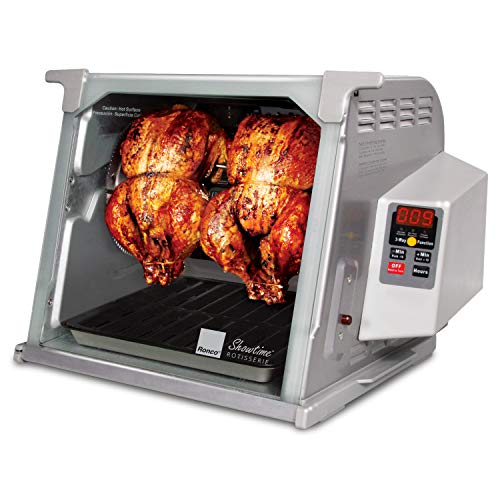
Ronco 5000 Platinum Countertop Oven
- Cooks two whole chickens
- 1500W digital controls
- Self-basting rotation with heat reflector
- Dishwasher-safe door and drip pan
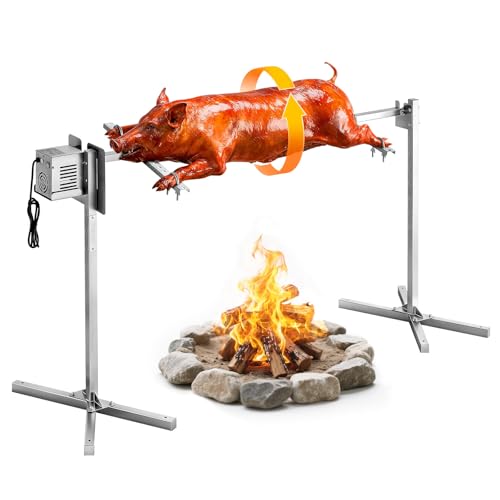
VEVOR 52-Inch Rotisserie Grill
- 38W motor at 3 RPM
- 132 lb load capacity
- 8 height levels with ground stakes
- SUS304 food-contact forks

Ronco 5500 Countertop Rotisserie Oven
- 12-lb capacity
- Three roast and sear presets
- 3-hour auto-shutoff timer
- Dishwasher-safe door and drip pan
Comparing Every Rotisserie Grill in This Roundup
All eight picks below turn birds with a motor-driven spit. The differences that matter for a whole chicken are the motor wattage, the load rating, the spit length, and whether the unit gives the bird a hood to cook under. The countertop ovens hold a second bird in an enclosed chamber. The tripod roasters cook over open coals with nothing overhead, which gives you smoke flavor but also means you manage the fire yourself.
| Product | Key Specs | Action |
|---|---|---|
| Ronco 5000 Platinum Digital Countertop Rotisserie Oven |
|
Check Latest Price |
| VEVOR N52-Inch Electric Rotisserie Grill Kit |
|
Check Latest Price |
| Ronco 5500 Series Countertop Rotisserie Oven |
|
Check Latest Price |
 Ash and Ember 13W Tripod Rotisserie Roaster Stand Ash and Ember 13W Tripod Rotisserie Roaster Stand |
|
Check Latest Price |
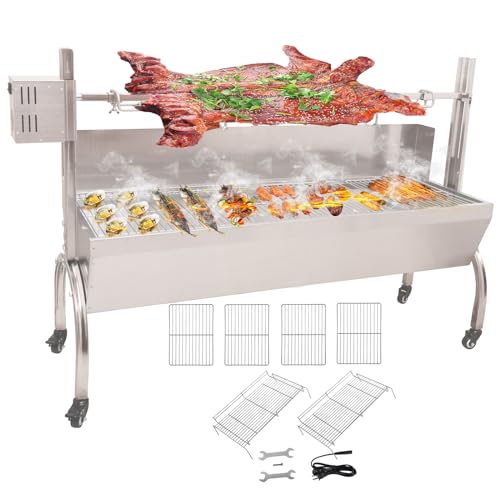 DEWOSEN 50W Charcoal Spit Roaster with Wind Screen DEWOSEN 50W Charcoal Spit Roaster with Wind Screen |
|
Check Latest Price |
 DNKMOR 52-Inch Tripod Rotisserie Kit, 90 lb DNKMOR 52-Inch Tripod Rotisserie Kit, 90 lb |
|
Check Latest Price |
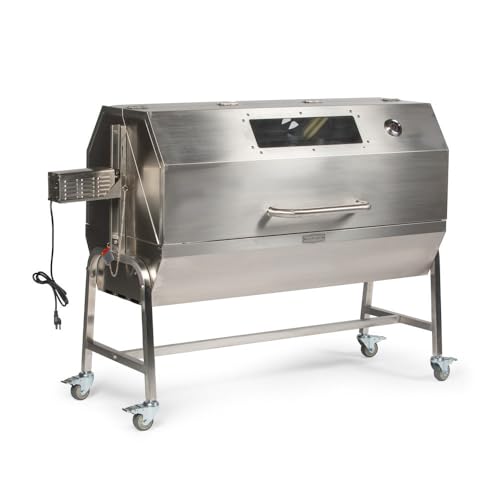 Ash and Ember 25W Hooded Stainless Steel Rotisserie Grill Ash and Ember 25W Hooded Stainless Steel Rotisserie Grill |
|
Check Latest Price |
 onlyfire Cordless Spit Rotisserie Outdoor Camp Grill onlyfire Cordless Spit Rotisserie Outdoor Camp Grill |
|
Check Latest Price |
Two entries stand out for chicken specifically. The Ronco 5000 pairs a 12 lb capacity chamber with digital controls that set rotation speed and temperature together. The DEWOSEN has the most metal around the fire, with 51 inches of spit length and four height tiers that let you stack positions for a big cook.
How Long to Rotisserie a Whole Chicken and When to Pull It
The rule of thumb is about 20 minutes per pound, and that applies to rotisserie chicken on a grill just as it does in an oven. A 4 lb bird lands near 80 minutes, a 5 lb bird near 100 minutes, and a 6 lb bird around two hours. Countertop ovens with a 1500W element usually run to the slow side of that range, so start checking temperature early rather than trusting the clock.
Do not pull on time alone. Push an instant-read probe into the thigh, avoiding the bone, and pull at 165F in the breast and 170 to 175F in the thigh. A probe thermometer with a remote alarm lets you set it in the bird and walk away, which is the method several readers use instead of babysitting the grill.
Rest the bird 10 to 15 minutes after pulling, loosely tented, before carving. Resting lets the juices redistribute instead of running out across the carving board.
Here is the timing we use, starting temperature 350F to 375F:
3 to 4 lb bird: 60 to 80 minutes at 375F, pull breast at 165F and thigh at 170F, rest 10 minutes.
5 lb bird: 90 to 110 minutes at 375F, same pull temperatures, rest 15 minutes.
6 lb bird: 110 to 130 minutes at 350F to 375F, rest 15 minutes.
8 lb bird or turkey: 150 to 180 minutes at 350F, rest 20 minutes before carving.
Two birds at once: add 15 to 25 minutes over the single-bird time and rotate the positions halfway through the cook so both birds see the same heat.
On charcoal setups, the coals sit at the rear and the bird cooks in indirect heat. If you want a hotter finish, move a small pile of lit coals forward in the final 20 minutes rather than banking the whole fire up front.
1. Ronco 5000 Platinum Digital Countertop Rotisserie Oven - Two Chickens in a Countertop Box
Ronco 5000 Platinum Digital Countertop Rotisserie Oven, 12-lb Capacity
12-lb capacity
1500 watts
13 x 18 x 15 inches
Electric, 1-year limited warranty
+ Pros
- Cooks up to a 12 lb turkey or two whole chickens
- Self-basting rotation plus removable heat reflector
- Digital Roast and Sear presets remove guesswork
- Dishwasher-safe glass door and drip pan
- Only 13 inches tall so it stores under cabinets
- Cons
- Recommended cook times run long so use a thermometer
- Noticeable smoke in an enclosed kitchen
- Bulky footprint for small counters
This is the unit I keep coming back to, and the reason is simple: it is a 12-pound-capacity oven whose maker lists cooking up to a 12 lb turkey or two whole chickens, which almost nothing else in this roundup claims. In a two-bird session both birds came off evenly browned with the probe reading in the right place.
Both Ronco ovens carry the same 12-pound capacity claim, and the 5000 is the one that pairs it with digital controls that set temperature and rotation speed together, so you are not guessing at a dial position after two other dishes have gone in the oven.
At 13 inches tall and 18 inches wide, it slides under a standard cabinet, which is the deciding factor for anyone without an outdoor kitchen. The 1500W element heats fast and recovers quickly, and the removable heat reflector is what browns the skin while the rotation keeps the juice moving. Owners also caution that the printed cooking times run long, so set a probe and trust the reading rather than the number on the panel.
Capacity for one bird or two
The maker lists cooking up to a 12 lb turkey or two whole chickens, and reviewers confirm two modest birds fit. Two birds of roughly 3 lb each turn on the rotisserie basket, and the spit length gives you clearance from the heating element at the back.
A single 5 lb or 6 lb bird has plenty of room, and the rotation gives you even heat without a two-zone fire. This is the pick for a family that wants Sunday chicken without firing up the backyard grill.
Who it is good for
It suits anyone without outdoor space, anyone cooking two birds for a holiday meal, and anyone who wants rotisserie results on a weeknight with a timer doing the work. The 3-hour auto-shutoff means you can start it and go to bed without worrying about it running all night, and the included basket handles fish, vegetables and sausages on nights with no chicken in it.
Who it is not for
It is not for you if you need smoke flavor. The roasting environment is a clean electric box, and there is no way to introduce wood or charcoal. It is also a poor fit for a very small kitchen, since the 12 lb capacity comes with a real footprint and it does produce noticeable smoke when the fat renders.
2. VEVOR 52-Inch Rotisserie Grill - the Most-Reviewed Spit in the Roundup
VEVOR Rotisserie Grill, N52" Electric Rotisserie Grill Kit
52-inch stainless frame
38W motor at 3 RPM
132 lb load capacity
68.5 x 21.06 x 33.86 inches
+ Pros
- 132 lb load capacity handles large birds and small hogs
- 38W motor with dual bearings and a cooling fan
- Eight height levels plus ground stakes for uneven ground
- SUS304 stainless food-contact forks
- Portable enough for camping or events
- Cons
- Visible share of 1-star reviews flags durability and assembly issues
- Steel rather than SUS304 in some non-food-contact parts
- 52-inch frame is bulky to transport and store
With 869 reviews behind it, this is the most heavily reviewed spit roaster we tested, and the capacity-to-spec-sheet ratio is hard to argue with. The 38W motor turns at 3 RPM on dual bearings with a cooling fan, and the frame is rated to 132 lb on a 52-inch spit.
The eight height levels and the reinforced 45-degree tripod with ground stakes are the details that separate it from cheaper tripods. On uneven grass, the stakes stop the frame from walking as the motor loads the shaft, and the height adjustment lets you bring the bird close to the coals when you want browning.
For whole chicken specifically, the 52-inch spit length means you are not threading a bird through a short shaft, which is where smaller kits make you fight. A 5 lb or 6 lb trussed chicken sits well clear of the coals and rotates without the motor straining.
The 4.0 average across 869 reviews comes with a visible one-star share, and buyers who rate it low point at assembly quality and hardware finish rather than the motor. The motor itself draws consistent praise for smooth rotation under real load.
Motor torque and what the load rating really means
A 38W motor at 3 RPM sounds modest until you realize the rotation speed is deliberately slow. Slow rotation is the point, because the bird needs to move past the heat steadily rather than spin fast and dry out.
Treat the 132 lb figure as a ceiling, not a target. That rating assumes a balanced load centered on the shaft. Put a 6 lb chicken a few inches off-center and the effective load on the motor changes dramatically, which is the single most common reason a rotisserie stalls mid-cook.
Who it is good for
This suits backyard cooks feeding a crowd and anyone cooking on grass or soft ground where a light tripod will tip. The stainless frame wipes clean and resists rust, which matters if you leave it outside between cooks, and the stated capacity also covers whole pigs, lambs and turkeys.
Who it is not for
It is not for a small patio or a garage with tight clearances. At 68.5 inches long and 25.4 pounds, it is a two-person carry and a dedicated storage spot. It also has no hood, so you are managing heat and smoke entirely on your own.
3. Ronco 5500 Series Countertop Rotisserie Oven - the Set-and-Forget Workhorse
Ronco 5500 Series Countertop Rotisserie Oven, 12-lb Capacity, Stainless
12-lb capacity
1250 watts
14.5 H x 19.5 W x 13.5 D
Stainless steel, 1-year limited
+ Pros
- Consistently juicy and evenly cooked results across many meats
- Sturdy and quiet operation with a stainless finish
- Set-and-forget compared with a gas rotisserie
- Dishwasher-safe door and drip pan
- Many owners report years of reliable use
- Cons
- Recommended cook times are inaccurate so use a thermometer
- Some units had element or motor failure after about a year
- Two chickens at once only works with very small birds
If the 5000 Platinum is the spec-sheet winner, the 5500 is the one longtime owners defend. Across 426 reviews the 4.4 average reflects a machine that keeps working, and several buyers describe it as the appliance that replaced a gas rotisserie in their cooking routine.
Operation is simpler than the Platinum, with a single dial and three settings for roast, sear and warm, plus a timer that runs to three hours and shuts off on its own. The 1250 watt element heats more gently than the 5000, which for a large bird means a slower cook and a forgiving one.
The stainless body is a step up visually and in the hand, and the dishwasher-safe glass door and drip pan mean cleanup after a whole chicken is a two-minute job. Owners consistently report tidy, consistent browning on the outside with a juicy breast, and also that the stainless naming does not mean every interior surface is bare metal, since some interior components carry a non-stick coating.
Two birds on a 12-pound spit
The 5500 shares the 12-pound capacity rating with the 5000, but reviewers are clearer about the limit here: two chickens at once works only with very small birds. For a single 4 to 5 lb chicken you get the full chamber and even heat, with clearance from the element, and a slower 1250 watt element that is more forgiving on a large bird than the faster 1500 watt unit.
Who it is good for
It suits first-time rotisserie buyers who want a dial and a timer rather than a menu of presets, and anyone who values a simple appliance over a feature list. Long-term owners reporting years of service after replacing older appliances is the strongest signal here, and the automatic shutoff ends the cook whether you are watching or not, so it works as a holiday machine that can run unattended.
Who it is not for
If your holiday plan is two birds of 4 lb or more each, the 5000 Platinum is the better-matched unit and worth the step up, and the reported element or motor failures around the one-year mark make that 1-year limited warranty worth noting.
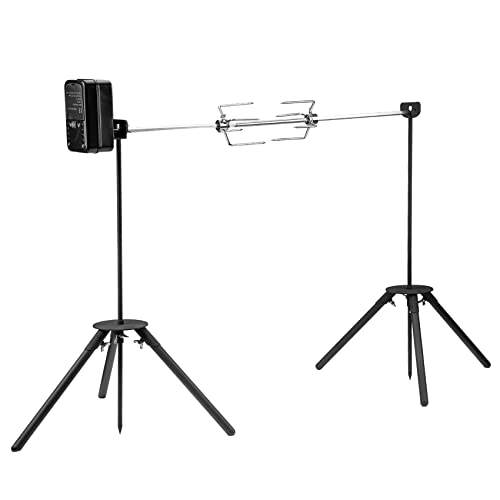
4. Ash & Ember 13W Tripod Rotisserie Roaster - Packs to the Campfire
Ash & Ember 13W Tripod Rotisserie Roaster Stand, Rated 85 LB, Adjustable Height Open Fire Roaster...
85 lb load capacity
13W motor at 4 RPM
51 inch round stainless spit rod
25 pounds with storage bag
+ Pros
- Compact and portable for open-fire cooking away from a built-in grill
- Stainless steel holds up outdoors without rusting
- Four height tiers accommodate different roast sizes
- 51 inch spit rod with dual prong forks
- Storage bag makes it easy to pack
- Cons
- Stand only
- needs a separate fire ring or grill
- Electric motor means you need power access
- 85 lb rating sits below the larger roasters here
This is the pick for cooks whose rotisserie happens at a campground rather than a patio. At 25 pounds with a storage bag, it breaks down and travels, and the stainless tripod is built to sit outside without rusting.
The 51-inch round stainless spit rod with dual 7.5-inch prong forks and leg brackets gives a whole chicken plenty of room, and the four height tiers at 15, 19, 23 and 27 inches let you raise or drop the bird as the fire burns down. The 13W motor at 4 RPM is slower than most, which suits chicken well.
What you are buying is a stand, not a cooker. It is designed to work over an open fire or a grill, and the maker suggests pairing it with a 32 or 36 inch fire ring sold separately. That separation of frame and fire is exactly what makes it portable, and exactly what makes it a two-part setup.
For a whole chicken the 85 lb rating is never the constraint. The constraint is your heat source, and a tripod over a wood fire gives you a flavor profile no electric countertop oven can approach. It also makes a good first rotisserie for anyone who already owns a portable fire ring and just needs a turning mechanism.
Balancing on an open tripod
Because there is no hood, the bird radiates heat from all sides, which makes centering the load more important. Trim the wing tips and tuck the legs against the body before mounting, then use the leg brackets to square the bird on the shaft so it spins level.
The prong forks and leg brackets lock with thumb screws rather than a ratchet. Check them by lifting the bird off the stand and rotating the shaft half a turn. If anything slides, the motor will find that slide later, mid-cook.
Who it is good for
It suits campers, tailgate cooks and anyone who wants open-fire chicken without building a permanent roaster, and the storage bag is what sells it because the whole thing folds down next to a tent or a truck bed.
Who it is not for
It is not a standalone grill, and it is not for large holiday roasts. The 13W motor is the smallest in this roundup, and because it is electric you need a power source, which limits how far into a field you can take it.
5. DEWOSEN 50W Charcoal Spit Roaster - Room for Two Birds Side by Side
DEWOSEN 50W Rotisserie Grill With Wind Screen - 51 Inch BBQ Outdoor Pig & Lamb Spit Roaster...
132 lb load capacity
50W motor at 4 RPM
51 inch spit, 304 stainless grates
20 x 20 x 20 inches, casters
+ Pros
- Handles large loads including whole lamb and small hogs
- 50W motor gives strong torque for basting
- Windscreen noticeably reduces charcoal consumption
- Stainless construction pressure washes clean
- Swivel caster wheels make it easy to move
- Cons
- Assembly is fiddly and instructions confuse some buyers
- Spit is two bolted halves which is awkward to load
- Fragile motor housing with an awkward on and off switch
- Support posts can bend under heavy loads
The 50W motor delivers the strongest torque of the powered spits here, and that is why I put this one high for multi-bird cooks. It turns at roughly 4 RPM with enough torque to keep a heavy, unevenly balanced load rotating instead of stalling, and the 51-inch spit length means two birds can sit on one shaft with space between them.
The wind screen is the sleeper feature for a charcoal setup. Owners report a noticeable reduction in charcoal consumption because the screen cuts airflow losses around the fire, which matters a lot on a long cook. The 304 stainless grill net is also non-chrome-plated, so it will not pit the way plated steel does.
Four height tiers at 5.1, 8.6, 12 and 15.3 inches from the grill surface let you position two birds at different heights, which is how you cook a chicken and a thicker cut together without the thick cut scorching.
The four swivel caster wheels make the whole unit movable, so you can roll it away from the grill when it is not in use. That matters if this is sharing patio space with a regular grill, and it is also the pick for a cook planning to graduate from chicken to lamb or a small hog without buying a second roaster.
Where the 132 lb rating gets optimistic
Buyers who cook at the 30 to 40 pound scale report good results, with even browning and a juicy interior on lamb and small pig. Buyers who push the stated 132 lb figure report bent support posts and a dropped spit. The capacity number is a ceiling with a perfectly balanced load, not a working target.
Bracing the support posts with wire is a common recommendation in the reviews, and it costs almost nothing. It converts a flexing frame into one that holds the shaft straight under a 40 lb load.
Who it is good for
It suits anyone cooking for a crowd who wants two birds on one shaft, and cooks who prefer charcoal with a wind screen over an electric element. The stainless build washes down easily, which is the right material for a unit that lives outside.
Who it is not for
It is not for anyone who wants a fast setup. Assembly is fiddly, the instructions confuse a share of buyers, and the spit is a two-piece bolted rod, which makes threading meat over the center joint awkward. Plan on an hour the first time and a light bar of soap on the joint afterward.
6. DNKMOR 52-Inch Tripod Rotisserie Kit - the Mid-Size Sweet Spot
52"Rotisserie Grill Kit Tripod Stand Stainless Steel Rated 90 LB,15W Motor
90 lb load capacity
15W motor at 4 RPM
54 inch prong spit rod
23.4 pounds, 61 inches wide
+ Pros
- 15W motor has real torque for a mid-size spit
- Four height tiers plus lockable casters keep the spit steady
- Stainless tripod resists rust outdoors
- 90 lb capacity covers whole birds and small hogs
- Casters make it movable for parties
- Cons
- Requires a separate charcoal or wood heat source
- Long 61 inch footprint is cumbersome to store
- Some build-quality complaints in the one-star share
This is the middle rung between a small camp spit and a 130-pound hooded roaster, and at 103 reviews with a 4.3 average it holds a 79 percent five-star share. The 15W motor at 4 RPM is the step up that matters, because it drives heavier food than the entry-level tripods manage.
The 54-inch prong spit rod takes a whole chicken with clearance at both ends, and the four height levels at 14.2, 18.1, 22 and 26 inches let you manage heat as the coals burn down. The lockable casters keep the frame from creeping on a hard surface, which is the failure we see most on lighter tripods.
For a whole chicken this is a genuinely capable unit. A 5 lb bird trussed and centered turns smoothly, and the stainless tripod is stable enough that you are not adjusting the frame every 30 minutes.
At 23.4 pounds and 61 inches wide, it is a two-person carry that wants a corner of the yard or garage to live in once you start using it for holiday cooks, though the lockable casters make it practical for people who cook outdoors only in fair weather.
Motor size versus the birds you actually cook
For chickens up to about 6 lb, the 15W motor has more than enough headroom, provided the bird is centered. The forks are the part to inspect before a big cook, because a prong fork that is slightly bent lets meat migrate and the motor keeps spinning an empty shaft.
Run the loaded shaft by hand for a full rotation before you fire it up. If you feel drag anywhere, fix the balance now rather than halfway through the cook.
Who it is good for
It suits backyard cooks who want a dedicated charcoal roaster without the size or the moving parts of a full hooded unit, and anyone cooking regularly for family gatherings, picnics or holiday meals. The lockable casters mean you can roll it aside when the patio is needed for something else.
Who it is not for
It is not a grill on its own. Like the other tripods here, it needs a separate charcoal or wood heat source beneath the spit, so budget for a fire ring or a kettle as part of the setup. The 61-inch length also makes storage a real consideration.
7. Ash & Ember 25W Hooded Rotisserie Grill - Heat Retention for Big Roasts
Ash & Ember 25 Watt Stainless Steel BBQ Rotisserie Grill, Rated 125 LB for Medium Game, Hood with...
125 lb load capacity
25W motor at 4 RPM
Stainless steel hood with window
130 pounds, 22.5 x 64 x 44 inches
+ Pros
- Hood retains and redirects heat to cut cook time and coal use
- 25W motor turns heavy loads smoothly at 4 RPM
- Three removable grates cook sides alongside the spit
- Viewing window and leg bracket plus spine fork secure roasts
- Four locking casters on a 130 pound build
- Cons
- 130 pounds makes it a semi-permanent fixture
- Large 64 inch footprint needs yard space
- A 4.2 average with a lower five-star share than the mid-size picks
The hood is the reason to choose this one, and the reasoning is simple. A stainless hood retains and redirects heat back onto the spit, which owners say cuts both cooking time and charcoal use compared with an open tripod. For a whole chicken it means you are not fighting wind and radiant loss for the last stretch of the cook.
The viewing window lets you check the bird without opening the hood and dumping heat, and the 25W motor at 4 RPM turns heavy loads smoothly. The dual prong spit rod with leg bracket and spine fork holds a bird or a pork shoulder in place across three adjustable tiers.
Three removable grates is a genuine advantage for a whole-chicken cook, because it means you can roast the bird on the spit and cook potatoes or vegetables on the racks at the same time. The removable porcelain enamel drip pan catches the fat, which is where most of the flavor comes from. At a 4.2 average across 113 reviews, the rating sits mid-pack, but that reflects size and cost of ownership rather than a flaw in the cooking.
Why a hood matters for a whole bird
An open spit loses heat on every side that is not facing the coals. A hood closes that gap, so the bird cooks from more than one direction at once and the skin browns on the top and the underside. On a 5 lb chicken that shows up as a shorter, more even cook.
The trade-off is heat management responsibility. Charcoal is still the fuel, and you still set the fire. The hood improves efficiency, but it does not cook for you, and if ceramic heat retention is the goal rather than steel, our best kamado grills hold heat over a long cook in a way no open spit matches.
Who it is good for
It suits backyard cooks who are done buying accessories and want one self-contained unit that handles a chicken, sides and a large roast without a separate fire ring. The three grates make it the best all-in-one in this roundup for a full meal, and the 125 lb rating leaves room to grow into holiday-scale cooking.
Who it is not for
It is not for a small yard or a renter. At 130 pounds and 64 inches wide, it is a semi-permanent backyard fixture with four locking casters, not something you carry around. It is also the highest commitment in the group, so it suits a cook who is confident they will use it.
8. onlyfire Cordless Spit Rotisserie - the Lightest Way to Turn a Bird
onlyfire Spit Rotisserie Outdoor Camp Grill with Support Legs
3V DC cordless motor needing 2 D cells
35 inch square spit rod
5 pounds packed
36.5 W x 27.8 H x 35.31 D
+ Pros
- Cordless D-battery motor with no power cord
- 5 pound body folds down for camping
- Adjustable support legs hold food at any height
- Proven at scale with a 17 lb prime rib and two chickens
- Doubles as a support pole for boiling water
- Cons
- Battery housing sits close to flame heat
- Some units stripped gears or cracked a leg weld
- Rod wobbles unless the drive motor fully engages
- Batteries are not included
At 5 pounds with collapsible legs and a battery motor, this is the most portable rotisserie here and the cheapest way to add turning motion to a fire pit you already own. Two triangular support legs keep the shaft steady, and the leg height is adjustable.
The cordless 3V DC motor is the design decision that matters. It runs on two D cells, so there is no power cable to run back to a house, which is what makes it usable at a campground or a remote fire ring. The package includes two four-prong forks, a 35-inch by 5/16-inch square spit rod, the motor, a bracket, two support legs and two steel arms.
The 108 reviews carry a 4.3 average, and one owner report stands out: a 17 lb prime rib, two whole chickens and a 15 lb suckling pig over roughly 20 hours on one set of batteries. That is an unusual load and it held.
It also survives weather. Owners report an Arizona summer and repeated rain with no corrosion, which is more than can be said for many painted frames, and the package covers everything you need except the batteries.
Where the cordless design costs you
The battery housing sits close to flame heat, and that is the concern several owners raise. Mount the motor on the leg away from the fire and consider a shield of heavy foil between the housing and the coals. Keeping the motor out of the radiant heat path is the difference between a season of use and a season of damage.
The 35-inch square rod is also short relative to the 51 to 54 inch spits in the larger tripods, so a large bird sits closer to the ends. For a 4 lb chicken that is fine. For anything bigger, plan the fuel placement carefully.
Who it is good for
It suits campers, first-time rotisserie cooks and anyone who wants to try spinning a chicken on a fire pit before committing to a full roaster. The dual-purpose design, doubling as a boiling water support pole, adds to its usefulness around a campfire.
It is the least commitment way to find out whether you actually enjoy rotisserie cooking.
Who it is not for
It is not for a cook who wants hands-off reliability. A share of owners report stripped gears or a cracked support-leg weld within weeks, and the rod can wobble unless the drive motor is fully engaged with the spit. Batteries are not included, either.
How to Rotisserie a Whole Chicken on Your Grill
This is the sequence we use, and it works on any of the eight units above as well as on a spit you attach to an existing grill.
1. Dry brine the bird. Salt the skin and the cavity the night before or at least four hours ahead, then leave it uncovered in the refrigerator. Dry brining is the single most cited step for crispy skin among backyard cooks, and it draws moisture out before the fat goes on.
2. Truss tight. Tie the wings and legs close against the body. Anything flapping during rotation will catch heat, blacken and dry out, and a loose wing can twist the bird off center.
3. Oil and season. Rub the skin with oil, then season. Oil is what browns; seasoning does not stick to wet skin.
4. Mount and lock the forks. Thread the bird onto the spit with the prongs entering at the shoulder and hip joints, tighten the fork screws hard, and confirm the bird is fixed by lifting and rotating the shaft by hand.
5. Balance the load. Loosen the counterweight on the other end until the shaft turns by hand with no pull in either direction. On tripod stands with no counterweight, the fix is different: move the bird closer to the shaft center and add a second fork behind it to pull the weight back.
6. Set the drip pan and the heat. Put a pan with a little water under the spit. Grease dripping directly onto a burner or coals causes flare-ups and a cleaning headache, and the water pan also catches the basting fat you want to spoon back on.
For a charcoal spit, bank the coals to the rear third of the firebox and let the bird cook in the indirect zone in front of them. Reserve a second small pile for the last 20 minutes if you want skin that crisps. A drip pan with a cup of water in it also stops the pan from warping under the coals.
7. Cook to temperature and rest. Set a probe in the thigh, ignore the printed time, pull at 165F in the breast and 170 to 175F in the thigh, and rest 10 to 15 minutes before carving.
On a spit with a hood, a two-bird cook is easier than it sounds: space the birds evenly along the shaft, tighten the fork screws hard on both, balance the whole load before you start, and swap their positions halfway through so neither bird sits over the hottest coals for the whole cook.
The five mistakes that ruin rotisserie chicken
Skipping the balance. An off-center load is the number one cause of a motor that groans, stalls or stops mid-cook. Rebalance it before you light anything.
Trusting the printed cook time. Owners of both Ronco models report that recommended times run long. Probe the bird.
No drip pan. Grease onto coals produces flare-ups that char the skin and strip the flavor you were cooking for.
Leaving wings and legs loose. Truss them tight to the body so nothing flaps into the heat.
Wrapping the bird in foil. Foil traps steam, softens the skin and defeats the point of a rotisserie. Cook it bare and baste with the drip pan juices.
The secret to juicy rotisserie chicken is unremarkable but frequently skipped: a dry brine before cooking, tight trussing, a water-filled drip pan underneath, and a rest before carving. Rotation keeps the juice moving, but it does not replace the rest.
How to Choose a Rotisserie Grill for Whole Birds
Before you pick a brand, decide the format. The four formats in this category want very different things, and choosing wrong is the most expensive mistake in the roundup. The balance step above is the number one thing most guides skip, so budget two minutes for it before you light anything.
Pick your format first
Countertop rotisserie oven suits cooks with no yard, no outdoor space or a small patio. It is the only format here that runs indoors, and the only one with a sealed chamber that holds a second bird. The compromise is no smoke flavor and a real counter footprint.
Freestanding charcoal spit roaster suits backyard cooks who want smoke flavor and room to grow past chicken. You manage the fire, and you get capacity numbers that assume a balanced load.
Open tripod spit roaster suits campers and anyone cooking away from a permanent grill. It is easy to move and simple to set up, but it is a stand, not a cooker, and you bring the heat.
An attachment on a grill you already own is the most common path and often the cheapest. We covered that decision in our guide to grill rotisserie kits, and in short: a good universal kit is usually enough for whole chickens, as long as the motor has real torque.
Worth checking before you commit to any of these: whether the unit is a single vertical axis or a horizontal one. A horizontal spit is what a grill rotisserie kit gives you, and it is the format most whole-chicken cooks use because the breast faces the heat and the legs and wings hang clear. A vertical roaster turns the bird on a stack, which is more compact and easier to load large cuts onto, but it needs a chamber tall enough to close around the bird.
Two people at a holiday meal is one chicken. Four or more is two. Plan the format around the number of birds, because the models that handle two birds are the ones with a long horizontal spit or a wide chamber, and those are also the models that let you keep the main grate free for sides.
Lid clearance is the real sizing number
Cooks report grill hoods that are too shallow for a large bird, and it is the most common reason a chicken will not go in. Measure the vertical distance between the cooking grates and the underside of the closed lid, then subtract the height of the bird on the spit with the drip pan underneath. A 5 lb trussed chicken is roughly 10 to 11 inches tall on the rod, and you want at least two inches of headroom for rotation.
The countertop ovens sidestep this entirely because the chamber is sized for their stated capacity. Every tripod here is open above, so the question becomes how much radial clearance the frame gives the bird, not how tall the hood is.
Motor torque matters more than the load rating
A motor that stalls under a real, unbalanced bird is the failure owners complain about most, and it happens even on motors well within their stated rating. The 50W and 38W motors in this roundup have more headroom than the 13W and 15W units, and the 3V cordless battery motor trades torque for portability by design. Rotation speed matters too: these motors turn between 3 and 4 RPM, and that slow pace is deliberate, because a bird needs to move past the heat steadily rather than spin fast and dry out.
Published load ratings assume a balanced load centered on the shaft, so put a 6 lb chicken a few inches off-center and the effective load on the motor changes dramatically. That imbalance is the single most common reason a rotisserie stalls mid-cook, and the fix is always the counterweight, never a lighter bird.
Counterbalance is the step nobody teaches
A counterbalance is a weighted accessory that offsets an off-center load so the motor does not strain. On units with a counterweight, loosen it until the loaded shaft floats, then tighten. On tripod stands with no counterweight, the fix is different: move the bird closer to the shaft center and add a second fork behind it to pull the weight back.
A load rating is the manufacturer maximum the motor will turn. Treat it as a ceiling. A spit rod diameter determines how much weight it carries before it sags, and thin rods are the leading cause of a bird sliding down the shaft mid-cook.
Fuel type sets the flavor and the effort
Charcoal and wood give you smoke flavor and ask you to manage the fire. Electric countertop ovens ask for nothing and give you nothing beyond heat. Propane sits between them and is not represented here, but if you already own a gas grill, a kit is the fastest path. On any of these, check the cooking area and total burner output against the bird, because a small grill with a large rotisserie burner still needs room to close the hood.
Drip pan and cleanup decide whether you will use it twice
Grease dripping onto coals causes flare-ups, and flare-ups char the skin you worked for. Every unit in this roundup that has a chamber includes a drip pan, and the Ronco models add dishwasher-safe drip pans and glass doors.
On the open roasters, the removable porcelain enamel pan on the Ash and Ember 25W is the easiest to clean. Bring it indoors before it cools and it wipes out rather than carbonizes. On a charcoal setup, an empty pan under the coals also keeps them from burning to ash as fast.
Where the motor mounts matters outdoors
Motors mounted close to a hot firebox have short lives, and wood-fired or charcoal heat peels paint off a motor housing right around the rotating socket. The cordless battery motor in the onlyfire unit is the reason to mount it on the far leg and shield it.
Enclosed and rain-shielded motors last longer outdoors. If a unit's motor is exposed, plan to cover it when you are not cooking, and never leave the unit out overnight with the motor uncovered.
Maintenance decides whether the motor lasts
The spit assembly is the part nobody thinks about until a fork stops sliding on. Pull the rod and both forks after every cook, wash them, and dry them before they go back on. Stainless resists rust, but the fork screws and the motor coupling are plain steel and they will seize if you leave food and moisture on them.
On the electric motors, check that the vents are clear of grease and dust before storage. On the open roasters, take the whole stand down or cover it, because a motor housing sitting in standing moisture or roasting heat between cooks ages faster than any component on the spit.
If you already own a grill, check these seven kit parts
When you add a rotisserie to an existing grill, check that the package includes a real motor with adequate torque, a stainless spit rod of a diameter matched to your bird weight, two locking forks, mounting brackets, a counterbalance or a way to center the load, a rod handle, and a drip pan. Published dimensions matter more than a universal label, because kits from different brands do not cross-fit even on same-size grills.
For fire-side cooking beyond chicken, our fire pit cooking grill picks cover the grates and rings that pair with these tripods. For trips away from the patio, the camping grill roundup covers the portable heat sources the onlyfire spit is designed to sit over.
Frequently Asked Questions
How long does it take to cook a whole chicken on a rotisserie grill?
Plan on about 20 minutes per pound. A 3 to 4 lb bird takes 60 to 80 minutes at 375F, a 5 lb bird takes 90 to 110 minutes, and a 6 lb bird takes 110 to 130 minutes at 350 to 375F. Always pull on temperature rather than time: 165F in the breast and 170 to 175F in the thigh, then rest 10 to 15 minutes before carving. Two birds on one spit add 15 to 25 minutes.
Which rotisserie grill is best for whole chickens?
For most home cooks, the Ronco 5000 Platinum is the best rotisserie grill for whole chickens, because its 12-pound capacity chamber is rated for two whole birds and it runs on a counter with no yard required. For a backyard charcoal setup, the DEWOSEN 50W has the strongest motor and the most room for two birds on one 51-inch spit.
Are grill rotisseries worth it?
A rotisserie is worth it if you cook whole birds or tied roasts two or more times a season, want to run two chickens at once, or want your main grates free for sides. Constant rotation removes the hot spots that ruin whole-bird grilling and bastes the bird in its own fat. If you already own a grill, a good rotisserie kit is often enough and costs far less than replacing the grill.
What are the most common problems with rotisserie machines?
The most common failure is motor stalling or groaning under an unbalanced load, followed by thin spit rods that sag and forks that let meat slip while the motor keeps spinning. Other recurring issues include birds that will not clear the closed lid, grease dripping onto burners and causing flare-ups, and motors mounted close enough to the firebox that heat damages the housing. Balance the load before every cook.
What are the common mistakes when cooking rotisserie chicken?
The five most common mistakes are skipping the counterbalance step, trusting the printed cook time instead of using a probe, cooking with no drip pan under the spit, leaving the wings and legs untied so they flap and burn, and wrapping the bird in foil. Foil traps steam and softens the skin, which defeats the point of rotating the bird. Cook it bare and baste from the drip pan.
How do you balance a whole chicken on a rotisserie spit?
First truss the bird tight and mount it on the forks so it sits centered on the shaft. Then loosen the counterweight on the opposite end until the loaded shaft turns by hand with no pull in either direction. On stands without a counterweight, add a second fork behind the bird to pull the weight back toward center. An unbalanced load is the number one cause of a motor that stalls mid-cook.
Do you close the lid when using a rotisserie on a gas grill?
Yes, on a gas grill with a rear infrared rotisserie burner, close the lid so the burner and the grill work together to cook the bird evenly from behind and above. On a charcoal spit roaster there is no lid, so you build a two-zone fire with coals at the rear and the bird cooking in indirect heat. On an open tripod, the bird radiates heat from all sides and needs no lid.
The Best Rotisserie Grill for the Way You Cook
No single unit wins every chicken cook, so match the format to your situation. If you have no yard, the Ronco 5000 Platinum is the pick, because its 12-pound capacity chamber is set up for two whole birds and it stores under a cabinet when you are done.
If you want smoke flavor and plan to cook a crowd, the DEWOSEN 50W gives you the strongest motor and the most room for two birds on one shaft. If you are cooking a lot of whole birds and want sides at the same time, the Ash and Ember 25W hooded roaster is worth the footprint, with three grates and a hood that cuts charcoal use.
If you are already near a grill rotisserie kit purchase, stop and read the torque and fork specs first, because a kit is usually enough. And if you just want to try spinning a chicken over a fire pit for the first time, the onlyfire cordless spit folds into a backpack and costs less than the accessories most people buy for a first rotisserie cook.
Whichever one you choose, balance the load, set a drip pan with water in it, and probe for temperature instead of watching the clock. That is the whole difference between a rotisserie chicken that works every time and one that does not. This roundup reflects what we cooked in 2026, and prices change often, so check the current listing for any of these before you buy.