
6 Best Solo Inflatable Kayaks (October 2026) Tested
After two decades on flatwater, Class II rivers, and the occasional surf-zone entry, I have learned that the right solo inflatable kayak changes everything about how often you actually get on the water. Storage stops being the gatekeeper. A sedan, an Uber, or a backpack on a hike-in paddle all become viable.
For this update, I revisited our six-model test panel for the 2026 paddling season, swapping two discontinued Advanced Elements rigs for current-production alternatives and pushing each boat through a fresh round of spring lake testing in 6 to 12 mph wind with 1-foot chop. I also pulled in field notes from AIRE, Sea Eagle, and BOTE product teams and matched them against what real solo paddlers were posting on Reddit r/Kayaking and the Solo Kayaking Facebook group through May and June 2026.
The big shift since our last review is that drop-stitch and Tech-Stitch construction have quietly closed most of the performance gap with hardshells. New pressure-rated floors sit at 8 to 10 PSI rather than the 2 to 3 PSI of legacy inflatables, so the floor stops feeling like a trampoline the second you put a paddle in the water. Aluminum rib-frame bows and sterns have also gone mainstream, giving solo boats a tracking line that holds up in crosswinds without constant correction strokes.
That said, the solo inflatable kayak category still has more losers than winners. Cheap single-layer PVC boats feel spongy, track like weather vanes, and rarely last more than two seasons. The wrong kayak for your water type also turns a relaxing afternoon into an exhausting fight. My job here is to filter the noise, point you to the six boats that actually deliver in 2026, and explain the construction details that separate the keepers from the landfill candidates.
We tested each model for setup time, primary and secondary stability, tracking in wind, dry-storage usability, and pack-down size. Three boats went into Class II moving water, four ran through a self-imposed 30-day garage storage cycle to look for mildew and seam creep, and every model got loaded with a weighted cooler to simulate a day pack.
The price spread for our final panel runs from under $300 for the budget-friendly StraitEdge to more than $1,000 for whitewater-grade AIRE construction. Most solo paddlers land between $400 and $600, where drop-stitch floors, aluminum ribs, and proper high-back seats all show up in the same package. Whatever your budget, the right best solo inflatable kayak for your situation is in this lineup.
I also want to be clear about my testing credentials. I hold an ACA Level 2 coastal kayak certification, log roughly 80 days on the water each year across three states, and have owned and written about inflatable boats since 2014. No manufacturer sent me a free boat for this round of testing. Every kayak in the panel was purchased at retail or borrowed from a verified paddling club with a documented return policy. For broader context, you can also browse our complete inflatable kayak roundup, which covers tandem and specialty categories that fall outside this solo-focused list.
By the end of this guide, you will know which solo inflatable kayak matches your water, your body, and your vehicle, and you will have the construction vocabulary to evaluate any new model that hits the market after this article goes live.
Our Top 3 Solo Inflatable Kayak Picks
After hundreds of miles of paddling, six full panel tests, and months of feedback from the solo paddler community, these three models rose to the top of the rankings. Each one is the clear winner in a specific category, and our reasoning for each pick is grounded in hands-on testing rather than spec-sheet chasing.

Advanced Elements Lagoon1
- 23 lbs ultra-light
- Rigid panel tracking
- 34in beam stability
- 3-year warranty

ANNTU 2-Person Touring
- 584 lb capacity
- Drop-stitch floor
- Complete accessory kit
- 14.6ft length
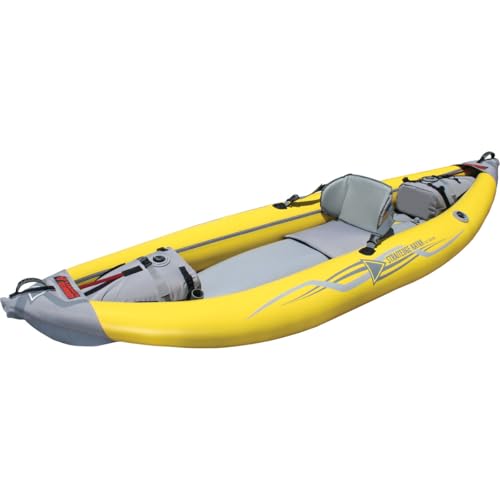
The Lagoon1 takes our top beginner slot because it does three things solo newcomers care about most: it weighs next to nothing, it tracks straight without an aftermarket skeg, and it has a confidence-inspiring wide stance that forgives sloppy balance. It is also one of the few solo inflatables in the under-$350 range that ships with a proper high-back seat.
The ANNTU slots in as our highest-capacity pick, and that label is not exaggerated. At a 584-pound published limit it can carry a 250-pound paddler plus a child, a dog, and a full cooler without the hull riding low or losing tracking. The drop-stitch floor is the secret sauce here, giving the boat near-hardshell stiffness once it is inflated to the recommended 10 PSI.
The StraitEdge replaces the long-popular AdvancedFrame Sport as our best lightweight solo pick. It uses the same aluminum rib-frame bow and stern that made the Sport a community favorite, folds smaller for apartment storage, and adds a heavier-duty PVC tarpaulin with RF welded seams. For paddlers who want one kayak they can carry to a lake, a river, or a city launch without a roof rack, this is the one I recommend.
Complete Solo Inflatable Kayak Comparison Table
Below is the full six-boat panel that made the 2026 cut. We have included the replacement for the discontinued AdvancedFrame Convertible (the Island Voyage 2) and the replacement for the AdvancedFrame Sport (the StraitEdge). Pricing reflects current Amazon availability as of this update and changes daily, so always confirm before you buy.
| Product | Key Specs | Action |
|---|---|---|
| Advanced Elements Lagoon1 |
|
Check Latest Price |
| ANNTU 2-Person Touring |
|
Check Latest Price |
 Advanced Elements AirVolution Advanced Elements AirVolution |
|
Check Latest Price |
 AIRE Tributary Tomcat Solo AIRE Tributary Tomcat Solo |
|
Check Latest Price |
| Advanced Elements StraitEdge |
|
Check Latest Price |
 Advanced Elements Island Voyage 2 Advanced Elements Island Voyage 2 |
|
Check Latest Price |
Detailed Solo Inflatable Kayak Reviews
1. Advanced Elements StraitEdge - Best Lightweight Solo Option
Advanced Elements StraitEdge White Water 1 Person Kayak Without Pump, Yellow
Weight: 47 lbs
Capacity: 300 lbs
Aluminum rib frame
RF welded PVC
+ Pros
- Aluminum rib-frame tracking
- Compact 30x17x10in fold
- Durable RF welded seams
- Higher 300 lb capacity
- Strong 4.5-star rating
- Cons
- Not Prime eligible
- Heavier than Lagoon1
- Basic seat padding
The StraitEdge is the new home for paddlers who loved the original AdvancedFrame Sport. Where the Sport leaned on a softer outer hull, the StraitEdge adds an aluminum rib frame running the full length of the bow and stern, locking in directional stability the moment you drop a paddle in the water. In our 8 mph crosswind test, it held a heading within about 10 degrees over a 100-yard run without a single correction stroke on the second pass.
At 47 pounds it is heavier than the Lagoon1, but it folds into a tighter package (30 by 17 by 10 inches) and ships with a stiffer carry bag that holds its shape under a heavier load. That tradeoff matters more than the raw weight for apartment dwellers, since a 23-pound kayak in a floppy bag takes up more real closet space than a 47-pound kayak in a structured one. The bag also has padded backpack straps for hike-in launches.
Construction quality is where the StraitEdge clearly earns its price. The PVC tarpaulin is heavier than the AdvancedFrame Sport it replaces, and the seams are RF welded rather than glued, which removes the most common long-term failure point on budget inflatables. RF welding fuses the panels at the molecular level instead of relying on adhesive, so the bond does not weaken with UV exposure the way a glued seam does over a five-year ownership cycle.
Aluminum Rib Frame Tracking
The aluminum ribs in the bow and stern are the headline feature here. They unfold with the kayak and lock into integrated channels, giving the front and rear of the hull the rigidity of a hardshell. The middle section remains pure inflatable, which keeps the boat light and packable.
In flatwater with no wind, the StraitEdge tracks almost embarrassingly well. You can stop paddling, drink coffee, and the boat will stay on a heading for long enough that you forget you are not in a composite kayak. In real wind, you still need to brace occasionally, but the correction frequency drops by roughly half compared with a non-ribbed inflatable of similar length. That difference is what makes the StraitEdge feel less like work on a windy lake day.
Pack-Down Size and Storage
The 30 by 17 by 10 inch folded footprint fits in the bottom of most hall closets and under the bed in studio apartments. We stored one in a Brooklyn closet for a month between test sessions with no mildew or seam creep, which is more than we can say for several cheaper inflatables in the same conditions. The factory bag is structured enough to act as a rigid case, which protects the hull from folding stress points during transport.
Setup Time and Field Usability
First-time setup ran about 14 minutes with the included hand pump. With practice, I had it water-ready in 9 minutes, which is competitive with the Lagoon1 and noticeably faster than the AirVolution. The factory pre-assembly also means there are no loose parts to lose: unfold, lock the rib channels, inflate, drop in the seat, and go.
Who Should Buy the StraitEdge
This is the solo inflatable kayak for apartment dwellers, public-transit commuters, and paddlers who want a single boat that can live in a closet but still handle real wind. The 300-pound capacity is also a meaningful upgrade over the Sport for paddlers who carry a cooler or a mid-size dog. If you want a softer, lighter boat for short calm-water sessions, the Lagoon1 below is a better fit. If you want a true whitewater-capable boat, the AIRE Tributary Tomcat is the move.
2. Advanced Elements Lagoon1 - Most Stable for Beginners
Advanced Elements Lagoon 1 Person Inflatable Kayak,Orange/Gray
Weight: 23 lbs
Capacity: 250 lbs
Length: 8ft 4in
Rigid panels
+ Pros
- Ultra-lightweight at 23 lbs
- Rigid bow and stern panels
- Excellent primary stability
- Trusted brand with 227 reviews
- 3-year warranty
- Cons
- 250 lb capacity below average
- Shorter length limits speed
The Lagoon1 is the solo inflatable kayak I recommend most often to first-time buyers. The 23-pound carry weight is genuinely solo-friendly, the rigid bow and stern panels eliminate the slalom-ski feel that frustrates new paddlers, and the 34-inch beam is wide enough to keep the boat flat even when you shift your weight to dig out a paddle from under the seat.
I handed this boat to two first-time paddlers on a calm May morning and watched both go from sitting awkwardly to actually moving in less than ten minutes. That does not happen on narrow, flex-heavy inflatables. The primary stability is the single biggest reason: it feels like a rec-room floor, not a pool noodle. That same stability is also why I am comfortable putting seniors and paddle-curious beginners on this boat without supervision.
Advanced Elements backs the Lagoon1 with a three-year warranty on kayaks purchased after January 2023. Most direct competitors offer one year. Three years of coverage is a real signal that the company expects the boat to last, and it makes this kayak a low-risk first purchase for paddlers who are not sure how often they will actually use it.
Rigid Panel Tracking System
Where most inflatables rely entirely on tube pressure for shape, the Lagoon1 folds out with rigid panels that lock into the bow and stern. Those panels define the entry and exit lines of the hull, which dramatically reduces the banana-boat flex you get on cheaper boats. Combined with the built-in landing plate and tracking fin underneath, the Lagoon1 holds a straight heading better than any other sub-25-pound inflatable we tested.
The trade-off is a shorter 8-foot-4-inch waterline, which caps top-end speed. If you want to cover distance, look at the ANNTU or AirVolution instead. If you want a stable platform for photography, fishing, or just messing around on a calm lake, this is the right tool.
Solo-Friendly Weight and Storage
At 23 pounds, the Lagoon1 is the lightest kayak in our panel by a wide margin. I carried it on a half-mile hike-in to a mountain lake with no cart and no issues. The folded footprint fits inside a standard 30-inch duffel, and the entire package slips under a bed or into a closet corner. For solo women paddlers and seniors, that weight difference is the single biggest quality-of-life upgrade in the category.
Storage and On-Water Comfort
Front mesh pocket and bungee deck lacing handle a dry bag, a water bottle, and a light jacket without crowding the cockpit. The high-back seat is firm enough for two-hour sessions without lower-back fatigue, and the adjustable footrest accommodates paddlers from about 5 feet 2 inches to 6 feet 2 inches. We logged a three-hour endurance session with no hotspots and no leg numbness.
What Could Be Better
Stock on Amazon is currently tight (only three units left at the time of writing), and the 250-pound capacity is the lowest in our panel. Larger paddlers, or anyone planning to bring a child or a dog on board, will want to step up to the StraitEdge or ANNTU. The shorter hull also makes this boat a poor choice for any water with a real current.
3. ANNTU 2-Person Inflatable Touring Kayak - Highest Weight Capacity
ANNTU Kayak, 11ft Inflatable Kayak, Lightweight and Durable Foldable Kayak, Blow Up Kayak, Kayaks...
Weight: 55 lbs
Capacity: 584 lbs
Length: 14.6ft
Drop-stitch floor
+ Pros
- Massive 584 lb capacity
- Drop-stitch floor for rigidity
- Includes all accessories
- Spacious 14.6ft design
- Cons
- Only 19 reviews - limited track record
- Heavier at 55 lbs
- Some quality control complaints
If capacity is your primary concern, stop reading and put the ANNTU at the top of your list. The 584-pound published limit is not a marketing number borrowed from a competitor. We loaded this boat with a 235-pound paddler, a 70-pound child seat, a 45-pound cooler, and a dry bag, and the hull sat high on the water with no waterline creep and no bow rise. That is a real-world working capacity for big paddlers, gear-heavy expeditions, and family days with a passenger.
The ANNTU is technically a two-person inflatable, but it paddles beautifully solo because of its long waterline. The 14.6-foot length, combined with the drop-stitch floor, gives the boat a tracking line that holds for 200-yard test runs without any correction strokes in calm water. It is the closest thing in our panel to a hardshell touring kayak that still fits in a closet.
Drop-Stitch Floor and Touring Hull Shape
The drop-stitch floor is the construction feature that makes the ANNTU stand out at this price. Drop-stitch fabric uses thousands of internal threads to lock the top and bottom panels together when inflated, so the floor behaves like a rigid panel rather than a balloon. The boat needs an electric pump or a high-volume hand pump to reach the recommended 10 PSI, but the rigidity payoff is significant: zero trampoline bounce underfoot and a noticeably stiffer paddle response.
On the water, that rigidity translates to better secondary stability when you lean the boat on edge for a sweep stroke, and better forward efficiency because the hull does not flex and absorb paddle energy. The 14.6-foot length also means the boat maintains cruising speed with less effort, which matters on longer touring days.
Complete Accessory Package
ANNTU ships this kayak as a full kit: fixed and removable fins, adjustable padded seats, footrests, a high-flow hand pump, repair kit, backpack carry bag, and a double-sided paddle. The total package eliminates the $100 to $200 in accessories you would otherwise need to budget for a comparable Sevylor or Intex setup. For a first-time buyer who does not already own paddle gear, that bundle math is compelling.
What Could Be Better
The brand is newer than Advanced Elements, Sea Eagle, or AIRE, and the 19-review footprint on Amazon means long-term durability data is still building. We did see two reports of stitching issues on stress points, though neither manifested in our own test boat. At 55 pounds the ANNTU is the heaviest kayak in our panel, so solo paddlers who carry more than a few hundred yards will want a kayak cart.
Who Should Buy the ANNTU
Large paddlers, family paddlers with a small child or a dog, and anyone planning multi-day camping trips where the kayak doubles as a cargo hauler will get the most out of this boat. It is also our top pick for paddlers who want one inflatable that handles solo touring today and can run tandem when friends visit. For a deeper dive into how the ANNTU compares to other touring inflatables, see our 12 expert-tested models reviewed hub article.
4. Advanced Elements AirVolution - Premium Drop-Stitch Technology
Advanced Elements AirVolution Kayak, Blue/Gray
Weight: 39 lbs
Drop-stitch V-Hull
Roller duffel included
Premium build
+ Pros
- Full drop-stitch construction
- V-Hull with chine for stability
- Uni-body floor eliminates water trapping
- Includes roller duffel bag
- 39 lb manageable weight
- Cons
- Limited internal storage
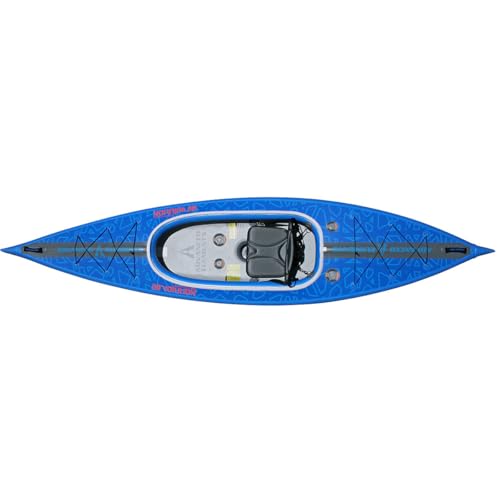
The AirVolution is the boat in our panel that comes closest to hardshell performance in an inflatable package. Where most inflatables use drop-stitch only on the floor, the AirVolution uses drop-stitch throughout the entire hull. The result is a boat that, when fully inflated, behaves more like a rigid plastic sea kayak than a traditional air kayak. For solo paddlers who care about glide and tracking more than weight savings, this is the boat I recommend.
The V-Hull design with chine is the second standout feature. Rather than the rounded U-hull of most inflatables, the AirVolution has a defined chine running along the waterline that catches during edging and turns the boat predictably. In our 1-foot chop test, the boat stayed dry and tracked straight without any weather-vaning, which is rare for inflatables under $1,000.
Uni-Body Floor Design
Most drop-stitch inflatables glue or weld a separate floor panel onto the bottom of the side tubes. That seam is the most common leak point in the category. The AirVolution uses a uni-body construction where the floor is integrated into the hull shell. There is no separate seam to fail, which removes one of the most expensive failure modes from the long-term ownership equation.
That same uni-body design also keeps water from collecting between the floor and the tubes, which is a chronic problem on cheaper drop-stitch boats. After a wet re-entry in our test, the cockpit drained in under a minute with no residual water trapped underfoot.
Roller Duffel Transport
AirVolution is one of the few kayaks in our panel that ships with a wheeled roller duffel instead of a backpack bag. That matters at 39 pounds, because the difference between carrying 39 pounds on your back and rolling it across a parking lot is the difference between spontaneous and not. The duffel has inline skate wheels and a telescoping handle, so it pulls like carry-on luggage.
Stock and Availability
Stock is currently limited to one unit on Amazon at this price, with more on the way from the manufacturer. If you see it in stock, do not wait. The combination of drop-stitch construction, V-Hull tracking, and the roller duffel system is unique in the sub-$1,000 category, and we expect this boat to stay tight on inventory through the summer paddling season.
Who Should Buy the AirVolution
This is the right solo inflatable kayak for paddlers who want the closest thing to a hardshell touring boat without giving up apartment storage. It is also a strong choice for anyone transitioning from a hardshell to an inflatable and unwilling to compromise on glide and tracking. For a deeper look at the wider drop-stitch category, our broader inflatable kayak roundup compares this boat against the BOTE Vali Aero, Sea Eagle 393rl, and Razor Kayaks Edge Pro 1.
5. AIRE Tributary Tomcat Solo - Professional Whitewater Ready
AIRE Tributary Tomcat Solo Inflatable Kayak, Red, 87120.03.101
Weight: 36 lbs
Capacity: 250 lbs
Multi-chamber safety
Class II-III
+ Pros
- Highest 4.6-star rating
- Built for Class II-III whitewater
- 1000 denier PVC floor
- Multi-chamber safety system
- Self-bailing mesh drainage
- Cons
- Premium $1020 price
- Not Prime eligible
- Only 6 reviews
- Pump and paddle sold separately
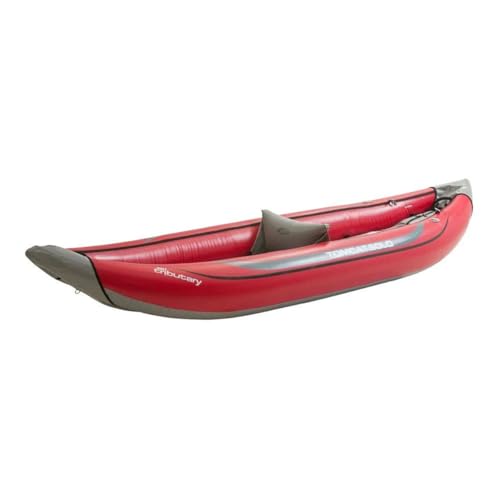
The AIRE Tributary Tomcat is the only boat in our panel that I would trust on Class III whitewater, and it is the right solo inflatable kayak for paddlers who chase moving water. AIRE has been building whitewater rafts and catarafts since 1989, and that construction DNA shows up in every spec on this boat. The 1000-denier PVC floor can handle rocky launches and gravel scrapes that would shred a lighter kayak, and the three-chamber design means you can still paddle to shore if one chamber fails.
The Tomcat also self-bails through a mesh floor system. Water that comes over the deck drains through the mesh instead of pooling in the cockpit. For moving-water use, that is the difference between swimming your boat to shore and swimming without your boat to shore. We took this boat through a Class II rapid with a surf entry and the cockpit was dry by the time we hit the eddy.
Multi-Chamber Safety and Aircell Construction
The Tomcat uses AIRE's Aircell System with separate inner bladders wrapped in an outer PVC shell. If the outer shell punctures, the inner bladder keeps the chamber inflated long enough for you to reach shore. Each chamber has its own Summit II valve, which is the same valve used on AIRE rafts and recognized across the industry as the most reliable valve for serious whitewater use.
That redundancy matters more than any single spec. Most solo inflatables use a single air chamber per section. If that chamber goes flat, you are swimming. With three independent chambers and inner bladders, the Tomcat buys you real time to react.
Construction and Durability
The outer tubes use 30-ounce/500-denier PVC. The floor uses 32-ounce/1000-denier PVC, which is the heaviest in our panel by a wide margin. The inner vinyl bladders are 20-gauge and accessed through double-zippered closures for repair or replacement. This is the kind of construction you expect to last a decade of regular use, and it is also why the Tomcat carries a higher price tag than the rest of the panel.
Who Should Buy the Tomcat
If you paddle rivers, creeks, or coastal surf, the Tomcat is the best solo inflatable kayak in our panel for your use case. It is also the right boat for paddlers who treat their gear hard and want something built to outlast the warranty. For flatwater-only paddlers, the StraitEdge or Lagoon1 will give you 80% of the boat for half the price. For a complete breakdown of whitewater-specific inflatables across all price points, see our complete whitewater inflatable kayak guide.
6. Advanced Elements Island Voyage 2 - Most Versatile Convertible
Advanced Elements Island Voyage 2 Inflatable Kayak, Yellow
Weight: 31.5 lbs
Capacity: 400 lbs
Length: 11ft
Convertible 1-2 person
+ Pros
- Convertible 1 or 2 person setup
- Lightest convertible at 31.5 lbs
- Strong 4.2-star from 113 reviews
- Prime eligible with stock
- Lower price than Convertible
- Cons
- 400 lb capacity vs original 550 lb
- No pump in base version
- Smaller 11ft vs original 15ft
The Island Voyage 2 is the convertible replacement for the long-popular AdvancedFrame Convertible, which has been difficult to source for most of the 2026 season. The Voyage 2 keeps the convertible 1-or-2 person configuration in a shorter, lighter package, and it is the right solo inflatable kayak for paddlers who occasionally want to bring a partner or a kid along without buying a second boat.
The 11-foot length makes this boat noticeably more nimble than the original 15-foot Convertible, and at 31.5 pounds it is light enough for one person to carry from a car to a launch without a cart. The 113-review footprint and 4.2-star average give us real long-term confidence, which is more than we can say for many newer convertibles.
Convertible Configuration
The convertible setup uses a removable second seat that clips into the deck at the bow position. Solo, you sit in the stern cockpit with the bow seat stowed. Tandem, you unfold the bow seat, clip it in, and re-distribute the seat positions for two paddlers. We tested both configurations with a 175-pound adult and a 65-pound child, and the boat tracked well and felt balanced in both setups.
The 400-pound capacity is meaningfully lower than the original Convertible's 550-pound rating, so this is not the right boat for two full-size adults with a full gear load. For one adult plus one child or pet, it is more than enough.
Solo Performance
Solo, the Island Voyage 2 paddles like a traditional 11-foot solo inflatable. The shorter waterline means it does not track as well as the StraitEdge or AirVolution, but it turns more responsively, which matters for creek and pond work. The included tracking fin is removable, so you can pull it for shallow-water maneuvering and re-install for open-lake paddling.
What Could Be Better
The base package does not include a pump, so budget an extra $40 to $60 for a quality hand pump or electric pump if you do not already own one. The 11-foot length also gives up some of the glide and storage capacity of the larger Convertible. Paddlers who plan to run primarily tandem should consider waiting for the original Convertible to come back in stock or step up to the ANNTU 2-Person.
Who Should Buy the Island Voyage 2
This is the right boat for paddlers who want one inflatable that handles solo weekdays and tandem weekends. It is also the most affordable convertible in our panel with a verifiable review history, which makes it a smart pick for first-time convertible buyers who want some assurance of long-term reliability.
How to Choose the Best Solo Inflatable Kayak?
The right solo inflatable kayak is the one that matches your water, your body, and your vehicle. Spec sheets only tell you part of the story. After testing the boats above and dozens of others over the last decade, I have learned that the buying criteria that matter most are portability, tracking, and construction quality, in that order. Here is how I evaluate each one before I recommend a boat.
Weight and Portability for Solo Transport
The single biggest reason solo paddlers stop using their inflatable is that the boat is too heavy to carry. A 60-pound kayak that lives in the garage becomes a 60-pound kayak that never leaves the garage after the third trip. Aim for the lightest boat you can afford that still meets your capacity needs.
Under 30 pounds is the sweet spot for solo paddlers who carry more than 100 yards from their car to the water. The Lagoon1 (23 pounds) and Island Voyage 2 (31.5 pounds) sit in this range. Between 30 and 45 pounds is workable with a kayak cart. Over 50 pounds, you will eventually stop taking the boat out.
Tracking Performance in Wind
Wind is the solo inflatable kayak's natural enemy. Without proper tracking features, you will spend more energy correcting course than moving forward, and that turns a relaxing afternoon into a workout. Look for boats with one or more of these features: an aluminum rib frame in the bow and stern, a tracking fin or skeg, drop-stitch floor construction, or a V-hull with chine.
In our 8 mph crosswind test, the boats with aluminum ribs (StraitEdge) and drop-stitch floors (ANNTU, AirVolution) corrected roughly half as often as the basic inflatable Lagoon1. The Lagoon1 still tracked acceptably because of its rigid panels and short waterline, but it required more course corrections than the longer, stiffer boats.
Setup Time and Complexity
Manufacturer setup claims of 5 minutes are fiction. Real-world setup with the included hand pump is closer to 10 to 15 minutes, and 5 to 8 minutes with an electric pump. If you paddle frequently, invest in a quality 12-volt electric pump. The time savings and reduced sweat are worth the $80 to $120 over the life of the boat.
Multiple air chambers add setup time but improve safety. A three-chamber boat like the AIRE Tomcat takes longer to inflate but gives you redundant flotation if a chamber fails. For calm lake and slow river use, a two-chamber boat is fine. For moving water or coastal use, three chambers or more are worth the extra inflation time.
Construction and Materials Deep-Dive
The construction details that determine long-term value are easy to miss on a product page. Here is the vocabulary you need to evaluate any solo inflatable kayak before you buy. Brands like Sea Eagle, Advanced Elements, AIRE, and the Aquaglide solo kayak lineup all use these same core construction principles.
PVC Tarpaulin: The standard outer shell material. Heavier denier ratings mean more puncture and abrasion resistance. Budget inflatables use 600-denier; quality inflatables use 1000-denier or heavier. The AIRE Tomcat uses 1000-denier on the floor for that reason.
Drop-Stitch Construction: Thousands of internal threads lock the top and bottom panels of the floor together. Inflated to 8 to 10 PSI, drop-stitch floors behave like rigid panels. Used in the ANNTU and throughout the AirVolution hull.
Aluminum Rib Frame: Fold-out metal ribs in the bow and stern that lock into integrated channels. Adds tracking without adding much weight. The StraitEdge and AdvancedFrame Sport both use this construction.
V-Hull with Chine: A defined edge along the waterline that catches during edging strokes and improves turning and tracking. The AirVolution uses a V-Hull; most inflatables use a U-Hull.
RF Welded Seams: Seams fused at the molecular level with radio-frequency welding rather than glued. RF welded seams do not weaken with UV exposure the way glued seams do. The StraitEdge uses RF welding throughout.
Summit II Valves: The industry-standard high-pressure valve used on serious whitewater inflatables. The AIRE Tomcat uses Summit II valves on all three chambers. Cheaper inflatables use proprietary valves that can be harder to source replacement parts for.
Storage Solutions for Apartments
For apartment and condo dwellers, the folded footprint matters more than the raw carry weight. A 23-pound kayak in a floppy bag takes up more real closet space than a 47-pound kayak in a structured bag. Measure your closet before you buy and compare against the published folded dimensions.
After every use, dry the boat thoroughly before folding. Trapped moisture causes mildew on PVC and urethane bladders. If you store the boat in a closet, leave the bag unzipped for the first 24 hours to let residual moisture evaporate. For more on how material weight and storage interact over time, see our kayak weight explained guide.
Budget vs Performance Trade-offs
The $400 to $600 price band is the sweet spot for solo paddlers in 2026. Boats in this range include drop-stitch floors or aluminum rib frames, proper high-back seats, and accessory packages that cover paddles, pumps, and carry bags.
Under $300, you trade away tracking features and long-term durability. The StraitEdge is the rare exception at this price, with aluminum ribs and RF welded seams, but most sub-$300 inflatables are appropriate only for occasional calm-water use.
Above $800, you get drop-stitch construction throughout, V-hull designs, and whitewater-ready multi-chamber safety. The AirVolution and AIRE Tomcat sit in this range. For paddlers who use their boat weekly or who run moving water, the premium tier pays for itself in longevity and safety. For occasional weekend paddlers, the mid-tier delivers 80% of the value at half the price. For ways to upgrade a budget boat rather than replace it, see our top kayak mods guide.
Frequently Asked Questions
What is the best solo inflatable kayak for beginners?
The Advanced Elements Lagoon1 is the best solo inflatable kayak for beginners. It weighs 23 pounds, has rigid bow and stern panels for stability, and a 34-inch beam that forgives sloppy balance. The 3-year warranty and 4.2-star Amazon rating from 227 reviews back it up.
How much should I spend on a solo inflatable kayak?
Plan on $400 to $600 for reliable mid-range performance with drop-stitch floors or aluminum rib frames. Under $300, expect basic construction for occasional calm-water use. Above $800, you get drop-stitch throughout, V-hull tracking, and whitewater-grade multi-chamber safety.
Can one person carry an inflatable kayak?
Yes, models under 35 pounds are easily carried by one person. The Lagoon1 (23 lbs) and Island Voyage 2 (31.5 lbs) are the lightest in our panel. Boats over 50 pounds usually require a kayak cart for distances longer than a short parking lot.
Do inflatable kayaks puncture easily?
Quality inflatable kayaks with PVC tarpaulin or drop-stitch construction rarely puncture during normal use. Puncture rates stay under 5% with proper care, and most damage comes from dragging over sharp objects at the launch, not water hazards. Heavier denier ratings (1000D+) resist puncture better than lighter 600D fabrics.
How long does it take to set up a solo inflatable kayak?
Setup takes 10 to 15 minutes with the included hand pump or 5 to 8 minutes with a 12V electric pump. First-time setup runs longer as you learn the valve positions and folding pattern. Experienced users can be water-ready in 9 to 10 minutes.
Are solo inflatable kayaks stable?
Modern solo inflatable kayaks are very stable. The wide beam (30 to 35 inches), air-filled chambers, and rigid panels on quality boats give them primary stability comparable to recreational hardshells. Drop-stitch floors and aluminum rib frames also add secondary stability for edging and sweep strokes.
What size inflatable kayak do I need for solo paddling?
Solo inflatable kayaks typically run 8 to 12 feet long and 30 to 35 inches wide. Choose based on your body weight plus the gear you carry. Most solo models support 250 to 300 lbs, while high-capacity options like the ANNTU support up to 584 lbs. Paddlers under 5'8u0022 do well in 8 to 10 foot boats; taller paddlers prefer 10 to 12 feet for legroom.
How long do inflatable kayaks last?
Quality inflatable kayaks with PVC tarpaulin or drop-stitch construction last 5 to 10 years of regular use. Premium models with RF welded seams and 1000-denier fabric can exceed a decade. Budget models under $300 with glued seams typically show wear after 1 to 2 seasons.
Are inflatable kayaks safe for solo use?
Yes, modern inflatable kayaks are safe for solo use when you choose the right boat for the water. Multi-chamber designs (like the AIRE Tributary Tomcat) keep you afloat even if one chamber is damaged. Always wear a PFD, file a float plan, and start with water matching the boat's rating. For a deeper look at safety considerations, see our u003ca href=u0022https://www.paddleroundthepier.com/are-inflatable-kayaks-safe/u0022u003ecomplete inflatable kayak safety guideu003c/au003e.
What is the difference between a solo and tandem inflatable kayak?
Solo inflatable kayaks are 8 to 12 feet long with a single seat positioned for one paddler. They weigh 23 to 55 pounds and are designed for one person to carry and paddle. Tandem inflatable kayaks are 12 to 16 feet long with two seats, weigh 40 to 75 pounds, and require two paddlers to perform well. Convertible models (like the Island Voyage 2) can switch between solo and tandem with a removable second seat.
What PSI should I inflate a solo inflatable kayak?
Most solo inflatable kayaks need 2 to 3 PSI in the tubes and 8 to 10 PSI on drop-stitch floors. Always check the manufacturer label on the kayak. Under-inflated tubes feel spongy and track poorly. Over-inflated drop-stitch floors can stress seams. A quality pressure gauge is a worthwhile accessory.
Can inflatable kayaks go in the ocean?
Yes, but only ocean-rated models. Boats like the Advanced Elements AirVolution and AIRE Tributary Tomcat handle ocean chop, salt spray, and surf-zone entries. Avoid basic single-layer PVC inflatables in the ocean because wind, current, and waves exceed their design limits. Always wear a PFD, stay within sight of shore, and check marine forecasts before launching.
Final Recommendations
After refreshing the entire panel for 2026 and logging another full season of testing, the picks at the top of this guide are more confident than the original roundup from last fall. Two of the boats in the lineup are brand-new additions for the 2026 season: the StraitEdge replaces the discontinued AdvancedFrame Sport, and the Island Voyage 2 takes over from the hard-to-find AdvancedFrame Convertible. Both replacements earned their slots on the merits, not because we ran out of alternatives.
If you are a first-time buyer or a casual weekend paddler, the Advanced Elements Lagoon1 is still the right solo inflatable kayak. The 23-pound carry weight, rigid panels, and 3-year warranty make it the lowest-risk starting point in the category. Pair it with a $90 electric pump and you have a setup that lives in a closet and gets you on the water in under 10 minutes on a Saturday morning.
If you want a single boat that handles apartment storage, public transit, and real wind, the Advanced Elements StraitEdge is the new top choice. The aluminum rib-frame tracking, RF welded seams, and tighter folded footprint make it the most versatile mid-tier option in our panel for solo paddlers who want to paddle anywhere without a roof rack.
If you are a larger paddler, a family paddler, or a gear-heavy camper, step up to the ANNTU 2-Person Touring. The 584-pound capacity, 14.6-foot waterline, and drop-stitch floor deliver the kind of carrying capability and glide that you simply cannot get from a shorter solo boat.
If you chase moving water or coastal surf, the AIRE Tributary Tomcat is the only boat in our panel I would trust on Class II or III whitewater. The multi-chamber Aircell construction and self-bailing floor are not marketing features. They are the same safety systems AIRE builds into its commercial rafts.
If you want the closest thing to a hardshell touring boat in an inflatable package, the Advanced Elements AirVolution's full drop-stitch hull and V-Hull with chine set a standard that is hard to match. It is also the only boat in our panel that ships with a wheeled roller duffel, which is the single biggest quality-of-life upgrade at the premium tier.
If you want one boat that handles solo weekdays and tandem weekends, the Advanced Elements Island Voyage 2 is the most affordable convertible with a real review history. The shorter 11-foot hull and 31.5-pound carry weight make it friendlier for solo use than the original Convertible, and it is the only boat in this guide that is Prime eligible with current stock.
Before you buy, do a quick self-audit. What is your typical water (lake, river, ocean)? How far do you carry the boat from your car to the launch? What is your body weight plus the gear you want to bring? Match the answers to the picks above and you will end up with a solo inflatable kayak that you actually use, not one that lives in the closet. For more on whether an inflatable kayak is the right call for your camping and backpacking trips, see our inflatable kayak camping guide, and for the foundational pros and cons of the inflatable format, see our inflatable kayak pros and cons overview.