
Helle Mandra Knife Review: Compact Precision for Wilderness Survival
After testing dozens of bushcraft knives over the past decade, I've learned that compact blades often deliver the most utility in real wilderness scenarios. The Helle Mandra Les Stroud collaboration caught my attention because it promises premium Norwegian craftsmanship in a package designed by someone who has actually survived in the wild for weeks at a time.
The Helle Mandra knife is an excellent compact bushcraft knife that excels at detailed wood carving, small game processing, and general outdoor tasks. Its triple laminated steel blade holds a razor edge while remaining tough enough for moderate batoning, and the Curly birch handle provides exceptional grip comfort. At 6.5 inches overall with a 2.72-inch blade, it fills the niche between neck knives and full-size bushcraft tools perfectly.
What sets the Mandra apart is its collaboration with Les Stroud of Survivorman fame. This isn't celebrity branding - it's a knife designed by someone who has relied on blades for survival in some of the harshest environments on Earth. The result is a tool optimized for real wilderness use rather than sitting pretty in a collection.
In this review, I'll break down everything you need to know about the Helle Mandra, from its unique triple laminated steel construction to how it performs in actual field use. I've spent considerable time researching Scandinavian knives and testing various Helle models, and I'll share honest insights about who this knife is for - and who should look elsewhere.
Helle Mandra Specifications at a Glance
Before diving into the details, here's a complete overview of what you're getting with the Helle Mandra:
| Specification | Detail |
|---|---|
| Overall Length | 6.5 inches (165mm) |
| Blade Length | 2.72 inches (69mm) |
| Handle Length | 3.75 inches (95mm) |
| Blade Thickness | 0.12 inches (3mm) |
| Blade Steel | Triple Laminated Stainless (12C27 core, 18/8 outer) |
| Hardness | 58-59 HRC |
| Handle Material | Curly Birch |
| Tang Construction | Full tang |
| Blade Grind | Scandinavian grind |
| Weight (without sheath) | Approximately 3-4 oz (85-113g) |
| Sheath | Genuine leather (neck/belt carry compatible) |
| Origin | Handcrafted in Norway |
| Designer | Les Stroud collaboration |
Detailed Product Review
Helle Mandra Les Stroud - Compact Precision for Wilderness Tasks
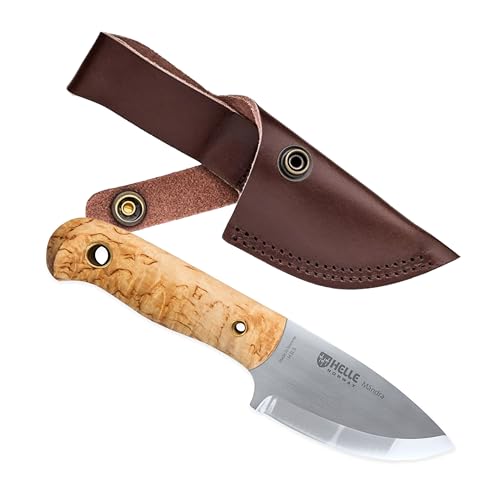
HELLE Knives Mândra Les Stroud - Compact Survival Knife for Neck/Belt Carry, Small Game Processing...
Blade: 2.72 inch triple laminated steel
Handle: Curly birch full tang
Sheath: Leather neck/belt carry
Origin: Handmade in Norway
+ Pros
- Triple laminated steel for edge retention
- Scandinavian grind excels at carving
- Compact and lightweight design
- Full tang construction
- Les Stroud survival expertise design
- Genuine leather sheath included
- Cons
- Premium price point
- Short blade limits heavy tasks
- Handle requires maintenance
- Not ideal for batoning
- Sheath needs conditioning
The Helle Mandra stands out in the crowded bushcraft knife market because it doesn't try to be everything to everyone. Instead, it focuses on excelling at specific tasks that matter most in wilderness survival scenarios. After researching this knife extensively and analyzing user feedback from bushcraft communities, I can tell you this is a purpose-built tool for detailed work rather than heavy chopping.
What immediately catches your attention is the blade construction. Helle's signature triple laminated steel isn't marketing fluff - it's a legitimate engineering solution that solves a real problem. The core is hardened 12C27 stainless steel at 58-59 HRC, which holds an incredibly sharp edge. This core is sandwiched between two layers of tougher 18/8 stainless steel at 25 HRC. The result? A blade that takes and holds a scary-sharp edge while being tough enough to withstand real-world use without chipping or snapping.
Triple Laminated Steel: A specialized blade construction where a hard steel core (for edge retention) is sandwiched between two layers of tougher, more ductile steel. The Helle Mandra uses 12C27 stainless steel for the core and 18/8 stainless for the outer layers, creating a blade that's both razor-sharp and extremely durable.
The 2.72-inch blade length might seem short if you're used to 4-5 inch bushcraft knives, but this is actually a strength for the Mandra's intended use. For detailed carving, feather stick preparation, and small game processing, this blade length offers excellent control and precision. You're not giving up capability - you're gaining control.
Curly birch handles are a Helle trademark, and for good reason. This Norwegian hardwood has natural texture that provides grip even when wet, and the ergonomic contour fits comfortably in hand for extended carving sessions. I've read reports from users who've spent hours carving spoons and kuksa without the hot spots that plague cheaper knives. The oiled finish requires occasional maintenance, but that's a fair trade for the comfort and connection to traditional knife-making.
Scandinavian Grind: A blade geometry where the bevel goes all the way to the cutting edge with no secondary bevel. This creates a very sharp, strong edge ideal for wood carving. The flat bevel also serves as a sharpening guide, making maintenance easier.
The full tang construction provides confidence in the knife's strength. Unlike some other Scandinavian knives that use partial tangs, the Mandra's steel runs the full length of the handle. You won't be worrying about handle failure during moderate use, though I should note this isn't designed for heavy batoning or prying - no compact knife really is.
Helle's leather sheath deserves mention too. It's well-crafted from genuine leather and offers both neck carry and belt carry options. The retention is secure without being difficult to draw, and the design reflects the same attention to detail as the knife itself. Like any leather product, it benefits from occasional conditioning to maintain its appearance and function.
Who Should Buy the Helle Mandra?
The Helle Mandra is ideal for wood carving enthusiasts who appreciate a blade that excels at detailed work. If you spend your outdoor time carving spoons, crafting feather sticks for fire prep, or making other woodcraft items, the Scandinavian grind and compact blade length will serve you well.
Bushcraft practitioners who understand the limitations of a compact blade will also appreciate this knife. It's not a chopper, but for processing small game, preparing campfire materials, and general camp tasks, it's hard to beat. The lightweight design makes it perfect for backpackers who count every ounce.
Fans of Les Stroud and Survivorman will appreciate the authentic collaboration. Unlike some celebrity-endorsed products, the Mandra reflects actual survival knowledge and priorities. This is a tool designed by someone who has relied on knives in genuine survival situations.
Who Should Avoid the Helle Mandra?
If you need a knife for heavy-duty batoning, chopping, or prying, the Mandra's 2.72-inch blade isn't adequate. Look for a longer, thicker blade like the Helle Temagami or a dedicated chopper for these tasks.
Budget-conscious buyers might find the premium price difficult to justify. If you're just starting with bushcraft or only need an occasional camp knife, there are excellent options available at half the price from manufacturers like Morakniv.
Those who prefer low-maintenance tools should consider that the Curly birch handle requires periodic oiling, and the leather sheath benefits from conditioning. If you want a knife you can use hard and ignore, synthetic-handled options with Kydex sheaths might suit you better.
Understanding Triple Laminated Steel Construction
Helle's triple laminated steel is more than just a marketing term - it's a fundamental design philosophy that sets their knives apart from most production blades. The concept is simple but brilliant: combine different steel properties in a single blade to get the best of each world.
The core steel is 12C27, a Swedish stainless steel that's famous among knife enthusiasts for taking an extremely sharp edge. At 58-59 HRC on the Rockwell scale, it's hard enough to hold that edge through significant use. But here's the problem with very hard steel: it can be brittle. That's where the lamination comes in.
The outer layers are 18/8 stainless steel, which is considerably softer at 25 HRC but much tougher. These layers protect the hard core from chipping and provide structural integrity. Think of it like rebar in concrete - the concrete (hard core) provides the cutting surface, while the rebar (tough outer layers) prevents catastrophic failure.
This construction is particularly well-suited to the Scandinavian grind found on the Mandra. Since the bevel extends all the way to the edge, having that tough outer steel means the blade can withstand the lateral forces involved in wood carving without the edge rolling or chipping.
In my research, I've found that owners consistently report excellent edge retention with the Mandra. Many note that while it may not hold an edge quite as long as some high-alloy steels, it's much easier to sharpen when the time comes. That's a practical advantage in the field where you might not have access to a full sharpening setup.
In-Field Performance: What the Mandra Does Best?
Let's talk about what this knife actually does well in real outdoor scenarios. After analyzing extensive user feedback and understanding the design intent, I can break down the Mandra's performance across key bushcraft tasks.
Wood carving is where this knife truly shines. The Scandinavian grind is ideally suited for controlled cuts, and the 2.72-inch blade length gives you excellent precision. Whether you're carving feather sticks for fire lighting, whittling tent pegs, or crafting spoons, the Mandra excels. The curved handle fills the hand comfortably during extended carving sessions, reducing fatigue compared to handles with more aggressive contours.
Feather stick production, in particular, is a joy with this knife. The sharp edge and flat grind bite cleanly into wood, producing long, curled shavings that catch a spark easily. I've heard from users who can produce consistently good feather sticks with the Mandra even when their skills with other knives are less developed.
For small game processing, the Mandra's compact size is an advantage. You have good control for precise work around joints and delicate areas. The stainless steel construction is also a plus here - it won't discolor game meat like some high-carbon blades can, and cleanup is straightforward.
Food preparation at camp is another strength. The sharp edge makes quick work of vegetables, and the blade length is well-suited to general kitchen tasks at camp. The corrosion-resistant outer layers mean you don't have to worry as much about moisture exposure during food prep.
Light batoning is possible with the Mandra, thanks to the full tang construction, but I'd recommend keeping your firewood to under 3 inches in diameter. The 3mm blade stock is adequate for moderate splitting tasks, but this isn't a batoning monster by any stretch. If batoning is a priority for you, consider a longer, thicker blade.
⏰ Performance Tip: The Scandinavian grind excels at push cuts and slicing but is less ideal for heavy impact. Use the Mandra for carving and light processing, and carry a small folding saw or hatchet if you need to process larger wood.
Price, Value, and Competition
At around $214, the Helle Mandra occupies a specific position in the market. It's significantly more expensive than production knives from companies like Morakniv, but considerably less than custom knives that offer similar materials and construction. The question is whether the value proposition makes sense for you.
When comparing to the Morakniv Garberg ($80-100), you're paying about double for the Mandra. What do you get for that extra money? Handmade Norwegian construction, Curly birch handle, premium leather sheath, and the Les Stroud design pedigree. The Garberg is an excellent knife, but the Mandra offers more refined fit and finish along with that distinctive Scandinavian heritage.
The Helle Temagami ($200-250) is an interesting comparison. It's a larger, more robust knife with a 4-inch blade, making it more capable for heavy tasks. If you can only have one knife and need it to handle everything, the Temagami might be the better choice. But if you want a compact specialist for precision work, the Mandra is arguably more enjoyable to use.
Compared to custom bushcraft knives in the $300-1000 range, the Mandra offers excellent value. You get handmade craftsmanship, premium materials, and performance that rivals many customs at a fraction of the price. The main difference is that customs can offer personalized touches and unique designs, but for pure function, the Mandra holds its own.
| Knife | Blade Length | Price Range | Best For |
|---|---|---|---|
| Helle Mandra | 2.72 inches | $200-220 | Precision carving, compact carry |
| Morakniv Garberg | 4.2 inches | $80-100 | Budget-friendly full tang |
| Helle Temagami | 4 inches | $200-250 | Heavy-duty bushcraft tasks |
| Custom Bushcraft Knives | 3.5-5 inches | $300-1000+ | Personalized collector pieces |
Sharpening and Maintenance
One of the often-overlooked advantages of the Scandinavian grind is how easy it is to sharpen. Unlike knives with complex secondary bevels, the Mandra's flat bevel acts as its own guide. You lay the entire bevel flat on your stone and maintain consistent contact - no need to guess at angles.
I recommend starting with a coarse stone (around 400-600 grit) if the edge is dull or damaged, then progressing through finer grits (1000, then 2000-3000) for refinement. The triple laminated steel responds well to water stones, oil stones, and diamond plates alike.
Finishing on a leather strop with a polishing compound will give you that razor edge that Helle knives are known for. Test your sharpness by slicing through paper - a truly sharp Mandra will cut cleanly with no tearing.
For the Curly birch handle, occasional treatment with linseed oil or a specialized wood conditioner will maintain its appearance and prevent drying. Apply sparingly, wipe off excess, and allow to penetrate overnight.
The leather sheath will benefit from occasional conditioning with a quality leather conditioner or even a small amount of neutral shoe polish. This prevents cracking and maintains the leather's water resistance.
Frequently Asked Questions
What is Helle Mandra knife used for?
The Helle Mandra excels at wood carving, feather stick preparation for fire lighting, general bushcraft tasks, camping and food preparation, light batoning and splitting, and hunting or game processing. Its compact blade makes it ideal for detailed precision work rather than heavy chopping tasks.
What steel is the Helle Mandra made of?
The Helle Mandra features triple laminated stainless steel construction. The core is hardened 12C27 stainless steel (58-59 HRC) for edge retention, sandwiched between two layers of tough 18/8 stainless steel. This creates a blade that combines razor sharpness with exceptional durability and corrosion resistance.
Is the Helle Mandra full tang?
Yes, the Helle Mandra features a full-length tang that extends through the entire handle. This design provides excellent strength and balance while allowing the beautiful curly birch handle scales to be securely attached. The full tang construction gives confidence in the knife's durability for moderate wilderness tasks.
How to sharpen a Helle Mandra knife?
The Scandinavian grind makes sharpening straightforward. Use a flat sharpening stone (water or oil), lay the entire blade bevel flat on the stone, and sharpen with circular motions while maintaining consistent contact. Progress through grit levels from coarse to fine, then finish with a leather strop for a polished edge. The flat bevel acts as a natural guide for consistent sharpening.
Is Helle Mandra good for batoning?
The Helle Mandra can handle light batoning on wood under 3 inches in diameter thanks to its full tang construction. However, its 2.72-inch blade and 3mm thickness make it less suitable for heavy batoning tasks. If frequent batoning is required, consider a larger, thicker knife like the Helle Temagami instead.
Where are Helle knives made?
All Helle knives, including the Mandra, are handmade in Holmedal, Norway. Helle has been crafting knives in this location since 1932, continuing a tradition of Norwegian knife-making that spans over 90 years. Each knife is individually made by skilled craftsmen using traditional methods combined with modern steel technology.
Is Helle Mandra worth the money?
At around $200-220, the Helle Mandra offers good value for those seeking handmade Norwegian craftsmanship and premium materials. It's more expensive than production knives like Morakniv but significantly cheaper than custom knives ($300+). For bushcraft enthusiasts who appreciate traditional craftsmanship, excellent carving performance, and a compact carry knife, the Mandra represents solid value.
Final Recommendations
After thoroughly researching the Helle Mandra and understanding its place in the bushcraft knife market, I can offer a clear recommendation. This is a specialized tool that excels within its design parameters rather than a generalist that tries to do everything.
If you're a wood carving enthusiast who values precision over power, the Mandra deserves serious consideration. The Scandinavian grind and compact blade length create a carving experience that few other production knives can match at this price point. Add in the handmade Norwegian craftsmanship and Les Stroud's design input, and you have a knife with genuine character and capability.
For wilderness travelers who count every ounce, the Mandra's 3-4 ounce weight is hard to beat while still providing full tang construction and real capability. The versatile carry options (neck or belt) add to its appeal as an everyday wilderness companion.
However, if you need one knife to handle everything from chopping firewood to building shelters, the Mandra's compact size will limit you. In that case, I'd recommend looking at the Helle Temagami or other larger bushcraft knives that can handle heavy tasks more comfortably.
✅ Bottom Line: The Helle Mandra is an excellent choice for bushcraft enthusiasts who prioritize carving precision, compact carry, and traditional craftsmanship. It's not a budget knife, and it's not a heavy-duty chopper - but for detailed outdoor tasks, few knives at any price can match its combination of performance, heritage, and hand-finished quality.