
How Much Firewood Do I Need For Camping?
I've been camping for over 20 years, and the question I hear most from new campers is about firewood. Running out of firewood on a cold night is miserable. Bringing too much wastes money and storage space.
Plan for 2-4 bundles of firewood per night for evening campfires, or 1/4 to 1/2 cord for a week-long trip with daily fires. Adjust based on fire frequency, weather conditions, and group size.
After organizing 50+ group camping trips, I've learned that firewood planning separates comfortable campers from cold ones. Let me break down exactly how to calculate your needs.
In this guide, you'll learn a simple formula for any trip length, which wood burns longest, and the gear that makes fire management easier.
Quick Answer: The Basic Rule
The general rule is simple: 2-4 bundles per night for evening fires around a standard campfire ring. One bundle typically contains 4-6 pieces of split firewood and weighs 5-8 pounds.
For a single overnight trip, grab 2-3 bundles. Weekend camping (2 nights) needs 4-6 bundles. Week-long trips require 14-28 bundles or approximately 1/4 to 1/2 cord of firewood.
Quick Formula: Multiply nights by 2-3 bundles for evening fires only. Multiply nights by 4-6 bundles if cooking meals over the fire or camping in cold weather.
I learned this the hard way on a spring camping trip when I brought 2 bundles for two nights of cooking. We made it work, but I spent two hours scavenging for downed wood on day two.
What Affects Your Firewood Needs?
Several factors change the calculation. Understanding these helps you plan accurately rather than guessing.
- Fire Frequency: Evening fires only consume 2-3 bundles nightly. All-day fires (weekends, base camps) need 4-6 bundles daily. Cooking adds 50% more wood.
- Weather Conditions: Cold weather (below 50°F) increases consumption by 25%. Windy conditions cause faster burning. Rain means you'll battle damp wood.
- Group Size: Solo campers manage with 2 bundles nightly. Families of 4-6 need 3-4 bundles. Large groups (8+) should plan 4-6 bundles per night.
- Season: Summer camping requires less wood for warmth. Spring and fall trips need 25% more for heat. Winter camping demands double the standard amount.
- Fire Purpose: Ambiance fires use minimal wood (2 bundles). Cooking fires need steady heat (3-4 bundles). Heating fires in cold weather consume the most (4-6 bundles).
- Wood Type: Hardwoods (oak, hickory) burn 2-3 hours per log. Softwoods (pine, cedar) burn 45-60 minutes. Dense wood means fewer trips to the woodpile.
Firewood Calculator by Trip Length
Here's a detailed breakdown based on actual camping experience. These numbers assume standard fire rings and typical weather conditions.
| Trip Length | Evening Fires Only | With Cooking | All-Day Fires | Cold Weather (+25%) |
|---|---|---|---|---|
| 1 Night | 2-3 bundles | 3-4 bundles | 4-6 bundles | 3-4 bundles |
| 2 Nights (Weekend) | 4-6 bundles | 6-8 bundles | 8-12 bundles | 6-8 bundles |
| 3 Nights | 6-9 bundles | 9-12 bundles | 12-18 bundles | 8-11 bundles |
| 4 Nights | 8-12 bundles | 12-16 bundles | 16-24 bundles | 10-15 bundles |
| 7 Nights (Week) | 14-21 bundles | 21-28 bundles | 28-42 bundles | 18-26 bundles |
Bundle: A standard campfire bundle contains 4-6 pieces of split firewood, typically weighing 5-8 pounds. This is the most common measurement sold at campgrounds and gas stations near camping areas.
I planned a week-long family reunion trip for 12 people last summer. Using the all-day fire calculation for 7 nights, we needed 28-42 bundles. I bought 40 bundles and we had exactly 3 left over.
For large groups, consider buying by the cord. A full cord (128 cubic feet) costs less per bundle and provides 50-75 bundles depending on how tightly it's stacked.
Best Firewood for Camping: Hardwood vs Softwood
The type of wood you burn dramatically affects how much you need. After burning through countless cords over two decades, here's what works best.
| Wood Type | Burn Time | Heat Output | Best For | Avoid For |
|---|---|---|---|---|
| Oak | 3-4 hours per log | Very High | Overnight heat, long burning | Quick fires (hard to start) |
| Hickory | 3-4 hours per log | Highest | Cooking, maximum heat | Budget (usually expensive) |
| Maple | 2-3 hours per log | High | All-around camping | Nothing - excellent choice |
| Ash | 2-3 hours per log | High | Easy starting, steady heat | Nothing - burns even when green |
| Pine | 45-60 minutes per log | Low-Medium | Fire starting only | Main fuel (smokes, pops) |
| Cedar | 45-60 minutes per log | Low-Medium | Kindling, ambiance | Cooking (strong flavor) |
Hardwoods are dense and heavy. One log of oak provides as much heat as three pine logs of the same size. This matters when you're carrying wood from your truck to the campsite.
Pro Tip: Buy mixed hardwood bundles from local sources near your campground. You'll get variety for different fire stages and avoid transport restrictions that exist in many states.
Avoid pine for your main firewood. It burns fast, creates excessive creosote in chimneys, and throws sparks that can burn holes in tents and gear. I use pine only for kindling.
Understanding Firewood Measurements
Buying firewood can be confusing with terms like cord, rick, and face cord. Here's what they actually mean.
Cord of Wood: A standard cord measures 4 feet high x 4 feet wide x 8 feet long, totaling 128 cubic feet of stacked firewood. This is the standard measurement for bulk firewood and contains 50-75 bundles depending on stacking tightness.
Rick of Firewood: A rick is a face cord - typically 4 feet high x 8 feet long, but only as deep as the log length (usually 16 inches). A rick contains about one-third of a full cord.
Face Cord: Same as a rick - a single stack of wood 4 feet high and 8 feet long, with log depth determining the total volume. A face cord of 16-inch logs equals approximately 42 cubic feet.
A standard pickup truck holds about 1/4 to 1/2 cord when stacked loosely. If you're buying in bulk, this gives you a rough visual reference when loading.
How to Store and Prepare Firewood While Camping
Proper storage keeps your firewood dry and ready to burn. Wet firewood is frustrating and can ruin a camping trip.
Store firewood off the ground using a rack, pallet, or even the bottom of your firewood carrier. Ground moisture seeps into bottom logs and makes them nearly impossible to burn.
Stack wood loosely to allow airflow between pieces. Tight stacking traps moisture and prevents proper seasoning, even for wood that was dry when you bought it.
Cover the top of your stack with a tarp or waterproof cover, but leave the sides open. Completely wrapping wood traps moisture and promotes rot. The goal is to shed rain while allowing ventilation.
Keep firewood at least 10 feet from your fire ring. I've seen too many campers lose their entire wood supply to accidental sparks or embers.
Essential Firewood Gear for Your Trip
The right equipment makes firewood management much easier. After testing dozens of products over years of camping, here are three items that actually make a difference.
1. BONTHEE Waxed Canvas Firewood Carrier - Best Overall Storage Solution

BONTHEE Extra Large Waterproof Firewood Log Carrier Canvas Firewood Holder Indoor with Shoulder...
Material: Waxed canvas
Capacity: Extra large
Features: Waterproof,Shoulder strap,Standing design
+ Pros
- Holds large firewood supply
- Waterproof waxed canvas
- Freestanding design
- Padded shoulder strap
- Heavy-duty construction
- Cons
- Expensive compared to basic carriers
- Bulky when empty
This waxed canvas carrier solved my messy firewood transport problem. The extra-large capacity holds enough wood for 2-3 evenings of fires, and the waterproof coating keeps rain from soaking your supply.
The freestanding design is what sets this carrier apart. Unlike flat bags that collapse when empty, this one stays upright for easy loading. Customer photos show the sturdy construction holds its shape even when fully loaded.
The padded shoulder strap makes carrying heavy loads comfortable, which matters when you're hauling wood from a truck 50 yards away from your site. The reinforced handles provide additional lifting options.
I've used similar bags that fell apart after one season. The heavy-duty stitching and quality materials on this carrier suggest it will last for many camping seasons.
Who Should Buy?
Car campers who want organized firewood storage and anyone tired of bark debris in their vehicle will appreciate this carrier's design.
Who Should Avoid?
Backpackers and minimalists who prefer to stuff wood into any available container won't need this dedicated solution.
2. Fiskars X7 Hatchet - Best for Splitting Kindling
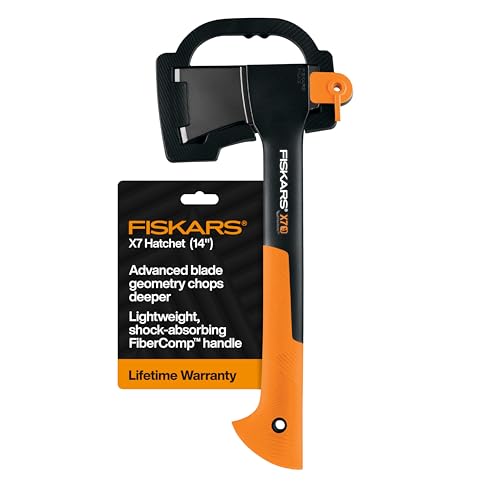
Fiskars X7 Small 14" Hatchet Axe with Sheath for Chopping Wood Kindling for Campfires while Outdoors...
Weight: 1.5 pounds
Length: 14 inch
Features: Proprietary blade,FiberComp handle,Lifetime warranty
+ Pros
- Ultra lightweight 1.5 lbs
- 3x deeper cutting power
- Shock-absorbing handle
- Stays sharp longer
- The best budget pick for hatchets
- Cons
- Not for large logs
- Handle flexes slightly on hard swings
Small hatchets usually perform poorly, but the Fiskars X7 is different. I've used this hatchet for five camping seasons, and it still splits kindling like new.
The proprietary blade geometry makes this 14-inch hatchet outperform larger axes. Fiskars designed the head to penetrate 3x deeper than traditional designs, which means fewer swings for each split.
The FiberComp handle absorbs shock remarkably well. After splitting a bundle of wood, my hands feel fine compared to wooden handles that transfer vibration. At only 1.5 pounds, this hatchet is light enough to pack but substantial enough for real work.
Customer reviews repeatedly mention the lifetime warranty. Fiskars stands behind this product completely, which explains the 23,000+ positive ratings.
Who Should Buy?
Anyone who splits their own kindling or processes larger logs into manageable pieces will appreciate this hatchet's performance.
Who Should Avoid?
If you only burn pre-split campground bundles or have shoulder or wrist issues, you might not need a dedicated hatchet.
3. Ours Furtif Ferro Rod Fire Starter - Most Reliable Fire Starter

OURS FURTIF Fire Starter Survival Kit – 3/8" Ferro Rod with Multi-Tool Striker & Natural Fatwood...
Rod Thickness: 3/8 inch
Strikes: 15000+
Features: Multi-tool striker,Fatwood included,Waterproof design
+ Pros
- Extra thick ferro rod
- 15000+ strikes lifetime
- Works even when wet
- Includes fatwood tinder
- Multi-tool striker built in
- Cons
- Learning curve for technique
- More expensive than basic rods
I've gone through countless cheap ferro rods that barely spark. This Ours Furtif rod is different - the 3/8-inch thickness produces massive showers of sparks that ignite tinder consistently.
The 15,000+ strike rating means this will last for years of regular use. Standard thin rods wear out after 3,000-5,000 strikes, making this a genuine long-term investment.
Water won't stop this fire starter. I've dropped it in streams and used it immediately after wiping it dry. The included fatwood tinder stick is a nice touch - it catches sparks even when slightly damp.
The multi-tool striker functions as a bottle opener, hex wrench, and ruler. Customer photos show the sparks this rod throws - they're impressive compared to standard fire steel.
Who Should Buy?
Bushcraft enthusiasts, emergency preppers, and anyone who wants reliable fire starting in any weather condition should add this to their kit.
Who Should Avoid?
Casual campers who only use matches or lighters might not need this level of fire-starting capability.
Firewood Transport Regulations and Safety
Before loading your truck with firewood, understand the regulations. Transporting firewood across state lines can spread invasive pests that destroy forests.
The emerald ash borer has killed millions of ash trees across 35 states. This pest travels in firewood, and moving infested wood accelerates the spread to new areas.
Warning: Many states prohibit transporting firewood from outside their borders. Some have quarantine zones where moving wood is illegal. Always check local regulations before bringing firewood.
The Don't Move Firewood campaign recommends buying firewood within 50 miles of your destination. Most campgrounds sell firewood specifically to prevent invasive species transport.
Look for certified firewood with a USDA or state seal. This wood has been heat-treated to kill pests and is safe for transport within approved areas.
Never bring firewood home from a distant camping trip. Any unused wood should stay at the campground or be disposed of properly according to local regulations.
Campfire Safety Essentials
- Check Burn Bans: Call ahead or check the forest service website. Many areas ban fires during drought conditions, regardless of your firewood supply.
- Use Designated Rings: Never build ground fires outside established fire rings. Ground fires can smolder underground and restart days later.
- Maintain Clearance: Keep 10 feet of clearance around your fire. Remove leaves, twigs, and overhanging branches that could catch from sparks.
- Never Leave Unattended: Extinguish fires completely if leaving camp. Wind changes can spread fire rapidly in dry conditions.
- Extinguish Properly: Douse with water, stir the ashes, douse again. Touch the ashes with your hand - if they're hot, it's not out.
Frequently Asked Questions
How much firewood do I need for one night?
Plan for 2-4 bundles of firewood for one night of camping. Use 2 bundles for a short evening fire (2-3 hours). Plan 3-4 bundles if cooking dinner over the fire or enjoying extended fires until late night.
How much firewood do I need for 3 days of camping?
For a 3-day camping trip, plan 6-9 bundles for evening fires only. If cooking meals over the fire, increase to 9-12 bundles. Cold weather camping (below 50°F) requires 8-11 bundles for the same duration.
Can you bring your own firewood to a campground?
Check local regulations before bringing firewood. Many states prohibit transporting wood across county or state lines due to invasive species like emerald ash borer. Buy firewood within 50 miles of your campground to avoid spreading pests. Look for certified heat-treated wood if transport is necessary.
How much firewood fits in a pickup truck?
A standard pickup truck bed holds approximately 1/4 to 1/2 cord of loosely stacked firewood. This equals 12-25 bundles depending on stacking method. A full cord (128 cubic feet) requires two truckloads or a trailer for transport.
What is the best firewood for camping?
Hardwoods like oak, hickory, and maple are best for camping fires. Oak burns 3-4 hours per log with high heat output. Hickory produces the hottest flames and is ideal for cooking. Maple offers a balance of burn time and easy lighting. Avoid pine for main fuel due to short burn time and sparking.
How much firewood do I need for a week?
For a week-long camping trip, plan 14-21 bundles for evening fires only. With cooking included, increase to 21-28 bundles. All-day fires throughout the week require 28-42 bundles. This equals approximately 1/4 to 1/2 cord of firewood for a full week of camping.
Final Planning Tips
After hundreds of nights around campfires, my advice is simple: bring 20% more than you think you need. Running out of firewood on a perfect stargazing night is disappointing. Having extra means you can share with neighboring campers and make new friends.
Buy from local sources near your campground. You'll avoid transport restrictions, support local economies, and ensure the wood is appropriate for local conditions.
Always check burn bans before you leave home. Nothing's worse than arriving with a truckload of firewood only to discover fires are prohibited.