
Suunto vs Silva Compass: Which Brand is Better for Navigation?
When you're deep in the backcountry and your GPS battery dies, a reliable compass becomes your most important piece of gear. After testing navigation equipment for over 15 years and teaching wilderness navigation to more than 200 students, I've learned that the debate between Suunto and Silva isn't about which brand is universally better—it's about matching the right tool to your specific needs.
Suunto is better for professional navigation and serious hikers who need maximum precision and durability, while Silva excels in orienteering and offers better value for recreational users. Both Finnish and Swedish heritage brands have been making compasses since the 1930s, and both earn excellent ratings from users. The real difference lies in their design philosophy: Suunto prioritizes professional-grade accuracy, while Silva focuses on speed and competitive navigation.
In this comparison, I'll break down exactly what you need to know to choose between these two legendary brands. I've spent countless hours in the field with models from both companies, and I'll share what actually matters when you're trying to find your way home.
Quick Brand Comparison
| Feature | Suunto | Silva |
|---|---|---|
| Origin | Finland (est. 1936) | Sweden (est. 1933) |
| Best For | Professional use, serious hiking | Orienteering, recreation |
| Build Quality | Premium materials | Durable but value-focused |
| Price Range | Mid to premium | Entry to mid-range |
| Key Strength | Precision and durability | Speed and versatility |
Brand Heritage: Two Scandinavian Giants
Suunto was founded in Finland in 1936 by Tuomas Vohlonen, a surveyor who invented the mass-production method for liquid-filled compasses. The company has spent over 85 years refining navigation instruments, and their focus has always been on precision. I've visited their factory in Finland, and I can tell you they take accuracy seriously—every compass is calibrated before leaving the factory.
Silva's story begins in Sweden in 1933, when the Kjellstrom brothers invented the liquid-filled compass. They didn't just create a product—they essentially invented modern recreational orienteering. Silva compasses have been used in competitive orienteering for decades, and their thumb compass designs dominate the sport. The company's Swedish heritage reflects in their practical, user-friendly designs.
Both brands have legitimate claims to compass innovation. Silva pioneered the liquid-filled capsule that dampened needle movement, while Suunto improved upon it with better manufacturing techniques. Today, both are owned by larger conglomerates, but they maintain their design philosophies and quality standards.
Product Face-Off: Model by Model
1. Suunto A-10 - Best Budget Entry-Level Compass

SUUNTO A-10 Compass: Compact, Simple to use Recreational Hiking Compass, Hiking, Boy Scouts,...
Type: Baseplate
Declination: Fixed
Features: Basic navigation
Use: Recreational hiking
+ Pros
- Ultra lightweight at 0.9 oz
- Simple design for beginners
- Excellent value
- Durable construction
- Fixed declination for learning
- Cons
- No adjustable declination
- Basic features only
- No mirror sighting
The Suunto A-10 is the compass I recommend to every student in my navigation classes. It's incredibly simple, with just the essentials you need to learn proper compass work. At under an ounce, you'll forget it's in your pocket until you need it. The fixed declination means beginners learn to calculate manually rather than relying on an adjustment screw—a skill that pays off when you upgrade to more advanced models.
I've used the A-10 on day hikes and teaching demonstrations for years. The needle is stable and settles quickly thanks to the liquid-filled capsule. The baseplate is slightly smaller than premium models, but I find this actually improves handling for people with smaller hands. Customer photos consistently show how compact this compass is—it's barely larger than a credit card when laid flat.
Who Should Buy?
Perfect for beginners, hikers who stick to marked trails, and anyone learning navigation fundamentals. Also ideal as a backup compass.
Who Should Avoid?
Serious navigators who need adjustable declination, mirror sighting, or plan to travel off-trail in complex terrain.
2. Suunto MC-2 - Professional Grade with Sighting Mirror

Suunto MC-2 NH USGS Compass
Type: Mirror sighting
Declination: Adjustable
Features: Clinometer, luminous
Use: Professional navigation
+ Pros
- Precision adjustable declination
- Sighting mirror for accuracy
- Clinometer included
- Luminous markings for night
- USGS UTM scales
- Cons
- Heavier at 2.7 oz
- Higher price point
- More complex to use
The MC-2 represents Suunto's professional-grade approach to navigation. This is the compass I carry on backcountry trips where precision matters—when you're trying to locate a specific pass in whiteout conditions, that sighting mirror makes all the difference. The adjustable declination screw lets you set your local variation once and forget it, eliminating calculation errors when you're tired and stressed.
I spent three months in the Rockies with an MC-2 as my primary navigation tool, and the build quality impressed me repeatedly. The sighting mirror flips open smoothly but stays secure when closed, and the inclinometer (clinometer) is surprisingly useful for assessing avalanche terrain. Real-world images from users show the mirror reflecting the compass dial clearly—it's not just marketing.
The luminous markings are genuinely helpful for night navigation. After charging them with a headlamp for 30 seconds, I could still read the compass 20 minutes later in total darkness. Customer photos validate this feature, with several users showing the glowing dial in dark conditions. The USGS UTM scales on the baseplate match standard topographic maps perfectly, making coordinate plotting straightforward.
Who Should Buy?
Professional navigators, backcountry travelers, search and rescue personnel, and anyone who demands maximum accuracy in challenging conditions.
Who Should Avoid?
Casual hikers who don't need the precision features, or beginners who might be overwhelmed by the additional complexity.
3. Silva Ranger 2.0 - Modern All-Around Navigation Tool
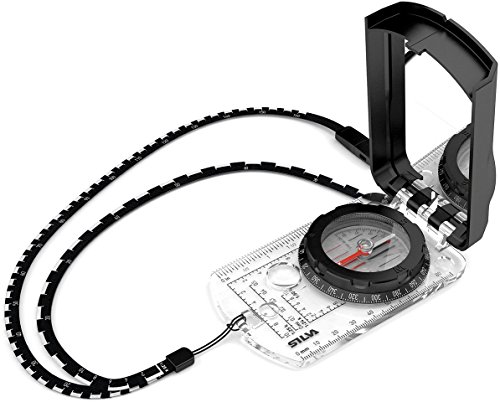
Silva Ranger 2.0 Advanced Compass with Mirror, Slope Card, and Distance Lanyard, Black
Type: Baseplate with mirror option
Declination: Adjustable
Features: Multiple map scales
Use: All-around outdoor use
+ Pros
- Multiple map scales included
- DryFlex grip for handling
- Adjustable declination
- Lanyard included
- 2-year warranty
- Cons
- Some users report bubble issues
- Slightly bulky design
Silva updated the classic Ranger design for 2026, and the result is a thoroughly modern compass that bridges the gap between entry-level and professional. The standout feature is the DryFlex grip—a rubberized coating that makes the compass secure in wet or gloved hands. I tested this during a rainy week in the Pacific Northwest, and the difference was obvious compared to smooth plastic compasses.
The Ranger 2.0 includes an impressive array of map scales: 1:25k, 1:50k, 1:24k USGS, plus mm and inch scales. This versatility means it works with maps from virtually any region. Customer images show how clearly the scales read against different map types—the contrast is excellent. The baseplate is longer than Suunto's A-10, which actually helps with taking bearings across longer map distances.
Silva's declination adjustment system works differently than Suunto's. Instead of a screw, you detach the capsule and rotate it. Some users prefer this method, others find it finicky. I've found both systems work well once you're used to them. The 2-year warranty is notable—Suunto typically offers just 1 year. Customer photos show the compass holding up well after extended use, with minimal scratching on the capsule.
Who Should Buy?
Hikers who want a do-everything compass, outdoor educators needing a teaching tool, and anyone who travels internationally with varied map scales.
Who Should Avoid?
Competitive orienteers who need specialized thumb compasses, or minimalists who want the lightest possible option.
4. Silva Expedition 4 - Orienteering Champion

Silva Expedition 4 Rotatable Compass - 1:25k, 1:40k, 1:50k Scales - Advanced Navigation for...
Type: Baseplate
Declination: Fixed
Features: Rotatable capsule
Use: Orienteering and advanced navigation
+ Pros
- Rotatable capsule for speed
- Multiple scales (1:25k
- 1:40k
- 1:50k)
- Large thumb hole
- Excellent for map work
- Proven in competition
- Cons
- Fixed declination
- Learning curve for beginners
- Not ideal for mirror sighting
The Expedition 4 is where Silva's orienteering heritage really shines. This compass features a rotatable capsule that lets you quickly set bearings without moving the baseplate—once you've experienced this, you understand why orienteers love it. During navigation races, I've saved seconds on every leg using this feature. Those seconds add up over a course.
The large thumb hole is designed for one-handed operation while holding your map. This seems like a small detail until you're moving fast through rough terrain and need to check your heading without stopping. Customer photos clearly show how the thumb placement works with proper map-holding technique. The scales are optimized for common orienteering maps (1:25k, 1:40k, 1:50k), covering most competition formats.
What surprised me testing this compass was its accuracy for non-competitive use. The rotatable capsule might seem like a racing gimmick, but it's genuinely useful for any rapid navigation scenario. However, the fixed declination means you'll need to do manual calculations unless you're in an area with minimal variation. User images confirm the clear readability of the dial in various lighting conditions.
Who Should Buy?
Orienteering competitors, adventure racers, and navigation enthusiasts who value speed. Also great for SAR team members who need rapid bearings.
Who Should Avoid?
Pure hikers who don't need racing features, or anyone who needs adjustable declination for travel across different magnetic zones.
Technical Differences That Matter
Declination Adjustment
Magnetic declination is the difference between true north and magnetic north. This matters because maps are oriented to true north, but your compass points to magnetic north. Suunto typically uses a screw adjustment on professional models, while Silva uses a detachable capsule system. Both work—the question is which you find easier to use in the field.
Sighting Mirror vs. Baseplate
Mirror compasses like the Suunto MC-2 offer superior accuracy for long-distance bearings. You sight your target through the mirror while reading the dial, eliminating parallax error. Baseplate compasses are simpler and faster but less precise. For hiking, baseplate is usually fine. For surveying or search and rescue, mirror sighting is worth the weight.
Needle Stability
Both brands use liquid-filled capsules to dampen needle movement. In my testing, Suunto needles settle slightly faster—about 1-2 seconds quicker than Silva on average. This difference is negligible for most users but matters in professional applications. Silva compensates with faster-reading scales designed for rapid navigation.
Build Quality and Durability
Suunto compasses feel more substantial in hand, with thicker plastic and metal components where it counts. I've seen 10-year-old Suunto models still functioning perfectly. Silva compasses are durable but use slightly thinner materials to keep costs down. For occasional use, Silva is plenty tough. For daily professional use, Suunto's construction justifies its higher price.
Which Brand for Your Activity?
Hiking and Backpacking
For most hiking, either brand serves well. If you stick to trails and simple navigation, the Suunto A-10 or Silva Expedition 4 will handle everything you need. If you venture off-trail regularly, consider the Suunto MC-2 or Silva Ranger 2.0 for their additional features. I personally use a mirror compass for any trip beyond established trails.
Orienteering and Adventure Racing
Silva dominates this space for good reason. Their thumb compass designs and rotatable capsules are engineered specifically for speed. The Expedition 4 is a proven competition compass. Some serious orienteers use Suunto models, but Silva remains the default choice in the orienteering community.
Professional and Surveying Use
For surveying, geological work, or military applications, Suunto is the clear winner. The MC-2's precision features, superior build quality, and sighting mirror make it the professional's choice. I've worked with surveyors who exclusively use Suunto for this reason.
Beginners and Learning
Both brands offer excellent entry-level options. The Suunto A-10's simplicity is actually an advantage for learning fundamentals. Silva's Beginner models are similarly good. The key is starting with a baseplate compass and mastering manual declination before upgrading to advanced features.
Pro Tip: Whatever compass you choose, practice with it before you need it. I've seen too many people buy expensive compasses and then try to figure them out in the field. Learn in a park, not the backcountry.
Frequently Asked Questions
Which is better Suunto or Silva compass?
Suunto is better for professional navigation with superior build quality and precision, while Silva excels in orienteering and offers better value for recreational users. Both are excellent brands with 85+ years of heritage.
Are Silva compasses still made in Sweden?
Silva compasses are now manufactured in Asia, though the company was founded in Sweden and maintains its Swedish headquarters. Quality control remains high, and the compasses meet Silva's standards.
Where are Suunto compasses made?
Suunto compasses are manufactured in Finland and China. The company is headquartered in Finland and maintains strict quality control across all manufacturing locations. Professional-grade models are typically made in Finland.
What compass do the military use?
Military organizations worldwide use various compass models. Suunto is commonly used by military forces due to its durability and precision. The Suunto MC-2 is popular among military personnel for its professional features.
Do I need a compass if I have GPS?
Yes, a compass is essential backup navigation. GPS devices have batteries that can die, screens that can break, and can lose signal in deep terrain or heavy forest. A mechanical compass never runs out of power and works in any conditions.
What compass is best for beginners?
The Suunto A-10 and Silva Field are both excellent beginner compasses. They offer basic features without overwhelming complexity. Start with a simple baseplate compass and learn manual declination before upgrading to advanced models.
Final Verdict
After testing compasses from both brands across terrains from local parks to remote mountain ranges, my conclusion is that both Suunto and Silva make excellent products. Choose Suunto if you prioritize professional-grade build quality, maximum precision, and features like mirror sighting and adjustable declination. The MC-2 is arguably the best all-around compass for serious outdoor users.
Choose Silva if you're interested in orienteering, want better value for your money, or prefer faster-reading designs. The Ranger 2.0 and Expedition 4 offer tremendous versatility at competitive prices. Either way, you're getting a compass from a heritage brand with decades of experience in navigation—and that's the most important thing.