
Petzl Grigri Review: 3 Years of Real-World Testing
I've been using the Petzl Grigri for over three years now, catching whippers on sport routes from the Red to the Redwoods.
After hundreds of belay sessions and countless falls caught, I can tell you this device has become the industry standard for good reason.
The Petzl Grigri is an assisted-braking belay device designed for sport climbing and gym climbing that uses a camming mechanism to help catch falls and lower climbers smoothly.
In this review, I'll break down everything you need to know about the Grigri based on real experience, not just manufacturer claims.
What is the Petzl Grigri?
The Petzl Grigri is an assisted-braking belay device designed primarily for sport climbing that uses a camming mechanism to automatically pinch the rope when sudden tension occurs.
Unlike traditional tube-style belay devices like the ATC that rely entirely on the belayer's grip, the Grigri provides mechanical backup that engages during a fall.
First introduced in 1991, the Grigri revolutionized sport climbing by making it easier to catch falls and reduce belayer fatigue during long projecting sessions.
Today, the Grigri line includes the standard model for experienced climbers and the Grigri+ with additional safety features for learners.
The device has become so ubiquitous that many climbing gyms now require assisted-braking devices for lead belay tests.
Assisted-Braking: A belay device mechanism that helps catch falls by mechanically pinching the rope when tension increases, providing a safety backup to proper belay technique.
Key Features That Make the Grigri Stand Out
Camming Mechanism
The heart of the Grigri is its camming device, a pivoting cam that rotates when rope tension spikes during a fall.
This cam pinches the rope against the device body, creating friction that arrests the fall without requiring excessive grip strength from the belayer.
I've noticed the difference especially on long, projecting days when catching multiple falls would leave my arms pumped with an ATC.
The cam engages smoothly but reliably, catching falls that might surprise a tired belayer.
Durable Construction
Built with aluminum side plates and a stainless steel cam, the standard Grigri weighs in at 170 grams.
After three years of weekly use, my Grigri shows minimal wear—the cam still engages smoothly and the rope groove hasn't deepened significantly.
Forum users report lifespans of 5-10 years with proper care, making the initial investment pay off over time.
The device feels solid in hand, with no plastic parts that might break under stress.
Rope Compatibility
The standard Grigri accommodates single ropes from 8.9 to 11 mm in diameter.
I've found it works optimally with ropes in the 9.4 to 10.3 mm range—the sweet spot for smooth feeding and reliable locking.
Thicker gym ropes feed smoothly, while skinny outdoor ropes still engage the cam reliably when needed.
Just check your rope diameter before buying—older Grigri models had narrower ranges than current versions.
| Grigri Model | Weight | Rope Range | Key Feature |
|---|---|---|---|
| Standard Grigri | 170 g | 8.9-11 mm | Simplified design, lighter |
| Grigri+ | 200 g | 8.5-11 mm | Anti-panic handle |
Smooth Lowering Control
The descent handle on the Grigri provides progressive lowering control that lets you modulate speed precisely.
Unlike some assisted-braking devices that can feel jerky, the Grigri's handle operation feels natural and responsive.
I've lowered partners from 100-foot routes without the hand fatigue that comes with tube devices, especially near the end when the rope weight stacks up.
How the Grigri's Assisted-Braking Works?
The Grigri uses a pivoting cam that rotates when rope tension increases during a fall, pinching the rope against the device body to create friction and arrest the fall.
During normal belaying, the cam stays disengaged, allowing smooth rope feed through the device.
When your climber falls, the sudden acceleration causes the cam to rotate, clamping down on the rope.
This mechanical engagement happens automatically, regardless of your brake hand position—which is exactly why proper technique remains critical.
The handle on the side disengages the cam for controlled lowering when you're ready to bring your partner down.
Quick Summary: The Grigri's cam rotates during falls to pinch the rope, while the handle overrides this for lowering. Proper belay technique is still essential—the assisted braking is a backup, not a replacement.
Grigri vs Grigri+: Which Model Should You Choose?
The Grigri+ adds two key features: an anti-panic handle and a selectable top-rope/lead mode.
The anti-panic function prevents the handle from opening too far if the belayer panics during lowering—a feature that literally saved one forum user from a dangerous accelerated descent.
Top-rope mode increases camming sensitivity for lighter climbers or when using thick gym ropes.
However, these features come with a weight penalty of 30 extra grams and a steeper price tag.
Which One Should You Buy?
Choose the standard Grigri if you're an experienced climber who values simplicity and weight savings.
The Grigri+ makes more sense for beginners, climbing instructors, or anyone who values the anti-panic safety net.
Proper Belay Technique with the Grigri
Setup
- Thread the rope: Follow the diagram on the device—rope goes from climber side, through the cam, out to brake hand side.
- Clip to belay loop: Use a locking carabiner through both the device and your harness belay loop.
- Test the cam: Pull sharply on the climber side to verify the cam engages before your partner leaves the ground.
Lead Belaying
Keep your brake hand on the rope at all times, just like with a tube device.
Feed slack smoothly by pulling rope through with your brake hand while simultaneously pushing up on the cam with your guide hand.
The Grigri doesn't replace proper technique—I've seen complacent belayers make dangerous mistakes because they trusted the device too much.
Top-Rope Belaying
For top-roping, keep steady tension and feed rope as the climber advances.
When lowering, engage the handle smoothly and modulate your grip for controlled descent speed.
Critical Warning: Never let go of the brake hand, even with a Grigri. The assisted braking is a backup system, not a replacement for proper belay technique. Complacency has caused real accidents.
Common Mistakes to Avoid
- Short-roping: Not feeding slack fast enough when the climber clips
- Letting go with brake hand: The cam won't always engage if you're feeding rope
- Wrong rope diameter: Using too-thin ropes can prevent the cam from engaging properly
- Dirt buildup: Failing to clean the device, which can affect cam operation
Pros and Cons of the Petzl Grigri
What I Love
- Catches falls effortlessly: The cam engages reliably, reducing fatigue during long sessions
- Durable construction: Built to last 5-10 years with proper care
- Smooth lowering: Precise control when bringing partners down
- Industry standard: Familiar to most climbers and gyms
- Good resale value: Holds value better than most climbing gear
Drawbacks to Consider
- Higher price point: Costs significantly more than tube-style devices
- Heavier: At 170-200g, it's heavier than minimalist options
- Learning curve: Proper feeding technique takes practice to master
- Limited versatility: Not ideal for trad or multi-pitch climbing
- Can breed complacency: Easy to over-rely on the assisted braking
Product Options: Grigri Models and Alternatives
1. Petzl GRIGRI Belay Device - Blue (Standard Model)

Petzl GRIGRI Rock Climbing Belay Device - Blue
Weight: 170g
Rope Range: 8.9-11mm
Type: Assisted braking
Best For: Sport climbing, projecting
+ Pros
- Lighter than Grigri+
- Simplified design
- Durable construction
- Smooth operation
- Industry standard
- Cons
- No anti-panic feature
- Higher price than tubes
- Heavier than minimalist devices
- Limited versatility
This is the standard Grigri model that I've been using for three years.
At 170 grams, it's 30 grams lighter than the Grigri+ while offering the same core assisted-braking functionality.
I appreciate the simplicity—fewer moving parts means less to think about when I'm focused on my climber.
The device excels at sport climbing and projecting, where catching multiple falls is part of the process.
After hundreds of belay sessions, mine still locks up instantly when needed and lowers smoothly.
For experienced climbers who don't need the anti-panic feature, this is the model I'd recommend.
2. PETZL GRIGRI+ Belay Device - Violet (With Anti-Panic)

Petzl GRIGRI+ Rock Climbing Belay Device - Violet
Weight: 200g
Rope Range: 8.5-11mm
Type: Assisted braking + anti-panic
Best For: Beginners, instruction
+ Pros
- Anti-panic handle
- Top-rope/lead mode
- Wider rope range
- Enhanced safety features
- Ideal for learners
- Cons
- 30g heavier than standard
- Higher price
- More complex operation
- Bulkier design
The Grigri+ adds the anti-panic handle that can prevent accidents during panicked lowering situations.
I've seen this feature literally save a beginner belayer who accidentally pulled the handle too far when startled by a falling climber.
The selectable top-rope mode increases cam sensitivity for lighter climbers or thick gym ropes.
At 200 grams, it's slightly heavier but worth the weight for anyone learning to belay or teaching others.
Climbing instructors I know consistently recommend this model for students because of the additional safety features.
3. PETZL Orange GRIGRI + Plus
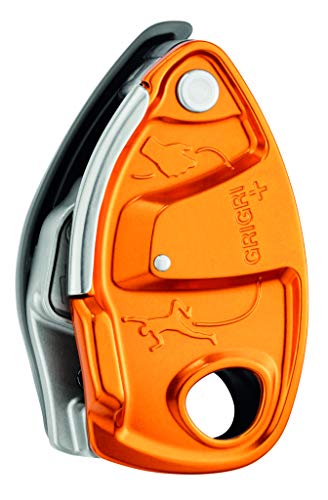
PETZL Orange GRIGRI + Plus Climbing Belay Device
Weight: 200g
Rope Range: 8.5-11mm
Type: Assisted braking + anti-panic
Best For: Visibility preference
+ Pros
- All Grigri+ features
- High-visibility orange
- Same anti-panic safety
- Wider rope range
- Cons
- Higher price
- Same weight as violet
- More complex than standard
This is the same Grigri+ as the violet model, just in a high-visibility orange colorway.
Some climbers prefer the brighter color for easier gear identification at the crag or in low-light conditions.
The functionality is identical—anti-panic handle, top-rope/lead mode selection, and the 8.5-11 mm rope compatibility.
Choose this one if you want the Grigri+ features but prefer orange over violet for visibility or personal style.
Frequently Asked Questions
Is the Petzl Grigri worth it?
Yes, the Grigri is worth it for sport climbers and gym climbers who belay frequently. The assisted braking reduces fatigue and provides a safety backup. However, occasional climbers or those on a tight budget may prefer a less expensive tube-style device.
Can a beginner use a Grigri?
Yes, beginners can use a Grigri with proper instruction. The Grigri+ model with anti-panic handle is especially recommended for new belayers. However, quality instruction and supervision are critical—never rely solely on the device without learning proper belay technique.
How long does a Petzl Grigri last?
A Grigri typically lasts 5-10 years with regular use and proper care. The lifespan depends on usage frequency, climbing environment, and how well you maintain it. Inspect regularly for wear on the cam and rope groove, and replace if you notice deepening grooves or inconsistent operation.
What rope diameter works with Grigri?
The standard Grigri works with single ropes from 8.9 to 11 mm in diameter. The Grigri+ accepts a slightly wider range of 8.5 to 11 mm. For optimal performance, use ropes in the 9.4 to 10.3 mm range.
Is Grigri better than ATC?
The Grigri and ATC serve different purposes. The Grigri excels for sport climbing and gym use with its assisted braking, while the ATC is lighter, cheaper, and more versatile for trad and multi-pitch climbing. Many climbers own both and choose based on the day's objectives.
When should I use a Grigri?
Use a Grigri for sport climbing projects, gym climbing, working routes, or whenever you'll be catching multiple falls. It's also helpful when belaying a less experienced climber or during long sessions when belayer fatigue is a concern. Consider other options for trad or alpine climbing where weight and versatility matter more.
Final Verdict: Is the Petzl Grigri Worth It?
After three years and hundreds of belay sessions with the Grigri, my answer is a qualified yes.
If you're primarily sport climbing or climbing in gyms where assisted-braking devices are encouraged or required, the Grigri is worth the investment.
The device reduces fatigue, provides a reliable safety backup, and has become the industry standard for good reason.
However, it's not the right choice for every climber—trad climbers may prefer lighter, more versatile options.
The key is understanding that the Grigri enhances but doesn't replace proper belay technique.
I've seen complacent belayers make dangerous mistakes because they over-trusted the device.
Used correctly, the Grigri is an excellent tool that can make belaying safer and more enjoyable.
Choose the standard model if you're experienced and value simplicity, or spring for the Grigri+ if you want the anti-panic safety net.