
8 Best Aeroponic Tower Gardens (October 2026)
Yes, an aeroponic tower garden is worth it on a patio, but only if you are growing leafy greens and herbs and you have a reliable outlet and a hose nearby. A tower turns roughly three square feet of paving into 24 to 148 planting sites, needs no soil, and uses a fraction of the water a raised bed does. The catch is that every tower in this roundup depends on a pump, and most depend on a timer, so a power cut becomes a dead root zone within hours. This guide covers the best aeroponic tower gardens for patios, ranked from a 24-pot self-lit cabinet to a 148-pod commercial tower, plus the honest failure modes nobody in this category advertises.
We spent weeks going through manufacturer spec sheets, warranty terms and buyer reviews for every tower below, then cross-checked them against what people actually report after a full growing season. Where a claim comes from the manufacturer rather than a measurement, we say so. Where the evidence is thin, we say that too.
A note before you start: this article contains affiliate links, and we may earn a commission if you buy through them. That does not change the order. And the category is genuinely confusing, because most towers sold as "aeroponic" are not aeroponic at all. We explain the difference properly a few sections down, because it changes what you are actually buying.
One more thing worth saying up front. If your patio is a relaxing space first, note that hammock chairs for patios and a good outdoor rug tend to matter more to daily enjoyment than yield numbers. A tower is a weekend commitment, not a weekend project you finish in an afternoon.
Our Top 3 Tower Picks for Patios Where Space Is Tight
These three cover the realistic range for a home patio: the most complete all-round system, the strongest balance of capacity and support, and the cheapest way to find out whether you even enjoy it.
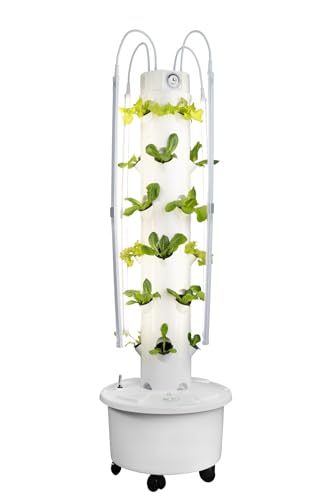
ALTO GARDEN GX Tower with LED
- 24 net pots under 3 sq ft
- 10 gallon reservoir
- Built-in LED with timer
- BPA-free 2mm walls
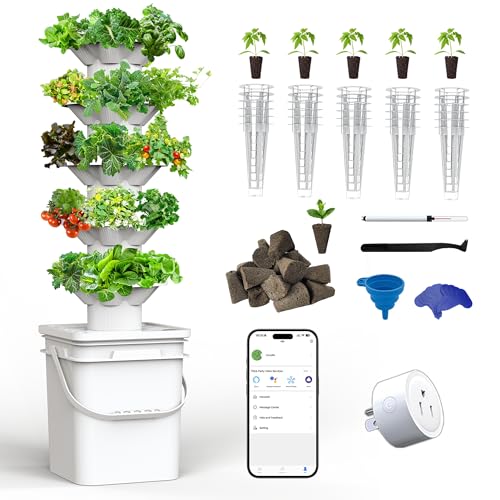
SJZX 5-Layer 30-Hole Tower
- 30 planting holes
- 12L tank with gauge
- Smart socket pump control
- BPA-free food-grade plastic
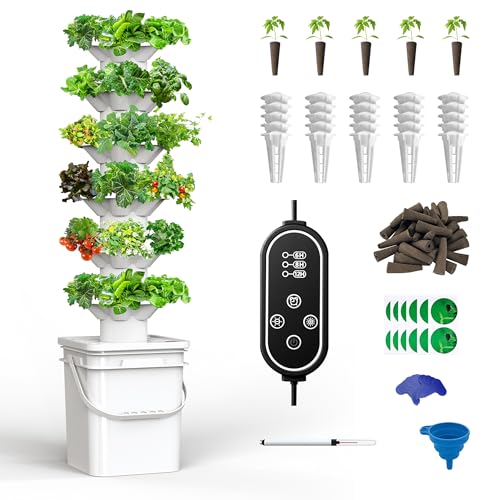
SJZX 6-Layer 36-Pod Tower
- 36 pods in about 2 sq ft
- 12L reservoir
- 3-stage timer pump
- UV-resistant PVC-U body
Comparing 8 Tower Gardens Side by Side in 2026
Capacity, footprint and reservoir volume are the three numbers that actually decide whether a tower fits your patio and how often you touch it. Height matters more than buyers expect, since a tall tower shades its own lower levels. Here is everything in the roundup in one view.
| Product | Key Specs | Action |
|---|---|---|
| ALTO GARDEN GX Tower with LED Grow Lights |
|
Check Latest Price |
| SJZX 6-Layer 36-Pod Tower |
|
Check Latest Price |
| SJZX 5-Layer 30-Hole Tower |
|
Check Latest Price |
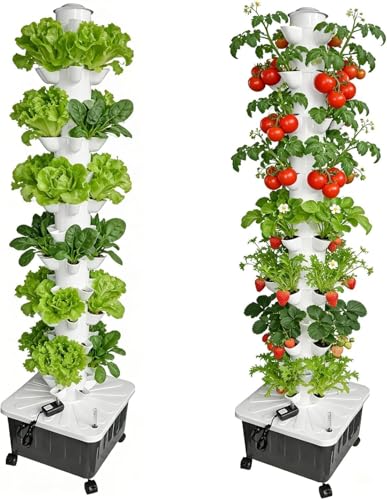 14-Layer 70-Slot Hydroponic Tower 14-Layer 70-Slot Hydroponic Tower |
|
Check Latest Price |
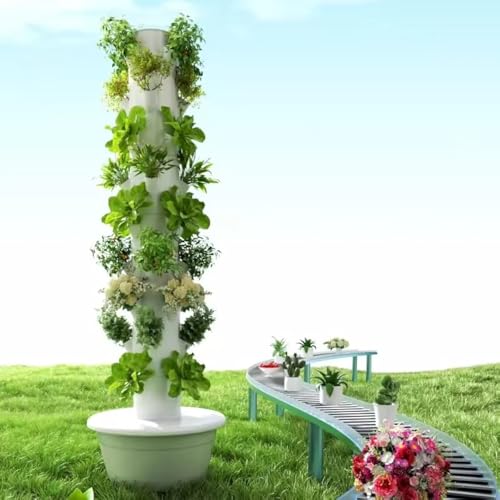 TIRUSS 9-Layer 36-Pot Grow Tower TIRUSS 9-Layer 36-Pot Grow Tower |
|
Check Latest Price |
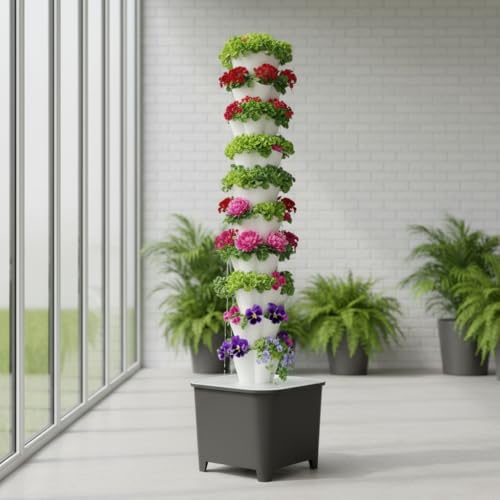 TIRUSSS 8-Layer 50-Hole Tower TIRUSSS 8-Layer 50-Hole Tower |
|
Check Latest Price |
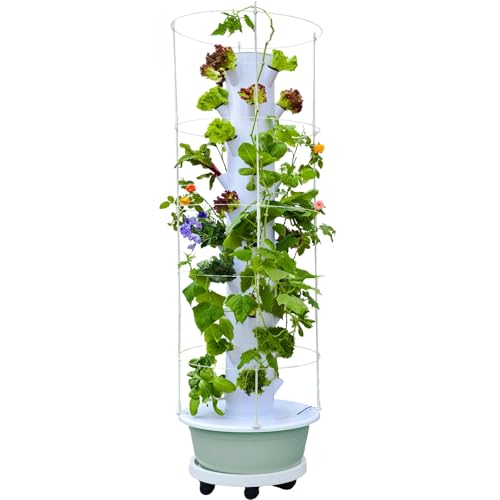 LnzyGarden 40-Pod Tower with Trellis LnzyGarden 40-Pod Tower with Trellis |
|
Check Latest Price |
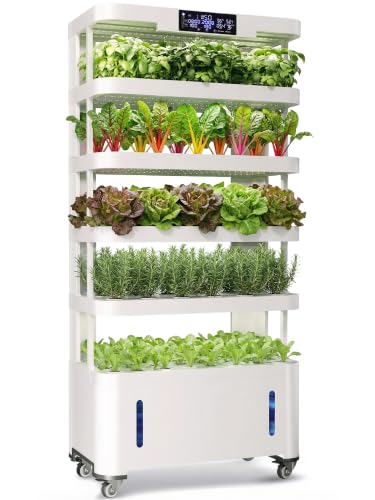 WooRoot Max Pro 148-Pod Tower WooRoot Max Pro 148-Pod Tower |
|
Check Latest Price |
Aeroponic vs Hydroponic vs Soil: What the Label Actually Means
Almost every tower in this roundup uses nutrient film technique, which is hydroponic rather than aeroponic. Genuine aeroponics suspends plant roots in air and atomises a fine nutrient mist onto them, so roots absorb water and nutrients through their whole surface. NFT instead runs a shallow film of water down channels or through stacked sites, with roots partly in that film and partly in air. Retailers use the two words interchangeably, so read the pump description rather than the title.
The practical difference on a patio is failure tolerance. NFT has more margin, because a root sitting in a thin film of solution is not instantly dry. True mist aeroponics is faster and can produce more per square foot, but it is unforgiving when a pump fails or a nozzle clogs. Several towers here describe a misting tank, which puts them closer to the aeroponic end of the spectrum than most listing copy admits.
Soil-based vertical planters sit in a third camp entirely. They need no power, no pump and no water at harvest time, and they tolerate a missed weekend. In exchange they are heavy, they need real nutrient management, and they are less space-efficient per plant site. If your top priority is reliability rather than yield per square foot, a soil tower is a genuinely defensible choice and you should not feel pushed toward a pump.
Here is the short version to remember: if the listing says NFT, nutrient film, or a submersible pump circulating solution, it is hydroponic. If it says mist, atomise, or aeroponic with a dedicated misting tank, it is closer to true aeroponics. The rest of this roundup is honest about which is which.
1. ALTO GARDEN GX Tower with LED Grow Lights - the Most Complete All-Round Patio System
ALTO GARDEN GX Hydroponic Tower | Vertical Planter Tower | Hydroponics Growing System Kit | Food...
24 net pots in under 3 sq ft
10 gallon reservoir
Integrated LED with timer
BPA-free 2mm walls
+ Pros
- Grows 24 plants in under 3 sq ft
- built-in broad-spectrum LED plus a 4-head germination light
- 10 gallon wheeled reservoir with water gauge
- includes 30 rockwool cubes plus A and B nutrients and a pH pen
- no subscription required for full features
- Cons
- one owner reported the tower coming apart during assembly
- faulty LED wand connector on one unit
- filled unit is heavy and should be moved from the base
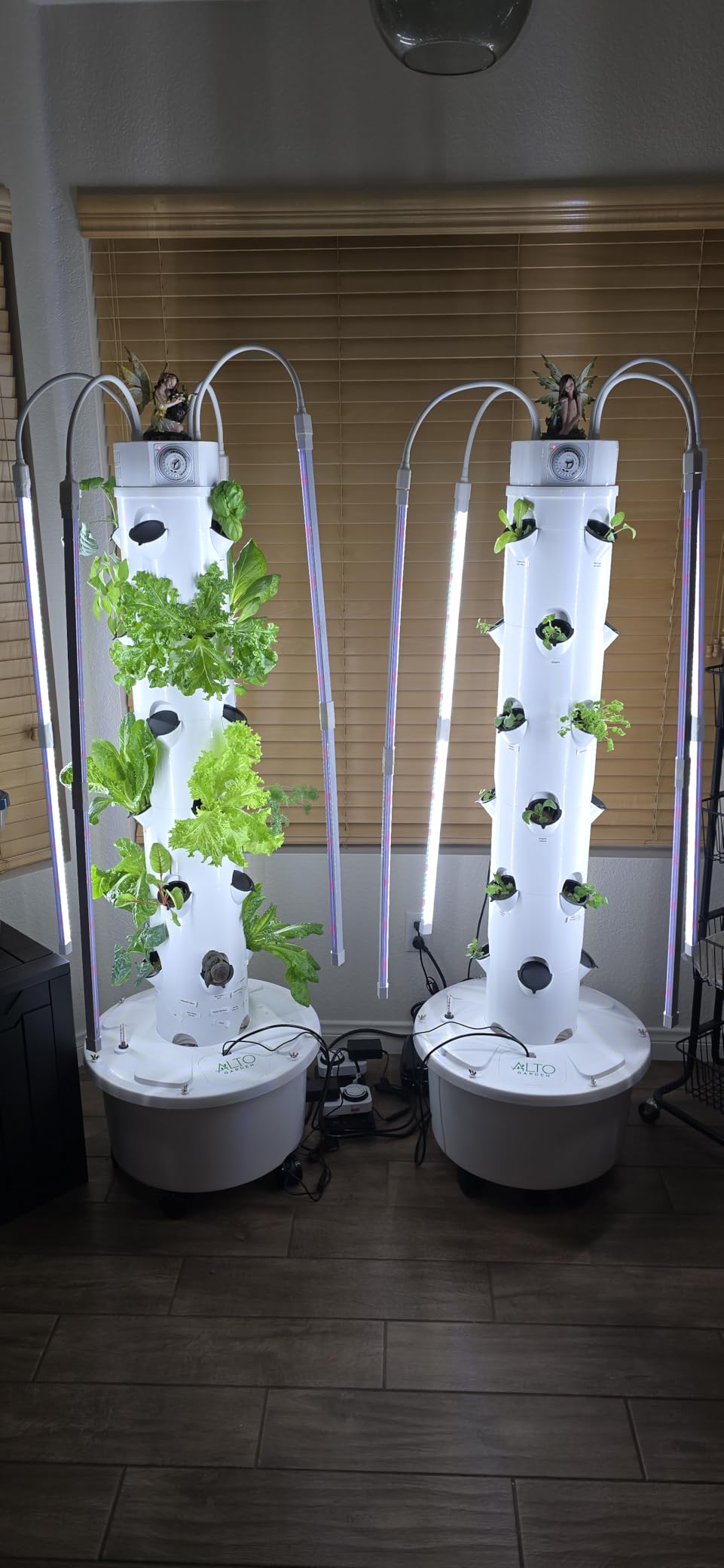
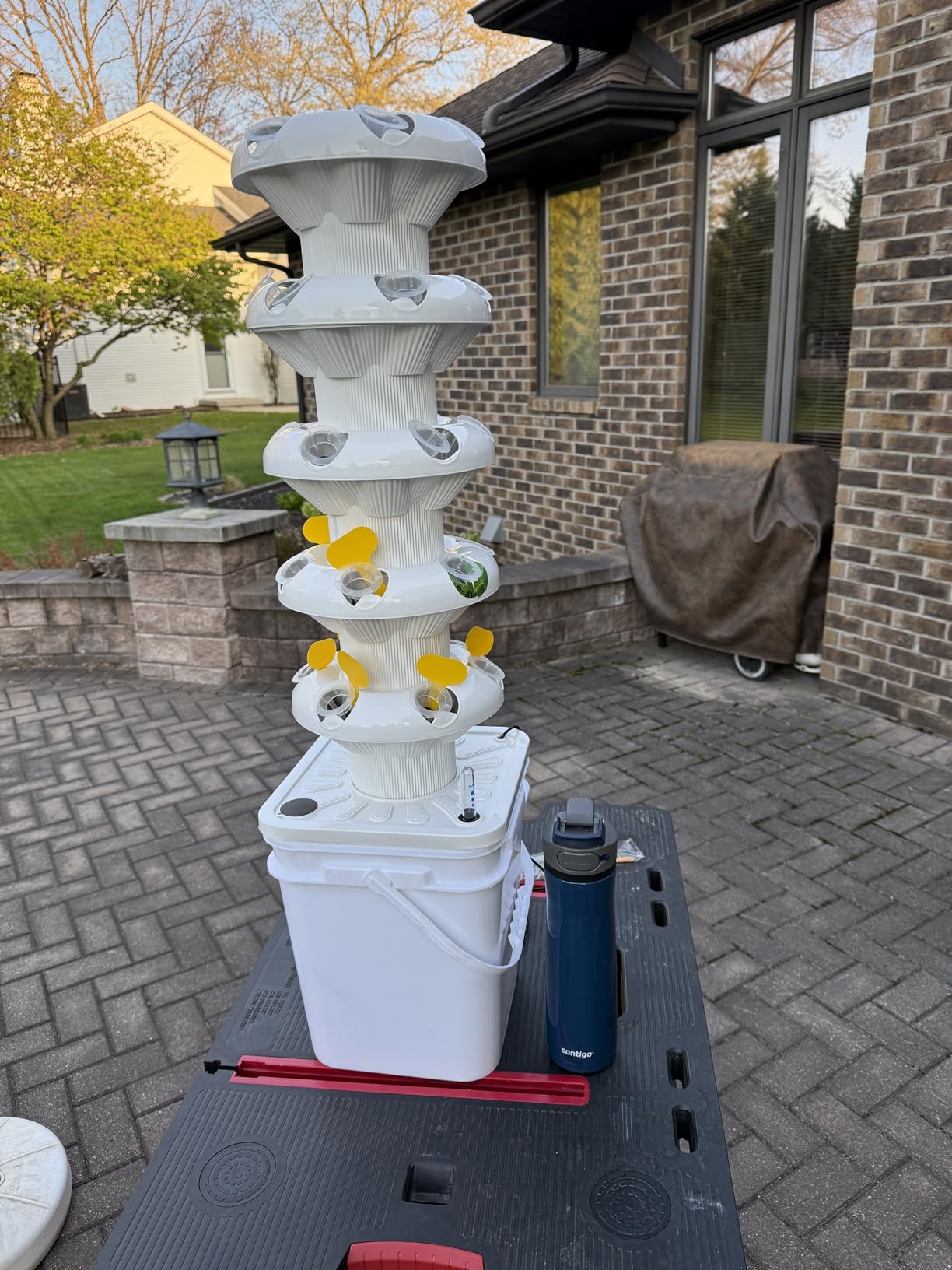
This is the only tower in the roundup you can plug in, fill and walk away from without buying a separate light or a separate nutrient kit. The LED wands are built into the tower on a timer, and the reservoir rolls on wheels, so you can follow the sun across a patio or push the whole thing indoors when the temperature drops.
What stood out in the reviews was the build. The walls are 2mm thick and fully enclosed rather than slotted panels, and buyers specifically mention no leaking joints after filling. Support was also the best in the set, with multiple owners reporting replacement parts sent quickly at no cost.
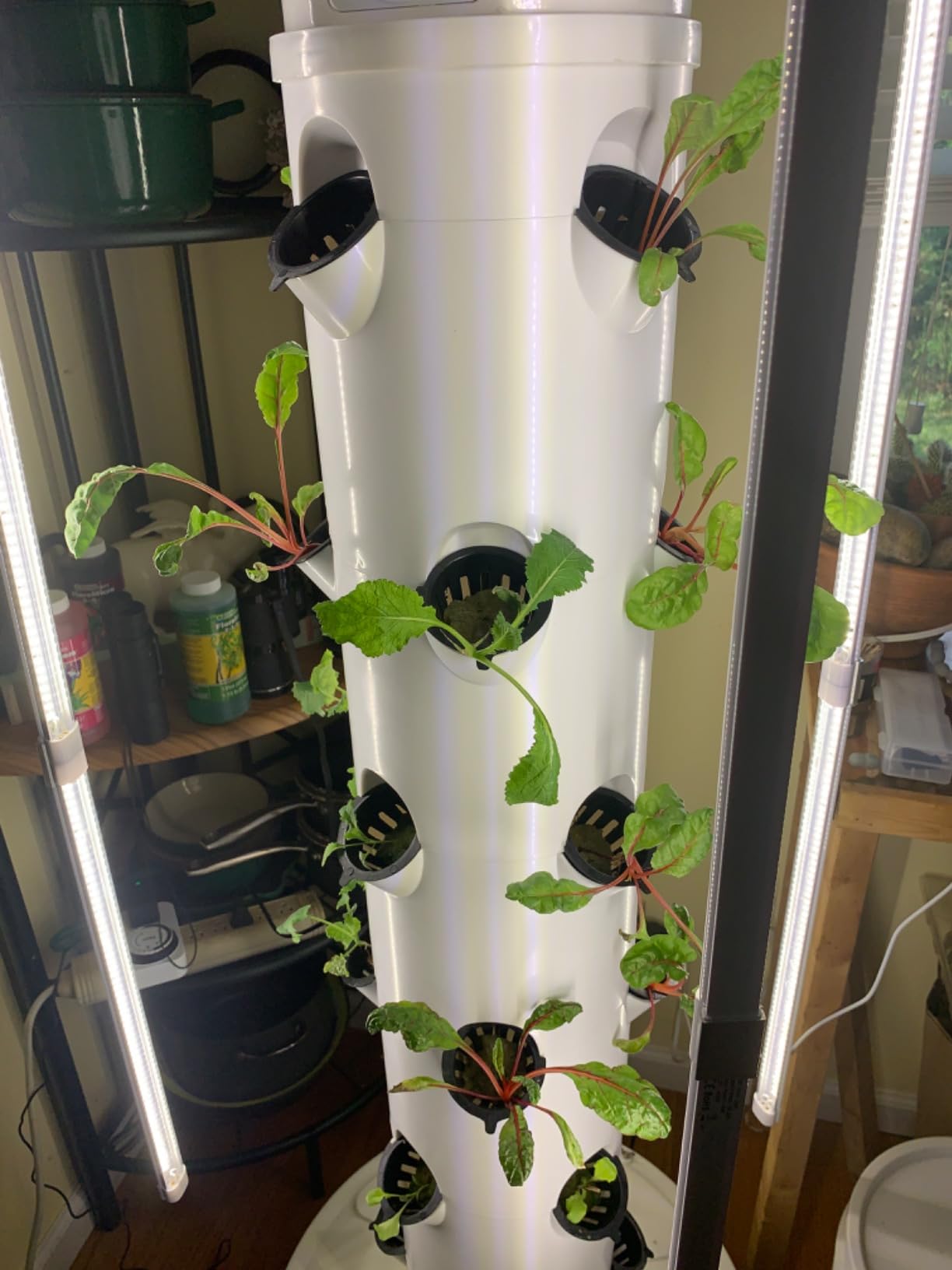
The honest weakness is durability evidence. One owner reported the tower coming apart and criticised the assembly video, and another had a single LED wand with a faulty connector. Neither is common, but neither is one you can dismiss as a single fluke on a tower this size.
Reservoir Size and Refill Interval
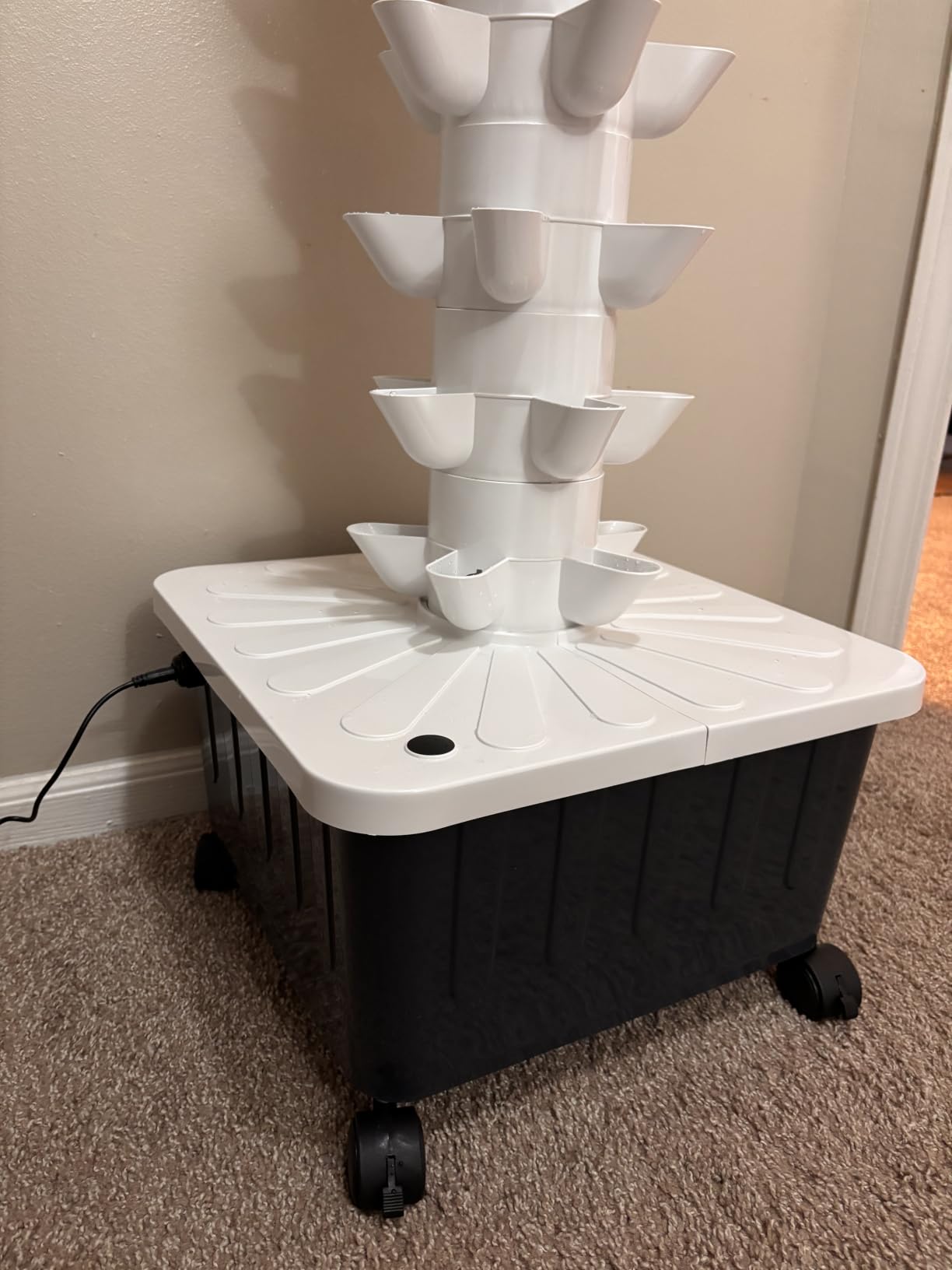
Ten gallons is the largest reservoir among the smaller towers here, and it means the pump can run several days without a refill even in warm weather. Wheeled casters on the tank mean refilling is a hose job rather than a lifting job. Buyers mention a water gauge on the tank, which is a small thing that saves guessing.
Keep in mind that a bigger reservoir is not free. The manufacturer claims 95% water savings against soil farming, and the direction of that claim is credible for a recirculating system, but the exact figure is a marketing number rather than an independent measurement. Plan on topping up weekly in summer and less often in spring and autumn.
Lighting: The Main Reason This Tower Stands Out
On a shaded patio, lighting is the whole argument. A tower that relies entirely on ambient sun will grow well at the top and poorly at the bottom, so integrated LEDs change the outcome rather than just the convenience. This system runs broad-spectrum lights on a built-in timer across all six levels, plus a separate 4-head clamp light for germination.
That also makes it the one tower here that works as a genuine indoor unit, which matters for anyone in a cold climate who wants to overwinter it rather than retire it for the season.
What Is in the Box and What You Still Need
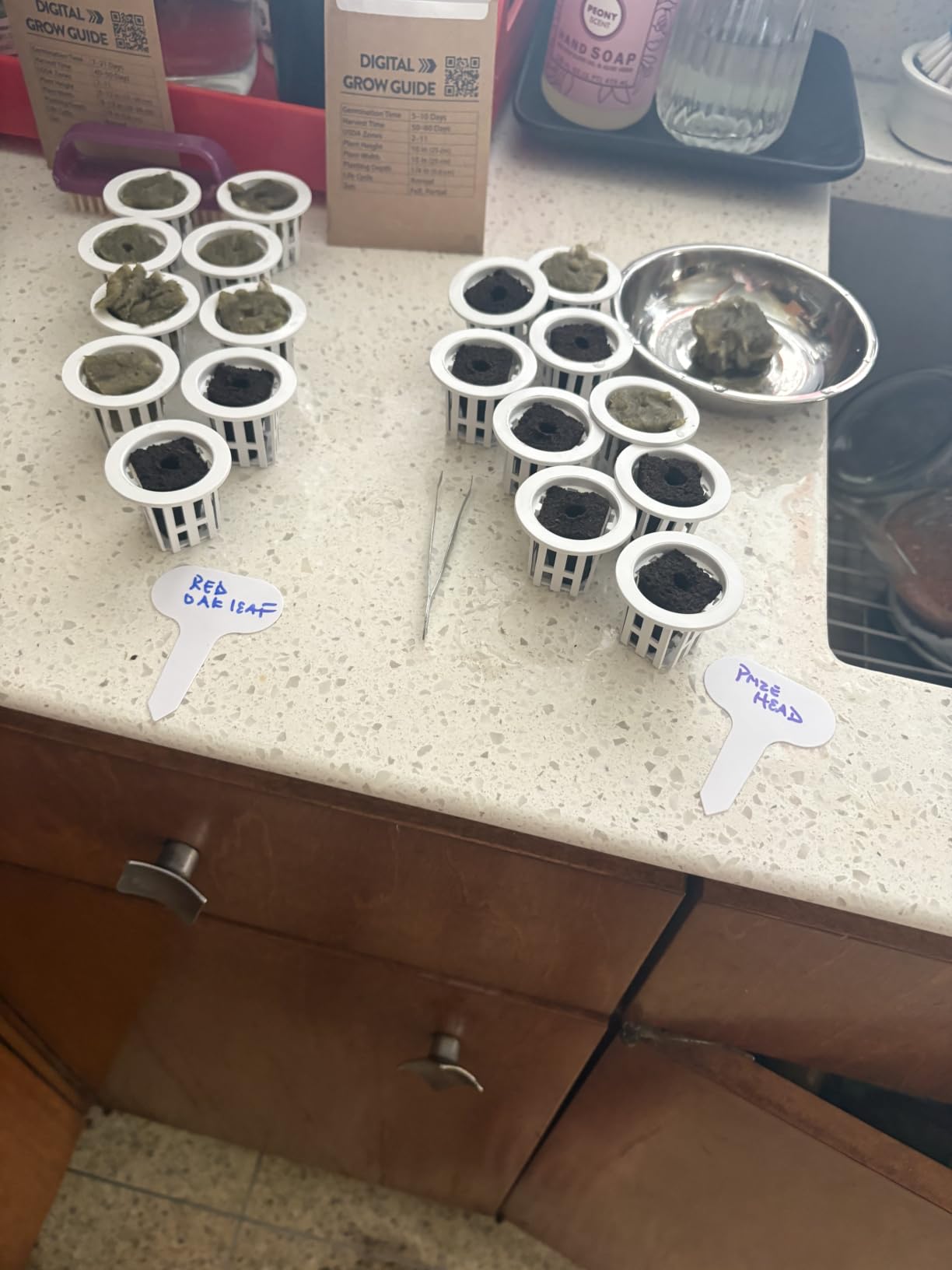
The kit is unusually complete: 24 net pots, 30 rockwool cubes, A and B nutrients, a digital pH pen, the germination light, pump, timer, water gauge and a wheeled reservoir. You need seed or seedlings, and nothing else. That removes the most common beginner failure, which is under-dosing nutrients because the measuring step was skipped.
Rockwool is an inert medium, so it gives your plants support and holds moisture but no nutrition. Everything your plants eat comes from what you add to the reservoir, which is why the included pH pen is more useful than it looks.
Who Should Skip This One
Skip it if cost is the deciding factor, because it costs more than the other mid-size towers here by a wide margin. Also skip it if you are renting and cannot move a filled 10-gallon tank, or if you already have full sun and no interest in indoor growing, because the lighting advantage matters far less to you and you are paying for it anyway.
For a first tower on a bright patio, it remains our pick. The combination of build quality, refill interval, integrated lighting and responsive support is the most complete package we found.
2. SJZX 6-Layer 36-Pod Tower - the Cheapest Way to Test Whether You Enjoy This
sjzxuv Vertical Hydroponics Growing System Kit, Indoor Outdoor Gardening System Kits, Herb & Fruits...
36 pods in about 2 sq ft
12L reservoir
3-stage timer at 3H 6H 12H
UV-resistant PVC-U body
+ Pros
- 36 planting sites in a small footprint
- quick assembly with a QR code video
- quiet pump with a visible water level
- baskets accept sponge or clay pebble media
- lowest entry cost in the roundup
- Cons
- Smart plug timer settings are unreliable
- net cups are too small for standard baskets
- uneven water distribution to some levels
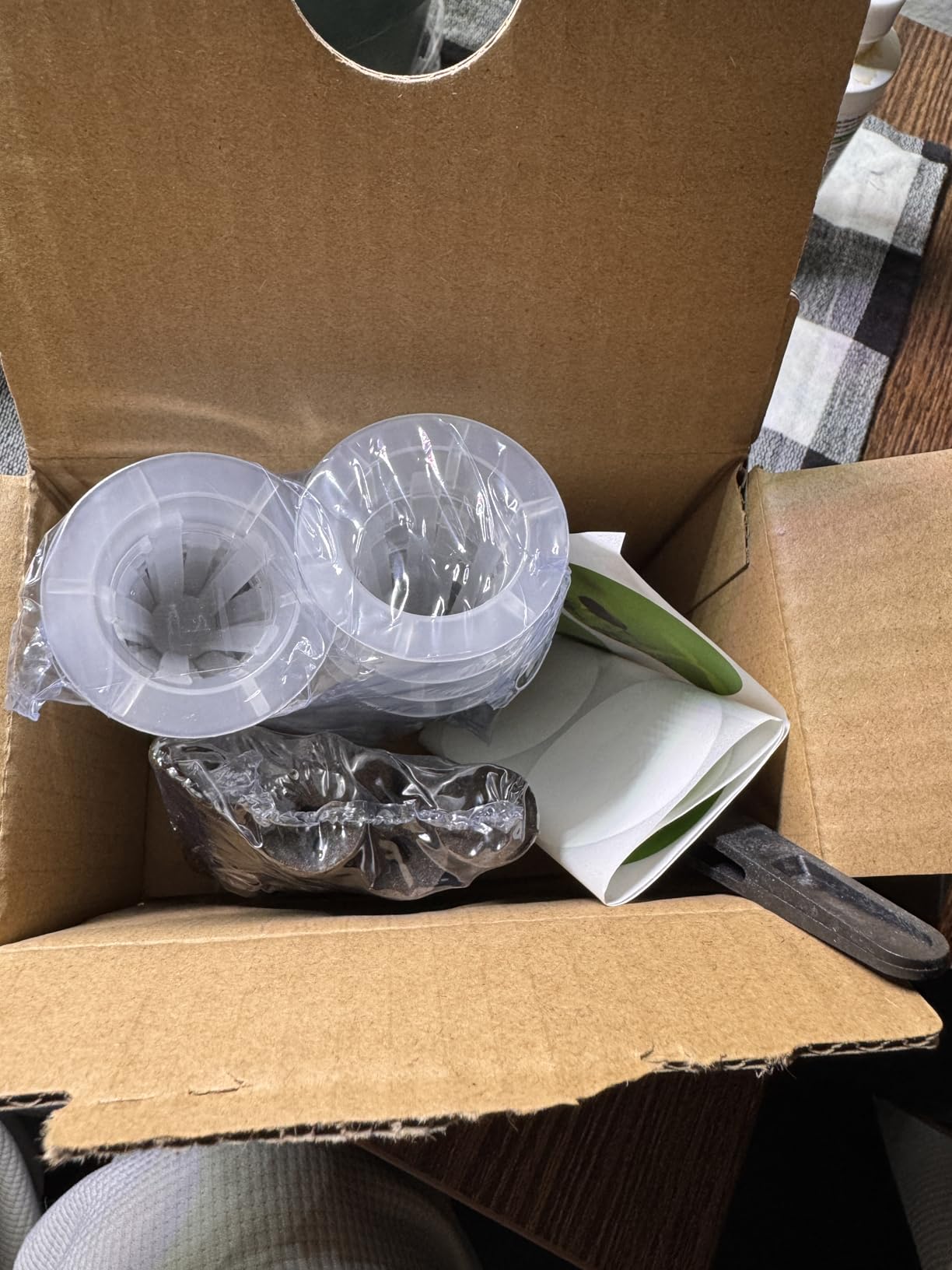
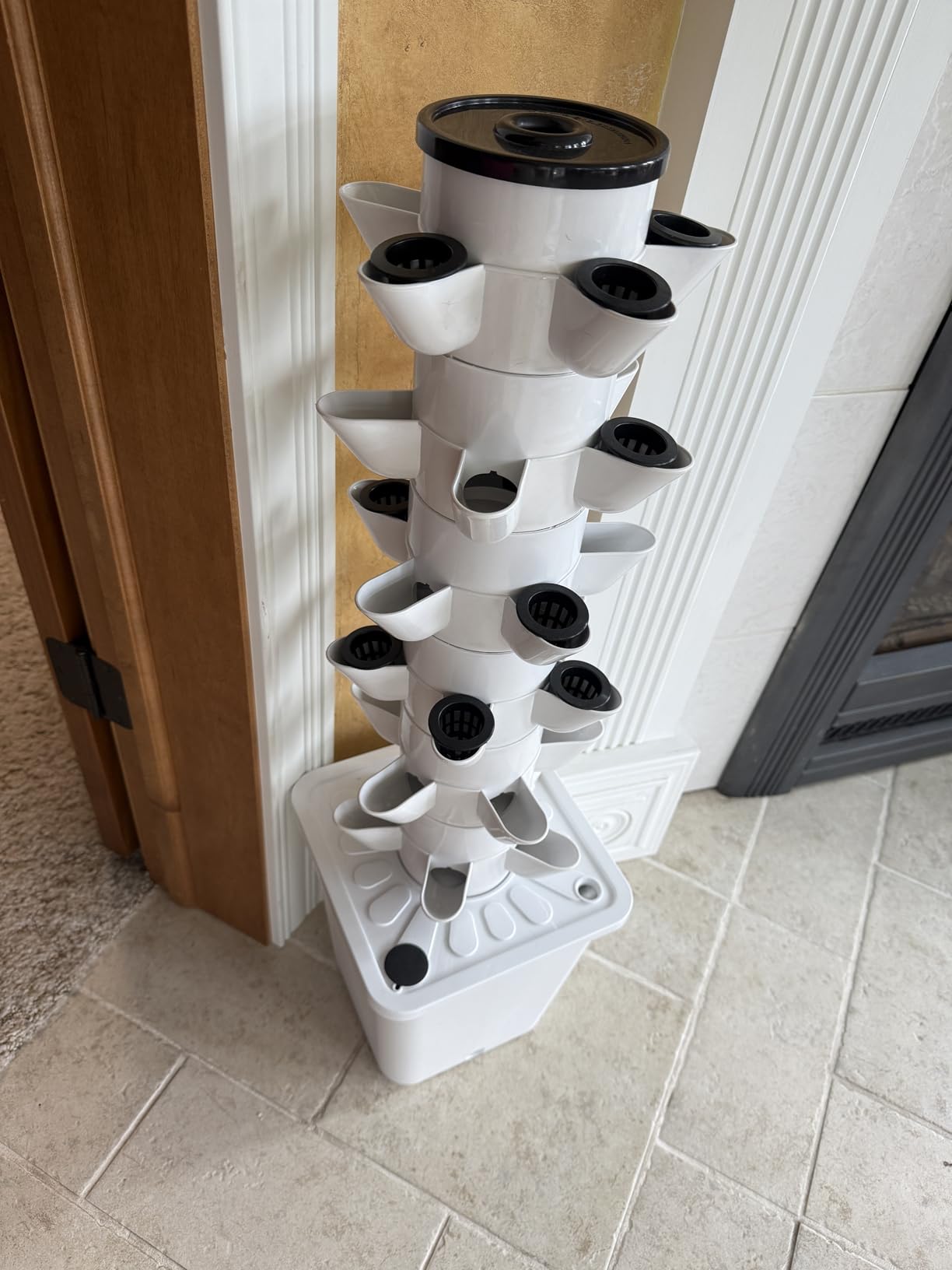
This is the tower to buy if you are not sure a tower belongs on your patio. It stacks six layers of six sites into about two square feet, it assembles quickly, and it is the least expensive way to find out whether you actually enjoy the routine. Reviewers praise the assembly instructions and the QR code walkthrough more than anything else.
It is also the most reviewed tower here at 111 ratings, which cuts both ways. A large sample means the flaws are well documented rather than hidden, and roughly 14 percent of ratings are one star.
Water Distribution Is the Real Weakness
The most common complaint is uneven flow. Some owners report that upper levels and certain pods receive little water, which shows up as stunted growth at the top while lower pods thrive. This is a flow problem inside the tower rather than a pump failure, and it is usually worse when the reservoir is not full.
Keep the 12 liter tank topped up rather than letting it run down between cycles. The three-stage timer offers 3, 6 and 12 hour intervals, and running shorter cycles more often keeps the film moving through the upper levels.
The Smart Plug and Why Most Owners Ignore It
The included smart plug lets you schedule the pump by phone, and when it works it is convenient. The recurring complaint is that the scheduling is unreliable and hard to program. Most owners report switching to a basic mechanical timer or programming the plug once and leaving it alone.
Treat the app as a convenience rather than a dependency. If your tower's success depends on a phone app remembering to run the pump, that is a single point of failure sitting between you and a dead root zone.
Size, Height and the Shade Problem
At 40 inches tall and 9.84 by 7.48 inches across, this is a narrow tower that fits a tight corner, which is exactly the patio constraint it is built for. The same height works against it, because the top of the tower receives noticeably less light than the bottom. Owners on partially shaded patios report needing an external grow light to get a full harvest from the upper layers.
Net cups are another practical limit. They are small and will not accept standard hydroponic baskets or larger pods, so if you already own spare medium and net pots of a common size, they will not fit.
Who Should Skip This One
Skip it if your patio is your only full-sun growing space and you expect heavy production from the top tiers, because the light and flow issues compound. Also skip it if you want a phone-driven system, since the smart plug is the least reliable part of an otherwise simple machine.
Choose it if the goal is a low-risk trial with a decent number of sites, and if your plan is to rotate or tilt the tower occasionally to even out the light.
3. SJZX 5-Layer 30-Hole Tower - the Best Balance of Capacity and Support
SJZX Hydroponics Growing System Kit, 5-Layer Hydroponic Tower, 30 Planting Holes, Space-Saving...
30 planting holes
12L tank with level gauge
BPA-free food-grade plastic
Smart socket control
+ Pros
- Sturdy construction that stays stable assembled
- 30 planting holes in a compact footprint
- water level gauge plus a large tank
- easy to run outdoors with light on all sides
- responsive customer service that replaced a missing item
- Cons
- No pump shutoff when water runs low
- shallow circulation can stall young seedlings
- some users saw low germination and mould
This tower is the most sensible middle option in the roundup. Five layers give 30 planting holes, the 12 liter tank is easy to monitor through the included level gauge, and the body is BPA-free food-grade plastic. Reviewers single out packaging and customer service as unusually good, with a missing item replaced quickly.
It is rated 4.0 from 67 ratings, with 62 percent five star and 16 percent one star, which is a healthy spread for a product in this niche.
Shallow Circulation and the Seedling Stage
The recurring weakness is water depth rather than pump power. When the tank is not near full, circulation through the lower sites is shallow and young plants curl and stall before they establish. Mature lettuce and herbs handle it fine, which is why long-term owners are positive while first-week growers are not.
Run the tank at or above the level gauge mark for the first two weeks, and only treat it as a refill-every-few-days system once roots are established.
What You Get in the Box
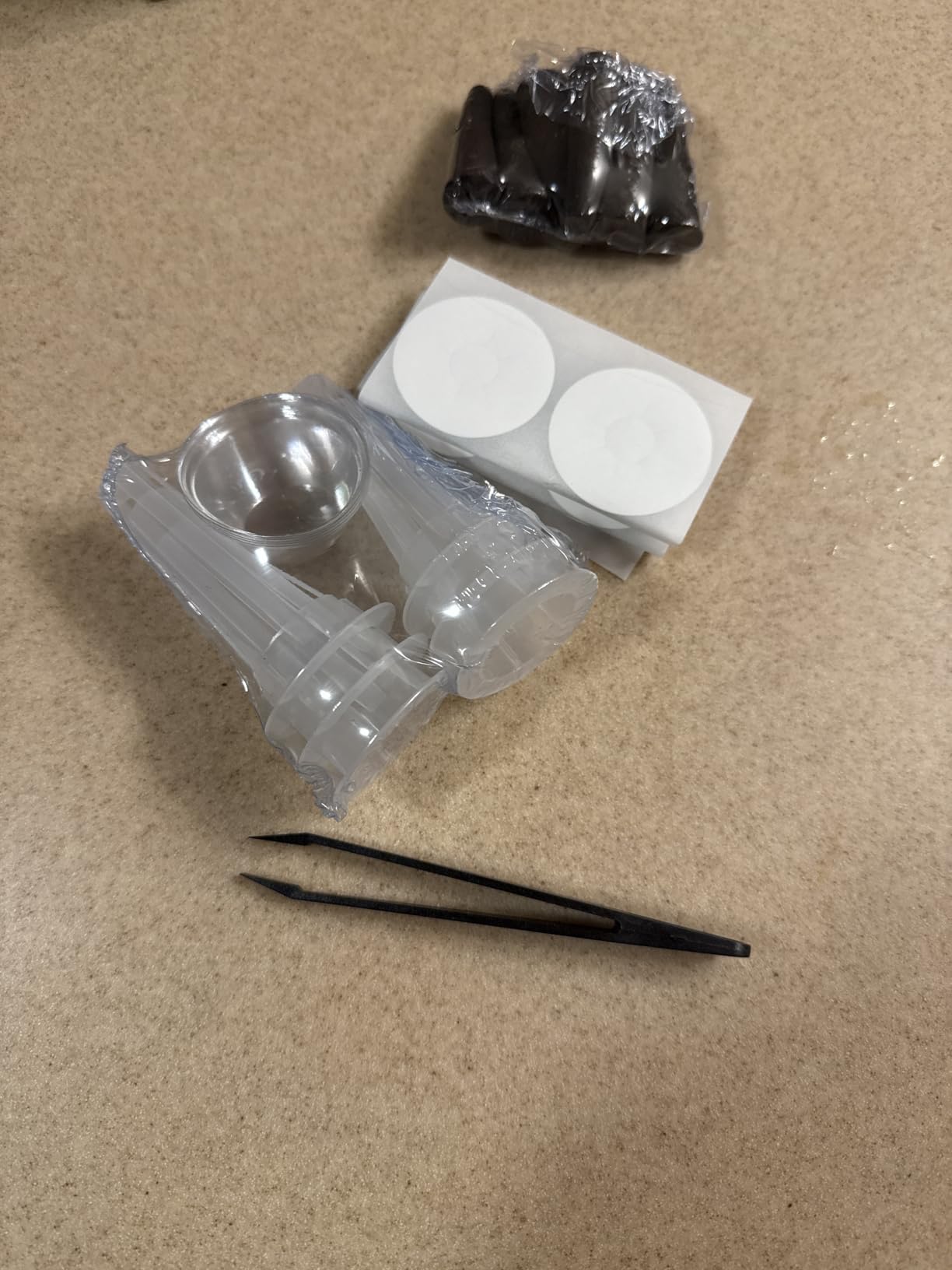
It is one of the better-equipped kits at this tier: five tower sections, the 12L tank, timer, pump, power adapter, level gauge, a collapsible funnel, two filter sponges, hose, tweezers, 30 labels, instructions, 30 biochar bases and 30 planting baskets. The funnel matters more than it sounds, because a wide mouth is the difference between a clean fill and a spill across the patio.
Biochar bases give seedlings something to root into, and the included filter sponges keep debris out of the pump, which is the cheapest pump protection you can buy.
Smart Socket Scheduling Without a Subscription
Like the six-layer model, this one uses a smart socket for phone-based scheduling and remote on and off control. Owners are more positive about it here than on the six-layer version, and there is no recurring fee attached to the automation, which separates it from subscription-based countertop systems.
Whichever tower you choose, the scheduling should be a convenience layer over a physically reliable timer rather than the only thing keeping water moving.
Who Should Skip This One
Skip it if you travel regularly or if your patio has unreliable power, because there is no low-water shutoff. A dry reservoir running a pump is the fastest way to kill a tower, and this model has no protection against it.
Choose it if you are buying your first tower, want a complete kit without hunting for accessories, and have patience for the first fortnight while seedlings establish.
4. 14-Layer 70-Slot Hydroponic Tower - the Most Plants in the Least Space
Hydroponic Tower, 14-Layer Hydroponics Growing System Kit with 70 Slots, Vertical Garden System with...
70 planting slots
20L tank for multi-day runs
Timed top-down submersible pump
+ Pros
- 70 slots in a narrow vertical footprint
- timed top-down pumping wets every layer
- 20L tank runs for days without refilling
- soil-free and clean with no weeds or pests
- strong 4.5 average with no one-star ratings
- Cons
- Generic branding with limited brand support
- no grow lights included for indoor use
- review base is small at 17 ratings
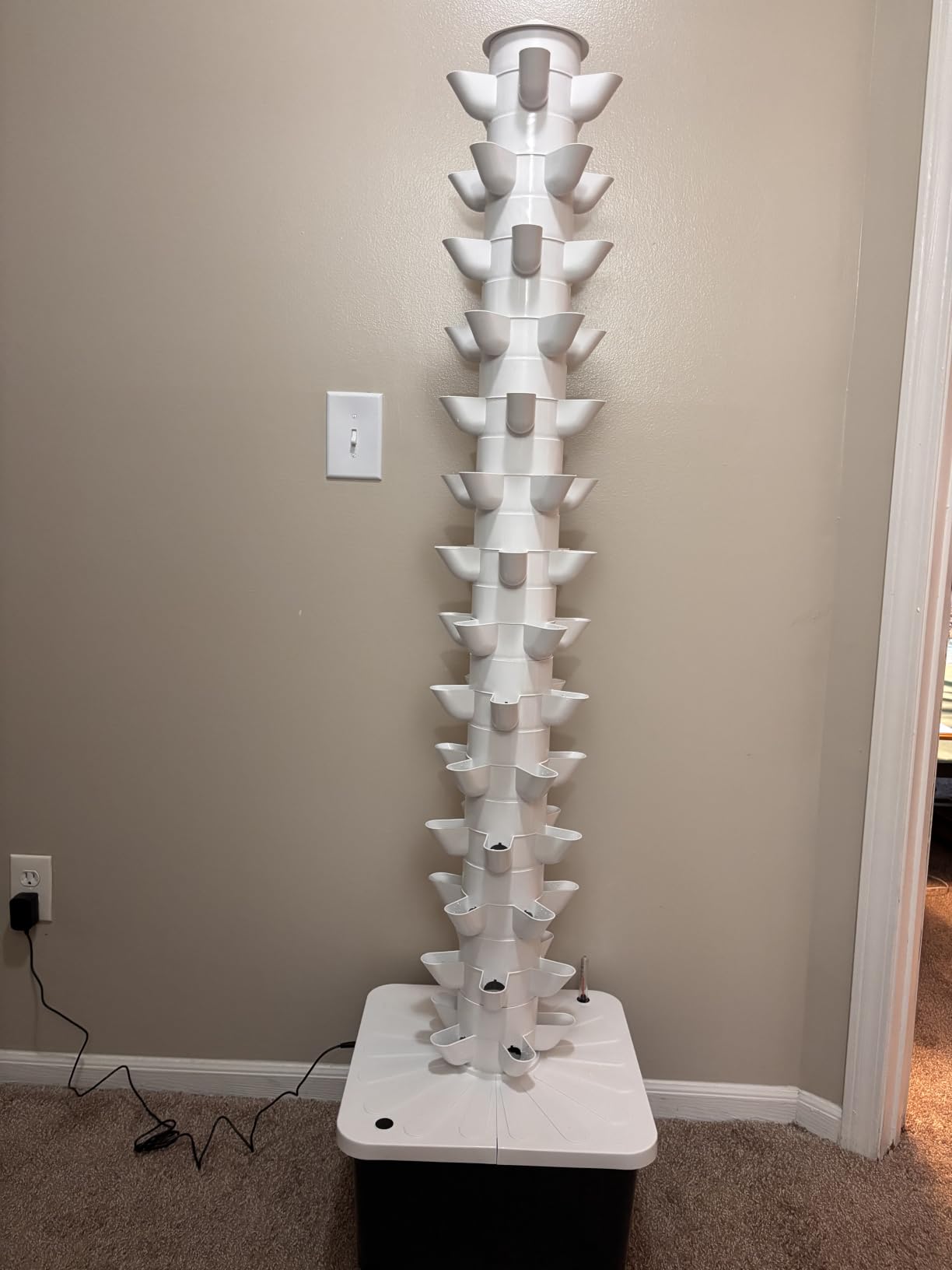
At 14 layers and 70 planting slots, this is the highest plant count per square foot in the roundup. The base is 15.7 inches square and the tower runs 64.5 inches tall, so it packs an enormous number of sites into a footprint most patios can spare. Rated 4.5 from 17 ratings with 68 percent five star and no one- or two-star ratings.
Its small review base is the reason this is not the top pick. A small sample is encouraging, but it tells you less about how the tower behaves in month eight than a large sample does.
Top-Down Pumping and Even Wetting
The pump sits in the reservoir and sends water to the top of the tower, where gravity carries it down through every layer. That is the opposite of the bottom-fed design used by the smaller towers here, and it is why owners report even moisture without dry spots.
Even wetting matters more than it sounds on a 14-layer tower. A bottom-fed system has to push solution up through 64 inches of column, and that is exactly where the competing models show flow complaints.
Reservoir Autonomy and Refill Habits
The 20 liter tank, which is 5.3 gallons, is the second largest in the roundup and supports multi-day operation without daily refills. That autonomy is the practical argument for this tower: a week away for a weekend is manageable when the reservoir will not empty.
Because it is taller than most towers, plan the site around height rather than width. A 64.5 inch tower will cast shade on its own lower layers late in the season, and a reflective or pale surface underneath helps more than buyers expect.
Crops and Indoor Limits
Sellers position it for lettuce, herbs, flowers and strawberries, which is a realistic list for this form factor. It is soil-free, so it eliminates weeds and most soil-borne pests, and the inert medium keeps the growing area clean enough to stand on a patio near furniture.
No grow lights are included, so indoor use means buying lighting separately. The listed light source wattage is 5 watts, which is well short of what a 70-slot canopy needs, so budget for a proper indoor light if that is the plan.
Who Should Skip This One
Skip it if support matters to you, because generic branding means thin warranty recourse and limited published service detail. Also skip it if you need climbing support, since there is no trellis and vining crops will struggle.
Choose it if your patio is tiny and your priority is sheer number of sites with a tank you do not have to refill every day.
5. TIRUSS 9-Layer 36-Pot Grow Tower - Best for Off-Grid and Low-Water Setups
TIRUSS Vertical Hydroponic Grow Tower Aeroponic Tower for Fruits and Vegetables 9 Layer 36 Pots...
36 pots across 9 layers
19.99 liter capacity
Floor standing and portable
20.86 x 20.86 x 56 inches
+ Pros
- Clean vertical design that grows well indoors and out
- works with a small solar panel to run the pump
- compact footprint for 36 growing positions
- rated 4.6 with 79 percent five-star ratings
- portable floor-standing design
- Cons
- Supplied pump will not push water past the top three levels
- promotional video shows a different professional unit
- review base is small at 12 ratings
At 20.86 inches square and 56 inches tall, this is a compact nine-layer tower with 36 planting pots and a 19.99 liter tank. It carries a 4.6 average from 12 ratings with 79 percent five star, the highest share of top ratings in the roundup, though the sample is small.
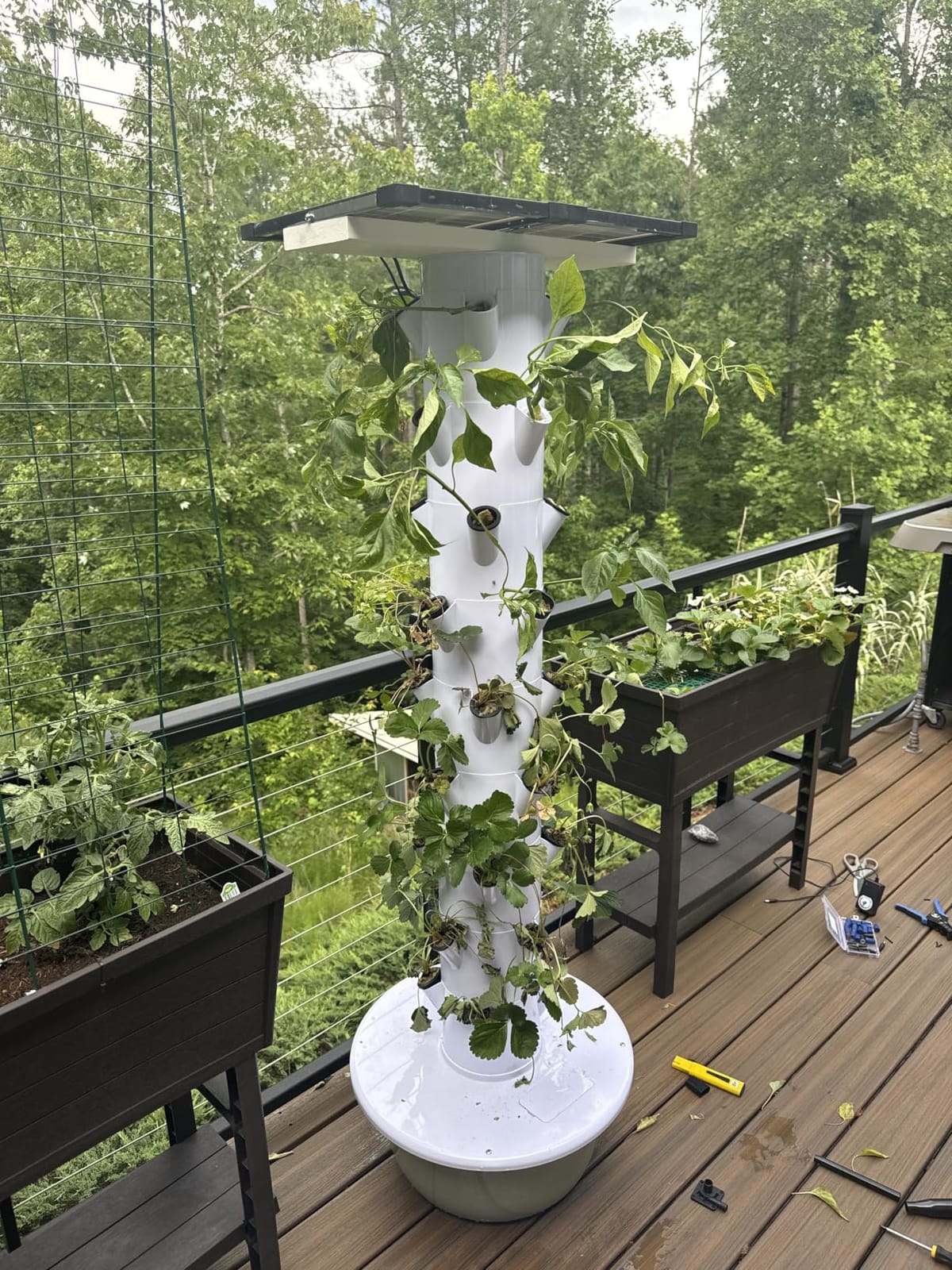
What makes it interesting for patios specifically is the report from an owner who ran the pump off a small solar panel. If your patio has no outlet and no hose, a low-draw pump is the whole game, and this is the tower where that has been reported working.
Where This Tower Falls Short: Pump Reach
The most common practical complaint is that the included pump lacks the power to move water past the top three layers at higher settings. On a nine-layer tower, losing the top third of the column is a significant loss of usable sites.
Ask yourself whether you will run it at the lower pump setting and accept reduced top-level flow, or whether you plan to upgrade the pump. The listing is honest that the pump is the weak component, and that is worth knowing before the tower is buried in foliage.
Footprint and Moving It
At roughly 20.86 inches square it needs about three square feet of clear paving, plus room to walk around it. The unit is listed as portable and floor standing, so moving it indoors for winter is realistic once the reservoir is emptied.
Weigh this against the 100 pound tower later in the roundup. Fifteen and a half pounds empty is a very different proposition when a freezer door and a set of steps are involved.
Water Reuse and Siting
The manufacturer states the recirculating reservoir and pump can reuse up to 98 percent of water versus conventional farming. Treat that as a directional claim rather than a measured figure, but recirculation genuinely does reduce water draw compared with a soil bed, and it is the reason towers suit water-conscious patios and dry climates.
Put the tower where the runoff can go somewhere sensible. A recirculating system still loses water to evaporation and to the plant uptake itself, and you will top it up more often in a hot, exposed corner.
Who Should Skip This One
Skip it if you intend to fill all 36 pots on day one, because the pump will not support the top three layers at full output. Also skip it if buying from an unbranded manufacturer with a thin review base makes you uneasy about spare pump availability.
Choose it if you have a genuinely off-grid corner, or you want a light, portable tower you can bring in for the winter.
6. TIRUSSS 8-Layer 50-Hole Tower - Best When You Need to Move the Tower Around
TIRUSSS Hydroponic Growing System Kit, Aeroponic Tower 50 Hole Garden Vertical Vegetable Planting...
50 planting holes
17 x 17 x 60 inches
Wheeled mobile base
Integrated reservoir
+ Pros
- 50 planting holes in a slim footprint
- wheeled base follows the sun and moves indoors
- integrated reservoir with drip irrigation reduces manual watering
- suited to year-round indoor or outdoor use
- Cons
- Only 8 reviews so long-term durability is unproven
- listed as indoor use in the specifications
- low sales rank within its category
Eight layers and 50 planting holes in a 17 by 17 inch base is an efficient use of floor area, and the wheeled mobile base is the distinguishing feature here. On a patio where the sun moves across the day, being able to roll the tower rather than abandon one side to shade is a real advantage.
Its rating is 4.2, but it rests on only 8 reviews. That is thin enough that we would treat any long-term reliability claim as unproven.
Why a Mobile Base Changes Patio Growing
Most towers are static, which means one face gets morning sun and the opposite face gets baked all afternoon. A wheeled base lets you follow the light or pull the whole unit into a corner out of a gust. Owners consistently mention this as the reason they like it.
There is a catch. Drainage exits sit above the ground on this design, so rolling the tower to a different spot means dragging a tray or catching runoff in a container rather than letting it drain straight onto the paving.
Specification Inconsistency Worth Noting
The specifications list this model for indoor use, while the marketing describes indoor and outdoor versatility. That contradiction is small but it matters on a patio, where UV exposure and seasonal rain are the whole environment.
If outdoor use is the plan, check the current listing with the manufacturer before you rely on it, and position it out of direct afternoon sun in the first season to see how the plastic handles it.
Who Should Skip This One
Skip it if you want a well-evidenced long-term record, because 8 reviews is not enough to know how the seams and the drip line hold up over multiple seasons. Buyers prioritising outdoor durability should pick a model with a clearer outdoor rating.
Choose it if the ability to move the tower is worth more to you than the size of the review base.
7. LnzyGarden 40-Pod Tower with Trellis - Best for Climbing Crops
Hydroponic Growing System, 40-Pod Vertical Tower with Trellis & Timer
40 large pods plus a trellis
8 gallon rolling reservoir
10 tiers at 68 inches tall
+ Pros
- Trellis included for climbing crops such as cucumbers and melons
- wide pods support larger plants
- assembles in under half an hour
- rolling base tray makes an 8 gallon system mobile
- adjustable flow and timer for automatic operation
- Cons
- Pump may not reach the top tiers and some owners run 32 pods
- unit must be kept level to work
- one timer failed within two months
- planting directions described as vague
Most towers in this roundup are honest about their limits with climbing crops, and this is the exception. It ships with a sturdy trellis set and wide net pods, and the listing names cucumbers, eggplants, peas and melons alongside greens and herbs. At 20.8 by 20.8 by 68 inches it is a tall, substantial unit rather than a corner tower.
It carries a 4.4 rating from just 6 reviews, and it comes with a 1-year replacement guarantee against manufacturing defects, which is a genuine commitment even if it is shorter than the long warranties in some other categories.
Why the Trellis Changes What You Can Grow
A tower without support gives vining crops nowhere to go, and that is the single most common request from buyers. A trellis spreads the plant outward rather than letting it shade its neighbours, which is the difference between a productive tower and a tomato plant that collapses onto the lettuce.
Be realistic about scale. Cucumbers and melons in a tower of this size are ambitious, and a practitioner report captured during our research on vertical systems advises that vining plants perform poorly on indoor vertical setups generally, with the recommendation not to bother. Beans, peas and compact cucumbers are the more forgiving options here.
Pump Reach and the 32-Pod Reality
The most common practical issue is that the pump does not push water to all 40 pods, and specifically struggles with the top three or four tiers. Some owners simply reduce to 32 pods. Plan on that from the start rather than discovering it in week three.
The tower also needs to stay level for correct operation, which matters on an uneven patio. Check the surface with a spirit level before you fill it, because a leaning column changes how the film behaves at every site.
Starter Kit Contents
It is the most complete kit in the roundup by count of parts: 40 net pots, 128 grow sponges, a seedling tray, pump, timer, pump regulator, rolling tray, trellis and a planting guide. Nothing here needs a second purchase to get started.
One owner reported the included timer failing within two months and not being resolved by support, and the planting directions were described as vague by another. Budget time to work it out rather than following the guide literally.
Who Should Skip This One
Skip it if your patio surface is sloped or uneven, or if you want to fill all 40 pods. Also skip it if you need strong evidence of long-term reliability, because 6 reviews is a very small base.
Choose it if climbing crops are a priority and you are willing to run fewer pods than the tower advertises.
8. WooRoot Max Pro 148-Pod Tower - Best for Continuous Family Harvests
Large Hydroponics Growing System, 148-Pod Vertical Hydroponic Tower Garden
148 pods across 5 tiers
34L reservoir plus 9.5L misting tank
100W five-tier LED system
18 x 33 x 72 inches
+ Pros
- Very high capacity for daily harvests of lettuce and mixed vegetables
- 34L reservoir and misting tank allow up to 30 days unattended
- ultra-quiet pump suitable for a home or classroom
- modular pump LED and misting parts with a 30-day replacement guarantee
- fast germination and reliable flow across all tiers
- Cons
- Weighs 100 pounds empty and needs two people to assemble
- light timers failed to program on multiple units
- mist nozzles leaked on two of five units
- drains sit about 4 inches off the floor
At 148 pods, this is the largest system in the roundup by a wide margin, and the 34 liter reservoir plus 9.5 liter misting tank are what separate it from a scaled-up domestic tower. Owners with commercial and classroom intent report daily harvests and up to 30 days of unattended operation, which is a different category of autonomy from everything else here.
It also has a dedicated misting tank rather than only nutrient circulation, which makes it one of the few systems here that is genuinely closer to true aeroponics rather than pure nutrient film technique.
Lighting and Autonomous Operation
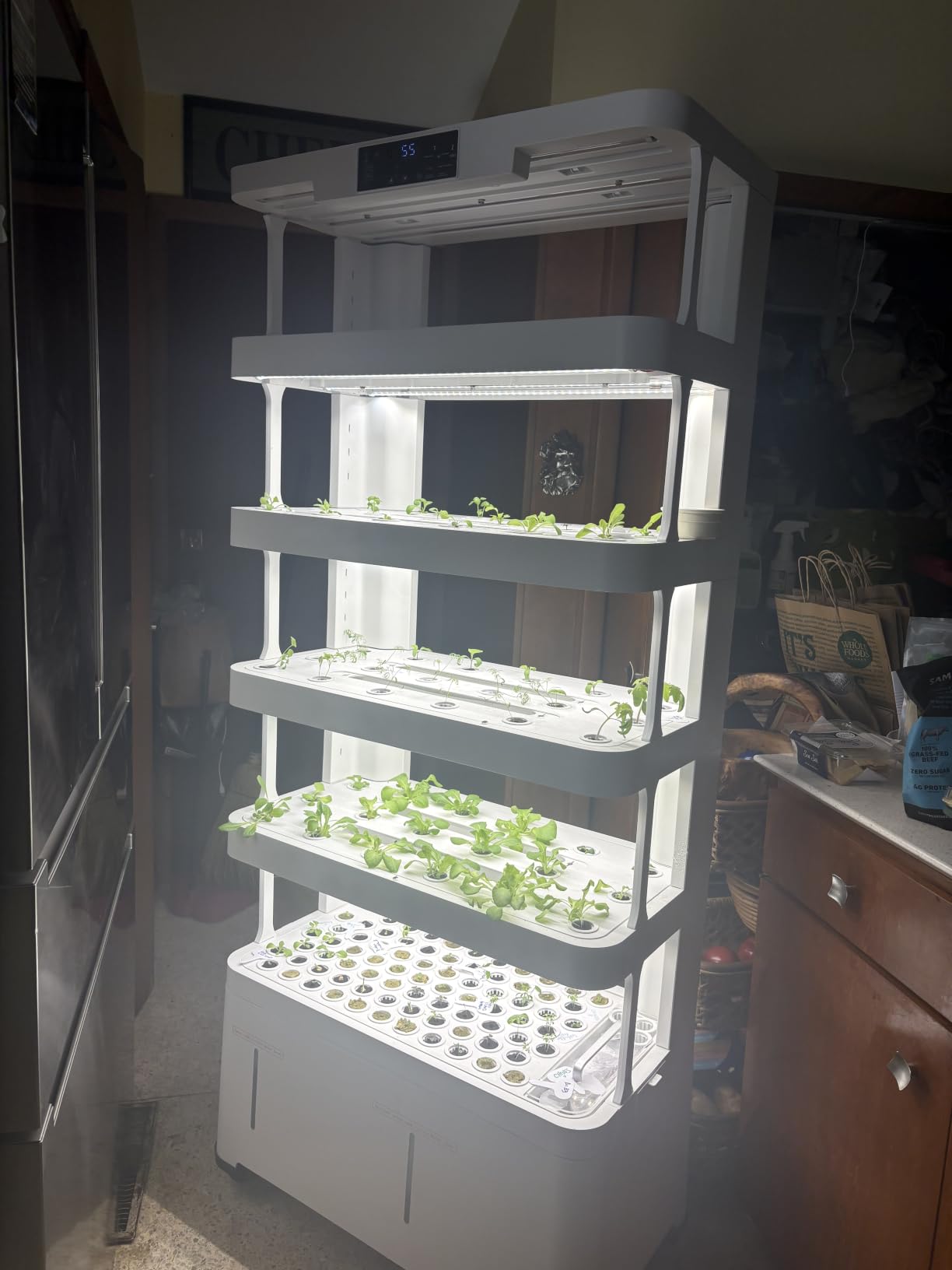
A 100 watt full-spectrum LED system runs across five independently controlled tiers with zero to 24 hour scheduling, so you can light seedlings and mature plants differently. That control, combined with low-level sensors on the reservoir, is what supports the claim of long unattended runs.
Independent tier control is genuinely useful on a patio as well as indoors. The top tiers mature first, and being able to reduce their lighting while the lower tiers catch up is a real advantage over a single switch.
Weight, Assembly and Drainage Reality
This is the heaviest tower in the roundup at 100 pounds empty, and reviewers are explicit that assembly realistically needs a second pair of hands. If you are fitting it onto a balcony with a narrow doorway, measure before you buy rather than after.
The drains sit about 4 inches off the floor, so emptying the reservoir is awkward. Put it where you can get a shallow tray or a low bucket underneath, because you will drain it more often than you expect when changing crops.
The Defects Buyers Actually Reported
One commercial buyer reported that light timers failed to program across all five units they bought, and two of those five had leaking mist nozzles. That is the most serious defect cluster in the roundup, and it is worth weighing carefully given the price and the weight.
Against it, the modular pump, LED, misting and control parts carry a 30-day replacement guarantee, and WooRoot support reportedly responds quickly and directly. For a system this size, replaceable modules matter more than a long warranty.
Who Should Skip This One
Skip it if you have a small patio, a narrow access route, or no second person to help with assembly. Also skip it if tower gardening is a tentative experiment, because at 100 pounds and a 72 inch height it is a commitment rather than a hobby.
Choose it if you are feeding a household or a classroom, or if you plan to overwinter indoors and want genuine light control.
How to Site a Tower Garden on a Patio
Siting decides more about your results than the tower you buy. A well-placed budget tower will outperform a premium one shoved into a shaded corner, and every item below is cheap to check before you spend anything.
Count Your Sun Hours Before You Buy
Leafy greens want six hours of direct sun, and that is the minimum worth aiming for. Watch a specific spot across a full day rather than guessing from the patio's general brightness, because buildings and fences throw much longer shadows than people expect.
Taller towers need more care here than shorter ones. A 64 inch or 68 inch tower shades its own lower layers, so prefer a spot where the sun tracks across the front rather than straight down one face, and consider a pale or reflective surface beneath the lower tiers.
Wind, Weight and Tip-Over Risk on Hard Surfaces
A mature tower is a sail. A 70 or 148 pod tower with wet medium and wet reservoir water puts real force on a base that is only as wide as the tower is deep, and patio edges and doorways create the wind funnels that make towers fall over.
Set it back from the edge, out of any funnel between walls, and keep the base on level paving. Check level with a spirit level before filling. If your patio is a raised deck, add a catch tray under the drains so you are not watering the boards below.
Weight is the other half of this. Most towers here weigh under 20 pounds empty, and one weighs 100. The heavy one is not a problem on a ground-level slab, but it changes the plan entirely on a balcony or a deck with a limited load.
Power, Water and Drainage Access
Every pump here needs a GFCI-protected outlet and a timer. Outdoor electrical near water calls for a ground fault circuit interrupter, so plan the outlet before you plan the tower, and use an extension rated for outdoor use if you need one.
Water access matters more than people expect. Reservoirs range from 12 litres to 34 litres, and a 20 litre tank in summer heat on a warm patio can need topping up more often than its multi-day autonomy suggests. A spigot within hose reach turns refilling into a two-minute job.
If you have neither an outlet nor a hose, an off-grid pump running off a small solar panel has been reported working with one of the mid-size towers in this roundup. Verify the pump's draw against your panel before you plan around it.
What You Can Realistically Grow
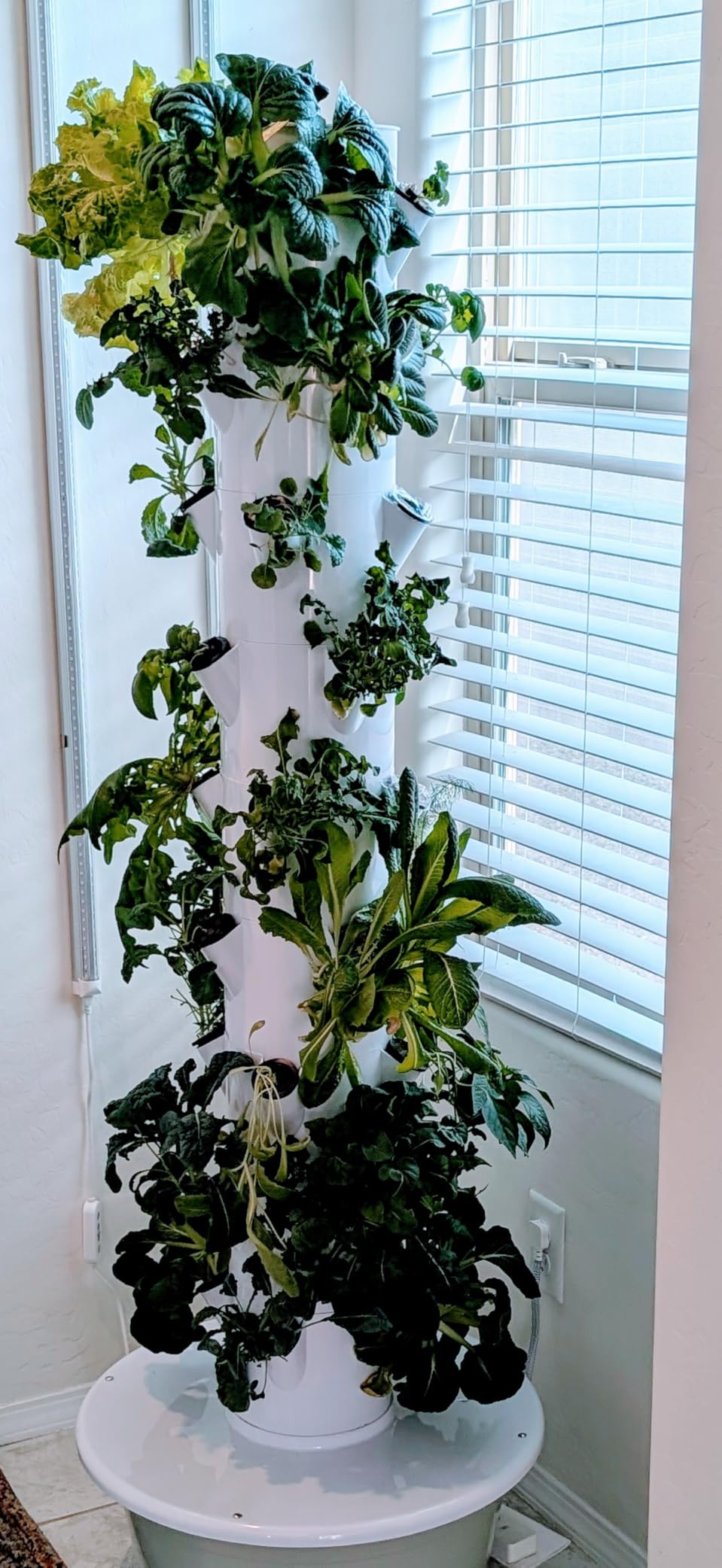
Greens and herbs are the reliable answer: lettuce, kale, chard, basil, mint, parsley and cilantro all perform well in a tower's root zone. A buyer of the self-lit tower in this roundup reports solid results with Swiss chard, kale and lettuce specifically.
Flowering and fruiting crops work on the larger systems. Strawberries, peppers and eggplants are plausible, and a trellised tower can handle compact climbers. Vining crops are the category where expectations need resetting, and a practitioner report captured in our research is blunt: neither major tower brand grows vining plants well, with the advice not to bother on any indoor vertical system.
Root crops such as carrots and beets are the wrong shape for a tower, since the roots have nowhere to go.
Matching the Tower to Your Maintenance Window
Be honest about how often you will actually check the reservoir. A 34 litre tank with a 30 day autonomy claim is a genuine advantage if you travel. A 12 litre tank is a two-minute top-up if the hose is close and an annoying errand if it is not.
You will also top up nutrient solution periodically, and you will clean the reservoir between crops. If algae appears on the walls or the solution goes cloudy, drain, scrub and reset rather than topping it up, because stale solution is the most common cause of stalled growth in recirculating systems.
Budget fifteen minutes twice a week and an hour a month for cleaning. If your available time is one weekend morning a month, a soil-based vertical planter is the more honest choice.
Honest Downsides: What Can Go Wrong With a Tower
Every vendor page in this category is marketing copy. These are the failure modes we found repeatedly in buyer reviews, and most apply to any recirculating system regardless of brand.
- Pump and power dependency. A tower is a machine, and the machine is the crop. If the pump fails, the timer fails, or the outlet loses power, roots on a nutrient film system can be in serious trouble within hours. Two of the towers in this roundup have no low-water shutoff, which is the specific version of this risk that does the most damage.
- Flow problems at the top of the column. Pump reach is the most common complaint across three separate towers here: water not reaching the top three or four layers, uneven distribution between sites, and one owner reducing a 40-pod tower to 32. This is a design limit, not bad luck.
- Roots drying out or stalling when the reservoir runs shallow. Young seedlings are the most vulnerable, and the symptom is curling and stalled growth rather than an obvious failure. Several reviews describe exactly this in the first weeks.
- A recurring nutrient and consumables cost. Inert media gives your plants no nutrition, so nutrients, rockwool, sponges and replacement seedlings are ongoing expenses that a soil planter does not have. A tower also has a pump and a timer with a finite life.
- Vining crops underperform. This is not a defect, it is geometry. A vertical column has no horizontal run for a plant that wants to trail, and a practitioner report captured in our research is categorical about this. Plan to grow greens and herbs instead.
- Weight, wind and the awkward realities of a hard surface. Tall towers tip in wind funnels, need a level base, and one unit in this roundup weighs 100 pounds empty. Drainage also has to go somewhere, and a tower on a wooden deck is watering the boards below.
- Marketing claims outrun the evidence. You will see yield multipliers quoted in marketplace listings with no cited basis. Towers do grow quickly compared with soil in ideal conditions, but a blanket percentage claim is not something we would repeat. Judge results on your own plants, not on a listing.
Frequently Asked Questions
What are the disadvantages of using an aeroponic tower?
The main drawbacks are pump and power dependency, since a failed pump or timer can kill roots within hours. Flow often fails at the top layers of tall towers, roots stall when the reservoir runs shallow, and nutrients, grow media and replacement pumps are recurring costs. Vining crops such as tomatoes and beans also perform poorly because a vertical column gives them nowhere to trail.
What is better, aeroponic or hydroponic?
For most patio growers, nutrient film technique hydroponics is the better choice because it tolerates a short pump failure without losing plants. True aeroponics, where roots hang in air and are atomised with a nutrient mist, grows faster and uses less water but is far less forgiving when a nozzle clogs or a pump dies. Most towers sold as aeroponic are actually NFT systems.
What are the 5 disadvantages of hydroponics?
The five most common drawbacks are: dependence on pumps and electricity, failure of flow to reach upper levels, root drying when the reservoir runs low, ongoing nutrient and consumable costs, and poor results with vining crops. Aeroponics is a subset of hydroponics, so all five apply to aeroponic towers as well. Most of these are setup or equipment issues rather than the method itself.
What are the downsides of aeroponic farming specifically?
Aeroponic-specific downsides include fragile root systems that depend on consistent misting, sensitivity to pump or nozzle failure, the need for closer control of humidity and water temperature, and less forgiving results than nutrient film systems when conditions drift. Yield consistency also varies more than marketing suggests, especially in consumer towers rather than commercial misting systems.
How much sun and space does an aeroponic tower garden need on a patio?
Aim for at least six hours of direct sun for leafy greens and herbs, and expect tall towers to shade their own lower layers. Footprints range from about 2 square feet for a 36-pod unit to nearly 9 square feet for a 148-pod system, so measure the spot and check the tower's base width plus clearance on all sides before you buy.
Which Tower Garden Is Right for Your Patio in 2026
If you want the most complete system and can handle a full patio corner, the ALTO GARDEN GX tower is our pick. It grows 24 plants in under three square feet, has the largest reservoir among the mid-size options, and the integrated lighting means it works indoors when winter arrives.
If you are buying your first tower and want the best balance of capacity, included accessories and support, the SJZX 5-layer 30-hole tower is the sensible middle. The 5-layer 30-hole layout suits a patio where you want something stable and complete, and the level gauge keeps refilling simple.
If your patio is genuinely tiny and you want to test the idea cheaply, the SJZX 6-layer 36-pod tower gives you the most planting sites per square foot for the least commitment, with the caveat that you should expect uneven flow and will want to rotate it for light.
If you need to move the tower to follow the sun or bring it indoors, the wheeled TIRUSSS 8-layer tower is built for it. If climbing crops matter, the LnzyGarden 40-pod tower is the only one here with a proper trellis. If you are feeding a household, the WooRoot Max Pro 148-pod tower is the only one with the reservoir volume and light control to do it without daily attention.
Whichever you pick, sit it in six hours of sun, keep the reservoir topped up in the first fortnight, and expect to fall in love with the harvest rather than the assembly. If you want automated watering for the wider patio around it, our guide to drip irrigation kits for vegetable gardens covers the ground-level side of the same system.