
Flat Boarding: The Ultimate Guide to Flatwater Paddleboarding 2026
Searching for "flat boarding" online often leads to unexpected territory. Google typically serves up snowboarding results about riding flat terrain and base techniques, leaving many water sports enthusiasts confused. In this comprehensive guide, we clarify that flat boarding refers to flatwater paddleboarding, also known as flat water SUP, a peaceful water activity perfect for beginners and experienced paddlers alike.
Flatwater paddleboarding offers a unique blend of fitness, relaxation, and adventure on calm lakes, slow-moving rivers, and protected bays. Unlike ocean paddleboarding where waves and currents create challenges, flat water SUP provides a stable platform for building skills, improving core strength, and connecting with nature. This guide covers everything you need to know about equipment, techniques, safety, and locations to help you get started with confidence.
What Precisely Is Flat Boarding?
Flat boarding, commonly called flatwater paddleboarding or flat water SUP, involves standing on a stable board and using a long paddle to propel yourself across calm water surfaces. This activity combines elements of surfing, kayaking, and canoeing into one accessible sport that appeals to all ages and fitness levels. The term "flat" refers to the calm water conditions rather than the terrain, distinguishing it from ocean SUP where waves and chop create additional challenges.
Many beginners confuse flat boarding with snowboarding terminology, where "riding flat" means cruising without engaging your board's edges. In the paddleboarding world, flat water SUP specifically targets sheltered bodies of water without waves, surf, or significant chop. This distinction matters because flatwater paddleboarding requires different equipment and techniques compared to surfing SUP or racing boards designed for choppy conditions.
While flat boarding involves standing upright, there is also prone paddle boarding where you lie on your stomach and paddle with your arms, similar to traditional surfing. Both disciplines offer excellent workouts, but flat water SUP provides better visibility and a more relaxed experience for casual paddlers. The standing position also makes it easier to spot wildlife, take photos, or simply enjoy the scenery around you.
The sport has exploded in popularity over the past decade because it requires minimal equipment, works your entire body, and can be enjoyed on almost any calm body of water. Whether you want a gentle morning workout on a local lake or a full-day touring adventure along a slow river, flatwater paddleboarding adapts to your goals and skill level.
Benefits of Flat Boarding
Flatwater paddleboarding delivers remarkable physical and mental health benefits that explain why millions of people have embraced this sport. The combination of low-impact exercise, outdoor immersion, and mindful movement creates an experience unlike any other fitness activity. Here is how flat water SUP can transform your wellbeing.
Physical Fitness
Flat boarding provides a comprehensive full-body workout that engages your core, arms, shoulders, back, and legs simultaneously. Every paddle stroke requires core stabilization to maintain balance while your upper body powers the movement and your legs adjust constantly to keep you upright. This integrated muscle activation burns between 300-450 calories per hour for casual paddling and up to 700+ calories for more vigorous sessions.
The cardiovascular benefits rival those of moderate cycling or jogging, with the added advantage of being low-impact on your joints. The water absorbs much of the stress that running places on knees and ankles, making flatwater paddleboarding ideal for people with joint concerns or those recovering from injuries. Learn more about the specific muscles worked during paddleboarding to understand how this sport targets areas that traditional gym workouts often miss.
Beyond muscle building and calorie burning, the balance required for flat water SUP enhances your proprioception, the body's ability to sense its position in space. This improved body awareness carries over into better posture, reduced fall risk for older adults, and enhanced performance in other sports and daily activities.
Mental Wellbeing
The mental health benefits of flat boarding may be even more significant than the physical ones. Being on water triggers an immediate calming response in the human nervous system, lowering cortisol levels and reducing anxiety. The rhythmic motion of paddling creates a meditative state similar to walking meditation, allowing your mind to process thoughts while your body moves through space.
Studies have shown that blue spaces, bodies of water visible from your environment, correlate strongly with reduced stress and improved mental health. Flatwater paddleboarding immerses you completely in these therapeutic environments, surrounded by water, sky, and natural scenery. The activity also releases endorphins, natural mood elevators that combat depression and enhance overall emotional resilience.
The concentration required to maintain balance and navigate effectively creates a flow state where daily worries fade into the background. Many paddlers report that their most creative ideas and clearest thinking happens during these sessions. The combination of physical exertion, natural beauty, and mindful presence makes flat water SUP one of the most effective stress-reduction activities available.
Equipment Needed for Flat Boarding
Choosing the right equipment makes the difference between a frustrating first experience and a lifetime passion for flatwater paddleboarding. Understanding board types, paddle specifications, and safety gear requirements ensures you invest wisely and stay protected on the water. This section covers everything you need to know about selecting gear that matches your goals and budget.
Types of Boards
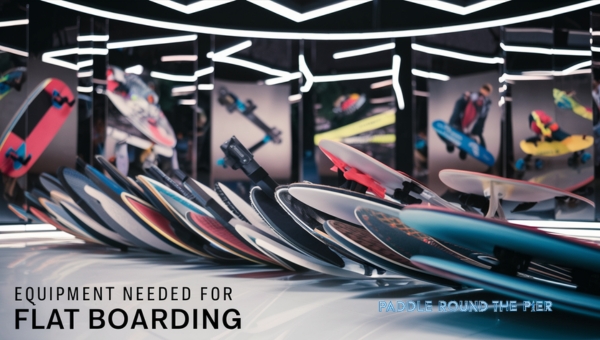
Flat water SUP boards come in several categories, each designed for specific conditions and uses. For beginners on flatwater, all-around recreational boards offer the best stability and versatility. These boards typically measure between 10'6 and 11'6 in length with widths ranging from 32 to 34 inches. The generous width provides the stability nervous beginners need, while the length offers reasonable tracking and glide efficiency.
Board construction falls into two main categories: inflatable SUPs and solid hard boards. Inflatable paddleboards use drop-stitch construction where thousands of internal threads connect the top and bottom PVC layers, creating a rigid platform when inflated to 12-15 PSI. These boards offer excellent portability, storage convenience, and surprising durability. Modern inflatable technology produces boards that perform nearly as well as solid boards for recreational flatwater use.
Solid boards, also called hard boards or epoxy boards, use foam cores wrapped in fiberglass, carbon fiber, or plastic. They provide superior glide, responsiveness, and speed compared to inflatables. However, they require roof racks or truck beds for transport and significant storage space at home. The weight and storage requirements make solid boards less practical for many beginners, though serious paddlers often graduate to them as skills advance.
Inflatable vs. Solid Board Comparison
| Feature | Inflatable SUP | Solid Board |
|---|---|---|
| Storage | Fits in closet, rolls to backpack size | Requires 10-14 feet of wall or rack space |
| Transport | Carries in any vehicle trunk | Needs roof racks or truck bed |
| Durability | Bounces off rocks, very impact resistant | Can chip, crack, or dent on impacts |
| Performance | Good for recreational flatwater use | Superior glide, speed, and responsiveness |
| Weight | Generally lighter (18-25 lbs) | Varies widely (20-35+ lbs) |
| Setup Time | 5-10 minutes to inflate | Ready to use immediately |
| Price Range | $300-$900 | $600-$2000+ |
For flatwater beginners, inflatable SUPs typically make more sense due to their convenience and forgiving nature. The slight performance compromise matters little on calm lakes where speed and responsiveness are less critical than stability and ease of use. As you progress, you can always add a solid board to your quiver for specific activities.
Paddle Selection and Sizing
Your paddle serves as the engine for flatwater paddleboarding, making proper selection essential for efficient, comfortable paddling. Paddles come in adjustable or fixed lengths, with materials ranging from heavy aluminum entry-level options to lightweight carbon fiber performance paddles. For beginners, adjustable paddles offer flexibility to experiment with different lengths as you develop your technique.
The correct paddle length depends on your height and the type of paddling you plan to do. The standard formula for flatwater recreational paddling calls for a paddle 8 to 10 inches taller than your standing height. This places the T-grip handle at wrist level when you stand the paddle vertically in front of you with your arm raised. Taller paddlers or those doing more aggressive touring might add an extra inch or two, while casual paddlers on very wide boards might subtract an inch for comfort.
| Paddler Height | Recommended Paddle Length | Use Case |
|---|---|---|
| 5'0" - 5'4" | 68" - 72" | Recreational flatwater |
| 5'5" - 5'8" | 72" - 76" | Recreational flatwater |
| 5'9" - 6'0" | 76" - 80" | Recreational flatwater |
| 6'1" - 6'4" | 80" - 84" | Recreational flatwater |
| 6'5"+ | 84" - 86" | Recreational flatwater |
Blade shape also matters for flatwater efficiency. Teardrop-shaped blades provide power for quick acceleration, while rectangular blades offer steady, efficient cruising strokes. For flat water SUP where you maintain consistent forward momentum, rectangular or slightly dihedral blades reduce flutter and require less correction during the stroke. Understanding paddleboard parts helps you make informed decisions about your equipment investments.
Essential Safety Gear
Personal flotation devices represent the most critical safety equipment for flatwater paddleboarding. The United States Coast Guard classifies paddleboards as vessels when outside surf or swim zones, requiring a personal flotation device for each person on board. Belt-pack inflatable PFDs offer the least restrictive option for active paddling, sitting comfortably around your waist until deployed. Traditional vest-style PFDs provide constant flotation but can interfere with paddling motion and cause overheating during summer sessions.
Leashes keep you connected to your board, preventing it from drifting away if you fall into the water. For flatwater lake paddling, a coiled ankle leash works well, staying out of the water and reducing drag. River paddlers should use straight leashes attached to quick-release belts worn around the waist, allowing fast detachment if the leash snags on underwater obstacles. Never paddle without a leash, as swimming after a drifting board in deep water exhausts even strong swimmers.
Additional safety equipment includes a whistle for signaling, a waterproof phone case or dry bag for communication, and appropriate clothing for water temperature. Many paddlers also carry a small first aid kit, sunscreen, and hydration. For lightweight paddle board options that are easy to transport with all your gear, consider boards under 22 pounds.
How to Get Started with Flat Boarding
Starting your flatwater paddleboarding journey requires learning proper standing technique, mastering fundamental paddle strokes, and selecting appropriate practice locations. Breaking these skills into manageable steps builds confidence quickly while minimizing frustration. This section provides detailed guidance for your first sessions on the water.
Step-by-Step Standing Technique
Begin in shallow water where you can stand comfortably next to your board. Place your paddle across the deck perpendicular to the length of the board, creating a stable handhold. Grip the rails of the board and carefully climb onto the center, starting on your hands and knees. Position yourself directly over the carrying handle, which marks the balance point of most boards.
From the kneeling position, take a few paddle strokes on each side to get a feel for the board's stability and movement. When ready to stand, place your hands flat on the deck in front of your knees. One foot at a time, step onto the board where your knees were, keeping your weight low and centered. Immediately rise to a standing position in one smooth motion, looking forward rather than down at your feet.
Once standing, position your feet shoulder-width apart on either side of the carrying handle. Keep your knees slightly bent and your core engaged, ready to adjust to the board's movements. Your gaze should remain forward on the horizon, as looking down at your feet actually decreases balance. For a detailed walkthrough on the standing process, see our complete guide to standing on a paddleboard.
Essential Paddle Strokes
Mastering four fundamental paddle strokes provides all the tools needed for confident flatwater paddling. The forward stroke propels you efficiently, the reverse stroke allows stopping and backing, the sweep stroke enables turning, and the draw stroke helps with lateral movement. Understanding each technique separately before combining them creates a solid foundation for advanced skills.
Forward Stroke: The workhorse of flatwater SUP, the forward stroke moves you in a straight line when alternated evenly on both sides. Reach forward with your bottom hand while extending your top arm, planting the blade fully in the water near the nose of your board. Pull the paddle back alongside the rail using your core muscles rather than just your arms, keeping the shaft vertical. Exit the water when the paddle reaches your feet and recover smoothly for the next stroke.
Reverse Stroke: To slow down, stop, or move backward, simply reverse the forward stroke motion. Reach back and plant the blade near your feet, then pull forward toward the nose. The reverse stroke creates drag and deceleration, useful for controlling speed when approaching docks or other paddlers. Practice alternating reverse strokes on both sides to maintain straight tracking when backing up.
Sweep Stroke: Turning efficiently requires the sweep stroke, which functions like a rudder to pivot the board. For a forward sweep that turns the nose away from your paddling side, reach wide and plant the blade away from the board's rail. Draw a wide arc from nose to tail, using your hips and torso to power the movement. Reverse sweep strokes, starting at the tail and sweeping forward, turn the nose toward your paddling side.
Draw Stroke: The draw stroke moves you sideways without turning, helpful for docking or adjusting position. Rotate your shoulders to face the direction you want to move, reach out and plant the blade perpendicular to the rail, then pull the board toward the blade by drawing your lower hand inward. This stroke requires practice to execute smoothly without losing balance, but adds tremendous control to your paddling repertoire.
Finding Suitable Locations
Choosing the right practice environment dramatically affects your learning curve and safety. Ideal beginner locations feature protected water without waves, minimal boat traffic, easy entry points, and nearby amenities like restrooms and parking. Local lakes, calm bays, and slow-moving river sections offer perfect training grounds for developing skills.
Wind conditions matter significantly for flatwater SUP beginners. Crosswinds create constant correction requirements, while headwinds make forward progress exhausting. Look for locations sheltered by trees, hills, or buildings that block prevailing winds. Early morning typically brings calmer conditions before afternoon thermal winds develop. Check local wind forecasts and avoid paddling when sustained winds exceed 10-12 mph.
Many outdoor retailers, marinas, and water sport shops offer rental equipment and beginner lessons. Taking a lesson from a certified instructor accelerates your progress and helps you avoid developing bad habits. Check out our guide to the top U.S. paddleboarding spots for inspiration, and discover the best places for paddle boarding across different regions and skill levels.
Flat Water SUP vs. Kayak: Which Should You Choose?
Many water enthusiasts debate whether to start with a paddleboard or kayak for flatwater recreation. Both offer excellent ways to explore lakes and calm rivers, but they differ significantly in experience, fitness benefits, and practical considerations. Understanding these differences helps you choose the right craft for your goals.
Paddleboards provide a standing platform with 360-degree visibility and freedom of movement. You can stretch, change positions, practice yoga, or even lie down for sunbathing. The standing position engages your entire body constantly for balance, creating a more intense workout than kayaking. Our detailed paddleboard vs kayak comparison breaks down all the differences to help you decide.
Kayaks offer seated comfort, better protection from splashing, and typically faster speeds for covering distance. The enclosed cockpit keeps you drier and allows paddling in cooler conditions without special gear. Storage capacity usually exceeds paddleboards, making kayaks preferable for multi-day touring or fishing with extensive equipment.
| Factor | Flat Water SUP | Kayak |
|---|---|---|
| Learning Curve | Moderate - requires balance | Easier - seated stability |
| Full Body Workout | Excellent - constant balance work | Good - primarily upper body |
| Versatility | Yoga, fishing, touring, surfing | Touring, fishing, whitewater |
| Portability | Inflatable options very portable | Rigid, harder to transport |
| Comfort | Standing, can kneel or sit | Seated with back support |
| Visibility | Superior standing viewpoint | Limited to seated eye level |
| Getting Wet | More likely to get splashed | Stay drier in calm conditions |
For fitness-focused paddlers who enjoy a challenge and want maximum visibility, flat water SUP provides unbeatable benefits. Those prioritizing comfort, speed, and all-weather capability may prefer kayaks. Many enthusiasts eventually own both, choosing the appropriate craft for each outing's conditions and goals.
Tips for Improving Your Flat Boarding Skills
Progressing from beginner to intermediate and advanced flatwater paddler requires targeted practice and skill development. Beyond simply spending more time on the water, specific exercises and techniques accelerate your improvement. Focus on balance enhancement, stroke efficiency, and advanced maneuvers to elevate your flat boarding abilities.
Enhancing Balance
Balance represents the foundational skill for all paddleboarding activities. Improving your stability on the board allows you to paddle more efficiently, handle rougher conditions, and attempt advanced techniques with confidence. Off-water training significantly accelerates balance development.
Practice yoga poses that challenge single-leg stability and core engagement. Tree pose, warrior III, and half-moon pose translate directly to the proprioceptive skills needed for paddleboarding. A balance board or Indo board provides an excellent training tool that mimics the constant micro-adjustments required on a SUP. Start with basic standing, then progress to squats, lunges, and eventually paddling motions while balancing.
On the water, deliberately challenge your balance within safe parameters. Practice shifting weight from foot to foot, taking small steps forward and back on the deck, and paddling while looking behind you. These controlled instability drills expand your comfort zone and prepare you for unexpected conditions.
Advanced Maneuvers
Once comfortable with basic strokes and balance, expanding your technical repertoire opens new possibilities for flatwater exploration. Pivot turns, cross-bow strokes, and brace techniques add sophistication to your paddling while increasing efficiency and control.
The pivot turn allows rapid direction changes without forward momentum. Step back toward the tail to lift the nose from the water, then use sweep strokes to spin the board around its submerged pivot point. This maneuver proves invaluable for navigating tight spaces, turning around quickly, or positioning yourself precisely.
Cross-bow strokes enable paddling on the opposite side without switching hand positions. Bring the paddle across the nose of the board and plant it on the far side, pulling back toward you. This technique maintains rhythm during long straightaways and provides alternative turning options. Practice on calm water until the motion feels natural.
Bracing techniques prevent falls when balance wavers. The low brace uses the paddle blade flat on the water surface for support, while the high brace plants the power face against the water for stronger stabilization. These recovery strokes separate confident paddlers from those who fall at every wobble. Once you have mastered these techniques, try paddleboarding with your dog for a fun new challenge.
Common Mistakes to Avoid
Beginners consistently make certain errors that slow progress and create unnecessary frustration. Recognizing these common pitfalls before they become habits saves time and enhances safety. Here are the mistakes we see most frequently and how to correct them.
1. Poor Stance: Standing with feet too close together or locked straight reduces stability significantly. Keep your feet shoulder-width apart with knees slightly bent, allowing your legs to act as shock absorbers. Your weight should center over the board's handle point, not toward the nose or tail.
2. Looking Down: Beginners instinctively watch their feet, but this actually decreases balance by disrupting your center of gravity. Train yourself to look at the horizon or a distant point. Your peripheral vision can monitor the board's position without compromising posture.
3. Arm-Only Paddling: Relying solely on arm strength exhausts you quickly and produces weak, inefficient strokes. Engage your core muscles, rotating your torso with each stroke. Think of your arms as extensions of the paddle, transferring power from your hips and back.
4. Incorrect Paddle Angle: Holding the paddle backward or at the wrong angle wastes energy. The blade should angle forward from the shaft when properly oriented. Maintain a vertical shaft position during the power phase of your stroke, entering the water near the nose and exiting at your feet.
5. Neglecting the Leash: Failing to attach your leash seems harmless on calm water, but a falling board drifts surprisingly fast. Swimming after your board in deep water exhausts even strong swimmers and creates dangerous situations. Always leash up before launching, regardless of conditions.
6. Paddling in the Wrong Conditions: Overestimating your abilities or ignoring weather forecasts leads to frightening experiences. Beginners should avoid wind over 10 mph, significant boat traffic, and water temperatures requiring heavy protection. Start in protected areas and gradually expand your comfort zone.
7. Improper Falling Technique: When you inevitably lose balance, falling incorrectly can cause injury. Aim to fall flat toward the water rather than diving or falling onto the board. Falling flat keeps you near the surface and reduces impact. Fall away from the board to avoid contact with the rails or fins.
8. Skipping the Warm-Up: Cold muscles react slower and fatigue faster. Perform dynamic stretches for your shoulders, back, and legs before paddling. Arm circles, torso twists, and leg swings prepare your body for the physical demands ahead.
9. Gripping Too Tightly: White-knuckling the paddle shaft creates arm fatigue and reduces stroke smoothness. Maintain a relaxed grip, tight enough for control but loose enough for fluid motion. Your top hand should guide while your bottom hand provides the anchor point.
FAQs
Is flat boarding difficult for beginners?
Flat boarding is one of the most accessible water sports for beginners. Most people can stand and paddle comfortably within their first session, especially on wide, stable boards designed for beginners. The calm water conditions of flat water SUP eliminate the waves and currents that make ocean surfing challenging. With proper instruction and appropriate equipment, adults of all fitness levels and ages can enjoy paddleboarding successfully.
What size paddle board do I need for flatwater?
For flatwater paddleboarding, beginners should choose all-around boards between 10'6 and 11'6 in length with widths of 32 to 34 inches. This size range provides excellent stability while offering reasonable tracking and glide. Consider your weight when selecting: heavier paddlers should choose longer, wider boards with higher volume. Most recreational paddlers find 10'8 to 11'2 boards ideal for flat water conditions.
How long should my SUP paddle be?
Your paddle should be 8 to 10 inches taller than your standing height for flatwater recreational paddling. To check, stand the paddle vertically and raise one arm overhead. The T-grip handle should reach your wrist or the webbing between your thumb and index finger. Adjustable paddles allow you to fine-tune this length as you develop your technique and preferences.
Is inflatable or hard board better for flatwater?
For flatwater beginners, inflatable boards typically offer better value and convenience. They provide excellent stability, transport easily in any vehicle, store compactly, and handle impacts well. Hard boards offer superior performance for speed and responsiveness, but these advantages matter less on flat water than on surf or choppy conditions. Many experienced paddlers own inflatables for casual use and hard boards for specific performance goals.
Do I need a life jacket for flatwater paddleboarding?
The United States Coast Guard requires a personal flotation device for all paddleboarders outside designated surf or swim zones. Belt-pack inflatable PFDs provide the least interference with paddling motion while meeting legal requirements. Children must wear properly fitted life jackets at all times. Even strong swimmers should carry flotation, as cold water, unexpected conditions, or injuries can create dangerous situations quickly.
Can children participate in flatwater SUP?
Children as young as five or six can enjoy paddleboarding when properly supervised and equipped. Kids should wear appropriately sized life jackets and use smaller, lighter boards when possible. Start with them sitting or kneeling until comfortable, then progress to standing. Many families enjoy tandem paddling where a parent controls the board while a child rides in front. Always prioritize safety and keep sessions short to match attention spans.
Is paddleboarding good for back pain and osteoporosis?
Flatwater paddleboarding offers excellent benefits for those with back pain or osteoporosis concerns. The low-impact nature avoids jarring movements that aggravate spinal issues. The core strengthening from balance work supports better posture and reduces back strain. For osteoporosis, weight-bearing exercise like SUP helps maintain bone density while the balance training reduces fall risk. Consult your doctor before starting, especially for severe conditions.
Is it better to have 1 or 3 fins on a flatwater SUP?
For flatwater paddling, a single large fin generally provides better tracking and speed than three smaller fins. The single fin setup reduces drag and helps the board maintain straight course with fewer correction strokes. Three-fin setups offer better maneuverability and work well for surfing or shallow water where a large single fin might strike bottom. Most recreational flatwater boards come with a single removable fin for optimal efficiency.
Conclusion
Flat boarding, or flatwater paddleboarding, offers an exceptional entry point into water sports that combines fitness, adventure, and tranquility. Unlike the snowboarding terminology that dominates search results for "flat boarding," this guide clarifies that flat water SUP represents a peaceful, accessible activity perfect for lakes, rivers, and protected bays. The sport welcomes beginners of all ages while providing enough depth to challenge advanced paddlers for years.
Success in flatwater paddleboarding comes down to three fundamentals: choosing appropriate equipment with the right board dimensions and paddle length, mastering basic techniques including proper standing position and efficient strokes, and respecting safety protocols like wearing PFDs and leashing up every session. With these elements in place, your time on the water becomes an endlessly rewarding pursuit of fitness, exploration, and mental renewal.
Whether you seek a new workout routine, family activity, or solo escape into nature, flat water SUP delivers on all fronts. Start with calm conditions, progress at your own pace, and embrace the learning process. The water awaits your first paddle stroke.