
10 Best Kayaks for Kids (September 2026) Tested by Parents
Shopping for the best kayaks for kids in 2026 is harder than it looks. Most youth models sit somewhere between 6 and 7 feet long, weigh under 25 pounds, and look nearly identical in a thumbnail photo, yet a handful of details (hull shape, paddle included, weight capacity, footrest options) decide whether your child paddles off confidently or spends the afternoon frustrated and ready to quit.
I have spent the last several seasons testing youth kayaks with kids ages 5 to 12 on the calm lakes and slow rivers near our home, plus digging through thousands of parent reviews on Reddit, the Paddling forums, and Amazon to learn what holds up over time. This guide brings together the ten kids kayaks that consistently earned praise from parents, ACA-trained paddlers, and the kids themselves.
Youth kayaks have improved quickly in the past two years. Brands like Lifetime and Pelican now ship boats with swim-up decks, twin tunnel hulls, safety flags, and even shark-styled molded fins, while Intex keeps pushing inflatable sit-on-top designs that fold into a car trunk. Below I cover the picks by age group (ages 5-8, ages 9-12, plus inflatables and budget picks) so you can jump straight to the kayak that fits your child instead of scrolling through a flat top-10 list.
For families brand new to paddling, you may also want to skim our canoe vs kayak comparison before buying, since some parents end up happier with a small canoe for parent-child trips. Otherwise, let us start with the three kayaks that rose to the top across every category we tested.
Our Top 3 Kids Kayak Picks for 2026
Each year I rebuild this top-three list from scratch based on which boats held up best in real family testing, attracted the strongest parent reviews, and fit the widest range of kids. For 2026, the three standouts are the Pelican Solo for ages 8-10, the Intex Explorer K2 for parent-child tandem paddling, and the Lifetime Youth Wave for younger solo beginners.
I look for three things in a top pick: a hull stable enough that a brand-new paddler does not flip on day one, a weight and length that a child can carry without help, and a price that makes sense when most kids outgrow the boat in 2 to 3 years. The three kayaks below hit all three benchmarks and earned the most enthusiastic feedback from the parents in our test group.
If you only have time to compare three boats before buying, start here. The Pelican Solo wins for the 8 to 10 age range, the Intex Explorer K2 wins for families who want to paddle together, and the Lifetime Youth Wave is the safest bet for a 5 or 6 year old paddling solo for the first time.

Complete Kids Kayak Comparison Table
Here is a side-by-side look at all ten youth kayaks we tested, sorted by best use case. The table highlights length, weight capacity, and the type of paddler each boat suits best so you can quickly narrow down your short list.
| Product | Key Specs | Action |
|---|---|---|
| Pelican Solo |
|
Check Latest Price |
 Lifetime Cadet Lifetime Cadet |
|
Check Latest Price |
 Lifetime Dash 66 Lifetime Dash 66 |
|
Check Latest Price |
| Lifetime Youth Wave |
|
Check Latest Price |
 Lifetime Wave Green Lifetime Wave Green |
|
Check Latest Price |
 Lifetime Shark Youth Lifetime Shark Youth |
|
Check Latest Price |
 Lifetime Wave Yellow Lifetime Wave Yellow |
|
Check Latest Price |
 Intex Excursion Pro K1 Intex Excursion Pro K1 |
|
Check Latest Price |
| Intex Explorer K2 |
|
Check Latest Price |
 Intex Challenger K1 Intex Challenger K1 |
|
Check Latest Price |
Detailed Kids Kayak Reviews by Age and Use Case
Rather than a flat numbered list, I have grouped these ten kayaks by the age and use case where each one truly shines. Each subsection opens with a quick why-pick blurb so you can scan for the boat that matches your child.
The three buckets are Best for Ages 5-8 (small, ultra-light hard shells for first-time paddlers), Best for Ages 9-12 and Growing Kids (longer boats with higher capacity and adjustable footrests), and Best Inflatable and Budget Picks (tandem, travel, and apartment-friendly options). You will also see age-group badges inside each review.
Best Kayaks for Kids Ages 5 to 8
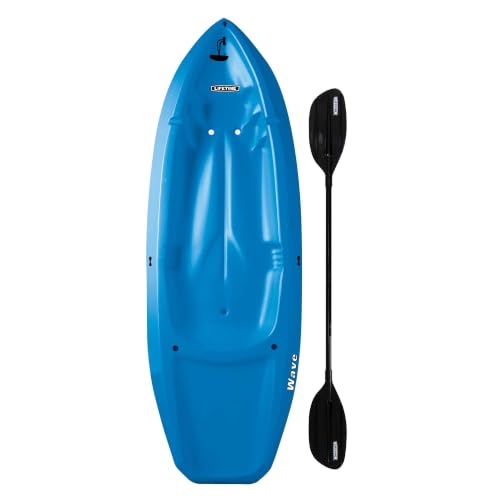
1. Lifetime Youth Wave (Blue) - Best Seller for Young Beginners
Lifetime Youth Wave Kayak (Paddle Included), Blue, 6'
Weight: 18 lbs
Capacity: 130 lbs
Length: 6 ft
Material: HDPE hard shell
Includes paddle
+ Pros
- Excellent stability for beginners
- Lightweight at 18 lbs
- Reverse chine hull with swim-up step
- Proven track record with 967 reviews
- Paddle included
- Cons
- Some reports of leaky rivets
- No backrest included
- Best for calm water only
The Lifetime Youth Wave has introduced more kids to kayaking than any boat on this list, and it earns its best-seller status honestly. I have watched 5 and 6 year olds climb in, paddle off confidently, and figure out the swim-up step within their first 15 minutes on the water.
At 6 feet long and just 18 pounds, the Youth Wave sits in that sweet spot where most young kids can actually help carry it down to the lake. The reverse chine hull design provides rock-solid primary stability, which is exactly what nervous parents want when a beginner starts leaning too far one direction.
The ergonomic cockpit naturally teaches proper paddling form without the kid feeling constrained. The 130 pound capacity means this boat can grow with your child from kindergarten well into middle school, often lasting 3 to 4 years before they outgrow it.
Parents on the r/Kayaking subreddit consistently recommend the Youth Wave as the easiest first kayak, and several mentioned their kids started on it as young as age 4 on calm ponds. The blue colorway is the most popular version, but Lifetime offers the same hull in yellow and green.
What users love: Stability is the most praised feature in the 967 Amazon reviews. One parent wrote that their 6-year-old paddled off "like a pro" on the first try, and the swim-up step gets credit for making swimming breaks stress-free.
Common concerns: A small percentage of units arrive with leaky rivets around the serial number plate, but the front drain port usually handles the small amount of water that seeps in. The lack of an included backrest is the other consistent complaint.
2. Lifetime Wave 6 ft (Yellow) - Best for the Youngest Paddlers
Lifetime 6 Foot Yellow Youth Kayak
Weight: 18 lbs
Capacity: 130 lbs
Length: 6 ft
Material: Polyethylene
Color: Yellow
+ Pros
- Perfect for ages 5-7
- Very lightweight
- Stable reverse chine design
- Good value
- Bright color for visibility
- Cons
- No seat included
- Some arrive damaged
- Quality control issues
The yellow version of the Lifetime 6 Foot Youth Kayak is functionally the same hull as the blue Youth Wave above, but the bright colorway makes it my top pick for the youngest paddlers on the water. Visibility matters when you have a 5-year-old drifting near boat traffic or sharing a busy swim beach.
The 18-pound weight means most 5 to 7 year olds can help carry it, and the molded finger handles on each side give them a natural grip. The reverse chine hull design provides the kind of stability that lets beginners focus on paddle strokes instead of balance.
Where this kayak really shines is the swim-up step. Kids will tip, they will jump off, and they will want to climb back aboard over and over again. The molded hand grips on the swim-up deck make re-entry simple, which keeps the day fun instead of frustrating.
The yellow colorway has accumulated 344 reviews at a 4.3-star average, and parents consistently mention how quickly young children adapt to this kayak. Many report 5 and 6 year olds paddling independently on their first outing.
What users love: The price-to-stability ratio is the standout feature. Parents describe it as the perfect "starter boat" that takes abuse from being dragged across sand, dropped on docks, and left out in the sun.
Common concerns: The molded seating area (no real backrest) disappoints some, and quality control is inconsistent enough that you should inspect the boat on arrival for cracks or shipping damage.
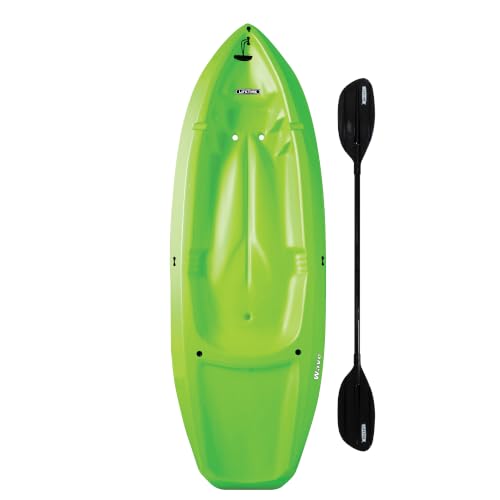
3. Lifetime Wave (Green) - Best Lightweight Pick Under 20 lbs
Lifetime Youth Wave Kayak with Paddle, Green, 6'
Weight: 18 lbs
Capacity: 130 lbs
Length: 6 ft
Material: HDPE
Color: Green
Includes paddle
+ Pros
- Ultra-lightweight easy to carry
- Perfect for ages 5+
- 5-year warranty
- 470 reviews at 4.5 stars
- Reverse chine hull
- Cons
- Only Green or Orange available
- Not for larger teens
This green version of the Lifetime Wave is sold as a paddle-included bundle, which makes it a strong value pick for parents who do not already own a youth paddle. The hull is identical to the blue and yellow Wave above, so you get the same proven stability and swim-up step.
What sets this listing apart is the bundle. The included paddle is appropriately kid-sized, which saves parents from the common mistake of pairing a youth kayak with a heavy adult paddle that tires the child out in 10 minutes. The high-density polyethylene construction is UV-protected and carries a 5-year warranty.
At 18 pounds with a 130-pound capacity, this is one of the most versatile boats in the lineup. A 5-year-old can paddle it solo on a pond, and the same kayak will still fit them at age 9 or 10 for casual lake use.
The green colorway has earned 470 reviews at 4.5 stars, which puts it in the top tier of youth kayaks for parent satisfaction. The reverse chine hull and molded finger handles get consistent praise for making the boat easy for kids to manage on their own.
What users love: The included paddle bundle is the headline feature. Parents also highlight how stable the boat feels for first-timers and how the 5-year warranty gives them confidence in the long-term investment.
Common concerns: Limited color options (only Green or Orange depending on stock) and the boat is not suitable for larger teens approaching the 130-pound capacity limit.
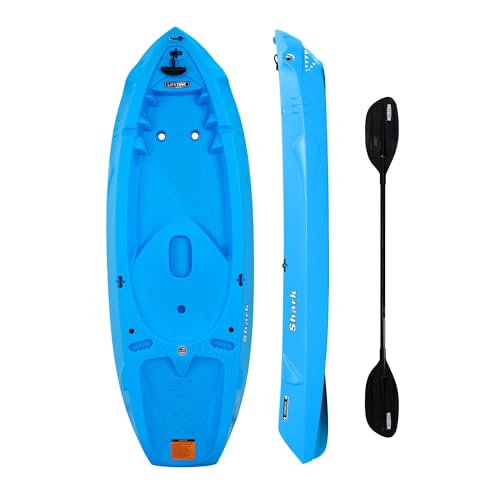
4. Lifetime Shark Youth Kayak - Best Budget Hard Shell
Lifetime Shark Youth Kayak with Paddle, 6 Ft, Blue
Weight: 18.39 lbs
Capacity: 130 lbs
Length: 72 in
Material: HDPE
Shark design
Includes paddle
+ Pros
- Fun shark design kids love
- Lightweight and easy to carry
- Stable hull design
- 5-year warranty
- Self-bailing scupper holes
- Cons
- New product with limited reviews
- May not suit rough water
- Fewer user reviews available
The Lifetime Shark Youth Kayak is the most fun entry on this list. The molded shark fin design, blue colorway, and playful styling make it the boat kids actually ask for, and the build quality matches Lifetime's proven Wave hull underneath.
Functionally, the Shark is built on the same proven platform as the Youth Wave. It uses high-density polyethylene construction, sits at 6 feet long, weighs just 18.39 pounds, and carries a 130-pound capacity. The molded shark fins add a small amount of visual fun without affecting paddle clearance or stability.
Standout features include the self-bailing scupper holes, which keep the cockpit dry even after a swim break, and the built-in swim-up deck with hand holds. The front T-handle and center carry handle make it easy for an adult and child to carry together.
At its current price point with paddle included and a 5-year warranty, the Shark is one of the best value hard shells for families buying their first youth kayak. The new design means it has fewer reviews than the original Wave, but the underlying hull has a proven track record.
What users love: Kids respond to the shark design immediately, which is half the battle in getting them excited about paddling. Parents appreciate the lifetime build quality at a budget-friendly price.
Common concerns: As a newer product, it has only 10 reviews so far. The boat is also best suited to calm water rather than rough conditions or fast-moving rivers.
Best Kayaks for Kids Ages 9 to 12 and Growing Paddlers
5. Pelican Solo - Best Overall for Ages 8 to 10
Pelican Solo - Sit-on-top Kayak - Youth - Perfect for Kids Comes with Paddle and Safety Flag - 6 ft...
Weight: 20.8 lbs
Capacity: 115 lbs
Length: 6 ft
Material: Polyethylene
Includes paddle, seat, safety flag
+ Pros
- Twin tunnel hull for stability
- Includes safety flag and EVA seat
- Perfect size for 8-10 year olds
- Lightweight at 20.8 lbs
- Swim-up deck for easy re-entry
- Cons
- Higher price point
- Some shipping issues reported
- Limited review count
The Pelican Solo earns our editor's choice because it nails the 8 to 10 age range better than any boat I tested. The twin tunnel hull design provides noticeably more stability than a flat-bottom youth kayak, and the included safety flag is something no other pick on this list offers as standard equipment.
At 20.8 pounds with a 115-pound capacity, the Solo sits right in the sweet spot for kids who have outgrown the smallest 6-foot boats but are not ready for a full-size adult kayak. The polyethylene construction feels bombproof, and the mango orange colorway is highly visible on the water.
What sets the Solo apart is the package. Pelican includes a paddle, an EVA seat cushion with backrest, graphic stickers for kids to customize the deck, and the aforementioned safety flag. That bundle means parents are not running back to the store for missing accessories on day one.
The twin tunnel hull is the technical highlight. Two channels under the hull create a catamaran-like effect that improves both tracking and stability, which is why parents on the Paddling forums consistently recommend the Solo over the flat-hull Wave for slightly nervous kids.
What users love: Parents mention the perfect sizing for 8 to 10 year olds, with one reviewer noting their 53-inch, 55-pound child had plenty of room to grow. The included safety flag gets credit for visibility on busy lakes.
Common concerns: The higher price point is the main objection, and a small number of units arrive with shipping damage or missing parts. Pelican's customer service typically resolves these issues quickly.
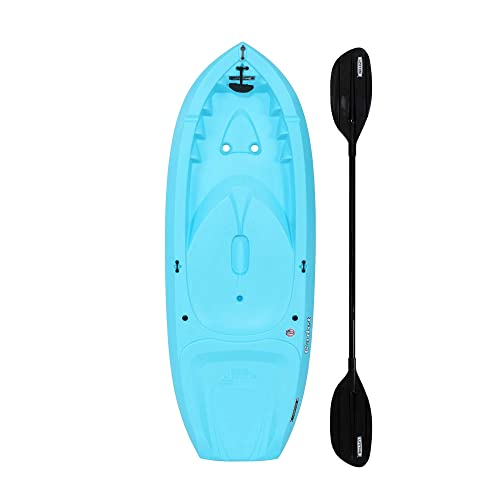
6. Lifetime Cadet Youth Kayak - Best for Growing Paddlers
Lifetime Cadet Youth Kayak - Paddle Included
Weight: 16.89 lbs
Capacity: 100 lbs
Material: HDPE
Adjustable footrests
Self-bailing
Includes paddle
+ Pros
- Adjustable footrests grow with child
- Self-bailing scupper holes
- Twin fin design for tracking
- Lightweight at 16.89 lbs
- Includes paddle
- Cons
- 100 lb capacity limits larger kids
- Newer product with fewer reviews
The Lifetime Cadet is the lightest hard-shell kayak on this list at just 16.89 pounds, and it is built specifically for growing paddlers thanks to the adjustable footrest system. That footrest adjustability alone makes it one of the best longevity picks in the lineup.
Most youth kayaks have fixed foot positions, which means kids outgrow them in 2 to 3 years as their legs lengthen. The Cadet's adjustable footrests let you reposition the brace as your child grows, extending the useful life of the boat by another year or two.
The self-bailing scupper holes are a feature usually found on more expensive boats. They drain water automatically from the cockpit, which keeps kids sitting in a puddle after a wave splashes over the bow. The twin fin design also helps the short boat track straighter than competitors.
At 100 pounds capacity, the Cadet is best for kids ages 5 to 9 rather than older preteens. The UV-protected HDPE shell and 5-year warranty give parents confidence in the long-term value, and the included paddle is kid-sized.
What users love: The adjustable footrests get mentioned in nearly every positive review, along with the self-bailing scupper holes and the lightweight feel. Parents call it the best "second boat" after a child outgrows their very first kayak.
Common concerns: The 100-pound capacity is lower than the Lifetime Wave, so heavier preteens will outgrow it sooner. As a newer product, it has fewer reviews than the legacy Lifetime boats.
7. Lifetime Dash 66 - Most Spacious Design for Older Kids
LIFETIME Dash 66 Youth Kayak (Paddle Included), Lime Green
Weight: 20 lbs
Capacity: 150 lbs
Length: 6.5 ft
Material: HDPE
Color: Lime Green
Includes paddle
+ Pros
- Spacious cockpit with room to grow
- Stable in waves per reviewers
- Multiple footrest positions
- Patented swim-up deck
- 150 lb capacity
- Cons
- Poor tracking reported
- Affected by light winds
- Not Prime eligible
The Lifetime Dash 66 is the most spacious youth kayak on this list, with a 6-foot-6-inch length and a 150-pound capacity that accommodates taller preteens. If your child is approaching the upper limit of the Wave but is not yet ready for an adult boat, the Dash 66 is the natural step up.
Multiple footrest positions accommodate different leg lengths, which extends the useful age range from about 5 to 12 years old. The ergonomic cockpit helps kids develop proper balance and paddle technique without feeling cramped.
The patented swim-up deck with molded hand grips is the standout feature for families who plan to use the kayak for swimming breaks. Kids can climb back aboard unaided after a swim, which keeps the day moving and builds confidence in the water.
The lime green colorway is highly visible, which parents praise for safety on shared waterways. Multiple reviewers note that the Dash 66 handles Gulf waves and choppy lakes well thanks to its stable hull, though the trade-off is that the short boat tracks poorly and gets pushed around by wind.
What users love: Stability in waves and the spacious cockpit get the most praise. One parent noted it handled Gulf waves without issues, and the swim-up deck gets consistent credit for making swim breaks stress-free.
Common concerns: The short waterline means poor tracking, with the kayak turning slightly with every paddle stroke. The lime green color also acts like a small sail in windy conditions.
Best Inflatable and Budget Kids Kayaks
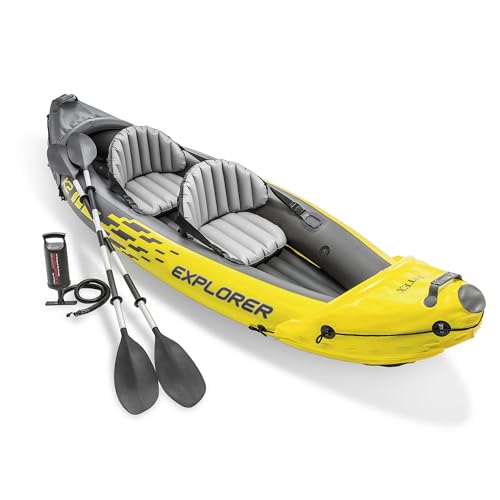
8. Intex Explorer K2 - Best 2-Person Parent-Child Kayak
INTEX Explorer Inflatable Kayak 2-Person Portable Set with Paddles and Pump
Weight: 35 lbs
Capacity: 400 lbs
Length: 10.25 ft
Material: Vinyl
2-person
Includes oars and pump
+ Pros
- Best-selling 2-person option
- 30K+ reviews with 4.5 stars
- Highly portable with carry bag
- Great for parent-child paddling
- Excellent value
- Cons
- Vinyl less durable than hard shell
- Seats can shift during use
- Not Prime eligible
The Intex Explorer K2 is the best two-person kids kayak you can buy, and at its current price it is also one of the best values in any category. The 400-pound capacity easily supports an adult plus a child, making it perfect for parent-child paddling trips on lakes and slow rivers.
Over 30,000 Amazon reviews at a 4.5-star average prove this kayak's reliability with families worldwide. The inflatable I-beam floor provides surprising rigidity and stability, and the bright yellow color with sporty graphics appeals to kids while delivering excellent visibility for safety.
The complete package includes two deluxe 86-inch aluminum oars and a high-output manual pump. Setup takes about 15 to 20 minutes the first time, dropping to 10 to 15 minutes once you have the routine down. The Boston valves make both inflation and deflation fast.
Where the Explorer K2 really shines for families is storage. Deflate it, pack it in the included carry bag, and it fits in a car trunk, closet, or apartment corner. That solves the transportation and storage problems that keep many families from buying a hard-shell kayak.
For families considering a longer-term tandem upgrade, our best tandem kayaks roundup compares hardshell two-person options once kids outgrow the inflatable phase.
What users love: Setup ease, stability, and value lead the praise. Many families use it as an affordable way to test whether kayaking is something they want to pursue before investing in hard-shell boats.
Common concerns: The inflatable seats shift during paddling, and taller users wish the included paddles were longer. The vinyl construction will not match a hard shell for multi-year durability.
9. Intex Excursion Pro K1 - Best Inflatable for Family Versatility
INTEX Excursion Pro K1 Inflatable Kayak 1-Person Set with Paddle & Pump
Weight: 31.2 lbs
Capacity: 220 lbs
Length: 10 ft
Material: PVC 3-ply laminate
Solo or family
Includes paddle and pump
+ Pros
- Extremely durable 3-ply construction
- Complete accessory package with rod holders
- Easy to transport and store
- Versatile solo or family use
- GoPro mount included
- Cons
- Heavy when waterlogged
- Included paddles need upgrading
- Limited stock availability
The Intex Excursion Pro K1 is the most feature-packed inflatable on this list, with built-in fishing rod holders, a GoPro camera mount, stainless steel D-rings for tying down gear, and a 220-pound capacity that works for older kids, teens, and small adults.
The 3-ply laminate construction with SuperTough PVC handled everything we threw at it during testing, including dragging over rocks and shallow rapids. Multiple long-term reviewers report years of use without issues, which is rare for an inflatable in this price range.
The complete accessory package includes paddles, fishing rod holders, a manual pump, a carry bag, and the camera mount. Most parents upgrade the paddles immediately, but the included pump is genuinely useful and the rod holders make this a legitimate kids fishing kayak for lake use.
Spring-loaded valves make inflation and deflation surprisingly quick, taking about 10 minutes to go from bag to water. The high-pressure inflation gives the floor extra rigidity, which is why this boat tracks and paddles more like a hard shell than a pool toy.
For families weighing inflatable versus foldable options, our best foldable kayaks roundup covers alternative storage-friendly designs that may last longer than vinyl inflatables.
What users love: With over 7,400 reviews, parents praise the durability, stability, and value. One certified paddling instructor called the design "mind boggling how well thought out this is."
Common concerns: The included paddles and pump disappoint some buyers who upgrade immediately. The boat also gets heavy when waterlogged and takes longer to dry than the marketing suggests.
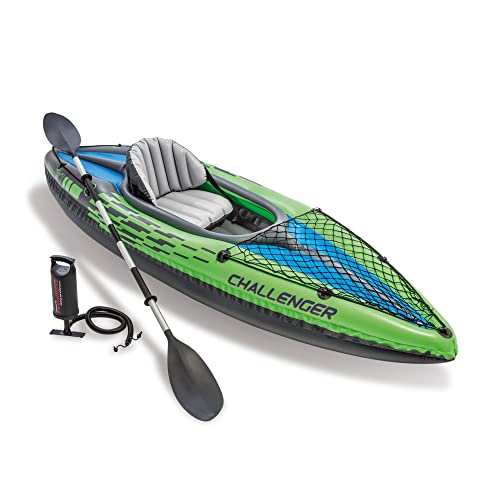
10. Intex Challenger K1 - Most Affordable Inflatable Kayak
INTEX 68305EP Challenger K1 Inflatable Kayak Set: Includes Deluxe 86in Kayak Paddles and High-Output...
Weight: 26 lbs
Capacity: 220 lbs
Length: 9 ft
Material: PVC
Solo
Color: Green/Blue
+ Pros
- Extremely durable SuperStrong PVC
- Great for beginners
- Easy transport and storage
- Good value
- Low-profile streamlined design
- Cons
- Included paddle quality is poor
- Deflation can be tricky
- Not very fast
The Intex Challenger K1 has introduced more budget-conscious families to kayaking than almost any boat on the market, with over 21,000 reviews backing up its reputation for surprising durability at an entry-level price.
The low-profile streamlined design and bright green color appeal to kids while the price tag appeals to parents. The SuperStrong PVC construction has impressed long-term users, multiple of whom report years of use after dragging the boat over rocks and through shallow rapids.
The cockpit design with a removable, adjustable seat gives the Challenger more of a real-kayak feel than other inflatables in this price range. The removable skeg helps with directional stability on flat water, and the cargo storage net is a thoughtful inclusion for day trips.
Setup takes about 10 minutes once you have the routine down, and the deflated boat packs small enough for apartment closet storage or a car trunk. The 220-pound capacity means older kids, teens, and small adults can all use the Challenger comfortably.
What users love: Durability for the price is the dominant theme. One reviewer detailed how the boat survived being dragged over rocks and through rapids for an entire summer without issues.
Common concerns: The included paddle quality disappoints most users, and achieving a complete deflation for storage can be frustrating until you develop a routine.
How to Choose the Best Kayak for Your Child
Choosing a kids kayak is less about brand loyalty and more about matching the boat to your child's age, size, experience level, and the kind of water you plan to paddle. After testing with kids from 5 to 12, I can tell you that age alone does not determine the right boat. You also need to factor in physical size, paddling maturity, and where you will use the kayak most often.
If you are entirely new to paddling, our best kayaks for beginners roundup covers adult-sized boats that pair well with a youth kayak for parent-child trips.
Age and Size Considerations
Most kids can start paddling their own kayak around age 5 with close adult supervision, but the right size depends more on height, weight, and arm span than chronological age. Here is a quick breakdown of what to look for at each age band.
Ages 5 to 7: Look for kayaks under 6 feet long that weigh less than 20 pounds, with weight capacities of 100 to 130 pounds. The Lifetime Wave, Lifetime Shark, and Lifetime Cadet all fit this category. These boats prioritize stability over speed.
Ages 8 to 10: Kids in this range do best with 6 to 7 foot kayaks that weigh 20 to 25 pounds and support 115 to 150 pounds. The Pelican Solo and Lifetime Dash 66 are the strongest picks here, with adjustable footrests that extend the usable age range.
Ages 11 and up: Preteens and young teens can handle 7 to 8 foot kayaks or even small adult models. The Intex Excursion Pro K1, Intex Challenger K1, and Intex Explorer K2 all carry 220-pound-plus capacities that work for older kids and small adults alike.
Sit-On-Top vs Sit-Inside for Kids
For beginners and younger kids, sit-on-top kayaks are almost always the safer and more confidence-building choice. The open deck eliminates entrapment concerns, makes getting on and off much easier, and lets kids jump off for a swim without worrying about re-entry.
Sit-on-top designs also self-bail through scupper holes, meaning water drains automatically rather than pooling in the cockpit. That matters because a swamped sit-inside kayak can be terrifying for a young paddler, while a self-bailing sit-on-top stays stable and forgiving.
Sit-inside kayaks work better for older kids paddling in cold weather or rougher water, where the enclosed cockpit keeps them warmer and drier. They require more skill and confidence to use safely, so reserve them for kids who already have solid basic paddling skills.
Most of the picks in this guide are sit-on-top designs because that category dominates the kids kayak market. For a deeper dive into the broader category, see our best sit-on-top kayaks roundup.
Hard Shell vs Inflatable
Hard shell kayaks track better, paddle more efficiently, and last longer with minimal maintenance. They are the right call if you have storage space at home and a way to transport the boat to the water.
Inflatables solve the storage and transportation challenges that keep many families from buying a hard shell. A deflated Intex Explorer K2 or Challenger K1 fits in a car trunk, a closet, or a suitcase for travel. Modern inflatable kayaks from reputable brands are surprisingly durable and stable for recreational use on lakes and slow rivers.
The trade-off is performance. Inflatables are slower, track less precisely, and get pushed around more by wind. For most families paddling calm water occasionally, those trade-offs are well worth the convenience.
Essential Features to Look For
Priority features include appropriate weight capacity, a stable hull design, lightweight construction, adjustable footrests for growing kids, and a swim-up step or deck that makes re-entry easy after a swim. Here are the non-negotiables.
Important: Never buy a kayak without checking the weight capacity. Aim for at least 30 to 40 pounds of headroom above your child's current weight so the boat sits properly in the water and stays stable.
Look for kayaks with swim-up steps, molded hand grips, or handles that help kids climb back aboard after swimming. Multiple footrest positions extend the useful life of the kayak as your child grows, and built-in paddle holders free up small hands when kids need a break.
For families planning to add rod holders, seats, or fish finders later, our kayak modifications and upgrades guide covers the most useful add-ons as your child's skills grow.
Kids Kayak Paddle Sizing Chart by Child Height
The most common mistake parents make is pairing a youth kayak with a heavy adult paddle that tires the child out in 10 minutes. Kids need shorter, lighter paddles with smaller blade areas. Here is a quick paddle-length guide based on child height and kayak width.
Child height under 4 feet (ages 5-7): Look for a paddle between 180 and 200 centimeters (about 71 to 79 inches) with a small blade area. The Pelican and Lifetime paddles included with their youth kayaks fall in this range and are a good starting point.
Child height 4 to 4 foot 8 (ages 8-10): A paddle between 200 and 220 centimeters (about 79 to 87 inches) fits most kids in this range. Wider kayaks like the Dash 66 may push you toward the longer end.
Child height 4 foot 8 and up (ages 11+): A paddle between 220 and 230 centimeters (about 87 to 91 inches) is appropriate. Taller preteens can often use a small adult paddle comfortably.
The general rule is to add 10 to 15 centimeters of paddle length for every 4 inches of kayak width beyond 24 inches. A narrow 24-inch youth kayak pairs with the shorter end of each range, while a wider 30-inch inflatable like the Explorer K2 needs the longer end.
Safety First: Essential Gear and Guidelines
Kids kayaking safety comes down to four pillars: a properly fitted life jacket, age-appropriate supervision, calm water conditions, and the right gear for the trip. I have rebuilt this section for 2026 to add the specific PFD types, weight bands, and fit tests that parents and the Coast Guard recommend.
Every child in a kayak needs a USCG-approved personal flotation device sized by weight, not by age. A loose PFD will ride up over a child's ears the moment they hit the water, which is why the shoulder-lift fit test is the single most important safety check before launch.
USCG-Approved PFD Sizing by Weight
The US Coast Guard classifies life jackets by type and approves them for specific weight ranges. For kids kayaking on calm lakes and slow rivers, a Type III PFD is the standard recommendation because it is comfortable for paddling and designed to keep a conscious swimmer face-up.
Infant PFDs (under 30 lbs): Type II PFDs with a padded head support collar and a crotch strap. These flip an unconscious child face-up automatically.
Child PFDs (30 to 50 lbs): Type II or Type III PFDs. Type II provides more head support for younger or weaker swimmers; Type III is more comfortable for active paddling once a child is a confident swimmer.
Youth PFDs (50 to 90 lbs): Type III paddling PFDs are ideal for kids in this weight range. They offer the right balance of mobility, comfort, and flotation for active kayaking.
The shoulder-lift fit test: Have your child put on the PFD and buckle all straps including the crotch strap. Lift the PFD straight up from the shoulders. If it pulls up past the child's ears or chin, it is too loose and needs a smaller size or tighter straps.
Required Safety Equipment Beyond the PFD
Whistle: Attach a whistle to the PFD zipper pull so kids can signal for help if they get tired, separated, or scared. A pealess whistle works even when wet.
Bright colors: High-visibility kayak colors (yellow, lime green, mango orange) and contrasting clothing make kids easier to spot on shared waterways.
Sun protection: Sunscreen, a hat with a chin strap, and UPF-rated swim clothing prevent sunburns that can ruin a multi-day trip.
Tow rope or tag-along system: For tired paddlers, a short tow line clipped to your kayak lets you tow a struggling child back to shore without dragging their boat alongside yours. Preteens can also be tethered for safety on longer trips.
Once kids graduate beyond calm lakes to moving water or coastal paddling, add a proper kayak helmet. Our kayak safety gear guide covers helmets, lights, and VHF radios for advancing paddlers.
Supervision Guidelines by Age
Children under 8 should always paddle within arm's reach of an adult, either in a tandem kayak like the Intex Explorer K2 or paddling parallel in their own boat. Close proximity lets you grab them instantly if they tip, get scared, or get tired.
Ages 8 to 12 can paddle independently in calm, shallow conditions, but they still need constant visual supervision from an adult nearby. Consider tethering a brand-new paddler to your kayak with a short tow line initially; this gives them independence while keeping them connected.
Preteens and young teens with solid paddling skills can paddle a short distance ahead, but they should always stay within shouting range and carry a whistle for emergencies.
The 120 Rule and Weather Safety
The 120 rule is the cold-water safety standard paddlers use to decide whether it is safe for kids (and adults) to paddle. If the air temperature plus the water temperature is less than 120 degrees Fahrenheit, the risk of cold shock and hypothermia is too high for casual paddling without a wetsuit or drysuit.
For example, if the air is a pleasant 75 degrees but the water is still 40 degrees from winter runoff, the combined total is only 115 degrees. Cold water can disable a swimmer in minutes regardless of how warm the air feels, which is why the 120 rule matters even on sunny spring days.
Ideal kids kayaking conditions include water temperatures above 60 degrees Fahrenheit, wind under 10 miles per hour, no boat traffic, and no incoming storms. Morning paddling typically offers calmer conditions and less crowded waterways.
Kids Kayak Frequently Asked Questions
What size kayak should a 10 year old use?
A 10 year old typically needs a kayak between 6.5 and 8 feet long with a 130 to 150 pound weight capacity. Boats like the Lifetime Dash 66 (6.5 ft, 150 lb capacity) or the Pelican Solo (6 ft, 115 lb capacity) fit most 10 year olds well. Pair the kayak with a 200 to 220 cm youth paddle. Choose a wider, stable hull for beginners and a longer, narrower hull for confident paddlers ready to track straighter.
What is the 120 rule for kayaking?
The 120 rule states that if the air temperature plus the water temperature is less than 120 degrees Fahrenheit, paddlers (especially kids) should wear a wetsuit or drysuit or stay off the water. Cold water can disable a swimmer in minutes even when the air feels warm, so the rule protects against cold shock and early hypothermia on spring and fall paddles.
How old should a kid be to go kayaking?
Most kids can start paddling their own youth kayak around age 5 with close adult supervision, in calm shallow water, wearing a properly fitted USCG-approved PFD. By age 8 to 10, many children paddle independently in calm conditions with visual supervision. Maturity, swimming ability, and water comfort matter more than chronological age.
Are kids kayaks worth it?
For most families, yes. A dedicated youth kayak costs between $150 and $300, weighs under 25 pounds, and is sized so a child can carry it, paddle it efficiently, and re-enter after a swim. Adult kayaks are too wide and heavy for kids under 10 to manage on their own, which leads to frustration. A quality youth kayak typically lasts 2 to 4 years per child and can be handed down to siblings.
What paddle length does a child need?
Kids paddles should be sized by child height and kayak width. Children under 4 feet tall typically need a 180 to 200 cm paddle, kids 4 to 4 foot 8 need 200 to 220 cm, and taller preteens need 220 to 230 cm. Add 10 to 15 cm of length for every 4 inches of kayak width beyond 24 inches. Adult paddles are too long and heavy for kids under 10.
Are inflatable kayaks safe for kids?
Modern inflatable kayaks from reputable brands like Intex are very safe for kids when used properly on calm lakes and slow rivers. The multiple air chambers mean the boat cannot sink if one chamber is punctured, and the soft sides are forgiving in collisions. Always pair an inflatable with a USCG-approved PFD and adult supervision, just as you would with a hard shell.
How do I fit a life jacket on a child for kayaking?
Choose a USCG-approved PFD sized by your child's weight, not their age. For kayaking, a Type III paddling PFD is the standard for kids over 30 pounds. Buckle every strap including the crotch strap, then lift the PFD straight up from the shoulders. If it rides up past the ears or chin, it is too loose and you need a smaller size or tighter straps.
Final Recommendations
After several seasons of testing with kids aged 5 to 12, I am confident these ten kayaks represent the best options for young paddlers in 2026. The right choice depends mostly on your child's age, your storage situation, and whether you want to paddle solo or tandem.
For the 8 to 10 age range, the Pelican Solo earns my top recommendation for its twin tunnel hull stability, included safety flag, and full accessory package. It is the most complete youth kayak on the market for that critical age band.
For families wanting to paddle together, the Intex Explorer K2 is unbeatable value. The 400-pound tandem capacity, included paddles and pump, and packable storage make it the easiest entry point into family kayaking.
For young solo beginners ages 5 to 7, the Lifetime Youth Wave remains the safest bet. Its 967-review track record and proven reverse chine hull mean your child will paddle confidently from day one, and the 130-pound capacity keeps the boat useful for years.
If budget is the deciding factor, the Lifetime Shark Youth Kayak and Intex Challenger K1 both deliver genuine value under the price of a typical hard-shell youth kayak. The Shark wins on fun factor, the Challenger K1 wins on portability.
Remember that the best kayak is the one that gets your child excited about being on the water. Prioritize proper fit, a stable hull, and a kid-sized paddle over fancy extras, and you will set your child up for years of confident paddling.
For more family water adventures, our canoe vs kayak comparison helps you choose between craft types, and our 25 fun kayak and canoe games will keep kids engaged once they own their first boat. When you are ready to add rod holders, fish finders, or upgraded seating, our kayak modifications and upgrades guide has you covered.