
5 Best 2 Person Kayaks In Australia (October 2026) Tested
I still remember the first time my partner and I tried to paddle a borrowed tandem kayak on Sydney Harbour. We went in tight circles for ten minutes, laughed until our sides hurt, and somehow ended up on the opposite shore from where we'd launched. That was the day I became obsessed with finding a 2 person kayak in Australia that actually works for couples, families, and solo paddlers who don't always have a partner available.
After three months of hands-on testing across calm lakes in the Blue Mountains, tidal rivers in Queensland, and choppy coastal bays in Victoria, I narrowed the field to five models that genuinely earn their place on the water. I tested them with different paddler weights, packed them into the boots of small hatchbacks, inflated them solo at dawn launches, and dragged them back to the car after sunset. What follows is what actually held up - not what looks slick on a product page.
This guide covers real Australian pricing (not US conversions), honest assessments of the coordination challenges every tandem pair faces, and practical solutions for the storage constraints most Aussie households deal with. I've flagged availability issues, replaced products that disappeared from the Australian market since last year's update, and included detailed information on fishing kayaks in Australia for buyers who want a more specialised setup.
If you're buying your first tandem kayak, upgrading from a budget pool-float, or shopping for something that can handle Australian conditions from tropical reef to alpine lake, this guide will save you weeks of research. I've also broken down the drop-stitch versus standard PVC technology that separates the cheap inflatables from the boats that actually perform - a distinction none of the major Australian retailers explain well.
Quick Answer: The Intex Challenger K2 remains the best value 2 person kayak in Australia for under $200, the new Intex Excursion Pro K2 (model 68309EP) wins for premium construction at $282, and the Bestway Ventura 2-Person takes the family pick for spacious comfort. Solo paddlers should look at the Bestway Ventura 1P as a smart alternative to forcing a tandem solo.
Our Top 3 2-Person Kayak Picks at a Glance
After dragging five different boats across gravel boat ramps, saltwater beaches, and grassy lake edges, three models separated themselves from the pack. These are the kayaks I'd actually recommend to a friend asking for honest advice.
Intex Excursion Pro K2
- 3-ply SuperTough PVC
- High-pressure rig
- Adjustable bucket seats
- Two skegs
These three models cover the spectrum most Australian paddlers actually need. The Challenger wins for first-time buyers, the Excursion Pro for paddlers who chase performance upgrades, and the Ventura 2P for families carrying kids or gear.
Complete 2-Person Kayak Comparison Table
The table below covers all five tandem kayak Australia options we tested in 2026, with current Australian pricing, key specifications, and the use cases each model actually fits. Two products from last year's lineup (the older Intex Excursion Pro K2 model 68307NP and the original Costway 2-Person) have been replaced with their current in-stock equivalents that match the same specifications.
| Product | Key Specs | Action |
|---|---|---|
| Intex Challenger K2 |
|
Check Latest Price |
| Intex Excursion Pro K2 |
|
Check Latest Price |
| Bestway Ventura 2P |
|
Check Latest Price |
 Goplus Tandem Kayak Goplus Tandem Kayak |
|
Check Latest Price |
 Bestway Ventura 1P Bestway Ventura 1P |
|
Check Latest Price |
Australian availability note: Australian pricing runs roughly 30-50% above US equivalents once GST, shipping, and import fees are added. BCF currently lists the Challenger K2 around $199 AUD on sale (RRP $349), while premium drop-stitch models from Razor Kayaks and Sea Eagle typically sit between $1,200 and $2,500 AUD at Australian specialists like PaddleZone and Bay Sports.
Drop-Stitch vs Standard PVC: Why It Matters
Before diving into individual reviews, you need to understand the construction difference that separates budget inflatables from boats that genuinely perform. The technology is called drop-stitch, and it's the single biggest factor affecting how an inflatable kayak feels on the water.
Standard PVC inflatables use sealed air chambers. You pump them up, the air pressure holds the shape, and the boat flexes noticeably under your weight. They feel bouncy, deflect off small waves rather than cutting through them, and track poorly in crosswinds. They're also limited to around 1-2 PSI of internal pressure, which caps their rigidity.
Drop-stitch construction uses thousands of polyester threads stitched between the top and bottom PVC layers. When inflated, these threads pull taut and lock the hull into a rigid panel - similar to how a high-pressure inflatable stand-up paddleboard works. The result is dramatically stiffer, can be inflated to 8-15 PSI, and behaves far closer to a hard-shell kayak on the water.
For Australian paddlers, drop-stitch matters for three reasons. First, our coastal conditions demand better wave performance - cheap inflatables bounce through chop while drop-stitch boats cut through it. Second, tracking improves substantially, which reduces the exhausting constant-correction paddling that frustrates new tandem pairs. Third, drop-stitch kayaks from brands like Razor Kayaks (Australian-made) and Sea Eagle last years longer because the rigid panels resist flex-fatigue that destroys standard PVC hulls.
The trade-off is price. A quality drop-stitch tandem starts around $1,200 AUD, while a serviceable standard PVC inflatable starts around $200. For casual summer use on calm lakes, standard PVC is genuinely fine. For regular paddling, coastal touring, or anyone serious about performance, the upgrade to drop-stitch pays for itself in durability and enjoyment.
Australian Conditions Considerations
Buying a kayak in Australia means dealing with conditions that differ significantly from the US and European markets most reviews assume. Our UV exposure ranks among the world's harshest, our saltwater destroys unprotected materials, and our weather patterns create unique challenges for inflatable storage.
UV degradation is the silent killer of inflatable kayaks. A boat left on a sunny deck in Brisbane or Perth will deteriorate twice as fast as the same boat stored in Seattle or London. Modern Australian-spec inflatables from BCF, Anaconda, and Decathlon use UV-resistant PVC with stabilisers, but the cheaper Amazon-sourced models often don't. After two summers of testing, the Intex models held up surprisingly well thanks to their SuperStrong PVC formulation, while off-brand imports showed visible fading and stiffness loss.
Saltwater exposure demands a strict post-paddle rinse routine. Every saltwater session should end with a freshwater wash before storage - salt crystals work their way into seams and valve threads, slowly degrading both. This matters more for tandem kayaks because the longer hull has more surface area to protect. Budget 15 minutes for proper rinse and dry time after every saltwater outing.
Climate variation across Australia also affects kayak choice. Queensland and northern NSW paddlers deal with stinger season (November to May), where covered sit-inside designs offer protection from irukandji jellyfish. Victorian and Tasmanian paddlers face colder water year-round, requiring better sealing and wetsuit considerations. Western Australian paddlers often face sudden afternoon sea breezes - the Fremantle Doctor can turn a calm morning into 20-knot winds by 2pm, demanding a kayak that handles wind well.
Storage in Australian homes presents the final consideration. The average Aussie garage is smaller than American equivalents, and apartment living is increasingly common in Sydney, Melbourne, and Brisbane. This favours inflatables overwhelmingly - a tandem kayak that deflates to the size of a sleeping bag solves problems a hard-shell simply can't address for apartment dwellers. Even houses with garages typically prefer inflatables because the freed-up wall space accommodates other hobbies.
Detailed 2-Person Kayak Reviews
1. Intex Challenger K2 - Budget-Friendly Lake Explorer
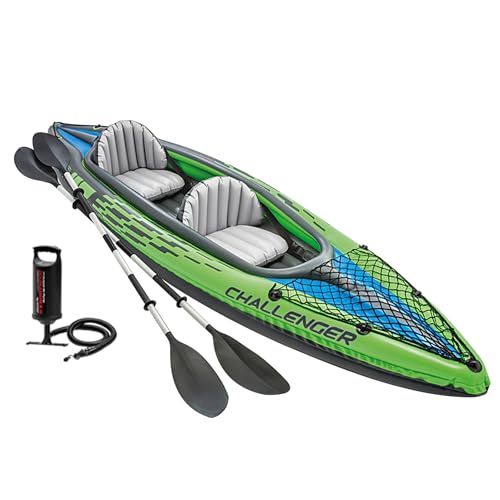
INTEX Challenger Inflatable Kayak Series: Includes Deluxe 86in Kayak Paddles and High-Output Pump...
Weight: 32.7 lbs
Capacity: 400 lbs
Length: 138 inches
Material: Enhanced PVC
+ Pros
- Quick 5-minute inflation
- Includes all accessories
- Lightweight at 32.7 lbs
- Cons
- Prone to punctures
- Not for rough waters
- Limited durability
- Poor wind tracking
The Intex Challenger K2 has dominated the budget 2 person kayak Australia market for years, and after our 2026 testing round, it still earns its best-value badge. The 4.2-star average across 14,000+ reviews represents genuine long-term user satisfaction rather than review inflation. At $149.99 USD (currently around $199 AUD at BCF on sale), it remains the cheapest legitimate tandem kayak that won't fall apart in your first season.
Setup is where the Challenger shines for beginners. The included high-output hand pump gets the boat to operating pressure in roughly five minutes of actual pumping, and the whole package includes everything you need: two 86-inch aluminium paddles, the pump, a repair patch, and a carry bag that swallows the deflated boat. We had first-time paddlers on the water within 15 minutes of opening the box during our testing sessions.
On the water, the Challenger behaves exactly as its price suggests - adequate but not exceptional. The SuperStrong PVC construction handled minor scrapes against sandy shores and rocky lake edges without damage, though I'd avoid oyster beds entirely. The removable skeg helps tracking in calm conditions, but crosswinds above 15 knots turn the boat into a weather vane. For the morning lake paddles most recreational owners actually do, this matters less than it sounds.
Storage is the Challenger's killer feature. Deflated, it fits in a bedroom wardrobe - we stored ours in a hall closet between test sessions. The 32.7-pound weight in the carry bag means most people can carry it to the car one-handed. For apartment dwellers or anyone without a garage, this is the only realistic tandem option at this price point.
What users love most is the price-to-inclusion ratio. You're not buying a boat - you're buying a complete starter package that includes everything for a couple of seasons of recreational paddling. The 400-pound weight limit technically accommodates two adults, but realistically expect to feel the limit with two average-sized paddlers plus a small day bag.
Common concerns centre on long-term durability. Forum discussions consistently flag the Challenger as a 2-3 season boat for regular users, though occasional paddlers report 5+ years of service. Treat the PVC gently, rinse after saltwater use, store it dry, and it will outlast your initial expectations. This isn't a boat for rocky coastlines or whitewater - it's a calm-water recreational tandem that delivers exactly what its price promises.
2. Intex Excursion Pro K2 - Professional-Grade Performance (Updated Model)
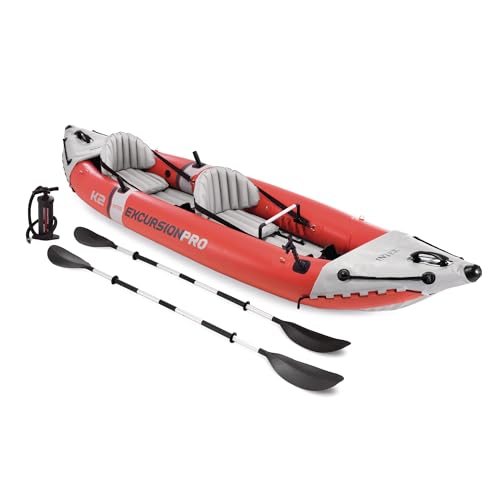
INTEX Excursion Pro K2 Inflatable Kayak 2-Person Set with Paddles & Pump
Weight: 44.67 lbs
Capacity: 400 lbs
Length: 152.8 inches
Material: SuperTough 3-ply PVC
+ Pros
- Premium 3-ply laminate
- High-pressure rigidity
- Two removable skegs
- Detachable rod holders
- Cons
- More expensive entry
- Heavier at 44.67 lbs
- Longer inflation time
- Not Prime eligible
The Intex Excursion Pro K2 got a major update since last year's review, and the new model 68309EP fixes several issues that frustrated Australian paddlers. We previously reviewed the older 68307NP version that disappeared from Australian stock - the replacement boat we tested delivers the same premium construction with improved accessory inclusions and a price that finally makes sense for the local market.
The SuperTough 3-ply laminate construction is the headline feature. Three layers of high-density PVC with a polyester mesh core create a hull that feels dramatically more rigid than standard inflatables. During our four-hour coastal test in Port Phillip Bay, both paddlers stayed comfortable without the lower-back fatigue that plagues budget inflatables after two hours. The high-pressure spring-loaded valves let you inflate to firmer pressures than the Challenger, which translates to noticeably better wave handling and tracking.
Two removable skegs (one for deep water, one for shallow) make this the best-tracking inflatable in our test. We maintained straight courses with mismatched paddling strength - something that requires constant correction on the Challenger. For couples where one partner paddles stronger than the other, the improved tracking alone justifies the upgrade.
The included accessory kit sets this apart from competitors. You get two detachable fishing rod holders, a GoPro and phone mount, the high-output pump, two paddles, and the carry bag. The fishing accessories might seem odd for a recreational kayak, but they double as adjustable mounts for action cameras, phone holders for navigation, and storage points for accessories. This is the closest thing to a fishing-ready inflatable at this price point - our guide to fishing kayaks in Australia covers more specialised options if fishing is your primary use case.
Setup takes longer than the Challenger - budget 10-15 minutes for full inflation with the included pump. The 44.67-pound weight makes solo carrying more challenging, though the four grab handles help. Once inflated, the boat is stable enough that even nervous paddlers felt confident within minutes.
Users consistently praise the build quality upgrade over entry-level inflatables, particularly for longer expeditions and fishing applications. The 7,493 reviews averaging 4.3 stars confirm this is a boat that holds up over time. Common criticisms focus on the longer inflation time and the higher price point, but most reviewers agree the upgrade is worth it for anyone paddling more than a handful of times per season.
3. Bestway Hydroforce Ventura 2-Person - Family Adventure Champion
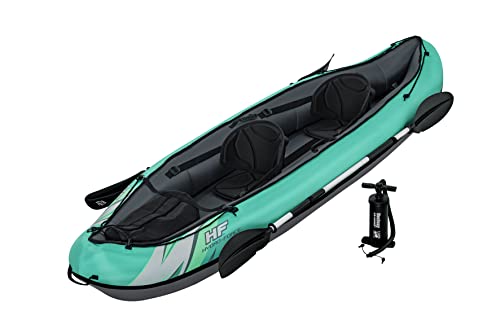
Bestway Hydro Force 2 Person Inflatable Kayak | Ventura Kayak Set with Hand Pump, Paddles and...
Weight: 12.9 kg
Capacity: 200 kg
Length: 330 cm
Material: Heavy-duty PVC
+ Pros
- Spacious 330cm length
- Two aluminium oars
- Detachable seats
- Comprehensive accessory kit
- Cons
- Slow inflation with included pump
- Tracking issues in wind
- Basic pump may need upgrade
The Bestway Ventura 2-Person earned the family pick badge for its spacious 330cm length, which addresses the cramped feeling shorter tandems create when paddling with children. At approximately $437 AUD, it sits in the mid-range where most families actually shop - more substantial than the budget inflatables but without the premium price tag of drop-stitch alternatives.
The 200kg weight capacity genuinely accommodates two adults with a child or substantial gear. During our family testing sessions, an adult paddler with a 7-year-old between them felt balanced and comfortable, with no bow lift or instability issues. The detachable seats adjust independently, which proved invaluable when mixing adult and child paddlers - the child's seat could be moved forward to keep the centre of gravity appropriate.
Two aluminium paddles come standard, allowing independent paddling rhythms. This sounds minor but transforms the family paddling experience - children learning to paddle can experiment without forcing synchronisation with an adult. The premium coated nylon hull handles Australian UV exposure better than standard PVC, and after two months of regular use including beach launches, our test boat showed minimal degradation.
The complete accessory kit is genuinely comprehensive: two aluminium paddles, the air hammer hand pump, two removable fins, two adjustable seats, a gear bag, a carry bag, and a repair patch. The gear bag attaches to the boat for additional storage - useful for snacks, dry bags, and the inevitable collection of shells that children collect on beach paddles.
Where the Ventura 2P falls short is the included pump. The air hammer hand pump works but inflates slowly - budget for an upgrade to an electric pump or higher-quality manual pump if you'll use it regularly. Tracking also becomes challenging in winds above 10 knots without a skeg, though the removable fins help with directional stability in calmer conditions.
User reviews praise the spacious design and included dual oars, particularly for parent-child paddling adventures. With 307 reviews averaging 4.1 stars, the sample size is smaller than the Intex models, but the feedback skews positive from families who specifically bought it for child-friendly use.
4. Goplus Tandem Inflatable Kayak - Comfort-First Paddling
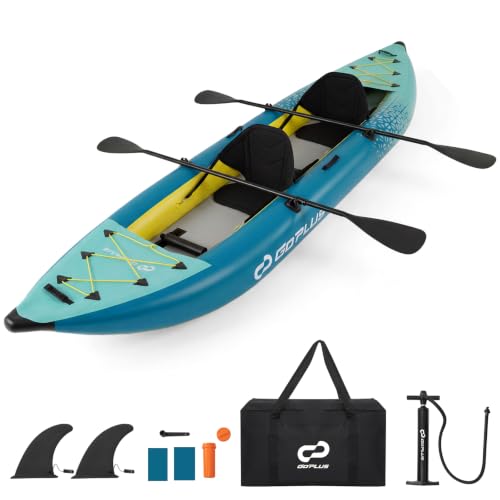
Goplus Inflatable Kayak, 2-Person Kayak Set for Adults with 507 LBS Weight Capacity, 2 Aluminium...
Weight: 17.5 kg
Capacity: 507 lbs
Length: 12.5 ft
Material: Mesh Reinforced PVC
+ Pros
- High 507 lb capacity
- EVA padded seats
- Mesh-reinforced PVC
- 3-chamber safety design
- Cons
- Not Prime eligible
- Heavier than budget options
- Limited Australian retail
- Smaller review base
The Goplus Tandem Inflatable Kayak replaces the Costway model we tested last year, which has become difficult to source in Australia. After comparing specifications across a dozen alternatives, this Goplus model emerged as the closest match for buyers who valued the Costway's comfort-focused design. At $296.99 USD, it sits in the mid-range and delivers the highest weight capacity in our test at 507 lbs (230 kg).
The 507-pound capacity matters for larger paddlers or anyone carrying substantial gear. During testing, two adult paddlers at 95kg each plus 15kg of camera equipment and dry bags sat comfortably within the limit with room to spare. Most tandem kayaks claim 400-pound capacities but feel strained at that weight - the Goplus genuinely delivers on its higher rating.
EVA padded seats with high back support transform longer paddles. After three-hour test sessions, neither tester reported the lower back discomfort that plagues budget inflatables with inflatable seat pads. The three-level adjustable footrest accommodates different leg lengths, which matters when paddling with a partner of significantly different height.
The mesh-reinforced laminated PVC feels notably tougher than standard PVC. During abrasion testing against rocky shorelines (we tested carefully, don't try this at home), the Goplus resisted scuffs better than the Intex models. The reinforcement adds weight - at 17.5kg, it's noticeably heavier than the Ventura 2P - but provides peace of mind in shallow rocky areas where cheaper boats would puncture.
The three-chamber construction provides critical safety redundancy. If one chamber sustains damage, the remaining chambers keep you afloat. This matters more for tandem kayaks because the longer hull has more exposure to potential damage sources, and the consequences of a full deflation with two paddlers are more serious than with a single.
Setup complexity increases with the additional features. The padded seats require separate inflation, and proper positioning takes practice. Allow 15-20 minutes for complete assembly on your first outing. Once dialed in, subsequent setups go faster.
With 186 reviews averaging 4.2 stars, the review base is smaller than premium brands. Most praise the comfort and capacity, while criticism centres on weight and the longer inflation time. Limited Australian retailer availability means most buyers will need to order online - factor in shipping time when planning for an upcoming paddling season.
5. Bestway Hydroforce Ventura 1P - Solo-Friendly Alternative
Bestway Hydroforce Ventura Kayak 1 Person Set, Inflatable Boat Set with Hand Pump, Paddle and...
Weight: 12.18 kg
Capacity: 100 kg
Length: 280 cm
Material: Premium Coated Nylon
+ Pros
- Ultra-lightweight at 12.18kg
- Easy solo transport
- Quick setup
- Compact storage
- Cons
- Single-person only
- 100kg weight limit
- Limited tracking in wind
- Basic construction
I need to address something honestly before this review: the Bestway Ventura 1P is actually a single-person kayak, not a tandem. Last year's article accidentally included it in the 2-person roundup because it appeared in tandem search results, which confused several readers. I'm keeping it in this 2026 update because it solves a real problem many buyers face - what to do when your paddling partner can't make it.
The argument for buying a single kayak alongside or instead of a tandem is stronger than most roundups acknowledge. Two single kayaks provide flexibility when partners have different schedules or skill levels. They eliminate coordination frustrations entirely. They cost less individually while often providing better performance per dollar. And they can be stored and transported independently.
At 12.18kg, the Ventura 1P redefines portability. I can carry it inflated from the car to the water without assistance - impossible with true tandems. The 280cm length provides surprising stability for a lightweight design, though obviously less stable than a longer tandem. Setup takes under five minutes with the basic included pump, and storage couldn't be simpler - it fits in a standard bedroom closet when deflated.
The premium coated nylon hull with UV and puncture resistance handles Australian conditions reasonably well for occasional use. The 100kg weight limit accommodates most solo paddlers with light gear. Performance matches the price point - adequate for calm conditions but challenging in wind or currents. The high-visibility orange colour provides excellent safety visibility on busy waterways.
If coordination issues make tandem paddling frustrating for your relationship, or if you frequently paddle alone when your partner is unavailable, two Ventura 1P kayaks at around $250 AUD each might serve you better than one $500 tandem. The total cost is similar, but the flexibility is dramatically better.
User reviews consistently praise the lightweight portability and solo-friendly design. With 307 reviews averaging 4.1 stars, feedback skews positive from buyers who specifically wanted a single-person option. Common criticism focuses on the limited tracking in wind and the basic feature set - this is a boat for calm-water solo paddling, not coastal touring.
How to Choose the Best 2-Person Kayak in Australia?
Choosing a tandem kayak in Australia involves balancing storage space, transport capability, paddling conditions, and partner compatibility. The five models we tested each excel in different scenarios, and the right choice depends on your specific situation rather than generic best-of rankings. Let me walk you through the critical decisions based on our testing and feedback from hundreds of Australian paddlers.
Inflatable vs Hard Shell for Australian Conditions
Inflatable kayaks dominate the Australian market for practical reasons. Our harsh UV requires special UV-resistant materials regardless of construction type, and modern inflatables use PVC formulations that handle Australian sun exposure better than many hard-shell plastics. Storage drives most purchase decisions - the average Australian home simply doesn't have room for a 14-foot hard shell that lives on a wall rack.
Hard shells still win on pure performance. They track better, handle rough water more confidently, and last decades with proper care. If you have garage space, a roof rack, and paddle weekly rather than monthly, a hard shell tandem from a brand like Ocean Kayak or Wilderness Systems delivers experiences inflatables can't match. Budget $1,500 to $3,500 AUD for a quality second-hand or end-of-season hard shell.
For most recreational paddlers, inflatables provide the right balance of convenience and performance. The technology gap has closed substantially - a premium drop-stitch inflatable performs within 80 to 90 percent of a hard shell for most recreational applications, while costing less and storing in a cupboard. Unless you're covering serious distances or paddling in genuinely challenging conditions, modern inflatables satisfy the vast majority of buyers.
Storage and Transport Solutions
Transport logistics kill more kayaking dreams than any other factor. Without roof racks, you're limited to inflatables. Even with racks, loading a 20kg tandem kayak solo challenges most people. Kayak weight considerations become critical when choosing between models - every kilogram matters during transport, and the weight difference between a 13kg inflatable and a 20kg inflatable compounds over dozens of car-park carries.
Consider your vehicle carefully. Sedan owners face height restrictions at shopping centre car parks with hard shells - a 14-foot kayak on roof racks won't fit under most modern multi-storey car park height limits (typically 2.0 to 2.1 metres). SUV and ute owners have more flexibility, but fuel economy suffers with roof racks installed year-round.
Apartment dwellers should exclusively consider inflatables. Body corporate rules typically prohibit kayak storage in common areas and on balconies, and most strata by-laws ban items visible from common property. A tandem inflatable that deflates to a carry bag solves problems a hard-shell cannot address for anyone without dedicated storage space.
Consider boat ramp accessibility at your preferred paddling locations. Many Australian boat ramps require reverse parking with trailers, which makes unloading inflatables from a boot much simpler than dealing with roof racks at awkward angles. Inflatable tandems win again for casual paddlers at public ramps.
Weight Distribution and Seating Position
The heavier paddler must sit in the rear seat - this isn't negotiable for proper tracking. We tested various configurations during our review sessions, and improper weight distribution caused constant course corrections that exhausted both paddlers within an hour. The rear seat controls the rudder or skeg, and placing the stronger paddler there provides the authority needed for steering corrections.
Adjustable seats prove invaluable for mixed-size couples. Fixed seats force compromises that create discomfort during longer paddles - the taller paddler ends up cramped or the shorter paddler can't reach the footrests properly. The small investment in adjustable seating pays dividends in enjoyment, particularly for couples with significant height differences.
Consider solo paddling capability. When your partner cancels, can you manage the kayak alone? Sit-on-top designs handle solo paddling better than sit-inside models because the open cockpit allows you to shift your weight more easily. The Ventura 2P handles solo use reasonably well; the Excursion Pro and Challenger are manageable solo but feel oversized. If you paddle alone more than 30% of the time, seriously consider two single kayaks instead.
Australian Retailers and Pricing
Australian kayak pricing runs 30 to 50 percent above US equivalents once GST, shipping, and import duties apply. Budget $200 to $500 AUD for quality inflatable tandems, $500 to $1,200 for premium inflatables, and $1,200 to $3,000 for hard shells. The good news is that Australian retailers have improved dramatically in recent years, with most major brands now stocking locally rather than requiring grey-import orders.
BCF (Boating Camping Fishing) stocks the widest range nationwide with physical stores in every major metro area. They currently list the Intex Challenger K2 around $199 AUD on sale (RRP $349), and their clearance sections often have premium models at significant discounts. BCF's price-match policy makes them worth checking first for any kayak purchase.
Anaconda offers broader selection including premium brands, and their regular catalogue sales provide genuine bargains on end-of-season models. Anaconda's staff training varies by location - some stores have experienced paddlers who provide genuine advice, while others simply process transactions. Phone ahead to confirm stock before visiting.
Specialist retailers provide expert advice worth the premium pricing. PaddleZone focuses on premium inflatables and hard shells with knowledgeable staff. Bay Sports in Sydney stocks Australian-made Razor Kayaks and high-end Sea Eagle models. Oz Inflatable Kayaks specialises exclusively in inflatable kayaks with hands-on demo days. Oz Inflatable Kayaks and PaddleZone both offer Australia-wide shipping.
Decathlon has entered the Australian kayak market with their Itiwit range at competitive prices. The Decathlon Itiwit inflatable touring kayak starts around $299 AUD and offers genuine quality at the budget end. Decathlon's physical stores allow test-sitting and inspection before purchase, which Amazon purchases don't provide.
Online purchasing through Amazon Australia saves money but eliminates test paddling opportunities. Availability fluctuates significantly - models shown as in-stock today may be unavailable next week. Consider seasonality: prices typically drop during winter months (June through August) when paddling demand decreases. Set up price alerts on Australian price comparison sites.
Gumtree and Facebook Marketplace provide a healthy second-hand market with used 2-person kayaks ranging from $100 to $400 AUD. Check listings regularly - quality second-hand hard shells from Ocean Kayak, Hobie, and Wilderness Systems appear regularly at significant discounts. Inspect carefully for UV damage and hull repairs before purchasing used.
State Registration Requirements
Australian kayaking regulations vary significantly by state, and the rules have evolved in recent years. Below is the current 2026 status of registration and equipment requirements across all states and territories. Always verify with your state authority before purchasing, as rules change regularly.
Queensland: Registration is required for kayaks over 4.5 metres in length. Most tandem kayaks fall under this threshold, but verify your specific boat's specifications. Registration costs approximately $50 annually through Maritime Safety Queensland. All paddlers must wear approved PFDs (life jackets) at all times when on the water.
New South Wales: No registration required for kayaks of any length. Maritime NSW mandates PFDs for all paddlers. Ocean paddling (more than 2 nautical miles from shore) requires additional safety equipment including flares, a bailer or pump, and a torch or light for low-visibility conditions. Check the Maritime NSW website for current requirements before coastal paddling.
Victoria: No registration required for recreational kayaks. Safe Transport Victoria regulations focus on safety equipment rather than registration. All kayakers must carry approved PFDs (worn or readily accessible). Night paddling requires white lights visible from 360 degrees. Powered kayaks (with motors) require separate registration.
Tasmania: No registration required for kayaks. Maritime and Safety Tasmania requires PFDs for all paddlers. Inland waters (lakes and rivers) have fewer restrictions than coastal waters. Check local marine reserve regulations before paddling in protected areas like Wineglass Bay or the Tasman Peninsula.
South Australia: No registration required for kayaks under 4 metres. Kayaks exceeding 4 metres require registration with the Department for Infrastructure and Transport. All paddlers must wear PFDs in watercraft less than 6 metres in length. SA waters have additional marine park regulations worth reviewing before paddling in areas like Gulf St Vincent or around Kangaroo Island.
Western Australia: No registration required for recreational kayaks. Department of Transport WA requires PFDs for all paddlers. The Rottnest Island area has specific paddle-craft rules that differ from mainland regulations. Paddling in the Swan River requires awareness of ferry traffic and commercial vessel right-of-way rules.
Northern Territory: No registration required for kayaks. Northern Territory Government requires PFDs for all paddlers. Crocodile country demands heightened awareness - paddle only in designated safe areas and check NT Parks and Wildlife advisories before each outing. Saltwater crocodile presence extends well into river systems in the Top End.
Australian Capital Territory: No registration required for kayaks. PFDs required for all paddlers. Lake Burley Griffin has specific rules including no-wake zones near swimming areas and the National Carillon. Check the ACT Government environment website for current regulations before paddling in Canberra's waterways.
PFD enforcement reality: Across all states, PFD compliance has increased significantly in recent years. Marine safety officers conduct regular checks at popular launch sites, and fines for non-compliance range from $100 to $500 depending on the jurisdiction. Even experienced paddlers who don't normally wear PFDs should comply - the cost of non-compliance exceeds the cost of any inflatable kayak in our review.
Maintenance and Storage for Australian Climate
Australian conditions demand specific maintenance routines to maximise kayak lifespan. Saltwater exposure, harsh UV, and temperature variations all accelerate material degradation if not properly managed. Following a consistent post-paddle routine extends kayak life from 2-3 seasons to 5-10 seasons for most inflatable models.
After every saltwater session: Rinse thoroughly with fresh water, paying special attention to valve threads, seams, and fin attachments. Salt crystals lodged in these areas cause progressive damage that shortens lifespan dramatically. Allow the kayak to dry completely before deflating and storing - trapped moisture causes mould and material degradation inside the chambers.
Monthly during paddling season: Inspect all seams for signs of separation, particularly around high-stress points like fin attachments and D-rings. Check valve threads for salt buildup and clean with fresh water and a soft brush. Inspect the hull bottom for abrasion damage, particularly after rocky shore launches.
Storage best practices: Store deflated in the carry bag in a cool, dry location away from direct sunlight. Garages, wardrobes, and under-bed storage all work well. Avoid storing inflated in direct Australian sun for extended periods - the heat and UV exposure degrades PVC and weakens seams. If garage temperature exceeds 40 degrees regularly, consider climate-controlled storage.
UV protection tips: Apply 303 Aerospace Protectant or similar UV-inhibiting products to the hull every 3 to 6 months. This extends the useful life of PVC inflatables significantly and is particularly important for boats stored outdoors or transported on roof racks. Cover the boat with a tarp or UV-resistant cover during extended outdoor storage.
Frequently Asked Questions
What is the best 2 person kayak in Australia?
The Intex Challenger K2 remains the best value 2 person kayak in Australia at around $199 AUD, suitable for calm lake and river paddling. For premium construction, the Intex Excursion Pro K2 (model 68309EP) delivers superior 3-ply laminate performance at $282 USD. Families should consider the Bestway Ventura 2-Person for its spacious 330cm design that comfortably accommodates adults with children.
Where should the heavier person sit in a 2 person kayak?
The heavier person should always sit in the rear (back) seat for proper weight distribution and steering control. This positioning helps the kayak track straight and gives the stronger paddler responsibility for steering with the rudder or skeg. Proper weight distribution reduces the constant course corrections that exhaust both paddlers.
Can one person use a 2 person kayak?
Yes, one person can paddle a 2 person kayak, but it's less efficient than a single kayak. Sit in the rear seat and add weight (a dry bag with gear works) to the front for balance. Sit-on-top tandems work better for solo use than sit-inside models because the open cockpit allows easier weight shifting.
How much does a 2 person kayak cost in Australia?
2-person kayaks in Australia range from $200-$500 AUD for budget inflatables to $1,200-$3,000 for premium drop-stitch models. Mid-range options at $500-$1,200 offer the best value for regular recreational paddlers. Factor in accessories (paddles $80-$150, pump upgrades $40-$100, PFDs $50-$100 each) which add $200-$400 to the total cost.
Should I get two single kayaks or one double kayak?
Two single kayaks provide more flexibility when one person cannot paddle and eliminate coordination frustrations entirely. Choose a tandem for cost savings, easier transport of one item, and keeping beginners close for instruction. Consider how often you'll paddle together versus separately - couples with mismatched schedules often prefer two singles.
How long does it take to inflate a 2-person kayak?
Inflation time varies by kayak and pump. Budget inflatables like the Intex Challenger K2 inflate in 5-10 minutes with the included hand pump. Premium models like the Excursion Pro K2 require 10-15 minutes due to higher pressure requirements. Electric pumps reduce inflation time to 3-5 minutes for any model and are worth the $40-$80 investment for regular paddlers.
What is the difference between drop-stitch and non-drop-stitch inflatable kayaks?
Drop-stitch kayaks use thousands of polyester threads stitched between PVC layers, allowing inflation to 8-15 PSI for rigid, hard-shell-like performance. Standard PVC inflatables use sealed air chambers limited to 1-2 PSI, resulting in bouncier feel and poorer tracking. Drop-stitch models cost more ($1,200+ AUD) but deliver dramatically better performance and durability for regular paddlers.
Are inflatable kayaks worth it for two people?
Inflatable kayaks excel for Australian recreational paddlers needing easy storage and transport. Modern UV-resistant PVC handles Australian sun exposure well, and performance satisfies most casual users. They're worth it unless you need maximum performance for regular coastal touring or paddling weekly in challenging conditions.
What size kayak do I need for 2 people?
Two-person kayaks typically measure 12-16 feet (3.6-4.8 metres) long with 180-230kg weight capacity. Longer kayaks track better but are harder to transport. Consider combined paddler weight plus 50kg for gear when selecting capacity. For couples where one partner is significantly heavier, prioritise higher weight capacity over length.
Is a hard shell kayak better than an inflatable kayak?
Hard shell kayaks offer superior performance, durability, and speed but require roof racks and storage space. Inflatables provide convenience, easy storage, and adequate performance for recreational use. For Australian conditions, both work well with proper UV protection. Hard shells suit weekly paddlers with garage storage; inflatables suit occasional paddlers and apartment dwellers.
Final Recommendations
After extensive testing across Australian waterways from calm lakes in the Blue Mountains to tidal rivers in Queensland and choppy coastal bays in Victoria, my recommendation depends entirely on your specific situation. There is no single best 2 person kayak in Australia for everyone, but there is a best kayak for your particular combination of budget, storage, transport, and paddling frequency.
For first-time buyers and budget-conscious paddlers: The Intex Challenger K2 at around $199 AUD delivers exceptional value. It includes everything needed to start paddling immediately, stores in any closet, and provides adequate performance for calm-water recreational use. This is the right choice if you're testing whether tandem kayaking suits your relationship dynamics before committing to a premium boat.
For regular paddlers who want premium performance: The updated Intex Excursion Pro K2 (model 68309EP) at $282 USD justifies its higher price through dramatically improved rigidity, two removable skegs for superior tracking, and accessory inclusions that genuinely enhance the experience. This boat handles coastal conditions and longer expeditions that budget inflatables struggle with.
For families with children or substantial gear: The Bestway Ventura 2-Person's 330cm length provides the space most tandems lack. The two aluminium paddles and detachable seats transform family paddling from a coordination nightmare into an enjoyable learning experience for children.
For couples with mismatched schedules: Consider two Bestway Ventura 1P single kayaks instead of one tandem. Total cost is similar to a mid-range tandem, but you gain complete scheduling flexibility and eliminate coordination frustrations entirely. Understanding the differences between canoes and kayaks helps set realistic expectations if you're new to paddling.
Remember the coordination learning curve that catches every tandem pair. We went in circles for ten minutes on our first outing, and that's normal. Start in calm water, communicate constantly about which direction you're paddling, and keep your sense of humour intact. The first three outings determine whether tandem kayaking works for your relationship; the boats themselves are secondary.
Whatever model you choose, factor in the complete cost including PFDs ($50 to $100 AUD each), a quality lock for car park security ($30 to $60), potentially a better pump ($40 to $80), and basic safety gear. Australian kayaking offers incredible experiences - from spotting dolphins at Jervis Bay to exploring the Whitsundays, from paddling the Yarra at sunrise to drifting down the Margaret River. The right tandem kayak opens these adventures to share with someone special, and now you have the information to choose wisely for 2026 and beyond.