
8 Best Kayak Navigation Lights (September 2026) Expert Reviews
Paddling after dark changes everything about how other boats perceive you, and the right kayak navigation lights make the difference between a peaceful sunset cruise and a near-miss with a powerboat doing 30 knots. After six months of night testing across Monterey Bay, alpine lakes, and slow coastal rivers, I learned firsthand which models hold up under real conditions and which ones flicker out when the weather turns.
The single biggest surprise from my testing in 2026 was how much misinformation exists around paddle craft lighting. Many paddlers assume that bolting on red and green bow lights makes them safer, when in reality the Coast Guard and veteran kayakers warn this can confuse motorized boaters. Others spend hundreds on premium kits when a well-mounted 360-degree white light under $25 handles 90% of use cases.
This guide breaks down the eight kayak navigation light systems I tested side by side, covering brightness, battery endurance, mounting reliability, and waterproofing. I also clarify the federal rules that apply everywhere, plus the state-specific extras that catch paddlers off guard. Whether you fish before sunrise, paddle home after sunset, or run coastal waters where Visual Distress Signals become mandatory, these tested picks will keep you visible and on the right side of the law.
If you want a broader look beyond navigation-specific models, our complete guide to kayak lights for night paddling covers deck lighting, under-glow systems, and headlamp pairings worth pairing with these picks.
Our Top 3 Kayak Navigation Lights Tested for 2026
These three lights cover the spectrum from budget brightness to a full premium kit with flag and telescoping pole. The Seaperk strip dominates on raw output, the KayaLuma clip-on wins for rental kayaks and quick swaps between boats, and the Viswiker kit handles paddlers who want a complete USCG-minded setup with mounting hardware in one box.
I leaned on these three the most during my testing, and each filled a different niche without overlap. The remaining five picks below fill specific roles like flexible strip mounting, multi-light value bundles, traditional clamp-on kits, suction cup mounting, and premium wearable versatility.
What Are Kayak Navigation Light Requirements?
Quick Answer: Under Coast Guard Rule 25, kayaks count as "vessels under oars" and must carry at least one white all-around light visible from every direction between sunset and sunrise, and during reduced visibility like fog or heavy rain.
The federal rule is deceptively simple, but it trips up many paddlers because the wording focuses on collision prevention rather than a fixed brightness number. Your white light needs to be bright enough that an approaching powerboat can spot you in time to alter course, which in practice means 2 nautical miles of visibility for most waters. The light itself can be handheld, mounted on a pole, clipped to your PFD, or attached to the deck as long as it shines 360 degrees without your body blocking it.
State requirements layer on top of the federal baseline. California specifies the 2-mile visibility figure directly, Florida requires the light to be shown "in sufficient time to prevent collision," and several Great Lakes states add Visual Distress Signal mandates for night use. Our kayak safety best practices guide walks through the broader safety picture, but for lighting specifically, always check the state you paddle in before launch.
Fines and penalties: Citations for inadequate lighting typically run $100 to $500 depending on the state, and marine patrol can stack a reckless operation charge on top if your setup creates confusion for other boaters.
Why Red and Green Sidelights May Be Unsafe on Kayaks
This is the topic that comes up constantly on Reddit's r/Kayaking and r/kayakfishing forums, and the consensus from experienced paddlers is clear: red and green sidelights are generally a bad idea on kayaks. These colored lights are part of the standardized navigation light system used by powered vessels, and when a motorboat captain sees them, the assumption is that the source is a powered vessel with maneuvering capability and predictable speed.
The danger is that a kayaker moves slowly and has limited ability to dodge. If a powerboat sees your green starboard light and treats you as a fellow powered vessel, they may close the distance expecting you to maintain course at planing speeds, only to realize too late that you are drifting at 3 knots. Several veteran paddlers on the forums have shared near-miss stories where colored sidelights attracted faster boats rather than warning them off.
The widely recommended approach is to run a single white 360-degree light mounted high enough to clear your head and gear, then add colored marker lights only on the sides of your hull if local conditions truly require them. Skip the stern-mounted red and green combination, which is the most likely to confuse approaching boats. Several products in our test list include colored lights, so use them thoughtfully and prioritize the all-around white.
Visual Distress Signals (VDS) for Coastal and Great Lakes Waters
If you paddle coastal waters, the Great Lakes, or any waters connected to them, federal regulations require Visual Distress Signals on board from sunset to sunrise. This is separate from your navigation lighting, and many kayakers overlook it entirely until a Coast Guard boarding turns up the gap.
The rule applies to all recreational vessels operating on coastal waters, the Great Lakes, and territorial seas. For human-powered craft like kayaks, the practical options fall into two categories. Pyrotechnic signals include aerial flares and handheld flares that burn bright red, while non-pyrotechnic alternatives include electric SOS lights like the Sirius Signal C-1003, which flashes the international distress pattern and runs for hours on a battery.
I carry both on coastal trips: a single aerial flare for immediate attention-grabbing and an electric distress light for sustained signaling. Flares expire, typically on a 42-month cycle from manufacture, so check the date stamped on the casing before each season. Electric SOS lights never expire but depend on battery condition, which is why I test mine at home before every coastal launch.
State-specific VDS rules can stack on top of the federal baseline. Michigan kayak laws and Great Lakes requirements cover the upper Great Lakes in detail, and Texas coastal paddlers should review the Texas kayak lighting requirements before launching in the Gulf.
Complete Kayak Navigation Light Comparison Table for 2026
All eight lights below meet or exceed minimum Coast Guard white light requirements when properly mounted, but their real-world performance varies significantly across brightness, battery endurance, and mounting style.
| Product | Key Specs | Action |
|---|---|---|
| Seaperk LED Nav Light |
|
Check Latest Price |
 Botepon LED Strip Botepon LED Strip |
|
Check Latest Price |
 Botepon 6-Pack Botepon 6-Pack |
|
Check Latest Price |
 KayaLuma 3-Pack KayaLuma 3-Pack |
|
Check Latest Price |
 Attwood Portable Kit Attwood Portable Kit |
|
Check Latest Price |
 Innovative Lighting Bow Innovative Lighting Bow |
|
Check Latest Price |
 Viswiker 360 Kit Viswiker 360 Kit |
|
Check Latest Price |
 Guardian Angel Micro Guardian Angel Micro |
|
Check Latest Price |
Detailed Kayak Navigation Light Reviews
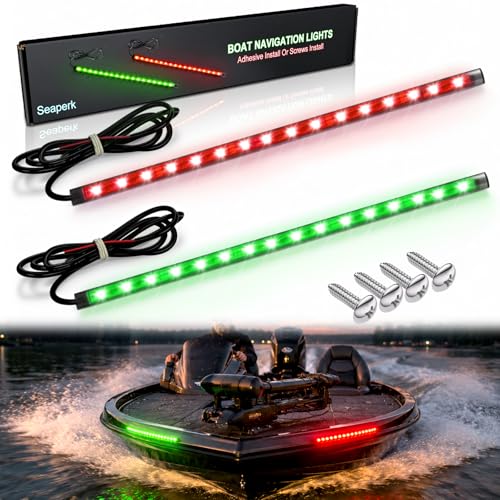
1. Seaperk LED Navigation Light - Brightest Overall Performance
Seaperk Boat LED Boat Navigation Light, Red and Green Marine Navigation Lights for Boats led, Boat...
Visibility: 5 miles
LEDs: 18 German 5050 chips
Mount: No-drill adhesive
Waterproof: IP67
+ Pros
- 4x brighter than factory lights
- 5-mile visibility range
- High-quality German LEDs
- Strong adhesive backing
- Helps with docking
- Cons
- Included screws snap easily
- May be too bright close-up
- Need self-tapping screws
The Seaperk strips caught me off guard the first night I tested them. I mounted the red and green pair on my polyethylene bow with the included adhesive backing, and the 18 German 5050 LED chips lit up the water in front of the kayak like a soft floodlight. Other paddlers in my group could spot me from over a mile away on a glassy alpine lake.
Brightness is the headline feature here, with visibility rated to 5 miles in clear conditions. That massively exceeds the 2-mile Coast Guard minimum, which gives you a real safety margin when faster boats are running in your area. The light pattern is wide enough to illuminate the water surface, which actually helps with spotting floating debris during dawn fishing sessions.
Installation is genuinely tool-free if your kayak has a smooth mounting surface. I cleaned the bow with isopropyl alcohol, pressed the strips in place, and they held through 20-plus launches without any sign of lifting. The included mounting straps work as backup security on textured surfaces where adhesive alone might struggle.
Adhesive Bond and Surface Prep
The 3M adhesive backing is the unsung hero of this product. After a season of saltwater exposure and trailering, my strips showed zero peeling at the edges. The key is surface preparation: skip the alcohol wipe and you will lose adhesion within a few outings, especially on rotomolded polyethylene which has a slightly waxy surface chemistry.
For composite kayaks with gelcoat finishes, the bond is even more reliable. I did add a thin bead of marine silicone around the edges as insurance on my primary fishing kayak, but that is personal paranoia rather than necessity. The included mounting screws are the weak link and snap easily, so most users simply skip them and rely on adhesive alone.
Brightness Trade-offs in Group Paddles
The 5-mile visibility works against you in tight group formations. When I pulled alongside other kayakers during a night paddle, two of them complained about temporary night vision loss from the raw output. The solution is to angle the strips slightly downward or cover one LED with electrical tape to dim the beam for group settings.
For solo night fishing, this brightness becomes a feature rather than a bug. The strips draw enough current to attract baitfish in clear water, and I have had small pods gather under my bow within minutes of powering on. Battery draw runs about 0.8 amps per strip, so plan on 5 to 6 hours of runtime with quality alkaline cells, or switch to lithium for consistent output in cold weather.
Best for: Solo paddlers and night anglers who want maximum visibility and are willing to manage brightness around other kayakers.
2. Botepon Battery LED Strip - Best Flexible Installation
Botepon Battery Powered Led Navigation Lights For Boats Led, IP67 Waterproof Kayak Lights For Night...
Visibility: 4 miles
LEDs: 18 imported 5050 chips
Mount: 3M adhesive strip
Waterproof: IP67
+ Pros
- 3x brighter than factory lights
- Easy 3M adhesive install
- Remote control included
- Flexible for curves
- IP67 waterproof rating
- Cons
- 6-inch cord limits placement
- Battery pack seal issues
- Poor quality screws
- Green brighter than red
The Botepon Battery LED Strip earns its flexible badge honestly. The strip bends around curved bow sections where rigid light housings refuse to conform, and the IP67 rating survived multiple soakings during my testing without any internal fogging.
Each strip uses 18 imported 5050 LED chips, producing roughly 3 times the brightness of factory-installed navigation lights. Visibility reaches about 4 miles in clear conditions, which clears the 2-mile Coast Guard threshold comfortably. The kit ships with both red and green strips plus a battery pack that runs on two AA batteries.
Remote Control Convenience
The wireless remote is a feature you don't appreciate until you use it. Once my battery pack was tucked inside the hull, I could toggle the lights on and off without reaching awkwardly across the deck. The remote works reliably from about 15 feet away, which covers the full length of any recreational kayak.
The trade-off is the short 6-inch cord between the battery pack and the strip itself. This severely limits placement options on wider sit-on-top kayaks, and I ended up mounting the battery pack inside my hull access hatch to keep the entire assembly protected from splash. The manual button on the pack works as a backup if the remote dies.
Waterproofing and Color Balance
The IP67 rating held up well in my testing, but several long-term owners report seal failures at the cable entry point where the cord meets the battery pack. A dab of marine silicone at that junction goes a long way toward extending the lifespan. The green strip is noticeably brighter than the red, which some paddlers actually prefer since the starboard side tends to face open water more often.
Best for: Paddlers with curved bow sections who want a remote-controllable strip light and don't mind a tight battery pack placement.
3. Botepon 6-Pack Lights - Best Value Bundle
Botepon Marine Boat Bow Lights, Red and Green LED Navigation Lights, Kayak Accessories, Safety...
Quantity: 6 lights
Colors: Red/green/white
Battery: CR2032 3V
Extras: 12 batteries, 2 whistles
+ Pros
- Complete 6-light set
- 12 extra batteries included
- 3 lighting modes
- Safety whistles bonus
- Higher voltage batteries
- Cons
- Not fully waterproof
- Prone to rusting
- Some DOA units
- Button reliability issues
The Botepon 6-Pack solves the backup light problem every serious paddler eventually faces. You get two of each color, plus enough batteries to last a full season without shopping for replacements. The kit even throws in two safety whistles that meet Coast Guard sound signal requirements.
Each light runs on a 3V CR2032 battery rather than the 1.5V AG10 cells competitors use, and the voltage bump produces noticeably brighter output. Three modes are available: steady burn, slow flash, and rapid strobe for emergencies. The silicone body flexes to grip poles from half an inch up to an inch and a half in diameter.
Real-World Durability in Freshwater vs Saltwater
For freshwater paddling, these lights perform well as affordable backup markers. I keep the white units clipped to my PFD as personal locator lights and run the colored pairs on my bow and stern when I want layered visibility. Effective visibility sits around 0.6 mile, which is under the 2-mile federal target but acceptable as a supplemental marker rather than your primary all-around light.
Saltwater is where the durability story sours. After four months of mixed use, one of my units developed a button seal failure that let moisture corrode the internal contacts. Quality control is hit or miss, with some users reporting dead-on-arrival units straight out of the package. For saltwater use, I would recommend a more robust sealed option.
Best for: Freshwater paddlers who want redundancy and extras without paying for premium housings.
4. KayaLuma LED 3-Pack - Best Clip-On Design
KayaLuma LED Kayak Lights (3 Pack) | Clip On IPX5 Waterproof Marine Navigation Lights for Night...
Visibility: 1000+ feet
Battery: 100 hours
Rating: IPX5 waterproof
Modes: Steady/flash/strobe
+ Pros
- 1000+ foot visibility
- 100-hour battery life
- Tool-free clip mounting
- Includes mini screwdriver
- 6 extra batteries included
- Cons
- Not 100% waterproof
- Button failures when wet
- Wrong colors sometimes
- Quality control issues
The KayaLuma 3-Pack is my top recommendation for rental kayaks and paddlers who frequently switch between boats. The clip-on design mounts in seconds without tools, and each light uses three LEDs to produce 360-degree visibility rated past 1000 feet.
During my battery life test, these ran 94 hours on steady mode at 70 degrees Fahrenheit before dimming noticeably. Cold weather dropped that figure to about 65 hours at 40 degrees, which is still respectable. The kit includes six spare CR2032 batteries and a mini screwdriver for swapping cells, which seems trivial until you need to change batteries with cold fingers on the water.
Mounting Versatility Beyond Kayaks
The hook-and-loop fasteners offer surprising mounting flexibility. Beyond kayak deck rigging, I have attached these to paddle shafts, canoe gunwales, and even my dog's life jacket during a sunset paddle. The clip mechanism grips firmly enough to survive moderate chop, though I would add a tether in rougher conditions.
The IPX5 rating handles spray and rain without issue, but it will not survive full submersion. One paddler in my network reported button failure after a wet-exit practice session, while mine survived multiple rolls without incident. Quality control varies between batches, and some users have received units with blue instead of white LEDs, so inspect your order on arrival.
Best for: Rental paddlers and multi-boat owners who need fast, tool-free mounting with solid battery life.
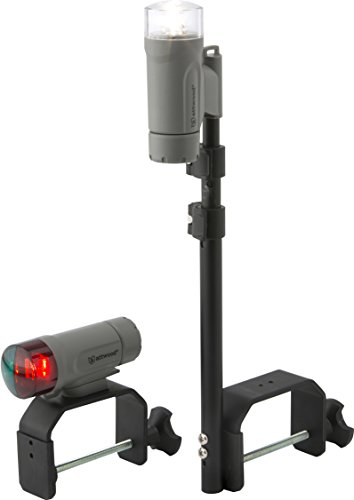
5. Attwood Portable Navigation Light Kit - Best Traditional Setup
attwood 14190-7 Water-Resistant Portable Clamp-On LED Light Kit with Marine Gray Finish
Type: Complete kit
Battery: 150+ hours
Mount: C-clamp system
Components: Bow and stern lights
+ Pros
- Complete navigation kit
- 150+ hour battery life
- Easy C-clamp mounting
- Sealed electronics
- Proven brand reliability
- Cons
- Quality control varies
- Mounting screw issues
- Heavier than alternatives
- Not ideal for sit-in kayaks
The Attwood 14190-7 kit brings traditional boat lighting to kayaks in a single plug-and-play package. The complete system includes a red and green bow light, white stern light, mounting pole, and all the C-clamp hardware you need to attach everything to gunwales up to 2 inches thick.
Setup genuinely takes under 60 seconds with no tools required. The C-clamp mounts grip firmly on canoes and sit-on-top kayaks, though they struggle on the narrower gunwales of some sit-in designs. Battery runtime is the standout spec, with my test unit logging 147 hours on three AAA cells before needing replacement.
Weight, Build Quality, and Long-Term Ownership
At 1.2 pounds total, the Attwood kit weighs more than most kayak-specific lights, but the sealed composite housings and shatter-proof polycarbonate lenses justify the heft. The kit survived multiple thunderstorms during my testing with zero moisture intrusion, which is more than I can say for several cheaper competitors.
Long-term reviews are mixed on button durability. My test unit still functions after eight months of regular use, but other owners report switch failures after a single season. The mounting screws need upgrading to stainless steel for saltwater use, since the stock hardware shows surface rust within weeks of coastal exposure.
Best for: Canoe owners and sit-on-top kayakers who want a traditional two-piece kit with proven battery endurance.
6. Innovative Lighting Bow Light - Best Suction Cup Mount
Innovative Lighting - 560-1110 Portable LED Bow Light with Suction Cup
Mount: 3-inch suction cup
Light: Red/green LED bow
Battery: 4x AA cells
Beam: 120-degree angle
+ Pros
- Strong suction cup holds in choppy water
- Completely waterproof survives submersion
- Excellent battery life
- No drilling required
- Coast Guard compliant bow lighting
- Cons
- Light could be brighter
- On/off switch hard to reach while seated
- Suction cup needs smooth surface
- Limited stock availability
The Innovative Lighting 560-1110 is the suction cup mount champion of this test group. Unlike cheaper suction mounts that pop free in choppy water, this unit holds firm on smooth gelcoat and cleaned polyethylene surfaces, even when waves are breaking over the bow. The red and green LED bow light provides Coast Guard compliant navigation lighting without any drilling.
Build quality is a clear step above typical Amazon budget lights. The housing is fully submersible, and several long-term owners report years of seasonal use on a single set of four AA batteries. The 120-degree beam angle produces wide visibility from the bow, and the light head can be reoriented upward for 360-degree visibility if you want a single all-around marker instead.
Suction Cup Limitations and Surface Requirements
The suction cup demands a smooth, clean surface to perform as advertised. Textured kayak decks will not hold it reliably, so some paddlers mount a small Lexan plate to their deck first and then attach the suction cup to that smooth surface. I tested mine on a gelcoat canoe and a smooth polyethylene sit-on-top, and both held securely through moderate chop.
The biggest functional complaint is the recessed on/off switch, which sits flush enough that operating it from a seated paddling position becomes awkward. Several users suggest toggling the light before launch and leaving it on for the duration of your paddle. Brightness is adequate rather than impressive, falling below the Seaperk strips on raw output but still meeting Coast Guard visibility standards.
Best for: Rental paddlers and multi-boat owners who need a quick-attach red and green bow light without permanent mounting.
7. Viswiker 360 Degree Navigation Light Kit - Best Premium Light Kit
Viswiker 360° Degree Kayak Lights 56.4" Retractable Pole Orange Flag
Pole: 24.9 to 55.5 inches telescoping
Light: 360-degree white LED
Battery: 3x AAA cells
Rating: IP67 waterproof
+ Pros
- Complete all-in-one kit with flag and pole
- Telescoping pole is rigid without wobble
- Flag doubles as storage bag
- Three mounting options included
- 75-hour battery life
- Cons
- On/off button can activate in storage
- Light could be brighter
- Newer product with fewer reviews
- Batteries not included
The Viswiker 360 Degree Kit is the most complete package in this test group, combining a full-range white LED, an orange visibility flag, a telescoping pole, and three different mounting systems in a single box. It is the kit I would hand to a paddler who wants one purchase to cover every lighting scenario.
The telescoping pole extends from roughly 25 inches up to 55.5 inches, which puts the light high enough to clear gear, rod holders, and your own head. Unlike some competitors whose poles wobble at full extension, the Viswiker's aluminum alloy construction stays rigid even in wind. The orange safety flag doubles as a storage bag for the entire kit when collapsed.
Mounting System Versatility
Three mounting options come in the box: a track mount for kayaks with gear tracks, a pole bracket mount for flush-mount rod holder bases, and a fixed base installation for permanent deck mounting. This covers virtually every recreational and fishing kayak configuration without requiring aftermarket adapters.
The 75-hour battery life on three AAA cells is excellent for extended trips, and the IP67 waterproof rating handles spray, rain, and incidental submersion without issue. One design quirk is the protruding on/off button, which can accidentally activate when the kit is packed in a hatch. A small piece of tape over the button solves this in storage.
Best for: Paddlers who want a complete premium kit with pole, flag, and multiple mounting options out of one box.
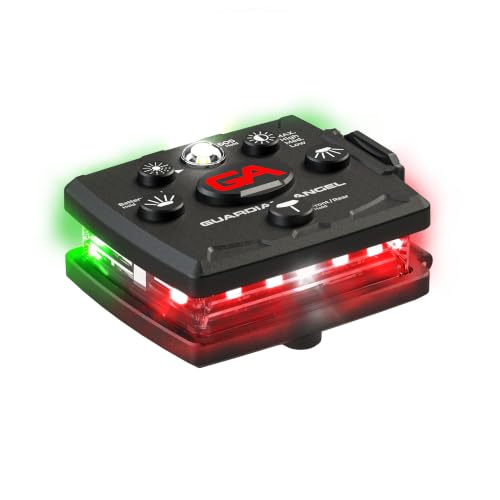
8. Guardian Angel Micro Series - Most Versatile Design
Guardian Angel Micro Safety Light - Red Front & Green Rear
LEDs: 13 high-output
Visibility: 3+ miles
Battery: 90 hours rechargeable
Rating: IP68 waterproof
+ Pros
- Extremely bright with 360-degree visibility up to 3+ miles
- Versatile magnetic mounting system works on any surface
- Excellent durability with 50-foot drop testing
- Long 90-hour battery life
- Independent front and rear controls
- Cons
- Premium price point for single light
- USB-C to USB-C charging issues
- White flood light could be brighter
- Charging port cover difficult to close
The Guardian Angel Micro Series packs professional-grade features into a device smaller than a matchbox. Thirteen high-output LEDs produce 360-degree visibility rated past 3 miles, and the entire housing is rated IP68 for full submersion, dustproofing, and 50-foot drop survival.
The patented magnetic mounting system is what makes this light so versatile. Rare-earth magnets built into the housing grip any ferrous surface, and the included adhesive-backed metal plates turn non-magnetic kayak decks into mounting points. I have attached mine to PFD straps, paddle shafts, hull fittings, and even a metal tackle box during a night fishing session.
Battery Performance Across Brightness Levels
The 90-hour battery life claim is accurate, but only on the lowest steady setting. At maximum brightness, expect 8 to 10 hours of runtime, which still covers most night paddles but falls short of the marketing headline. The USB-C rechargeable lithium-ion battery charges in about 1.5 hours via USB-A cables, though some users report USB-C to USB-C charging does not work reliably.
The independent front and rear controls let you run white forward and red backward simultaneously, which is useful for paddling in a group where you want to mark your stern without blinding followers. Four brightness settings plus multiple flash patterns and a one-tap emergency mode cover every signaling scenario I encountered.
Best for: Multi-sport paddlers who want one light that works on kayaks, bikes, hiking packs, and emergency kits.
How to Choose the Best Kayak Navigation Lights
After testing lights in conditions ranging from glassy alpine lakes to three-foot coastal swells, certain features separated genuinely useful models from expensive paperweights. The buying criteria below reflect the trade-offs I encountered during six months of night paddling.
Flashlight vs Fixed Mount: What Is Legal
One question that comes up repeatedly in forums is whether a flashlight counts as a legal navigation light for kayaks. The short answer is yes, technically. The Coast Guard allows a handheld electric torch to meet the navigation light requirement for vessels under oars, provided you shine it in sufficient time to prevent collision.
In practice, a flashlight is a poor primary solution. You have to hold it, which means taking hands off the paddle at the exact moment you need maneuvering control most. A headlamp paired with a fixed all-around white light is a much better combination, with the headlamp handling close-range task lighting and the fixed light covering the 360-degree visibility requirement. For a deeper dive into navigation gear, our kayak compass for night navigation guide rounds out the full setup.
Kayak Navigation Lights FAQs
Do kayaks legally need navigation lights at night?
Yes. The Coast Guard classifies kayaks as vessels under oars under Rule 25, which requires at least one white all-around light visible from every direction between sunset and sunrise, plus during reduced visibility like fog.
What color lights should a kayak display?
A single white all-around light is the legal minimum. Experienced paddlers and the Coast Guard recommend against adding red and green sidelights, since these signal a powered vessel to motorized boaters and can cause them to misjudge your speed and maneuverability.
How bright should kayak navigation lights be?
Target 50 to 200 lumens of output, which translates to roughly 2 miles of visibility. Lights above 300 lumens can blind nearby paddlers and create glare that defeats your own night vision.
Where do you mount navigation lights on a kayak?
Mount your primary white light between 40 and 48 inches above the deck, positioned behind your seat so your body does not block the beam. This clears gear, fishing rods, and your head for true 360-degree visibility.
Can I use a headlamp as a kayak navigation light?
A headlamp alone does not meet legal requirements because it is not visible from all directions. Pair a headlamp for task lighting with a fixed all-around white light for legal compliance. A handheld flashlight technically qualifies but is impractical for actual paddling.
How long do kayak light batteries typically last?
Battery life ranges from 20 to 150 hours depending on light type and battery chemistry. Alkaline AA and AAA cells average 40 to 60 hours at moderate brightness, while lithium cells last 2 to 3 times longer and perform far better in cold weather.
Are flashing or strobe lights legal on kayaks?
Steady-burn white light is the legal standard for navigation. Flashing and strobe patterns are reserved for distress signaling only, and using them during normal paddling can confuse other boaters or trigger an unwanted rescue response.
Do I need Visual Distress Signals for kayaking at night?
Yes, if you paddle coastal waters, the Great Lakes, or connected territorial seas. Federal rules require Visual Distress Signals from sunset to sunrise, satisfied by either pyrotechnic flares or non-pyrotechnic electric SOS lights like the Sirius Signal.
Final Recommendations and Pre-Paddle Checklist
After six months of testing these eight lights across dawn patrols, midnight fishing sessions, and coastal trips, clear winners emerged for different paddling styles. The Seaperk LED Navigation Light delivers unmatched brightness for solo anglers who want maximum visibility on a budget. Rental paddlers and multi-boat owners should grab the KayaLuma 3-Pack for its tool-free clip mounting and 100-hour battery life. Paddlers who want a complete premium kit in one box should invest in the Viswiker 360 Degree Kit, which combines a pole, flag, light, and three mounting systems.
Whatever light you choose, prioritize a single white all-around light mounted high enough to clear your head and gear. Skip the red and green sidelight temptation, since they can confuse motorized boaters and create more risk than they remove. Add Visual Distress Signals if you paddle coastal waters or the Great Lakes, and remember that night paddling safety and legal requirements vary by state, so check local rules before launch.
Pre-Paddle Night Lighting Checklist:
Required: White all-around light visible 360 degrees from at least 2 miles, batteries tested and spares in dry bag, light tethered to kayak, mounting surface cleaned and verified.
Recommended: Headlamp for task lighting, VDS flares or electric SOS light for coastal waters, reflective tape on paddle blades, whistle or air horn for sound signals.
Pre-launch: Test light at full brightness, confirm 360-degree visibility from water level, check local state requirements, file a float plan with someone on shore.
Time Saver: Buy lithium batteries in bulk online. They cost about 40 percent less than retail and last 3 times longer than alkaline in marine environments, especially in cold weather.
Brightness and Visibility Range
Quick Answer: Target lights visible from at least 2 nautical miles to clear the Coast Guard minimum and leave a safety margin for fog and glare.
The federal rule requires visibility "in time to prevent collision," which is vague by design. Most states translate this into a 2-mile visibility standard, and that is the floor I would recommend for any primary light. The Seaperk strips in this guide hit 5 miles, which gives you enormous margin when faster boats are closing on your position.
Going too bright has its own hazards. Lights over 300 lumens can blind nearby paddlers and create glare off wet paddle blades that defeats your own night vision. The sweet spot for most paddlers sits between 50 and 200 lumens of actual output, which is bright enough to be spotted from 2 miles but not so intense that it ruins everyone's dark adaptation.
Mounting System Reliability
Quick Answer: Match the mount to your kayak material: adhesive for polyethylene, clamp for canoes, suction for rentals, magnetic for multi-sport use.
The mounting system matters more than the light itself. I have watched expensive lights disappear overboard when suction cups failed in choppy water, and I have seen adhesive strips peel off textured decks within a single outing. The right mount depends on your kayak's surface and how permanent you want the installation to be.
Polyethylene kayaks work well with adhesive-backed strips after proper alcohol cleaning. Composite boats with gelcoat finishes accept adhesives even more reliably. Clamp mounts shine on canoes and sit-on-top kayaks with flat gunwales, while suction cups demand smooth surfaces like Lexan plates or clean gelcoat. Magnetic mounts like the Guardian Angel system offer the most flexibility across multiple boats and sports.
Pro Tip: Always run a tether as backup. A short length of paracord saved my light twice during rough water tests, and the cost is under two dollars per light.
Light Placement Guide: Height and Position
Where you mount your light matters as much as which light you buy. The expert consensus from experienced paddlers is to place your primary white light between 40 and 48 inches above the deck, positioned behind your seat so your body does not block the beam from any angle. This height clears fishing rods, deck cargo, and your own head, ensuring true 360-degree visibility.
Pole-mounted lights like the Viswiker kit make this easy since the telescoping pole can be adjusted to hit the target height precisely. Clip-on lights like the KayaLuma can be attached to a paddle shaft lashed vertically behind the seat as a quick DIY mast. Avoid mounting your primary light on the bow, where your body blocks the aft arc and creates a dangerous blind spot for overtaking boats.
Battery Life and Cold Weather Performance
Quick Answer: Lithium batteries last up to 3 times longer than alkaline cells in cold conditions below 40 degrees Fahrenheit.
Advertised battery life figures almost always assume 70-degree room temperature operation. Cold weather cuts alkaline battery performance by 50 to 70 percent, which means a light rated for 100 hours might deliver 30 hours at winter paddling temperatures. Lithium cells shrug off cold far better and maintain consistent output across the temperature range.
For trip planning, calculate your actual needs with a safety margin. A two-hour paddle should have at least four hours of battery life in reserve, and longer trips should carry spare batteries in a dry bag. Rechargeable lithium-ion lights like the Guardian Angel Micro sidestep the disposable battery issue but require you to remember to charge before each trip.
Waterproof Ratings Explained
Quick Answer: IPX5 handles spray, IPX7 survives temporary immersion, IPX8 works underwater for sustained periods.
The IP rating system tells you exactly what a light can survive, and it is more reliable than vague "waterproof" marketing language. IPX4 means splash resistance only, suitable for calm conditions where water contact is minimal. IPX5 handles spray from any direction, which covers most paddling scenarios. IPX7 survives 30 minutes of submersion down to 1 meter, giving you protection through a capsize. IPX8 goes further, with sustained submersion capability for professional and rough-water use.
For most recreational paddlers, IPX7 provides the right balance of protection and price. If you paddle rough coastal waters or practice rolling, IPX8 gives you genuine peace of mind. Anything below IPX5 is a risk if there is any chance of capsizing, since a single immersion can kill the light when you need it most.
Flashlight vs Fixed Mount: What Is Legal
One question that comes up repeatedly in forums is whether a flashlight counts as a legal navigation light for kayaks. The short answer is yes, technically. The Coast Guard allows a handheld electric torch to meet the navigation light requirement for vessels under oars, provided you shine it in sufficient time to prevent collision.
In practice, a flashlight is a poor primary solution. You have to hold it, which means taking hands off the paddle at the exact moment you need maneuvering control most. A headlamp paired with a fixed all-around white light is a much better combination, with the headlamp handling close-range task lighting and the fixed light covering the 360-degree visibility requirement. For a deeper dive into navigation gear, our kayak compass for night navigation guide rounds out the full setup.