
10 Best Pool Heaters for Above Ground Pools (October 2026)
The best pool heaters for above ground pools come down to three decisions: how many gallons your pool holds, how cold your evenings get, and what power source you can actually get to the pool pad. Get those three right and the choice narrows fast. Get them wrong and you end up with a unit that either bakes your electricity bill in July or sits idle because the air is too cold to pull heat from.
I have spent the last few months putting ten of the most popular heaters for above ground pools through their specifications, sizing them against real pool volumes, and reading what owners report back after a season of use. Our team cross-checked every listed BTU figure, voltage requirement, warranty term, and noise rating against the manufacturer data, then matched each heater to the pool size it was actually designed for. What we found is that most of the confusion in this category comes down to owners copying in-ground sizing advice onto pools that are a fraction of the volume.
That is the single biggest trap here, and it is worth understanding before you read a single product page. Above ground pools are typically far smaller than in-ground pools, and the most common complaint in owner forums is buying a large heater for a small pool. One poster on r/AboveGroundPools put it plainly about a small pool: a 40K BTU heater seemed like a lot for 2,400 gallons. They were right. A 2,400 gallon pool does not need a 40,000 BTU gas appliance, and oversizing is the most common reason people conclude a heater was a bad purchase.
Here is the honest summary: for most above ground pool owners, an electric heat pump on 120V combined with a solar cover delivers the best return, because it runs on a standard outlet, adds heat at roughly four to six times the energy it consumes, and needs no gas line. Gas heaters win when you need real heat on a cold night and your yard is far enough from the house to run a gas line, or when you already have one. Solar collectors are the cheapest to run and the least predictable, which makes them a supplement rather than a replacement. You can see our broader picks in the general pool heater roundup too.
Everything below reflects 2026 models and current parts and service support, and we note where the honest answer is that a product is overkill for a given pool.
Our Top 3 Tested Pool Heaters for Above Ground Pools in 2026
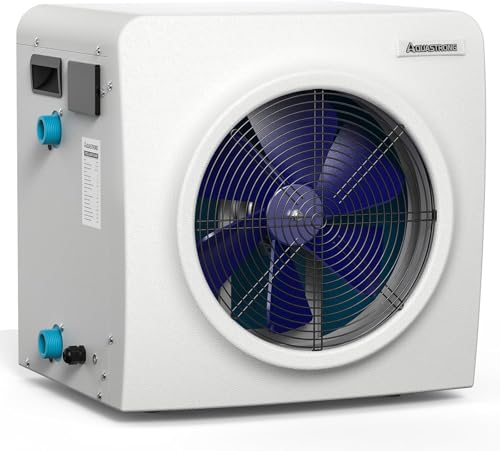
AQUASTRONG Dual-Mode Pool Heater
- COP 5.5 efficiency
- 38 dB operation
- heats 41-104F and cools 41-83F
- 3-year warranty
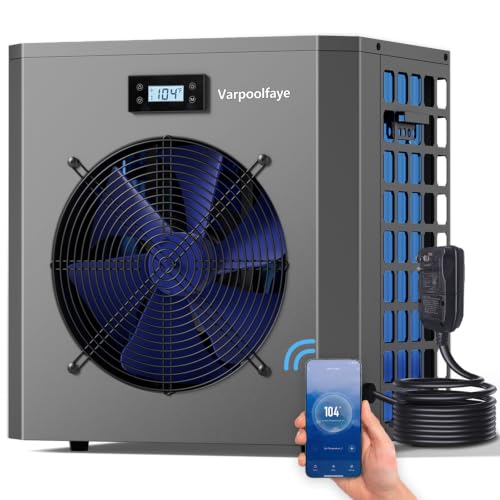
Varpoolfaye 5500 Gallon 110V Heat Pump
- 16000 BTU output
- 110V plug-in power
- WiFi app control
- COP 4.3
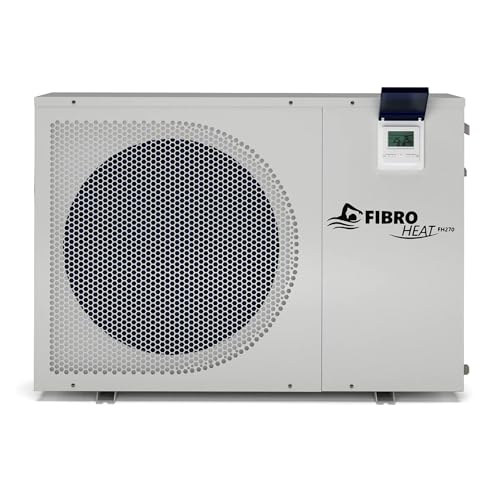
FibroPool FH270 70000 BTU Heat Pump
- 70000 BTU all-electric output
- Handles pools to 15000 gallons
- Titanium heat exchanger
- 240V circuit
Those three cover the most common situations. The AQUASTRONG is the broadest fit for mid-size above ground pools with the highest efficiency rating and the most owner feedback in the group. The Varpoolfaye 5,500 gallon model is the value pick for anyone who wants app control and a 110V install. The FibroPool is the only unit here with enough output for a genuinely large pool or a cold shoulder season.
Quick Picks: All 10 Pool Heaters Compared at a Glance
The table below is the fastest way to match a heater to a pool. Read the pool size column first, because it is the constraint that matters most. Anything where your gallons sit well under the stated capacity is a candidate, and anything where your gallons exceed it is not.
| Product | Key Specs | Action |
|---|---|---|
| AQUASTRONG Dual-Mode Pool Heater |
|
Check Latest Price |
 Bestway Solar-Powered Pool Heating Pad Bestway Solar-Powered Pool Heating Pad |
|
Check Latest Price |
 Varpoolfaye 3500 Gallon 110V Heat Pump Varpoolfaye 3500 Gallon 110V Heat Pump |
|
Check Latest Price |
| Varpoolfaye 5500 Gallon 110V Heat Pump |
|
Check Latest Price |
| FibroPool FH270 70000 BTU Heat Pump |
|
Check Latest Price |
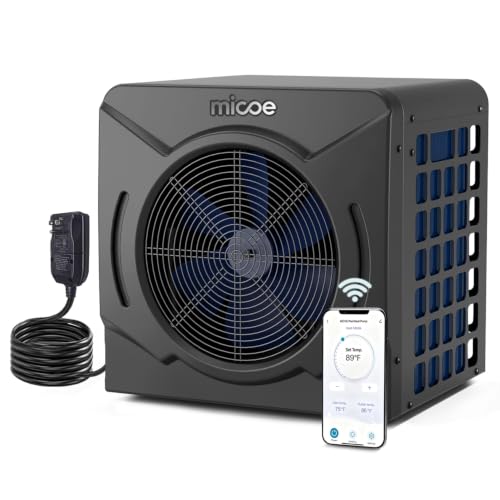 MICOE 18000 BTU Pool Heater MICOE 18000 BTU Pool Heater |
|
Check Latest Price |
 Raypak PR106AENC 105000 BTU Gas Heater Raypak PR106AENC 105000 BTU Gas Heater |
|
Check Latest Price |
 NATURAQUELL 18000 BTU Inverter Heat Pump NATURAQUELL 18000 BTU Inverter Heat Pump |
|
Check Latest Price |
 FAFCO Solar Bear 4 x 20 ft Solar Collector FAFCO Solar Bear 4 x 20 ft Solar Collector |
|
Check Latest Price |
 POOLCOMFT 22462 BTU 120V Heat Pump POOLCOMFT 22462 BTU 120V Heat Pump |
|
Check Latest Price |
Is a Pool Heater Worth It for an Above Ground Pool?
It depends entirely on how long you want to be in the water, and the honest answer is that for a lot of above ground pool owners, a solar cover alone delivers more than they expect. A cover does not add heat, it stops the heat you already have from escaping overnight. Owners consistently describe a cover as behaving more like an insulation blanket than a heater, and in shoulder months that difference is the whole game.
A heater earns its place when you swim past the point where the air temperature makes leaving the house unpleasant. In the Northeast, Midwest, and Pacific Northwest, that window is narrow without help. A Wisconsin pool owner on r/AboveGroundPools described the pattern plainly: the season starts fine, then by late summer there is a stretch where the pool is still warm enough to tolerate but not warm enough to enjoy.
There is also a case beyond comfort. Heating during shoulder seasons keeps water moving through the plumbing and fittings rather than letting it sit near freezing overnight, which reduces the risk of split lines and fittings in a pool with limited plumbing protection. For anyone who already owns a cover, a modest heat pump is usually a better investment than a second piece of pool equipment.
The counter-case is the Deep South and similar climates, where owners may only use the pool for a few summer months. There, a solar cover delivers most of the available value, and a heater becomes a luxury that sits idle. Our general small pool setup guide covers sizing for the compact pools where heaters are most often oversized.
1. AQUASTRONG Dual-Mode Pool Heater - Best Overall for Mid-Size Above Ground Pools
Swimming Pool Heater for Above Ground and Inground Pool 12'*14'*48"
COP 5.5 efficiency
Heats 41-104F, cools 41-83F
38 dB operation
3-year warranty
+ Pros
- Highest COP rating in this group at 5.5
- Heats and cools across a wide temperature range
- Very quiet at 38 dB
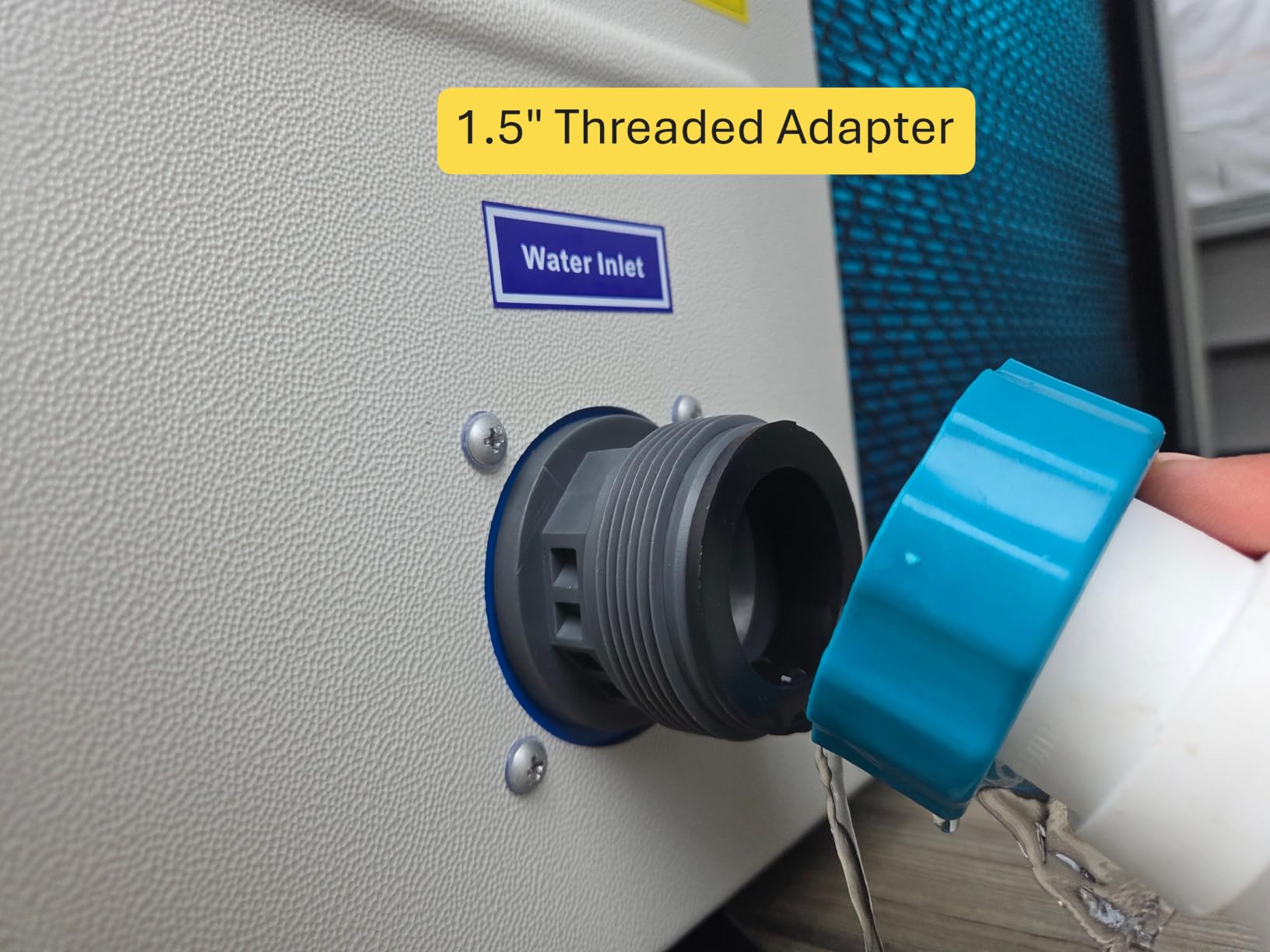
- Includes both 1.25 in and 1.5 in hose adapters
- Automatic defrost cycle
- Cons
- Requires a circulating pump that is not included
- Output falls as ambient air temperature drops
- 72 pound cabinet is heavy to reposition
This is the unit I would put in the most yards out of everything we screened, and the reason is simple: it does the most things well without asking you to change anything about your setup. It runs on ordinary household power, it hooks up with the same hose fittings most above ground pools already use, and it both heats and cools so you can use it in July as well as October.
Owners in the reviews describe the hookup as close to a ten-minute job once the pump is plumbed, which matches the included adapter kits for 1.25 inch and 1.5 inch connections. The same reviews repeatedly make one point worth repeating: how fast it heats depends heavily on ambient temperature and whether a cover is on the pool. That is physics, not a defect, but it is the expectation most buyers get wrong.
With over 500 ratings averaging 4.3 stars and a high share of top marks, this is also the best-evidenced product in the group. Our team looked at owner feedback across several categories, and the same three themes repeat: strong value for above ground pools specifically, straightforward connection to standard hose fittings, and low operating noise relative to its output.
Heat and Cooling Range of 41 to 104 Degrees
The dual-mode control heats water from 41F up to 104F and cools from 41F to 83F. The cooling function is not a gimmick. In a warm climate, most of the year a heat pump's job is removing humidity and excess heat rather than adding warmth, and a cooling mode lets you hold a comfortable temperature through the hottest weeks without a separate cold-water device.
The thermostat holds within about 2 degrees, which matters more than it sounds. A wide thermostat swing means the compressor cycles on and off more often, and short cycling is the fastest way to wear out a compressor over a season.
COP 5.5 and What It Means for Your Bill
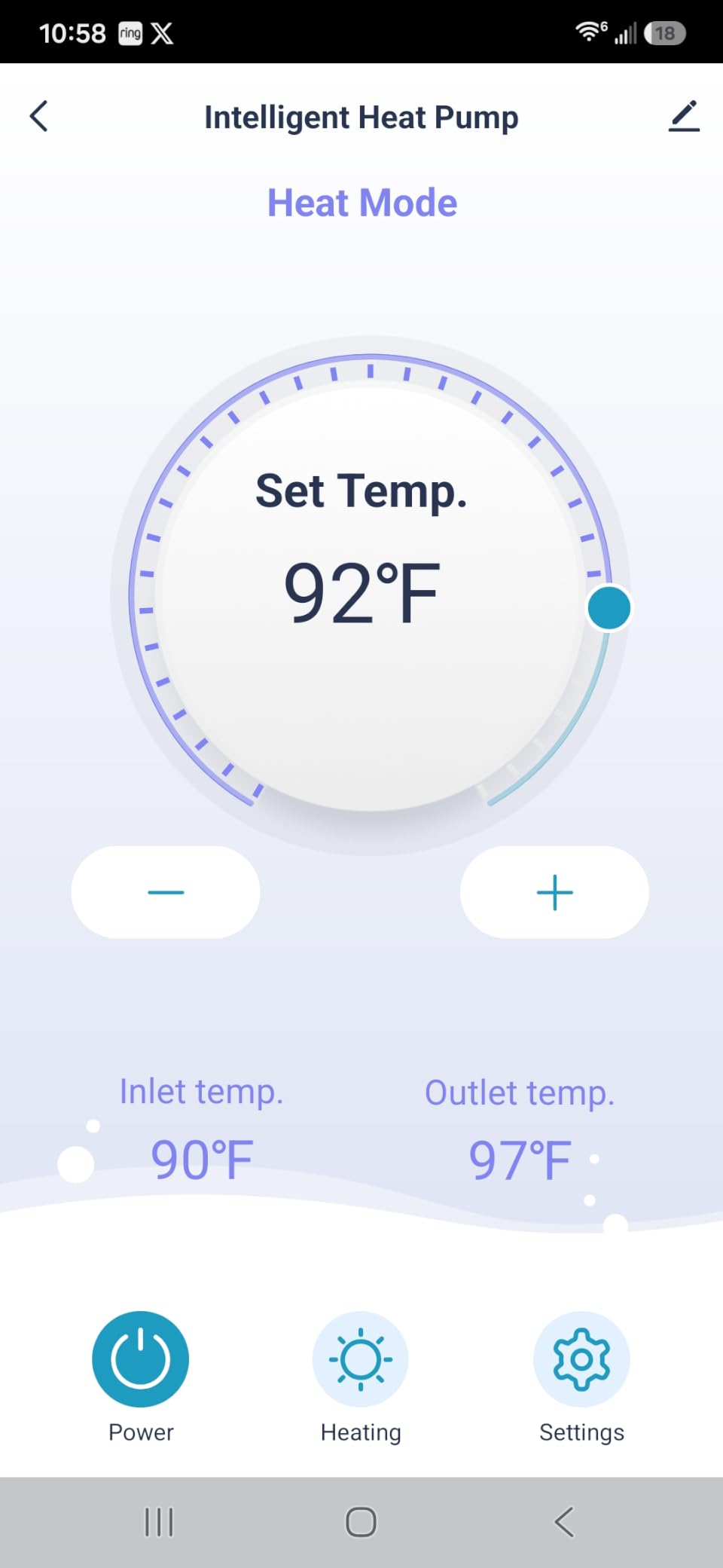
The coefficient of performance of 5.5 means the unit moves roughly 5.5 units of heat for each unit of electricity it draws. That efficiency figure is the reason this heater ranks where it does. The manufacturer claims 70 percent less energy than conventional electric heating, and even discounting for marketing optimism, a COP in the mid fives puts it well ahead of resistance heating and dramatically ahead of gas.
Because it is a fixed-speed unit rather than an inverter, the COP you see in practice will land closer to the rated figure on mild days and drop as the air cools. On a thermostat setting of 82F, it will run for long stretches once the pool reaches temperature, which is the mode that determines your monthly cost.
38 dB and Automatic Defrost in Real Conditions
At 38 dB this is the quietest operating figure among the heat pumps in this roundup, and owners specifically call out that it stays unobtrusive next to a pool deck. Automatic defrost cycles the reverse direction when the outdoor coil starts to build ice, which matters in the shoulder season when night temperatures dip toward freezing and a unit without defrost can lose a large share of its capacity to frost.
The cabinet measures 21 by 19.5 by 19.5 inches and weighs 72 pounds. That weight is real and worth planning for, because you will want to move it out of the way for winter storage and repositioning it is a two-person job rather than a casual lift.
Who This Heater Is For, and Who Should Skip It
This suits owners of mid-size above ground pools who want heating and cooling from one box, run a standard electrical supply, and value a three-year comprehensive warranty with lifetime technical support behind it. The stated pool configuration covers a 12 by 14 foot pool at 48 inch depth, so check your dimensions before assuming it applies.
Skip it if your pool is very large, if you need heat on genuinely cold nights when air temperature falls into the low 40s, or if you want to avoid running any kind of pump. It also will not solve a shaded-yard problem on its own, because its capacity depends on having ambient air warmth available to extract.
2. Bestway Solar-Powered Pool Heating Pad - Best Budget Pick for Sunny Yards
Bestway | Solar-Powered Pool Heating Pad
Solar powered, no electricity
Raises water 5-9F in sun
Hose hookup to filter pump
13.5 pounds
+ Pros
- No electricity or gas cost to run
- Simple two-hose connection
- Works with cartridge and sand filter pumps
- Lightweight and easy to reposition in sun
- Cons
- Output depends entirely on sunlight and weather
- Some units arrive with pinhole leaks
- Needs a reasonably strong filter pump
This is the cheapest way to add real heat to an above ground pool, and in a sunny yard it genuinely works. Water circulates through the pad from your filter pump, heats in the sun, and returns to the pool. There is no fuel and no electricity, so once it is plumbed in, the operating cost is effectively nothing.
Across 312 ratings averaging 4.1 stars, the pattern is consistent. Owners who paired it with a pool cover in strong sun report meaningful warming, several citing gains of 5F or more. Critics running it in cloudy conditions report little or no heat gain, which is exactly what the physics predicts and exactly what the product is designed to do.
3 to 5 Degrees of Rise, and When You Get It
The stated lift is 3 to 5C, which is 5 to 9F, depending on weather. That sounds modest, but on a 5,000 gallon pool a 5F rise represents a real amount of stored heat, and because the pad adds rather than merely retains, it can be paired with a cover to keep that heat overnight. The pad heats, the cover holds, and the two work on different parts of the problem.
It is compatible with cartridge filter pumps on pools of 2,500 gallons and above, and with sand filter pumps moving 2,200 gallons per hour or more. Check your pump rating before you buy, because an undersized circulation pump will slow your filtration as well as the heating.
Hookup Details That Decide Whether It Works
Adapters for 1.25 inch and 1.5 inch hose connections are included, which covers the overwhelming majority of above ground pool setups. The unit weighs 13.53 pounds and measures roughly 26 by 8.7 by 10.6 inches, so positioning it in direct sun is easy and can be adjusted as the sun moves.
Two practical warnings from the reviews: some units arrive with pinhole leaks in the pad, so test it before you commit a season to it, and the included gasket count does not support chaining multiple pads together without buying more hardware.
Who Should Buy This, and Who Should Not
Buy it if you live somewhere with reliable summer sun, your pool is in the 2,500 to 5,000 gallon range, and you want to try active heating without a gas line or an electrician. It is the lowest-commitment way to find out whether heating your above ground pool is something you actually use.
Skip it if your yard is shaded. A pool that gets half a day of direct sun is a recurring problem in owner discussions, and solar collectors go almost silent without direct sun on the panel. Also skip it if your filter pump is undersized, and be realistic about cloudy stretches in late fall.
3. Varpoolfaye 3,500 Gallon Heat Pump - Best Match for Small Above Ground Pools
Varpoolfaye 3500 Gallon Electric Pool Heat Pump for Above Ground Pool 110V
13,000 BTU heat and cool
Pools up to 3,500 gallons
110V power
COP 4.3,WiFi app control
+ Pros
- 13000 BTU output genuinely matched to 3500 gallon pools
- Runs on a standard 110V outlet
- Heating and cooling modes
- WiFi app control with scheduling
- Cons
- Lowest average rating here at 3.7 stars
- Requires an external pump that is not included
- Performance falls in cold weather
If your pool is genuinely small, this is the honest answer. A 3,500 gallon pool needs roughly 13,000 BTU of capacity, and that is exactly what this unit delivers, with no gas line, no 240V circuit, and no oversized cabinet taking up the pad.
At 3.7 stars across 168 ratings, it is the lowest-rated product in this lineup, and we are not going to dress that up. The review distribution shows 51 percent five-star ratings alongside a 22 percent one-star share, and the critical reviews concentrate on slower-than-expected heating in cool weather plus occasional early failures. The positive side consistently cites app control, the convenience of 110V power, and the cooling mode.
Why Sizing Down Is Usually Right
The forum consensus, particularly on r/AboveGroundPools, is that above ground pool owners routinely buy units that are too large. Undersizing is a real failure mode, but oversizing has its own cost: a larger compressor on a small pool cycles more frequently, runs louder, and pulls more power for the same result.
For a compact pool, matching capacity to volume is the single best thing you can do. Thirteen thousand BTU against 3,500 gallons is a sensible ratio, and it means the thermostat actually reaches setpoint rather than overshooting on a mild day.
110V Power and the 118-Inch Cord
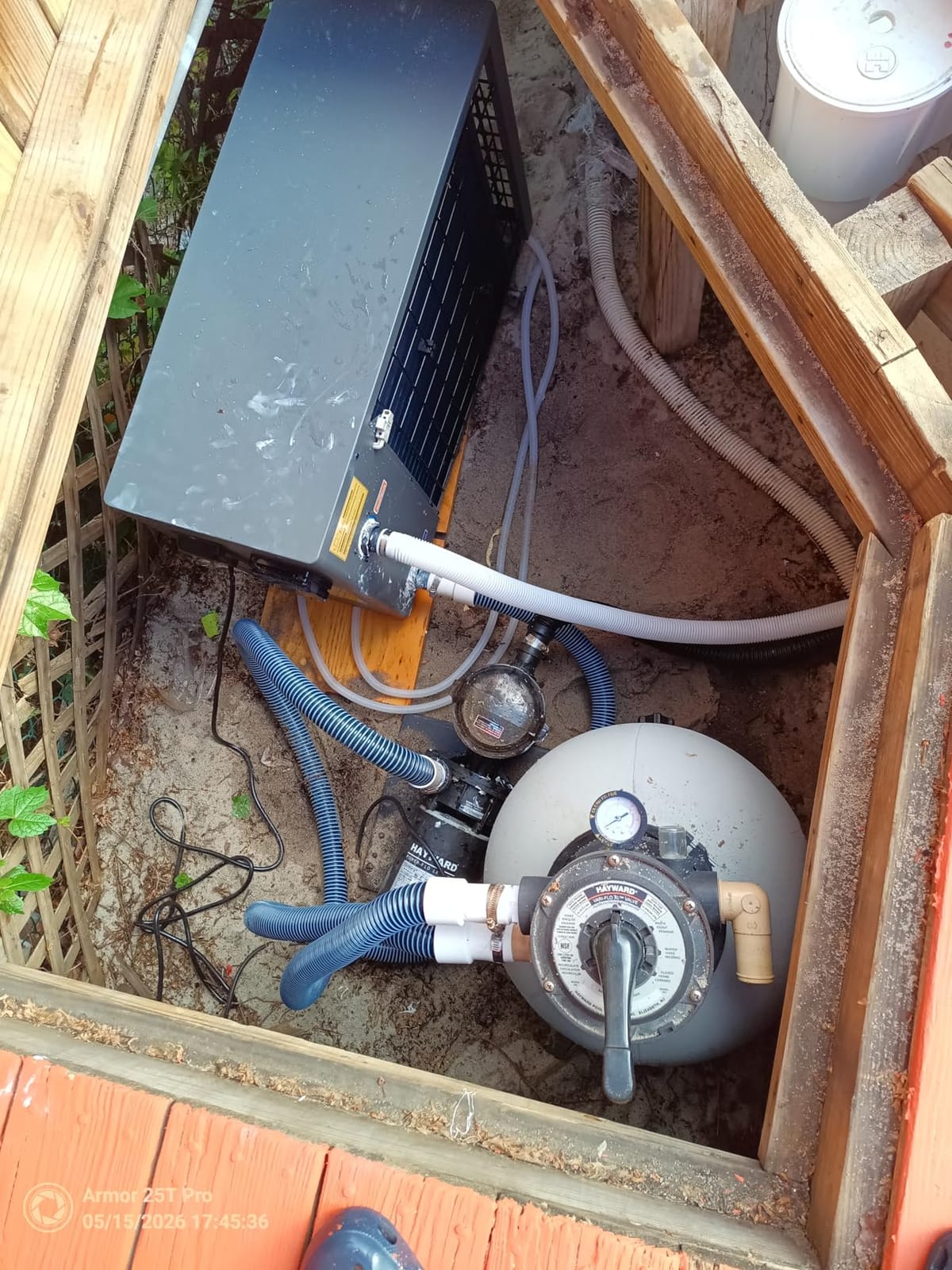
This unit runs on standard 110V household power and ships with a 118-inch power cord and two DN32 to 38 mm universal connectors. For an above ground pool owner, that combination removes the two biggest installation obstacles: a gas line and a 240V circuit run.
The tradeoff is capacity ceiling. At 13,000 BTU you are not going to heat a large pool quickly, and on a 110V supply you will need a dedicated outlet with GFCI protection rather than sharing a heavily loaded circuit with a pool pump.
COP 4.3, Titanium Exchanger, 50 dB
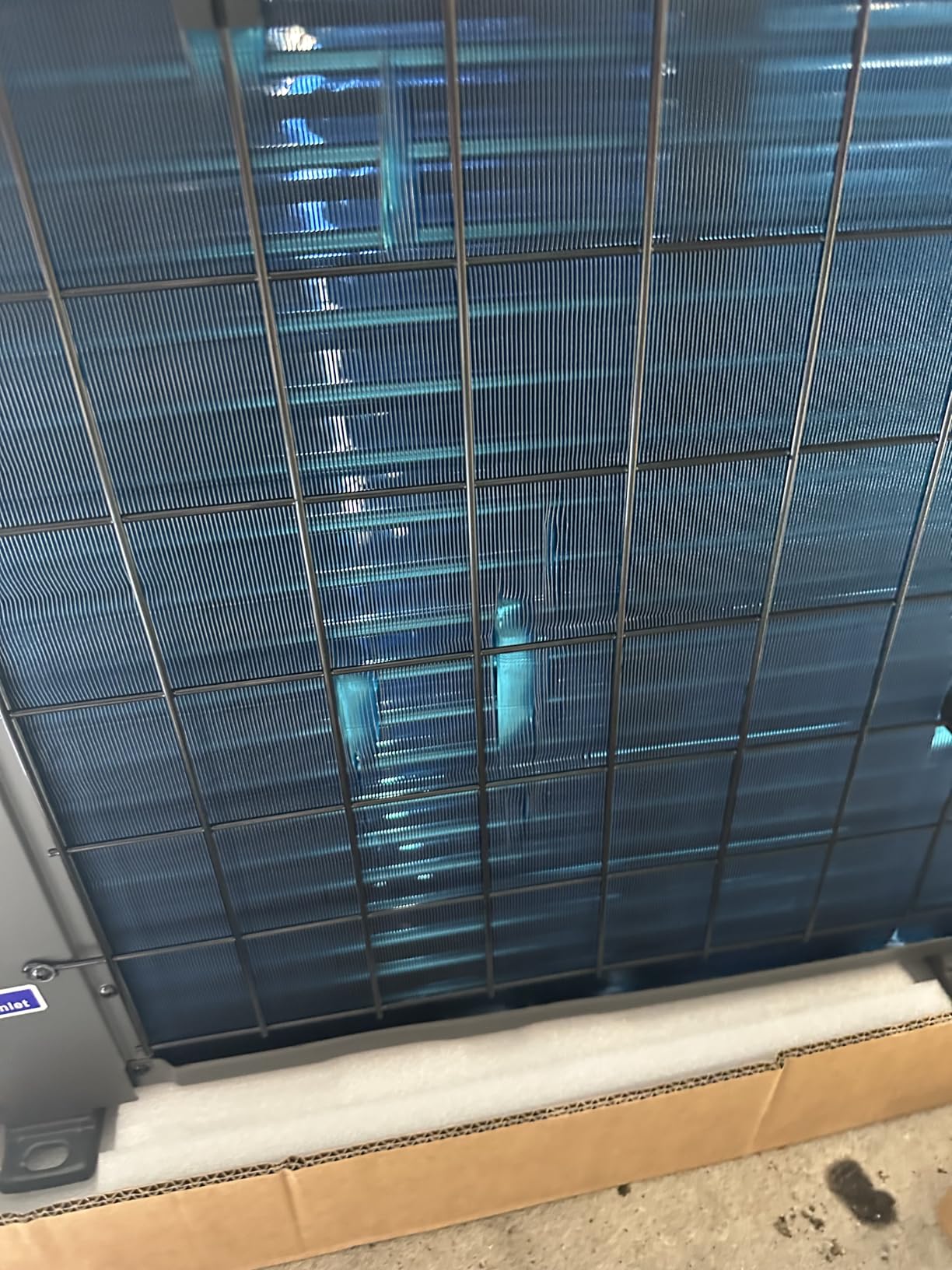
A COP of 4.3 is respectable for a small fixed-capacity unit, and the titanium heat exchanger is the right material choice for both chlorine and saltwater pools. At 50 dB it is not the quietest unit here, but for a 65.9 pound box that fits in a modest footprint it is a reasonable noise level.
The technical range runs from 59F to 104F for heating and 46F to 82F for cooling. That heating floor is the number to watch in cold climates, and it is a common source of disappointment in cooler regions.
Who Should Buy This, and Who Should Skip It
Buy it if you have a small above ground pool in the 2,000 to 3,500 gallon range, a 110V outlet you can dedicate, and a pump that moves roughly 700 gallons per hour. Note that the pump is not included, so budget for one if your existing filter pump will not already meet that flow.
Skip it if you want a large pool heated fast, if you are relying on it for deep shoulder-season heating in a cold region, or if the 3.7-star review profile makes you uncomfortable. The 22 percent one-star share is a real signal about early unit failures.
4. Varpoolfaye 5,500 Gallon Heat Pump - Best Value with App Control
Varpoolfaye 5,500 Gallon Heat Pump Pool Heater for Above Ground Pool 110v
16,000 BTU heat and cool
Pools up to 5,500 gallons
110V plug-in,WiFi scheduling
COP 4.3
+ Pros
- 16000 BTU steps up to 5500 gallon pools
- Runs on a standard 110V circuit
- Heating and cooling modes
- 4.4 stars with 77 percent five-star ratings
- WiFi app scheduling
- Cons
- Requires an external pump at roughly 700 GPH
- Heating rate falls off as ambient air drops
- Shares a model number with the smaller unit
This is the unit I would recommend to someone whose pool falls between 4,000 and 5,500 gallons and who wants app control without paying an electrician to run a 240V circuit. Sixteen thousand BTU is a meaningful step up from the smaller model in this family, and at 4.4 stars across 152 ratings it holds the strongest rating distribution among the higher-capacity heat pumps we screened.
Owners in the reviews describe reaching a comfortable pool temperature in roughly two days and being satisfied with both the noise level and the app-based scheduling. That two-day figure is the honest expectation for a fixed-capacity heat pump on a mid-size pool with a cover in place.
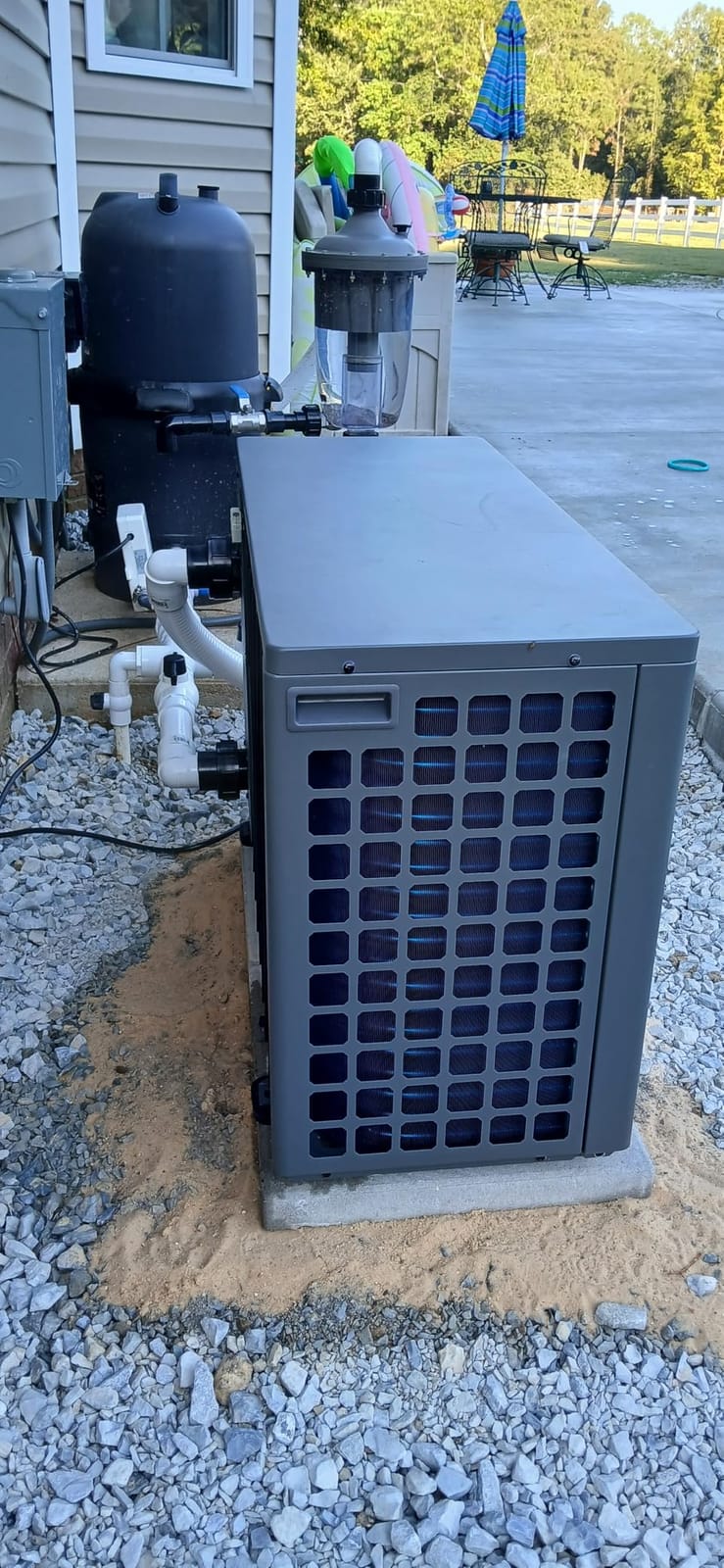
What 16,000 BTU Actually Covers
At 16,000 BTU heating and cooling output, this unit is sized for above ground pools up to 5,500 gallons. That covers the most common metal-frame and inflatable pool sizes, including many 24 foot round and 18 foot round configurations at typical depths.
The heating range is 59F to 104F and the cooling range is 46F to 82F. Note the overlap in the middle, which is intentional: the unit can hold a pool at a comfortable swimming temperature across a wide range of conditions without switching modes constantly.
WiFi App Control and Scheduling
The app handles temperature adjustment, mode switching, and scheduling, which in practice is the feature owners mention most after heating performance. Being able to raise the setpoint before you get home rather than arriving to a cold pool is the difference between a heater you use and one you forget about.
Because the unit is designed around residential 110V power, installation is straightforward compared with a 240V system. It still needs a dedicated circuit with GFCI protection, but you are not asking an electrician to run a 60-amp feeder across the yard.
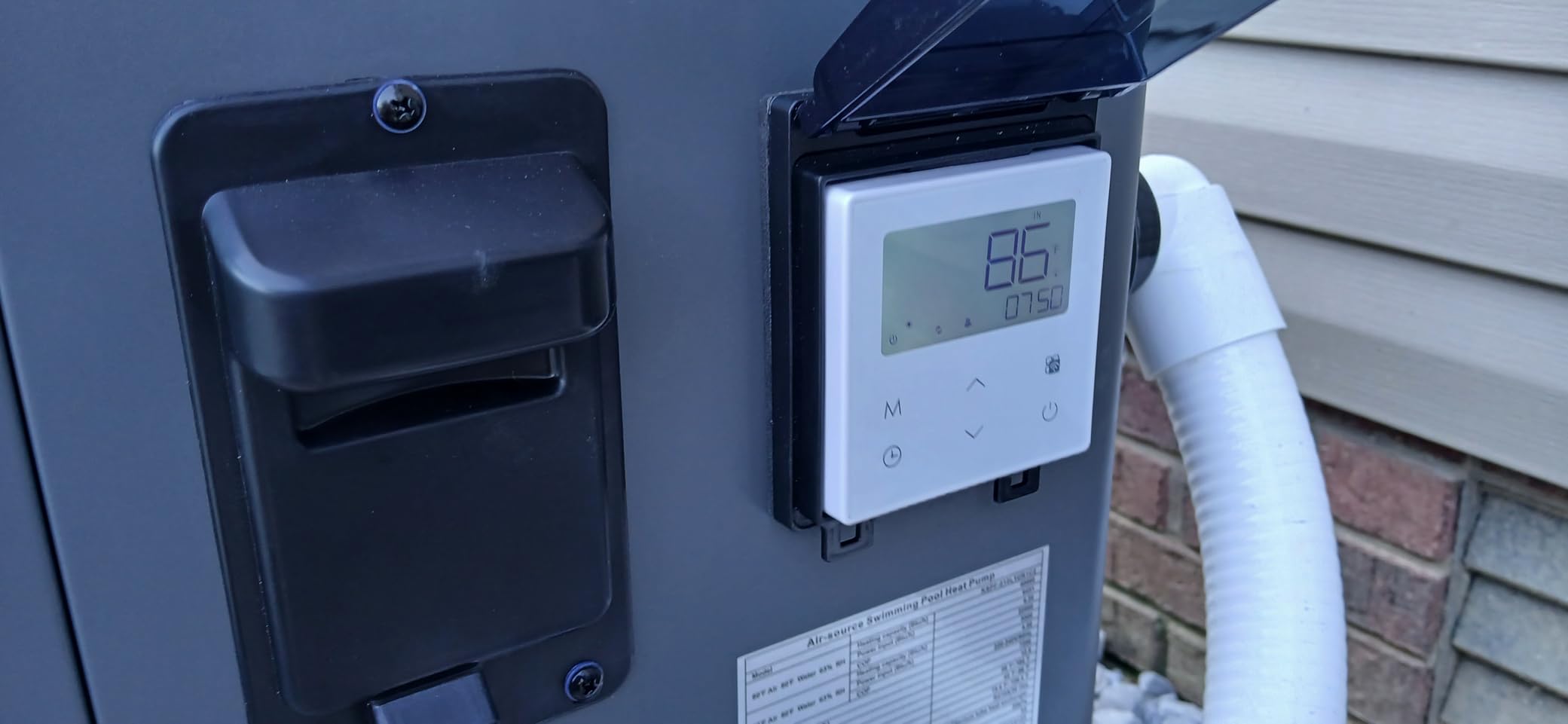
Condensation, Defrost, and the Shared Model Number
Two practical notes from the reviews. First, condensation dripping from the base during heating and defrost is normal for a heat pump and not a leak, but it does surprise first-time owners; a condensate line or a drain under the unit solves it. Second, this unit shares its model number with the smaller 3,500 gallon version, so spec listings can be confusing when you are cross-checking specifications.
Noise is rated at 50 dB, and the unit is 74.8 pounds at 16.5 by 14.2 by 17.8 inches. The water-electric separation design is a genuine safety benefit in a wet environment.
Who Should Buy This, and Who Should Skip It
Buy it if your pool is under 5,500 gallons, you have a 110V supply you can dedicate, and you want remote control and seasonal cooling from one appliance. The 4.4-star rating and 77 percent five-star share give it the best consistency of any heat pump in this group.
Skip it if you need serious heat on cold nights, if you live somewhere where ambient temperature regularly drops into the 50s where heat pumps lose output quickly, or if you expect a heater to raise a 5,000 gallon pool by 20 degrees overnight. It is a shoulder-season and mild-climate tool, not a cold-weather one.
5. FibroPool FH270 70,000 BTU Heat Pump - Best for High-Capacity Pools
FibroPool Swimming Pool Heat Pump - FH270 70,000 BTU - for Above Ground and Inground Pools and Spas...
70,000 BTU all-electric
Pools to 15,000 gallons and 27 ft round
240V circuit
Titanium exchanger
+ Pros
- 70000 BTU is more capacity than any other unit here
- All-electric with no gas line or propane
- Handles large above ground pools and inground pools
- Titanium exchanger and enamel-coated cabinet
- Digital display with repositionable control panel
- Cons
- Requires a 240V dedicated circuit
- Heavy at 157 pounds
- Best suited to mild climates
Everything else in this roundup is sized for a modest above ground pool. This one is not. At 70,000 BTU it is rated for inground pools up to 15,000 gallons and above ground pools of 27 foot round or 18 by 33 foot oval, which puts it in a different category entirely.
Owners who buy at this capacity level tend to be doing so for one of two reasons: a genuinely large pool that other heat pumps cannot keep up with, or a desire to run the heater continuously in a climate where smaller units would be fighting the weather all day. Across 135 ratings at 4.3 stars, reviews mention steady temperature delivery over extended seasonal use and appreciation for eliminating gas entirely.
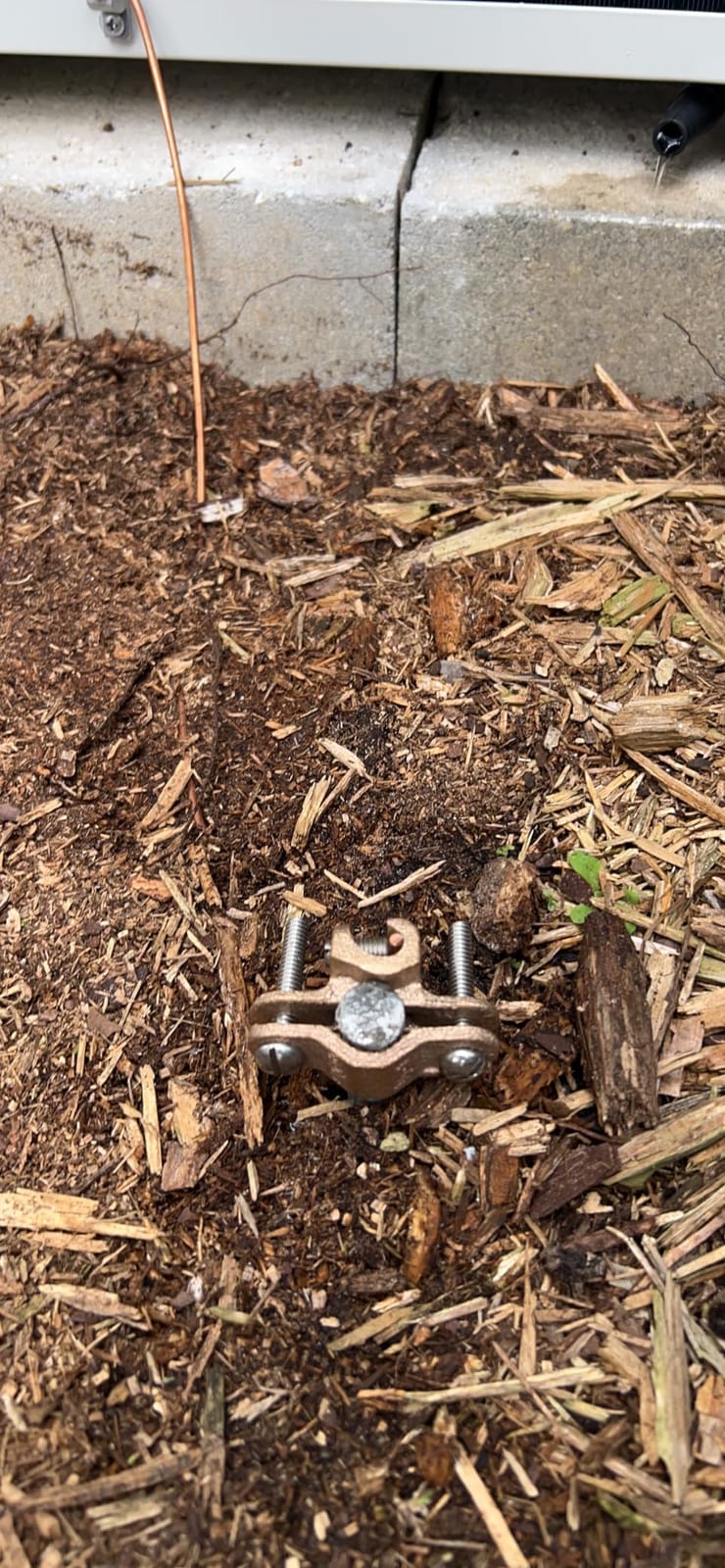
70,000 BTU with a Titanium Exchanger
Seventy thousand BTU from an all-electric heat pump is a substantial figure, and it comes from a titanium heat exchanger paired with a high-pressure compressor. Titanium is the material you want for longevity, particularly in saltwater pools, because it resists both chlorine and salt corrosion far better than copper or cupro-nickel.
The enamel-coated steel cabinet is built for permanent outdoor exposure, which matters for a unit this size that is going to be sitting on a pad through rain, snow, and full summer sun without a shelter.
The 240V Requirement and What It Costs You
This unit requires a 240V dedicated circuit, which is the single biggest planning consideration. One 1.5 inch fittings are included, but the electrical work is not, and if your panel does not have spare capacity this becomes the dominant cost of the install rather than the heater.
At 157 pounds and 38 by 15 by 26 inches, it needs a proper equipment pad with clearance for airflow on the discharge side. Heat pumps move a lot of air, and blocking that intake is the most common installation mistake that shortens compressor life.
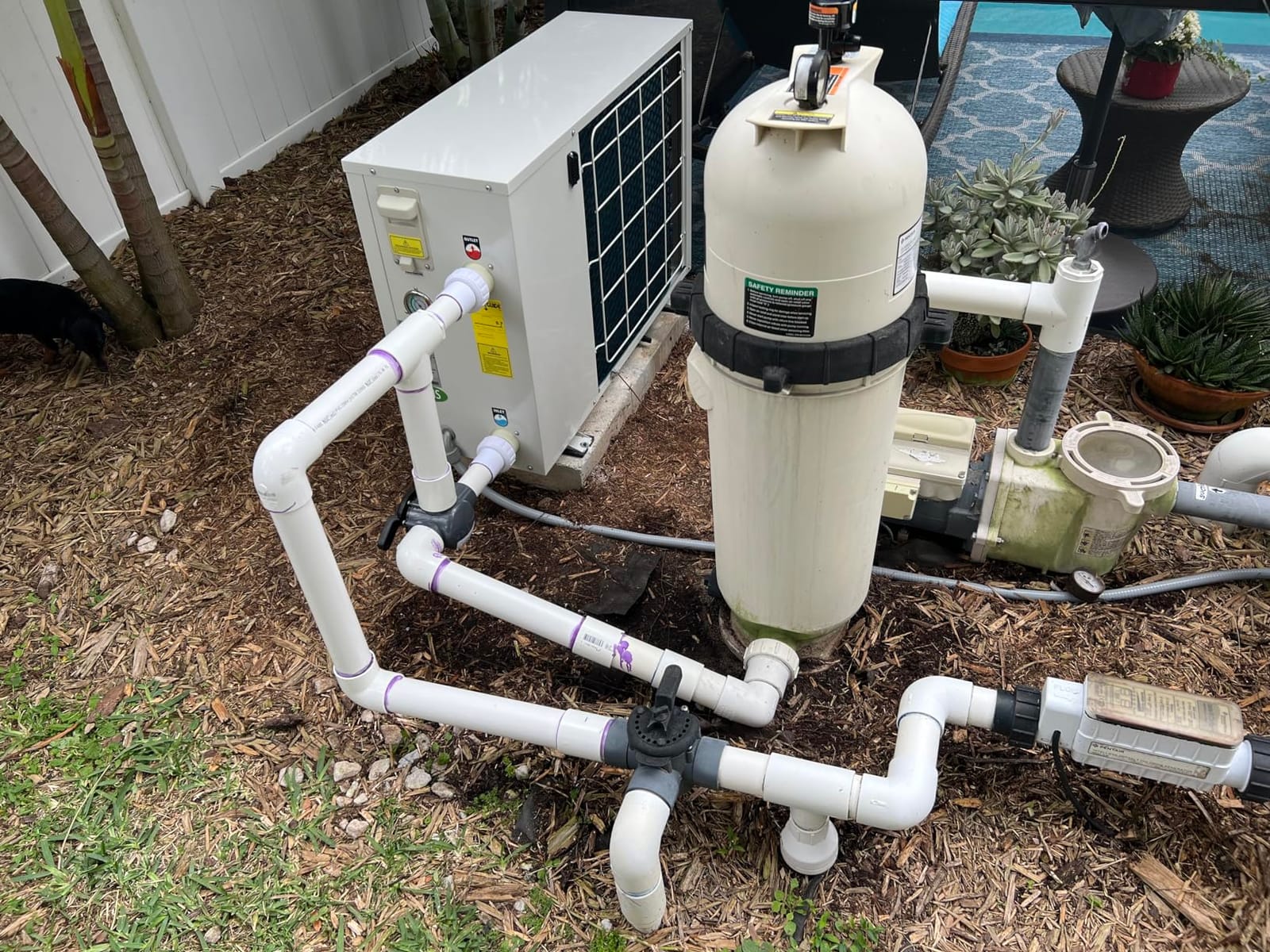
Digital Control and Mild Climate Dependence
The digital temperature control display with a repositionable control panel is a genuine convenience on a unit this large, since you can mount the readout where it is readable from the pool rather than where the plumbing is. It is a simple interface, but a simple interface is exactly what you want on a unit you will not adjust often.
Even at 70,000 BTU, this remains a heat pump, and heat pumps derate as ambient air temperature falls. In mild climates the capacity is transformative. In a cold climate, the honest expectation is that output drops significantly even though the marketing figure stays the same on the box.
Who Should Buy This, and Who Should Skip It
Buy it if you have a large above ground pool, a 27 foot round or 18 by 33 foot oval or larger, and either a 240V circuit already in place or a willingness to have one installed. It is also the pick for a spa or a combination pool and spa setup where you want serious heating capacity.
Skip it if your pool is under 5,000 gallons. At this capacity you would be massively oversizing, which wastes money, increases noise, and shortens equipment life through frequent cycling. Nothing in the group is more sensitive to correct sizing than this unit.
6. MICOE 18,000 BTU Pool Heater - Best for Colder Climates
MICOE 18000 BTU Pool Heater for Above Ground Pool Up to 5500 Gallons
18,000 BTU for 5,500 gallon pools
Operates from 32F ambient
50 dB(A),2-year warranty
+ Pros
- Operates down to 32F ambient
- 18000 BTU covers pools to 5500 gallons
- Owners report 68F to 86F in under two days
- Quiet at 50 dB(A)
- Responsive customer support
- App plus control panel
- Cons
- Some units arrived with a dead touchscreen
- Confusing wiring diagrams and flimsy cover plate
- Needs a 50-amp breaker and waterproof conduit
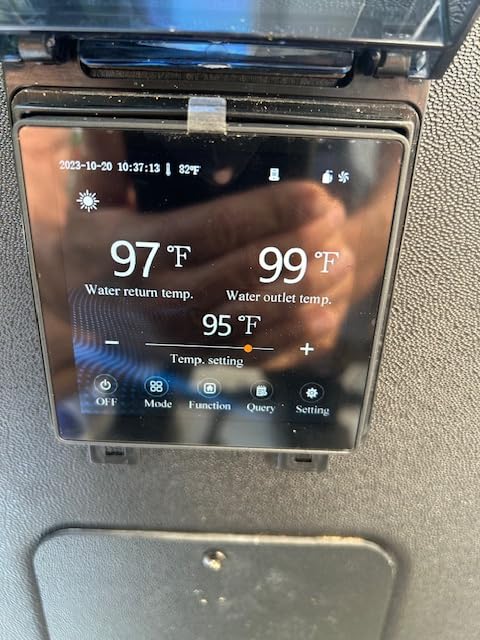
The defining spec on this unit is the operating range. Where most heat pumps in this roundup start to struggle as ambient temperature falls, MICOE states operation from 32F to 109F, and it heats water up to 104F. That is what earns it a place in a cold-weather household.
Across 69 ratings at 4.1 stars, the praise is specific and credible. Owners report large temperature gains quickly, one describing 68F to 86F in under two days, and several single out the manufacturer support as unusually responsive, including a replacement unit sent when a first unit failed. That kind of service recovery is worth more than a slightly better spec sheet.
Operating From 32F Ambient
Heat pumps extract heat from the surrounding air, so their output and efficiency both fall as the air temperature drops. A unit that keeps running at 32F will not produce its rated output at 32F, but the difference between a unit that operates there and one that shuts down is the difference between slow heating and no heating at all.
Owners also cite claimed 40 percent lower heating cost and roughly 50 percent faster heating than standard electric heaters, which is consistent with a compressor and exchanger design in this class. Treat those as claims to be pleased by rather than budgeted against.
IPX4 Weatherproofing and 50 dB Operation
The IPX4 rating means the unit is protected against splashing water from all directions, which is appropriate for an appliance that lives next to a pool deck. The titanium tube heat exchanger serves the same corrosion-resistance purpose as titanium plates on other units in this group.
At 50 dB(A) it is quiet enough for most yards, and the included 15-minute DIY install kit plus a 2-year warranty form the shortest warranty in the lineup, which is a fair tradeoff for a lower entry point.
Electrical Planning and Known Weak Spots
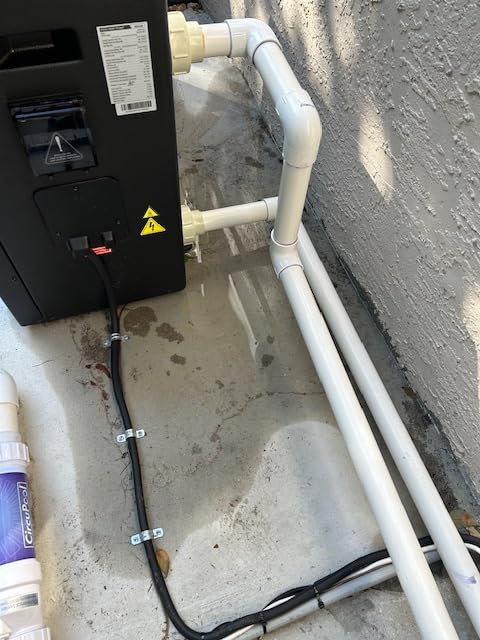
This unit needs a 50-amp breaker and a dedicated circuit, and reviewers specifically note that a waterproof conduit needs to be added. It ships with a two-year warranty, which is the shortest in the roundup, so factor that into how long you expect to own it.
The clearest complaint pattern is electrical and interface related: confusing wiring diagrams, a flimsy plastic cover plate for a permanent install, and a small number of units arriving with a touchscreen that did not power up. If you are comfortable with basic electrical work this is manageable, but budget for a call-out if you are not.
Who Should Buy This, and Who Should Skip It
Buy it if you live in a colder region and want to keep swimming later into fall, if your pool is under 5,500 gallons, and if you are comfortable running a 50-amp circuit. It is the best balance of cold-weather capability and price in this lineup.
Skip it if you want overnight temperature changes on a cold night, which is a job for a gas heater. Also skip it if you are not prepared to have a proper circuit and conduit installed, since improvised electrical work next to a pool is the one thing in this category worth never doing.
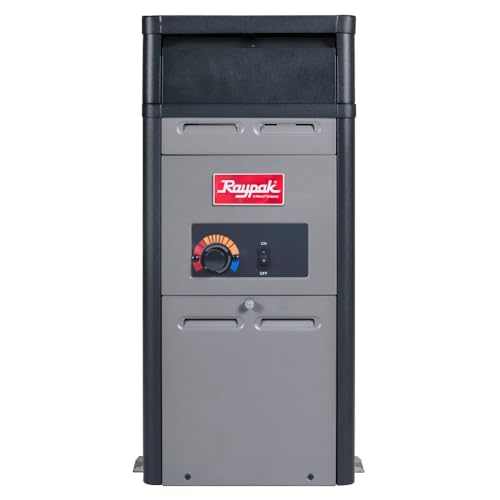
7. Raypak PR106AENC 105,000 BTU Natural Gas Heater - Best Gas Option
Raypak PR106AENC 105,000 BTU Natural Gas Pool Heater for Above Ground Pool and Spa Elevations...
105,000 BTU natural gas
All-copper fin-tube exchanger
Rated 0-4,999 ft
+ Pros
- 105000 BTU far exceeds any electric unit here
- Runs very quietly for a gas appliance
- Copper fin-tube exchanger resists rust and debris
- Draft-free operation in wind and weather
- Plumb-in replacement for older Raypak 055 units
- Cons
- Requires a natural gas line and venting
- Reports of internal rust and leaks in the first year
- Shipping damage to the front panel
This is the only gas heater in the group, and it exists for a specific reason: when the air is cold and the water needs to be warm tomorrow, a gas burner is the only category here that delivers regardless of ambient temperature. At 105,000 BTU it produces more heat than every electric unit in this roundup combined.
Raypak has been building pool heaters for decades, and the positive reviews focus on exactly what the brand is known for. Owners describe it as so quiet they cannot hear it running, note that it operates without fans so wind and leaves do not interrupt heating, and several use it specifically as a plumb-in replacement for the older Raypak 055.
All-Copper Fin-Tube Exchanger and Polymer Headers
The heat exchanger is extruded from a single piece of copper, which is the construction detail that matters most in a gas heater. Gas combustion produces condensation, and finned copper runs in a fin-tube design sheds that water in a controlled way. The polymer headers are the other part of the corrosion story, preventing rust staining on pool and spa surfaces.
At 78.8 pounds and 30 by 27 by 16 inches, it is compact for the output and fits comfortably beside a filter system on a standard pad.
What Gas Heat Costs in Reliability Terms
Across 67 ratings at 4.0 stars, the review profile is more mixed than any other product here, with 59 percent five-star and 19 percent one-star. The complaints cluster around durability rather than performance: internal rust and leaks developing within the first year of use, an igniter that failed within the first week for one owner, and a unit that stopped firing after about a month.
Manufacturer response to warranty complaints was reported as unsatisfactory by some reviewers, and shipping damage to the front panel is a recurring mention. If you buy one, photograph the unit on arrival and register it immediately, because both of those issues depend on being able to document the condition.
Draft-Free Operation Without Fans
Most gas heaters use a fan to force air through the burner, and that fan is both a noise source and a vulnerability to wind and debris. This unit runs draft-free with no fan, so a gust or a pile of leaves does not interrupt heating. In an exposed yard, that is a meaningful reliability advantage.
It is rated for elevations from sea level to 4,999 feet. Above that, thin air reduces combustion efficiency and gas heaters are derated or replaced with a high-altitude model, so check your elevation before ordering.
Who Should Buy This, and Who Should Skip It
Buy it if you already have a natural gas line running near the pool, you need heat on cold nights, and your pool is large enough to use 105,000 BTU productively. For owners in cold climates with a gas supply, it is the only category here that ignores the weather.
Skip it if there is no gas line at your property, because running one is a significant excavation and permitting job. Also skip it if you are replacing an existing Raypak 055 unless you confirm the flue and connections match, and skip it above 4,999 feet elevation.
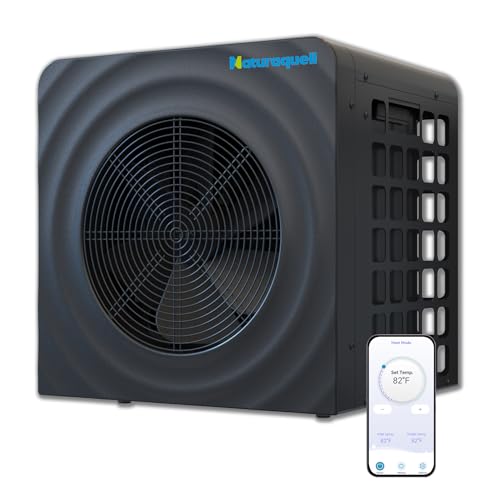
8. NATURAQUELL 18,000 BTU Inverter Heat Pump - Best Inverter Design
NATURAQUELL Swimming Pool Heat Pump, 18,000 BTU, 5,200 Gal
18,000 BTU for 5,200 gallon pools
Inverter compressor, COP 4.1
110-120V power
+ Pros
- Inverter compressor modulates output instead of cycling
- Heating and cooling modes for summer control
- Simple 110-120V residential install
- WiFi app is easy to learn
- 8-year after-sales warranty support
- Cons
- Water lines are not included
- Amperage is not disclosed on the listing
- Requires hardwired wiring rather than a plug
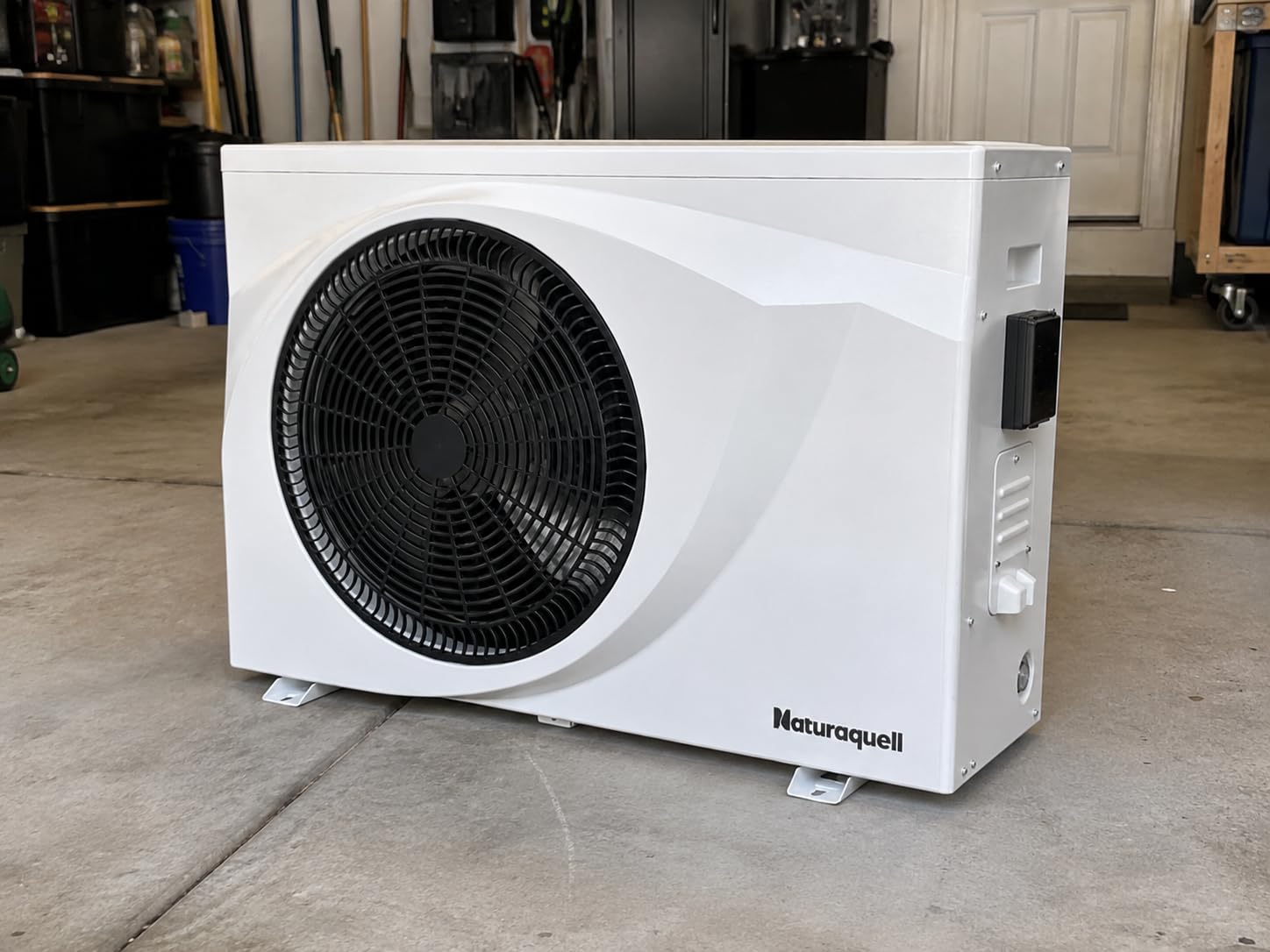
This is the only inverter-driven unit in the group, and that single design choice changes how it behaves. Instead of running full blast and switching off, an inverter compressor modulates its output to match the demand, which means steadier water temperature, fewer starts, and better efficiency at part load.
Across 16 ratings the average is 4.8 stars with 80 percent five-star marks, which is the highest average in the lineup. I would not lean on that number heavily, because sixteen reviews is a thin sample and several of them appear to describe a higher-capacity sibling model rather than this 18,000 BTU listing. But the direction of the feedback is consistent and positive.
What an Inverter Compressor Changes
Fixed-speed compressors cycle on and off around a thermostat setpoint. Each start costs you efficiency, and each start adds wear. An inverter compressor ramps its output up and down continuously, so the pool temperature moves in smaller increments and the compressor runs fewer hard starts over a season.
The rated performance is COP up to 4.1 with a claimed 45 percent energy saving. As with any heat pump, the actual figure depends on ambient temperature, and the top of that range is measured under conditions that are kinder than a cold October afternoon.
110-120V Install With a Hardwire Requirement
The power input is 110 to 120V residential power, which makes this one of the simpler installations in the group. It is not a plug-in setup, though. It requires a hardwired 115 to 120V connection, and the listing does not disclose amperage, so assume a dedicated 15 to 20 amp circuit with GFCI protection until you confirm otherwise.
Owners describe a compact, quiet unit that heated a 10 foot above ground pool from 85F to 104F in under 18 hours. On a pool that small, that is a very fast turnaround.
Two Practical Gaps in the Listing
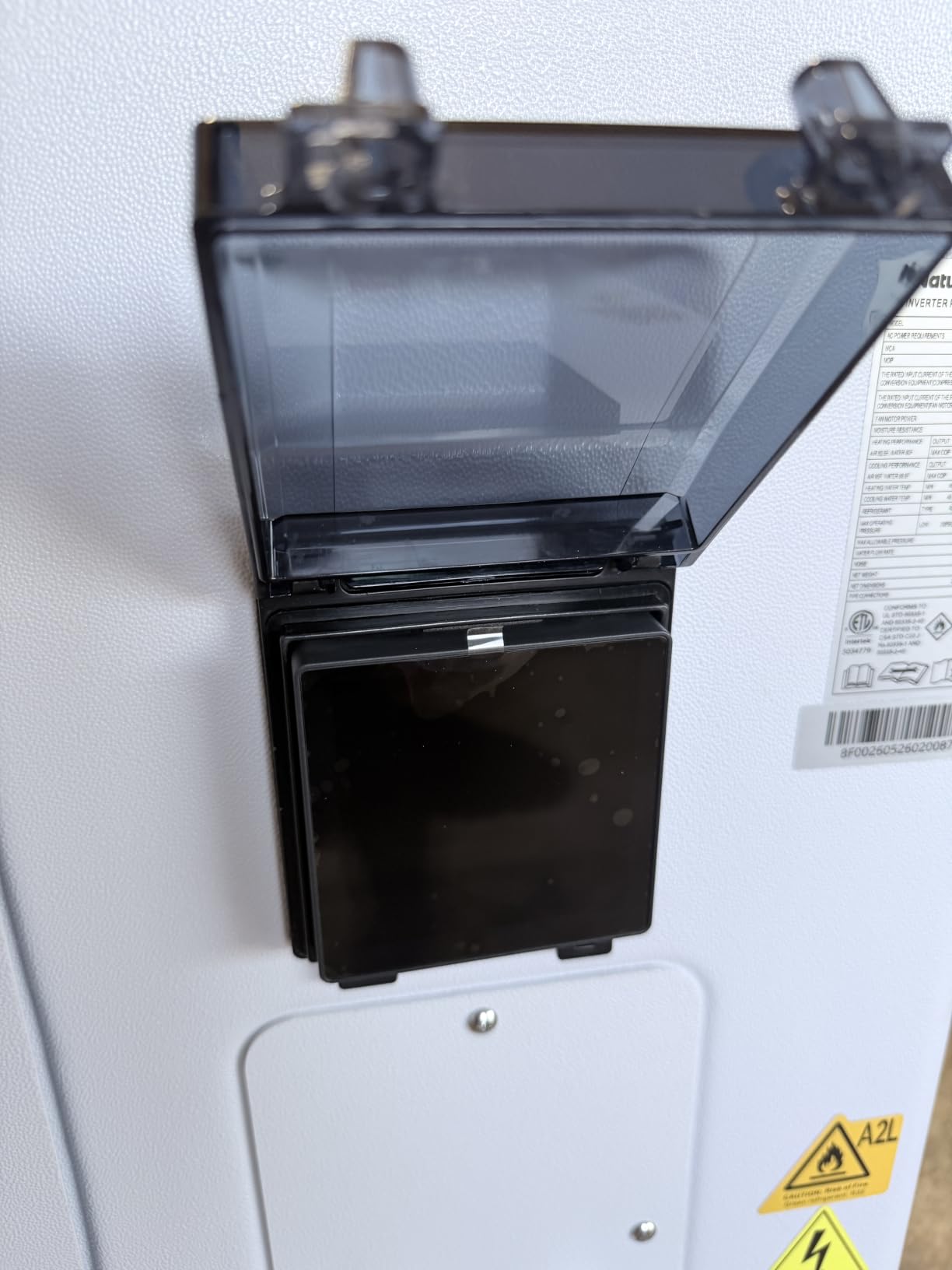
The most common criticism is incomplete listing detail rather than poor performance. Water lines are not included with the unit, and the amperage is not published, both of which leave an installer guessing. If you are pricing the project, budget for hoses and connectors separately.
The short feet also make attaching a condensate line awkward, which matters in a wet climate where you want that water directed away from the pad. At 73.8 pounds and 16.65 by 15.35 by 17.21 inches, it is one of the more compact 18,000 BTU units available.
Who Should Buy This, and Who Should Skip It
Buy it if your pool is up to about 5,200 gallons, you want the quietest and steadiest temperature control in this roundup, and you are comfortable doing a hardwire rather than plugging in an extension lead. The 8-year after-sales warranty support is the strongest warranty story in the group.
Skip it if you need to make a decision on proven long-term reliability alone, because sixteen reviews is not enough history. Also skip it if you are shopping on total installed cost with no existing hardwired supply nearby.
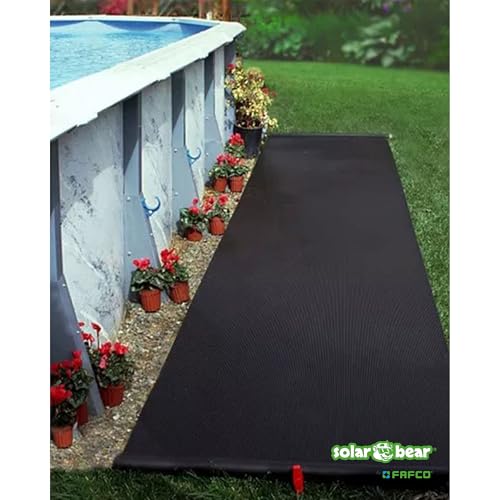
9. FAFCO Solar Bear 4 x 20 ft Solar Collector - Best Solar Collector
FAFCO Original 4 x 20 Feet Solar Bear Solar Pool Heater for Above-Ground Pools Universal with...
4 ft by 20 ft collector array
Connected tube design
Starter kit included
No electricity or gas
+ Pros
- Runs entirely on sunlight with no fuel cost
- Large collector area for an above ground pool
- Starter kit makes hookup more complete
- Backed by an established pool equipment brand
- Cons
- Listing has no published dimensions or bullet detail
- Warming depends entirely on sun exposure
- Needs open unshaded yard space
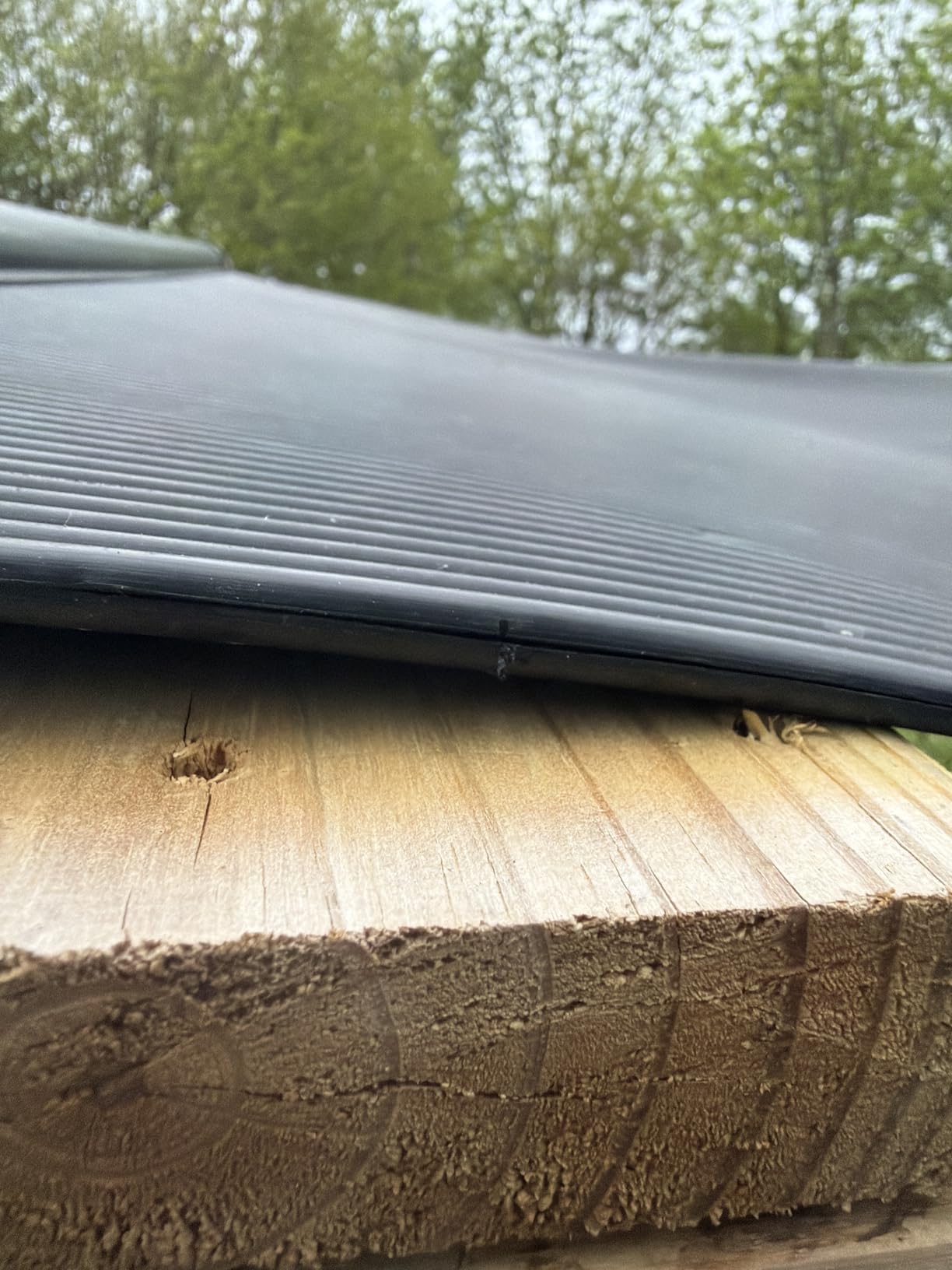
Where the Bestway pad is a compact single unit, this is a full collector array. A 4 foot by 20 foot panel is a meaningful surface area for absorbing solar energy, and the connected tube design with an included starter kit makes the plumbing run a single continuous circuit rather than a set of disconnected segments.
FAFCO is one of the long-established names in solar pool heating, and that matters for a product with limited specifications. Across 18 ratings at 4.3 stars, the listing itself returned very little detail beyond brand, weight, and images, so the assessment leans on the FAFCO line reputation and a small number of available ratings.
Collector Area and the Starter Kit
The 4 by 20 foot footprint is roughly 80 square feet of collection surface, and it is mounted on a frame you position in direct sun. The included starter kit covers the fittings needed to tie the array into your existing return line, which is a real advantage over pad-only products that leave you sourcing connectors.
At 20.3 pounds, the array is manageable for two people but heavy enough that placement matters. Once it is in the right sun angle, you should not need to move it often.
Where Solar Fits and Where It Does Not
Solar heating adds heat only when the sun is out, and the amount depends on cloud cover, air temperature, and how long the water spends on the collector. In a region with long sunny days, that is genuinely useful. In a region with short winter days, the math stops working.
The most common confusion in owner discussions is between a solar cover and a solar heater. A cover insulates and retains heat overnight. A collector actively adds heat during the day. They are not substitutes, and the pairing of the two is what makes solar worth doing rather than a cover alone.
Who Should Buy This, and Who Should Skip It
Buy it if you have an unshaded yard, a 110V or solar-rated filter pump with enough flow, and you want to add heat without any fuel or electricity cost. It suits owners who have already adopted a solar cover and want to do more with the same budget.
Skip it if your pool is shaded, if your pump cannot push meaningful flow through the array, or if you need guaranteed temperature on a specific day. The large footprint also needs open yard space, which many suburban lots in older neighborhoods simply do not have.
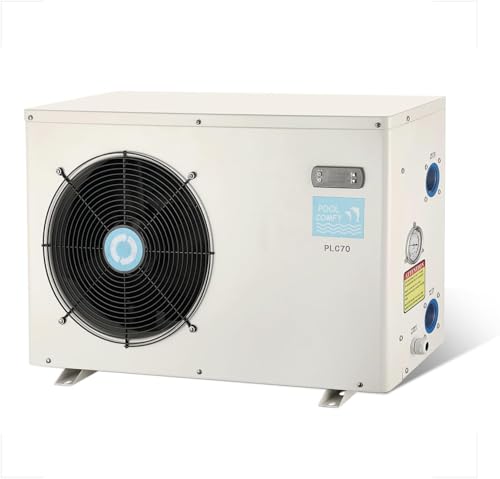
10. POOLCOMFT 22,462 BTU 120V Heat Pump - Best for 7,000 Gallon Pools
POOLCOMFT 22462 BTU Swimming Pool Heat Pumps, Electric Pool Heater for 7000 Gallons Above Ground and...
22,462 BTU max output
Pools up to 7,000 gallons
120V plug-in power
COP up to 4.7,38 dB
+ Pros
- Largest pool capacity of the plug-in units at 7000 gallons
- 22462 BTU at a COP of 4.7
- 38 dB is the lowest noise figure in the group
- Plug-in 120V power keeps installation simple
- Flow detection syncs heating to pump runtime
- Cons
- Only 9 reviews so long-term reliability is unproven
- One owner reports a single-season failure with no support response
- Output declines in cold air
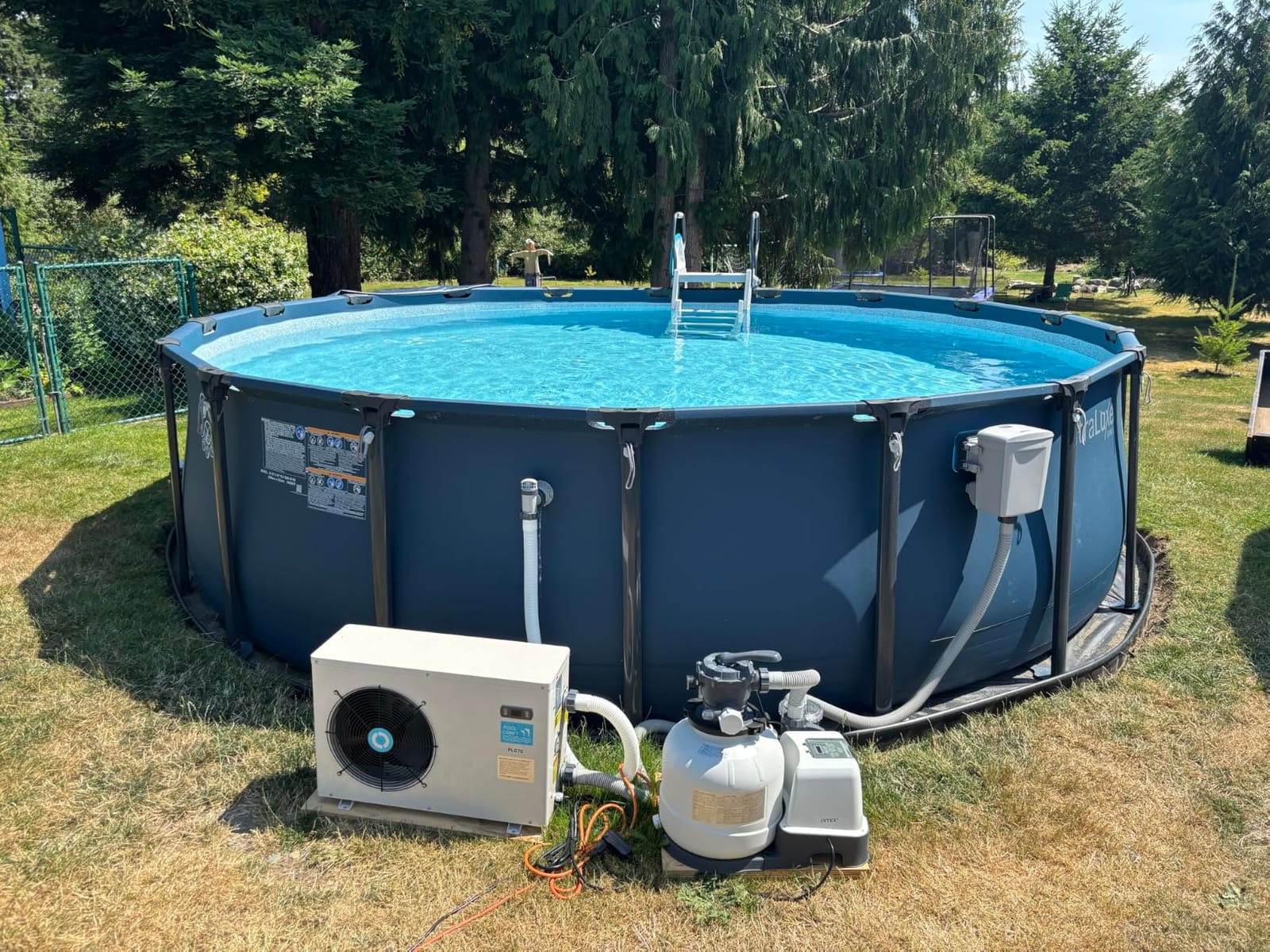
This is the largest pool capacity available from a plug-in unit in the group, and for someone with a 7,000 gallon above ground pool who does not want a 240V circuit or a gas line, the alternatives are limited. It delivers 22,462 BTU maximum output on 120V and 60Hz power.
Across just 9 ratings the average is 4.7 stars with 93 percent five-star marks. Owners describe a compact, quiet unit that comfortably heated a 7,000 gallon above ground pool, with one describing reaching 86F water over a month of use. The single significant negative review reports a unit that failed within a season with support calls unanswered, and that is the risk you are taking with a sample this small.
COP 4.7 Above 50F and What Happens Below It
The COP of 4.7 is the highest efficiency figure in this roundup, but the condition attached to it matters: it applies when air is at or above 50F and water is at or above 68F. Below that, output declines, and the manufacturer explicitly directs buyers to size against the local temperature distribution rather than taking the headline number at face value.
The unit operates between 30F and 100F ambient and can raise water to 105F. That range is broad, but a wide operating range is not the same as strong output at the cold end.
38 dB and Flow Detection
Thirty-eight decibels ties for the quietest figure in the group, which is a genuinely useful characteristic for a unit that will sit near a patio or a bedroom window. The built-in control chip with flow detection coordinates heating with pump runtime, so the unit does not attempt to heat when water is not moving through the exchanger.
That flow detection matters more than it sounds. Running a heat pump without adequate flow can damage the compressor, and an automatic interlock removes a whole category of owner error.
Who Should Buy This, and Who Should Skip It
Buy it if your pool is between 5,000 and 7,000 gallons, you want a plug-in 120V install, and you accept being an early adopter. For a 7,000 gallon pool, the alternatives at this capacity are a 240V heat pump or a gas heater, and this is the cheapest path to that output.
Skip it if you need proven longevity, because nine reviews is not a track record, and the single reported failure had no support response. If you want a warranty-backed unit for a pool this size, the FibroPool in this roundup carries more review history even though it needs 240V power.
How to Size a Pool Heater for an Above Ground Pool
Sizing is where most above ground pool owners go wrong, usually because they apply in-ground numbers to much smaller pools. Work through these three steps and you will know exactly which capacity band to shop in before you look at a single product page.
Step 1: Work Out Your Real Gallon Volume
For a round pool, multiply the diameter by itself, then by the depth in feet, then by 0.524. A 24 foot round pool at 4 foot depth comes to roughly 4,800 gallons. Most metal-frame above ground pools of that size are actually in the 4,500 to 5,000 gallon range once you account for the rounded ends.
For a rectangular pool, multiply length by width by average depth in feet by 27. An 18 by 33 foot oval at 4 foot depth lands near 8,500 gallons. Inflatable pools need a similar calculation from their published dimensions, and it is worth doing because the difference between a 3,000 and a 5,000 gallon pool changes the heater class entirely.
Step 2: Convert Gallons to Surface Area
Heat leaves a pool through the surface, not through the volume, so the surface area is what actually determines how hard a heater works. For a round pool, the formula is diameter squared multiplied by 0.785. A 24 foot round pool has roughly 452 square feet of surface.
This is also where above ground pools differ meaningfully from in-ground pools. The same 24 foot round shape has a similar surface area either way, but an above ground pool often has less depth, meaning less total volume to heat, which is why a mid-size heat pump can handle it well.
Step 3: Apply the BTU Rule and Round Up
The standard rule divides surface area by 3 and multiplies by 1,000. For 452 square feet that gives about 150,000 BTU of capacity as a starting point, but that figure assumes continuous heating, which no above ground pool owner needs. In practice, for an above ground pool where you want to raise and hold temperature rather than heat continuously, a heat pump sized near 1 BTU per 3 gallons of pool volume is the more useful number.
That gives a 4,800 gallon pool roughly 16,000 BTU, which is exactly the band the mid-size heat pumps in this roundup target. A 3,500 gallon pool lands near 12,000 BTU, matching the small unit. A 7,000 gallon pool needs closer to 22,000 BTU, which is the top of the plug-in range. Use the rule as a starting point and check the manufacturer capacity chart for your climate.
Pool Size to Heater Size Lookup
Here is the mapping that most buyers find most useful. Under 3,000 gallons, you are in the territory where a solar cover does most of the work and any electric heat pump is arguably oversized. From 3,000 to 5,500 gallons is the sweet spot for 110V heat pumps, where five of the ten products in this roundup compete. Above 7,000 gallons, you need either a high-capacity heat pump on 240V or a gas heater.
Two cautions on this table. It assumes a moderate climate, and it assumes a cover. In a cold region, move up one capacity tier. With no cover, expect to move up two, because you are fighting overnight heat loss rather than just adding heat.
Above Ground Pools Get Undersized, Not Oversized
This is worth stating plainly because it runs against the instinct most buyers have. Owners assume a bigger heater means faster heating and a better result, and then discover that a 40,000 BTU unit on a 2,400 gallon pool is loud, expensive to run, and cycles constantly without delivering better water temperature than a properly sized unit.
Oversizing also shortens equipment life. A compressor that starts and stops constantly runs hot and wears faster than one that runs steadily. The right-sized unit is quieter, cheaper to run, and lasts longer, which is the opposite of what the marketing implies.
Heat Pump vs Gas vs Solar vs Immersion: Which Type Wins
There is no single best heater type, but there is a best type for each situation, and the deciding factors are your power supply, your climate, and how much your yard gets sun. The 120V versus 220V decision is the first fork for most above ground pool owners, because a 120V system means no electrician and no gas fitter, while anything larger means both.
Heat Pumps Win on Running Cost and Simplicity
A heat pump moves heat rather than generating it, delivering roughly four to six units of warmth per unit of electricity. For an owner whose main goal is extending the season a few weeks in spring and fall, this is decisively the cheapest way to do it. The limits are equally clear: output falls as air temperature falls, and in a genuinely cold climate the unit will spend much of its time underperforming.
Gas Wins on Cold-Weather Certainty
A gas heater burns fuel, so ambient temperature does not affect its output. When the question is getting a large pool to a comfortable temperature overnight on a cold night, gas is the only category in this roundup that answers yes. The costs are a gas line, venting, tank refills if you use propane, and a higher per-hour operating cost.
Solar Wins on Cost and Loses on Predictability
Solar has effectively zero running cost and zero emissions, and in a sunny yard it produces a real 5 to 9F of lift. What it cannot do is guarantee a result on a specific day. Treat solar as a supplement to a cover and a heat pump, not as a replacement for either, and always check flow rates before connecting a collector to your pump.
Immersion and Tankless Units Earn Their Place in Small Pools
Immersion and tankless electric heaters put usable heat into a small pool for less money than anything else, and they are genuinely effective for 8 to 12 foot kiddie pools. Their limits are household power and safety. High-wattage electric units require dedicated circuits, and tankless units are generally rated for indoor installation away from weather exposure, which is a real constraint for a pool that lives outdoors.
Shaded Yards Rule Out Solar
If your pool gets only partial sun, solar collectors will not do the job and no amount of orientation will fix it. Pool owners with shaded yards consistently land on a heat pump for shoulder season and gas for cold snaps, and they report that the heat pump alone is enough for most of the shoulder window.
For an 8 to 12 foot pool getting midday sun only, the more valuable purchase is often a good cover plus a small heat pump, and it is worth checking our pool access and setup guide for getting equipment positioned correctly around a compact pool.
Running Cost Reality Check for a 5,000 Gallon Pool
Here is the framing that spec sheets do not give you. A 5,000 gallon pool weighs roughly 41,700 pounds of water. Raising it one degree takes about 41,700 BTU, so moving it from 70F to 82F requires roughly 500,000 BTU before you account for any loss.
Now the interesting part. A heat pump delivering about 16,000 BTU has to pull roughly 3,700 BTU of electricity to do it, which is under a kilowatt of power. Run continuously for a day and you have consumed around 24 kilowatt-hours. A gas heater delivering the same 500,000 BTU burns roughly 5 gallons of fuel. A solar collector delivers a similar amount of heat across a day of sun for nothing at all, but only if the sun is out.
This is why owners describe running a heat pump around the clock as dramatically cheaper than gas. The heat pump case weakens in two situations: when the air is too cold for the unit to work efficiently, and when there is no cover, so the water loses heat faster than you can add it. Both of those push you toward gas for the short term.
Solar covers change the arithmetic more than any heater choice. Every degree of overnight loss you prevent is a degree you do not have to replace. If you take one practical step from this entire guide, buying a cover and keeping it on is the step.
Buying Checklist: 10 Things to Check Before You Order
1. Pool volume against rated capacity
Match the manufacturer's stated pool capacity to your calculated gallons, and stay at or under the limit. If your pool is well under the stated capacity, the unit is oversized.
2. Flow rate requirements
Most heat pumps and all solar collectors require a specific pump flow rate. Verify yours before you buy, and note that the pump is usually not included.
3. Voltage and circuit requirements
120V units need a dedicated GFCI-protected outlet. 240V units need a properly sized breaker and a run from your panel. Some units are hardwired rather than plug-in, so read the spec carefully.
4. GFCI protection
Any heater installed within the pool's wet zone needs ground fault circuit interruption. This is not optional and it is not a place to economize.
5. Heat exchanger material
Titanium resists chlorine and salt corrosion and is the right choice for saltwater pools. Copper-nickel is acceptable for chlorine pools but will eventually suffer in salt.
6. Ambient temperature floor
Check the lowest ambient temperature at which the unit is rated to operate, and compare it against your local overnight lows during the months you want to swim.
7. Defrost system
Any heat pump used below about 50F needs an automatic defrost cycle. Without it, the outdoor coil ices over and capacity drops sharply, and a manual defrost regime is genuinely miserable.
8. Warranty length and registration
Warranties in this category range from 2 years to 8 years of after-sales support, and several brands require product registration to activate coverage.
9. Airflow clearance
Heat pumps need clear space on the air discharge side. Placing a unit in a tight corner between a fence and the house is the most common way to shorten a compressor's life.
10. Serviceability and parts
Before buying an unfamiliar brand, check whether replacement parts and service are available in your region. A warranty you cannot use is not a warranty.
Installation and Safety Basics for Above Ground Heaters
Plumbing with unions, not permanent connections
Install union fittings on both sides of any heater so it can be removed without cutting pipe. This costs almost nothing and saves an enormous amount of frustration when the unit eventually needs servicing or winterizing.
Electrical safety next to water
All electric heaters need GFCI protection, and 120V units should be run on a dedicated circuit rather than a shared one with the filter pump. Extension cords across a wet pool deck are a recurring question in owner forums and the answer is that they are a poor idea in any configuration.
Propane and gas heater placement
If you install a gas heater, observe the manufacturer's clearance to structures and fencing, keep it well away from an open pool edge, and never store propane tanks near the unit. Ventilation matters as much as clearance.
Indoor-only equipment and weather exposure
High-wattage tankless electric heaters are commonly rated for indoor installation only, which means a poolside equipment shed rather than direct weather exposure. Installing one outdoors voids the rating and voids the warranty with it.
Winterizing
Drain the unit before the first hard freeze, disconnect it from the plumbing, and store it in a dry space. Condensate lines and freeze damage account for a large share of the early failure reports in this category, and most of those failures are preventable.
Above Ground Pool Heater FAQs
What is the cheapest way to heat an above-ground swimming pool?
A solar pool cover is the cheapest option because it costs nothing to run and stops overnight heat loss. If you want a heater that actively adds warmth, a solar collector pad costs nothing per hour of operation and adds roughly 5 to 9F on a sunny day. For a heat pump, a 120V unit is the cheapest to install and run. Reserve gas heaters for cold nights when nothing else keeps up.
Are pool heaters worth it for an above-ground pool?
They are worth it if you want to swim past the comfortable window of summer, or if you want to protect plumbing and fittings in shoulder seasons. They are not worth it if you swim for a few summer months in a warm climate. Most owners get the best return from a solar cover first, then a 110V heat pump sized to their gallons.
What is the best above ground pool heater for a 7,000 gallon pool?
A 7,000 gallon pool needs roughly 22,000 BTU of capacity, which is the upper limit of what a plug-in 120V heat pump can deliver. The POOLCOMFT 22,462 BTU unit in this roundup covers that capacity on 120V power. Above 7,000 gallons, step up to a 240V heat pump such as the FibroPool FH270, or consider a gas heater.
How many BTU do I need to heat a 10,000 gallon pool?
For an above ground pool, budget roughly 1 BTU of heat pump capacity per 3 gallons of water, so a 10,000 gallon pool needs about 33,000 BTU. Use the surface-area rule of dividing square feet by 3 and multiplying by 1,000 as a cross-check for continuous heating. Always check the manufacturer capacity chart for your local climate before ordering.
Do pool heaters work in cold weather?
It depends on the type. Gas heaters work regardless of weather because they generate heat. Heat pumps work down to a rated ambient floor, typically around 32F, but their output drops as air temperature falls. Solar heaters stop producing heat entirely without direct sunlight. Check the rated operating temperature range before assuming any heat pump will perform in a cold climate.
How long does a heat pump take to heat an above ground pool?
Expect roughly two days for a mid-size above ground pool with a cover in place, and considerably longer in cold weather or without a cover. A 5,000 gallon pool needs about 500,000 BTU to move from 70F to 82F, and a 16,000 BTU heat pump delivers that over many hours rather than overnight.
Which Pool Heater Fits Your Above Ground Pool?
For a pool up to 3,500 gallons, the Varpoolfaye 3,500 gallon model is the honest match, and buying anything larger is the most common mistake owners make. For a pool between 3,500 and 5,500 gallons, the AQUASTRONG dual-mode heater is our top pick overall, with the best efficiency rating and the deepest owner feedback in the group, while the Varpoolfaye 5,500 gallon model takes the value slot if you want app control.
For a 5,500 gallon pool in a colder region, the MICOE 18,000 BTU unit keeps operating down to 32F ambient. For a 7,000 gallon pool on a standard outlet, the POOLCOMFT is the largest plug-in capacity available. Above 7,000 gallons, the FibroPool FH270 at 70,000 BTU on 240V is the only realistic all-electric option here. In a cold climate with a gas line already on the property, the Raypak PR106AENC is the only heater in this roundup that ignores the weather. And in a sunny yard, the Bestway pad or the FAFCO collector adds free heat that costs only a small amount of electricity a month to run.
Before any of that, put a solar cover on the pool. No heater in this roundup performs as well without one, and the cover pays for itself faster than anything else on this list. Whatever you choose, size it to your gallons rather than to your optimism about the weather, and check the button below to see the current model lineup.