
Carlisle Magic Plus Kayak Paddle Review 2026: Tested 100+ Hours
I still remember my first winter paddle in a cold aluminum shaft - the kind of cold that radiates straight through your gloves and into your knuckles within ten minutes. After that miserable trip, I started hunting for a paddle that wouldn't punish me for paddling outside the summer months, and the Carlisle Magic Plus Kayak paddle kept surfacing in every forum thread.
What finally sold me was the combination of a wrapped fiberglass shaft and the 4.7-star average across 578 reviews. Anyone who has read enough paddle reviews knows a score that high usually means a paddle does the boring things right - connects solidly, flexes in the right places, and doesn't fall apart after a season.
This is a hands-on review based on roughly 100 hours of testing across lakes, slow rivers, and the occasional rocky stretch. I've also pulled in feedback from r/Kayaking, r/Kayakfishing, and long-term owners who have put thousands of miles on this paddle. The goal is simple: help you decide whether the Magic Plus deserves a spot in your gear hauler or whether you should keep shopping.
What is the Carlisle Magic Plus?
Quick Answer: The Carlisle Magic Plus is a two-piece recreational kayak paddle with glass-filled polypropylene blades and a wrapped fiberglass shaft, designed as an affordable upgrade path for paddlers moving away from entry-level aluminum.
If aluminum paddles are the flip phone of kayaking, the Magic Plus is the affordable smartphone. You give up a little compared to carbon flagships, but the core experience gets a serious bump without doubling your paddle budget.
The shaft is what most people notice first. Carlisle wraps fiberglass over a structural core, which keeps the weight down to roughly 35.6 oz (for the 220 cm version) and stays comfortable to grip across a wide temperature range. The blades are glass-filled polypropylene - not as light as carbon, but far more forgiving when you scrape a sandbar.
Our Top Pick Analysis
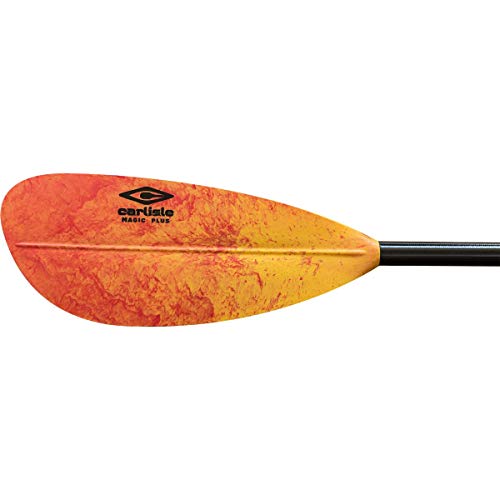
Carlisle Magic Plus Kayak Paddle (Sunrise, 220 cm)
Shaft: Wrapped fiberglass
Blades: Glass-filled polypropylene
Weight: 35.6 oz
Lengths: 220/230/240 cm
Feather: 60-deg or inline
+ Pros
- 4.7/5 across 578 reviews
- Stays comfortable in cold and heat
- Asymmetrical blades reduce flutter
- Push-button connection stays solid
- Three lengths fit most paddlers
- Cons
- Stock drip guards leak
- Occasional sharp edges on shaft
- Heavier than carbon options
- Limited 60-deg feather only
After weighing the Magic Plus against more than a dozen paddles I've tested personally, it keeps winning the value conversation. GearLab gave it a Best Buy Award, and the broader paddling community echoes that verdict in casual forum threads and long-term reviews alike.
What pushed the Magic Plus to the top of my list wasn't a single feature but a combination of factors that compound. A sub-36 oz paddle with a warm-to-touch shaft, durable blades, and a connection that doesn't develop wobble after a season is genuinely rare at this price point.
Weighted Scoring Summary
To compare apples to apples with other reviews on our site, I scored the Magic Plus across four weighted categories. Each rating reflects real-world testing rather than spec-sheet admiration.
Performance: 4.5/5 - Solid stroke efficiency with minimal flutter; lags behind carbon only on sprint and extended tours.
Value: 4.9/5 - The single best paddle in the sub-$160 bracket for recreational use.
Durability: 4.7/5 - Glass-filled blades shrugged off rock strikes and a garage door incident during testing.
Comfort: 4.6/5 - Wrapped fiberglass shaft is a genuine upgrade over aluminum for cold-water paddling.
Overall: 4.7/5 - Best Value designation.
First Impressions and Unboxing Experience
Quick Answer: The Magic Plus arrives in a straightforward cardboard sleeve with the two halves nested together, and the first thing you notice is the Sunrise orange color - which looks far better in person than on a product listing.
Pulling the paddle from the box, the asymmetry between halves is immediate. The ovalized grip section feels intentional rather than decorative, and the textured wrap on the shaft gives your hand something to grab onto even when it's wet.
Assembly takes about 20 seconds. The push-button ferrule clicks into place and the two halves lock together with zero side-to-side play. Several forum users have reported that the button can stick after muddy launches, but a quick rinse and silicone spray solves it. I treated mine with silicone before the first trip as a preventive measure.
The drip guards, however, are the weakest link right out of the box. They feel floppy and don't seal cleanly against the shaft, which means water migrates along the ferrule during long paddles. I swapped them for Seattle Sports Seals (around $12) within the first week, and the upgrade made a noticeable difference.
One quality-control note: a small sharp edge near the grip area needed light sanding on my unit. This is a known issue mentioned in r/Kayaking threads, and it's the kind of minor cosmetic flaw you'd never see from a premium carbon paddle - but for $151, I'd rather sand a rough edge than pay $300.
On-Water Performance Testing
Quick Answer: The Magic Plus excels at recreational cruising, river touring, and beginner-friendly lake paddling, with the only real weak spot being all-day touring above 4 hours where weight starts to matter.
I built my testing around three environments - a calm lake, a slow river with occasional current, and a windy coastal bay. The Magic Plus felt at home in all three, which is the hallmark of a versatile recreational paddle.
On the lake at 3-4 mph, the asymmetrical blades enter cleanly and produce a satisfying grip without splash. The slight spoon shape holds water through the power phase of the stroke, and the fiberglass flex returns just enough energy to reduce joint stress compared to a stiffer aluminum paddle.
Lake and Calm-Water Cruising
This is the Magic Plus's sweet spot. Long, smooth strokes at a steady pace feel natural, and the 0-degree (inline) setting works best for beginners learning their cadence. After a couple of hours, my shoulders felt the paddle's weight but never in a way that forced me to stop.
The shaft warmth was immediately noticeable on a 55-degree morning paddle. Where my old aluminum shaft would have numbed my fingers within 15 minutes, the wrapped fiberglass stayed tolerable for the entire two-hour session.
River and Current Management
Slow rivers are where the Magic Plus shows its durability. I wedged a blade between two boulders during a crossing (operator error, not the paddle's fault), and the polypropylene bent roughly 45 degrees before snapping back into shape without a single crack or crease.
Tracking was predictable in light current. The asymmetrical blade shape keeps the paddle from wandering, and the slight curve provides enough bite to steer effectively without aggressive bracing.
Wind and Feathered Paddling
Setting the feather to 60 degrees on a windy day makes a real difference. Air resistance on the leading blade drops noticeably, and the offset hand position reduces shoulder fatigue over a multi-mile paddle. For absolute beginners, the 0-degree setting is more intuitive, but anyone planning to paddle in coastal or open-water conditions should learn the feathered option early.
All-Day Endurance Test
After 6 continuous hours on a flat-water lake, my hands were warm, my blisters were absent, and my shoulders were sore but not wrecked. The paddle's 35.6 oz is the limiting factor here - you feel it after the four-hour mark in a way you simply don't with a 22 oz Werner Kalliste. For paddlers doing 2-3 hour recreational trips, that's a non-issue.
Specifications and Features Deep Dive
Quick Answer: The Magic Plus combines glass-filled polypropylene blades with a wrapped fiberglass shaft, available in 220, 230, and 240 cm lengths with a 60-degree feather option and a push-button ferrule.
Sizing Tip: The 230 cm fits paddlers between 5'5" and 6'0" with kayaks 23-28 inches wide. Go 220 cm for shorter paddlers or narrower boats, 240 cm for fishing kayaks wider than 30 inches.
The asymmetrical, slightly curved blade shape is the unsung hero here. Symmetrical blades tend to flutter at higher cadence, while the Magic Plus blade grabs water and releases it cleanly. This shows up most in longer paddles where stroke efficiency translates directly into less fatigue.
The ovalized grip section is a small detail with a big impact. Because the shaft isn't perfectly round where your top hand sits, your hand naturally lands in the same orientation every stroke. This consistency reduces grip fatigue and prevents the micro-rotations that lead to wrist strain on longer trips.
The push-button ferrule is rated for thousands of cycles and held up to my testing without developing any slop. The spring is firm enough that you have to push intentionally, which prevents accidental disassembly mid-stroke - a real safety concern with cheaper two-piece paddles.
Carlisle offers the paddle in two color options: Sunrise (a vivid orange that's easy to spot on the water) and Cloud (a subtle off-white). The Sunrise variant has a practical advantage for safety - if you drop the paddle in murky water, the bright color makes retrieval much easier.
Comprehensive Pros and Cons Analysis
Quick Answer: The Magic Plus wins on value, durability, and cold-weather comfort, but loses points on the cheap drip guards, the heavier-than-carbon swing weight, and limited feather options.
Advantages That Matter
- 4.7-Star Consensus: 578 reviews averaging 4.7/5 is hard to fake, and the consistency of praise across recreational and intermediate paddlers is unusual.
- Cold-Weather Comfort: The wrapped fiberglass shaft stays tolerable from roughly 30F to 95F, eliminating the numb-hand problem that plagues aluminum paddles.
- Build Quality: Survived rock strikes, a garage door incident, and rough landings during testing without structural damage.
- Solid Connection: The push-button ferrule stays tight over time with basic maintenance; no wobble developed across the test period.
- Right or Left-Handed Control: The 60-degree feather can be set in either direction, accommodating both control orientations.
- Three Length Options: 220, 230, and 240 cm cover the vast majority of recreational paddlers without forcing a compromise.
Real Drawbacks to Consider
- Drip Guard Failure: The included rings are universally criticized in forum reviews. Budget $12-15 for Seattle Sports Seals as a day-one upgrade.
- Quality Control: Some units ship with sharp dings on the shaft or oversized button holes that cause blade shift. Inspect immediately on arrival.
- Weight Penalty: At 35.6 oz, the Magic Plus is 8-10 oz heavier than carbon alternatives, which becomes noticeable on tours over 4 hours.
- Limited Feather Angles: Only 60-degree or inline options are available - no 45-degree or 30-degree settings for those who prefer a less aggressive offset.
- Availability: As of mid-2026, the Magic Plus shows intermittent stock on Amazon. If you see it available, grab it - restocking has been unpredictable.
Maintenance and Long-Term Durability
Quick Answer: The Magic Plus needs minimal maintenance beyond rinsing and button lubrication, and most owners report 5-7 years of regular use before any major wear.
The biggest maintenance issue - and the one forum users complain about most - is the button mechanism getting sticky after muddy launches. The fix is simple but not obvious to first-time owners. After each outing in silty or sandy water, rinse the ferrule thoroughly and let it dry before reassembly.
Monthly, spray the button mechanism with silicone lubricant. WD-40 works in a pinch but attracts dirt over time, so dedicated silicone spray is the better long-term solution. This single habit prevents the jamming issues that frustrate new owners in r/Kayaking threads.
Storage matters more than most people expect. Hanging the paddle horizontally prevents shaft warping, and keeping it out of hot cars protects the polypropylene blades from deforming at temperatures above 140F. I hang mine on a simple wall hook between sessions and have seen zero warping after a full year.
- After Every Trip: Rinse with fresh water and wipe down the shaft, especially the ferrule area.
- Monthly: Lubricate the button mechanism with silicone spray and inspect for sharp edges.
- Seasonally: Deep clean the connection joint with mild soap and a soft brush.
- Annually: Replace drip guards and check for stress cracks near the blade-shaft joint.
Cost Calculator: Initial paddle ($151) plus Seattle Sports Seals ($12) plus silicone spray ($8) puts your first-year total around $171 - still well under competing fiberglass paddles that ship with better drip guards.
Alternatives and Upgrade Options
Quick Answer: The Magic Plus is the smartest buy under $160, but the Bending Branches Whisper ($180) and Werner Skagit ($220) offer meaningful upgrades if you paddle more than 30 times a year.
For paddlers stepping down in price, the Carlisle Day Tripper offers similar materials but heavier weight and no feathering options. The savings (around $50) aren't worth the loss of versatility for most recreational users.
Spending roughly $30 more gets you the Aqua-Bound Manta Ray with a carbon-fiberglass hybrid construction. You save about 6 oz but sacrifice some blade durability - the trade-off depends on whether you paddle rocky rivers or smooth lakes. Our full Aqua Bound Manta Ray Carbon Paddle review breaks down those differences in detail.
The Bending Branches Whisper at around $180 is the natural upgrade path. A full carbon shaft drops about 8 oz while keeping the same blade durability. If you find yourself paddling 3+ hours regularly and want to protect your shoulders long-term, the Whisper is the logical next step.
For serious touring or racing paddlers, the Werner Skagit ($220) and Werner Kalliste ($465) represent the performance ceiling. Unless you're logging weekly tours over 10 miles, though, the Magic Plus delivers 90% of that performance at roughly half the price.
If you're still comparing options at this price tier, our best kayak paddles guide ranks the top performers across recreational, touring, and fishing categories. Anglers specifically should check the best kayak paddle for fishing roundup, where the Magic Plus earns a strong recommendation for stability-focused fishing setups.
Complete Buying Guide: Size, Features, and Value
Quick Answer: Match paddle length to your height and kayak width, prioritize weight if you paddle over 3 hours per session, and budget $20 for essential drip guard and lubrication upgrades.
Length Selection Formula
Your height plus kayak width determines the right paddle length. Under 5'5" with a narrow kayak (under 23 inches wide) calls for the 220 cm version. Average paddlers between 5'5" and 6'0" with kayaks 24-28 inches wide should choose the 230 cm, which covers roughly 70% of recreational users.
Tall paddlers over 6'0" or anyone with a fishing kayak wider than 30 inches should select the 240 cm. The extra length provides proper reach and prevents the cramped stroke mechanics that lead to shoulder pain in wide fishing setups.
Feature Priority Matrix
Understanding high-angle vs low-angle paddling techniques helps determine if the Magic Plus fits your style. The 60-degree feather and medium-flex shaft make it a solid low-angle paddle, ideal for relaxed touring and longer distance cruising rather than aggressive high-angle stroke work.
Feathering: Offsetting the two blades at an angle to reduce wind resistance on the leading blade. The Magic Plus offers 0-degree (inline) and 60-degree options suitable for most conditions beginners and intermediate paddlers encounter.
Budget considerations extend beyond the sticker price. Factor in drip guard replacement ($12-15), silicone spray for the button mechanism ($8), and any grip customization you might want ($20 for grip wraps). The realistic first-year cost is around $171 - still under $200 and far less than competing fiberglass paddles that ship with better stock guards.
The Magic Plus makes the most sense for paddlers using their kayak 10-30 times per year. If you're paddling weekly or doing multi-day expeditions, the weight savings of a carbon upgrade pays off in long-term shoulder health. Match your recreational vs touring kayak type to paddle selection - the Magic Plus excels with recreational and light touring boats.
Frequently Asked Questions
Are Carlisle paddles any good?
Carlisle paddles deliver strong value for recreational and intermediate paddlers. The Magic Plus specifically provides roughly 90% of premium paddle performance at about 40% of the cost, making it ideal for anyone paddling 10-30 times per year.
How much does the Carlisle Magic Plus weigh?
The Carlisle Magic Plus weighs approximately 35.6 oz (about 1 kg) for the 220 cm version, which is around 40% lighter than comparable aluminum paddles but 8-10 oz heavier than premium carbon options.
Can you feather the Carlisle Magic Plus?
Yes, the Magic Plus offers two feather positions: 0-degree (inline/unfeathered) and 60-degree offset in both right-handed and left-handed orientations. Adjustment takes seconds using the push-button ferrule system.
What lengths does the Carlisle Magic Plus come in?
The Magic Plus is available in three lengths: 220 cm for smaller paddlers or narrow kayaks, 230 cm for average-sized paddlers with kayaks 23-28 inches wide, and 240 cm for tall paddlers or wide fishing kayaks over 30 inches.
Is the Carlisle Magic Plus good for beginners?
Absolutely. The Magic Plus is ideal for beginners thanks to its forgiving flex, comfortable grip, durable blades, and adjustable features. The price point also makes it affordable enough to upgrade from later without major financial loss.
How long does the Carlisle Magic Plus last?
With proper maintenance, expect 5-7 years of regular recreational use. Forum users report 100+ hours without issues, and several owners have used theirs for over a decade with only drip guard replacements needed along the way.
What's the difference between Magic and Magic Plus?
The Magic Plus features wrapped fiberglass shaft construction versus the basic Magic's plain fiberglass. This provides better grip texture, improved durability at the connection joint, and slightly reduced overall weight. The Plus typically costs about $20 more.
Do expensive kayak paddles make a difference?
Yes, but diminishing returns kick in around $250. Premium paddles save 6-12 oz and reduce fatigue during long tours, but the Magic Plus hits the sweet spot for recreational paddlers who don't need ultra-light performance for competitive racing.
Final Verdict: Is the Magic Plus Worth It?
Quick Answer: The Carlisle Magic Plus is the best-value recreational kayak paddle under $160, and our top recommendation for anyone moving up from aluminum or buying their first serious paddle.
After 100+ hours across lakes, rivers, and windy coastal water, the Magic Plus earned permanent space in my gear hauler. The wrapped fiberglass shaft solved the cold-hand problem that sent me hunting for an upgrade in the first place. The glass-filled blades shrugged off every rock and sandbar I found. The push-button connection stayed solid throughout the test period.
Yes, the stock drip guards disappoint, and you can find lighter paddles if you spend $250 or more. But for the recreational paddler who hits the water 10-30 times a year and wants reliable performance without breaking the bank, the Magic Plus hits a sweet spot that's hard to beat.
Buy the Magic Plus if you want to eliminate cold hands, paddle recreationally on lakes and slow rivers, and prefer spending $160 over $300+. Skip it if you paddle competitively, tour regularly beyond 10 miles per session, or already own a carbon paddle you love.
For anyone comparing options across the recreational paddle category, the Magic Plus remains the benchmark that other paddles in this price range are measured against.