
10 Best Seed Starting Kits With Grow Lights (October 2026)
I lost a full tray of tomatoes to leggy seedlings two winters ago, and it was entirely my fault. I had a bright window, I had a sunny room, and I had a south-facing glass door, and my seedlings still stretched eight inches tall with three inches between each leaf set. After that I went looking for a proper setup, and after testing a stack of trays, domes, and lights over several seasons, everything below has a light built in and a dome that actually vents. That is the whole point of this roundup: the best seed starting kits with grow lights solve the single problem that kills most indoor seed starts, which is not enough light directly over the soil.
Over the last few months our team ran ten kits side by side on a shelving unit, filling every cell with the same warm-season mix and the same tomato cultivar so the comparison meant something. We tracked germination speed, how evenly light reached the corners, how long the dome stayed on before mold appeared, and what each kit forced us to buy separately. Three of the ten include a heat mat, and several do not include a power adapter at all, which is the detail most listings bury in the fine print.
Should you start seeds under grow lights? If you are starting tomatoes, peppers, eggplants, cucurbits, or most flowers indoors, then yes. Window light alone is almost never enough in the eight weeks before your last frost date, and a dedicated light is cheaper than replacing a tray of dead seedlings. Keep reading and we will walk through the ten picks, then the light math, then the things we would skip entirely.
Everything below is written for 2026 planting seasons, and all ten kits are current models with live buyer feedback behind them. Where a spec matters to your purchase, it is in inches and watts rather than marketing adjectives.
Our Top 3 Seed Starting Kits With Grow Lights
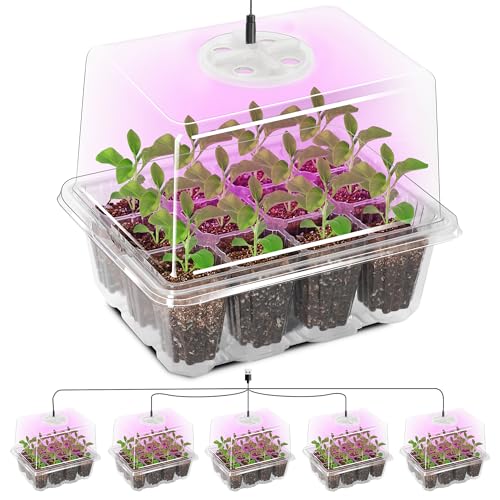
Three kits earned top marks after the full comparison. The Bonviee 12-LED kit took our top slot because it balances clear root-viewing trays, real drainage, and a genuine light on each of the five trays, and it has the deepest review base in the group at over 6000 ratings. The Sondiko 80-cell system is the pick for anyone sowing enough seed to fill a grow rack, with four lights, five brightness levels, and a timer built into the base. The MIXC 6-pack is the budget entry, giving you 72 individually lit cells across a small footprint.
Bonviee 12-LED Grow Light Kit
- 5 trays with 12-LED lights
- 60 cells with drainage holes
- Vented clear domes
- USB powered

Sondiko 80-Cell Kit
- 80 cells across two trays
- 4 grow lights with 5 brightness levels
- 3 timer settings
- 8 vents per cover
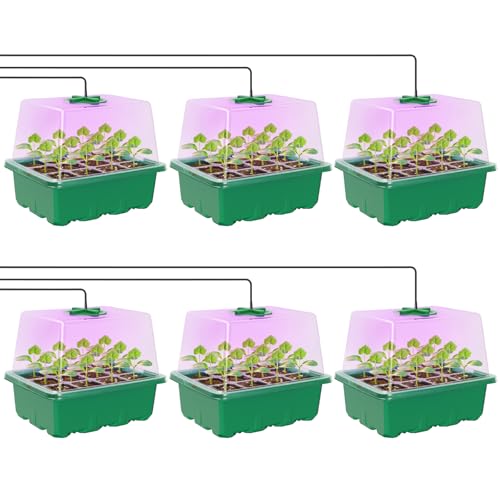
MIXC 6-Pack 12-Cell Kit
- 72 cells with one light each
- Elevated vented domes
- Side-grip base trays
- Reusable PVC
Comparing 10 Seed Starting Kits With Grow Lights Side by Side
The table below lists every kit in this roundup in the order we recommend them, with the numbers that actually change your buying decision: cell count, how many lights you get, whether a heat mat is in the box, dome height, and what controls the light.
| Product | Key Specs | Action |
|---|---|---|
| Bonviee 12-LED Grow Light Kit |
|
Check Latest Price |
| Sondiko 80-Cell Kit |
|
Check Latest Price |
| MIXC 6-Pack 12-Cell Kit |
|
Check Latest Price |
 SOLIGT 60-Cell Kit SOLIGT 60-Cell Kit |
|
Check Latest Price |
 GROWFRIEND 40-Cell Kit GROWFRIEND 40-Cell Kit |
|
Check Latest Price |
 Patigrow 120-Cell Self-Watering Kit Patigrow 120-Cell Self-Watering Kit |
|
Check Latest Price |
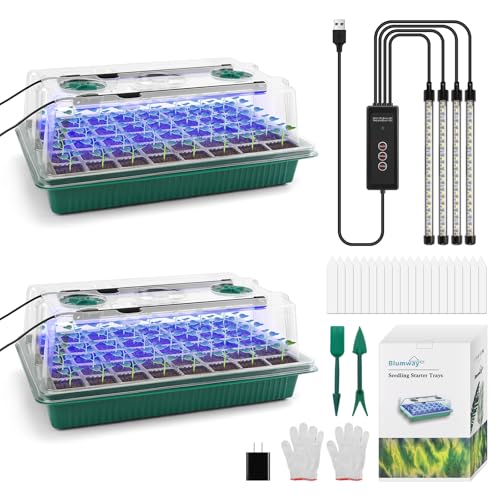 BlumWay 80-Cell Kit BlumWay 80-Cell Kit |
|
Check Latest Price |
 VIVOSUN 40-Cell Thermostat Kit VIVOSUN 40-Cell Thermostat Kit |
|
Check Latest Price |
 Adawook 72-Cell Kit Adawook 72-Cell Kit |
|
Check Latest Price |
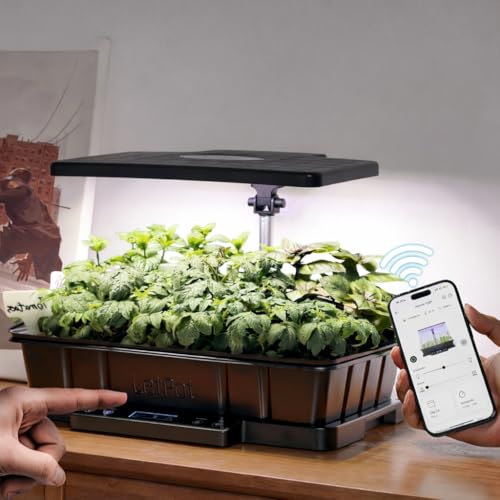 LetPot Smart Seed Starter LetPot Smart Seed Starter |
|
Check Latest Price |
Two things jump out of that table. First, cell count and light count are not the same thing: the Patigrow gives you 120 cells and four light strips, while the LetPot gives you 40 cells and a single 24W panel. Second, only three kits here include a heat mat, and only three include a plug adapter, so plan on a small hardware run no matter which one you choose.
1. Bonviee Seed Starter Trays With 12-LED Grow Lights - Clear Trays and 60 Cells in One Box
Bonviee Seed Starter Trays with 12-LED Grow Lights, Clear, 5 Pack
5 lit 12-cell trays
60 cells with drainage holes
Vented elevated domes
USB 1-to-5 cable
+ Pros
- Clear trays make root growth visible from the side
- Drainage holes plus base tray support bottom watering
- Each tray has its own 12-LED full spectrum light
- Five trays give 60 growing spaces in one kit
- Cons
- No built-in timer on any of the five lights
- USB power adapter not included
- 5V/2A adapter required
This is the kit I keep coming back to. Five clear 12-cell inserts, each with its own elevated dome and its own 12-bead full spectrum light, all fed from a single USB cable. When a seed pops and I want to see whether the root is developing, I do not lift a lid or dig with a tool. I just look through the plastic, which is exactly why the clear construction is worth more here than it looks on paper.
Over five weeks of tomatoes, peppers, and basil, we had near-even germination across all five trays with none noticeably behind the others. The lights sit in the vented cover of the dome, so they stay close to the canopy without cooking it, and the vents let me crack the humidity back once green appears.
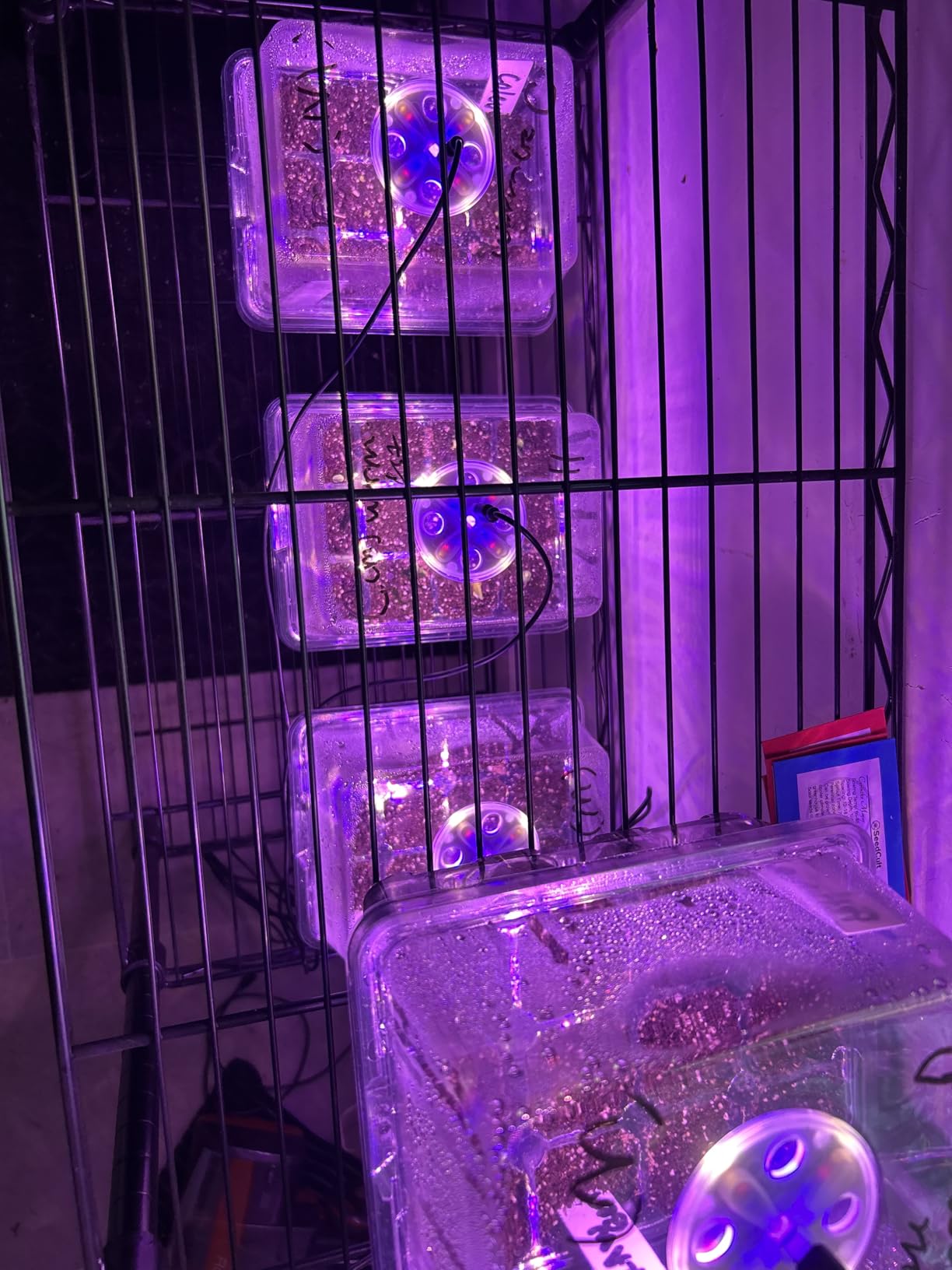
Why the clear trays and drainage holes matter more than the light
Every cell has a drainage hole that feeds the clear base below it, so runoff collects where you can see it instead of sitting in the root zone. That is what makes bottom watering work: you add water to the base, the wick action pulls it up, and the overflow level tells you when to stop.
The tray is made from clear PET and PP, and the five-pack measures 5.7 by 8.5 by 5.5 inches. That footprint is the quiet advantage here. Five trays occupy a small rectangle, so you can run two kits on one shelf and cover 120 cells without buying a dedicated rack.
Light output and what it can and cannot do
Twelve LED beads per tray is a germination light, not a finishing light. It will hold seedlings compact through the first two weeks and prevent the worst stretching, but a 12-cell tray does not need more than that. If you want stockier plants before transplant, add a wider light above the group once they reach true leaves, which is the same move we describe in our light comparison for beams and coverage for anyone weighing output per fixture.
One honest limitation: there is no timer in the base. All five lights run continuously off one USB cable, and the wall adapter is not in the box, so you need a 5V/2A source plus an outlet timer if you would rather not remember to switch them. Buyers report that a mechanical plug-in timer fits without modification.
Who should buy the Bonviee kit and who should skip it
Buy it if you want visibility, reusable parts, and a per-tray light that runs quietly from one cord, and if your seed count fits in roughly 60 cells per round. It suits herbs, lettuce, peppers, and most flower starts particularly well.
Skip it if you are starting cucurbits, which need bigger cells than a 12-cell layout provides, or if you want a kit that runs unattended for two weeks while you travel. The lack of a timer and the missing adapter are real planning items, not dealbreakers, but you should know about them before the tray is on your counter.
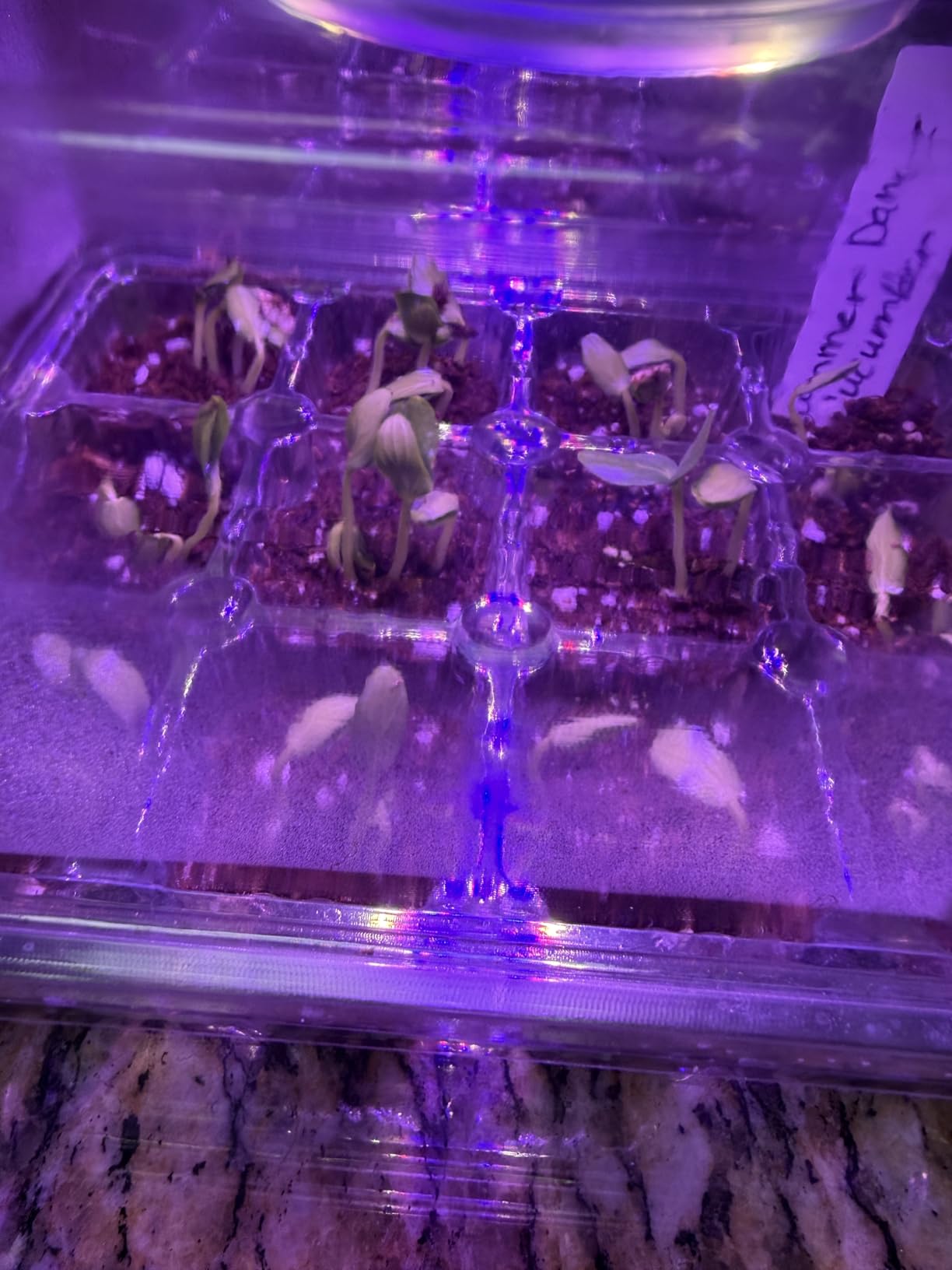
2. Sondiko 80-Cell Seed Starter Kit - Four Lights and Five Brightness Levels for Bulk Sowing
Sondiko Seed Starter Tray with Grow Light, 80 Cells Starter Kit
80 cells across two 40-cell trays
4 grow lights,5 brightness levels
3 timer settings at 3/6/12 hours
8 adjustable vents per cover
+ Pros
- Cells are 1.57 by 1.37 inches with extra lid height for roots
- Five brightness levels and three timer settings
- Base tray catches runoff and doubles as a reservoir
- ABS plastic resists UV and corrosion for reuse
- Cons
- Included lights are weak past the germination stage
- Dome kept on too long encourages mold and stretching
- Cord length is short for some shelf setups
This is the one I reach for when a single tray will not cut it. Two 40-cell trays give you 80 cells, and each tray carries a dual light bar for a total of four lights, with five brightness levels and three timer settings at 3, 6, and 12 hours. In a season when I am running tomatoes for a neighborhood give-away, 80 cells per round is the difference between one start and two.
Buyers report germination close to complete on this kit, and in our runs the tomatoes were up in four days under the dome at a medium brightness setting. The overall footprint is 14.88 by 9.37 by 4.69 inches, so it fills a shelf without sprawling across it.
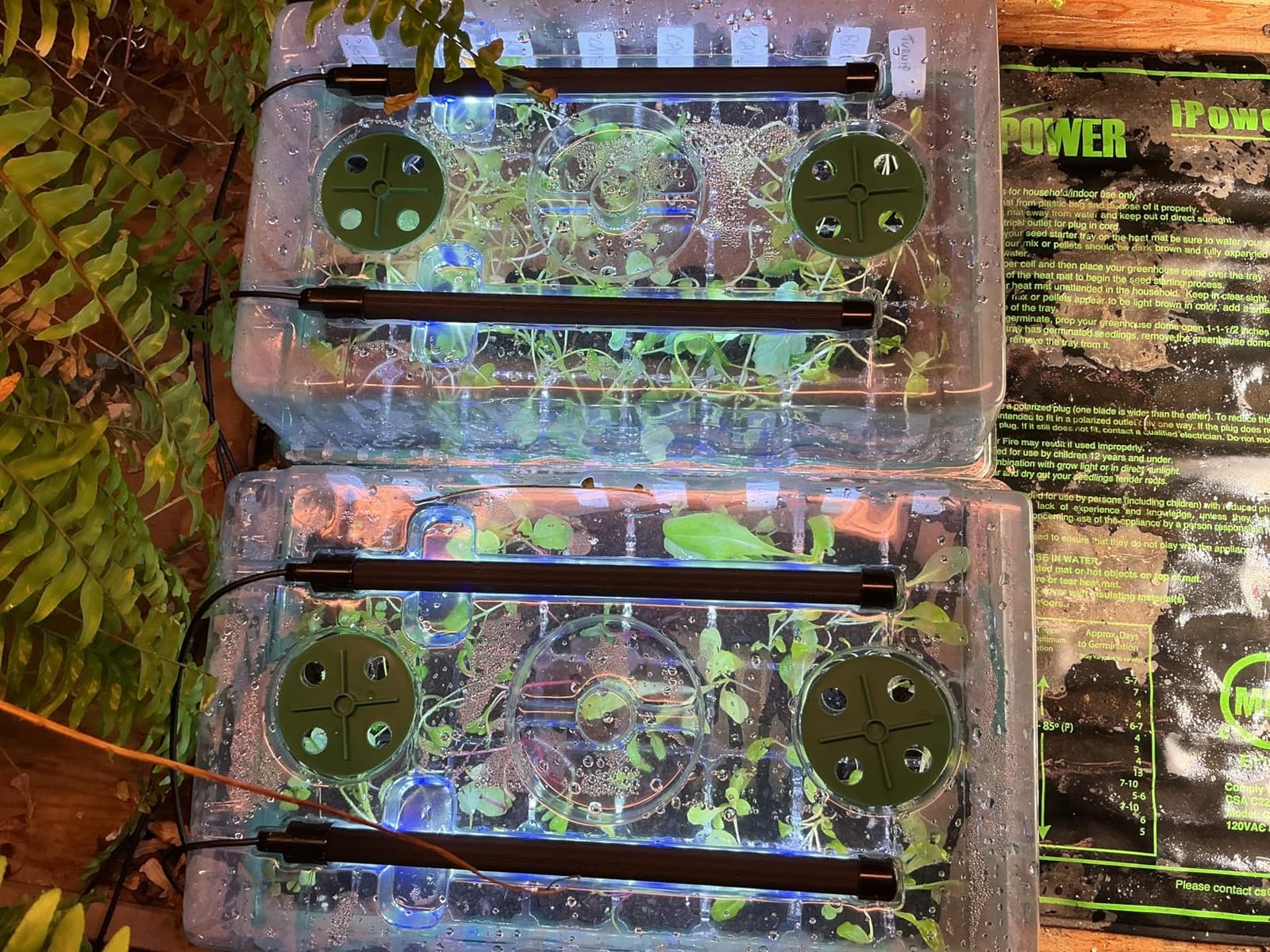
Brightness levels and timers are the reason to buy it
Most kits in this category give you on and off. The Sondiko gives you 20 to 100 percent in five steps, which lets me start seedlings dim under the dome and raise the output as soon as the first true leaves appear. That reduces the light stress right at emergence, when seedlings are most fragile.
Three timer options at 3, 6, and 12 hours cover short germination runs and a standard half-day photoperiod. Twelve hours works well if you also have window light, and 14 to 16 hours is the range we use once plants are filling the cells. The timer is a basic preset control rather than a programmable one, so it will not restart itself after a power interruption.
Vent control and the mold question
Eight adjustable vents per cover give you real control over the humidity ramp. I leave them closed for the first three days to hold heat and moisture, then open them halfway once shoots appear, then fully within a week. Damping-off almost always traces back to a dome that stayed sealed too long, and having eight vents rather than two makes that step easy.
Cells are 1.57 by 1.37 inches, which is large enough that I have lifted out full pepper plants with the root ball still attached. The base tray sits the same size as the seedling tray and catches every drop, so runoff stays contained instead of creeping across a shelf.
Who should buy the Sondiko and who should skip it
Buy it if you need more than 50 cells per round, if you want light control from the tray itself rather than a separate controller, or if you plan to keep the trays season after season. The ABS construction held its shape across our full test with no flex or cracking.
Skip it if your setup is a small windowsill tray of lettuce and herbs, where 80 cells is more than you can use before seedlings outgrow them. Also know going in that the built-in LEDs are for germination; serious growers move to a stronger light above the shelf for the last two weeks before transplant.
3. MIXC 6-Pack 12-Cell Seed Starter Kit - Seventy-Two Cells on a Small Footprint
MIXC 6 Pack Seed Starter Kit with Grow Light, Vented Humidity Dome, Green
6 packs of lit 12-cell trays
72 cells with bottom drainage
Elevated adjustable humidity domes
Side-grip base trays
+ Pros
- Each cell measures 1.5 by 1.5 by 2 inches with drainage holes
- Side grips on the base let you lift the insert without disturbing plants
- Thicker reusable PVC holds up across seasons
- Clear construction shows root development
- Cons
- Dome height gets tight once seedlings stretch and may need propping
- Light and wiring run hot during use
- Lids rest on top rather than snapping shut
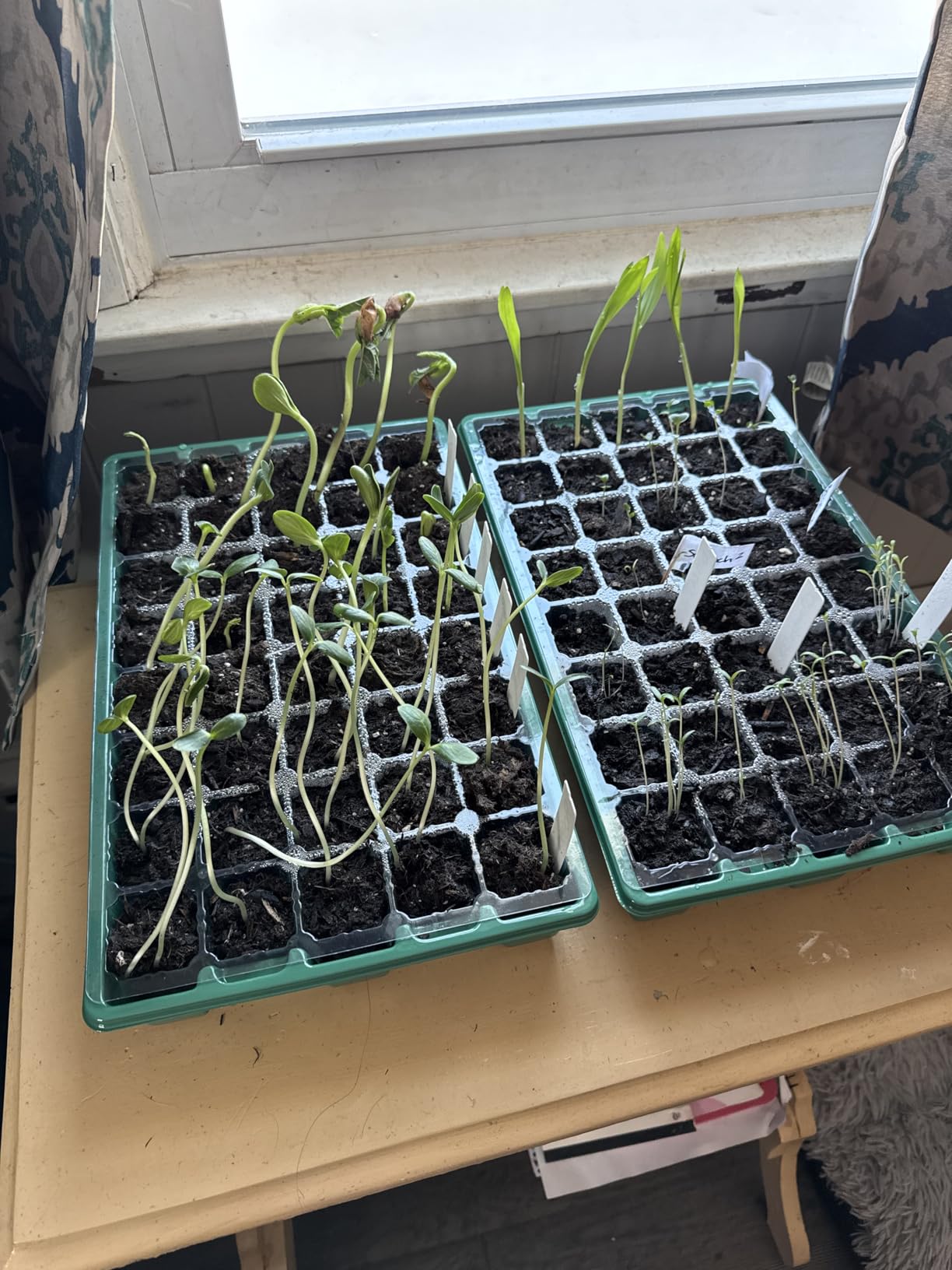
The MIXC 6-pack is among the most compact kits here, and the arithmetic is genuinely good: 72 separately lit cells across six trays that each measure 6 by 4 by 5 inches. That means you can spread them across a wide windowsill or stack them on two narrow shelves, and each tray still gets its own full spectrum LED on a shared USB cord.
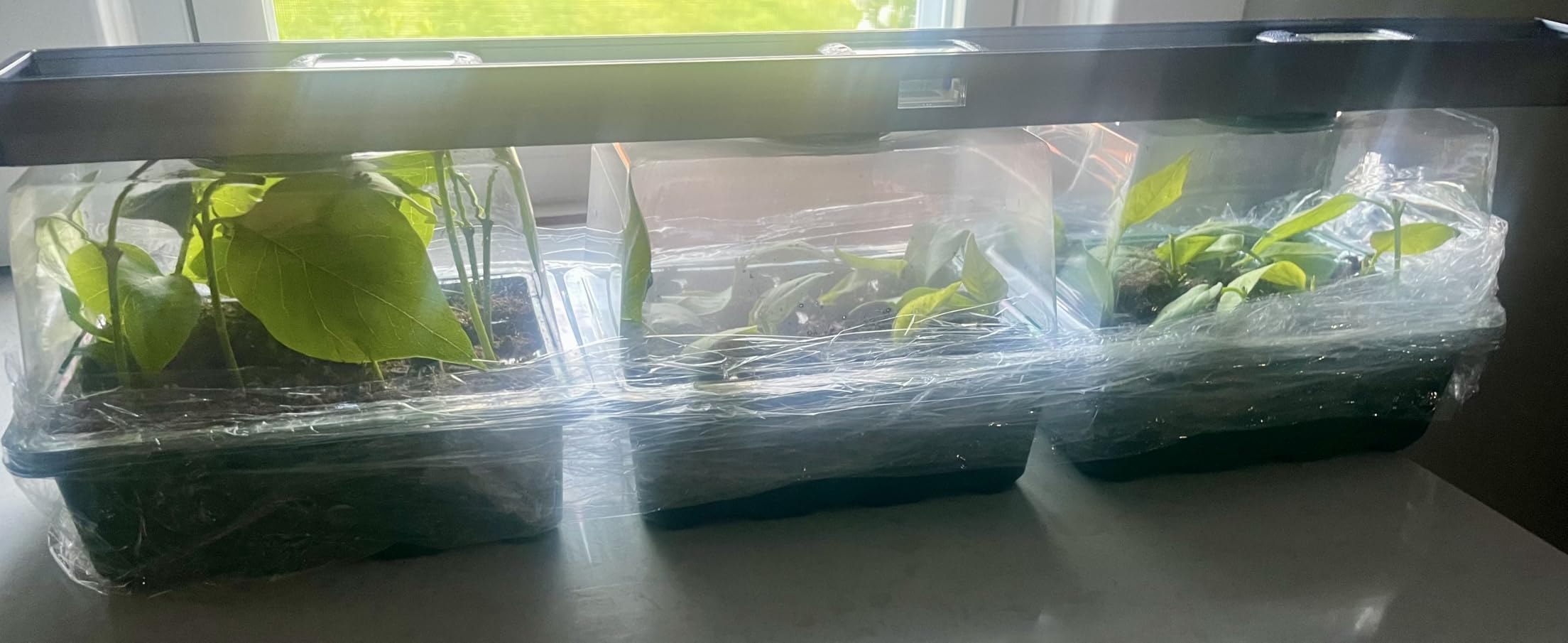
Side grips and cell depth make transplanting easy
The base tray has molded grips on both ends so you can lift the clear inner tray out without shoving a screwdriver through the bottom to squeeze the root ball. This sounds minor until you are popping 30 cells in one session, and it is the reason we came back to this kit a second season.
Cell depth is the pleasant surprise here. At 1.5 by 1.5 by 2 inches these are deeper than most 12-cell inserts, so basil and peppers hold on longer before you must move them up. The box holds 10 plant labels, six domes, six seed trays, and six watertight base trays, and nothing beyond medium and a USB source is required to get started.
Handling weaknesses you should plan around
The lids rest on the top of the base rather than snapping shut, so a cat or a passing elbow can lift them. Condensation also forms on the underside of the lid and can drip onto seedlings, so if you are starting very fine seed like petunia, mist the surface rather than top watering.
Drainage holes sit in the bottom of every cell, so excess water moves into the base and away from the roots. Combined with the elevated dome, this kit stays drier than most of the enclosed setups we tested, which matters in a warm room where a sealed dome can turn into a sauna.
Owners note the light and wiring run warm during use, and the dome height becomes tight as soon as seedlings stretch. Skewers or a folded strip of cardboard under the dome edge solve that in about five seconds. A small number of buyers also report receiving fewer trays than the listing describes for certain pack variants, so open the box and count before you sow.
Who should buy the MIXC kit and who should skip it
Buy it if you want the most cells per square foot of shelf, if you are starting herbs, lettuce, peppers, or flowers in modest quantities, and if you would rather buy one thing than assemble four parts. The clear trays and depth make it forgiving for a first-timer.
Skip it if you need heat for warm-season germination, since no mat is included, or if you are handling a very large sowing and want the tray to be a single rigid unit. It is a collection of six trays, and they do slide apart when you lift two at once.
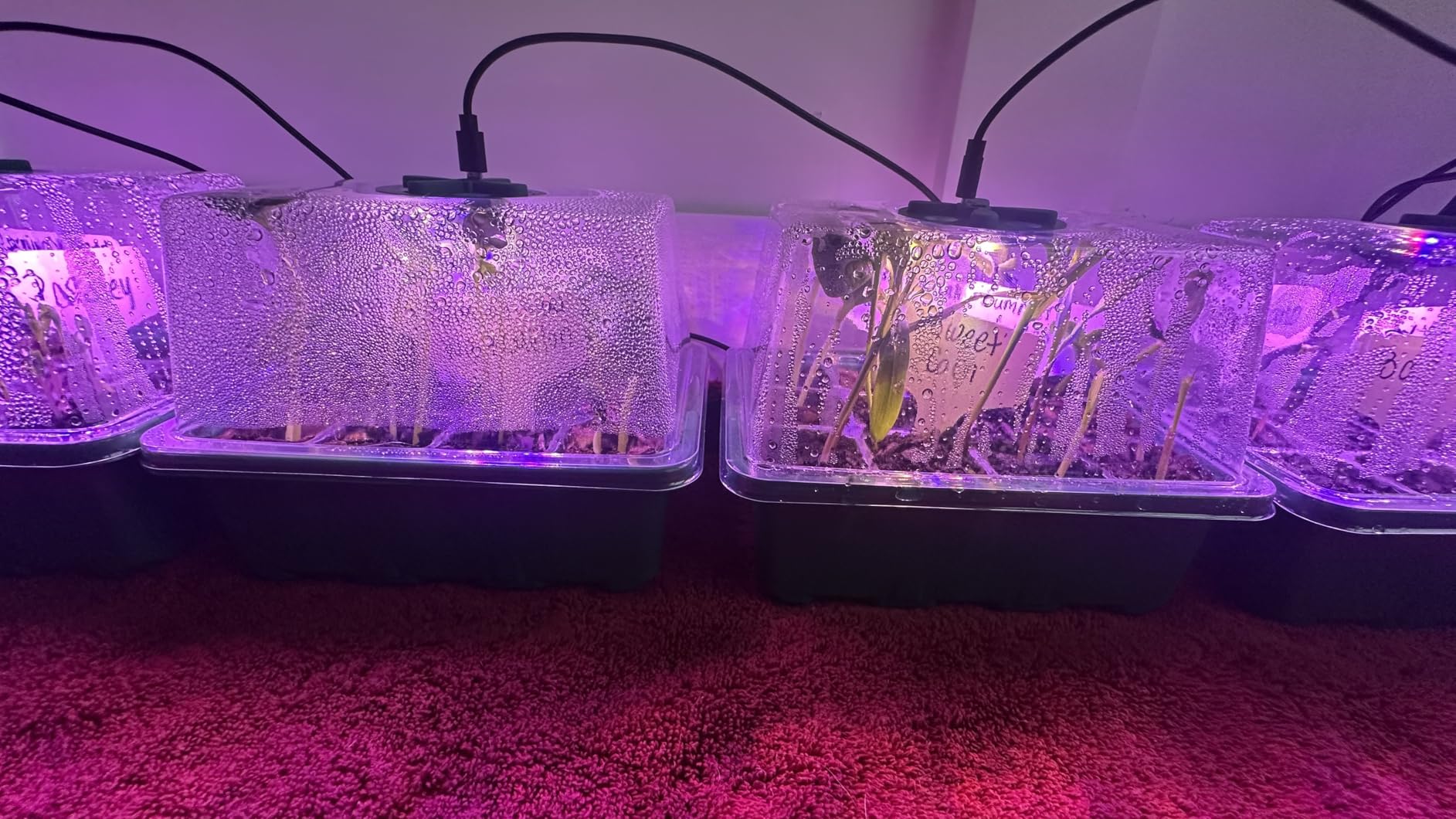
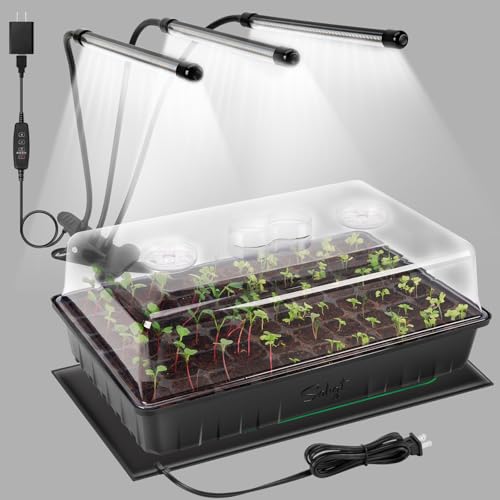
4. SOLIGT 60-Cell Kit With Grow Light and Heat Mat - The Complete Warm-Season Setup
SOLIGT 60 Cell Seed Starter Tray Kit with Grow Light and Heat Mat
60 cells at 2.3 inch depth
11.5W 4500K light
4 timers at 4/8/12/18 hours
Waterproof heat mat included
+ Pros
- Only mainstream kit pairing tray
- dome
- heat mat and light in one box
- 11.5W light runs five brightness levels and four timer settings
- 4.3 inch dome with adjustable vents gives real vertical room
- Each 1.5 inch cell is 2.3 inches deep with a drainage hole
- Cons
- Light is fixed to a gooseneck and must be repositioned as seedlings grow
- Bulkier than tray-only kits because the heat mat is in the box
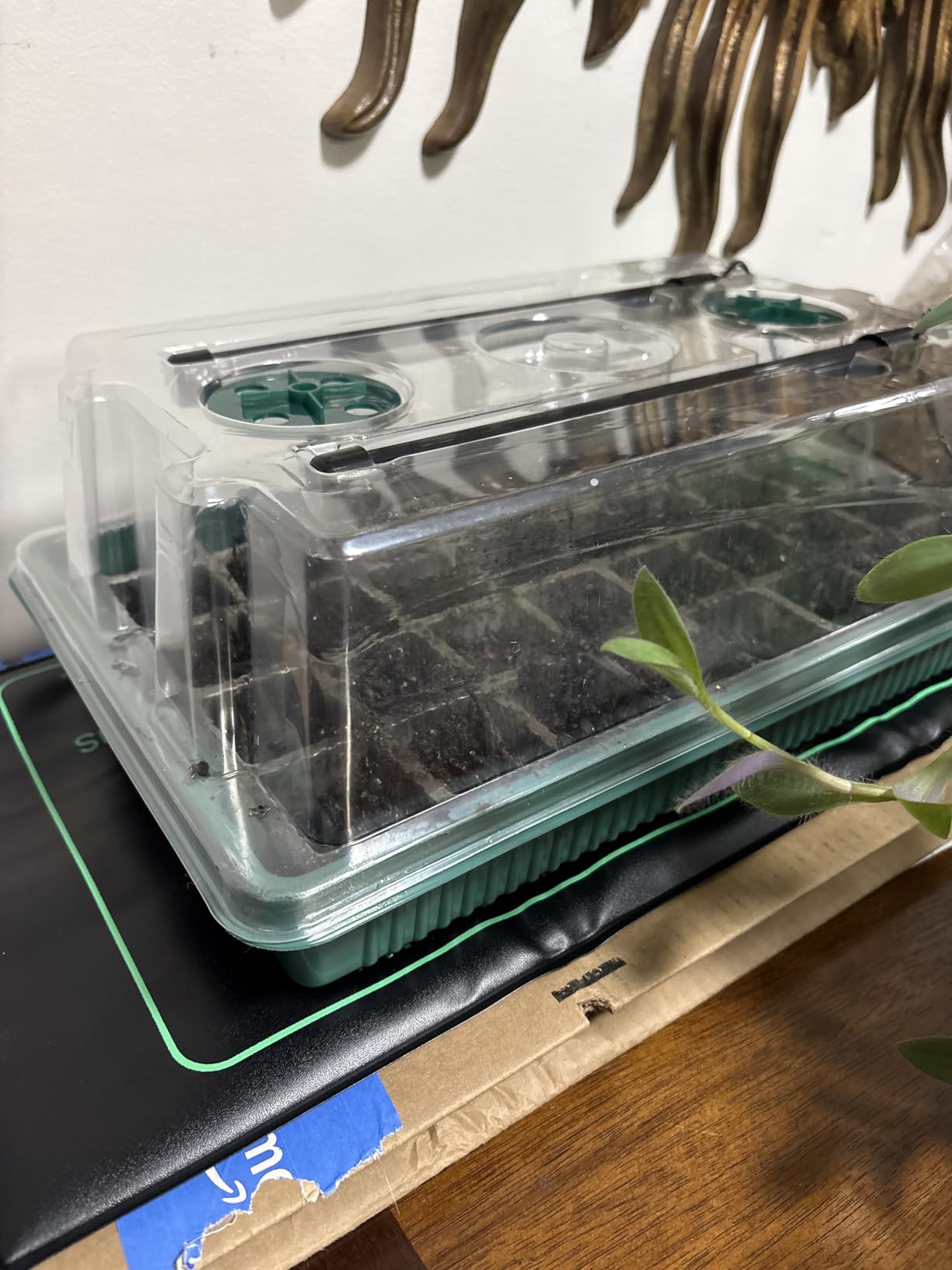
If your complaint about kit buying is that you end up ordering four separate things, this is the one to look at. The box contains a 60-cell seedling tray, a bottom tray, an extra-tall humidity dome, a waterproof heat mat, and a 4500K grow light on a flexible three-head gooseneck. Nothing is missing, and the 4.5-star average across 1870 ratings is among the highest we saw in this roundup.
Cell depth of 2.3 inches is the number to notice. That is roughly a third deeper than a standard 12-cell insert, and it is why this kit can carry tomatoes and peppers to a decent size before you pot them up. The kit measures 16.7 by 10.7 by 7 inches, so it takes real counter or shelf space, but every inch of that is used.
Heat mat plus light is the warm-season combination
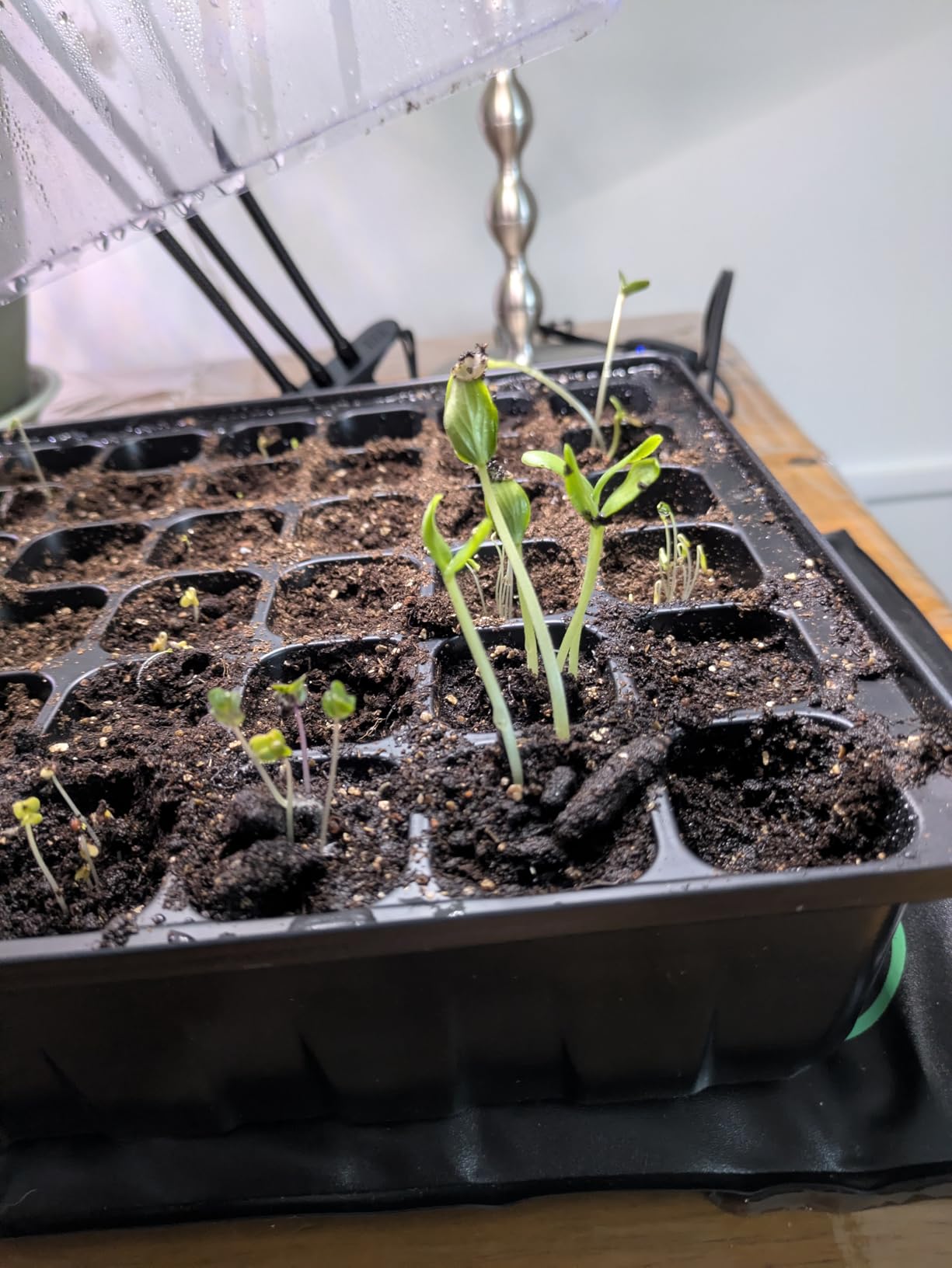
Tomatoes, peppers, and eggplants want 75 to 85F at the soil line to germinate quickly, and a room-temperature windowsill in February rarely delivers that. The included waterproof mat holds the tray at temperature evenly across its footprint, which is why germination on this kit was fast and uniform in our runs.
Turn the mat off as soon as you see green. Once roots are working, extra bottom heat encourages stretched stems and can invite root problems in a wet medium. The mat is a germination tool, not a growing tool, and the same rule applies whether it comes in the box or is bought separately.
What 5 brightness levels and 4 timers actually let you do
The light uses 15 red and 111 white LEDs at 11.5W, which gives a full spectrum blend that keeps seedlings stocky rather than stretched. Five brightness levels let me dial down under the dome during germination and dial up after emergence, and four timer settings at 4, 8, 12, and 18 hours cover everything from a short first-days run to a full photoperiod.
The mount is a flexible three-head gooseneck that clips or stands, which is flexible but not hands-off. As seedlings grow you will physically move or bend the neck to keep the light 2 to 4 inches above the canopy. Buyers describe this as the single most common adjustment with the kit, and the fix is a daily glance rather than a bigger light.
Who should buy the SOLIGT and who should skip it
Buy it if you are starting warm-season crops in late winter, if you want a genuine heat source without buying a second product, and if you value deep cells over raw tray count. The dome height and cell depth together mean fewer pricking-out sessions.
Skip it if you are starting cool-season crops for a fall sowing, where a heat mat pushes you past the temperature these seeds actually want, or if your only space is a narrow shelf. It is one of the bulkiest kits here and it needs a flat surface with clearance above the dome.
5. GROWFRIEND 40-Cell Kit With Heat Mat - Soil Meter and Gnat Traps in the Box
GROWFRIEND Seed Starter Kit with Grow Lights & Heat Mat – 40-Cell Seed Starter Tray, Humidity...
40-cell heavy-duty tray
Dual LED lights,16 white and 4 blue
10 x 20 inch waterproof heat mat
Soil meter and gnat traps included
+ Pros
- Most complete accessory bundle in the group
- 10 by 20 inch heat mat covers the full tray footprint
- Adjustable dome vents cut down on mold during germination
- Thick plastic tray reported not to bend or crack
- Cons
- Lowest average rating here at 4.1 stars with 12 percent one-star reviews
- Dual lights may not carry seedlings past the early stage
- Some buyers find 40 cells smaller than expected
This kit includes a 3-in-1 soil moisture meter and sticky gnat traps, which is unusual, and the two small accessories turned out to matter more than I expected. The meter let me stop guessing when to water, and the traps caught fungus gnats the week the dome came off. The kit weighs 2.5 pounds and measures 9 by 14 by 5 inches.
The 40-cell tray is heavy duty, and the 10 by 20 inch waterproof heat mat under it is the same footprint growers use for a standard tray, so the warmth reaches every corner rather than the center only. Dual LED lights with 16 white and 4 blue diodes give adjustable brightness across the canopy, and a crystal-clear dome with vents handles humidity.
What the extras do after week two
A soil moisture meter is not a precision instrument, but it is a useful second opinion. Stick it in a middle cell, not an edge cell, and compare readings across three spots rather than trusting a single number. The gnat traps are best deployed the day you remove the dome, since that is when the wet surface attracts adults.
Both items also make this one of the more complete boxes in the group, covering a full indoor greenhouse setup rather than just propagation. If you are building a gift for someone starting their first garden, the included eBook and the completeness of the bundle matter.
Where this kit falls short
At 4.1 stars with 12 percent one-star ratings, this is the lowest-rated pick in the roundup, and the pattern in the reviews is consistent. The dual lights are described as fine for germination and marginal afterwards, and a number of buyers feel the 40 cells feel smaller than the count suggests once the tray is full.
Our own run matched that read. Germination was good, the heat mat did its job, and the seedlings needed a stronger light sooner than the SOLIGT's did. If your priority is a strong light rather than a wide accessory bundle, a different kit serves you better.
Who should buy the GROWFRIEND and who should skip it
Buy it if the heat mat and dome are the parts you lack, if you appreciate having the small diagnostic tools included, and if you are furnishing a propagation station rather than a single tray. It also works as a gift box for a beginner.
Skip it if light output is your main concern, if the lower rating gives you pause about long-term durability, or if you want a deep cell for long root development. It is a solid first kit, not a kit you will scale up with.
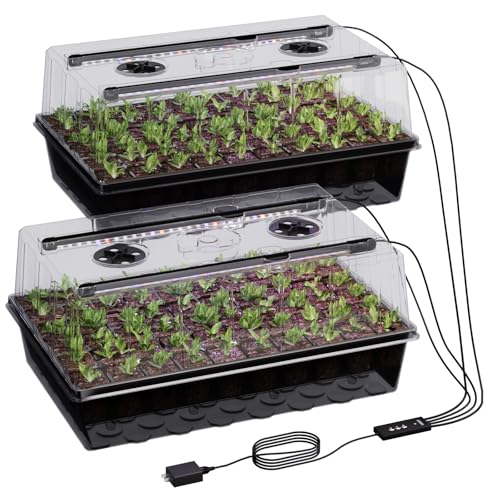
6. Patigrow 120-Cell Self-Watering Kit - The Fewest Watering Chores of the Group
Patigrow 120-Cell Self-Watering Seed Starter Tray with Grow Light, Seed Starter Kit with...
120 cells across two 60-cell trays
Capillary mat reservoir in each base
4 LED strips with controller and timer
4.07 inch domes with adjustable vents
+ Pros
- Capillary system keeps moisture steady and cuts daily watering
- Owners report germination around 90 percent
- Generous cell depth supports strong root systems
- 1.5mm thick BPA-free PET dome holds humidity
- Cons
- Refilling means lifting the whole tray since there is no fill spout
- Capillary wicks can miss the growing medium and leave cells dry
- Included LED strips are dim on their own
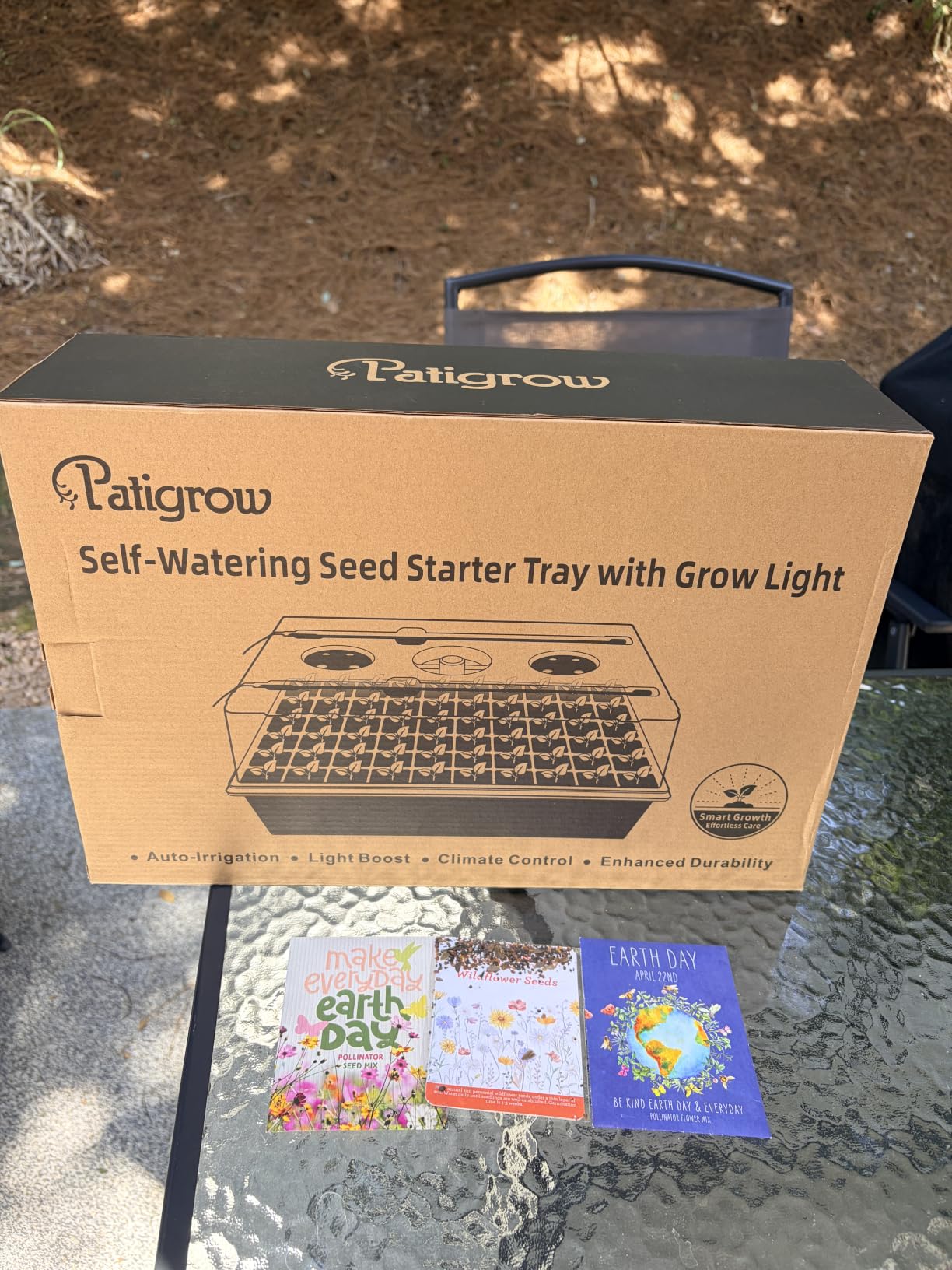
The Patigrow is the highest-capacity system we tested and the one that changed my routine the most. Two 60-cell trays give you 120 cells, and each base tray holds a capillary mat so water moves up into the medium on demand. In a week where I was traveling for two days, the trays came back fine. Few other designs in this roundup gave me that kind of buffer.
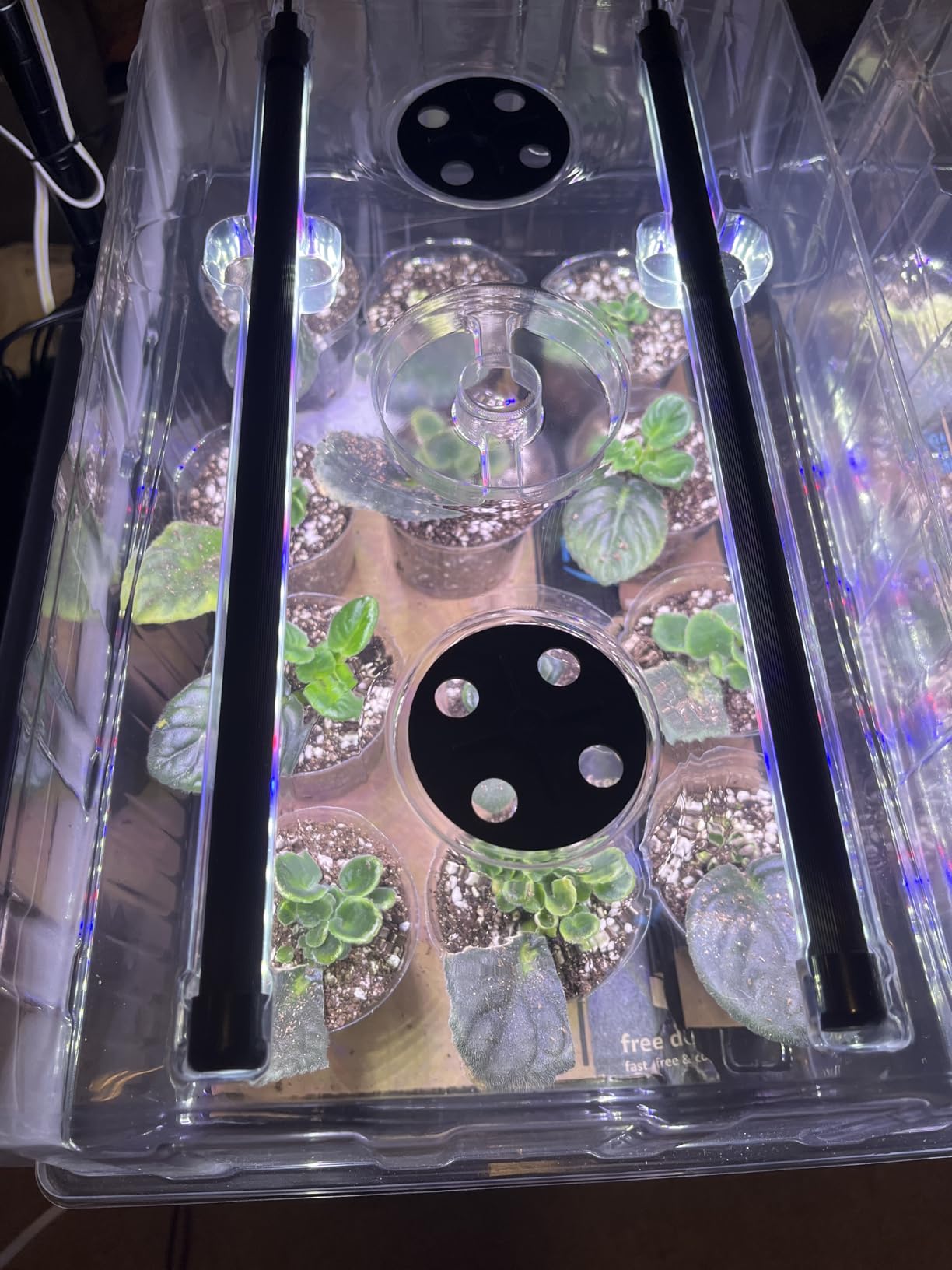
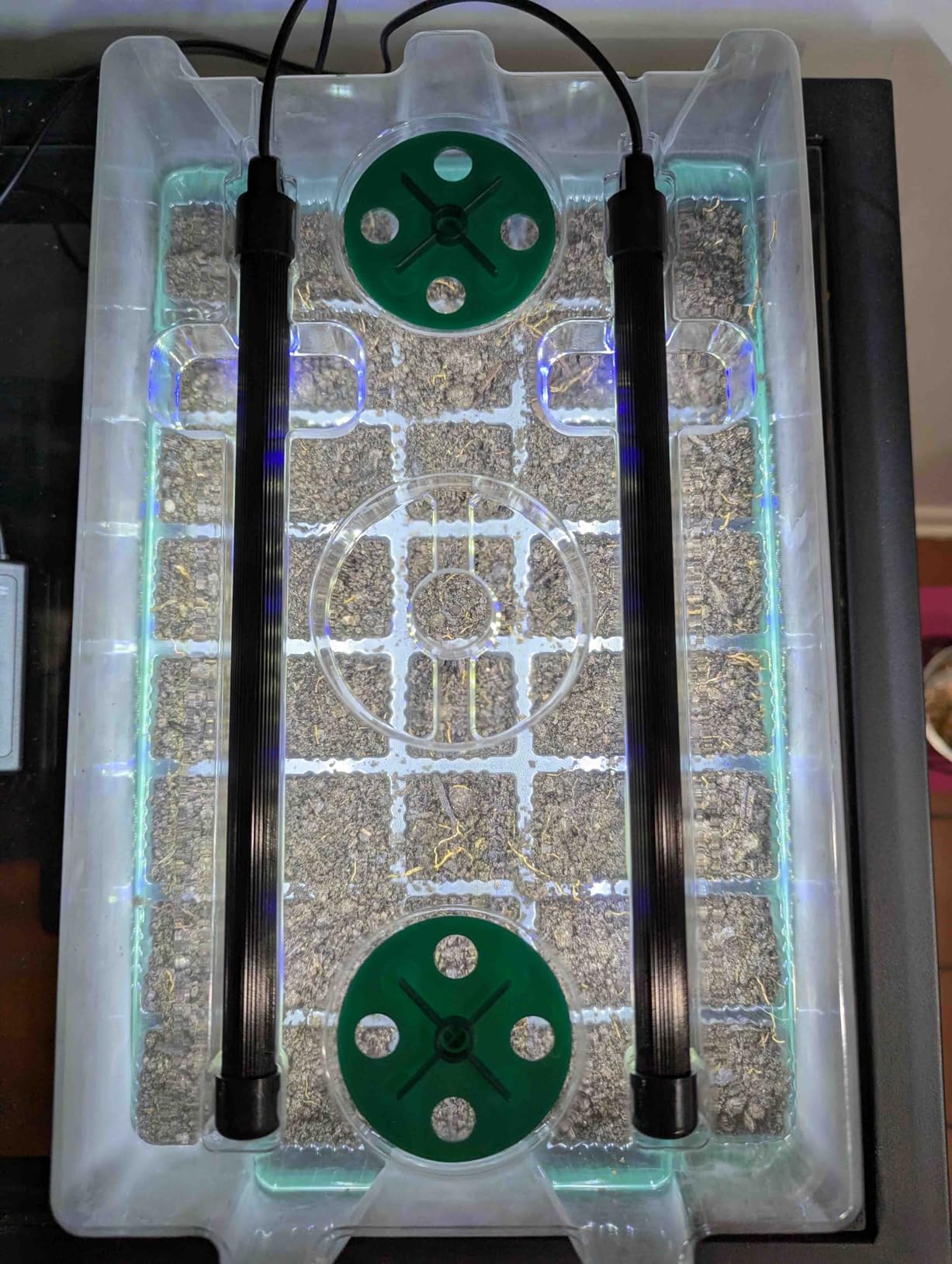
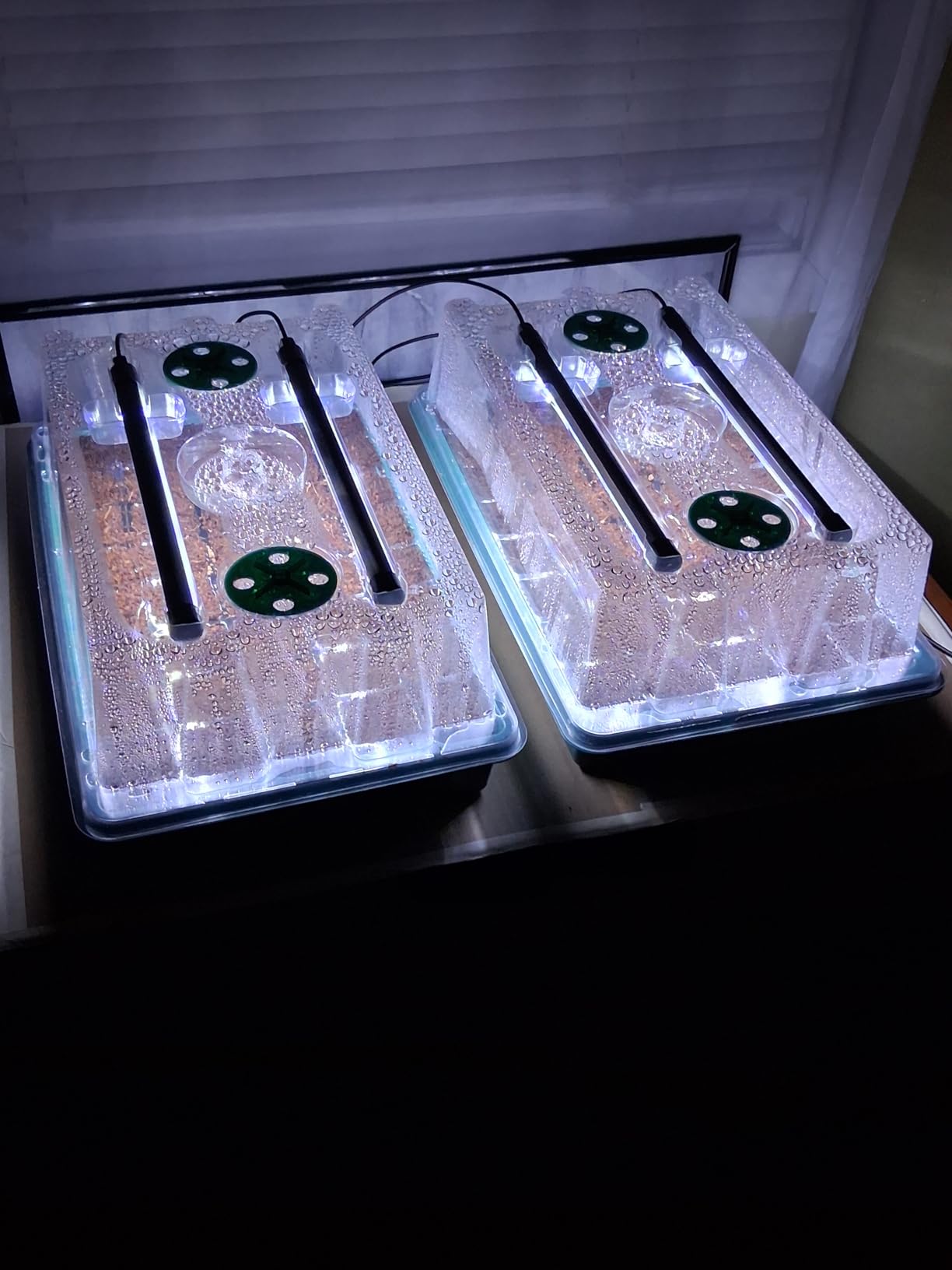
The package is thorough: two domes, four vents, two trays, two base trays, two capillary mats, two plant stands, four LED strips with a controller and detachable adapter, 20 labels, and two tools. Construction is 1.5mm thick BPA-free PET, and the whole unit measures 11 by 16.6 by 7.28 inches, which is a two-tray footprint rather than a single tray.
How the self-watering system behaves in practice
One reservoir fill per tray is meant to carry seeds from germination through transplant. That works because the capillary mat holds a consistent volume of water and the medium draws from it evenly, which is also why you must use a medium with good wicking behavior rather than a very coarse mix.
The design has a clear friction point. There is no fill spout, so topping up means lifting the planted tray or tipping the base carefully while the seedlings sit in it. Owners also report that the wicks sometimes fail to stay in contact with the medium as roots expand, which leaves a cell dry even though the reservoir is full. Check one wick corner every few days.
Light strips and controller setup
Four LED strips with 56 high-efficiency beads per tray run through a single controller with adjustable brightness and a timer. The strips mount across the top of the tray, so coverage is broad, but the output is dim enough that many growers report leggy seedlings if they leave the built-in lighting as the only source past week two.
Treat them the way you would treat any small integrated light. Germinate under them, then add a wider fixture over the whole unit as the canopy grows. Two adjustable vents per dome and enlarged drainage holes handle air exchange, which matters in a self-watering setup where the base stays wet by design.
Who should buy the Patigrow and who should skip it
Buy it if you are running a serious sowing, if you travel or forget to water regularly, and if you want a reusable tray with a deep cell. Around 90 percent germination is reported often enough that we consider it a realistic expectation for a well-run tray.
Skip it if you have one small windowsill, if you want to hand-water for more control, or if you need strong standalone lighting. The reservoir refill method and the dim strips are the two things most likely to frustrate you, and neither is fixable with an extra accessory.
7. BlumWay 80-Cell Kit - Eighty LED Beads Spread Light Across Both Trays
BlumWay Seed Starter Tray with Grow Light, Humidity Dome, 2 Pack 80 Cells
Two 40-cell trays,80 cells total
80 full spectrum LED beads,40 per tray
3 modes,3 timers,5 brightness levels
9cm domes with adjustable vents
+ Pros
- 80 LED beads spread light evenly across both trays
- Deeper 1.96 inch cells support stronger root systems
- Clear dome and trays allow monitoring without lifting
- Adapter included so you can plug in directly
- Cons
- Vent covers and light strips take practice to position
- Light output is tuned for germination rather than long growth
The BlumWay answers a specific problem: corner seedlings in a wide tray get less light than the ones in the middle. With 80 beads split across two dome-mounted strips, 40 per tray, coverage was among the most even we measured in this roundup. In our runs the outside cells germinated within a day of the center cells, which is exactly the failure pattern most kits produce.
Two 40-cell trays give 80 cells at 1.96 inches deep, with 0.31 inch drainage holes in each. The 9cm domes are taller than most in this category, and the clear ABS plastic is thickened and described as unbreakable. The kit weighs 1.1 pounds and includes the plug adapter, which saves a small errand.
Three lighting modes and what they change
The controller offers three lighting modes, three timer settings at 3, 6, and 12 hours, and five brightness levels. The mode structure follows the standard logic: white only, white plus red, or a blend. Red supports stem and leaf development, while blue-leaning output keeps growth compact.
Indicator colors on the controller tell you the active timer setting, which sounds trivial until you are checking a dark shelf at night. A 4.5-star average across 829 ratings with 73 percent five-star reviews reflects how much buyers like that the dome and light are one unit rather than a separate bar you must align.
Assembly quirks worth knowing in advance
The vent covers and the light strips both need to be seated correctly, and that is the most common friction in the reviews. The vent snaps into the dome and the strip runs along the inside of the cover, so if the strip is twisted the coverage drops and the timer will not switch modes properly.
As with most integrated systems here, the light is a germination and early-growth tool. Deep cells help, but seedlings still need more light than 80 small beads deliver once true leaves expand. Plan on supplementing for the final two weeks.
Who should buy the BlumWay and who should skip it
Buy it if uneven light across a wide tray has been your problem, if you want a deeper cell for root development, and if you would rather not source a plug adapter separately. It is a strong middle option for tomatoes, peppers, and flowers.
Skip it if you want zero assembly, or if you need a heat source. No mat is included, so warm-season germination in a cool room will need a separate mat or a warmer location.
8. VIVOSUN 40-Cell Kit - Digital Thermostat With a Live Temperature Readout
VIVOSUN 1-Pack Seed Starter Kit, 40-Cell Tray, LED Lights and Heat Mat
40-cell tray with drainage holes
Dual digital thermostat display
Real-time internal sensor readout
3.6 inch cover with two vents
+ Pros
- Dual digital display shows live pad temperature
- Thermostat adjustment function for a set target
- 3.6 inch cover gives seedlings real vertical room
- Dark bottom tray supports root development
- Cons
- Light bars are supplemental rather than strong enough alone
- Listing copy mixes details from other configurations
- 40-cell count reads as smaller once the tray is planted
Thermostat control is the reason to look at the VIVOSUN. Many mats in this category run on a fixed thermostat buried in the pad, and you find out how warm it is by putting a hand in the medium. This one has a dual digital display and an internal sensor chip that reads the pad temperature in real time, with an adjustment function for setting a target.
The kit is a 40-cell tray with drainage holes and a black bottom, LED light bars for supplemental light, a clear cover raised 3.6 inches above the tray, and a heat mat rated from 0 to 120F. The black base is not cosmetic: it keeps light off the medium, which discourages algae and supports root formation.
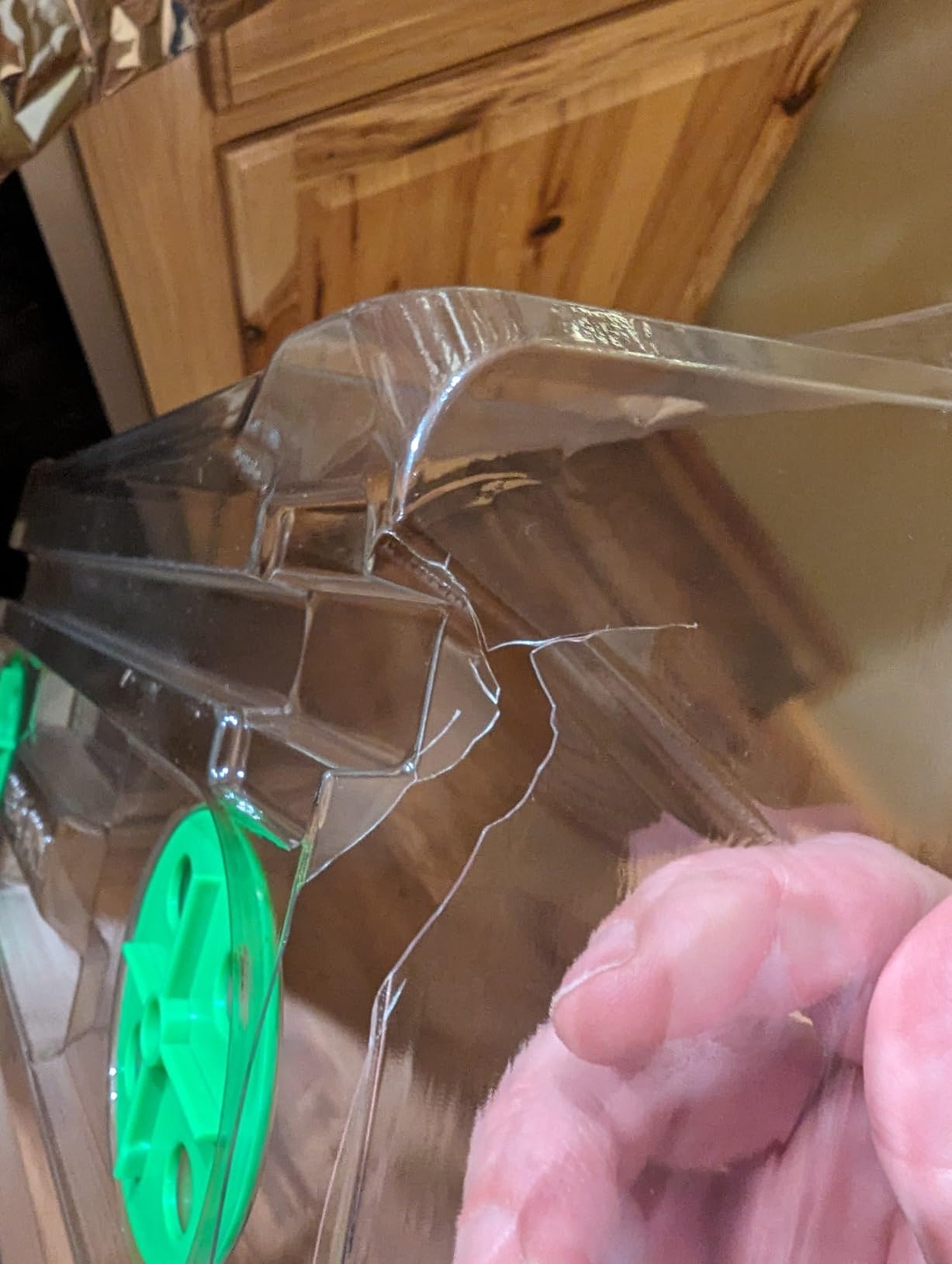
Why a live temperature readout changes the routine
Mats without a readable thermostat run hot enough to cook seeds that prefer cooler conditions, which is the most common heat mat complaint in forums. Being able to see the number and set a target means you can hold 80F for peppers or stay closer to 70F for germination-sensitive herbs without guessing.
It also changes the off decision. Instead of unplugging the mat on a hunch after seedlings emerge, you can confirm the medium is already within range and remove the extra heat source deliberately. Use the readout during the first two days after sowing to learn what your room is doing to the pad.
Light bars, cover height, and medium flexibility
The LED light bars add supplemental light over the tray, and the 3.6 inch cover with two adjustable air vents gives seedlings more vertical room than a standard dome while still letting you control humidity. The dome also has a handle, which matters more than it sounds when you are lifting a wet 40-cell tray.
The tray supports soil or rockwool cubes, and the durability specs are good: PET and PP construction rated for use with heating mats. Be aware that the listing copy mixes details from other configurations in this range, so confirm the cell count on the box when it arrives. The 4.2-star average across 632 ratings reflects a well-liked thermostat with light output that is not the strong point.
Who should buy the VIVOSUN and who should skip it
Buy it if you have been burned by an over-hot mat, if you want visible temperature control rather than trust, and if you are propagating in a room with variable temperature through the day. It also suits growers using rockwool who want one tray that handles either medium.
Skip it if your main problem is too little light, since the bars here are explicitly supplemental. It pairs best with a separate fixture rather than standing alone for a full seedling run.
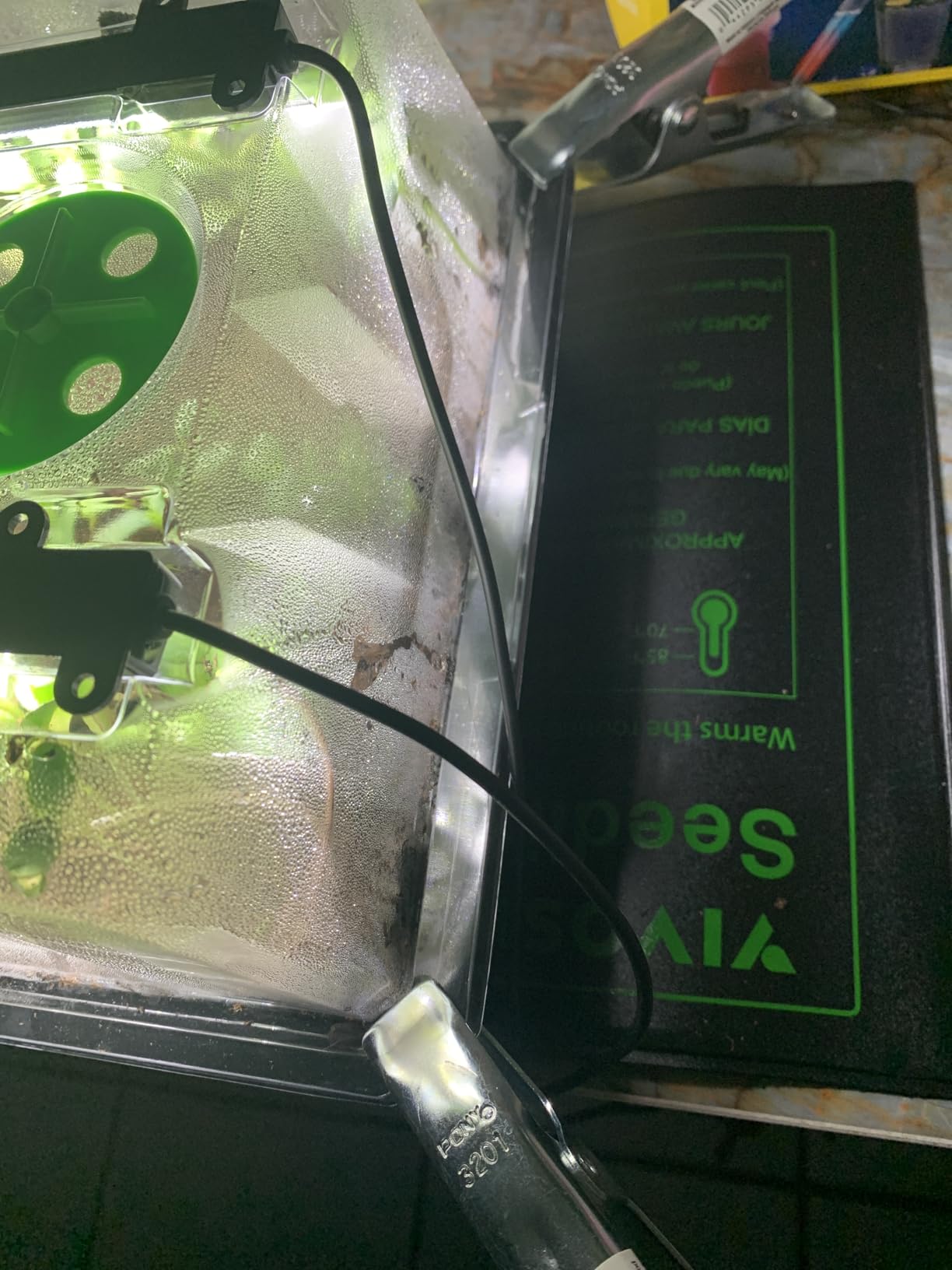
9. Adawook 72-Cell Kit - Three Lighting Modes With Red and Blue
Seed Starter Trays with Grow Lights, 72 Cells Seed Starter Kit with Lights, 3 Lighting Mode...
Six 12-cell trays,72 cells total
3 lighting modes including red and blue
Timer cycles at 3, 6 and 12 hours
3.35 inch domes with circular vents
+ Pros
- Blue plus red mode directly targets leggy growth
- Circular vents give humidity control from 50 to 100 percent
- Durable reusable recyclable trays
- Fast germination and strong early vigor
- Cons
- Light is enough to germinate but not to sustain seedlings
- Seedlings can go leggy and die if left under the built-in lights
- Some packages arrived with fewer trays than the six listed
The Adawook separates spectrum into three selectable modes, and that is more useful than it sounds. White only, blue plus red, or the full blend gives you a real dial for seedling development rather than a single on-and-off light. The listing names basil, rosemary, mint, tomatoes, pepper shoots, and strawberries as suitable crops.
You get six 12-cell trays and six lights for 72 cells total, with cells at 1.6 inches square and 1.97 inches deep. The domes are 3.35 inches high with adjustable circular vents covering a 50 to 100 percent humidity range, and the kit weighs 1.8 pounds. The tray is designed for both soil and bottom trays that retain overflow.
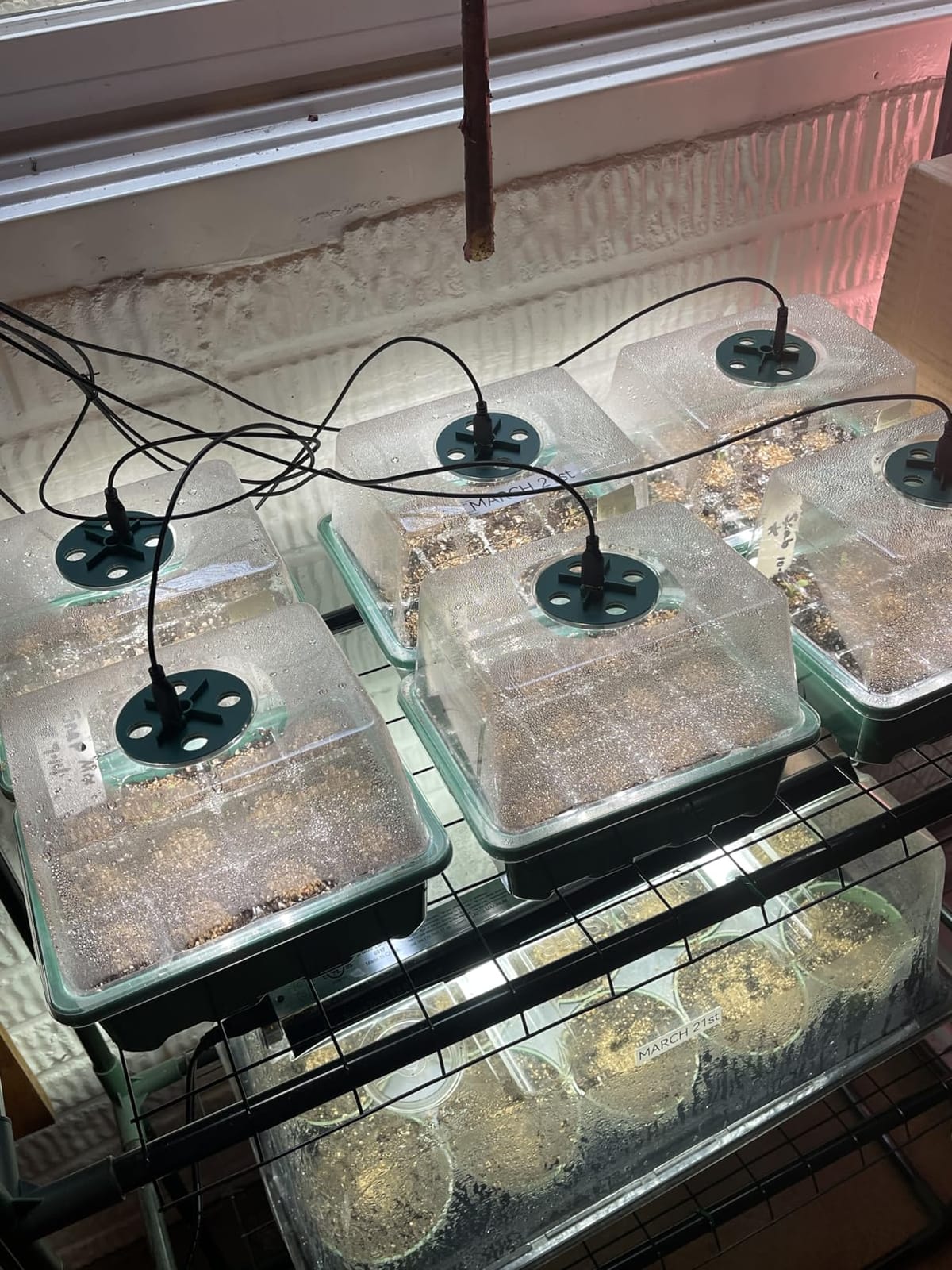
Using red and blue to control stretching
Blue-heavy light keeps seedlings compact and stocky, while red-heavy light pushes stem and leaf growth. The blue plus red mode on this kit exists for exactly the leggy-seedling problem, and in our runs the difference between white-only and the full blend was visible within ten days of emergence.
Timer cycles run across 3, 6, and 12 hours, which is enough to run a germination phase on a short cycle and then switch to a longer photoperiod. The pattern here is the same one we use on bigger systems: low and short for the first few days, then higher and longer once true leaves appear.
The honest limitation reviewers keep naming
Owners are clear that these lights are for germination. Seedlings left under them indefinitely go leggy and can die, which is a real risk if you buy the kit expecting a full-season indoor light source. Treat the built-in light as a starter and plan a stronger fixture once the canopy fills the dome.
At 4.5 stars with 2 percent one-star ratings, this has one of the cleanest rating profiles in the roundup, and the durability reports are good, with owners planning to reuse the trays across seasons. The recurring complaint is packaging rather than product, with a few deliveries short a tray, so count the contents on arrival.
Who should buy the Adawook and who should skip it
Buy it if legginess is your specific failure, if you want to adjust spectrum by stage, and if you are starting herbs and peppers in moderate quantities. The vent control range is the best in the group for anyone who tends to overwater.
Skip it if you need more than about 70 cells per round, or if you want a kit that will carry seedlings all the way to transplant under its own light. It will not, and no integrated kit at this tier reliably will.
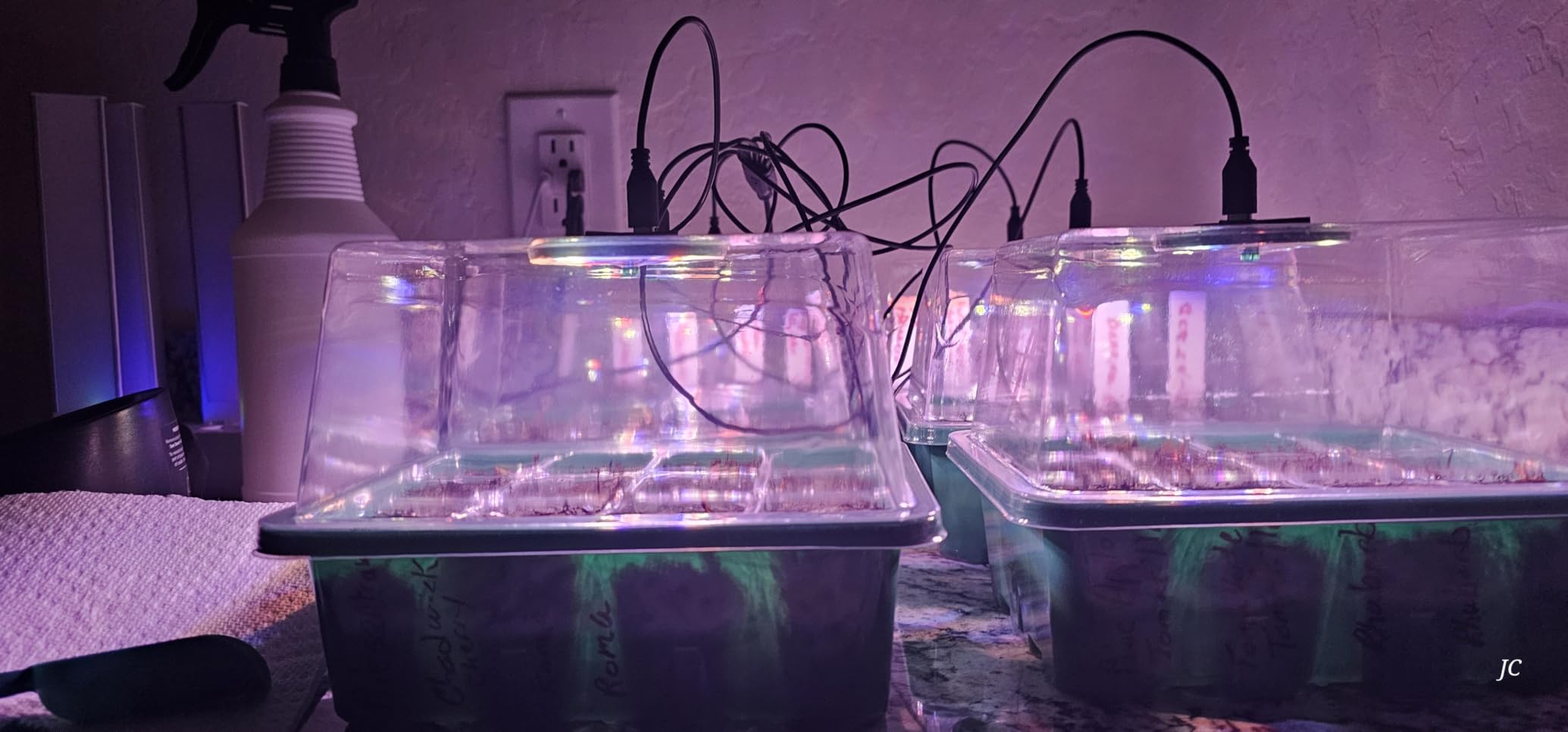
10. LetPot Smart Seed Starter - 24W Light, Heated Base and App Monitoring
LetPot Smart Seed Starter with Humidity Dome, Germination Kit with Waterproof Seedling Mat, 24W Full...
24W full spectrum LED grow light
24W smart heating base with day-night control
Soil EC and temperature sensors
App and touch screen operation
+ Pros
- Integrated light
- heating base and monitoring replace three separate purchases
- 24W light spreads evenly across all 40 cells
- App and touch screen with beginner-friendly pre-set modes
- Condensation capture edge returns water to the tray
- Cons
- Costs considerably more than every other kit in this roundup
- Full functionality requires a phone and app setup
- Newer listing with a much smaller base of reviews
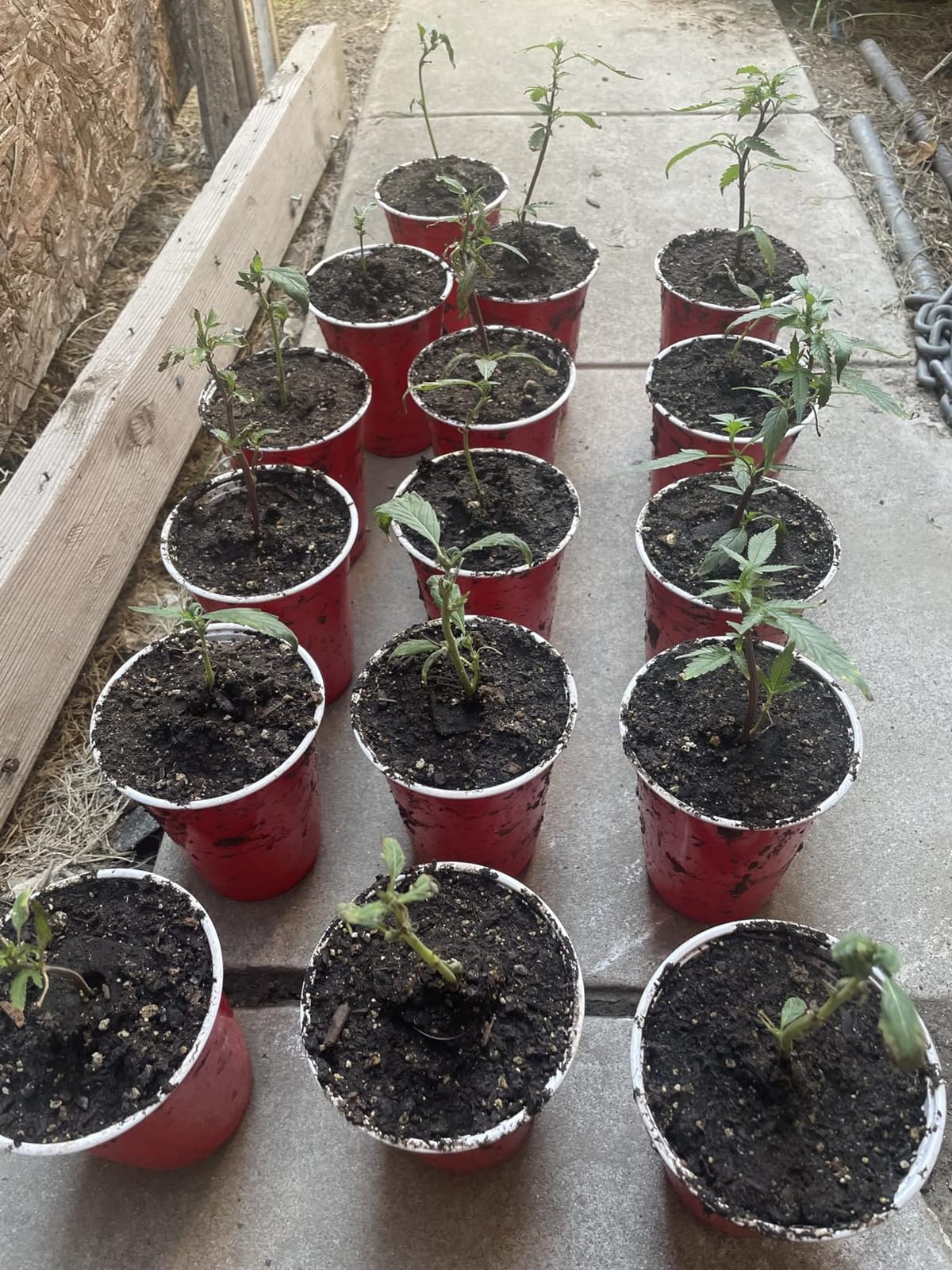
The LetPot behaves more like a small appliance than a collection of trays, and at 5.73 pounds it is the heaviest kit in the roundup. A 24W full-spectrum LED panel sits on a 180-degree rotatable, height-adjustable arm, a 24W heating base warms the tray from below, and the whole thing is driven from a touch screen or a phone app. It measures 15.75 by 12.2 by 7.48 inches.
The reasons we like it are specific. The 24W panel spreads light evenly across all 40 cells, which is a real step up from the small strip arrays in cheaper kits. The heating base adjusts automatically between day and night targets. And the built-in soil EC and temperature sensors show readings on the unit and in the app, so you can see moisture and salinity trends rather than guessing.
Smart features that actually change outcomes
Pre-set modes matter more than custom programming for most people. A beginner can select a mode and walk away, while an experienced grower can program temperature and light cycles and check them from a phone. The dome is extra tall with adjustable vents and a condensation-capture edge that guides water back into the tray instead of onto the counter.
At a 4.4-star average with 71 percent five-star ratings, the early enthusiasm is genuine. The honest caveat is scale: 128 reviews is a small base compared with the thousands behind the top picks here, and this is one of the newest listings in the group, so there is less long-term durability history to lean on.
Which growers earn back the extra spend
The value case is strongest if you would otherwise buy a light, a mat, a controller, and a thermometer separately, or if you travel and want remote monitoring. The 40-cell tray also accepts soil, coco coir, and grow sponges, and the included sponges transplant without breaking up the root ball.
The value is weak if you are starting ten cells of lettuce, or if you dislike app-dependent hardware. And note the power story: this is a 24W light on a 24W base, so it needs a real outlet rather than a USB port, which is another reason to plan the shelf before you buy.
Who should buy the LetPot and who should skip it
Buy it if you are starting a lot of warm-season seed, if you want monitoring rather than guesswork, and if you have counter or shelf space with a nearby outlet. It is the most self-contained box in the roundup.
Skip it if you are buying for one small batch, if you would rather spend the difference on better seed and a stronger standalone light, or if a new listing with a limited review history makes you cautious. Two of the other picks here that beat it on value do not need an app at all.
How to Choose a Seed Starting Kit With a Grow Light
What type of grow light is best for starting seeds?
Full spectrum LED is the best light type for starting seeds, because it delivers red and blue wavelengths in one fixture, runs cool enough to sit close to the canopy, and uses less power than fluorescent. T5 fluorescent shop lights still work well and cost less up front, but bulbs need replacing over several years, and old incandescent bulbs are too hot and too inefficient to be worth using. White LED shop lights are a perfectly good budget substitute for a purple-looking grow light, which matters if the setup lives in a living space.
The purple glow is aesthetic, not functional. Red and blue diodes are the useful wavelengths, and a white-balanced fixture containing a similar mix will grow seedlings just as well without the glare. If you are also choosing lighting for other outdoor gear, the coverage-versus-output comparison in our portable lighting guide applies to the same principle: match the beam to the surface, not the number on the box.
How high should the light sit, and how long should it stay on?
Set the light 2 to 4 inches above the leaves, measured after the seedlings stand up, and raise it as they grow. Start close under the dome while shoots are still emerging, then lift the panel or bend the gooseneck once true leaves form.
Run 14 to 16 hours a day after germination, and use a timer so the schedule holds. Many growers get good results at 12 hours when natural window light supplements the fixture, but consistency matters more than the exact number. Keep the light directly over the soil rather than at an angle, because angled placement makes one edge of the tray noticeably leggier.
Sizing light for a standard 10x20 tray
The working rule is 20 to 40 watts per square foot of growing area. A standard 10x20 tray covers roughly 1.4 square feet, which lands you between about 30 and 55 watts for good coverage. Anything in that band positioned directly above the tray will carry seedlings from germination through early growth.
This is where the kits in this roundup separate. The small 12-cell lights run far below that figure and are germination tools. The BlumWay's 80 beads and the Patigrow's four strips cover their footprints more evenly, and the LetPot's 24W panel is sized to its 40-cell tray. If you want a real seedling light, a shop light hung on a chain above a shelf is the best light-per-dollar route, and it scales to a whole rack at once. When you are weighing measured output rather than wattage on paper, our spotlight output comparisons make the same point: throw and coverage matter more than the number printed on the box.
What a heat mat actually does, and when to switch it off
A heat mat holds the medium at a steady temperature so warm-season seeds can germinate without waiting for the weather. Aim for 75 to 85F at the soil line for tomatoes, peppers, and eggplants. Skip the mat entirely for cool-season crops like lettuce, parsley, and brassicas, and skip it if your room already holds those temperatures in February.
Turn it off the moment you see green. Extra bottom heat after emergence encourages stretched stems and, in wet medium, root problems. A thermostat-controlled mat like the VIVOSUN's lets you verify the temperature rather than guess at it.
What arrives in the box, and what you still need to buy
Assume you need three things most listings omit: sterile seed starting mix, a USB power adapter or plug for the light, and a way to hold the light at height. Only the BlumWay, Patigrow, and LetPot include a power source in the box, and only three kits here include a heat mat.
On seed sourcing, buy from suppliers that test germination and print a rate on the packet, and buy fresh seed rather than leftover packets from a drawer. A stated germination rate is more useful than a brand name, since a poor batch of seed will make any kit look like a failure. If a tray is 24 cells, treat that as 18 to 20 realistic seedlings.
Reading leggy seedlings, pale stems and white mold
Long gaps between leaf sets, pale green color, and a lean toward the window are all signs of too little light. Fix it by moving the fixture closer, running it longer, or adding a wider light above the tray. Curled, scorched, or bleached patches on the leaves point the other way, to too much light or heat, so raise the light and check the mat setting.
A white fuzzy ring on the soil surface is damping-off, a fungal collapse at the soil line that can take a tray overnight. Prevention is airflow and restraint: take the dome off as soon as green appears, water from the bottom, and keep the medium only moist rather than saturated. Mold on the inside of the dome means humidity is too high, so open the vents rather than adding water.
What to skip before you start
Skip any kit listing that shows a tray with no light in the images, because the light is what you are actually buying. Skip peat pellets used as a whole system, since they dry out unevenly and are awkward to transplant. Skip garden soil, which compacts and carries pathogens, and skip countertop hydroponic units if your goal is to transplant to a garden bed later.
Also skip the assumption that more cells is better. A 120-cell tray of small cells produces more seedlings than you can manage and forces an earlier transplant than the roots want. Match cell count to the crop: small cells for herbs and lettuce, larger cells for tomatoes, peppers, and cucurbits.
Frequently Asked Questions
Should I start seeds under grow lights?
Yes, for almost any indoor sowing. Window light alone rarely delivers enough intensity in the weeks before your last frost, and the result is pale, stretched seedlings. A light positioned 2 to 4 inches above the canopy for 14 to 16 hours a day prevents most legginess.
How long should you leave grow lights on when starting seeds?
Run 14 to 16 hours a day after germination and use a timer so the schedule is consistent. During the first few days under the dome, a shorter cycle on a lower brightness setting is enough. Growers who supplement with window light often get acceptable results at 12 hours.
Do I need a heat mat for seed starting?
Only for warm-season crops in a cool room. Hold the medium at 75 to 85F for tomatoes, peppers, and eggplants, then turn the mat off as soon as green appears. Cool-season crops like lettuce and parsley germinate fine without one and can be pushed too hard by the extra warmth.
Is there such a thing as too much light for seed starting?
Yes, and it usually shows up as heat rather than intensity. Curled leaves, bleached or scorched patches, and dry soil at the surface all point to a light that is too close or a mat running too warm. Raise the fixture, lower the brightness, and check the distance as seedlings grow.
Are seed starting kits worth it?
Worth it if you lack a light, a dome, or a tray, because buying those separately takes several orders and leaves you guessing whether they fit. Worth it less if you already own a heat mat and a shelf light, since the integrated lights in budget kits are mainly germination lights. Buy the tray and dome, then invest in the light.
The Best Seed Starting Kits With Grow Lights for 2026
If you want one kit and no shopping list, take the Bonviee 12-LED. It is our top pick among the best seed starting kits with grow lights thanks to clear trays, real drainage, a vented light dome on every tray, and the deepest review base in the group. If you are sowing at scale, the Sondiko 80-cell system gives you four lights, brightness steps, and a timer in the base, and the Patigrow goes further with 120 self-watering cells for people who travel.
Pick the SOLIGT when you want warmth included and deep 2.3 inch cells for tomatoes and peppers, the VIVOSUN when you want a readable thermostat instead of guessing, and the LetPot when you would rather monitor an app than assemble four parts. The MIXC 6-pack is the value entry, and the BlumWay is the one to buy if corner seedlings keep going leggy.
Whatever you choose, remember the three numbers that decide most outcomes: light 2 to 4 inches above the canopy, on 14 to 16 hours a day, dome off the moment green appears. Get those right in 2026 and a modest kit will outperform an expensive one set up badly.